

Model card
Browse files
README.md
ADDED
|
@@ -0,0 +1,123 @@
|
|
|
|
|
|
|
|
|
|
|
|
|
|
|
|
|
|
|
|
|
|
|
|
|
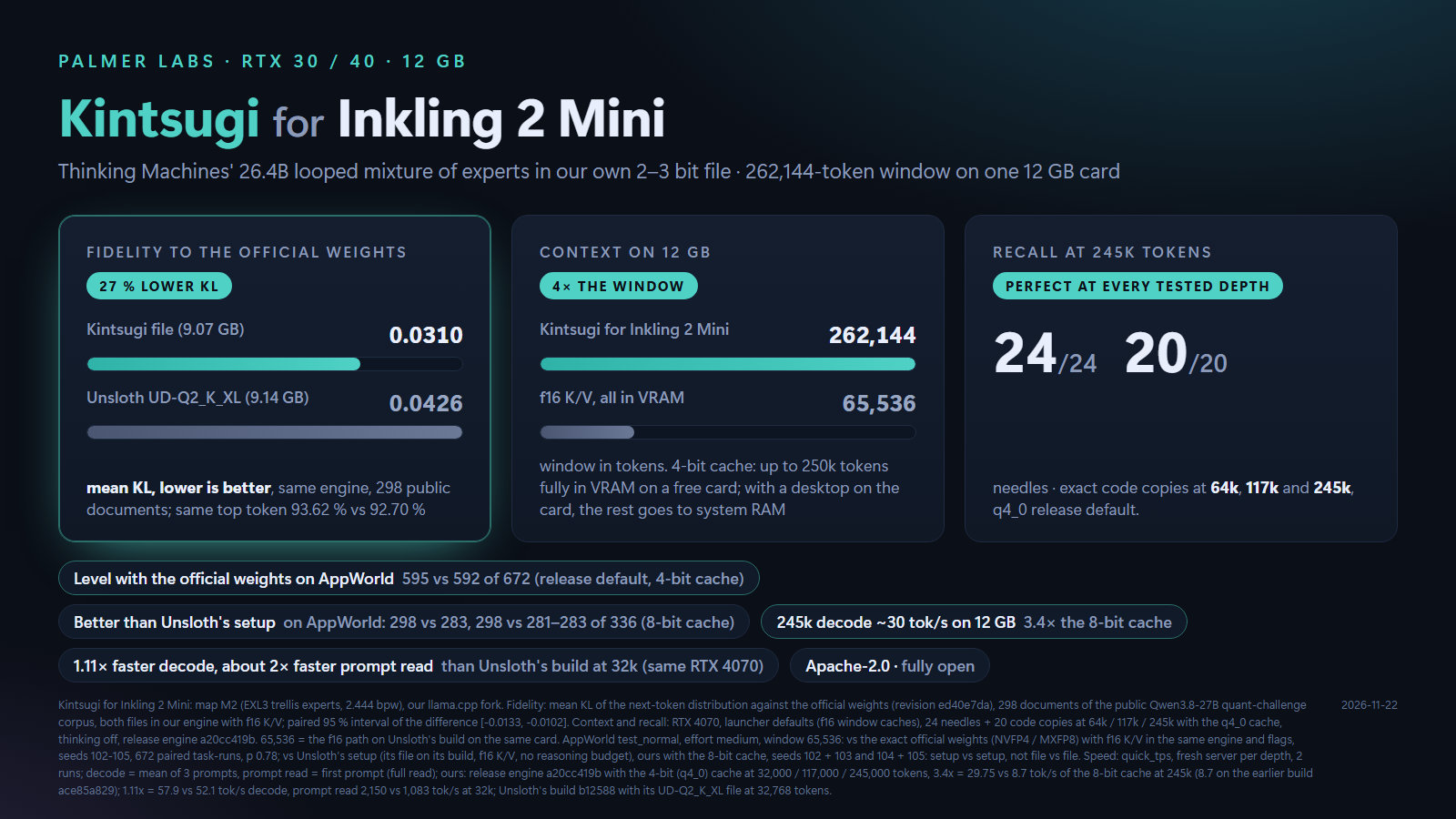
|
|
|
|
|
|
|
|
|
|
|
|
|
|
|
|
|
|
|
|
|
|
|
|
|
|
|
|
|
|
|
|
|
|
|
|
|
|
|
|
|
|
|
|
|
|
|
|
|
|
|
|
|
|
|
|
|
|
|
|
|
|
|
|
|
|
|
|
|
|
|
|
|
|
|
|
|
|
|
|
|
|
|
|
|
|
|
|
|
|
|
|
|
|
|
|
|
|
|
|
|
|
|
|
|
|
|
|
|
|
|
|
|
|
|
|
|
|
|
|
|
|
|
|
|
|
|
|
|
|
|
|
|
|
|
|
|
|
|
|
|
|
|
|
|
|
|
|
|
|
|
|
|
|
|
|
|
|
|
|
|
|
|
|
|
|
|
|
|
|
|
|
|
|
|
|
|
|
|
|
|
|
|
|
|
|
|
|
|
|
|
|
|
|
|
|
|
|
|
|
|
|
|
|
|
|
|
|
|
|
|
|
|
|
|
|
|
|
|
|
|
|
|
|
|
|
|
|
|
|
|
|
|
|
|
|
|
|
|
|
|
|
|
|
|
|
|
|
|
|
|
|
|
|
|
|
|
|
|
|
|
|
|
|
|
|
|
|
|
|
|
|
|
|
|
|
|
|
|
|
|
|
|
|
|
|
|
|
|
|
|
|
|
|
|
|
|
|
|
|
|
|
|
|
|
|
|
|
|
|
|
|
|
|
|
|
|
|
|
|
|
|
|
|
|
|
|
|
|
|
|
|
|
|
|
|
|
|
|
|
|
|
|
|
|
|
|
|
| 1 |
+
---
|
| 2 |
+
license: apache-2.0
|
| 3 |
+
base_model: thinkingmachines/Inkling-2-Mini
|
| 4 |
+
base_model_relation: quantized
|
| 5 |
+
pipeline_tag: text-generation
|
| 6 |
+
library_name: gguf
|
| 7 |
+
tags:
|
| 8 |
+
- inkling2
|
| 9 |
+
- exl3
|
| 10 |
+
- trellis
|
| 11 |
+
- long-context
|
| 12 |
+
- 12gb
|
| 13 |
+
---
|
| 14 |
+
|
| 15 |
+
<!-- The Hugging Face model card of CaryPalmer/Kintsugi-Inkling-2-Mini (the repo holds the GGUF, this card as
|
| 16 |
+
README.md, and LICENSE = the Apache-2.0 text). -->
|
| 17 |
+
|
| 18 |
+
# Kintsugi for Inkling 2 Mini
|
| 19 |
+
|
| 20 |
+
Thinking Machines' Inkling 2 Mini in our own 2-3 bit file, made to run on one 12 GB NVIDIA card with a
|
| 21 |
+
**262,144-token context**.
|
| 22 |
+
|
| 23 |
+
|
| 24 |
+
|
| 25 |
+
|
| 26 |
+
**How it was made:** the method, the evidence and the tests behind these numbers are in the paper "Kintsugi: Find and Repair Quantization Damage Where Tasks Break, Not Where Averages Look": https://github.com/professorpalmer/kintsugi-method
|
| 27 |
+
|
| 28 |
+
## What this is
|
| 29 |
+
|
| 30 |
+
- **The model**: Inkling 2 Mini by Thinking Machines (26.4B looped mixture of experts, Apache-2.0), text only.
|
| 31 |
+
- **This file**: every expert in EXL3 trellis code at 2 or 3 bits (2.444 bits per weight over the
|
| 32 |
+
experts), fitted by us on Thinking Machines' weights. Mean KL 0.0310 against the official weights on a
|
| 33 |
+
public golden set; the same top token 93.62 %.
|
| 34 |
+
- **The engine**: our llama.cpp fork (MIT). Only this engine loads the file. It keeps the K/V cache of the model's 8
|
| 35 |
+
global attention passes at 4 bits (q4_0): up to 250k tokens in VRAM on a free card, the rest in system RAM: 262,144
|
| 36 |
+
tokens on 12 GB. It also has a repetition guard for agent loops (on by default: at two stuck points it broke the
|
| 37 |
+
loop in 6 and 7 of 10 tries, against 0 of 10 without it) and an opt-in two-slot mode (`INKLING_SLOTS=2`: one shared
|
| 38 |
+
window, fewer cells in VRAM, saved chats off, not bit-equal to one slot).
|
| 39 |
+
- **The bundles** (Windows and Linux, with the engine, launcher and saved-chat layer) are on
|
| 40 |
+
[GitHub](https://github.com/professorpalmer/Kintsugi-Inkling-2-Mini/releases).
|
| 41 |
+
|
| 42 |
+
## Results (RTX 4070 12 GB, the bundle's defaults)
|
| 43 |
+
|
| 44 |
+
| | |
|
| 45 |
+
|---|---|
|
| 46 |
+
| Fidelity to the official weights (mean KL, same top token) | 0.0310, 93.62 % |
|
| 47 |
+
| The same test, Unsloth's UD-Q2_K_XL (9.14 GB) in the same engine, 2026-11-21 | 0.0426, 92.70 % (ours: 27.3 % lower KL, 27.7 % with the release-default K/V; on user / tool text past 1k tokens ours is higher, 0.76 vs 0.61) |
|
| 48 |
+
| AppWorld agent tasks vs the official weights (NVFP4 / MXFP8, exact, same engine), 672 paired task-runs | 595 vs 592 with the release default (4-bit cache): level (p = 0.78) |
|
| 49 |
+
| AppWorld vs Unsloth's setup (its file on its build; setup vs setup, not file vs file; ours with the 8-bit cache) | 298 vs 283 and 298 vs 281-283 of 336: better |
|
| 50 |
+
| Recall at 64k / 117k / 245k (24 needles / 20 code copies) | 24/24 + 20/20 at each depth (q4_0 release default) |
|
| 51 |
+
| Decode at 4k / 32k / 117k / 245k (tok/s) | 64.5 / 57.9 / 42.4 / 29.75 |
|
| 52 |
+
| Coding harnesses (6 tasks each): Claude Code, Codex, Pi, OpenCode | 5 of 6 in each |
|
| 53 |
+
|
| 54 |
+
Details, settings and dates: [benchmarks](https://github.com/professorpalmer/Kintsugi-Inkling-2-Mini/blob/main/benchmarks/README.md).
|
| 55 |
+
|
| 56 |
+
## Use it
|
| 57 |
+
|
| 58 |
+
1. Download the bundle for your system from
|
| 59 |
+
[the GitHub releases](https://github.com/professorpalmer/Kintsugi-Inkling-2-Mini/releases) and unpack it.
|
| 60 |
+
2. Download `Kintsugi-Inkling-2-Mini-12G.gguf` from this page into the bundle's `models` folder. SHA-256
|
| 61 |
+
`7d93d5e8e61f6694776ec8b488751787a7dd3cb745d4f9eaee9f0b78b0e60cec`.
|
| 62 |
+
3. Start: `powershell -ExecutionPolicy Bypass -File start-server.ps1 -Wait` (Windows) or `./start-server.sh --wait`
|
| 63 |
+
(Linux). The server is OpenAI-compatible on `http://127.0.0.1:8080/v1` and works with Claude Code, Codex, Pi and
|
| 64 |
+
OpenCode.
|
| 65 |
+
|
| 66 |
+
Needs: an NVIDIA RTX 30 / 40 card with 12 GB or more; driver 580+ (Windows) or 570+ (Linux); 32 GB of system
|
| 67 |
+
RAM is best for very long chats.
|
| 68 |
+
|
| 69 |
+
## Hardware
|
| 70 |
+
|
| 71 |
+
| Hardware | Status |
|
| 72 |
+
|---|---|
|
| 73 |
+
| RTX 40 (Ada) | Supported: every release check ran on an RTX 4070 (Windows and Linux). |
|
| 74 |
+
| RTX 30 (Ampere) | Supported: the release engine was checked on an RTX 3080 Ti (Linux): it starts with the launcher defaults, 24 / 24 needles at 32k, the identity prompts answer, top-1 agreement 97.8 %. Its mean KL is 7.5 % lower than on the RTX 4070; without one near-tie token in the 4070 reference run the two cards differ by 0.6 % (the same kernels; only the order of sums differs). |
|
| 75 |
+
| RTX 50 (Blackwell), H100 / H200 (Hopper) | Not yet: this engine has no code for them. Planned for v1.0.1. |
|
| 76 |
+
| RTX 20 (Turing) | Not supported: it fails our exact-output checks and runs 6-14x slower than an RTX 4070. |
|
| 77 |
+
| AMD Radeon | Not yet: after Kintsugi-27B's AMD release (test builds exist). |
|
| 78 |
+
| Apple Silicon | Not yet: needs its own port; not scheduled. |
|
| 79 |
+
|
| 80 |
+
You need 12 GB of VRAM or more, and an NVIDIA driver 580 or newer (Windows) or 570 or newer (Linux). 32 GB of system
|
| 81 |
+
RAM or more is best for very long chats.
|
| 82 |
+
|
| 83 |
+
## Files
|
| 84 |
+
|
| 85 |
+
| File | Size | SHA-256 |
|
| 86 |
+
|---|---|---|
|
| 87 |
+
| `Kintsugi-Inkling-2-Mini-12G.gguf` | 9,067,638,560 | `7d93d5e8e61f6694776ec8b488751787a7dd3cb745d4f9eaee9f0b78b0e60cec` |
|
| 88 |
+
| `LICENSE` | | Apache-2.0 |
|
| 89 |
+
|
| 90 |
+
## How it was made
|
| 91 |
+
|
| 92 |
+
Hessians from our forward pass of the official weights on the public calibration corpus of the Qwen3.8-27B quant
|
| 93 |
+
challenge (StillDeadcode, CC BY 4.0), re-rendered with Inkling's template; every expert saw every token during the
|
| 94 |
+
capture, and the three loop passes add into one Hessian. Fits with exllamav3's `quantize_exl3` (turboderp, MIT);
|
| 95 |
+
the Escha W2 layout (Escha Labs).
|
| 96 |
+
|
| 97 |
+
- **Map M2** (2.444 bits per weight over 24,461,180,928 expert weights): the down projections at 3 bits in all 24
|
| 98 |
+
layers; the fused gate and up projections at 3 bits in the 4 global layers (5, 11, 17, 23) and at 2 bits in the
|
| 99 |
+
other 20.
|
| 100 |
+
- **Other tensors**: attention projections and head Q8_0, token embedding Q4_0, loop controllers, sinks and
|
| 101 |
+
convolution projections F16, router and norms F32, all from Thinking Machines' official release (revision
|
| 102 |
+
`ed40e7da`).
|
| 103 |
+
- The GGUF metadata, tokenizer and chat template are as in Unsloth's GGUF of the model (Apache-2.0).
|
| 104 |
+
|
| 105 |
+
## Licence and use
|
| 106 |
+
|
| 107 |
+
This file is a quantized derivative of Inkling 2 Mini by Thinking Machines, licensed under Apache-2.0 (see LICENSE).
|
| 108 |
+
Use of the model is also subject to the Thinking Machines
|
| 109 |
+
[Model Acceptable Use Policy](https://thinkingmachines.ai/model-acceptable-use-policy). Our engine is MIT; our
|
| 110 |
+
launcher and layer are Apache-2.0.
|
| 111 |
+
|
| 112 |
+
## Credits
|
| 113 |
+
|
| 114 |
+
Thinking Machines (Inkling 2 Mini); turboderp (exllamav3: the EXL3 codec, `quantize_exl3` and the CUDA kernels);
|
| 115 |
+
Albert Tseng, Qingyao Sun, David Hou and Christopher De Sa (QTIP); Escha Labs (the Escha W2 format); StillDeadcode (the
|
| 116 |
+
calibration corpus and golden set, CC BY 4.0); Unsloth (the llama.cpp port of Inkling 2 Mini that our engine code is
|
| 117 |
+
ported from, MIT); Piotr Wilkin, Daniel Han, Aldehir Rojas and Xuan-Son Nguyen (the upstream llama.cpp support); Project Maya
|
| 118 |
+
(MIT: Peasant Smith and the Project Maya contributors, Niko1221 and the Strata contributors; mrsirg97-rgb and
|
| 119 |
+
OscarSheng for the Inkling 2 engine maya-ik2; Alexey Fateev (alesha-pro) for the Inkling 2 Mini work: the measurement
|
| 120 |
+
of llama.cpp's per-token launch overhead on Inkling 2 Mini and the idea to fuse its small glue launches, which our own
|
| 121 |
+
fused kernels follow; cobra91 for the Windows port); the ggml authors and llama.cpp contributors. Full list:
|
| 122 |
+
[CREDITS.md](https://github.com/professorpalmer/Kintsugi-Inkling-2-Mini/blob/main/CREDITS.md). No person or company
|
| 123 |
+
named here endorses or sponsors this project.
|