---
license: cc-by-nc-4.0
language:
- en
tags:
- audio-generation
- video-to-audio
- text-to-audio
- diffusion-transformer
- multimodal
pipeline_tag: text-to-audio
---
Omni2Sound — Unified Video-Text-to-Audio Generation



CVPR 2026 (Highlight)
## Model Description
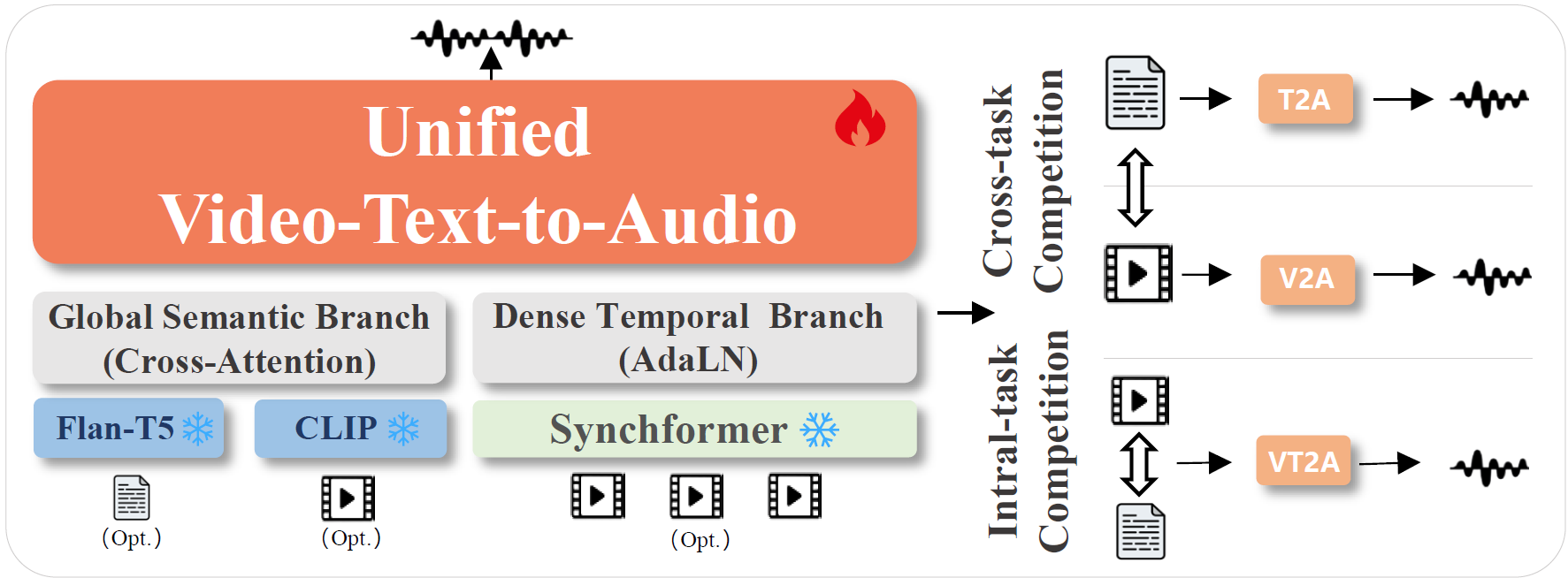
Omni2Sound is a **unified framework** for generating temporally aligned and semantically faithful audio from **video**, **text**, or **both**. A single model handles three tasks:
- **VT2A** (Video + Text → Audio)
- **V2A** (Video → Audio)
- **T2A** (Text → Audio)
Omni2Sound achieves **state-of-the-art performance across all three tasks** on the VGGSound-Omni benchmark, surpassing both previous unified models (AudioX, MMAudio) and specialized models (ThinkSound, HunyuanVideo-Foley).
## Architecture
Omni2Sound is built on a standard **Diffusion Transformer (DiT)** backbone with a decoupled two-branch conditioning design:
- **Semantic Branch ("What")**: Fuses text embeddings from Flan-T5 and visual features from CLIP via cross-attention, providing high-level semantic context. For unimodal tasks (V2A or T2A), the absent modality is simply omitted — no padding needed.
- **Temporal Branch ("When")**: Uses a Synchformer to extract fine-grained visual-temporal features, injected globally via Adaptive Layer Normalization (AdaLN) for precise audio-visual synchronization.
The model is trained with a **three-stage progressive multi-task training schedule**:
1. **Stage 1** — Large-scale T2A pretraining on text-audio pairs
2. **Stage 2** — Multi-task interleaved finetuning (joint VT2A + V2A + T2A) on SoundAtlas
3. **Stage 3** — Decoupled robustness finetuning with off-screen synthesis and text dropout augmentations
## Key Features
- **Unified SOTA**: A single model achieves state-of-the-art on VT2A, V2A, and T2A simultaneously
- **Strong temporal control**: Fine-grained audio-visual synchronization via Synchformer temporal features
- **Strong semantic control**: Faithful audio generation guided by text and/or visual semantics
- **Robustness**: Handles challenging scenarios including off-screen audio synthesis and incomplete text inputs
- **Simple design**: Plain DiT backbone — all gains come from high-quality data (SoundAtlas) and training strategy
## Model Files
```
omni2sound/
├── oob_vae_16k_224410.ckpt # Audio VAE
├── synchformer_state_dict.pth # Synchformer temporal encoder
└── vt2a-24-v55vt35-oa15-mq-td15/
├── args.yaml
├── data_config.yaml
├── model_config.json
└── checkpoints/model.ckpt # DiT backbone weights
```
Additionally, download the following dependencies into `weights/`:
| Model | Source |
|---|---|
| DFN5B-CLIP-ViT-H-14-384 | [apple/DFN5B-CLIP-ViT-H-14-384](https://huggingface.co/apple/DFN5B-CLIP-ViT-H-14-384) |
| flan-t5-base | [google/flan-t5-base](https://huggingface.co/google/flan-t5-base) |
## Quick Start
```bash
git clone https://github.com/omni2sound/Omni2Sound.git
cd Omni2Sound
pip install torch==2.1.0 torchaudio==2.1.0 torchvision==0.16.0 \
--index-url https://download.pytorch.org/whl/cu121
pip install -r requirements.txt
huggingface-cli download Dalision/Omni2Sound --local-dir weights/omni2sound
# Run inference
bash scripts/infer_online.sh
```
See the [GitHub repo](https://github.com/omni2sound/Omni2Sound) for full instructions on inference and finetuning.
## Links
- **Paper**: [arXiv:2601.02731](https://arxiv.org/pdf/2601.02731)
- **Project Page**: [omni2sound.github.io/](https://omni2sound.github.io/)
- **Code**: [github.com/omni2sound/Omni2Sound](https://github.com/omni2sound/Omni2Sound)
- **Benchmark & Dataset**: [Dalision/Omni2Sound_Benchmark](https://huggingface.co/datasets/Dalision/Omni2Sound_Benchmark)
- **Evaluation Results**: [Dalision/Omni2Sound_Result](https://huggingface.co/datasets/Dalision/Omni2Sound_Result)
## Citation
```bibtex
@article{dai2026omni2sound,
title = {Omni2Sound: Towards Unified Video-Text-to-Audio Generation},
author = {Dai, Yusheng and Chen, Zehua and Jiang, Yuxuan and Gao, Baolong and
Ke, Qiuhong and Cai, Jianfei and Zhu, Jun},
journal = {arXiv preprint arXiv:2601.02731},
year = {2026}
}
```
## License
Both the code and model weights are released under [CC BY-NC 4.0](https://creativecommons.org/licenses/by-nc/4.0/) (non-commercial use only).