---
library_name: transformers
license: mit
datasets:
- Darayut/khmer-document-synthetic-low-res
- Darayut/khmer-scene-text-synthetic-contrast
language:
- km
metrics:
- cer
pipeline_tag: image-to-text
tags:
- transformer
- khmer-ocr
- text-recognition
- crnn
- khmer-text-recognition
---
GitHub |
Model Download |
Dataset Download |
Inference Space |
A Squeeze-and-Excitation Transformer Network for Khmer Optical Character Recognition
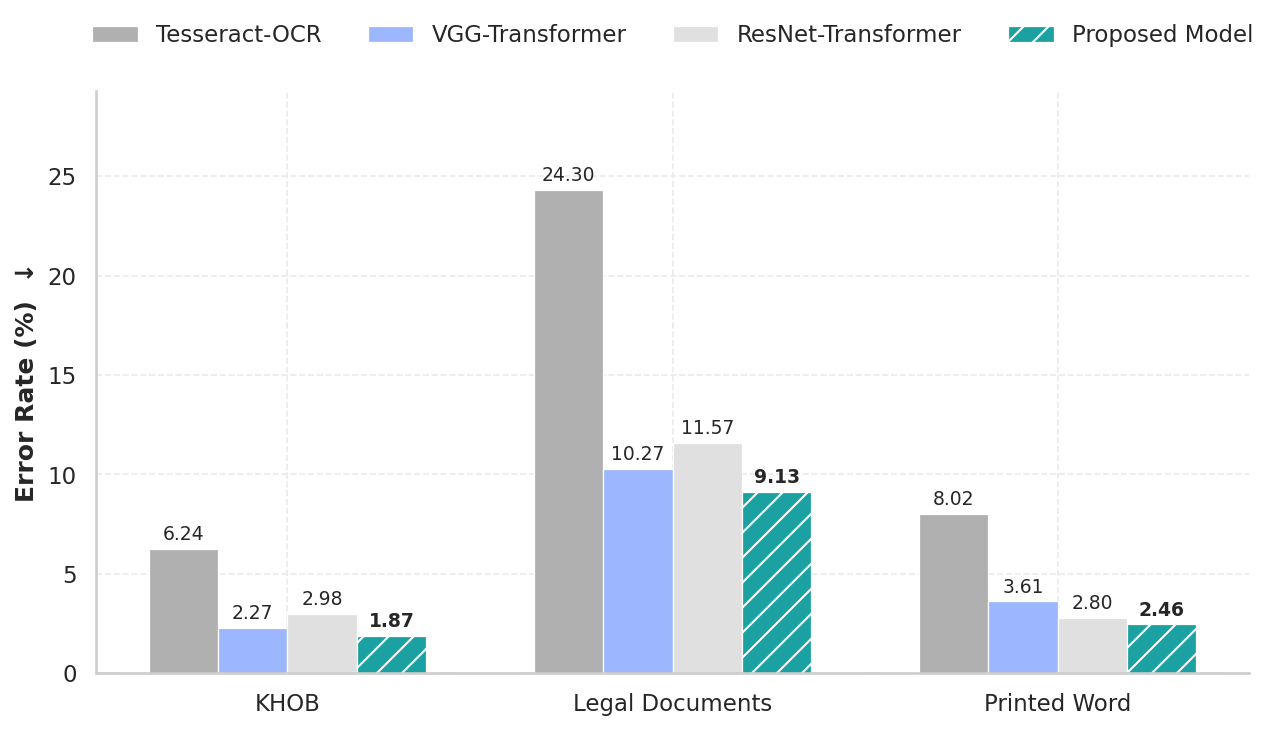
Character Error Rate (CER %) on KHOB, Legal Documents, and Printed Word Benchmark
## Introduction
This repository contains the implementation, datasets, and evaluation results for the **Squeeze-and-Excitation Transformer Network**, a high-performance Khmer Text Recognition model that utilizes a hybrid architecture combining **Squeeze-and-Excitation** blocks for feature extraction and **BiLSTM** smoothing for context smoothing, specifically designed to handle the complexity and length of Khmer script.
## Overview
Khmer script presents unique challenges for OCR due to its large character set, complex sub-consonant stacking, and variable text line lengths. This project employs an enhanced pipeline that:
1. **Chunks** long text lines into manageable overlapping segments.
2. **Extracts Features** using a **Squeeze-and-Excitation Network** (SE-VGG) that preserves horizontal spatial information.
3. **Encodes** local spatial features using a Transformer Encoder.
4. **Merges** the encoded chunks into a unified sequence.
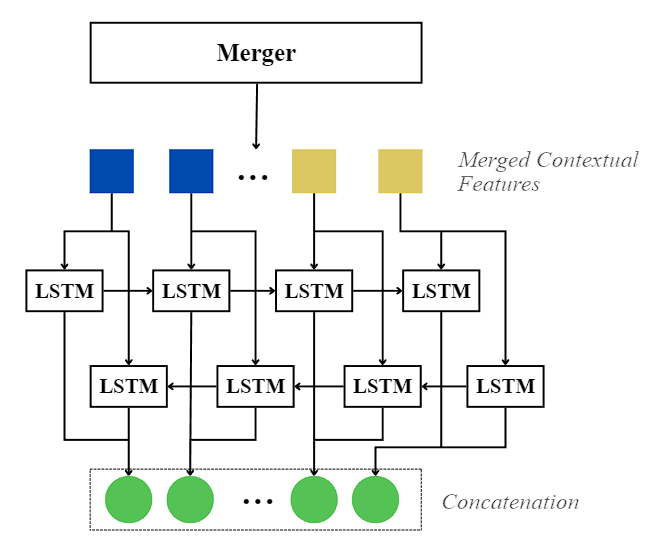
5. **Smooths Context** using a **BiLSTM** layer to resolve boundary discontinuities between chunks.
6. **Decodes** the final sequence using a Transformer Decoder.
## Datasets
The model was trained entirely on synthetic data and evaluated on real-world datasets.
### Training Data (Synthetic)
We generated **200,000 synthetic images** to ensure robustness against font variations and background noise.
| Dataset Type | Count | Generator / Source | Augmentations |
| :--- | :--- | :--- | :--- |
| **Document Text** | 100,000 | Pillow + Khmer Corpus | Erosion, noise, thinning/thickening, perspective distortion. |
| **Scene Text** | 100,000 | SynthTIGER + Stanford BG | Rotation, blur, noise, realistic backgrounds. |
### Evaluation Data (Real-World + Synthetic)
| Dataset | Type | Size | Description |
| :--- | :--- | :--- | :--- |
| **KHOB** | Real | 325 | Standard benchmark, clean backgrounds but compression artifacts. |
| **Legal Documents** | Real | 227 | High variation in degradation, illumination, and distortion. |
| **Printed Words** | Synthetic | 1,000 | Short, isolated words in 10 different fonts. |

---
## Methodology & Architecture
### 1. Preprocessing: Chunking & Merging
To handle variable-length text lines without aggressive resizing, we employ a "Chunk-and-Merge" strategy:
* **Resize:** Input images are resized to a fixed height of 48 pixels while maintaining aspect ratio.
* **Chunking:** The image is split into overlapping chunks (Size: 48x100 px, Overlap: 16 px).
* **Independent Encoding:** Each chunk is processed independently by the CNN and Transformer Encoder to allow for parallel batch processing.
### 2. Model Architecture: Squeeze-and-Excitation Transformer Network
Our proposed architecture integrates sequence-aware attention and recurrent smoothing to overcome the limitations of standard chunk-based OCR. The model consists of six key modules:

1. **Squeeze-and-Excitation Network (SE-VGG):**
* A modified VGG backbone with **1D Squeeze-and-Excitation** blocks after convolutional layer **3**, **4**, and **5**.
* Unlike standard SE, these blocks use **vertical pooling** to refine feature channels while strictly preserving the horizontal width (sequence information).
![SE Module]()
2. **Patch Module:**
* Projects spatial features into a condensed **384-dimensional** embedding space.
* Adds local positional encodings to preserve spatial order within chunks.
3. **Transformer Encoder:**
* Captures contextual relationships among visual tokens within each independent chunk.
4. **Merging Module:**
* Concatenates the encoded features from all chunks into a single unified sequence.
* Adds **Global Positional Embeddings** to define the absolute position of tokens across the entire text line.
5. **BiLSTM Context Smoother:**
* A Bidirectional LSTM layer that processes the merged sequence.
* **Purpose:** Bridges the "context gap" between independent chunks by smoothing boundary discontinuities, ensuring a seamless flow of information across the text line.
6. **Transformer Decoder:**
* Generates the final Khmer character sequence using the globally smoothed context.
---
## Training Configuration
* **Epochs:** 100
* **Optimizer:** Adam
* **Loss Function:** Cross-Entropy Loss
* **Learning Rate Schedule:** Staged Cyclic
* *Epoch 0-15:* Fixed 1e-4 (Rapid convergence)
* *Epoch 16-30:* Cyclic 1e-4 to 1e-5 (Stability)
* *Epoch 31-100:* Cyclic 1e-5 to 1e-6 (Fine-tuning)
* **Sampling:** 50,000 images randomly sampled/augmented per epoch.
---
## Quantitative Analysis
We benchmarked our **proposed model** against VGG-Transformer, ResNet-Transformer, and Tesseract-OCR.
**Character Error Rate (CER %)** - *Lower is better*
TABLE 1: Character Error Rate (CER in %) results on the KHOB, Legal Documents, and Printed Word
| Model | KHOB | Legal Documents | Printed Word |
| :--- | :--- | :--- | :--- |
| Tesseract-OCR | 6.24 | 24.30 | 8.02 |
| VGG-Transformer | 2.27 | 10.27 | 3.61 |
| ResNet-Transformer | 2.98 | 11.57 | 2.80 |
| Proposed Model | **1.87** | **9.13** | **2.46** |
---
## Qualitative Analysis
TABLE 2: Failure cases on KHOB, Legal Documents, and Printed Word
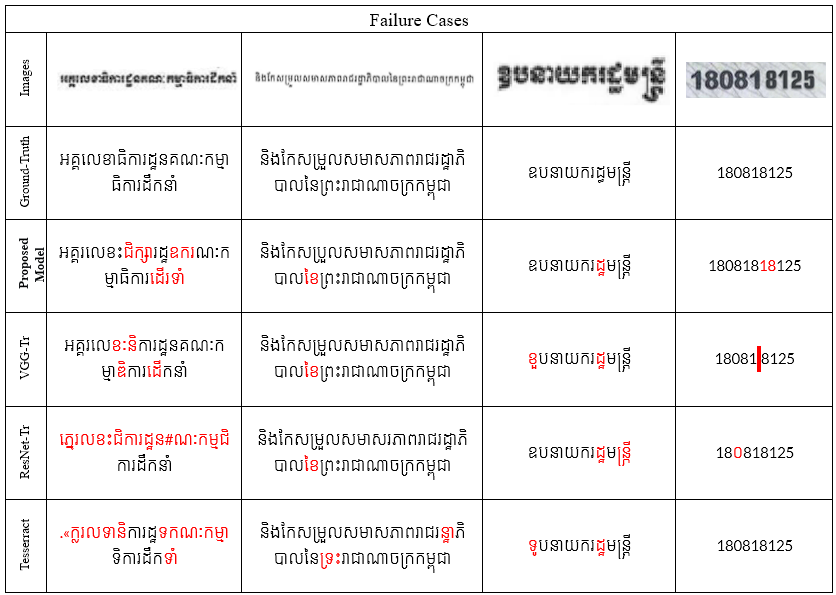
TABLE 3: Example of our **proposed model** against all baseline compared with the ground truth. Errors in the predictions are highlighted in red.

**Key Findings:**
* **The Proposed Model** achieves the highest accuracy on long, continuous text lines (KHOB), demonstrating that the **BiLSTM Context Smoother** effectively resolves the chunk boundary discontinuities that limit standard Transformer baselines.
* On degraded and complex legal documents, **the proposed model** demonstrates superior robustness, significantly outperforming all baselines. This attributes to the **Squeeze-and-Excitation blocks**, which filter background noise while preserving character-specific features.
* **The Proposed Model** still retains a slight advantage on short, isolated words even where global context is less critical, outperforming both ResNet and VGG Transformer baseline.
---
## Inference Usage
You can load this model directly from Hugging Face using the `transformers` library. Because this is a custom architecture, you must set `trust_remote_code=True`.
### 1. Setup
```bash
pip install torch torchvision transformers pillow huggingface_hub
# Setup the inference script
wget https://huggingface.co/Darayut/khmer-text-recognition/resolve/main/configuration_khmerocr.py
wget https://huggingface.co/Darayut/khmer-text-recognition/resolve/main/inference.py
```
### 2. Run via Command Line
```bash
python inference.py --image "path/to/image.png" --method beam --beam_width 3
```
### 3. Run via Python
```python
from inference import KhmerOCR
# Load Model (Downloads automatically)
ocr = KhmerOCR()
# Predict
text = ocr.predict("test_image.jpg", method="beam", beam_width=3)
print(text)
```
---
## References
1. **An Image is Worth 16x16 Words: Transformers for Image Recognition at Scale**
*Alexey Dosovitskiy, Lucas Beyer, Alexander Kolesnikov, et al.*
ICLR 2021.
[arXiv:2010.11929](https://arxiv.org/abs/2010.11929)
2. **TrOCR: Transformer-based Optical Character Recognition with Pre-trained Models**
*Minghao Li, Tengchao Lv, Lei Cui, Yijuan Lu, Dinei Florencio, Cha Zhang, Zhoujun Li, Furu Wei.*
AAAI 2023.
[arXiv:2109.10282](https://arxiv.org/abs/2109.10282)
3. **Toward a Low-Resource Non-Latin-Complete Baseline: An Exploration of Khmer Optical Character Recognition**
*R. Buoy, M. Iwamura, S. Srun and K. Kise.*
IEEE Access, vol. 11, pp. 128044-128060, 2023.
[DOI: 10.1109/ACCESS.2023.3332361](https://doi.org/10.1109/ACCESS.2023.3332361)
4. **Balraj98.** (2018). *Stanford background dataset* [Data set]. Kaggle. https://www.kaggle.com/datasets/balraj98/stanford-background-dataset
5. **EKYC Solutions.** (2022). *Khmer OCR benchmark dataset (KHOB)* [Data set]. GitHub. https://github.com/EKYCSolutions/khmer-ocr-benchmark-dataset
6. **Em, H., Valy, D., Gosselin, B., & Kong, P.** (2024). *Khmer text recognition dataset* [Data set]. Kaggle. https://www.kaggle.com/datasets/emhengly/khmer-text-recognition-dataset
7. **Squeeze-and-Excitation Networks**
*Jie Hu, Li Shen, and Gang Sun.*
CVPR 2018.
[arXiv:1709.01507](https://arxiv.org/abs/1709.01507)
8. **Bidirectional Recurrent Neural Networks**
*Mike Schuster and Kuldip K. Paliwal.*
IEEE Transactions on Signal Processing, 1997.
[DOI: 10.1109/78.650093](https://doi.org/10.1109/78.650093) 