---
license: other
license_name: tencent-hunyuan-community
license_link: https://huggingface.co/tencent/HunyuanOCR/blob/main/LICENSE
language:
- multilingual
- en
- zh
tags:
- ocr
- vision-language-model
- document-parsing
- text-spotting
- information-extraction
- text-image-translation
pipeline_tag: image-text-to-text
library_name: transformers
---
# HunyuanOCR-1.5: Making Lightweight OCR VLMs Faster and Better
🤗 [Model](https://huggingface.co/tencent/HunyuanOCR) | 💻 [GitHub](https://github.com/Tencent-Hunyuan/HunyuanOCR) | 📄 [Paper](https://arxiv.org/pdf/2607.04884)
> 📦 **Model layout.** This repository hosts **HunyuanOCR-1.5** at the root
> (target base weights). The **DFlash speculative-decoding draft** lives under
> [`dflash/`](https://huggingface.co/tencent/HunyuanOCR/tree/main/dflash), and
> the previous **HunyuanOCR-1.0** is archived under
> [`v1.0/`](https://huggingface.co/tencent/HunyuanOCR/tree/main/v1.0)
> (load it with `subfolder="v1.0"`, or download the `v1.0/` directory directly).
---
## 📖 Introduction
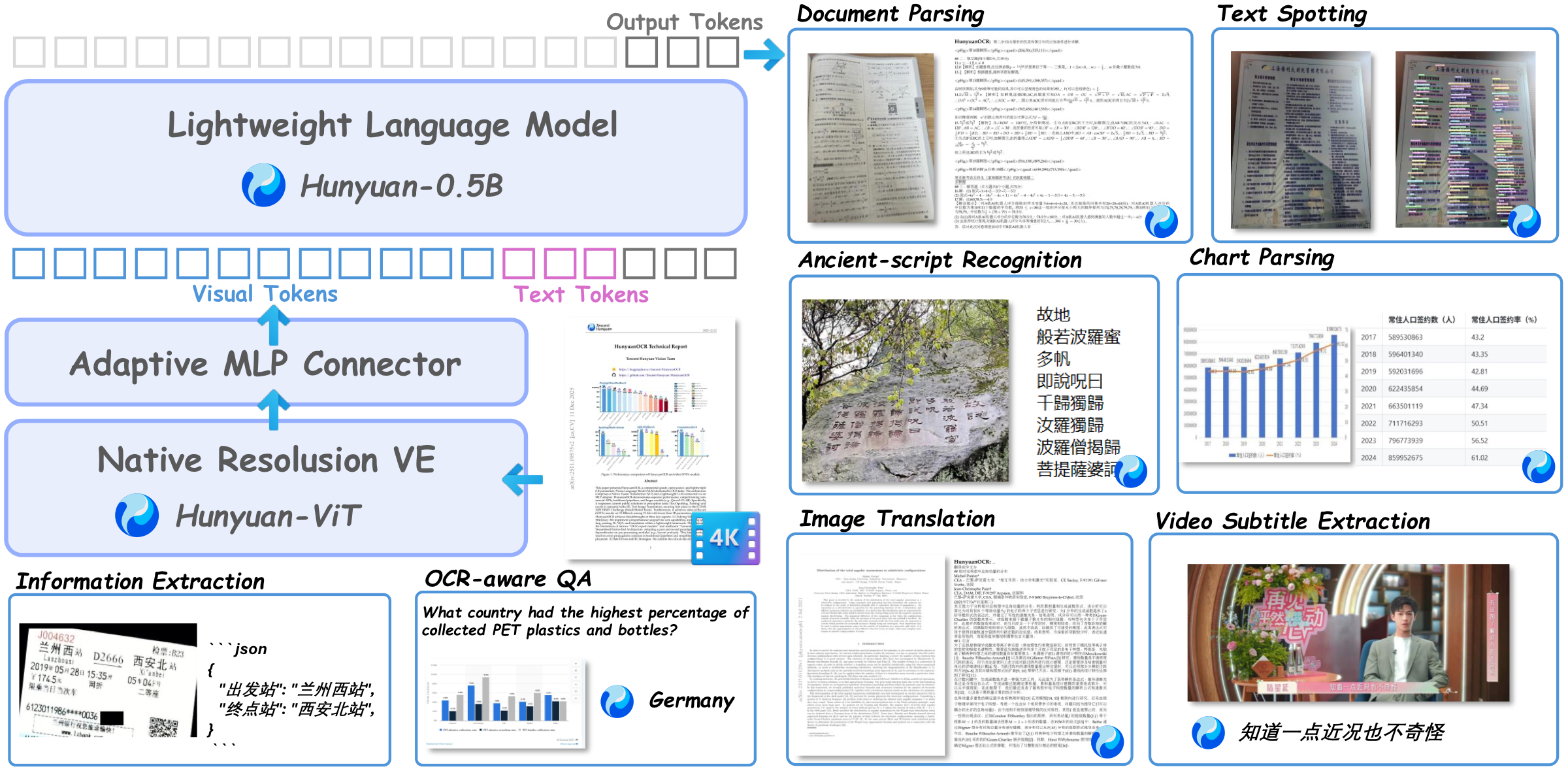
**HunyuanOCR-1.5** is a lightweight, end-to-end OCR-specialized vision-language model. It targets a broad range of text-centric visual tasks and unifies **document parsing, text spotting, information extraction, text-image translation** within a single end-to-end VLM.
Building upon the validated lightweight architecture of HunyuanOCR-1.0, HunyuanOCR-1.5 does **not** redesign the model backbone. Instead, it performs a systematic upgrade around two goals — **making the model faster and better**:
- ⚡ **Faster — DFlash inference acceleration.** End-to-end OCR is often accompanied by long autoregressive decoding, which becomes the major bottleneck for dense documents, tables, formulas, and other long structured outputs. HunyuanOCR-1.5 adapts a speculative-decoding framework based on **DFlash**: a lightweight block-diffusion draft model drafts multiple candidate tokens in parallel, which are then verified by the target model in a single pass. This significantly reduces the decoding latency of long structured outputs while **preserving the output distribution** of the target model.
- 💻 **PC-side deployment via llama.cpp.** Beyond server-grade vLLM, HunyuanOCR-1.5 also supports **CPU / consumer-GPU / laptop** deployment through [`llama.cpp`](https://github.com/ggml-org/llama.cpp) with a GGUF-converted checkpoint and an OpenAI-compatible `llama-server`. A DFlash-adapted `llama.cpp` fork is provided as well, so the same speculative-decoding acceleration is available on PC.
- 🧠 **Better — Agentic Data Flow + upgraded training recipe.** On the data side, we propose **Agentic Data Flow**, an agent-driven data-construction system that translates model weaknesses into executable data requirements. Agents deeply participate in material search, tool-based verification, sample cleaning, and data-pipeline development, and iterate in a closed loop with algorithm engineers. In HunyuanOCR-1.5, this system is used for targeted long-tail capabilities such as **low-resource OCR, ancient-script OCR, and multi-image text-centric QA**. On the training side, we systematically upgrade the recipe: pretraining Stage-3 is re-planned to incorporate the newly produced capability data, multi-image data, and historical OCR data, with maximum image resolution extended to **4K** and context window extended to **128K**; post-training refines the SFT data and further explores RL across different OCR tasks to amplify the gains from reinforcement learning.
Together, HunyuanOCR-1.5 achieves **both faster inference and broader OCR capability coverage** while retaining the deployment advantages of a lightweight end-to-end model. The full SFT / DFlash training pipeline and the transformers / vLLM / llama.cpp inference stack are open-sourced in the [GitHub repo](https://github.com/Tencent-Hunyuan/HunyuanOCR).
---
## ⚙️ Environment
Inference is split into **three self-contained, mutually exclusive setups** in the [GitHub repo](https://github.com/Tencent-Hunyuan/HunyuanOCR) under [`inference/`](https://github.com/Tencent-Hunyuan/HunyuanOCR/tree/main/inference). vLLM (AR / DFlash) and native transformers inference require different, incompatible `transformers` versions and **cannot share one environment** — this is a validated constraint, not a preference:
| Setup | vLLM | DFlash accel. | transformers | CUDA | Best for |
|---|:-:|:-:|:-:|---|---|
| [`inference/vllm_0_18_1`](https://github.com/Tencent-Hunyuan/HunyuanOCR/tree/main/inference/vllm_0_18_1) | 0.18.1 (release) | ❌ | ❌ | 12.x | simplest setup, AR only |
| [`inference/nightly`](https://github.com/Tencent-Hunyuan/HunyuanOCR/tree/main/inference/nightly) | nightly | ✅ | ❌ | 13 | AR + DFlash acceleration |
| [`inference/transformers`](https://github.com/Tencent-Hunyuan/HunyuanOCR/tree/main/inference/transformers) | — | — | ✅ 5.13.0 | host driver | native HF inference |
Each subfolder ships its own README and `requirements.txt`. See
[`inference/README.md`](https://github.com/Tencent-Hunyuan/HunyuanOCR/blob/main/inference/README.md)
for the selection guide and the full rationale.
**Common prerequisites:** Python 3.10+ (3.12 tested), an NVIDIA GPU, and
`huggingface_hub` for downloading the weights:
```bash
pip install -U "huggingface_hub[cli]"
# target base (1.5) — skip the archived 1.0 to save space
huggingface-cli download tencent/HunyuanOCR --local-dir ./HunyuanOCR --exclude "v1.0/*"
```
The download contains both the base model and the `dflash/` draft model.
---
## 🧪 Inference
All setups share the same weights and the same task-type prompts + sampling
(`temperature=0.0`, `top_p=1.0`, `top_k=-1`, `repetition_penalty=1.08`) +
post-processing, so their outputs are directly comparable. Grab the toolkit from
GitHub first:
```bash
git clone https://github.com/Tencent-Hunyuan/HunyuanOCR.git
cd HunyuanOCR
```
### A. HuggingFace transformers (native)
The model ships the official `HunYuanVLForConditionalGeneration` + `AutoProcessor`
integration (transformers **≥ 5.13.0**). The simplest path — weights are pulled
from the Hub automatically:
```python
import torch
from transformers import AutoProcessor, HunYuanVLForConditionalGeneration
MODEL_ID = "tencent/HunyuanOCR"
processor = AutoProcessor.from_pretrained(MODEL_ID, trust_remote_code=True)
model = HunYuanVLForConditionalGeneration.from_pretrained(
MODEL_ID, torch_dtype=torch.bfloat16, device_map="auto",
trust_remote_code=True,
).eval()
prompt = (
"提取文档图片中正文的所有信息用markdown格式表示,其中页眉、页脚部分忽略,"
"表格用html格式表达,文档中公式用latex格式表示,按照阅读顺序组织进行解析。"
)
messages = [{
"role": "user",
"content": [
{"type": "image", "image": "/path/to/document.png"},
{"type": "text", "text": prompt},
],
}]
inputs = processor.apply_chat_template(
messages, add_generation_prompt=True, tokenize=True,
return_dict=True, return_tensors="pt",
).to(model.device)
with torch.inference_mode():
out = model.generate(**inputs, max_new_tokens=8000, do_sample=False)
gen = out[:, inputs["input_ids"].shape[1]:]
print(processor.batch_decode(gen, skip_special_tokens=True)[0])
```
For **multi-GPU batch inference** with sampling / early-stop / doc-parse
normalization strictly aligned to the vLLM client, use the shipped script in a
dedicated `transformers==5.13.0` environment (see
[`inference/transformers/README.md`](https://github.com/Tencent-Hunyuan/HunyuanOCR/blob/main/inference/transformers/README.md)):
```bash
# install per inference/transformers/requirements.txt, then:
python inference/transformers/infer_hf_8gpu_hyocr15.py \
--model ./HunyuanOCR \
--input /path/to/bench.jsonl \
--output ./results/hf_out \
--gpu-ids 0,1,2,3,4,5,6,7 \
--max-new-tokens 8192 \
--merge
```
### B. vLLM (OpenAI-compatible)
Two mutually-exclusive vLLM setups. Both serve the model as `tencent/HunyuanOCR`
with `-tp 1` and `--max-model-len 131072`.
**B1 — vLLM 0.18.1 (release, AR only, simplest).** The release build natively
supports `HunYuanVLForConditionalGeneration`; no nightly or patch required.
Install per
[`inference/vllm_0_18_1/requirements.txt`](https://github.com/Tencent-Hunyuan/HunyuanOCR/blob/main/inference/vllm_0_18_1/requirements.txt)
(core: `pip install "vllm==0.18.1"`), then:
```bash
MODEL_PATH=./HunyuanOCR GPU=0 PORT=8000 bash inference/vllm_0_18_1/serve.sh
curl -sf http://127.0.0.1:8000/v1/models # readiness check
```
**B2 — vLLM nightly (AR + DFlash speculative decoding).** Required for the real
DFlash speedup. Install per
[`inference/nightly/requirements.txt`](https://github.com/Tencent-Hunyuan/HunyuanOCR/blob/main/inference/nightly/requirements.txt):
```bash
uv pip install -U vllm --torch-backend=cu130 --extra-index-url https://wheels.vllm.ai/nightly
uv pip install runai-model-streamer
```
The DFlash draft lives under the `dflash/` subfolder of `tencent/HunyuanOCR`.
vLLM's `--speculative-config` does not accept an HF subfolder, so download the
draft weight into a flat local dir first:
```bash
huggingface-cli download tencent/HunyuanOCR dflash/model.safetensors --local-dir ./HunyuanOCR
cp -r ./HunyuanOCR/dflash ./hyocr_dflash
```
Then launch AR or DFlash:
```bash
# AR (autoregressive) baseline
MODEL_PATH=./HunyuanOCR GPU=0 PORT=8000 bash inference/nightly/serve_ar.sh
# DFlash speculative decoding
MODEL_PATH=./HunyuanOCR DFLASH_PATH=./hyocr_dflash \
GPU=0 PORT=8001 NUM_SPEC_TOKENS=15 bash inference/nightly/serve_dflash.sh
```
**Client (either vLLM setup).** Send one image with the shipped client. The
prompt is locked to an official task type via `--task-type` (run `--list-tasks`
to see all); sampling and streaming tail-repetition early-stop / cleanup are
built in:
```bash
# use the client from the same setup folder, e.g. inference/vllm_0_18_1/ or inference/nightly/
python inference/vllm_0_18_1/infer_vllm_client.py \
--host 127.0.0.1 --port 8000 \
--model tencent/HunyuanOCR \
--image /path/to/document.png \
--task-type doc_parse \
--max-tokens 32768
# add --no-stream to disable streaming + early-stop
# add --no-doc-postprocess to disable doc_parse markdown normalization
```
Available task types (`--task-type`): `doc_parse` (default), `structured_parse`, `spotting_json`, `spotting_hunyuan`, `layout`, `layout_parse`, `chart_parse`, `formula`, `table`, `doc_trans_en2zh`, `trans_other2en`, `trans_other2zh`.
For **batch** inference over a directory (same task types, multi-endpoint
concurrency, resumable):
```bash
python inference/vllm_0_18_1/batch_infer.py \
--image-dir /path/to/images \
--out-dir /path/to/output \
--ports 8000 \
--task-type doc_parse \
--max-tokens 32768 \
--concurrency 16
```
Or hand-written with the OpenAI SDK:
```python
import base64
from openai import OpenAI
def data_url(p): # Mime is fixed to image/jpeg
return f"data:image/jpeg;base64,{base64.b64encode(open(p,'rb').read()).decode()}"
client = OpenAI(api_key="EMPTY", base_url="http://127.0.0.1:8000/v1")
resp = client.chat.completions.create(
model="tencent/HunyuanOCR",
messages=[
{"role": "system", "content": ""},
{"role": "user", "content": [
{"type": "image_url", "image_url": {"url": data_url("/path/to/document.png")}},
{"type": "text", "text": "请提取图片中的文字内容。"},
]},
],
max_tokens=32768,
temperature=0.0, top_p=1.0,
extra_body={"top_k": -1, "repetition_penalty": 1.08, "skip_special_tokens": True},
)
print(resp.choices[0].message.content)
```
### C. PC-side deployment via llama.cpp
For **CPU / consumer-GPU / laptop** environments, HunyuanOCR-1.5 can also be deployed through [`llama.cpp`](https://github.com/ggml-org/llama.cpp) after converting the checkpoint to GGUF. Both the community `llama.cpp` (HunyuanOCR base only) and a DFlash-adapted fork ([`wendadawen/llama.cpp @ dflash-adapt-hunyuanocr-hunyuanstyle`](https://github.com/wendadawen/llama.cpp/tree/dflash-adapt-hunyuanocr-hunyuanstyle)) are supported.
Minimal build & serve (community, no DFlash):
```bash
# 1. Build
git clone https://github.com/ggml-org/llama.cpp.git && cd llama.cpp
cmake -B build -DLLAMA_BUILD_EXAMPLES=ON # add -DGGML_CUDA=ON for NVIDIA GPU
cmake --build ./build --config Release -j
# 2. Convert HunyuanOCR to GGUF (base + mmproj)
hf download tencent/HunyuanOCR --local-dir ./HunyuanOCR --exclude "v1.0/*"
python3 convert_hf_to_gguf.py --outfile ./HunyuanOCR/hyocr-f16.gguf --outtype f16 ./HunyuanOCR
python3 convert_hf_to_gguf.py --outfile ./HunyuanOCR/mmproj-hyocr-f16.gguf --outtype f16 --mmproj ./HunyuanOCR
# 3. Serve (OpenAI-compatible)
build/bin/llama-server \
--model ./HunyuanOCR/hyocr-f16.gguf \
--mmproj ./HunyuanOCR/mmproj-hyocr-f16.gguf \
--host 0.0.0.0 --port 8080 --alias HYVL \
--ctx-size 10240 --n-predict 4096
```
The DFlash-adapted variant and the full guide are in [`docs/llama_cpp.md`](https://github.com/Tencent-Hunyuan/HunyuanOCR/blob/main/docs/llama_cpp.md) in the GitHub repo.
---
## 🎯 Default OCR prompt for document parsing
```
提取文档图片中正文的所有信息用markdown格式表示,其中页眉、页脚部分忽略,表格用html格式表达,文档中公式用latex格式表示,按照阅读顺序组织进行解析。
```
The model also handles text spotting, information extraction, and text-image translation — pass a task-specific instruction as the text prompt (or use `--task-type` with the shipped client).
---
## 🔗 Related resources
- **GitHub — training & inference toolkit**:
- **DFlash draft weights**: [`tencent/HunyuanOCR/dflash`](https://huggingface.co/tencent/HunyuanOCR/tree/main/dflash)
- **HunyuanOCR-1.0** (previous generation, archived under `v1.0/`): [`tencent/HunyuanOCR/v1.0`](https://huggingface.co/tencent/HunyuanOCR/tree/main/v1.0)
---
## 🙏 Acknowledgements
We would like to thank [Qwen](https://github.com/QwenLM/Qwen3.6) and [DFlash](https://github.com/z-lab/dflash) for their valuable models and ideas.
Special thanks to the Hugging Face community for their Day-0 support.
---
## 📜 License
HunyuanOCR-1.5 is released under the same license as HunyuanOCR 1.0 — the **Tencent Hunyuan Community License Agreement**. See [`LICENSE`](https://huggingface.co/tencent/HunyuanOCR/blob/main/LICENSE) for the full terms.