---
license: apache-2.0
tags:
- text-to-audio
---
# MOSS-TTS Family

## Overview
MOSS‑TTS Family is an open‑source **speech and sound generation model family** from [MOSI.AI](https://mosi.cn/#hero) and the [OpenMOSS team](https://www.open-moss.com/). It is designed for **high‑fidelity**, **high‑expressiveness**, and **complex real‑world scenarios**, covering stable long‑form speech, multi‑speaker dialogue, voice/character design, environmental sound effects, and real‑time streaming TTS.
## Introduction
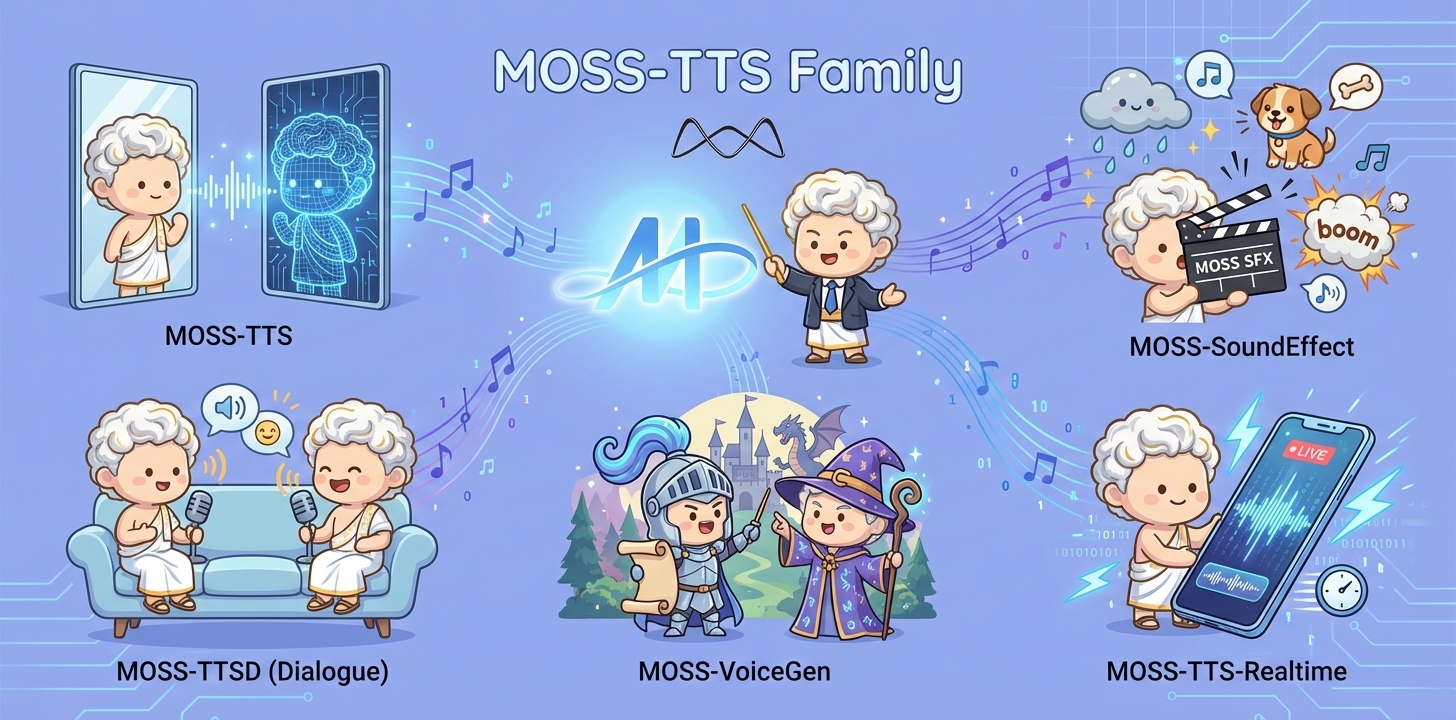
When a single piece of audio needs to **sound like a real person**, **pronounce every word accurately**, **switch speaking styles across content**, **remain stable over tens of minutes**, and **support dialogue, role‑play, and real‑time interaction**, a single TTS model is often not enough. The **MOSS‑TTS Family** breaks the workflow into five production‑ready models that can be used independently or composed into a complete pipeline.
- **MOSS‑TTS**: MOSS-TTS is the flagship production TTS foundation model, centered on high-fidelity zero-shot voice cloning with controllable long-form synthesis, pronunciation, and multilingual/code-switched speech. It serves as the core engine for scalable narration, dubbing, and voice-driven products.
- **MOSS‑TTSD**: MOSS-TTSD is a production long-form dialogue model for expressive multi-speaker conversational audio at scale. It supports long-duration continuity, turn-taking control, and zero-shot voice cloning from short references for podcasts, audiobooks, commentary, dubbing, and entertainment dialogue.
- **MOSS‑VoiceGenerator**: MOSS-VoiceGenerator is an open-source voice design model that creates speaker timbres directly from free-form text, without reference audio. It unifies timbre design, style control, and content synthesis, and can be used standalone or as a voice-design layer for downstream TTS.
- **MOSS‑SoundEffect**: MOSS-SoundEffect is a high-fidelity text-to-sound model with broad category coverage and controllable duration for real content production. It generates stable audio from prompts across ambience, urban scenes, creatures, human actions, and music-like clips for film, games, interactive media, and data synthesis.
- **MOSS‑TTS‑Realtime**: MOSS-TTS-Realtime is a context-aware, multi-turn streaming TTS model for real-time voice agents. By conditioning on dialogue history across both text and prior user acoustics, it delivers low-latency synthesis with coherent, consistent voice responses across turns.
## Released Models
| Model | Architecture | Size | Model Card | Hugging Face |
|---|---|---:|---|---|
| **MOSS-TTS** | MossTTSDelay | 8B | [moss_tts_model_card.md](https://github.com/OpenMOSS/MOSS-TTS/blob/main/docs/moss_tts_model_card.md) | 🤗 [Huggingface](https://huggingface.co/OpenMOSS-Team/MOSS-TTS) |
| | MossTTSLocal | 1.7B | [moss_tts_model_card.md](https://github.com/OpenMOSS/MOSS-TTS/blob/main/docs/moss_tts_model_card.md) | 🤗 [Huggingface](https://huggingface.co/OpenMOSS-Team/MOSS-TTS-Local-Transformer) |
| **MOSS‑TTSD‑V1.0** | MossTTSDelay | 8B | [moss_ttsd_model_card.md](https://github.com/OpenMOSS/MOSS-TTS/blob/main/docs/moss_ttsd_model_card.md) | 🤗 [Huggingface](https://huggingface.co/OpenMOSS-Team/MOSS-TTSD-v1.0) |
| **MOSS‑VoiceGenerator** | MossTTSDelay | 1.7B | [moss_voice_generator_model_card.md](https://github.com/OpenMOSS/MOSS-TTS/blob/main/docs/moss_voice_generator_model_card.md) | 🤗 [Huggingface](https://huggingface.co/OpenMOSS-Team/MOSS-Voice-Generator) |
| **MOSS‑SoundEffect** | MossTTSDelay | 8B | [moss_sound_effect_model_card.md](https://github.com/OpenMOSS/MOSS-TTS/blob/main/docs/moss_sound_effect_model_card.md) | 🤗 [Huggingface](https://huggingface.co/OpenMOSS-Team/MOSS-SoundEffect) |
| **MOSS‑TTS‑Realtime** | MossTTSRealtime | 1.7B | [moss_tts_realtime_model_card.md](https://github.com/OpenMOSS/MOSS-TTS/blob/main/docs/moss_tts_realtime_model_card.md) | 🤗 [Huggingface](https://huggingface.co/OpenMOSS-Team/MOSS-TTS-Realtime) |
# MOSS-SoundEffect
**MOSS-SoundEffect** is the **environment sound & sound effect generation model** in the **MOSS‑TTS Family**. It generates ambient soundscapes and concrete sound effects directly from text descriptions, and is designed to complement speech content with immersive context in production workflows.
## 1. Overview
### 1.1 TTS Family Positioning
MOSS-SoundEffect is designed as an audio generation backbone for creating high-fidelity environmental and action sounds from text, serving both scalable content pipelines and a strong research baseline for controllable audio generation.
**Design goals**
* **Coverage & richness**: broad sound taxonomy with layered ambience and realistic texture
* **Composability**: easy integration into creative pipelines (games/film/tools) and synthetic data generation setups
### 1.2 Key Capabilities
MOSS‑SoundEffect focuses on **contextual audio completion** beyond speech, enabling creators and systems to enrich scenes with believable acoustic environments and action‑level cues.
**What it can generate**
- **Natural environments**: e.g., “fresh snow crunching under footsteps.”
- **Urban environments**: e.g., “a sports car roaring past on the highway.”
- **Animals & creatures**: e.g., “early morning park with birds chirping in a quiet atmosphere.”
- **Human actions**: e.g., “clear footsteps echoing on concrete at a steady rhythm.”
**Why it matters**
- Completes **scene immersion** for narrative content, film/TV, documentaries, games, and podcasts.
- Supports **voice agents** and interactive systems that need ambient context, not just speech.
- Acts as the **sound‑design layer** of the MOSS‑TTS Family’s end‑to‑end workflow.
### 1.3 Model Architecture
**MOSS-SoundEffect** employs the **MossTTSDelay** architecture (see [moss_tts_delay/README.md](https://github.com/OpenMOSS/MOSS-TTS/blob/main/moss_tts_delay/README.md)), reusing the same discrete token generation backbone for audio synthesis. A text prompt (optionally with simple control tags such as **duration**) is tokenized and fed into the Delay-pattern autoregressive model to predict **RVQ audio tokens** over time. The generated tokens are then decoded by the audio tokenizer/vocoder to produce high-fidelity sound effects, enabling consistent quality and controllable length across diverse SFX categories.
### 1.4 Released Models
**Recommended decoding hyperparameters**
| Model | audio_temperature | audio_top_p | audio_top_k | audio_repetition_penalty |
|---|---:|---:|---:|---:|
| **MOSS-SoundEffect** | 1.5 | 0.6 | 50 | 1.2 |
## 2. Quick Start
### Environment Setup
We recommend a clean, isolated Python environment with **Transformers 5.0.0** to avoid dependency conflicts.
```bash
conda create -n moss-tts python=3.12 -y
conda activate moss-tts
```
Install all required dependencies:
```bash
git clone https://github.com/OpenMOSS/MOSS-TTS.git
cd MOSS-TTS
pip install --extra-index-url https://download.pytorch.org/whl/cu128 -e .
```
#### (Optional) Install FlashAttention 2
For better speed and lower GPU memory usage, you can install FlashAttention 2 if your hardware supports it.
```bash
pip install --extra-index-url https://download.pytorch.org/whl/cu128 -e ".[flash-attn]"
```
If your machine has limited RAM and many CPU cores, you can cap build parallelism:
```bash
MAX_JOBS=4 pip install --extra-index-url https://download.pytorch.org/whl/cu128 -e ".[flash-attn]"
```
Notes:
- Dependencies are managed in `pyproject.toml`, which currently pins `torch==2.9.1+cu128` and `torchaudio==2.9.1+cu128`.
- If FlashAttention 2 fails to build on your machine, you can skip it and use the default attention backend.
- FlashAttention 2 is only available on supported GPUs and is typically used with `torch.float16` or `torch.bfloat16`.
### Basic Usage
```python
from pathlib import Path
import importlib.util
import torch
import torchaudio
from transformers import AutoModel, AutoProcessor
# Disable the broken cuDNN SDPA backend
torch.backends.cuda.enable_cudnn_sdp(False)
# Keep these enabled as fallbacks
torch.backends.cuda.enable_flash_sdp(True)
torch.backends.cuda.enable_mem_efficient_sdp(True)
torch.backends.cuda.enable_math_sdp(True)
pretrained_model_name_or_path = "OpenMOSS-Team/MOSS-SoundEffect"
device = "cuda" if torch.cuda.is_available() else "cpu"
dtype = torch.bfloat16 if device == "cuda" else torch.float32
def resolve_attn_implementation() -> str:
# Prefer FlashAttention 2 when package + device conditions are met.
if (
device == "cuda"
and importlib.util.find_spec("flash_attn") is not None
and dtype in {torch.float16, torch.bfloat16}
):
major, _ = torch.cuda.get_device_capability()
if major >= 8:
return "flash_attention_2"
# CUDA fallback: use PyTorch SDPA kernels.
if device == "cuda":
return "sdpa"
# CPU fallback.
return "eager"
attn_implementation = resolve_attn_implementation()
print(f"[INFO] Using attn_implementation={attn_implementation}")
processor = AutoProcessor.from_pretrained(
pretrained_model_name_or_path,
trust_remote_code=True,
)
processor.audio_tokenizer = processor.audio_tokenizer.to(device)
text_1 = "雷声隆隆,雨声淅沥。"
text_2 = "清晰脚步声在水泥地面回响,节奏稳定。"
conversations = [
[processor.build_user_message(ambient_sound=text_1)],
[processor.build_user_message(ambient_sound=text_2)]
]
model = AutoModel.from_pretrained(
pretrained_model_name_or_path,
trust_remote_code=True,
# If FlashAttention 2 is installed, you can set attn_implementation="flash_attention_2"
attn_implementation=attn_implementation,
torch_dtype=dtype,
).to(device)
model.eval()
batch_size = 1
save_dir = Path("inference_root")
save_dir.mkdir(exist_ok=True, parents=True)
sample_idx = 0
with torch.no_grad():
for start in range(0, len(conversations), batch_size):
batch_conversations = conversations[start : start + batch_size]
batch = processor(batch_conversations, mode="generation")
input_ids = batch["input_ids"].to(device)
attention_mask = batch["attention_mask"].to(device)
outputs = model.generate(
input_ids=input_ids,
attention_mask=attention_mask,
max_new_tokens=4096,
)
for message in processor.decode(outputs):
audio = message.audio_codes_list[0]
out_path = save_dir / f"sample{sample_idx}.wav"
sample_idx += 1
torchaudio.save(out_path, audio.unsqueeze(0), processor.model_config.sampling_rate)
```
### Input Types
**UserMessage**
| Field | Type | Required | Description |
|---|---|---:|---|
| `ambient_sound` | `str` | Yes | Description of environment sound & sound effect |
| `tokens` | `int` | No | Expected number of audio tokens. **1s ≈ 12.5 tokens**. |







