---
license: bsd-3-clause
pipeline_tag: video-text-to-text
---
# UniPixel-3B
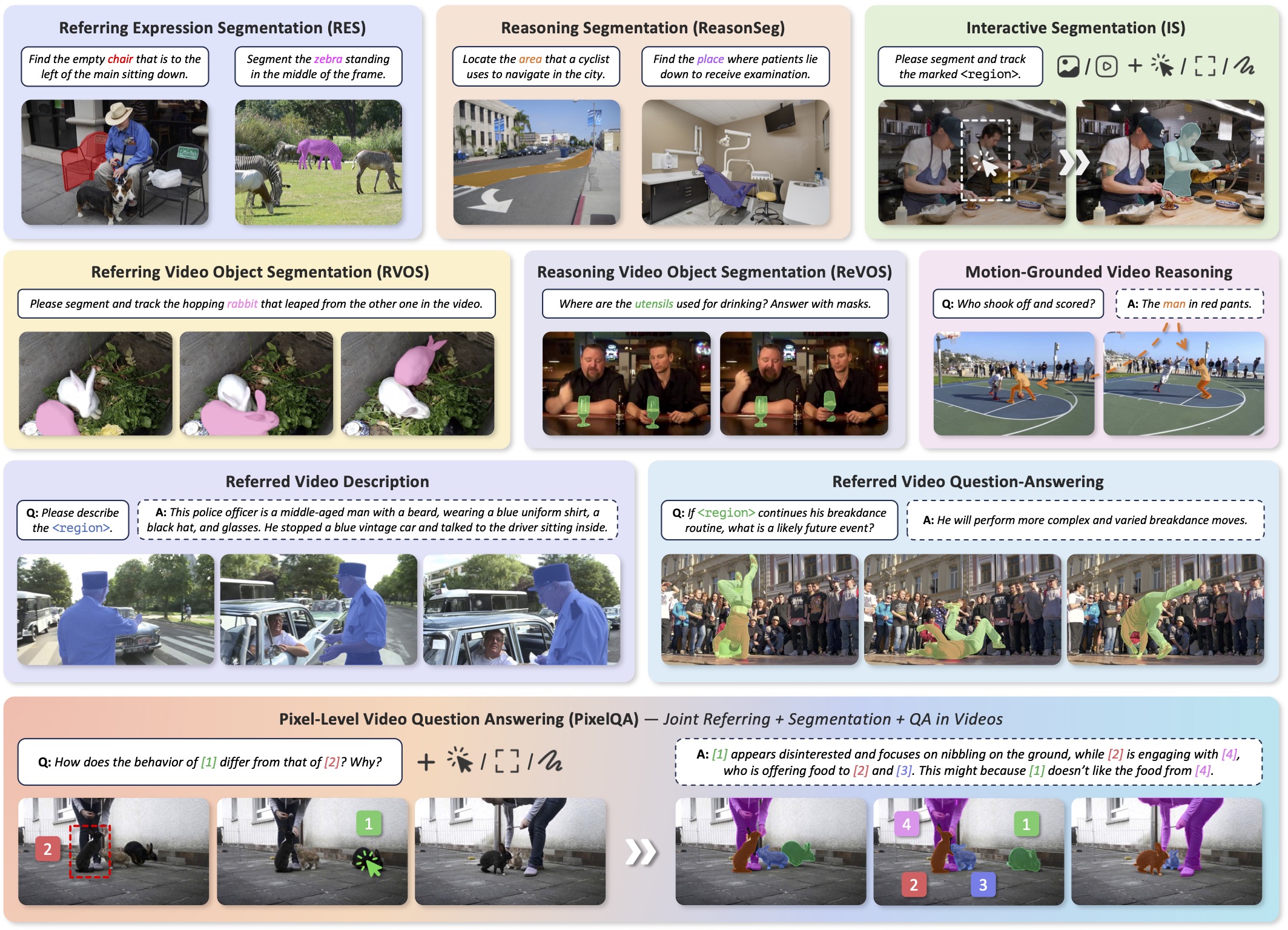
UniPixel is a unified MLLM for pixel-level vision-language understanding. It flexibly supports a variety of fine-grained tasks, including image/video segmentation, regional understanding, and a novel PixelQA task that jointly requires object-centric referring, segmentation, and question-answering in videos.
## 🔖 Model Details
- **Model type:** Multi-modal Large Language Model
- **Language(s):** English
- **License:** BSD-3-Clause
## 🚀 Quick Start
### Install the environment
1. Clone the repository from GitHub.
```shell
git clone https://github.com/PolyU-ChenLab/UniPixel.git
cd UniPixel
```
2. Setup the virtual environment.
```shell
conda create -n unipixel python=3.12 -y
conda activate unipixel
# you may modify 'cu128' to your own CUDA version
pip install torch==2.7.1 torchvision==0.22.1 --index-url https://download.pytorch.org/whl/cu128
# other versions have no been verified
pip install flash_attn==2.8.2 --no-build-isolation
```
3. Install dependencies.
```shell
pip install -r requirements.txt
```
For NPU users, please install the CPU version of PyTorch and [`torch_npu`](https://github.com/Ascend/pytorch) instead.
### Quick Inference Demo
Try our [online demo](https://huggingface.co/spaces/PolyU-ChenLab/UniPixel) or the [inference script](https://github.com/PolyU-ChenLab/UniPixel/blob/main/tools/inference.py) below. Please refer to our [GitHub Repository](https://github.com/PolyU-ChenLab/UniPixel) for more details.
```python
import imageio.v3 as iio
import nncore
from unipixel.dataset.utils import process_vision_info
from unipixel.model.builder import build_model
from unipixel.utils.io import load_image, load_video
from unipixel.utils.transforms import get_sam2_transform
from unipixel.utils.visualizer import draw_mask
media_path = ''
prompt = 'Please segment the...'
output_dir = 'outputs'
model, processor = build_model('PolyU-ChenLab/UniPixel-7B')
device = next(model.parameters()).device
sam2_transform = get_sam2_transform(model.config.sam2_image_size)
if any(media_path.endswith(k) for k in ('jpg', 'png')):
frames, images = load_image(media_path), [media_path]
else:
frames, images = load_video(media_path, sample_frames=16)
messages = [{
'role':
'user',
'content': [{
'type': 'video',
'video': images,
'min_pixels': 128 * 28 * 28,
'max_pixels': 256 * 28 * 28 * int(16 / len(images))
}, {
'type': 'text',
'text': prompt
}]
}]
text = processor.apply_chat_template(messages, add_generation_prompt=True)
images, videos, kwargs = process_vision_info(messages, return_video_kwargs=True)
data = processor(text=[text], images=images, videos=videos, return_tensors='pt', **kwargs)
data['frames'] = [sam2_transform(frames).to(model.sam2.dtype)]
data['frame_size'] = [frames.shape[1:3]]
output_ids = model.generate(
**data.to(device),
do_sample=False,
temperature=None,
top_k=None,
top_p=None,
repetition_penalty=None,
max_new_tokens=512)
assert data.input_ids.size(0) == output_ids.size(0) == 1
output_ids = output_ids[0, data.input_ids.size(1):]
if output_ids[-1] == processor.tokenizer.eos_token_id:
output_ids = output_ids[:-1]
response = processor.decode(output_ids, clean_up_tokenization_spaces=False)
print(f'Response: {response}')
if len(model.seg) >= 1:
imgs = draw_mask(frames, model.seg)
nncore.mkdir(output_dir)
path = nncore.join(output_dir, f"{nncore.pure_name(media_path)}.{'gif' if len(imgs) > 1 else 'png'}")
print(f'Output Path: {path}')
iio.imwrite(path, imgs, duration=100, loop=0)
```
## 📖 Citation
Please kindly cite our paper if you find this project helpful.
```
@inproceedings{liu2025unipixel,
title={UniPixel: Unified Object Referring and Segmentation for Pixel-Level Visual Reasoning},
author={Liu, Ye and Ma, Zongyang and Pu, Junfu and Qi, Zhongang and Wu, Yang and Ying, Shan and Chen, Chang Wen},
booktitle={Advances in Neural Information Processing Systems (NeurIPS)},
year={2025}
}
```



