
🤗 HuggingFace | 🤖 ModelScope | 📑 Research Paper | 📑 Blog | 🤗 Demo
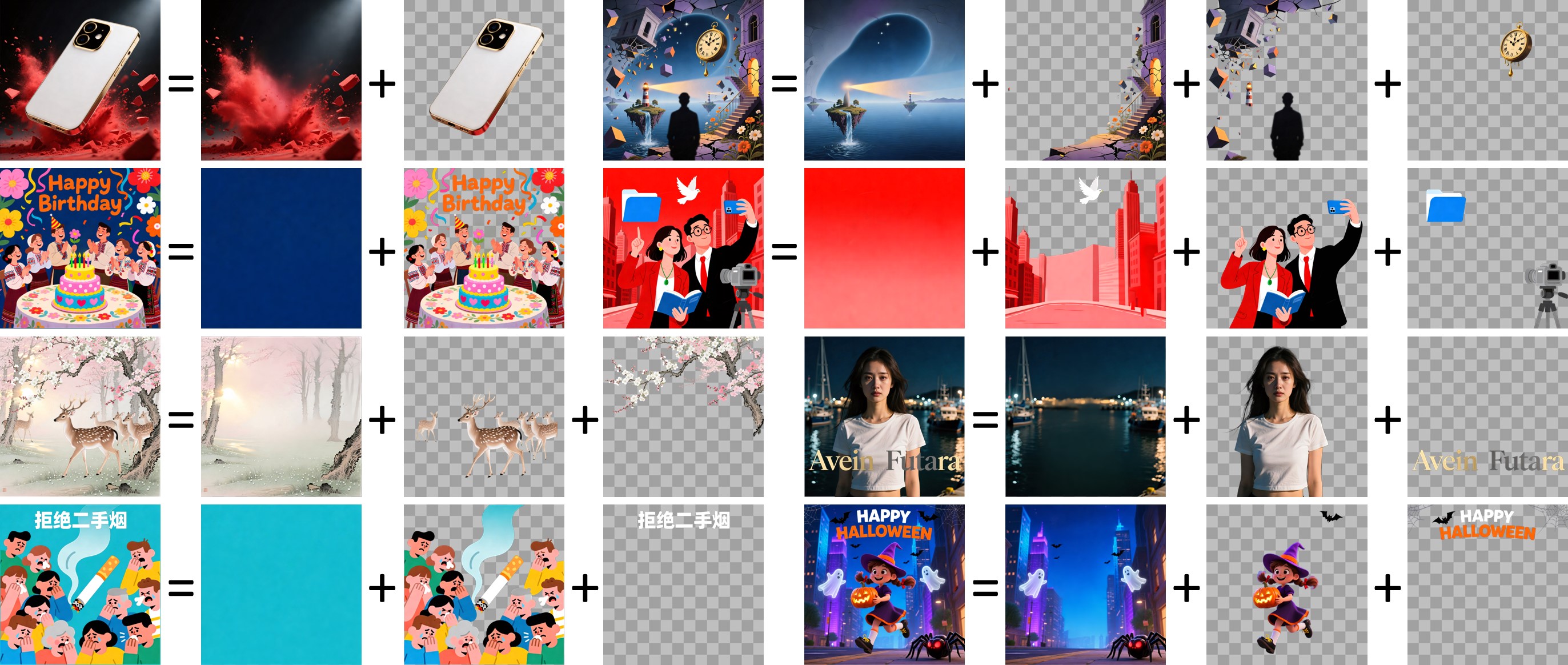
## Introduction We are excited to introduce **Qwen-Image-Layered**, a model capable of decomposing an image into multiple RGBA layers. This layered representation unlocks **inherent editability**: each layer can be independently manipulated without affecting other content. Meanwhile, such a layered representation naturally supports **high-fidelity elementary operations**-such as resizing, reposition, and recoloring. By physically isolating semantic or structural components into distinct layers, our approach enables high-fidelity and consistent editing. ## Quick Start 1. Make sure your transformers>=4.51.3 (Supporting Qwen2.5-VL) 2. Install the latest version of diffusers ``` pip install git+https://github.com/huggingface/diffusers pip install python-pptx ``` ```python from diffusers import QwenImageLayeredPipeline import torch from PIL import Image pipeline = QwenImageLayeredPipeline.from_pretrained("Qwen/Qwen-Image-Layered") pipeline = pipeline.to("cuda", torch.bfloat16) pipeline.set_progress_bar_config(disable=None) image = Image.open("asserts/test_images/1.png").convert("RGBA") inputs = { "image": image, "generator": torch.Generator(device='cuda').manual_seed(777), "true_cfg_scale": 4.0, "negative_prompt": " ", "num_inference_steps": 50, "num_images_per_prompt": 1, "layers": 4, "resolution": 640, # Using different bucket (640, 1024) to determine the resolution. For this version, 640 is recommended "cfg_normalize": True, # Whether enable cfg normalization. "use_en_prompt": True, # Automatic caption language if user does not provide caption } with torch.inference_mode(): output = pipeline(**inputs) output_image = output.images[0] for i, image in enumerate(output_image): image.save(f"{i}.png") ``` ## Showcase ### Layered Decomposition in Application Given an image, Qwen-Image-Layered can decompose it into several RGBA layers: 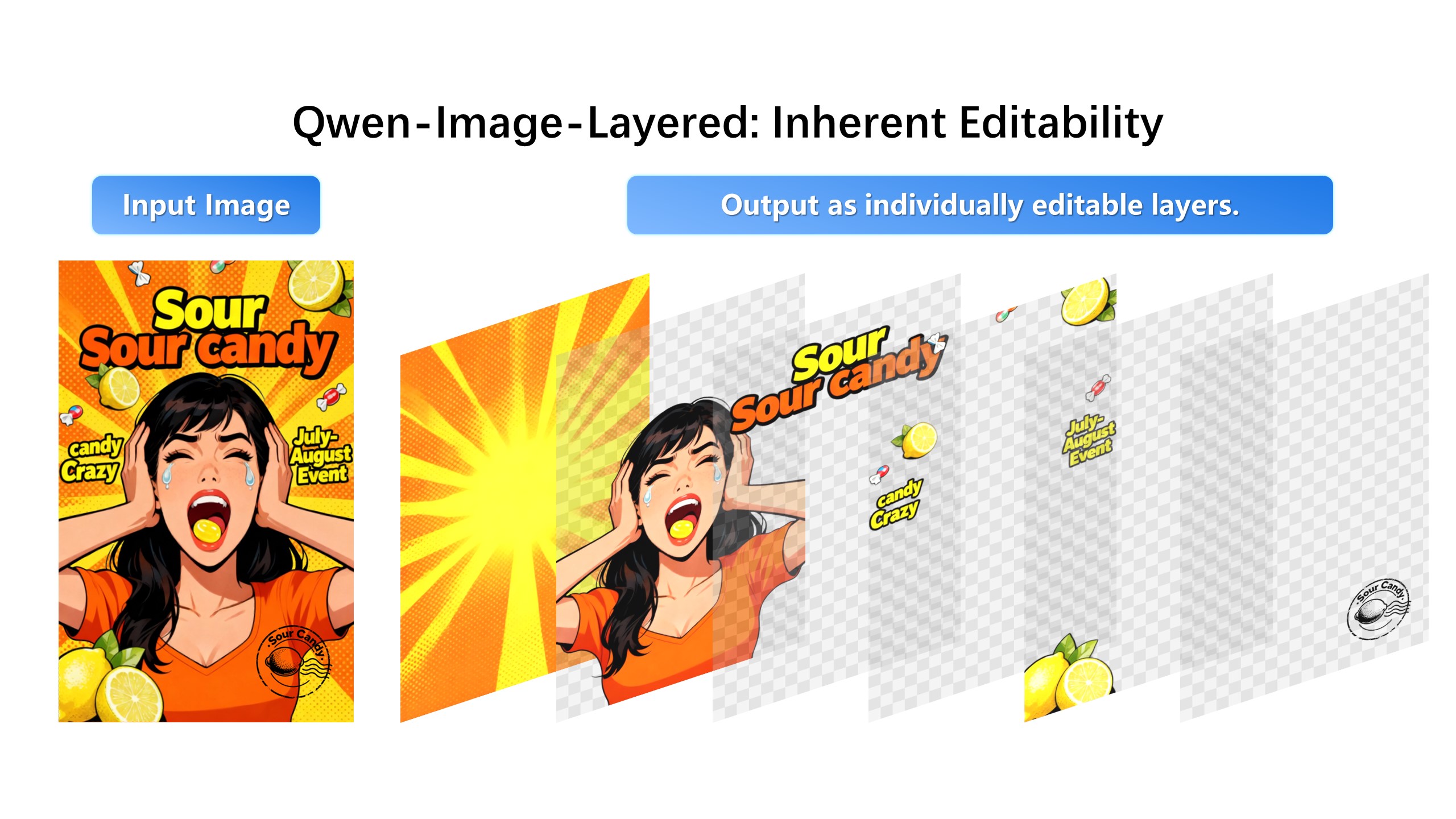 After decomposition, edits are applied exclusively to the target layer, physically isolating it from the rest of the content, and thereby fundamentally ensuring consistency across edits. For example, we can recolor the first layer and keep all other content untouched: 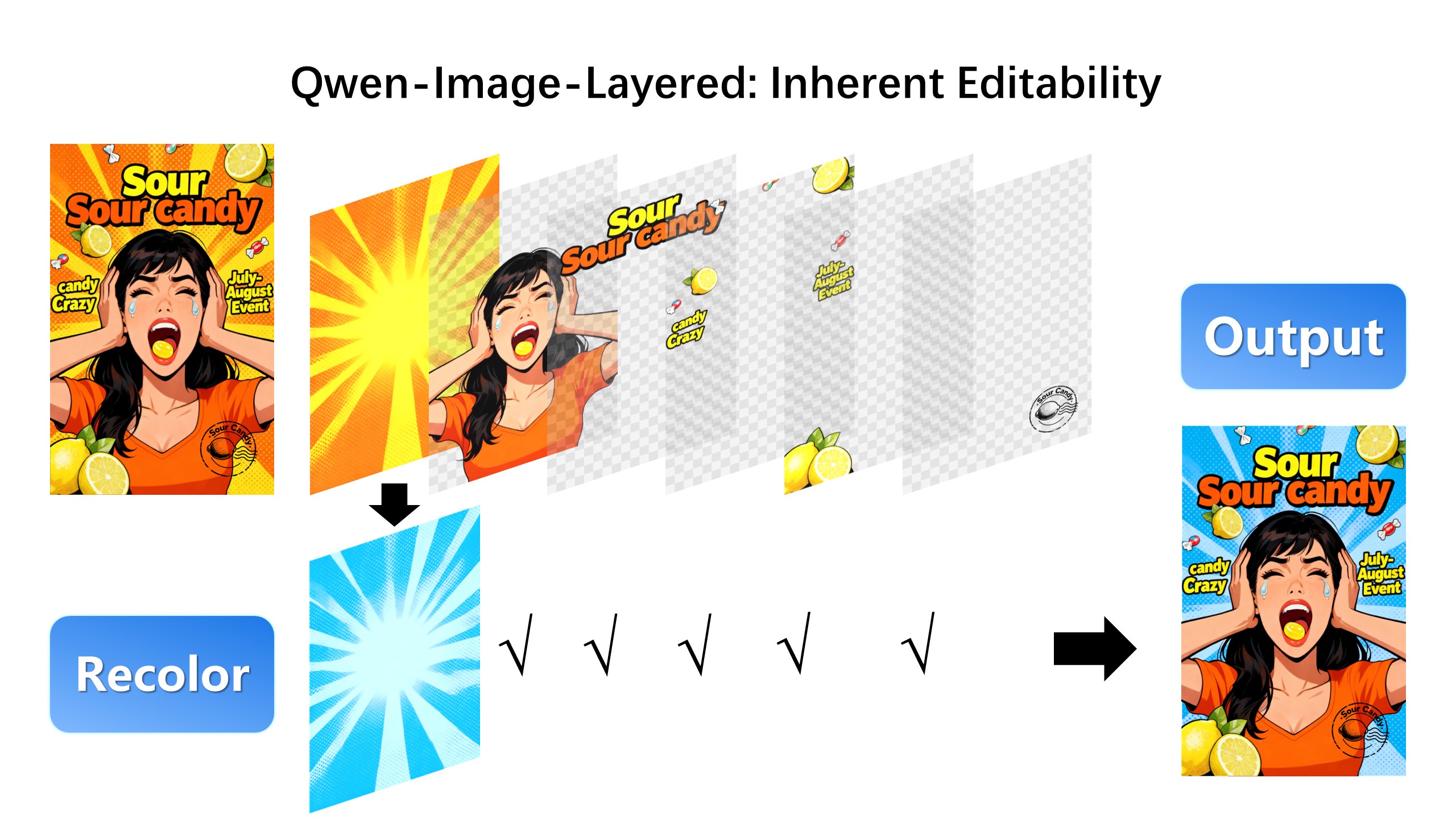 We can also replace the second layer from a girl to a boy (The target layer is edited using Qwen-Image-Edit): 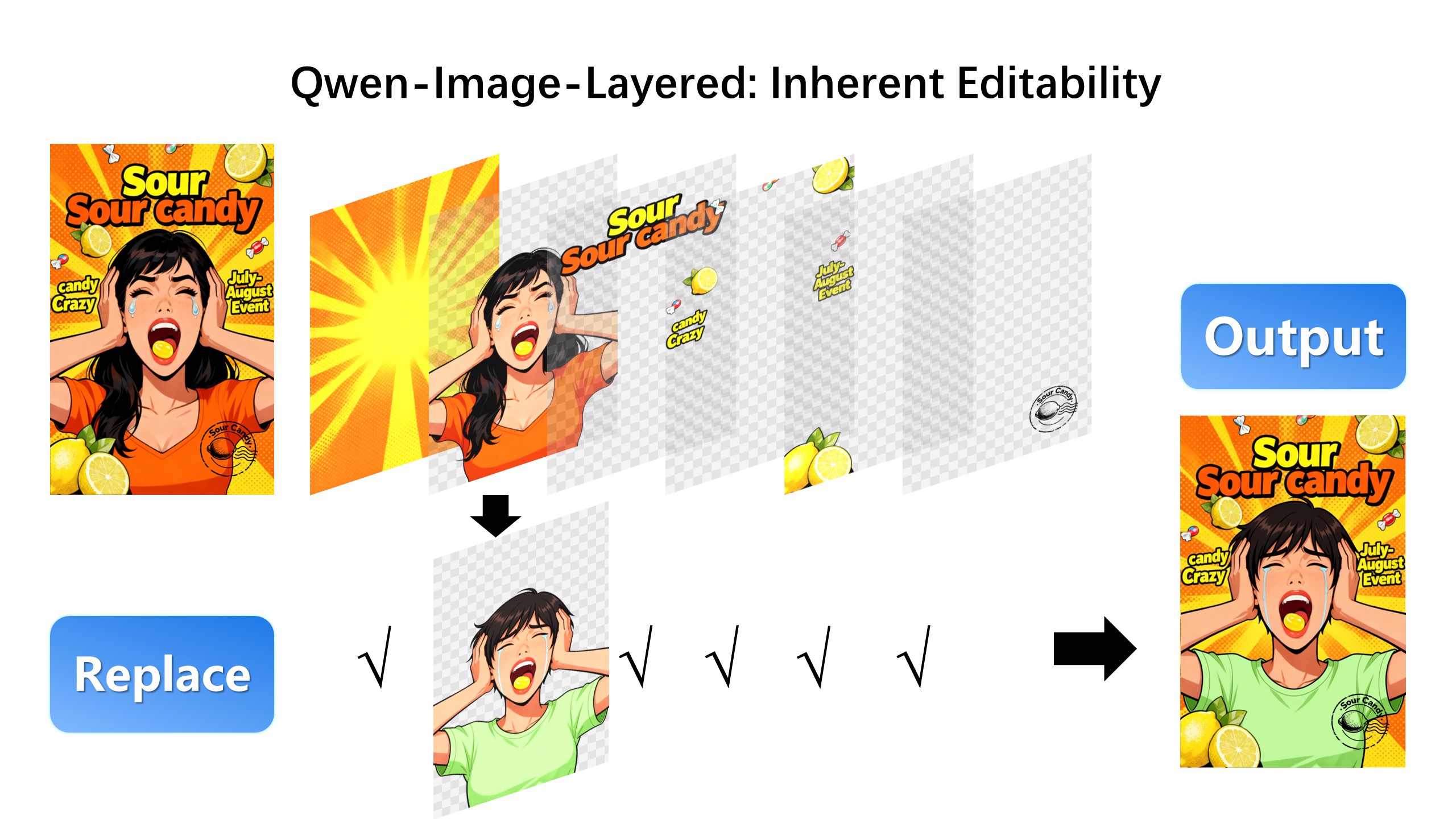 Here, we revise the text to "Qwen-Image" (The target layer is edited using Qwen-Image-Edit): 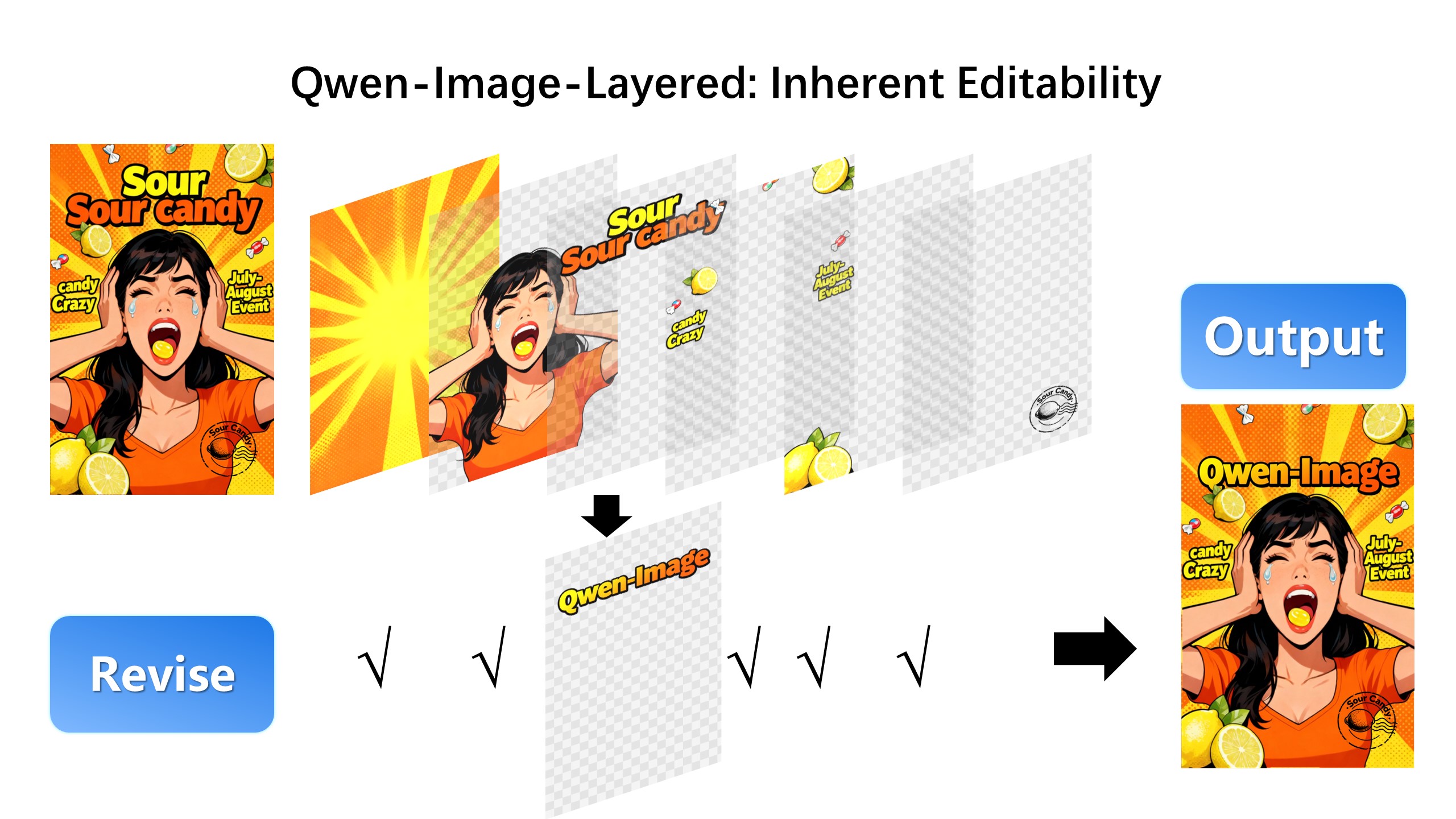 Furthermore, the layered structure naturally supports elemetary operations. For example, we can delete unwanted objects cleanly: 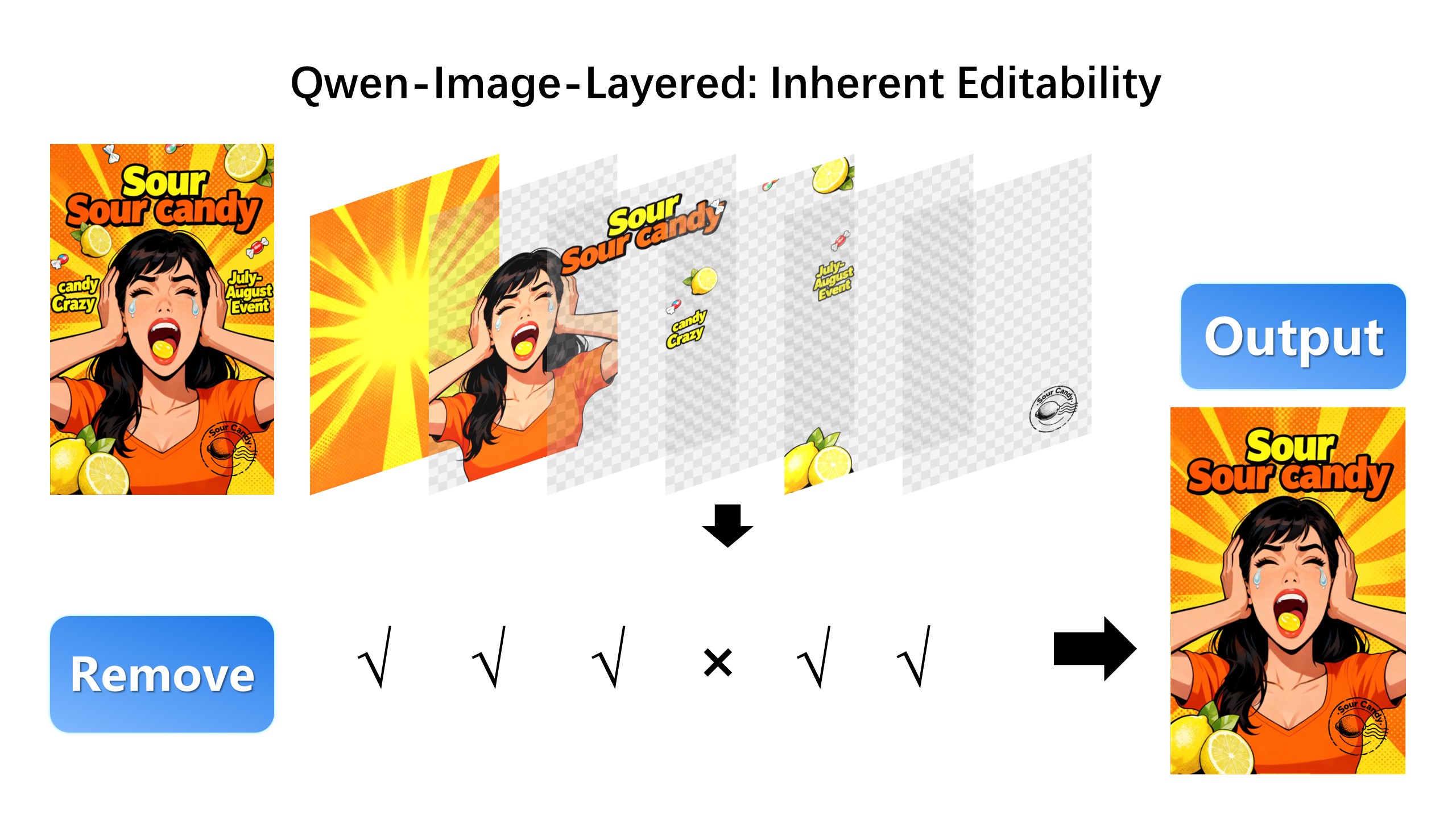 We can also resize an object without distortion: 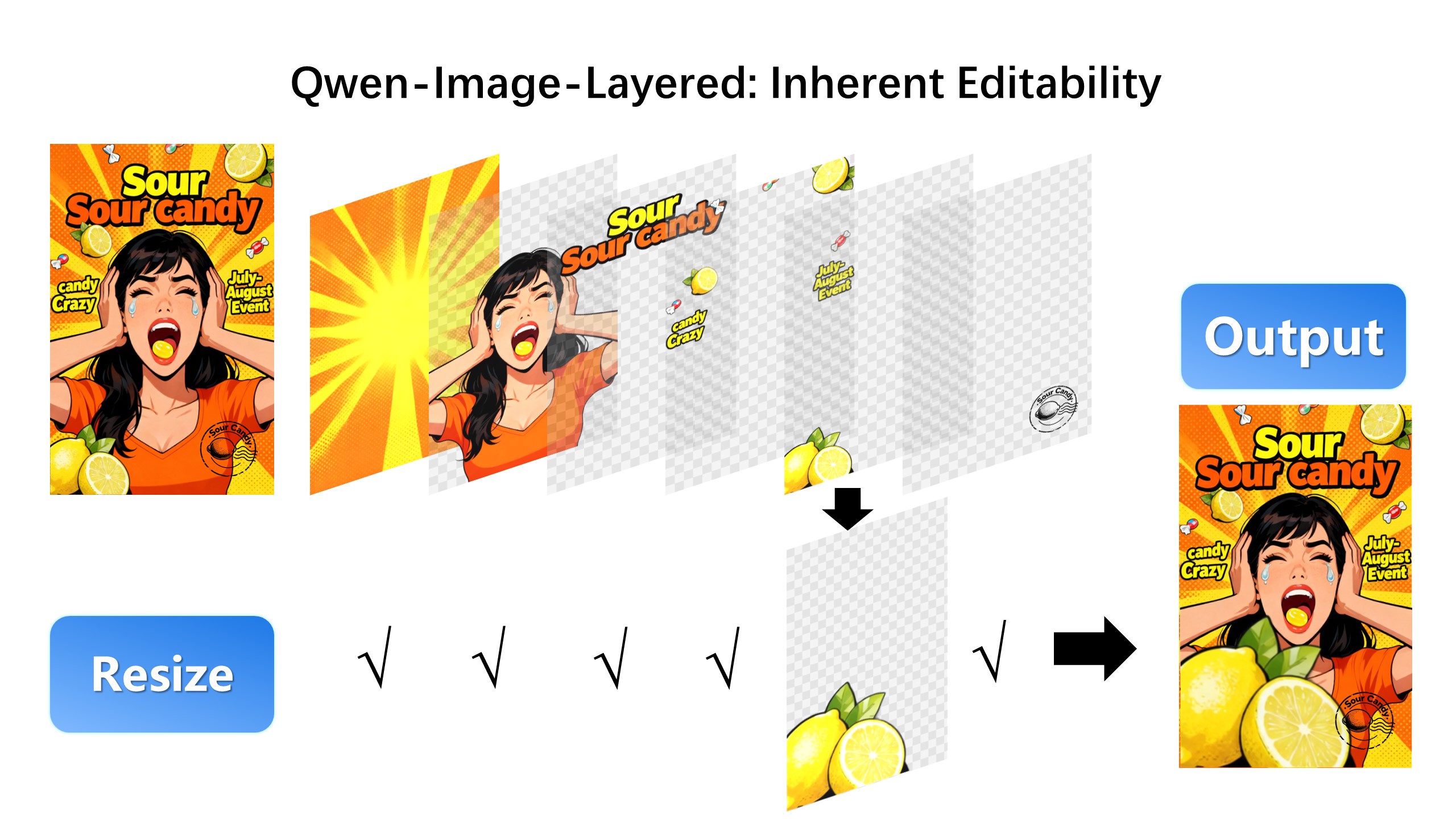 After layer decomposition, we can move objects freely within the canvas: 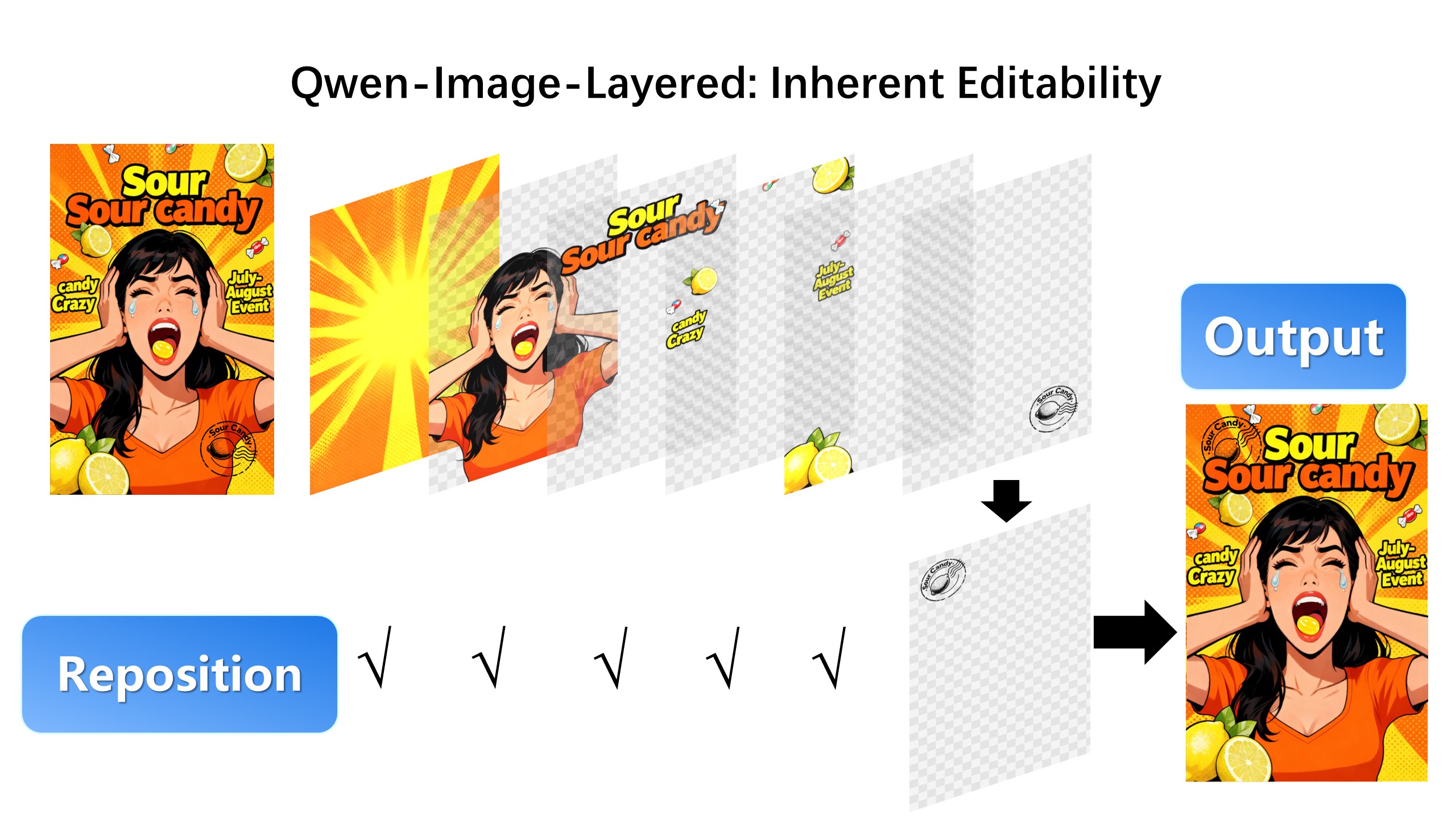 ### Flexible and Iterative Decomposition Qwen-Image-Layered is not limited to a fixed number of layers. The model supports variable-layer decomposition. For example, we can decompose an image into either 3 or 8 layers as needed: 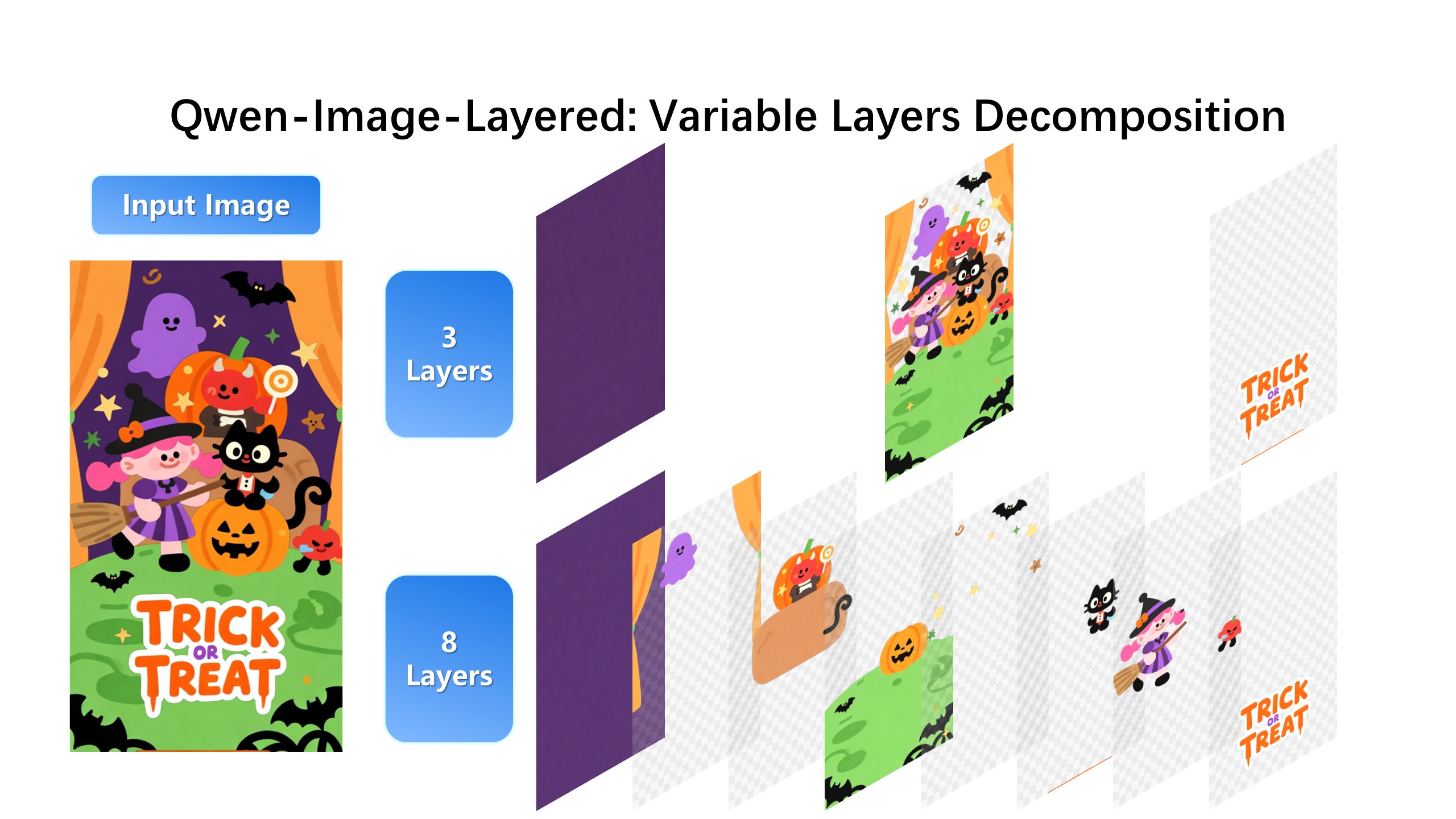 Moreover, decomposition can be applied recursively: any layer can itself be further decomposed, enabling infinite decomposition. 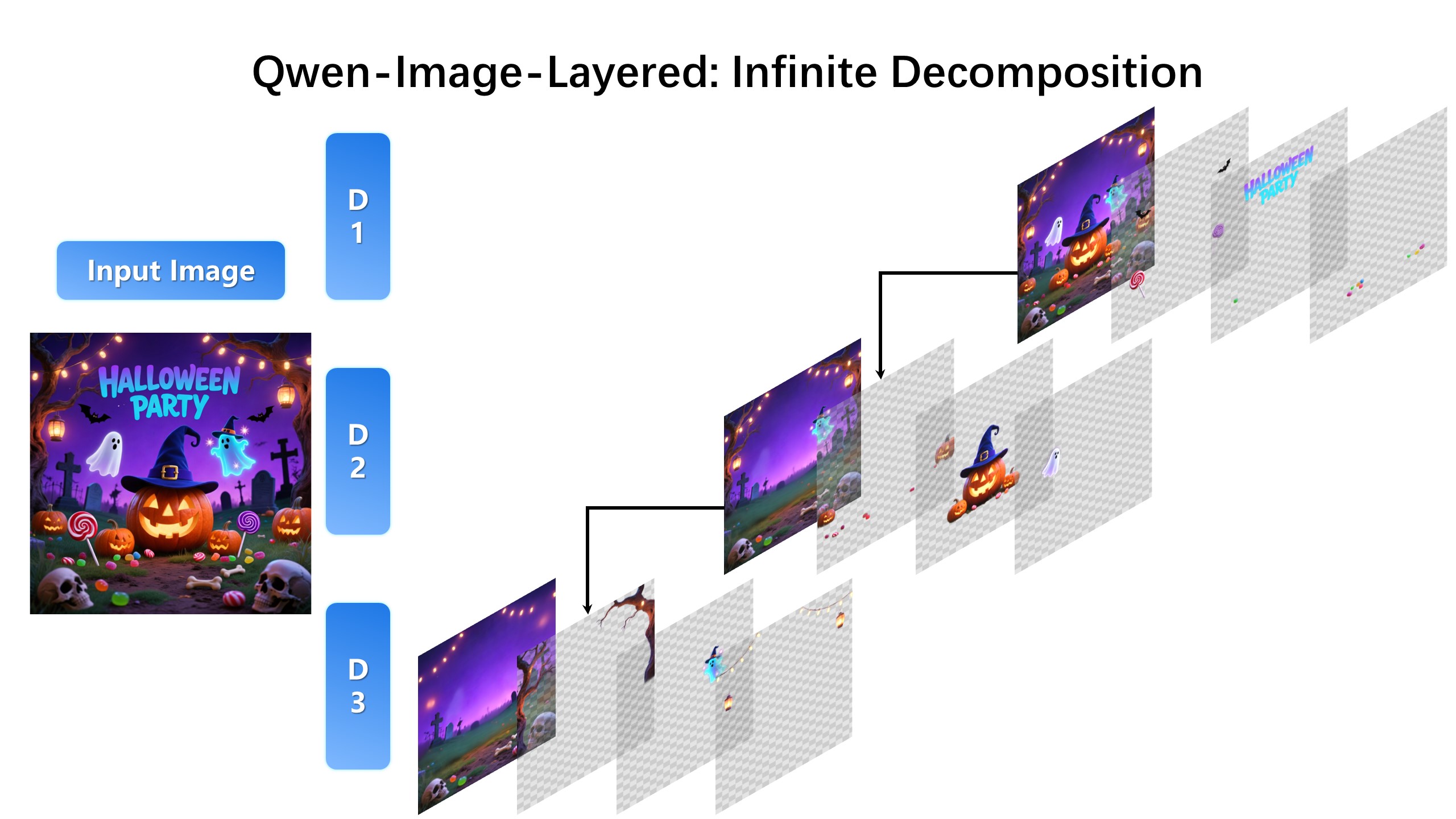 ## License Agreement Qwen-Image-Layered is licensed under Apache 2.0. ## Citation We kindly encourage citation of our work if you find it useful. ```bibtex @misc{yin2025qwenimagelayered, title={Qwen-Image-Layered: Towards Inherent Editability via Layer Decomposition}, author={Shengming Yin, Zekai Zhang, Zecheng Tang, Kaiyuan Gao, Xiao Xu, Kun Yan, Jiahao Li, Yilei Chen, Yuxiang Chen, Heung-Yeung Shum, Lionel M. Ni, Jingren Zhou, Junyang Lin, Chenfei Wu}, year={2025}, eprint={2512.15603}, archivePrefix={arXiv}, primaryClass={cs.CV}, url={https://arxiv.org/abs/2512.15603}, } ```