--- license: mit library_name: mlx tags: - computer-vision - image-classification - chess - cnn - lightweight datasets: - synthetic-chess-squares model-index: - name: chess-cv results: - task: type: image-classification name: Image Classification dataset: name: Chess CV Test Dataset type: chess-cv-test metrics: - type: accuracy value: 0.9990 name: Accuracy verified: false - type: f1 value: 0.9990 name: F1 Score (Macro) verified: false - task: type: image-classification name: Image Classification dataset: name: Chess CV OpenBoard Dataset type: chess-cv-openboard metrics: - type: accuracy value: 0.9930 name: Accuracy verified: false - type: f1 value: 0.9856 name: F1 Score (Macro) verified: false - task: type: image-classification name: Image Classification dataset: name: Chess CV ChessVision Dataset type: chess-cv-chessvision metrics: - type: accuracy value: 0.9313 name: Accuracy verified: false - type: f1 value: 0.9228 name: F1 Score (Macro) verified: false - name: chess-cv-arrows results: - task: type: image-classification name: Image Classification dataset: name: Chess CV Arrows Test Dataset type: chess-cv-arrows-test metrics: - type: accuracy value: 0.9999 name: Accuracy verified: false - type: f1 value: 0.9999 name: F1 Score (Macro) verified: false - name: chess-cv-snap results: - task: type: image-classification name: Image Classification dataset: name: Chess CV Snap Test Dataset type: chess-cv-snap-test metrics: - type: accuracy value: 0.9993 name: Accuracy verified: false - type: f1 value: 0.9993 name: F1 Score (Macro) verified: false pipeline_tag: image-classification ---
# Chess CV Model Architecture
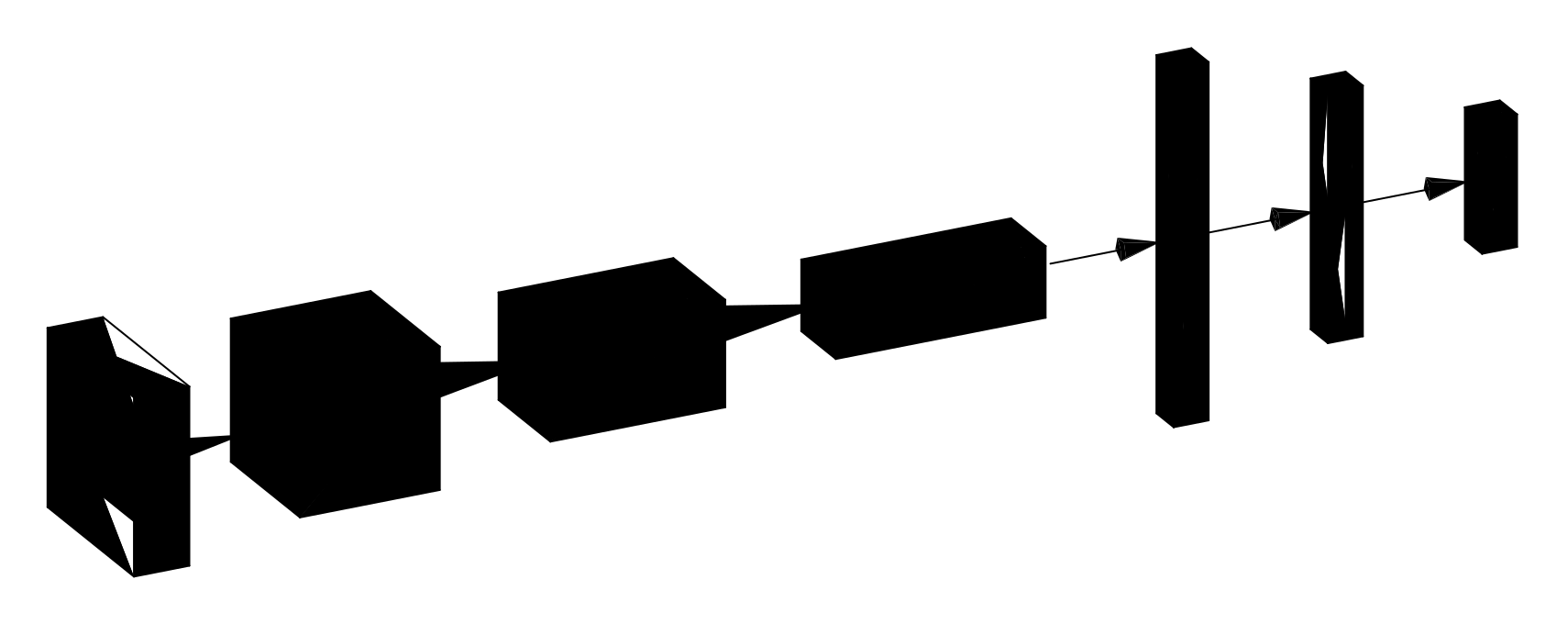
Lightweight CNNs (156k parameters each) for chess board analysis from 32×32 pixel square images. The project includes three specialized models trained on synthetic data from chess.com/lichess boards, piece sets, arrow overlays, and centering variations: - **Pieces Model**: Classifies 13 classes (6 white pieces, 6 black pieces, empty squares) for board state recognition and FEN generation - **Arrows Model**: Classifies 49 classes representing arrow overlay patterns for detecting chess analysis annotations - **Snap Model**: Classifies 2 classes (centered vs off-centered pieces) for automated board analysis and piece positioning validation ## Quick Start ```bash pip install chess-cv ``` ```python from chess_cv import load_bundled_model # Load pre-trained models (weights included in package) pieces_model = load_bundled_model('pieces') arrows_model = load_bundled_model('arrows') snap_model = load_bundled_model('snap') # Make predictions piece_predictions = pieces_model(image_tensor) arrow_predictions = arrows_model(image_tensor) snap_predictions = snap_model(image_tensor) ``` **Alternative: Load latest version from Hugging Face Hub** ```python from huggingface_hub import hf_hub_download from chess_cv.model import SimpleCNN import mlx.core as mx # Download latest weights from Hugging Face model_path = hf_hub_download(repo_id="S1M0N38/chess-cv", filename="pieces.safetensors") model = SimpleCNN(num_classes=13) weights = mx.load(str(model_path)) model.load_weights(list(weights.items())) model.eval() ``` ## Models This repository contains three specialized models for chess board analysis: ### ♟️ Pieces Model (`pieces.safetensors`) **Overview:** The pieces model classifies chess square images into 13 classes: 6 white pieces (wP, wN, wB, wR, wQ, wK), 6 black pieces (bP, bN, bB, bR, bQ, bK), and empty squares (xx). This model is designed for board state recognition and FEN generation from chess board images. **Training:** - **Architecture**: SimpleCNN (156k parameters) - **Input**: 32×32px RGB square images - **Data**: ~93,000 synthetic images from 55 board styles × 64 piece sets - **Augmentation**: Aggressive augmentation with arrow overlays (80%), highlight overlays (25%), move overlays (50%), random crops, horizontal flips, color jitter, rotation (±10°), and Gaussian noise - **Optimizer**: AdamW (weight_decay=0.001) with LR scheduler (warmup + cosine decay: 0→0.001→1e-5) - **Training**: 1000 epochs, batch size 64 **Performance:** | Dataset | Accuracy | F1-Score (Macro) | | ----------------------------------------------------------------------------------------------- | :------: | :--------------: | | Test Data | 99.90% | 99.90% | | [S1M0N38/chess-cv-openboard](https://huggingface.co/datasets/S1M0N38/chess-cv-openboard) \* | - | 98.56% | | [S1M0N38/chess-cv-chessvision](https://huggingface.co/datasets/S1M0N38/chess-cv-chessvision) \* | - | 92.28% | \* *Dataset with unbalanced class distribution (e.g. many more samples for empty square class), so accuracy is not representative.* --- ### ↗ Arrows Model (`arrows.safetensors`) **Overview:** The arrows model classifies chess square images into 49 classes representing different arrow overlay patterns: 20 arrow heads, 12 arrow tails, 8 middle segments (for straight and diagonal arrows), 4 corner pieces (for knight-move arrows), and empty squares (xx). This model enables detection and reconstruction of arrow annotations commonly used in chess analysis interfaces. The NSEW naming convention (North/South/East/West) indicates arrow orientation and direction. **Training:** - **Architecture**: SimpleCNN (156k parameters, same as pieces model) - **Input**: 32×32px RGB square images - **Data**: ~4.5M synthetic images from 55 board styles × arrow overlays (~3.14M train, ~672K val, ~672K test) - **Augmentation**: Conservative augmentation with highlight overlays (25%), move overlays (50%), random crops, and minimal color jitter/noise. No horizontal flips to preserve arrow directionality - **Optimizer**: AdamW (lr=0.0005, weight_decay=0.00005) - **Training**: 20 epochs, batch size 128 **Performance:** | Dataset | Accuracy | F1-Score (Macro) | | --------------------- | -------- | ---------------- | | Test Data (synthetic) | 99.99% | 99.99% | The arrows model is optimized for detecting directional annotations while maintaining spatial consistency across the board. **Limitation:** Classification accuracy degrades when multiple arrow components overlap in a single square. --- ### 📐 Snap Model (`snap.safetensors`) **Overview:** The snap model classifies chess square images into 2 classes: centered ("ok") and off-centered ("bad") pieces. This model is designed for automated board analysis and piece positioning validation, helping ensure proper piece placement in digital chess interfaces and automated analysis systems. **Training:** - **Architecture**: SimpleCNN (156k parameters) - **Input**: 32×32px RGB square images - **Data**: ~1.4M synthetic images from centered and off-centered piece positions (~985,960 train, ~211,574 validate, ~210,466 test) - **Augmentation**: Conservative augmentation with arrow overlays (50%), highlight overlays (20%), move overlays (50%), mouse overlays (80%), horizontal flips (50%), color jitter, and Gaussian noise. No rotation or geometric transformations to preserve centering semantics - **Optimizer**: AdamW (weight_decay=0.001) with LR scheduler (warmup + cosine decay: 0→0.001→1e-5) - **Training**: 200 epochs, batch size 64 **Performance:** | Dataset | Accuracy | F1-Score (Macro) | | --------------------- | :------: | :--------------: | | Test Data (synthetic) | 99.93% | 99.93% | The snap model is optimized for detecting piece centering issues while maintaining robustness to various board styles and visual conditions. **Use Cases:** - Automated board state validation - Piece positioning quality control - Chess interface usability testing - Digital chess board quality assurance ## Training Your Own Model To train or evaluate a model yourself: ```bash git clone https://github.com/S1M0N38/chess-cv.git cd chess-cv uv sync --all-extras # Generate training data for a specific model chess-cv preprocessing pieces # or 'arrows' or 'snap' # Train model chess-cv train pieces # or 'arrows' or 'snap' # Evaluate model chess-cv test pieces # or 'arrows' or 'snap' ``` See the [Setup Guide](https://s1m0n38.github.io/chess-cv/setup/) and [Train and Evaluate](https://s1m0n38.github.io/chess-cv/train-and-eval/) for detailed instructions on data generation, training configuration, and evaluation. ## Limitations - Requires precisely cropped 32×32 pixel square images (no board detection) - Trained on synthetic data; may not generalize to real-world photos - Not suitable for non-standard piece designs - Optimized for Apple Silicon (slower on CPU) For detailed documentation, architecture details, and advanced usage, see the [full documentation](https://s1m0n38.github.io/chess-cv/). ## Citation ```bibtex @software{bertolotto2025chesscv, author = {Bertolotto, Simone}, title = {{Chess CV}}, url = {https://github.com/S1M0N38/chess-cv}, year = {2025} } ```
**Repo:** [github.com/S1M0N38/chess-cv](https://github.com/S1M0N38/chess-cv) • **PyPI:** [pypi.org/project/chess-cv](https://pypi.org/project/chess-cv/)