

Upload folder using huggingface_hub
Browse files
README.md
CHANGED
|
@@ -26,16 +26,14 @@ base_model_relation: adapter
|
|
| 26 |
|
| 27 |
# Steppe for FLUX.2 VAE latents
|
| 28 |
|
| 29 |
-
|
| 30 |
|
| 31 |
> ### 🧩 ComfyUI nodes: [ComfyUI-Steppe](https://github.com/TensorForger/ComfyUI-Steppe)
|
| 32 |
> Available in **ComfyUI-Manager**: search for "Steppe" and install (or `comfy node install steppe`).
|
| 33 |
-
> The nodes download these models on first use.
|
| 34 |
>
|
| 35 |
> [](https://github.com/TensorForger/ComfyUI-Steppe)
|
| 36 |
|
| 37 |
-
<!-- TODO: FLUX.2 support needs ComfyUI-Steppe 1.1.0 (branch flux2-support, not released yet); publish this card after the node release. -->
|
| 38 |
-
|
| 39 |
**Steppe** is a family of *generative latent upscalers*: small generative models trained only for upscaling,
|
| 40 |
which run directly on VAE latents. The upscaled latent is **decoded straight by the VAE**: no second sampling pass of
|
| 41 |
the base model, no hires fix, no prompt.
|
|
@@ -63,6 +61,18 @@ Select a `steppe_flux_2_*` model in **Load Steppe Upscaler** (the same loader li
|
|
| 63 |
|
| 64 |
To install the models manually, put the files into `ComfyUI/models/latent_upscale_models`.
|
| 65 |
|
|
|
|
|
|
|
|
|
|
|
|
|
|
|
|
|
|
|
|
|
|
|
|
|
|
|
|
|
|
|
|
|
|
|
|
|
| 66 |
## Files
|
| 67 |
|
| 68 |
| file | steps | parameters | use |
|
|
@@ -80,11 +90,13 @@ repository (versions, recommended settings).
|
|
| 80 |
|---|---|---|
|
| 81 |
| FLUX.2 [dev] | FLUX.2 VAE | native |
|
| 82 |
| FLUX.2 [klein] 4B / 9B (distilled and base) | FLUX.2 VAE | native |
|
| 83 |
-
| MOSS-Image | FLUX.2 VAE (small decoder) | native
|
| 84 |
| FLUX.2 small decoder, TAEF2 (madebyollin/taef2) | FLUX.2 VAE decoders | works, TAEF2 benchmarked |
|
| 85 |
| FLUX.1, Wan, Qwen-Image, SD3, SDXL, … | other VAEs | **not supported** here (Wan 2.1 VAE: [Steppe-Wan2.1](https://huggingface.co/TensorForger/Steppe-Wan2.1)) |
|
| 86 |
|
| 87 |
-
|
|
|
|
|
|
|
| 88 |
|
| 89 |
## Settings
|
| 90 |
|
|
@@ -98,6 +110,8 @@ repository (versions, recommended settings).
|
|
| 98 |
|
| 99 |
## Benchmark
|
| 100 |
|
|
|
|
|
|
|
| 101 |
1000 photos (Axis-V1), 512 → 1024. Every solution gets only the FLUX.2 latent (no prompt, no hff). Patch FID on native
|
| 102 |
256 px tiles (lower is better); latency at batch 1, VAE decode included, RTX 5090, eager bfloat16.
|
| 103 |
|
|
@@ -113,14 +127,11 @@ repository (versions, recommended settings).
|
|
| 113 |
| SesquiLSR FLUX.2 (latent, made for hires fix) | 7.71 | 7.26 | 124 ms | 2.6 GB |
|
| 114 |
| bicubic after decode | 8.12 | 1.77 | 25 ms | 0.8 GB |
|
| 115 |
| Real-ESRGAN x2 after decode | 9.03 | 7.99 | 53 ms | 0.8 GB |
|
| 116 |
-
| VOSR 1.4B (one step diffusion SR) | 25.88 | 15.83 | 595 ms | 9.2 GB |
|
| 117 |
|
| 118 |
The VAE reconstruction limit on this set is patch FID 0.71. Steppe stays close to the input: roundtrip color error
|
| 119 |
ΔE00 1.82 (bicubic 1.74). A FLUX.2 [klein] 9B LoRA upscaler (Hildegard, 4 steps, ~7 s per image) was compared on 30
|
| 120 |
images: it adds plausible detail but moves away from the input (ΔE00 3.8 at best vs 2.2 for Steppe on the same images).
|
| 121 |
|
| 122 |
-
<!-- TODO stage 4: benchmark plot + crops (raw_results/flux_upscale_benchmark_axis_v1_1k/latency_vs_patch_fid.png). -->
|
| 123 |
-
|
| 124 |
Benchmark images: [Axis-V1](https://huggingface.co/datasets/refine-axis/axis-v1_1k) by refine-axis (CC BY 4.0), cropped.
|
| 125 |
|
| 126 |
## Python
|
|
@@ -138,7 +149,9 @@ upscaler.model.to("cuda")
|
|
| 138 |
# FLUX.2 latents as ComfyUI and the diffusers FLUX.2 pipelines use them: 2x2 packed and batch norm normalized,
|
| 139 |
# [B, 128, H / 16, W / 16]. From a bare AutoencoderKLFlux2: patchify the 32 channel latent 2x2 (channel order
|
| 140 |
# C, 2, 2) and normalize it with vae.bn.running_mean / sqrt(vae.bn.running_var + 1e-4).
|
| 141 |
-
upscaled = upscaler.upscale(
|
|
|
|
|
|
|
| 142 |
```
|
| 143 |
|
| 144 |
## How it works
|
|
|
|
| 26 |
|
| 27 |
# Steppe for FLUX.2 VAE latents
|
| 28 |
|
| 29 |
+
[](https://raw.githubusercontent.com/tensorforger/tensorforger/main/assets/steppe_flux2/flux2_compare_cat.png)
|
| 30 |
|
| 31 |
> ### 🧩 ComfyUI nodes: [ComfyUI-Steppe](https://github.com/TensorForger/ComfyUI-Steppe)
|
| 32 |
> Available in **ComfyUI-Manager**: search for "Steppe" and install (or `comfy node install steppe`).
|
| 33 |
+
> FLUX.2 support needs version 1.1.0 or newer. The nodes download these models on first use.
|
| 34 |
>
|
| 35 |
> [](https://github.com/TensorForger/ComfyUI-Steppe)
|
| 36 |
|
|
|
|
|
|
|
| 37 |
**Steppe** is a family of *generative latent upscalers*: small generative models trained only for upscaling,
|
| 38 |
which run directly on VAE latents. The upscaled latent is **decoded straight by the VAE**: no second sampling pass of
|
| 39 |
the base model, no hires fix, no prompt.
|
|
|
|
| 61 |
|
| 62 |
To install the models manually, put the files into `ComfyUI/models/latent_upscale_models`.
|
| 63 |
|
| 64 |
+
## Gallery
|
| 65 |
+
|
| 66 |
+
[](https://raw.githubusercontent.com/tensorforger/tensorforger/main/assets/steppe_flux2/flux2_compare_neon.png)
|
| 67 |
+
|
| 68 |
+
[](https://raw.githubusercontent.com/tensorforger/tensorforger/main/assets/steppe_flux2/flux2_compare_gulls.png)
|
| 69 |
+
|
| 70 |
+
[](https://raw.githubusercontent.com/tensorforger/tensorforger/main/assets/steppe_flux2/flux2_compare_food.png)
|
| 71 |
+
|
| 72 |
+
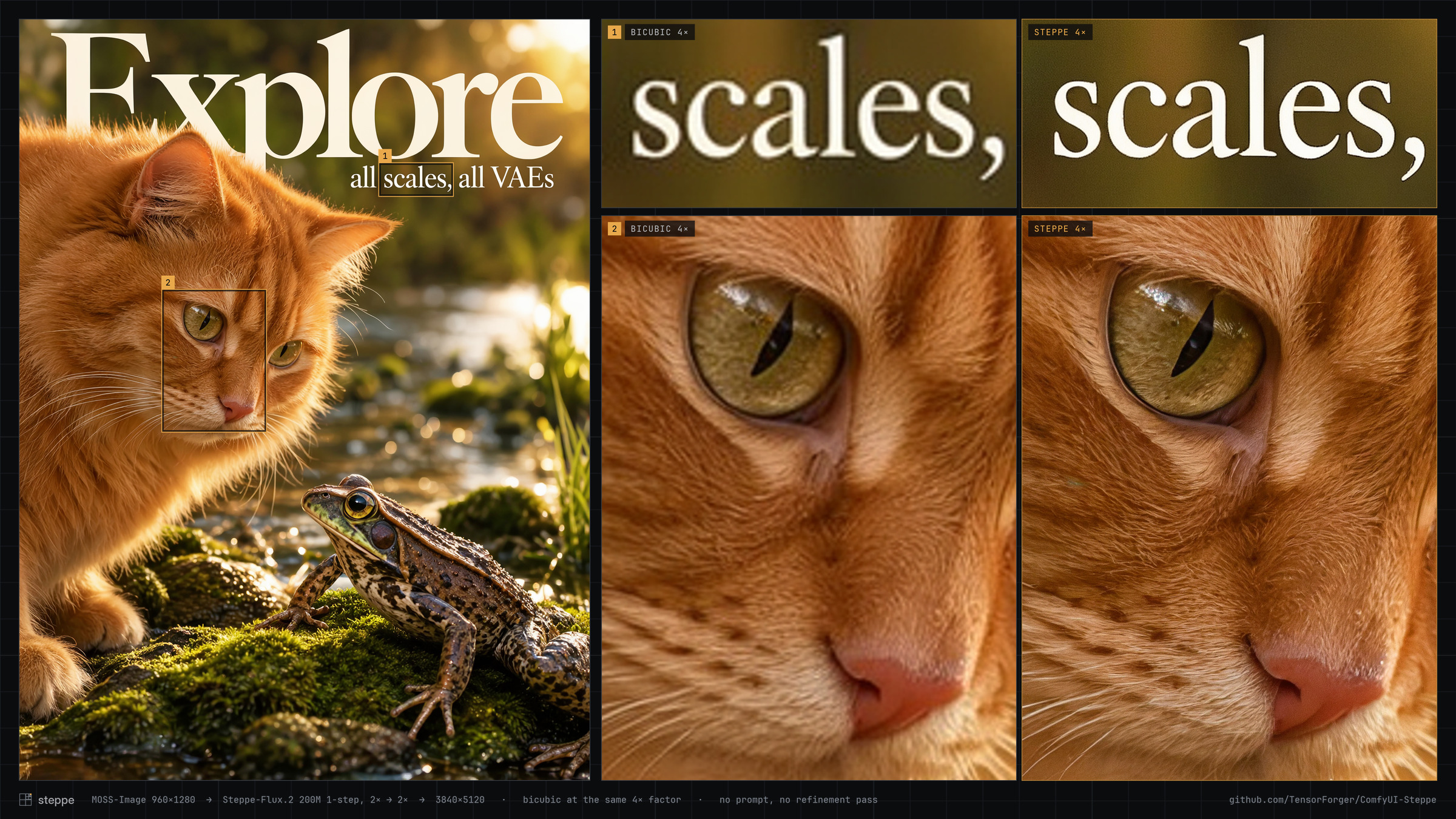
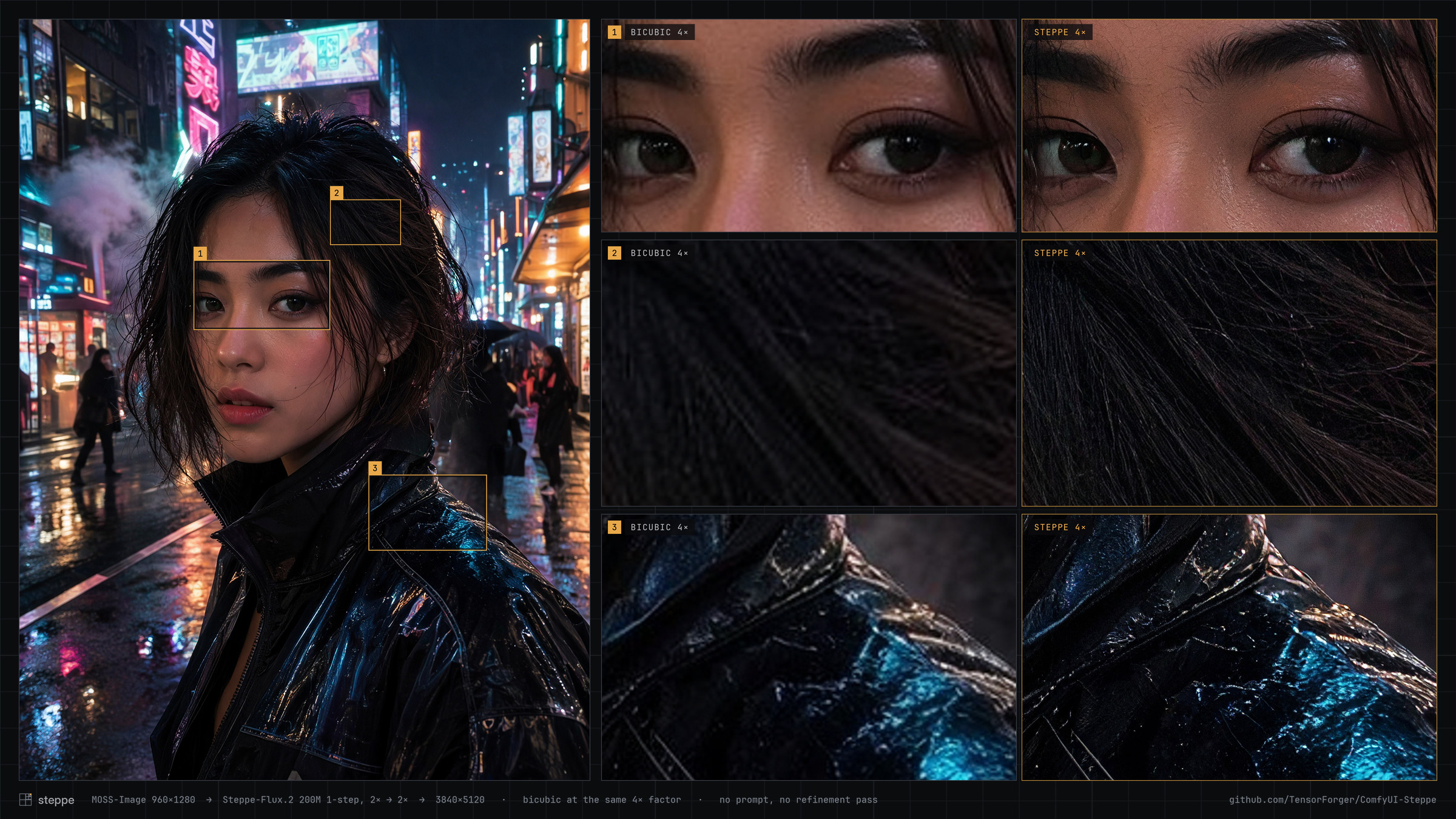
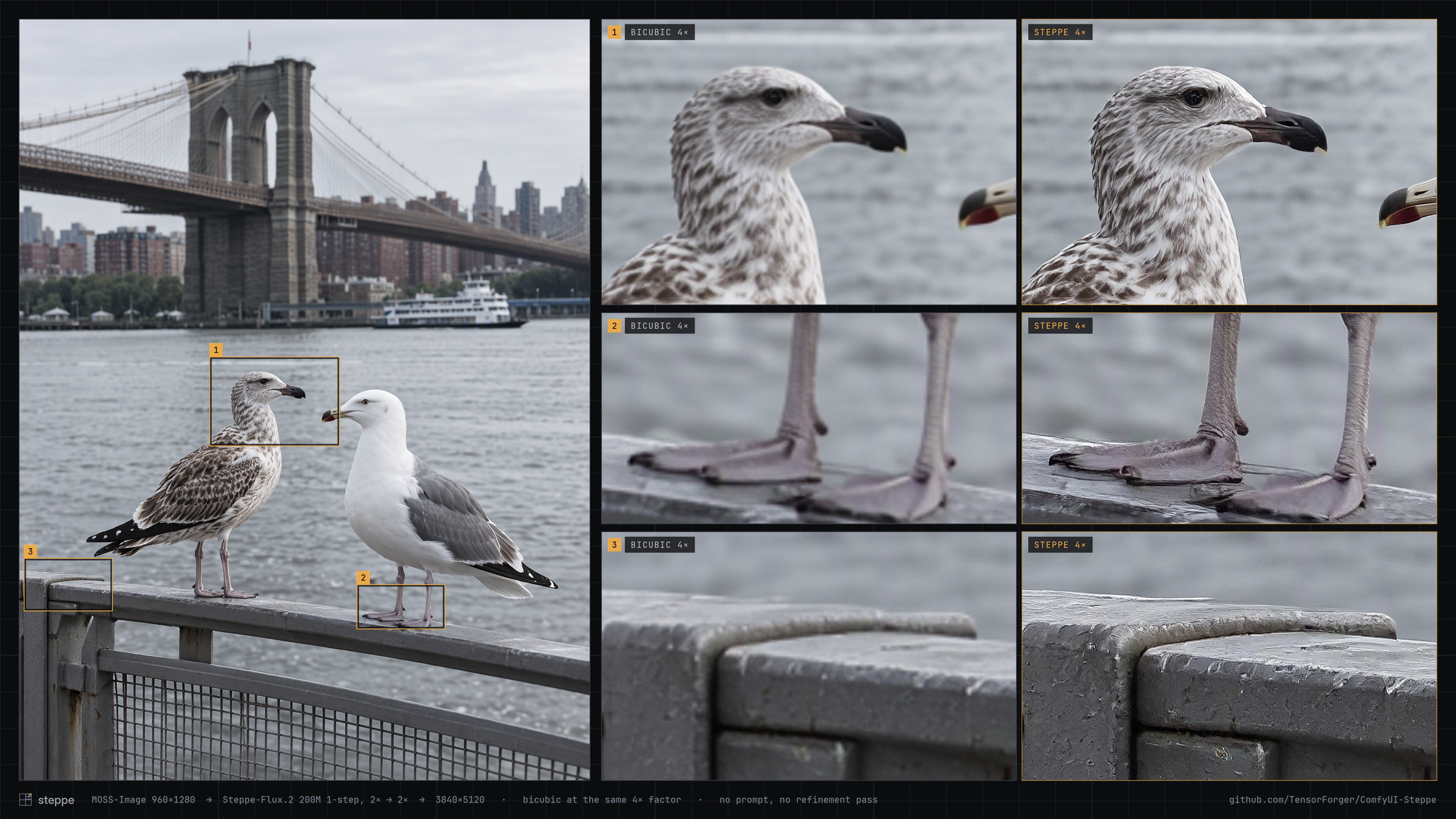
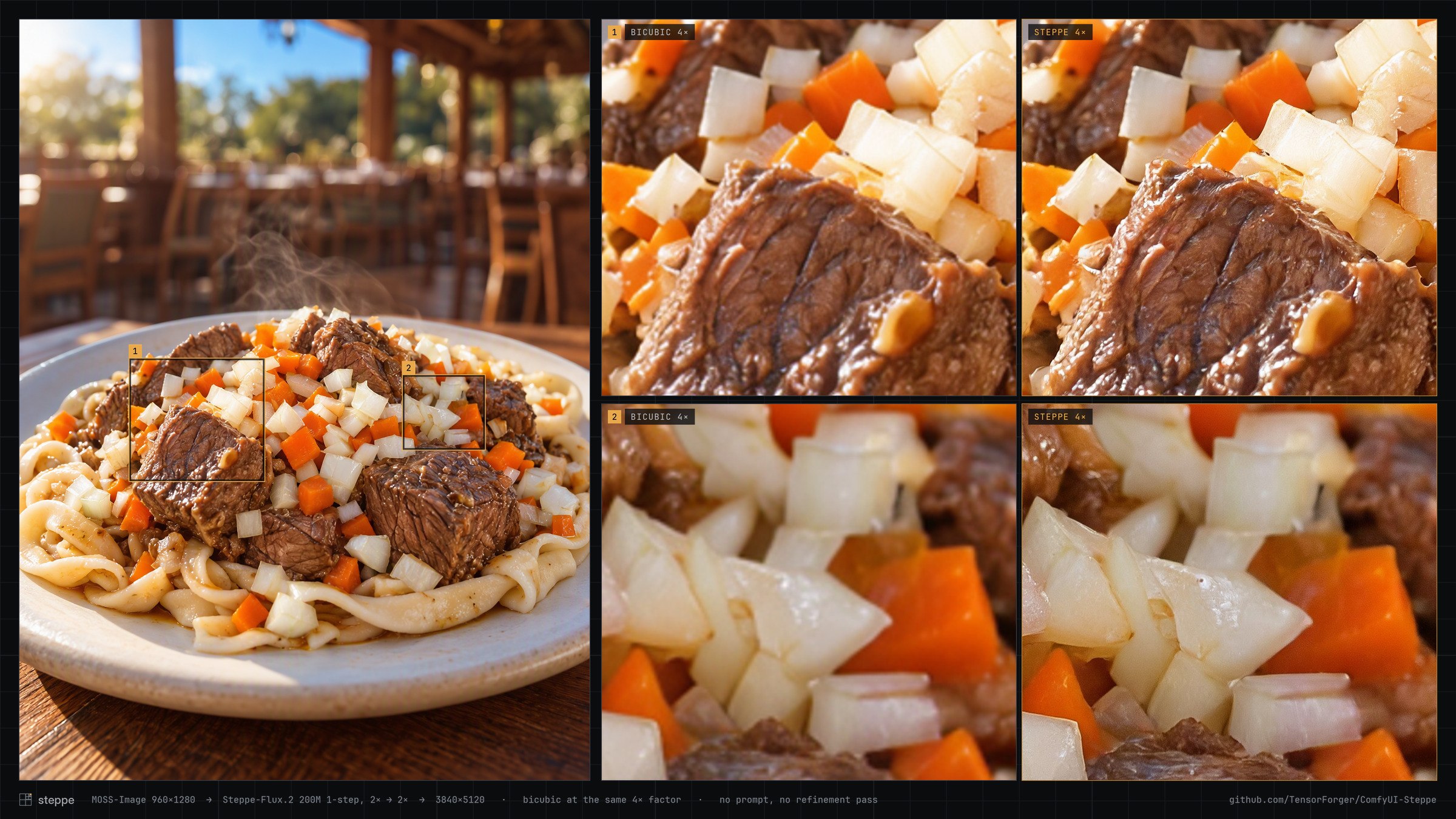
All examples: MOSS-Image at 960x1280, Steppe-Flux.2 200M 1-step, chained 2x → 2x to 3840x5120, no prompt and no
|
| 73 |
+
refinement pass. Bicubic tiles are upscaled by the same 4x factor from the same input. Click an image for the full
|
| 74 |
+
resolution card.
|
| 75 |
+
|
| 76 |
## Files
|
| 77 |
|
| 78 |
| file | steps | parameters | use |
|
|
|
|
| 90 |
|---|---|---|
|
| 91 |
| FLUX.2 [dev] | FLUX.2 VAE | native |
|
| 92 |
| FLUX.2 [klein] 4B / 9B (distilled and base) | FLUX.2 VAE | native |
|
| 93 |
+
| MOSS-Image (SFT and base) | FLUX.2 VAE (small decoder) | native |
|
| 94 |
| FLUX.2 small decoder, TAEF2 (madebyollin/taef2) | FLUX.2 VAE decoders | works, TAEF2 benchmarked |
|
| 95 |
| FLUX.1, Wan, Qwen-Image, SD3, SDXL, … | other VAEs | **not supported** here (Wan 2.1 VAE: [Steppe-Wan2.1](https://huggingface.co/TensorForger/Steppe-Wan2.1)) |
|
| 96 |
|
| 97 |
+
Tested in ComfyUI with FLUX.2 [klein] 4B (`flux2-vae`) and MOSS-Image (`flux2-vae_small`), single 2x and chained
|
| 98 |
+
2x → 2x. Both workflows are in
|
| 99 |
+
[ComfyUI-Steppe/example_workflows](https://github.com/TensorForger/ComfyUI-Steppe/tree/main/example_workflows).
|
| 100 |
|
| 101 |
## Settings
|
| 102 |
|
|
|
|
| 110 |
|
| 111 |
## Benchmark
|
| 112 |
|
| 113 |
+
[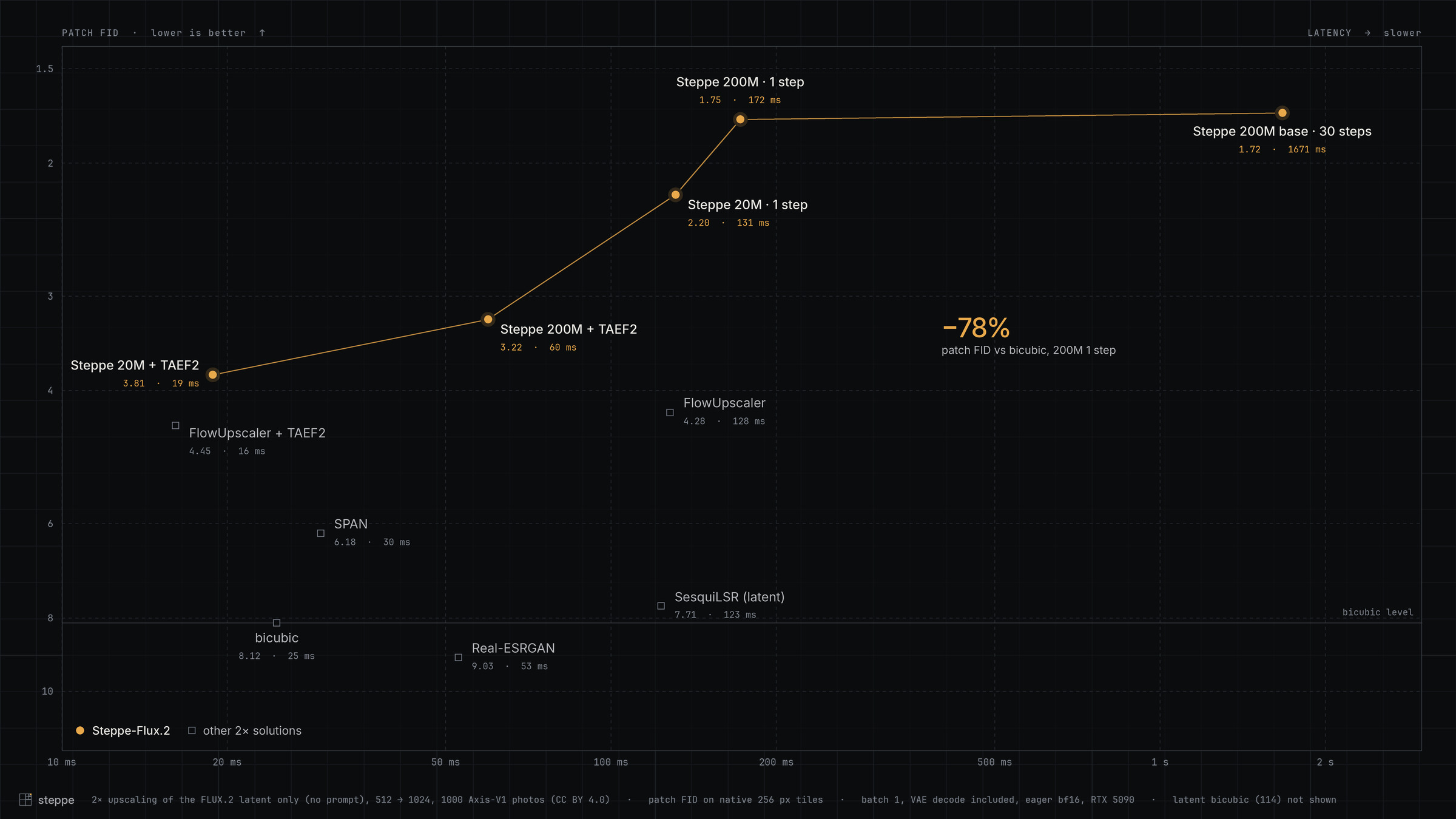](https://raw.githubusercontent.com/tensorforger/tensorforger/main/assets/steppe_flux2/flux2_benchmark_plot.png)
|
| 114 |
+
|
| 115 |
1000 photos (Axis-V1), 512 → 1024. Every solution gets only the FLUX.2 latent (no prompt, no hff). Patch FID on native
|
| 116 |
256 px tiles (lower is better); latency at batch 1, VAE decode included, RTX 5090, eager bfloat16.
|
| 117 |
|
|
|
|
| 127 |
| SesquiLSR FLUX.2 (latent, made for hires fix) | 7.71 | 7.26 | 124 ms | 2.6 GB |
|
| 128 |
| bicubic after decode | 8.12 | 1.77 | 25 ms | 0.8 GB |
|
| 129 |
| Real-ESRGAN x2 after decode | 9.03 | 7.99 | 53 ms | 0.8 GB |
|
|
|
|
| 130 |
|
| 131 |
The VAE reconstruction limit on this set is patch FID 0.71. Steppe stays close to the input: roundtrip color error
|
| 132 |
ΔE00 1.82 (bicubic 1.74). A FLUX.2 [klein] 9B LoRA upscaler (Hildegard, 4 steps, ~7 s per image) was compared on 30
|
| 133 |
images: it adds plausible detail but moves away from the input (ΔE00 3.8 at best vs 2.2 for Steppe on the same images).
|
| 134 |
|
|
|
|
|
|
|
| 135 |
Benchmark images: [Axis-V1](https://huggingface.co/datasets/refine-axis/axis-v1_1k) by refine-axis (CC BY 4.0), cropped.
|
| 136 |
|
| 137 |
## Python
|
|
|
|
| 149 |
# FLUX.2 latents as ComfyUI and the diffusers FLUX.2 pipelines use them: 2x2 packed and batch norm normalized,
|
| 150 |
# [B, 128, H / 16, W / 16]. From a bare AutoencoderKLFlux2: patchify the 32 channel latent 2x2 (channel order
|
| 151 |
# C, 2, 2) and normalize it with vae.bn.running_mean / sqrt(vae.bn.running_var + 1e-4).
|
| 152 |
+
upscaled = upscaler.upscale(
|
| 153 |
+
latents, UpscaleSettings(hff=0.9, guidance=1.0)
|
| 154 |
+
) # [B, 128, H / 8, W / 8]
|
| 155 |
```
|
| 156 |
|
| 157 |
## How it works
|