

File size: 6,942 Bytes
0d80452 | 1 2 3 4 5 6 7 8 9 10 11 12 13 14 15 16 17 18 19 20 21 22 23 24 25 26 27 28 29 30 31 32 33 34 35 36 37 38 39 40 41 42 43 44 45 46 47 48 49 50 51 52 53 54 55 56 57 58 59 60 61 62 63 64 65 66 67 68 69 70 71 72 73 74 75 76 77 78 79 80 81 82 83 84 85 86 87 88 89 90 91 92 93 94 95 96 97 98 99 100 101 102 103 104 105 106 107 108 109 110 111 112 113 114 115 116 117 118 119 120 121 122 123 124 125 126 127 128 129 130 131 132 133 134 135 136 137 138 139 140 141 142 143 144 145 146 147 148 149 150 151 152 153 154 155 156 157 158 159 160 161 162 163 164 165 166 167 168 169 170 171 172 173 174 175 176 177 178 179 180 181 182 | # LIBERO
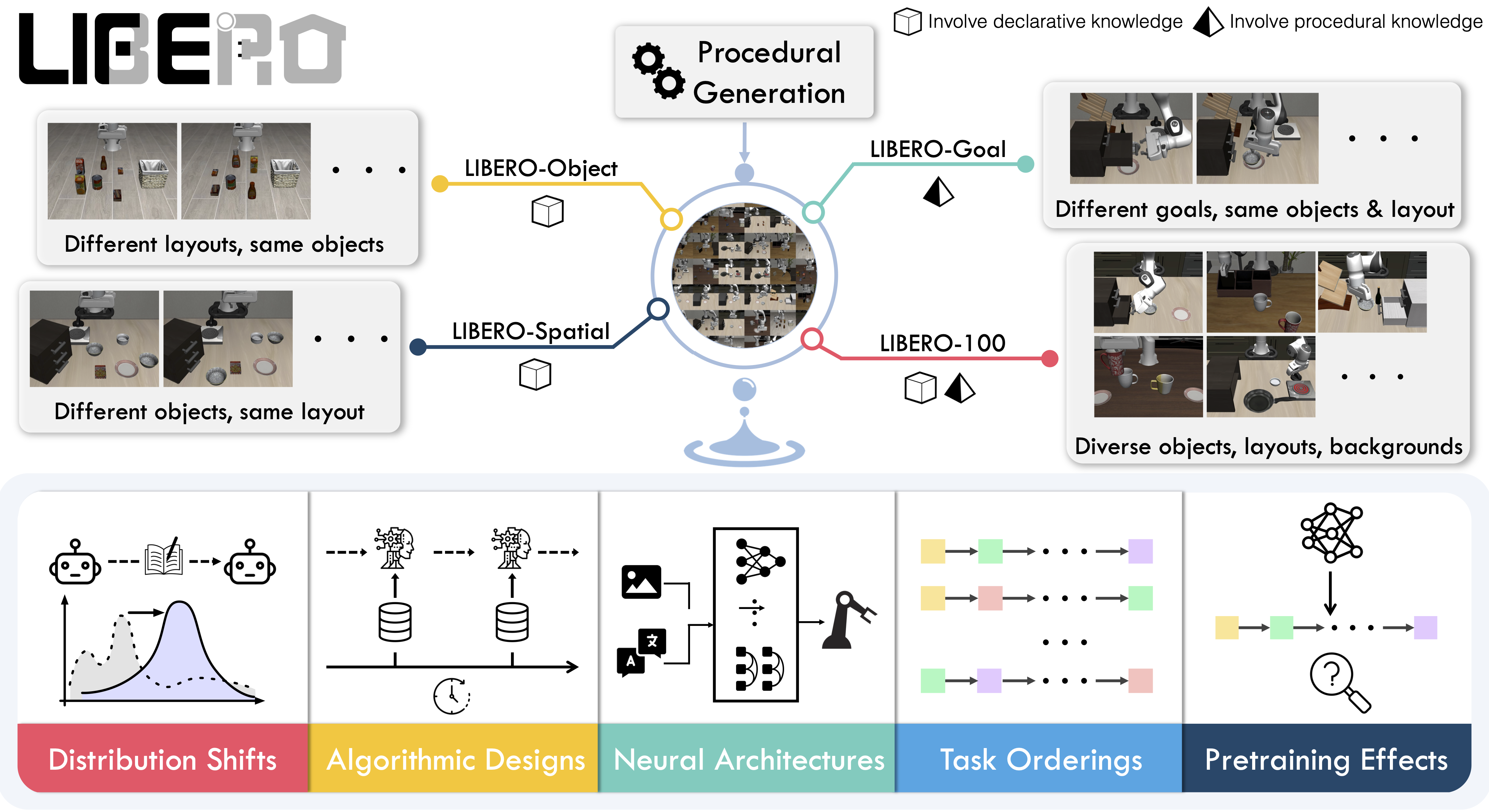
LIBERO is a benchmark designed to study **lifelong robot learning** — the idea that robots need to keep learning and adapting with their users over time, not just be pretrained once. It provides a set of standardized manipulation tasks that focus on **knowledge transfer**: how well a robot can apply what it has already learned to new situations. By evaluating on LIBERO, different algorithms can be compared fairly and researchers can build on each other's work.
- Paper: [Benchmarking Knowledge Transfer for Lifelong Robot Learning](https://arxiv.org/abs/2306.03310)
- GitHub: [Lifelong-Robot-Learning/LIBERO](https://github.com/Lifelong-Robot-Learning/LIBERO)
- Project website: [libero-project.github.io](https://libero-project.github.io)
## Available tasks
LIBERO includes **five task suites** covering **130 tasks**, ranging from simple object manipulations to complex multi-step scenarios:
| Suite | CLI name | Tasks | Description |
| -------------- | ---------------- | ----- | -------------------------------------------------- |
| LIBERO-Spatial | `libero_spatial` | 10 | Tasks requiring reasoning about spatial relations |
| LIBERO-Object | `libero_object` | 10 | Tasks centered on manipulating different objects |
| LIBERO-Goal | `libero_goal` | 10 | Goal-conditioned tasks with changing targets |
| LIBERO-90 | `libero_90` | 90 | Short-horizon tasks from the LIBERO-100 collection |
| LIBERO-Long | `libero_10` | 10 | Long-horizon tasks from the LIBERO-100 collection |
## Installation
After following the LeRobot installation instructions:
```bash
pip install -e ".[libero]"
```
<Tip>
LIBERO requires Linux (`sys_platform == 'linux'`). LeRobot uses MuJoCo for simulation — set the rendering backend before training or evaluation:
```bash
export MUJOCO_GL=egl # for headless servers (HPC, cloud)
```
</Tip>
## Evaluation
### Default evaluation (recommended)
Evaluate across the four standard suites (10 episodes per task):
```bash
lerobot-eval \
--policy.path="your-policy-id" \
--env.type=libero \
--env.task=libero_spatial,libero_object,libero_goal,libero_10 \
--eval.batch_size=1 \
--eval.n_episodes=10 \
--env.max_parallel_tasks=1
```
### Single-suite evaluation
Evaluate on one LIBERO suite:
```bash
lerobot-eval \
--policy.path="your-policy-id" \
--env.type=libero \
--env.task=libero_object \
--eval.batch_size=2 \
--eval.n_episodes=3
```
- `--env.task` picks the suite (`libero_object`, `libero_spatial`, etc.).
- `--env.task_ids` restricts to specific task indices (`[0]`, `[1,2,3]`, etc.). Omit to run all tasks in the suite.
- `--eval.batch_size` controls how many environments run in parallel.
- `--eval.n_episodes` sets how many episodes to run per task.
### Multi-suite evaluation
Benchmark a policy across multiple suites at once by passing a comma-separated list:
```bash
lerobot-eval \
--policy.path="your-policy-id" \
--env.type=libero \
--env.task=libero_object,libero_spatial \
--eval.batch_size=1 \
--eval.n_episodes=2
```
### Control mode
LIBERO supports two control modes — `relative` (default) and `absolute`. Different VLA checkpoints are trained with different action parameterizations, so make sure the mode matches your policy:
```bash
--env.control_mode=relative # or "absolute"
```
### Policy inputs and outputs
**Observations:**
- `observation.state` — 8-dim proprioceptive features (eef position, axis-angle orientation, gripper qpos)
- `observation.images.image` — main camera view (`agentview_image`), HWC uint8
- `observation.images.image2` — wrist camera view (`robot0_eye_in_hand_image`), HWC uint8
<Tip warning={true}>
LeRobot enforces the `.images.*` prefix for visual features. Ensure your
policy config `input_features` use the same naming keys, and that your dataset
metadata keys follow this convention. If your data contains different keys,
you must rename the observations to match what the policy expects, since
naming keys are encoded inside the normalization statistics layer.
</Tip>
**Actions:**
- Continuous control in `Box(-1, 1, shape=(7,))` — 6D end-effector delta + 1D gripper
### Recommended evaluation episodes
For reproducible benchmarking, use **10 episodes per task** across all four standard suites (Spatial, Object, Goal, Long). This gives 400 total episodes and matches the protocol used for published results.
## Training
### Dataset
We provide a preprocessed LIBERO dataset fully compatible with LeRobot:
- [HuggingFaceVLA/libero](https://huggingface.co/datasets/HuggingFaceVLA/libero)
For reference, the original dataset published by Physical Intelligence:
- [physical-intelligence/libero](https://huggingface.co/datasets/physical-intelligence/libero)
### Example training command
```bash
lerobot-train \
--policy.type=smolvla \
--policy.repo_id=${HF_USER}/libero-test \
--policy.load_vlm_weights=true \
--dataset.repo_id=HuggingFaceVLA/libero \
--env.type=libero \
--env.task=libero_10 \
--output_dir=./outputs/ \
--steps=100000 \
--batch_size=4 \
--eval.batch_size=1 \
--eval.n_episodes=1 \
--env_eval_freq=1000
```
## Reproducing published results
We reproduce the results of Pi0.5 on the LIBERO benchmark. We take the Physical Intelligence LIBERO base model (`pi05_libero`) and finetune for an additional 6k steps in bfloat16, with batch size of 256 on 8 H100 GPUs using the [HuggingFace LIBERO dataset](https://huggingface.co/datasets/HuggingFaceVLA/libero).
The finetuned model: [lerobot/pi05_libero_finetuned](https://huggingface.co/lerobot/pi05_libero_finetuned)
### Evaluation command
```bash
lerobot-eval \
--output_dir=./eval_logs/ \
--env.type=libero \
--env.task=libero_spatial,libero_object,libero_goal,libero_10 \
--eval.batch_size=1 \
--eval.n_episodes=10 \
--policy.path=pi05_libero_finetuned \
--policy.n_action_steps=10 \
--env.max_parallel_tasks=1
```
We set `n_action_steps=10`, matching the original OpenPI implementation.
### Results
| Model | LIBERO Spatial | LIBERO Object | LIBERO Goal | LIBERO 10 | Average |
| ------------------- | -------------- | ------------- | ----------- | --------- | -------- |
| **Pi0.5 (LeRobot)** | 97.0 | 99.0 | 98.0 | 96.0 | **97.5** |
These results are consistent with the [original results](https://github.com/Physical-Intelligence/openpi/tree/main/examples/libero#results) reported by Physical Intelligence:
| Model | LIBERO Spatial | LIBERO Object | LIBERO Goal | LIBERO 10 | Average |
| ------------------ | -------------- | ------------- | ----------- | --------- | --------- |
| **Pi0.5 (OpenPI)** | 98.8 | 98.2 | 98.0 | 92.4 | **96.85** |
|