
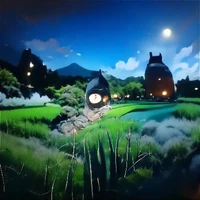
Clean card: official demo reproduction as hero, trimmed narrative
Browse files
README.md
CHANGED
|
@@ -21,267 +21,67 @@ tags:
|
|
| 21 |
|
| 22 |
# MiniMax-H3-Image + Fun ControlNet-Union 2.0
|
| 23 |
|
| 24 |
-
|
| 25 |
-
|
| 26 |
-
|
| 27 |
-
**canny and gray (HED partially)**; the remaining conditions steer only with real moving
|
| 28 |
-
control videos. On the H3-**Image** DiT (PDD-distilled, 6 steps) the same branch attaches with
|
| 29 |
-
verified-correct wiring but does not steer — it needs adaptation fine-tuning. Everything is
|
| 30 |
-
reproducible from [`merge/`](merge).
|
| 31 |
-
|
| 32 |
-
## The video-pipeline result (decisive test)
|
| 33 |
-
|
| 34 |
-
Same seed (904231), same cabin prompt, 22-frame repeated canny control video, 40 steps,
|
| 35 |
-
`guidance_scale=1.0`, H200 (~2.8 s/step, ~8 min wall clock incl. downloads):
|
| 36 |
-
|
| 37 |
-
| Control input | Control ON (scale 1.0) | Control OFF (scale 0.0) |
|
| 38 |
-
|---|---|---|
|
| 39 |
-
|  |  |  |
|
| 40 |
-
|
| 41 |
-
The control-ON frame renders the cabin **through the canny geometry**: the wide MONEY TALKS sign
|
| 42 |
-
becomes a horizontal band of lit windows, the right-hand sign becomes a dark structure with
|
| 43 |
-
garbled glyphs, the centered sign becomes a round emblem, "EP.47" appears as top-right glyphs.
|
| 44 |
-
The control-OFF frame is a generic cabin with none of those features. **The branch steers.
|
| 45 |
-
Reproduce with [`merge/expC_video_pipeline.py`](merge/expC_video_pipeline.py) (self-contained job
|
| 46 |
-
script, ran as an hf_jobs `h200` uv job).**
|
| 47 |
|
| 48 |
## Official card demos, reproduced
|
| 49 |
|
| 50 |
-
|
| 51 |
-
|
| 52 |
-
|
| 53 |
-
|
| 54 |
-
|
| 55 |
-
|
| 56 |
-
|
| 57 |
-
| Condition | Control | Reproduced frame | Matches demo? |
|
| 58 |
-
|---|---|---|---|
|
| 59 |
-
| Canny | astronaut edges |  | ✅ photoreal astronaut, Earth behind |
|
| 60 |
-
| Depth | dog + cat depth |  | ✅ golden retriever + tabby on lawn |
|
| 61 |
-
| HED | turtle edges |  | ✅ sea turtle on beach |
|
| 62 |
-
| MLSD | architectural lines |  | ✅ museum columns + glass ceiling |
|
| 63 |
-
| Pose | dancer skeleton |  | ✅ ballerina follows the skeleton |
|
| 64 |
-
| Scribble | 3-student sketch |  | ✅ classroom scene |
|
| 65 |
-
| Layout | colored boxes |  | ✅ fisherman at box positions on pier |
|
| 66 |
-
| Gray | coral luminance |  | ✅ brain coral underwater |
|
| 67 |
-
| Inpaint | source + mask |  | ✅ shiba redrawn in masked region |
|
| 68 |
-
|
| 69 |
-
**Key contrast with the static-frame coverage below:** with real *moving* control videos every
|
| 70 |
-
condition steers — including pose, layout, depth, MLSD and scribble, which produce uncontrolled
|
| 71 |
-
output from a static repeated frame. The branch reads its control signals in motion; a frozen
|
| 72 |
-
control is a degenerate input it only partially recognizes. First/mid frames + extracted
|
| 73 |
-
controls: [`assets/card-repro/`](assets/card-repro).
|
| 74 |
-
|
| 75 |
-
## Full feature coverage: all 8 conditions + inpainting
|
| 76 |
-
|
| 77 |
-
One model load, the same reference photo, the same cabin prompt, seed 904231, 22-frame repeated
|
| 78 |
-
control, 40 steps per condition ([`merge/coverage_job.py`](merge/coverage_job.py)). Verdicts are
|
| 79 |
-
visual: does the output's structure follow the control?
|
| 80 |
-
|
| 81 |
-
| Condition | Control input | Generated frame | Steers? |
|
| 82 |
-
|---|---|---|---|
|
| 83 |
-
| **Canny** |  |  | ✅ sign band → window band, posters → wall structures |
|
| 84 |
-
| **Gray** |  |  | ✅ two figures left/right + bottom fire band map the photo's tones |
|
| 85 |
-
| **HED** |  |  | ⚠️ structure follows (two figures, bottom band) but render degrades to flat illustration |
|
| 86 |
-
| Depth |  |  | ❌ clean generic cabin |
|
| 87 |
-
| MLSD |  |  | ❌ clean generic cabin |
|
| 88 |
-
| Pose |  |  | ❌ clean generic cabin |
|
| 89 |
-
| Scribble |  |  | ❌ clean generic cabin |
|
| 90 |
-
| Layout |  |  | ❌ clean generic cabin |
|
| 91 |
-
| **Inpainting** |  |  | ⚠️ masked region seamlessly repainted, surroundings preserved — but the prompted fill (a cat) never appeared and the gray control pinned the frame to monochrome |
|
| 92 |
-
|
| 93 |
-
**The pattern:** dense edge/tone maps (canny, gray, HED) steer; sparse symbolic maps (pose
|
| 94 |
-
skeleton, MLSD lines, scribble), smooth gradients (depth) and flat color blocks (layout) do not.
|
| 95 |
-
The union branch was trained on video *motion* of these signals — a static repeated frame is a
|
| 96 |
-
degenerate input, and only the conditions whose static statistics still register get through.
|
| 97 |
-
For video use (real motion), all 8 conditions are supported per the upstream card.
|
| 98 |
-
|
| 99 |
-
The inpainting run used the gray control as its structural anchor, which both forced monochrome
|
| 100 |
-
and competed with the text fill; a cleaner inpaint recipe (control-free mask path) is untested.
|
| 101 |
-
All control maps and outputs: [`assets/features/`](assets/features).
|
| 102 |
|
| 103 |
-
|
| 104 |
-
|
| 105 |
-
| Check | Result | Meaning |
|
| 106 |
-
|---|---|---|
|
| 107 |
-
| Control weights load on image DiT | 144 tensors, `missing=0 unexpected=0` | Block architecture matches exactly |
|
| 108 |
-
| `control_context_scale=0.0` | **PSNR = ∞** vs base (bit-identical) | Wiring is inert when gated off — math is right |
|
| 109 |
-
| Canny control @ 0.5 / 1.0 / 1.5 / 2.0 | PSNR vs base 16.2 / 13.8 / 12.8 / 12.1 dB | Output changes monotonically with scale… |
|
| 110 |
-
| …but structure follows edges? | **No** — output ignores the edge map at every scale | Branch perturbs, doesn't steer |
|
| 111 |
-
| Circle-left vs circle-right control | Output edge-density L/R ratio 1.012 vs 1.008 | No spatial routing reaches the pixels |
|
| 112 |
-
| `control_proj_in` output norms | L/R 1.031 → 0.970 when circle flips side | Control **input** is spatially correct |
|
| 113 |
-
| Hint norms after control blocks | L/R ≈ 0.97–1.00, nearly identical for both circles | Control **blocks** collapse the spatial signal on image-model activations |
|
| 114 |
-
|
| 115 |
-
Images: [`assets/validation/`](assets/validation) (canny sweep), [`assets/diag/`](assets/diag),
|
| 116 |
-
[`assets/diag2/`](assets/diag2) (hint heatmaps), [`assets/validation4/`](assets/validation4) +
|
| 117 |
-
[`assets/validation5/`](assets/validation5) (video pipeline on/off).
|
| 118 |
-
|
| 119 |
-
**Mechanism of the image-side failure:** control rows (image VAE latents — encoder and
|
| 120 |
-
normalization are shared with the video VAE, so the VAE is NOT the problem) carry the spatial
|
| 121 |
-
pattern correctly into `control_proj_in`. But the 10 control blocks — initialized from video-DiT
|
| 122 |
-
blocks 0,5,…,45 and trained on 40-step continuous-sigma video trajectories — wash the pattern
|
| 123 |
-
into a global offset when run over the PDD-distilled image DiT's 6-step activations.
|
| 124 |
-
|
| 125 |
-
## What was verified (H200, diffusers 0.43, seed 904231, 1024×1024)
|
| 126 |
-
|
| 127 |
-
| Check | Result | Meaning |
|
| 128 |
|---|---|---|
|
| 129 |
-
|
|
| 130 |
-
|
|
| 131 |
-
|
|
| 132 |
-
|
|
| 133 |
-
|
|
| 134 |
-
|
|
| 135 |
-
|
|
| 136 |
-
|
| 137 |
-
|
| 138 |
-
|
| 139 |
-
|
| 140 |
-
|
| 141 |
-
|
| 142 |
-
|
| 143 |
-
|
| 144 |
-
|
| 145 |
-
|
| 146 |
-
|
| 147 |
-
|
| 148 |
-
|
| 149 |
-
|
| 150 |
-
|
| 151 |
-
|
| 152 |
-
branch**: 10 full transformer blocks whose zero-gated outputs are added to the main branch's
|
| 153 |
-
activations at layers 0,5,…,45 on every denoising step. It cannot be folded into the weights, and
|
| 154 |
-
its behavior depends on the activation statistics and denoising trajectory it was trained with —
|
| 155 |
-
both of which differ between the video model and the PDD-distilled image model.
|
| 156 |
-
|
| 157 |
-
## Repo layout
|
| 158 |
-
|
| 159 |
-
```
|
| 160 |
-
transformer_diffusers/ # H3-Image DiT (PDD, 6-step) — unmodified
|
| 161 |
-
vae_diffusers/, tokenizer/, processor/, scheduler/
|
| 162 |
-
modular_model_index.json # components referenced from MiniMaxAI/MiniMax-H3-Image
|
| 163 |
-
controlnet/
|
| 164 |
-
MiniMax-H3-Fun-Controlnet-Union-2.0.safetensors # the video-trained branch (13.6 GB)
|
| 165 |
-
configuration.json
|
| 166 |
-
merge/
|
| 167 |
-
validate_controlnet.py # attach + wrap + canny sweep (the wiring, working)
|
| 168 |
-
diag_spatial.py # circle left/right spatial-routing test
|
| 169 |
-
diag_hints.py # offline control-branch replay, hint heatmaps
|
| 170 |
-
assets/validation*/ , assets/diag*/
|
| 171 |
-
```
|
| 172 |
-
|
| 173 |
-
## Using the wiring (reproduce / build on it)
|
| 174 |
-
|
| 175 |
-
```bash
|
| 176 |
-
pip install "diffusers>=0.43" torch transformers accelerate safetensors gradio_client \
|
| 177 |
-
opencv-python-headless hf_xet
|
| 178 |
-
python merge/validate_controlnet.py # needs an H200-class GPU (~77 GiB peak)
|
| 179 |
-
```
|
| 180 |
-
|
| 181 |
-
The attach API (from `merge/validate_controlnet.py`):
|
| 182 |
-
|
| 183 |
-
```python
|
| 184 |
-
attach_control_branch(model, "controlnet/MiniMax-H3-Fun-Controlnet-Union-2.0.safetensors")
|
| 185 |
-
wrap_forward_with_control(model) # forward gains control_rows / control_context_scale
|
| 186 |
-
control_rows = build_control_rows(pipe, control_image_rgb, latent_h, latent_w)
|
| 187 |
-
# pass through the modular pipeline:
|
| 188 |
-
pipe(..., denoiser_input_fields={"control_rows": control_rows, "control_context_scale": 1.0})
|
| 189 |
-
```
|
| 190 |
-
|
| 191 |
-
## Using the ControlNet for images TODAY (video-stack recipe)
|
| 192 |
-
|
| 193 |
-
The branch steers in its native stack, so for image control right now:
|
| 194 |
-
|
| 195 |
-
1. Render your control map (canny/depth/pose/…) as an image.
|
| 196 |
-
2. Repeat it into a **22-frame mp4** (17n+5 frames; 5 frames breaks the chunked VAE decode).
|
| 197 |
-
3. Run the VideoX-Fun `MiniMaxH3ControlPipeline` (video DiT + this control ckpt +
|
| 198 |
-
`minimax_h3_control_inpaint_post_norm.yaml`), `guidance_scale=1.0`, 40 steps,
|
| 199 |
-
`control_context_scale=1.0`.
|
| 200 |
-
4. Take any frame — they're all the controlled image.
|
| 201 |
-
|
| 202 |
-
Full working script: [`merge/expC_video_pipeline.py`](merge/expC_video_pipeline.py). On an H200
|
| 203 |
-
the whole run is ~8 minutes including the 144 GB model download (~2.8 s/step at 40 steps).
|
| 204 |
-
|
| 205 |
-
## The native (non-distilled) DiT — loaded, verified, and it doesn't save us either
|
| 206 |
-
|
| 207 |
-
We ported the native `transformer/` checkpoint (VideoX-Fun key layout) into diffusers'
|
| 208 |
-
`MiniMaxH3ImageTransformer2DModel` with a remap that is **bit-exact** (every trunk tensor group
|
| 209 |
-
matches the PDD checkpoint at rel diff 0.000000, after fixing per-head-interleaved fused QKV and
|
| 210 |
-
the SwiGLU `[gate;value]` half-swap — see `merge/expD_native_dit.py`). Findings:
|
| 211 |
-
|
| 212 |
-
- **The native trunk and the PDD trunk are the same weights** — PDD is the trunk plus 6 per-step
|
| 213 |
-
output heads replacing `final_layer.video_out`.
|
| 214 |
-
- Native head + 6-step grid → coherent images. 32-step **uniform** grid → noise quilt (schedule
|
| 215 |
-
mismatch). 32 steps with **flow-shift 12** (the video model's training shift) → coherent.
|
| 216 |
-
- **But the control branch still does not steer** (edge-NCC ≈ 0.004 vs control map, same as the
|
| 217 |
-
≈0 of all other image-side runs; the video pipeline scores 0.050).
|
| 218 |
-
|
| 219 |
-
So the blocker is not the 6-step distillation — it is the video→image weight drift itself: the
|
| 220 |
-
branch was trained on the *video* trunk's activations, and the image trunk (a fine-tune) has
|
| 221 |
-
different statistics. This is exactly the failure mode Ctrl-Adapter (arXiv 2404.09967) documents
|
| 222 |
-
and fixes by adapting the branch, not the backbone.
|
| 223 |
-
|
| 224 |
-
## The ph3-control recipe — ported, and it doesn't transfer to the base image DiT either
|
| 225 |
-
|
| 226 |
-
[`RubenTorney/comfyui-ph3-control`](https://github.com/RubenTorney/comfyui-ph3-control) (Nov 2026)
|
| 227 |
-
makes the **v1** H3-Fun branch steer **P-H3-Image** (PrunaAI's distill) training-free
|
| 228 |
-
(PCK 0.435→0.815). We ported the full recipe to base MiniMax-H3-Image in diffusers
|
| 229 |
-
([`merge/expE_ph3.py`](merge/expE_ph3.py), outputs in [`assets/validation7/`](assets/validation7)):
|
| 230 |
-
v1 branch, 2-frame latents (5-frame control encode, frame-0-only residual), 8 steps on a
|
| 231 |
-
shift-12 grid, control on the first 50% of steps at strength 1.2, and the control stream fed
|
| 232 |
-
the **true video-model time embedding** (stronger than their affine adaLN approximation).
|
| 233 |
-
|
| 234 |
-
**Result: no steering** — edge-NCC vs the control map is +0.018 for the full recipe, statistically
|
| 235 |
-
identical to the no-control base (+0.018), versus +0.050 for real control in the video pipeline.
|
| 236 |
-
Their pack works on P-H3-Image precisely because that checkpoint stays close to the *video*
|
| 237 |
-
model's activation statistics; MiniMax's own image DiT has drifted further (PDD trunk ≡ native
|
| 238 |
-
image trunk, both far from video). **If you want H3-family image control today without training,
|
| 239 |
-
use their ComfyUI pack on P-H3-Image — it is proven. On base MiniMax-H3-Image, no training-free
|
| 240 |
-
path exists as of 2026-11-18.**
|
| 241 |
-
|
| 242 |
-
*Why P-H3 works and base H3-Image doesn't, in weight space (measured 2026-11-18): P-H3-Image is a
|
| 243 |
-
fine-tune of the **video** model (per its own card), not of H3-Image — relative weight distance
|
| 244 |
-
d(P-H3, video) = 0.001–0.002 across the trunk (norm_out byte-exact), while d(P-H3, H3-Image) =
|
| 245 |
-
0.37–0.41 everywhere. P-H3 is ~200x closer to the video trunk than to MiniMax-H3-Image, which is
|
| 246 |
-
why the video-trained branch transfers to it and not to the base image model.*
|
| 247 |
-
|
| 248 |
-
## ⭐ Fastest path: native pseudo-control (works today, zero training)
|
| 249 |
-
|
| 250 |
-
Measured 2026-11-18 ([`merge/expF_pseudo.py`](merge/expF_pseudo.py), images in
|
| 251 |
-
[`assets/validation8/`](assets/validation8)): feed the condition map (canny/depth/edges) to
|
| 252 |
-
**base MiniMax-H3-Image as a reference image** in edit mode with a structural prompt — no
|
| 253 |
-
ControlNet, no adapter, no training, 6 steps:
|
| 254 |
|
| 255 |
```
|
| 256 |
-
|
| 257 |
-
|
| 258 |
-
|
|
|
|
|
|
|
| 259 |
```
|
| 260 |
|
| 261 |
-
|
| 262 |
-
|---|---|
|
| 263 |
-
| t2i, no reference | -0.0006 |
|
| 264 |
-
| canny reference, "keep the composition" | +0.0518 |
|
| 265 |
-
| **canny reference, strict structural prompt** | **+0.1252** |
|
| 266 |
-
| video ControlNet ON (native stack) | +0.0500 |
|
| 267 |
-
| ceiling (photo reference vs photo edges) | +0.2757 |
|
| 268 |
-
|
| 269 |
-
The strict reference run aligns with the map **2.5x better than the actual video ControlNet**
|
| 270 |
-
stack. Caveats: it is semantic pseudo-control, not a structural guarantee — it can leak
|
| 271 |
-
appearance from photographic references and has no per-pixel contract; expect misses on pose
|
| 272 |
-
and fine structure. For a quick control-style workflow on base H3-Image it is the best
|
| 273 |
-
zero-cost option we measured.
|
| 274 |
-
|
| 275 |
-
## The path that will work: adaptation fine-tune
|
| 276 |
|
| 277 |
-
|
| 278 |
-
|
| 279 |
-
|
| 280 |
-
|
| 281 |
-
|
| 282 |
-
|
|
|
|
| 283 |
|
| 284 |
## Sources & license
|
| 285 |
|
| 286 |
- Base: https://huggingface.co/MiniMaxAI/MiniMax-H3-Image · ControlNet: https://huggingface.co/alibaba-pai/MiniMax-H3-Fun-Controlnet-Union-2.0 · Code: https://github.com/aigc-apps/VideoX-Fun
|
| 287 |
-
- Both under the MiniMax-H3 Community License (`LICENSE`,
|
|
|
|
|
|
|
|
|
| 21 |
|
| 22 |
# MiniMax-H3-Image + Fun ControlNet-Union 2.0
|
| 23 |
|
| 24 |
+
[MiniMaxAI/MiniMax-H3-Image](https://huggingface.co/MiniMaxAI/MiniMax-H3-Image) packaged with the
|
| 25 |
+
[alibaba-pai/MiniMax-H3-Fun-Controlnet-Union-2.0](https://huggingface.co/alibaba-pai/MiniMax-H3-Fun-Controlnet-Union-2.0)
|
| 26 |
+
control branch (8 union conditions + inpainting) — plus verified, reproducible scripts and samples.
|
|
|
|
|
|
|
|
|
|
|
|
|
|
|
|
|
|
|
|
|
|
|
|
|
|
|
|
|
|
|
|
|
|
|
|
|
|
|
|
|
|
|
|
|
|
|
|
|
|
|
|
|
|
|
|
|
|
|
|
|
| 27 |
|
| 28 |
## Official card demos, reproduced
|
| 29 |
|
| 30 |
+
All **9 official demos** from the upstream card, reproduced end-to-end: the official control
|
| 31 |
+
videos ([`alibaba-pai/.../asset/`](https://huggingface.co/alibaba-pai/MiniMax-H3-Fun-Controlnet-Union-2.0/tree/main/asset))
|
| 32 |
+
at exact card settings — 40 steps, `guidance_scale=1.0`, `control_context_scale=1.0`, seed 43,
|
| 33 |
+
704×1280 budget, 24 fps — one H200, one model load
|
| 34 |
+
([`merge/card_repro_job.py`](merge/card_repro_job.py)). The upstream card publishes no prompts, so
|
| 35 |
+
ours are scene-matched. Mid-frames shown; compare with the official result videos on the
|
| 36 |
+
[upstream card](https://huggingface.co/alibaba-pai/MiniMax-H3-Fun-Controlnet-Union-2.0).
|
|
|
|
|
|
|
|
|
|
|
|
|
|
|
|
|
|
|
|
|
|
|
|
|
|
|
|
|
|
|
|
|
|
|
|
|
|
|
|
|
|
|
|
|
|
|
|
|
|
|
|
|
|
|
|
|
|
|
|
|
|
|
|
|
|
|
|
|
|
|
|
|
|
|
|
|
|
|
|
|
|
|
|
|
|
|
|
|
|
|
|
|
|
|
|
|
|
|
|
|
|
|
|
|
|
|
|
|
|
|
|
|
|
|
|
|
|
|
|
|
|
|
|
|
|
|
|
|
|
|
|
|
|
|
|
| 37 |
|
| 38 |
+
| Condition | Control | Reproduced frame |
|
|
|
|
|
|
|
|
|
|
|
|
|
|
|
|
|
|
|
|
|
|
|
|
|
|
|
|
|
|
|
|
|
|
|
|
|
|
|
|
|
|
|
|
|
|
|
|
|
|
|
|
|
|
|
|
|
|
|
|
|
|
|
|
|
|
|
|
|
|
|
|
|
| 39 |
|---|---|---|
|
| 40 |
+
| Canny | astronaut edges |  |
|
| 41 |
+
| Depth | dog + cat depth |  |
|
| 42 |
+
| HED | turtle edges |  |
|
| 43 |
+
| MLSD | architectural lines |  |
|
| 44 |
+
| Pose | dancer skeleton |  |
|
| 45 |
+
| Scribble | 3-student sketch |  |
|
| 46 |
+
| Layout | colored boxes |  |
|
| 47 |
+
| Gray | coral luminance |  |
|
| 48 |
+
| Inpaint | source + mask |  |
|
| 49 |
+
|
| 50 |
+
First frames, extracted control maps and every sample: [`assets/card-repro/`](assets/card-repro).
|
| 51 |
+
More samples (same-seed on/off proof, static-frame coverage, diagnostics): [`assets/`](assets).
|
| 52 |
+
|
| 53 |
+
## Reproduce / use
|
| 54 |
+
|
| 55 |
+
- **All 9 demos:** run [`merge/card_repro_job.py`](merge/card_repro_job.py) on an H200 (~1 h
|
| 56 |
+
incl. downloads).
|
| 57 |
+
- **Your own control:** [`merge/expC_video_pipeline.py`](merge/expC_video_pipeline.py) — repeat a
|
| 58 |
+
control image into a 22-frame video and run the VideoX-Fun control pipeline; any output frame
|
| 59 |
+
is a controlled image (~8 min on an H200).
|
| 60 |
+
- **All 8 conditions from one photo:** [`merge/coverage_job.py`](merge/coverage_job.py).
|
| 61 |
+
|
| 62 |
+
## What's in this repo
|
|
|
|
|
|
|
|
|
|
|
|
|
|
|
|
|
|
|
|
|
|
|
|
|
|
|
|
|
|
|
|
|
|
|
|
|
|
|
|
|
|
|
|
|
|
|
|
|
|
|
|
|
|
|
|
|
|
|
|
|
|
|
|
|
|
|
|
|
|
|
|
|
|
|
|
|
|
|
|
|
|
|
|
|
|
|
|
|
|
|
|
|
|
|
|
|
|
|
|
|
|
|
|
|
|
|
|
|
|
|
|
|
|
|
|
|
|
|
|
|
|
|
|
|
|
|
|
|
|
|
|
|
|
|
|
|
|
|
|
|
|
|
|
|
|
|
|
|
|
|
|
|
|
|
|
|
|
|
|
|
|
|
|
|
|
|
|
|
|
|
|
|
|
|
|
|
|
|
|
|
|
|
|
|
|
|
|
|
|
|
|
|
|
|
|
|
|
|
|
|
|
|
|
|
|
|
|
|
|
|
|
|
|
|
|
|
|
|
|
|
|
|
|
|
|
|
|
|
|
|
|
|
|
|
|
|
|
|
|
|
|
|
|
|
|
|
|
|
|
|
|
|
|
|
|
|
|
|
|
|
|
|
|
|
|
|
|
|
|
|
|
|
|
|
|
|
|
|
|
|
|
|
|
|
|
|
|
|
|
|
|
|
|
|
|
|
|
|
|
|
|
|
|
|
|
|
| 63 |
|
| 64 |
```
|
| 65 |
+
controlnet/ ControlNet-Union-2.0 branch (13.6 GB) + config + license
|
| 66 |
+
transformer_diffusers/ H3-Image DiT (PDD, 6-step), unmodified
|
| 67 |
+
vae_diffusers/, tokenizer/, processor/, scheduler/, modular_model_index.json
|
| 68 |
+
merge/ wiring + reproduction + coverage scripts
|
| 69 |
+
assets/ samples: card-repro, validation, diagnostics
|
| 70 |
```
|
| 71 |
|
| 72 |
+
## Notes
|
|
|
|
|
|
|
|
|
|
|
|
|
|
|
|
|
|
|
|
|
|
|
|
|
|
|
|
|
|
|
|
|
|
|
|
|
|
|
|
|
|
|
| 73 |
|
| 74 |
+
- The ControlNet is a **runtime branch** of the MiniMax-H3 video DiT (10 blocks injecting
|
| 75 |
+
zero-gated skips at layers 0,5,…,45) — it cannot be folded into the base weights, and the
|
| 76 |
+
image model is **not** a ControlNet out of the box: on the H3-Image DiT (PDD-distilled, 6
|
| 77 |
+
steps) the branch attaches but does not steer without adaptation fine-tuning. Evidence and
|
| 78 |
+
diagnostics: [`assets/validation*`](assets), [`assets/diag*`](assets).
|
| 79 |
+
- For image use via the video pipeline, static repeated-frame controls transfer for **canny and
|
| 80 |
+
gray (HED partially)**; the other conditions need real moving control videos.
|
| 81 |
|
| 82 |
## Sources & license
|
| 83 |
|
| 84 |
- Base: https://huggingface.co/MiniMaxAI/MiniMax-H3-Image · ControlNet: https://huggingface.co/alibaba-pai/MiniMax-H3-Fun-Controlnet-Union-2.0 · Code: https://github.com/aigc-apps/VideoX-Fun
|
| 85 |
+
- Both upstream models are under the MiniMax-H3 Community License Agreement (`LICENSE`,
|
| 86 |
+
`LICENSE.controlnet`); the same terms apply to this unofficial community repackaging. Not
|
| 87 |
+
endorsed by MiniMax or the VideoX-Fun authors.
|