

File size: 13,498 Bytes
cbc6e22 | 1 2 3 4 5 6 7 8 9 10 11 12 13 14 15 16 17 18 19 20 21 22 23 24 25 26 27 28 29 30 31 32 33 34 35 36 37 38 39 40 41 42 43 44 45 46 47 48 49 50 51 52 53 54 55 56 57 58 59 60 61 62 63 64 65 66 67 68 69 70 71 72 73 74 75 76 77 78 79 80 81 82 83 84 85 86 87 88 89 90 91 92 93 94 95 96 97 98 99 100 101 102 103 104 105 106 107 108 109 110 111 112 113 114 115 116 117 118 119 120 121 122 123 124 125 126 127 128 129 130 131 132 133 134 135 136 137 138 139 140 141 142 143 144 145 146 147 148 149 150 151 152 153 154 155 156 157 158 159 160 161 162 163 164 165 166 167 168 169 170 171 172 173 174 175 176 177 178 179 180 181 182 183 184 185 186 187 188 189 190 191 192 193 194 195 196 197 198 199 200 201 202 203 204 205 206 207 208 209 210 211 212 213 214 215 216 217 218 219 220 221 222 |
<p align="center">
<picture>
<source media="(prefers-color-scheme: dark)" srcset="https://github.com/albertan017/LLM4Decompile/blob/main/samples/logo-dark.png">
<img alt="LLM4Decompile" src="https://github.com/albertan017/LLM4Decompile/blob/main/samples/logo-light.png" width=55%>
</picture>
</p>
<p align="left">
📊 <a href="#evaluation">Results</a>
| 🤗 <a href="#models">Models</a>
| 🚀 <a href="#quick-start">Quick Start</a>
| 📚 <a href="#humaneval-decompile">HumanEval-Decompile</a>
| 📎 <a href="#citation">Citation</a>
| 📝 <a href="https://arxiv.org/abs/2403.05286">Paper</a>
| 🖥️ <a href="https://colab.research.google.com/drive/1X5TuUKuNuksGJZz6Cc83KKI0ATBP9q7r?usp=sharing">Colab</a>
| ▶️ <a href="https://www.youtube.com/watch?v=x7knF3Z1yLk">YouTube</a>
</p>
Reverse Engineering: Decompiling Binary Code with Large Language Models
[](https://trendshift.io/repositories/8664)
## Updates
* [2025-10-04]: Release SK²Decompile: LLM-based Two-Phase Binary Decompilation from Skeleton to Skin. Phase 1 Structure Recovery (Skeleton): Transform binary/pseudo-code into obfuscated intermediate representations 🤗 [HF Link](https://huggingface.co/LLM4Binary/sk2decompile-struct-6.7b). Phase 2 Identifier Naming (Skin): Generate human-readable source code with meaningful identifiers 🤗 [HF Link](https://huggingface.co/LLM4Binary/sk2decompile-ident-6.7).
* [2025-05-20]: Release [decompile-bench](https://huggingface.co/collections/LLM4Binary/decompile-bench-68259091c8d49d0ebd5efda9), contains two million binary-source function pairs for training, and 70K function pairs for evaluation. Please refer to the [decompile-bench](https://github.com/albertan017/LLM4Decompile/tree/main/decompile-bench) folder for details.
* [2024-10-17]: Release [decompile-ghidra-100k](https://huggingface.co/datasets/LLM4Binary/decompile-ghidra-100k), a subset of 100k training samples (25k per optimization level). We provide a [training script](https://github.com/albertan017/LLM4Decompile/blob/main/train/README.md) that runs in ~3.5 hours on a single A100 40G GPU. It achieves a 0.26 re-executability rate, with a total cost of under $20 for quick replication of LLM4Decompile.
* [2024-09-26]: Update a [Colab notebook](https://colab.research.google.com/drive/1X5TuUKuNuksGJZz6Cc83KKI0ATBP9q7r?usp=sharing) to demonstrate the usage of the LLM4Decompile model, including examples for the LLM4Decompile-End and LLM4Decompile-Ref models.
* [2024-09-23]: Release [LLM4Decompile-9B-v2](https://huggingface.co/LLM4Binary/llm4decompile-9b-v2), fine-tuned based on [Yi-Coder-9B](https://huggingface.co/01-ai/Yi-Coder-9B), achieved a re-executability rate of **0.6494** on the Decompile benchmark.
* [2024-06-19]: Release [V2](https://huggingface.co/LLM4Binary/llm4decompile-6.7b-v2) series (LLM4Decompile-Ref). V2 (1.3B-22B), building upon **Ghidra**, are trained on 2 billion tokens to **refine** the decompiled pseudo-code from Ghidra. The 22B-V2 version outperforms the 6.7B-V1.5 by an additional 40.1%. Please check the [ghidra folder](https://github.com/albertan017/LLM4Decompile/tree/main/ghidra) for details.
* [2024-05-13]: Release [V1.5](https://huggingface.co/LLM4Binary/llm4decompile-6.7b-v1.5) series (LLM4Decompile-End, directly decompile binary using LLM). V1.5 are trained with a larger dataset (15B tokens) and a maximum token **length of 4,096**, with remarkable performance (over **100% improvement**) compared to the previous model.
* [2024-03-16]: Add [llm4decompile-6.7b-uo](https://huggingface.co/arise-sustech/llm4decompile-6.7b-uo) model which is trained without prior knowledge of the optimization levels (O0~O3), the average re-executability is around 0.219, performs the best in our models.
## About
* **LLM4Decompile** is the pioneering open-source large language model dedicated to decompilation. Its current version supports decompiling Linux x86_64 binaries, ranging from GCC's O0 to O3 optimization levels, into human-readable C source code. Our team is committed to expanding this tool's capabilities, with ongoing efforts to incorporate a broader range of architectures and configurations.
* **LLM4Decompile-End** focuses on decompiling the binary directly. **LLM4Decompile-Ref** refines the pseudo-code decompiled by Ghidra.
## Evaluation
### Framework
<p align="center">
<img src="https://github.com/albertan017/LLM4Decompile/blob/main/samples/compile-decompile.png" alt="image" width="400" height="auto">
</p>
During compilation, the Preprocessor processes the source code (SRC) to eliminate comments and expand macros or includes. The cleaned code is then forwarded to the Compiler, which converts it into assembly code (ASM). This ASM is transformed into binary code (0s and 1s) by the Assembler. The Linker finalizes the process by linking function calls to create an executable file. Decompilation, on the other hand, involves converting binary code back into a source file. LLMs, being trained on text, lack the ability to process binary data directly. Therefore, binaries must be disassembled by ```Objdump``` into assembly language (ASM) first. It should be noted that binary and disassembled ASM are equivalent, they can be interconverted, and thus we refer to them interchangeably. Finally, the loss is computed between the decompiled code and source code to guide the training. To assess the quality of the decompiled code (SRC'), it is tested for its functionality through test assertions (re-executability).
### Metrics
* **Re-executability** evaluates whether the decompiled code can execute properly and pass all the predefined test cases.
### Benchmarks
* **HumanEval-Decompile** A collection of 164 C functions that exclusively rely on **standard** C libraries.
* **ExeBench** A collection of 2,621 functions drawn from **real** projects, each utilizing user-defined functions, structures, and macros.
### Results
<p align="center">
<img src="https://github.com/albertan017/LLM4Decompile/blob/main/samples/results_end_final.png" alt="results" width="800" height="auto">
</p>
<p align="center">
<img src="https://github.com/albertan017/LLM4Decompile/blob/main/samples/results_refine_final.png" alt="image" width="800" height="auto">
</p>
## Models
Our LLM4Decompile includes models with sizes between 1.3 billion and 33 billion parameters, and we have made these models available on Hugging Face.
| Model | Checkpoint | Size | Re-executability | Note |
|-----------------------|-------------------------------------------------------------------|------|---------------------|----------------------|
| **llm4decompile-1.3b-v1.5**| 🤗 [HF Link](https://huggingface.co/LLM4Binary/llm4decompile-1.3b-v1.5) | 1.3B | **27.3%** | Note 3 |
| **llm4decompile-6.7b-v1.5**| 🤗 [HF Link](https://huggingface.co/LLM4Binary/llm4decompile-6.7b-v1.5) | 6.7B | **45.4%** | Note 3 |
| **llm4decompile-1.3b-v2**| 🤗 [HF Link](https://huggingface.co/LLM4Binary/llm4decompile-1.3b-v2) | 1.3B | **46.0%** | Note 4 |
| **llm4decompile-6.7b-v2**| 🤗 [HF Link](https://huggingface.co/LLM4Binary/llm4decompile-6.7b-v2) | 6.7B | **52.7%** | Note 4 |
| **llm4decompile-9b-v2**| 🤗 [HF Link](https://huggingface.co/LLM4Binary/llm4decompile-9b-v2) | 9B | **64.9%** | Note 4 |
| **llm4decompile-22b-v2**| 🤗 [HF Link](https://huggingface.co/LLM4Binary/llm4decompile-22b-v2) | 22B | **63.6%** | Note 4 |
Note 3: V1.5 series are trained with a larger dataset (15B tokens) and a maximum token size of 4,096, with remarkable performance (over 100% improvement) compared to the previous model.
Note 4: V2 series are built upon **Ghidra** and trained on 2 billion tokens to **refine** the decompiled pseudo-code from Ghidra. Check [ghidra folder](https://github.com/albertan017/LLM4Decompile/tree/main/ghidra) for details.
## Quick Start
[](https://colab.research.google.com/drive/1X5TuUKuNuksGJZz6Cc83KKI0ATBP9q7r?usp=sharing)
**Setup:** Please use the script below to install the necessary environment.
```
git clone https://github.com/albertan017/LLM4Decompile.git
cd LLM4Decompile
conda create -n 'llm4decompile' python=3.9 -y
conda activate llm4decompile
pip install -r requirements.txt
```
Here is an example of how to use our model (Revised for V1.5. For previous models, please check the corresponding model page at HF).
Note: **Replace the "func0" with the function name you want to decompile**.
**Preprocessing:** Compile the C code into binary, and disassemble the binary into assembly instructions.
```python
import subprocess
import os
func_name = 'func0'
OPT = ["O0", "O1", "O2", "O3"]
fileName = 'samples/sample' #'path/to/file'
for opt_state in OPT:
output_file = fileName +'_' + opt_state
input_file = fileName+'.c'
compile_command = f'gcc -o {output_file}.o {input_file} -{opt_state} -lm'#compile the code with GCC on Linux
subprocess.run(compile_command, shell=True, check=True)
compile_command = f'objdump -d {output_file}.o > {output_file}.s'#disassemble the binary file into assembly instructions
subprocess.run(compile_command, shell=True, check=True)
input_asm = ''
with open(output_file+'.s') as f:#asm file
asm= f.read()
if '<'+func_name+'>:' not in asm: #IMPORTANT replace func0 with the function name
raise ValueError("compile fails")
asm = '<'+func_name+'>:' + asm.split('<'+func_name+'>:')[-1].split('\n\n')[0] #IMPORTANT replace func0 with the function name
asm_clean = ""
asm_sp = asm.split("\n")
for tmp in asm_sp:
if len(tmp.split("\t"))<3 and '00' in tmp:
continue
idx = min(
len(tmp.split("\t")) - 1, 2
)
tmp_asm = "\t".join(tmp.split("\t")[idx:]) # remove the binary code
tmp_asm = tmp_asm.split("#")[0].strip() # remove the comments
asm_clean += tmp_asm + "\n"
input_asm = asm_clean.strip()
before = f"# This is the assembly code:\n"#prompt
after = "\n# What is the source code?\n"#prompt
input_asm_prompt = before+input_asm.strip()+after
with open(fileName +'_' + opt_state +'.asm','w',encoding='utf-8') as f:
f.write(input_asm_prompt)
```
Assembly instructions should be in the format:
<FUNCTION_NAME>:\nOPERATIONS\nOPERATIONS\n
Typical assembly instructions may look like this:
```
<func0>:
endbr64
lea (%rdi,%rsi,1),%eax
retq
```
**Decompilation:** Use LLM4Decompile to translate the assembly instructions into C:
```python
from transformers import AutoTokenizer, AutoModelForCausalLM
import torch
model_path = 'LLM4Binary/llm4decompile-6.7b-v1.5' # V1.5 Model
tokenizer = AutoTokenizer.from_pretrained(model_path)
model = AutoModelForCausalLM.from_pretrained(model_path,torch_dtype=torch.bfloat16).cuda()
with open(fileName +'_' + OPT[0] +'.asm','r') as f:#optimization level O0
asm_func = f.read()
inputs = tokenizer(asm_func, return_tensors="pt").to(model.device)
with torch.no_grad():
outputs = model.generate(**inputs, max_new_tokens=2048)### max length to 4096, max new tokens should be below the range
c_func_decompile = tokenizer.decode(outputs[0][len(inputs[0]):-1])
with open(fileName +'.c','r') as f:#original file
func = f.read()
print(f'original function:\n{func}')# Note we only decompile one function, where the original file may contain multiple functions
print(f'decompiled function:\n{c_func_decompile}')
```
### Docker setup
```
# build docker
docker build -t llm4decompile .
# run docker with GPU
docker run --gpus all -it --name llm4decompile llm4decompile /bin/bash
# run demo.py (choose a model suitable for your resources before running)
cd ghidra
python demo.py
```
## HumanEval-Decompile
Data are stored in ``llm4decompile/decompile-eval/decompile-eval-executable-gcc-obj.json``, using JSON list format. There are 164*4 (O0, O1, O2, O3) samples, each with five keys:
* ``task_id``: indicates the ID of the problem.
* ``type``: the optimization stage, is one of [O0, O1, O2, O3].
* ``c_func``: C solution for HumanEval problem.
* ``c_test``: C test assertions.
* ``input_asm_prompt``: assembly instructions with prompts, can be derived as in our [preprocessing example](https://github.com/albertan017/LLM4Decompile?tab=readme-ov-file#quick-start).
Please check the [evaluation scripts](https://github.com/albertan017/LLM4Decompile/tree/main/evaluation).
## On Going
* Larger training dataset with the cleaning process. (done:2024.05.13)
* Support for popular languages/platforms and settings.
* Support for executable binaries. (done:2024.05.13)
* Integration with decompilation tools (e.g., Ghidra, Rizin)
## License
This code repository is licensed under the MIT and DeepSeek License.
## Citation
```
@misc{tan2024llm4decompile,
title={LLM4Decompile: Decompiling Binary Code with Large Language Models},
author={Hanzhuo Tan and Qi Luo and Jing Li and Yuqun Zhang},
year={2024},
eprint={2403.05286},
archivePrefix={arXiv},
primaryClass={cs.PL}
}
```
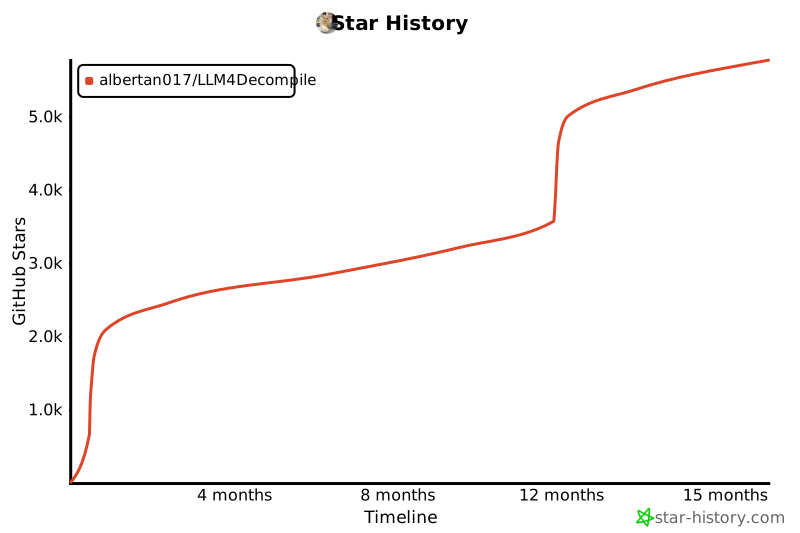
## Star History
[](https://star-history.com/#albertan017/LLM4Decompile&Timeline)
|