| 🏆 BenchLabs Leaderboard • 🌍 Tiny-T2I Leaderboard • 📝 Blog Post |
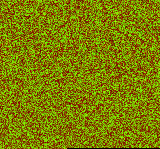 A neural network where the weights **are** the image. Now the model is a thumbnail.
## 📌 What is this?
`model.png` is not a picture — it *is* the model.
Every pixel encodes neural network weights. At inference, the PNG is decoded
into weight matrices, the prompt is hashed into an embedding, and a
coordinate-conditioned decoder paints an image — at **any resolution**.
[v0](https://huggingface.co/bench-labs/pixelmodel) was a 202,752-parameter MLP
welded to 32×32 output, trained on 6 color swatches. v1 is **8.5× smaller
(23,747 parameters)**, renders at any resolution (native 64×64), and is trained
on ~20K real MS-COCO caption/image pairs.
# cherry on top 🍒
The model generates 600 images (cpu) in 5 (five) seconds.
Thats 5000 images in 24 seconds on cpu.
The model trained on cpu for just 30 minutes.
## 🆕 v0 → v1
| | v0 | v1 |
|---|---|---|
| Parameters | 202,752 | **23,747** |
| `model.png` | 64×3200 px | **160×149 px** (a thumbnail) |
| Output head | 1 weight row per pixel (196K params, 97% of model) | CPPN decoder on (x, y) — resolution-free |
| Resolution | fixed 32×32 | any; native 64×64 |
| Prompt embedding | char-sum (order-blind, collision-heavy) | hashed trigrams + words (FNV-1a), still 0 params |
| Biases | none | yes |
| Weight precision | 8-bit (G channel wasted) | **16-bit** (R=high byte, G=low byte) |
| Training data | 6 solid-color swatches | ~20K MS-COCO caption/image pairs |
A neural network where the weights **are** the image. Now the model is a thumbnail.
## 📌 What is this?
`model.png` is not a picture — it *is* the model.
Every pixel encodes neural network weights. At inference, the PNG is decoded
into weight matrices, the prompt is hashed into an embedding, and a
coordinate-conditioned decoder paints an image — at **any resolution**.
[v0](https://huggingface.co/bench-labs/pixelmodel) was a 202,752-parameter MLP
welded to 32×32 output, trained on 6 color swatches. v1 is **8.5× smaller
(23,747 parameters)**, renders at any resolution (native 64×64), and is trained
on ~20K real MS-COCO caption/image pairs.
# cherry on top 🍒
The model generates 600 images (cpu) in 5 (five) seconds.
Thats 5000 images in 24 seconds on cpu.
The model trained on cpu for just 30 minutes.
## 🆕 v0 → v1
| | v0 | v1 |
|---|---|---|
| Parameters | 202,752 | **23,747** |
| `model.png` | 64×3200 px | **160×149 px** (a thumbnail) |
| Output head | 1 weight row per pixel (196K params, 97% of model) | CPPN decoder on (x, y) — resolution-free |
| Resolution | fixed 32×32 | any; native 64×64 |
| Prompt embedding | char-sum (order-blind, collision-heavy) | hashed trigrams + words (FNV-1a), still 0 params |
| Biases | none | yes |
| Weight precision | 8-bit (G channel wasted) | **16-bit** (R=high byte, G=low byte) |
| Training data | 6 solid-color swatches | ~20K MS-COCO caption/image pairs |
 ## 🎨 Weight Encoding
Each pixel stores one weight at 16-bit precision, mapped from [-2, 2]:
- **R channel** → high byte
- **G channel** → low byte
- **B channel** → reserved
Round-trip quantization error ≈ 3×10⁻⁵ per weight.
## 🧠 Architecture
```text
prompt string
→ hashed char-trigram + word embedding (64-dim, deterministic, 0 params)
→ T1 (80×64)+b → tanh
→ T2 (64×80)+b → tanh = latent z (64)
for every pixel (x, y):
concat(z, fourier features of (x, y)) ← 18 coord dims, freqs 1/2/4/8
→ D1 (80×82)+b → tanh
→ D2 (80×80)+b → tanh
→ D3 (3×80)+b → sigmoid = RGB
```
Because pixels are decoded from coordinates, parameter count is independent of
resolution — `--res 256` works with the same 23,747 weights.
All weights live inside `model.png` (160×149 px).
## 📦 Standard weights (safetensors)
`model.png` is the canonical model — training writes to it directly. For
tooling that expects standard weight files, the same 10 tensors are exported as
`model.safetensors` (23,747 parameters total):
```bash
python convert_to_safetensors.py # model.png -> model.safetensors
```
Parameter count is verifiable without running code: `config.json`
(`total_parameters: 23747`, full per-layer breakdown) and the safetensors
header metadata (`total_parameters`, `param_breakdown`, `has_bias`,
`text_encoder_parameters: 0`, `vae_parameters: 0`).
## 📊 Benchmark results
Measured per the [Tiny-T2I-Leaderboard](https://huggingface.co/spaces/FlameF0X/Tiny-T2I-Leaderboard) protocol — see `eval.md` for full method and `EVAL_REPRODUCTION.md` to re-run:
| Metric | v0 | v1 | Tooling |
|---|---|---|---|
| FID ↓ | 566.84 (n=40) | **439.46** (n=5000) | `torchmetrics.image.fid.FrechetInceptionDistance` |
| CLIP Score ↑ | 18.60 (n=40) | **20.02** (n=5000) | `torchmetrics.multimodal.CLIPScore`, `openai/clip-vit-base-patch32` |
| Native resolution | 32×32 | 64×64 | |
Real set: MS-COCO val2014 pairs from `sayakpaul/coco-30-val-2014` (256×256
center-crop). Training images are hash-checked to be disjoint from the eval
images.
Expectation management: a 23K-parameter model does not draw recognizable
objects. It learns caption-conditioned color, layout, and texture statistics of
COCO photos — the outputs are blurry impressions, not pictures. The point is
the size:quality ratio and the PNG-as-model gimmick, executed honestly.
## 🎨 Weight Encoding
Each pixel stores one weight at 16-bit precision, mapped from [-2, 2]:
- **R channel** → high byte
- **G channel** → low byte
- **B channel** → reserved
Round-trip quantization error ≈ 3×10⁻⁵ per weight.
## 🧠 Architecture
```text
prompt string
→ hashed char-trigram + word embedding (64-dim, deterministic, 0 params)
→ T1 (80×64)+b → tanh
→ T2 (64×80)+b → tanh = latent z (64)
for every pixel (x, y):
concat(z, fourier features of (x, y)) ← 18 coord dims, freqs 1/2/4/8
→ D1 (80×82)+b → tanh
→ D2 (80×80)+b → tanh
→ D3 (3×80)+b → sigmoid = RGB
```
Because pixels are decoded from coordinates, parameter count is independent of
resolution — `--res 256` works with the same 23,747 weights.
All weights live inside `model.png` (160×149 px).
## 📦 Standard weights (safetensors)
`model.png` is the canonical model — training writes to it directly. For
tooling that expects standard weight files, the same 10 tensors are exported as
`model.safetensors` (23,747 parameters total):
```bash
python convert_to_safetensors.py # model.png -> model.safetensors
```
Parameter count is verifiable without running code: `config.json`
(`total_parameters: 23747`, full per-layer breakdown) and the safetensors
header metadata (`total_parameters`, `param_breakdown`, `has_bias`,
`text_encoder_parameters: 0`, `vae_parameters: 0`).
## 📊 Benchmark results
Measured per the [Tiny-T2I-Leaderboard](https://huggingface.co/spaces/FlameF0X/Tiny-T2I-Leaderboard) protocol — see `eval.md` for full method and `EVAL_REPRODUCTION.md` to re-run:
| Metric | v0 | v1 | Tooling |
|---|---|---|---|
| FID ↓ | 566.84 (n=40) | **439.46** (n=5000) | `torchmetrics.image.fid.FrechetInceptionDistance` |
| CLIP Score ↑ | 18.60 (n=40) | **20.02** (n=5000) | `torchmetrics.multimodal.CLIPScore`, `openai/clip-vit-base-patch32` |
| Native resolution | 32×32 | 64×64 | |
Real set: MS-COCO val2014 pairs from `sayakpaul/coco-30-val-2014` (256×256
center-crop). Training images are hash-checked to be disjoint from the eval
images.
Expectation management: a 23K-parameter model does not draw recognizable
objects. It learns caption-conditioned color, layout, and texture statistics of
COCO photos — the outputs are blurry impressions, not pictures. The point is
the size:quality ratio and the PNG-as-model gimmick, executed honestly.
 ## ⚙️ Usage
```bash
# training data (COCO subset)
python fetch_coco_subset.py --out ../pm-work
# train (writes model.png every epoch)
python train.py --data ../pm-work/coco_train.npz --epochs 50
# inference from model.png (canonical)
python main.py "a red double decker bus" --out bus.png
# inference from model.safetensors (standalone, needs only this one file + torch)
python convert_to_safetensors.py
python INFERENCE.py "a red double decker bus" --out bus.png
# any resolution from the same 23,747 weights
python main.py "a beach with palm trees" --res 256 --scale 1
# benchmark eval
python eval/run_eval.py --work ../pm-work --model model.png --n 5000
```
`main.py` and `INFERENCE.py` produce identical output for the same prompt and
resolution.
## 📁 Files
```text
model.png ← THE MODEL (160×149 px)
model.safetensors ← same weights, standard format + param metadata
config.json ← architecture + parameter-count metadata
main.py ← inference, loads model.png
INFERENCE.py ← inference, loads model.safetensors (standalone)
convert_to_safetensors.py ← model.png -> model.safetensors
train.py ← training
model.py ← architecture + PNG weight codec
fetch_coco_subset.py ← builds train/eval data from COCO
eval/run_eval.py ← FID + CLIP Score via torchmetrics
eval.md ← benchmark results + method
EVAL_REPRODUCTION.md ← step-by-step reproduction guide
```
---
*Still a toy. Slightly less useless. The model is literally a thumbnail.*
Bench Labs · Simple, Reliable, Open sourced
## ⚙️ Usage
```bash
# training data (COCO subset)
python fetch_coco_subset.py --out ../pm-work
# train (writes model.png every epoch)
python train.py --data ../pm-work/coco_train.npz --epochs 50
# inference from model.png (canonical)
python main.py "a red double decker bus" --out bus.png
# inference from model.safetensors (standalone, needs only this one file + torch)
python convert_to_safetensors.py
python INFERENCE.py "a red double decker bus" --out bus.png
# any resolution from the same 23,747 weights
python main.py "a beach with palm trees" --res 256 --scale 1
# benchmark eval
python eval/run_eval.py --work ../pm-work --model model.png --n 5000
```
`main.py` and `INFERENCE.py` produce identical output for the same prompt and
resolution.
## 📁 Files
```text
model.png ← THE MODEL (160×149 px)
model.safetensors ← same weights, standard format + param metadata
config.json ← architecture + parameter-count metadata
main.py ← inference, loads model.png
INFERENCE.py ← inference, loads model.safetensors (standalone)
convert_to_safetensors.py ← model.png -> model.safetensors
train.py ← training
model.py ← architecture + PNG weight codec
fetch_coco_subset.py ← builds train/eval data from COCO
eval/run_eval.py ← FID + CLIP Score via torchmetrics
eval.md ← benchmark results + method
EVAL_REPRODUCTION.md ← step-by-step reproduction guide
```
---
*Still a toy. Slightly less useless. The model is literally a thumbnail.*
Bench Labs · Simple, Reliable, Open sourced