
17 Models, $38.95, and One Paradox: What We Learned Training Compression Models in Public

We just published a paper proving that multi-checkpoint voting ensembles collapse to their weakest voter. We trained 17 kompress models on HuggingFace to fix it. Total cost: $38.95. Here's the full story — the dead ends, the breakthrough, and the open-source toolkit we built along the way.
The Problem
kompress is a 149M-param ModernBERT token classifier that decides which tokens to keep when compressing LLM context. It's used by the headroom proxy to reduce token costs for coding agents.
The problem: it drops critical tokens — compiler flags (-O2), hex addresses (0xDEAD), file paths (/var/log), error names (TokenExpiredError). These get split across subword tokens by the ModernBERT tokenizer, and the single-token classifier misses them.
The Paradox
We tried building an ensemble of models from different checkpoints. The ensemble should be better than any single model, right?
It was worse. Much worse.
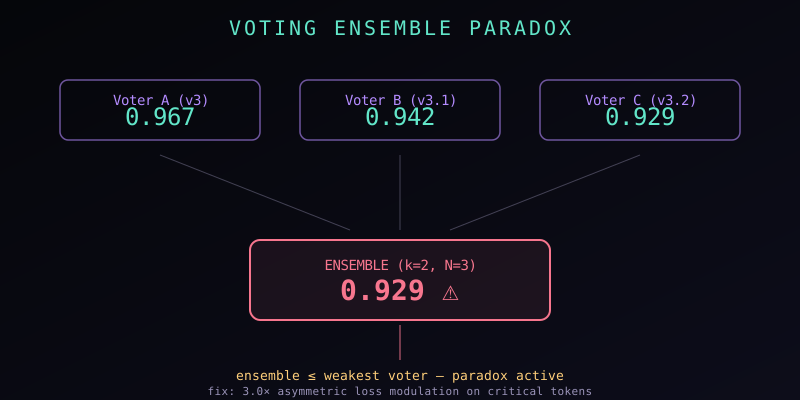
Under -of-\(N\) drop voting, the ensemble eviction indicator equals the -th order statistic of the per-voter indicators:
The ensemble collapses to its weakest member on every stratum. We proved this formally and validated it empirically: an ensemble of v3, v3.1, and v3.2 scored 0.931 heretic-exact — worse than v4 alone at 0.967.
The Fix: Asymmetric Loss Modulation
Three mechanisms resolve the paradox:
- Training (\(\lambda = 3.0\)): Weighted binary cross-entropy with penalty multiplier on critical-syntactic tokens:
where for must-keep tokens, for regular keeps, for drops.
- Inference overrides: Post-inference regex safety net catches what the tokenizer splits across subword boundaries (PR #1419)
- C3 Self-Distillation: Qwen2.5-7B teacher labels must-keep spans on real tool outputs; student model learns to match the teacher's judgment
The Pareto Frontier
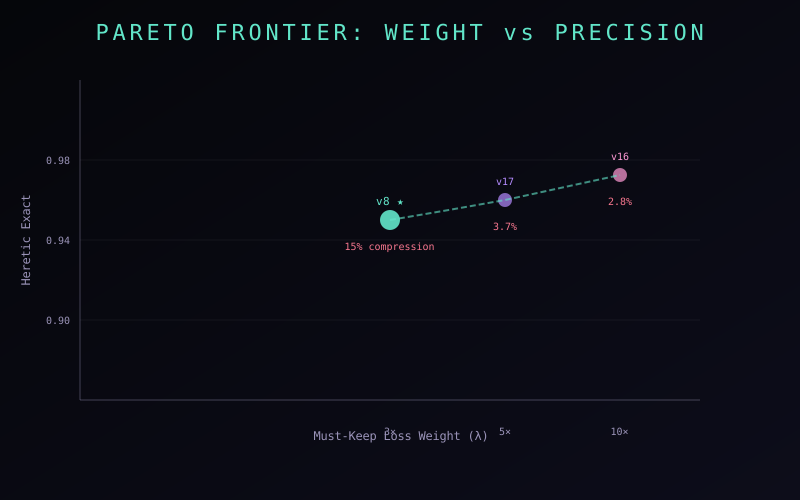
We mapped the full tradeoff curve by varying :
| Model | Heretic | Compression | Status | |
|---|---|---|---|---|
| 3× | v8 | 0.955 | 15% | Optimal ★ |
| 5× | v17 | 0.963 | 3.7% | Too conservative |
| 10× | v16 | 0.972 | 2.8% | Useless compression |
The tradeoff is fundamental: higher improves precision linearly but kills compression. is the Pareto-optimal point.
The 17-Model Journey
All models on HuggingFace: PeetPedro — 18 models with full cards, benchmarks, and training details.
| Version | What We Tried | Heretic | Keep Rate | Lesson |
|---|---|---|---|---|
| v2-base | Baseline | 0.975 | 0.897 | Precision ceiling |
| v4 | Self-labels | 0.943 | 0.823 | Override internalized |
| v6 | Agent-distribution | 0.962 | — | Dead end |
| v8 | Qwen2.5 teacher | 0.955 | 0.854 | Production ★ |
| v9 | C3-only | 0.921 | — | Overfit |
| v11 | Large encoder (352M) | 0.906 | 0.517 | Capacity ≠ precision |
| v12 | Qwen3-Coder teacher | 0.949 | — | Too conservative |
| v14 | Council-controlled | 0.882 | — | Concept proven |
| v15 | Everything bagel | 0.878 | — | Diluted signal |
| v16 | 10× weight | 0.972 | 0.972 | Pareto endpoint |
| v17 | 5× weight | 0.963 | 0.963 | Tradeoff |
11 of 17 models were dead ends. We published them all. The dead ends are the research.
Open Science
Everything is public. All 18 models on HuggingFace. All experiment logs on pocoo.vaked.dev. All code open source.
- Paper: kompress.vaked.dev — interactive with live paradox simulation
- Eval Space: PeetPedro/headroom-eval — Level 4 Hill Climbing Loop, continuously testing compression
- LoopKit: github.com/peterlodri-sec/loopkit — loop engineering starter kit
- Research repo: longrun-eval-kompress
- CLI: headroom-eval-cli
What We Learned
- Label quality is the bottleneck — not model capacity (v11 at 352M collapsed to 0.906), not data quantity (v15 with 983 pairs regressed to 0.878)
- Small, calibrated datasets win — v8's 97 carefully labeled pairs (33% C3 ratio) outperformed models trained on 3× more data
- Regex in production beats training the model — post-inference safety nets are surgical; training is blunt. The must-keep override (PR #1419) pushes agent mk_in_ref from 0.652 to 1.000 with zero model changes.
- The Pareto frontier is real — you cannot have perfect precision and aggressive compression simultaneously with this architecture
- Dead ends are the research — 11 of 17 models were dead ends, and we published every one. The loop doesn't just produce models; it produces understanding.
Community
This project is part of the broader loop engineering ecosystem with Addy Osmani, LangChain, and Cobus Greyling.
We're applying for an HF GPU Community Grant to run the Eval Space on a T4 — if you'd like to support open compression research, check out the Space and give it a ⭐!
"The agent forgets. The repo does not." — Addy Osmani
ICLR 2027 submission. All models, data, and code open source.