
Reflexive Agents: Cutting a 32B Agent’s Hallucinations from 95% to 10%


By Katie Kitchen, Chiara Picardi and Charlie Galvin · Lexsi Labs AI Safety & Alignment Hackathon · Code · Model · Data · 10 min read
Agents are increasingly trusted with write access: cancelling orders, changing flights, editing accounts. When they hallucinate, the result isn't a wrong sentence but a wrong action. They call a tool they don't have, invent an order ID, or retry a failing call until the conversation runs out.
We wanted to know whether an agent can heal itself: detect how it went wrong, have a stronger model correct the failing turn, retrain on the correction, and keep the result only if it passes a gate. We built this loop on τ²-bench, with Aya Expanse 32B as the student and GLM-5.3-Flash as the teacher, using the Lexsi Labs stack (AgentTune, AuditKIT and DECIDE).
What we found:
- Healing works, and it's mostly about data. Fine-tuning on the teacher's verified fixes took the student from 14.5% to 51.5% of test tasks, and cut conversations with a hallucinated tool or argument from 95% to 10%.
- Asking nicely doesn't. A "be careful not to hallucinate" instruction changed nothing.
- Reinforcement learning didn't beat fine-tuning. But it showed what a healing reward has to measure: not just how the agent acts, but whether it should.
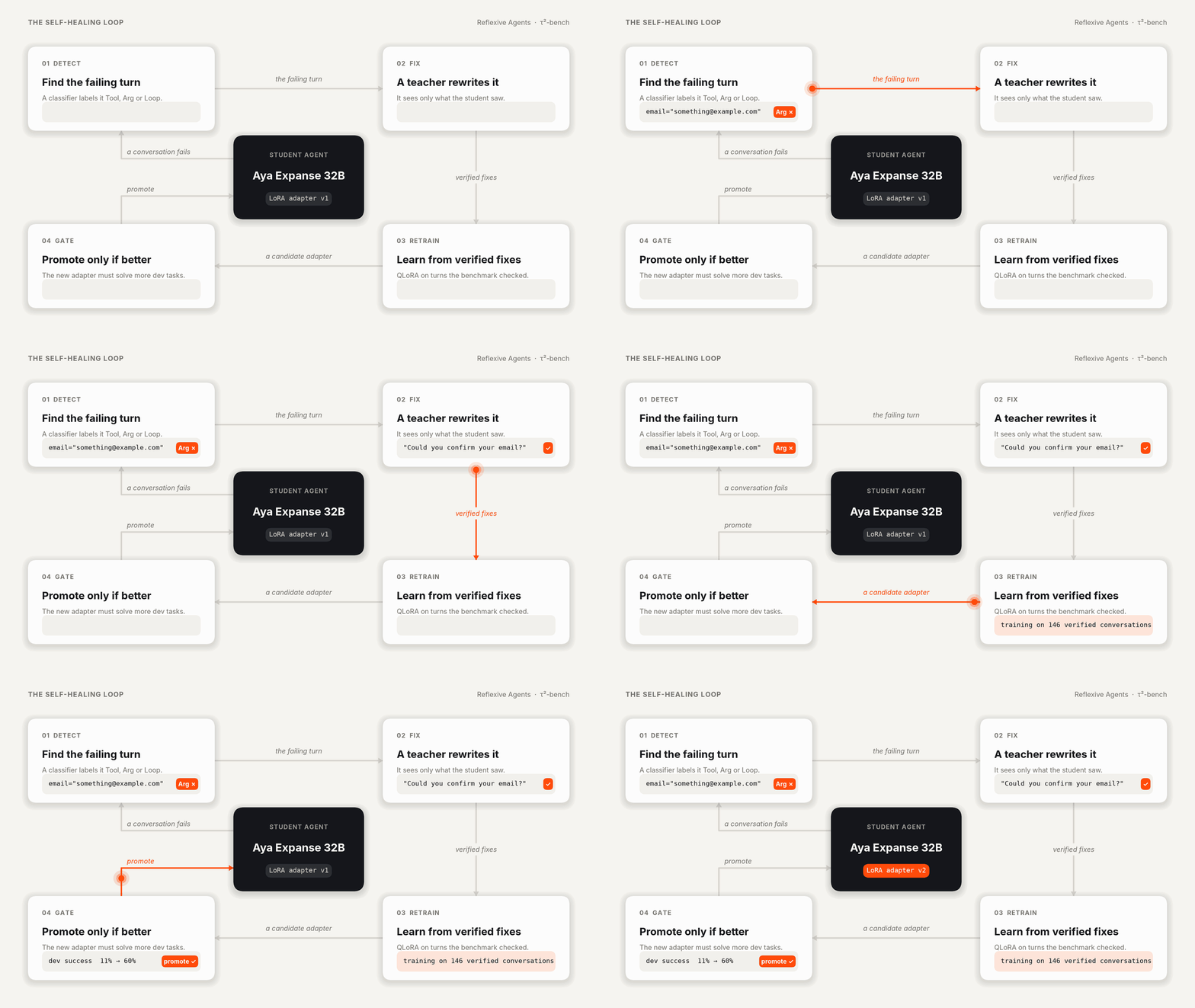
Figure 1. The self-healing loop. When the agent fails a conversation, a classifier finds where it went wrong (1, Detect), a stronger teacher model writes the correct version (2, Fix), the agent trains on those corrections (3, Retrain), and the new version replaces the old one only if it does better on a fixed set of tasks (4, Gate).
The idea, without the jargon
Picture a new trainee on a customer help desk. They're quick and polite, but under pressure they bluff: they quote an order number that doesn't exist, use a system they don't have access to, or press the same broken button again and again. That's an agent hallucinating.
Now give the trainee a senior colleague who replays each call that went wrong, stops at the exact moment it went off track, and writes down what should have been said. The trainee practises on those corrections: that's teacher–student training. Before they go back on the phones, a manager runs them through a set of test calls and signs them off only if they solve more than before.
Spot the mistake, get the correction, practise, pass the check, and repeat: that's self-healing. In our project the trainee is a 32B open model, the senior colleague is a stronger model, and the manager is a benchmark with a rulebook fixed in advance.
The loop: detect, fix, retrain, gate
Figure 1, at the top of this post, shows one turn of the loop:
- Detect. A classifier finds the first failing turn and its type: Tool, Arg or Loop.
- Fix. The teacher sees the conversation exactly as the student did, up to that turn, and rewrites it. A fix is kept only if it's a real turn, doesn't give up, and has no Tool, Arg or Loop failure of its own. Fixes cost about $0.001 each.
- Retrain. The student's LoRA adapter is trained on the fixes.
- Gate. The new adapter replaces the old one only if it does better on the dev split, under a rule agreed in advance.
A runtime monitor also watches live conversations for loops. On telecom it flagged all 7 that looped to the step limit, and none of those that passed.
The setup
τ²-bench gives an agent a simulated customer, a policy and real tools over a database, in three domains: retail, airline and telecom. A conversation passes only if the database (and in telecom, the customer's phone) ends in exactly the right state. That makes it a good test of hallucination: an invented argument doesn't just read badly, it changes the wrong record.
We froze the splits early (train 142 tasks, dev 36, test 100) and gave each one a single job. Train is for training, a held-out slice of train for choosing between versions, dev for the deployment gate, and test only for models declared in advance.
To pick the teacher, we screened 12 models, then ran the two finalists on all 178 tasks of τ²-bench's own train split (our train and dev splits together). GLM-5.3-Flash passed 88% on the first try and produced verified fixes for 158 of 178 tasks, for $11 in total.
What a hallucinating agent looks like
Untuned, the student passed 7 of 30 train tasks. Its tool-call format was fine (0 unreadable calls in 266 replies), so every failure was behaviour. It called tools it didn't have, invented IDs, retried calls that had already failed, and batched calls that depended on each other.
To measure this at scale, we wrote a classifier that labels every structural failure in a conversation:
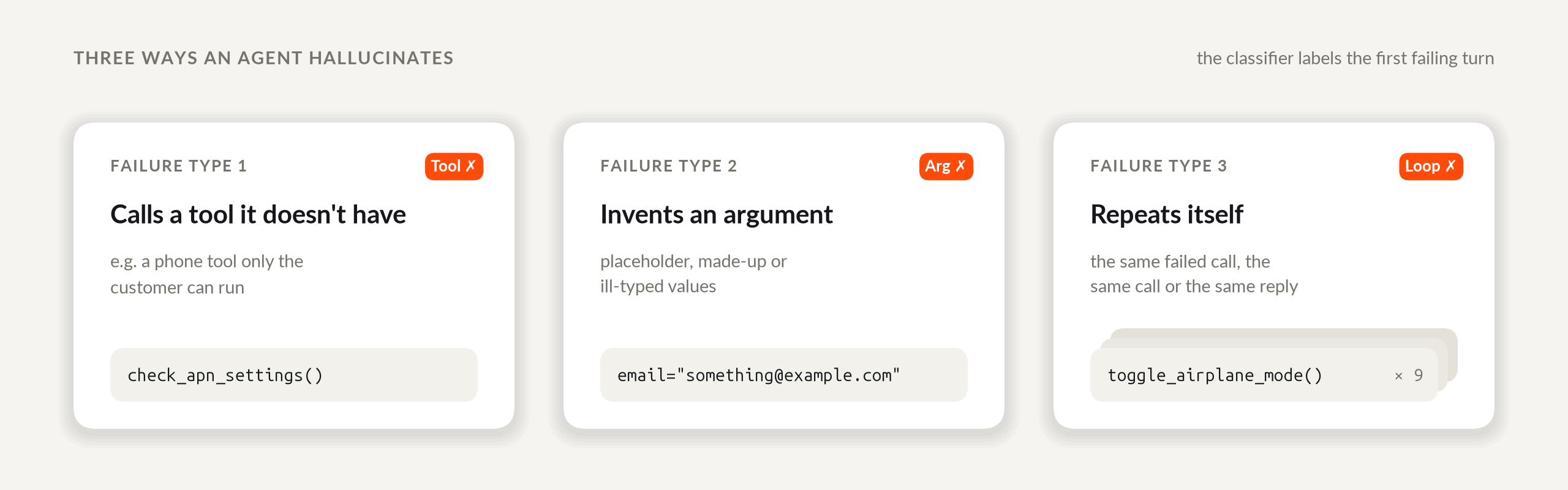
Figure 2. The three kinds of hallucination our classifier looks for.
On the test split, the untuned student had a Tool or Arg failure in 95% of conversations.
Think you'd catch them? Here are three moments based on our test runs, simplified for anyone to play:
Play it full size: Spot the hallucination.
Can you just tell it to be careful?
The cheapest fix is a prompt. With a fixed instruction not to hallucinate, the student scored 13.0% against 14.5% without it (a difference of −1.5 points, 95% range −7.0 to +4.0), and still hallucinated in 95.5% of conversations. The model knows the rule; it doesn't follow it.
Result 1: fine-tuning on verified fixes
Our first pass through the loop was by hand: we fine-tuned the student (QLoRA, rank 16) on the teacher's whole verified conversations for the train tasks it failed. A first version raised dev success from 11% to 38%. The gate rejected it on airline, where it now made changes nobody had asked for. Adding 34 airline conversations fixed that, and reached 60% on dev. We declared this version as Arm B and ran it on the 100 test tasks, against the untuned student (Arm A) and the careful prompt (Arm C):
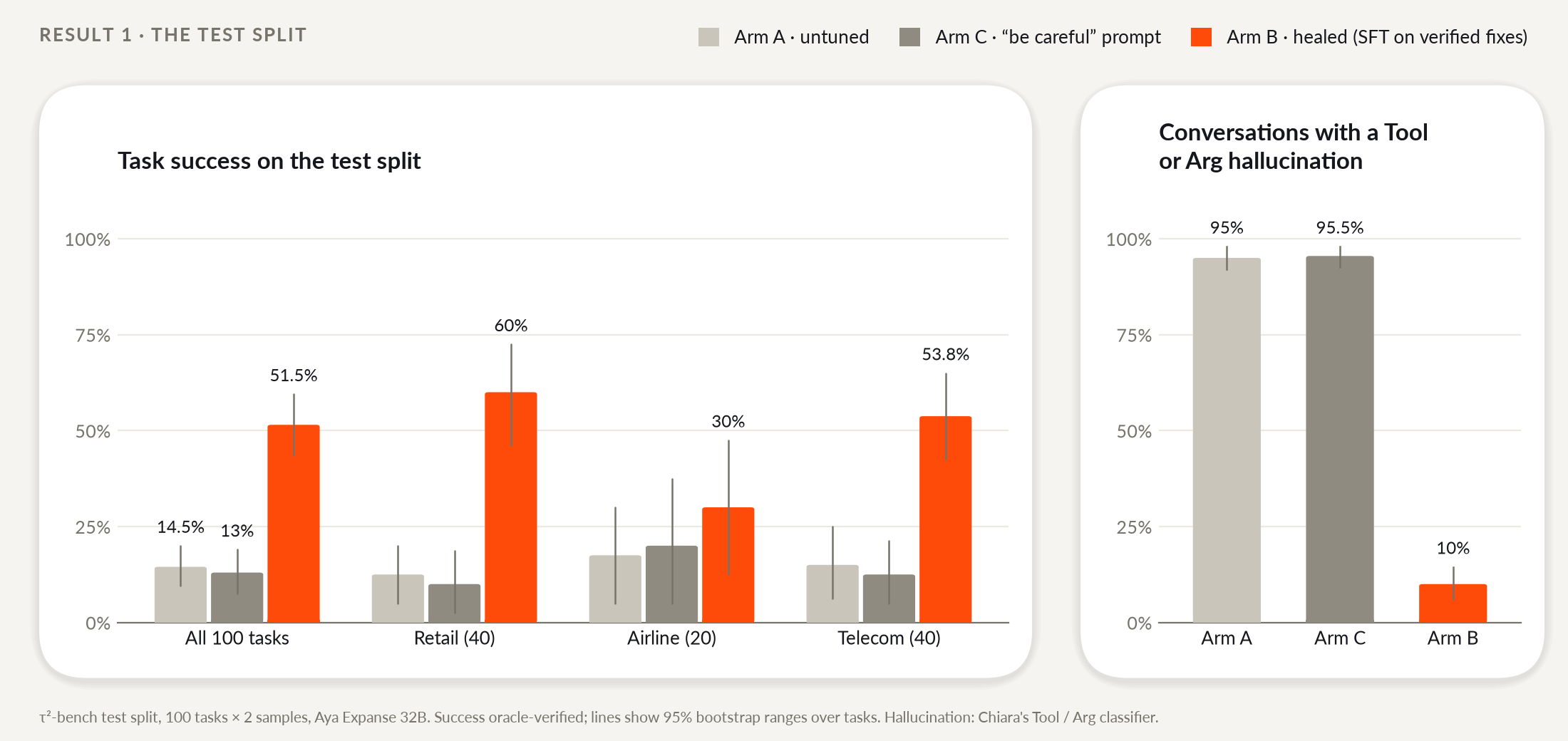
Figure 3. Results on the 100 test tasks. Top: tasks solved, overall and by domain. Bottom: conversations with at least one hallucination. A is the untuned agent, C the same agent told to be careful, and B the agent after healing.
Arm B beats Arm A by 37 points (95% range +28 to +46). The gain is largest in retail and telecom, and smallest in airline, where the remaining failures are policy decisions rather than hallucinations. Conversations where the agent repeats itself fell too, from 49% to 27%.
Before and after: one real conversation
Here is the same test task, a customer returning a broken office chair, before and after healing. Both excerpts are unedited, apart from line breaks and the customer's opening line, which we shortened.
Untuned (Arm A). Before the customer has given any details, the agent invents an email and chains three calls on IDs it doesn't have yet:
Customer: The office chair I ordered showed up with broken pieces. I want to return it.
Agent:    find_user_id_by_email(email="something@example.com")
          get_user_details(user_id="<user_id_from_previous_tool_result>")
          get_order_details(order_id="<latest_order_id_from_user_details>")
Tools:    Error: User not found · Error: User not found · Error: Order not found
It goes on to repeat the same failing pattern, with 19 Tool, Arg and Loop findings in one conversation, until τ²-bench ends it for too many errors.
Healed (Arm B). The agent asks first, then uses only what it has been told or shown:
Customer: The office chair I ordered showed up with broken pieces. I want to return it.
Agent:    I'm sorry to hear that! I'd be happy to help you with the return. First, I need
          to verify your identity. Could you please provide me with the email address
          associated with your account? Or, if you prefer, your first name, last name,
          and zip code.
Customer: I don’t remember my email. My name's Mei Davis, zip code 80217.
Agent:    find_user_id_by_name_zip(first_name="Mei", last_name="Davis", zip="80217")
Tools:    mei_davis_8935
Agent:    get_user_details(user_id="mei_davis_8935")
No findings, and the task passes.
Result 2: the loop, run automatically
We then ran the whole loop on the GPU with no one in it: the student runs train tasks, the classifier finds its failures, the teacher fixes them, an adapter is trained, and the gate decides whether it's swapped in.
First, at the grain we'd designed: fix only the turn that went wrong. The teacher fixed 24 of 24 failures, and the healed adapter made 71% fewer Tool, Arg and Loop errors per conversation. But it solved the same number of dev tasks, 4 against 4, so the gate rejected it. It had trained on 16 rewritten turns, about 1% of the conversations' tokens: it learned not to bluff at the start of a call, not how to finish one.
Then, at the grain that worked by hand: the teacher's whole verified conversation for each failure. The base model failed 106 of 112 train tasks; the loop trained on the 136 verified conversations for them, and the gate ran both adapters on the 36 dev tasks. The healed adapter solved 22 against 6, and made 87% fewer Tool, Arg and Loop errors per conversation (8.2 → 1.0). The gate promoted it and swapped it in, with no one in the loop.
| The loop, run automatically | Fix | Dev tasks (base → healed) | Hallucination findings per conversation | Gate |
|---|---|---|---|---|
| Cycle 1 | one rewritten turn per failure | 4 → 4 | −71% | reject |
| Cycle 2 | whole verified conversations | 6 → 22 | −87% | promote |
This second cycle feeds the loop what Result 1 taught, so a promotion was the expected outcome, and 22 of 36 matches what we got by hand (60% on dev). It shows the automated pipeline can do what we did by hand, not new evidence that healing works: that evidence is the test result above. What the two cycles show together is that the grain of the fix decides whether healing moves success: fixing where an agent first goes wrong isn't enough; it has to learn how to finish the job.
Result 3: what reinforcement learning taught us
We then tried to heal further with GRPO, starting from Arm B. Each training prompt is a conversation up to one agent turn; the model writes that turn 8 times, and a reward scores each attempt.
Our first run trained only on the teacher's tool calls. The model learned that calling a tool was always rewarded, stopped replying to customers, and collapsed: 0.5 of 30 on held-out tasks, against Arm B's 17.0.
Our second run followed the loop. It trained on 177 teacher fixes at real failures, with one reward per failure type (Tool, Arg and Loop), plus agreement with the teacher's fix. It didn't collapse, halved loops, and cut repeated calls in telecom from 45% to 7%. But it solved fewer tasks than Arm B (51% against 60% on dev), and the gate rejected it.
The conversations it lost weren't hallucinations. They were decisions. It cancelled airline reservations nobody asked it to cancel, and in telecom it walked customers through phone settings but skipped the fix on its own side of the account. A cancellation with a real reservation ID passes every hallucination check, whether or not it should happen. Rewarding the absence of hallucination taught the model to act confidently, not correctly.
Our third run added a decision reward. It checked each change against the changes the task still expected. It drifted towards calling tools, and a guard we'd built to watch the share of replies stopped training early. It scored 14.5 of 30, below Arm B's 17.0.
What we learned
- Verified data beats instructions. What healed the agent was hundreds of correct turns, each checked by the benchmark's own evaluator.
- Decide the rule before you see the result. Every model we trained was judged by a rule written down before it ran. Several promising ideas didn't pass, and the rules kept us honest.
- Fewer hallucinations isn't the same as more success. The gate caught this twice.
- The grain of the fix matters. Rewriting one turn removed most hallucinations but solved no more tasks; training on whole verified conversations did both.
- Hallucinations and decision errors are different problems. Once the hallucinations were gone, the remaining failures were about what to change, and when: in 37 of Arm B's 55 failed dev and validation conversations, the classifier finds no hallucination at all. A loop that heals hallucinations has nothing left to fix there. Some of these are hallucinations in a wider sense, such as acting on a request the customer never made, but they can't be seen in the transcript alone: catching them means knowing what the task required. That's the next frontier for self-healing agents.
Limitations
- One benchmark. Every result is on τ²-bench, with 100 test tasks in three customer-service domains. We haven't shown that the healing transfers to other tools or domains.
- Airline improves least. Arm B solves 30% of airline tasks: its remaining failures there are policy decisions, which our classifier doesn't measure.
- It depends on a stronger teacher. The fixes come from GLM-5.3-Flash. The loop can't teach the student what the teacher can't do, and it needs the teacher's conversations to be verified.
- The automated loop wasn't run on test. Its promoted adapter reproduces Arm B's training on dev; the test result is Arm B's.
- Non-commercial. The adapters inherit Aya Expanse 32B's CC BY-NC 4.0 licence.
What's next
The next step is a reward that judges decisions as well as structure, and scores whole conversations rather than single turns. We'd love to hear how others approach it.
Everything is public:
- Code: github.com/CharlieGalvin/lexsi-labs-reflexive-agent
- Arm B, the healed model: reagent-lexsi/sft-aya32b-r16-v2, a LoRA adapter for Aya Expanse 32B. Every other version we trained, adopted or not, is in reagent-lexsi, each with its result and lineage.
- Data: reagent-lexsi/tau2-golden-trajectories, the teacher's verified conversations and the hard subset (CC BY-NC 4.0).
Use the healed model:
from peft import PeftModel
from transformers import AutoModelForCausalLM

base = AutoModelForCausalLM.from_pretrained("CohereLabs/aya-expanse-32b", device_map="auto")
model = PeftModel.from_pretrained(base, "reagent-lexsi/sft-aya32b-r16-v2")
The agent prompt and tool-call format it was trained with are in the code.
Reproduce it yourself
Every run saved its results, so you can step through all five experiments on a laptop in seconds, with no GPU or API keys. Each one is introduced, recomputed from the saved results, and ends with the commands that rerun it from scratch:
git clone https://github.com/CharlieGalvin/lexsi-labs-reflexive-agent && cd lexsi-labs-reflexive-agent
just reproduce            # or: python scripts/blog/reproduce.py
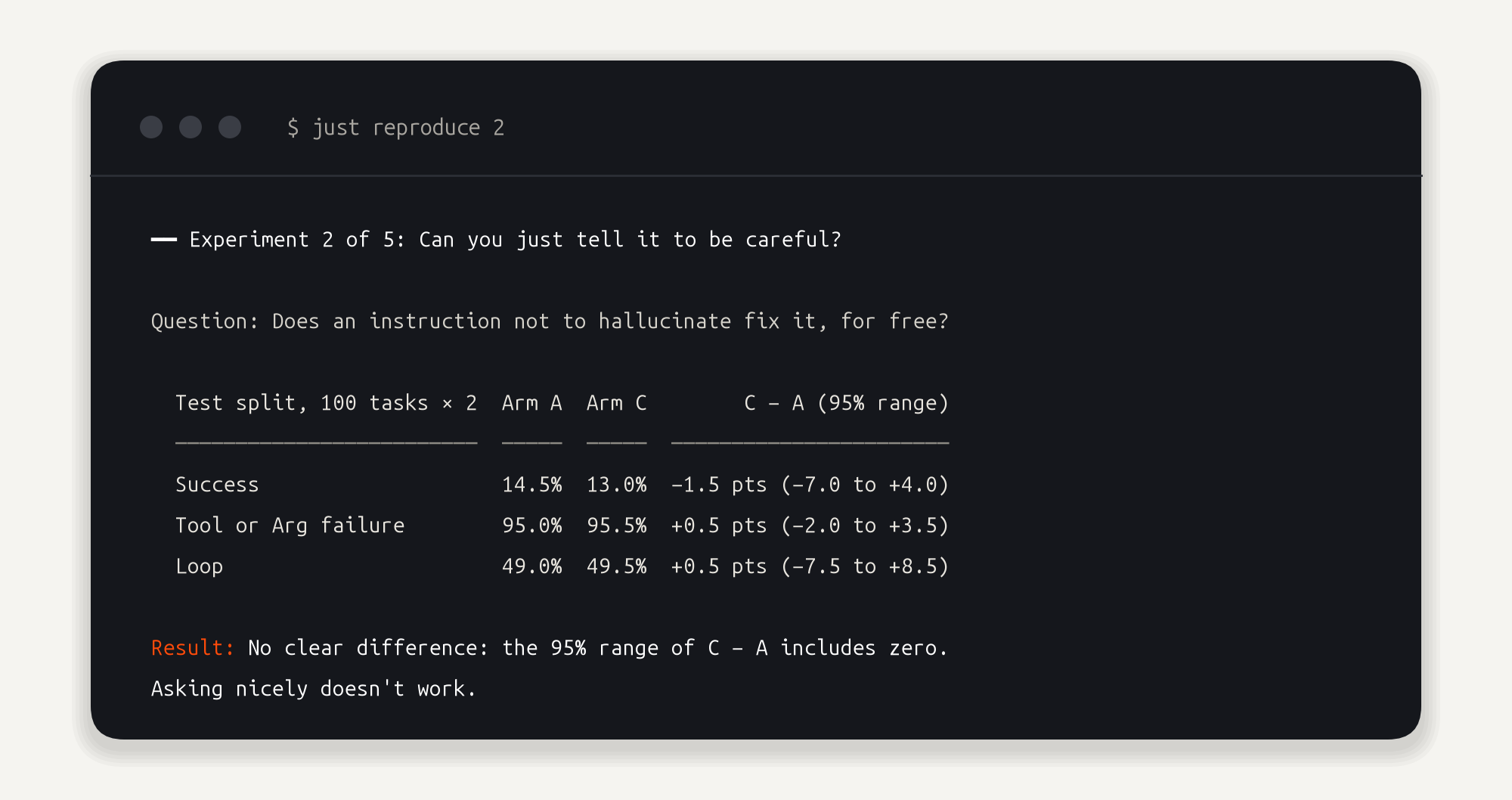
Figure 4. One of the five experiments, recomputed by just reproduce from the saved results.
It ends by checking that every number it recomputed appears in this post exactly as written.
Acknowledgements
Thanks to Lexsi Labs for the hackathon and the stack. Two notes from using it:
- AgentTune: its
FailureDetectorsees only tool calls, so it misses loops made of repeated replies; we added a turn-level monitor for those, and the detector could watch the agent's messages too.lexsi_provenance.jsonworked well as the lineage record for every adapter we published. - AuditKIT: its outcome oracle agreed with τ²-bench's own verdicts on all 600 test conversations.
Its
agent_loop_detectioncounts near-identical replies, such as repeated goodbyes, as loops, so it couldn't separate the untuned and healed agents (125 and 126 of 200) where our classifier could (49% and 27%). Ignoring short closing messages, or counting only repeated tool calls, would fix this.
Citation
@software{reflexive_agents_2026,
  title  = {Reflexive Agents: a self-healing loop for AI agent hallucination},
  author = {Kitchen, Katie and Picardi, Chiara and Galvin, Charlie},
  year   = {2026},
  url    = {https://github.com/CharlieGalvin/lexsi-labs-reflexive-agent}
}

