---
tags:
- confucius4
- r2t2
- asr
- streaming
- real-time
- low-latency
- speech-recognition
- vllm
- multilingual
base_model: Qwen/Qwen3-ASR-1.7B
pipeline_tag: automatic-speech-recognition
license: other
license_name: netease-model-use-license-agreement
license_link: https://raw.githubusercontent.com/netease-youdao/Confucius4-R2T2/refs/heads/master/MODEL_LICENSE
---
Confucius4-R2T2: A Low Latency and High Accuracy Real-Time Speech Recognition Model
Real
Real-Time
Transcription
Confucius4-R2T2 is a low-latency and high-accuracy true streaming Automatic Speech Recognition (ASR) model that features fine-grained and configurable decoding chunks from 80 ms to 2 s. The model operates in append-only output mode: committing transcript text permanently without revising previous words, which is critical for applications where text must be processed or acted upon instantly. This results in a smoother user experience, avoiding disruptive text revisions and visual flickering in real-time applications, such as Real-Time Live Captioning & Subtitling, Downstream NLP Pipelines & LLM Agents, Simultaneous Speech Translation, etc.
R2T2, short for Real Real-Time Transcription, is built upon the Qwen3-ASR model. And it is trained with a unique set of data construction techniques including stable-prefix data, forced time-alignment data, and token-level audio segmentation. Combined with a Longest Stable Prefix (LSP) learning paradigm (tech report will be released soon), R2T2 can dynamically determine when a stable prefix can be safely emitted and when additional audio context is needed. By exposing only stable prefixes, the model provides high-quality context that conditions subsequent predictions while guaranteeing that previously emitted text remains unchanged. Despite its streaming design, R2T2 maintains strong accuracy in offline recognition.
- **Low-latency and high accuracy streaming recognition** — The model achieves accuracy close to that of offline recognition, with only 200 to 600 milliseconds average latency.
- **Stable streaming output** — Emitted text is committed as it arrives and remains unchanged.
- **Configurable low-latency chunking** - Supports decoding chunks from 80 ms to 2 s for different latency/accuracy trade-offs.
- **No loss in offline accuracy** — Adding streaming support does not degrade offline recognition accuracy.
- **vLLM backend** — Provides high-throughput inference. A Hugging Face `transformers` backend is also available.
- **Context and hotword prompts** — Natively supported.
- **Multilingual support** — Optimized for **Chinese and English**, while also supporting a broad range of additional languages.
Experimental results show that R2T2 achieves state-of-the-art (SOTA) performance in both latency and recognition quality among a range of open-source models, while remaining competitive with leading closed-source systems. The [GitHub repository](https://github.com/netease-youdao/Confucius4-R2T2) provides inference code, a minimal usage example, and a vLLM-based backend supporting both offline and real-time streaming inference.
## Table of Contents
- [Overview](#overview)
- [Demo](#demo)
- [Side-by-side comparison with GPT-Live-Transcribe](#side-by-side-comparison-with-gpt-live-transcribe)
- [Additional resources](#additional-resources)
- [Evaluation](#evaluation)
- [Streaming performance](#streaming-performance)
- [Accuracy](#accuracy)
- [English](#english)
- [Chinese](#chinese)
- [Installation](#installation)
- [Clone the repository](#clone-the-repository)
- [Option 1: Conda](#option-1-conda)
- [Option 2: uv](#option-2-uv)
- [Docker (recommended)](#docker-recommended)
- [1. Start a container](#1-start-a-container)
- [2. Run the example inside the container](#2-run-the-example-inside-the-container)
- [3. Manage the container](#3-manage-the-container)
- [Quick Start](#quick-start)
- [Configuration](#configuration)
- [Python API](#python-api)
- [Offline transcription (vLLM backend)](#offline-transcription-vllm-backend)
- [Streaming transcription (vLLM backend)](#streaming-transcription-vllm-backend)
- [WebSocket Server](#websocket-server)
- [Start and stop the server](#start-and-stop-the-server)
- [WebSocket endpoint](#websocket-endpoint)
- [Message format](#message-format)
- [Example client](#example-client)
- [Supported Languages](#supported-languages)
- [Community & Contact](#community--contact)
- [WeChat Group](#wechat-group)
- [Discord Server](#discord-server)
- [Business contact](#business-contact)
- [GitHub Issues](#github-issues)
- [Acknowledgements](#acknowledgements)
- [Citation](#citation)
- [License](#license)
---
## Overview
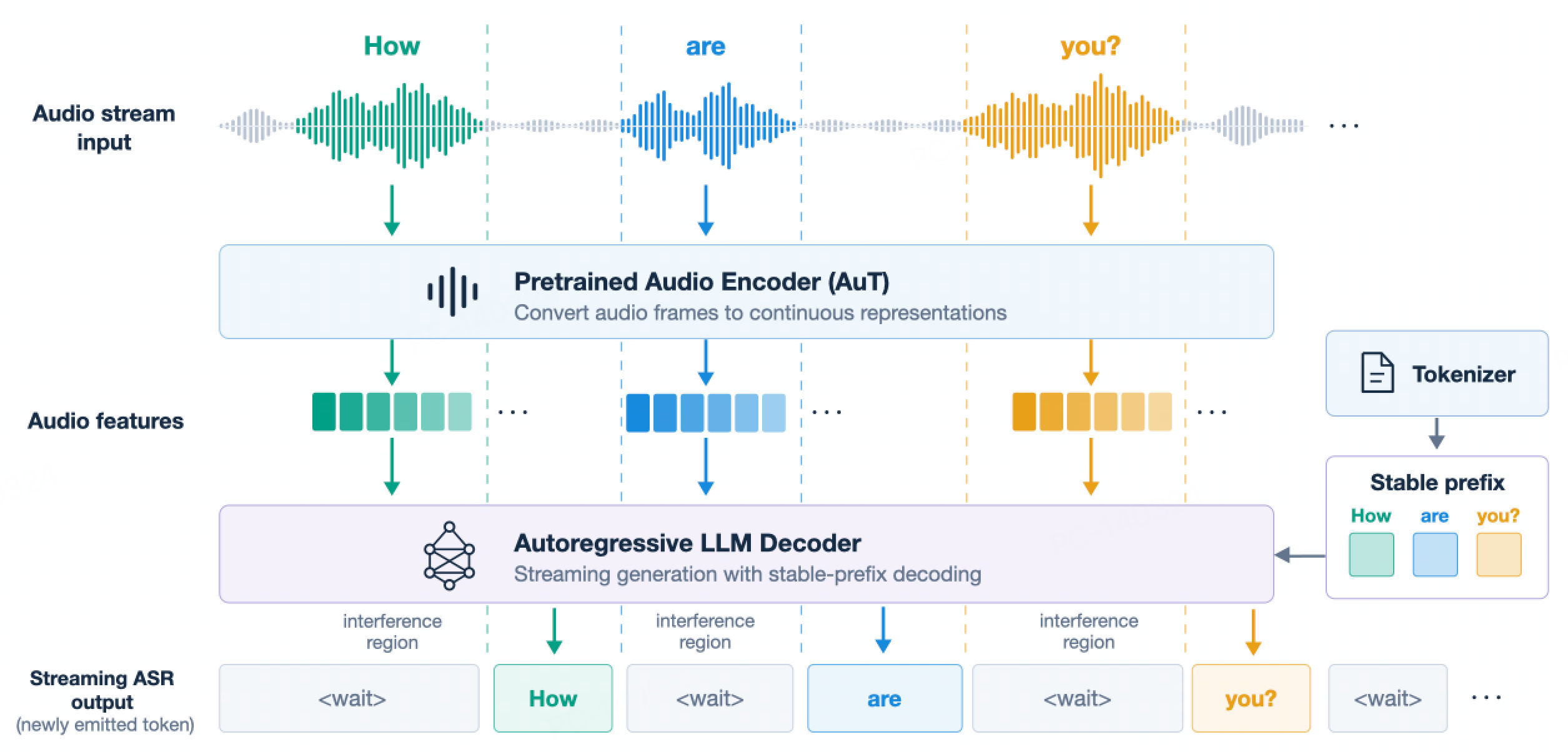
Figure 1. Overall framework of R2T2.
## Demo
### Side-by-side comparison with GPT-Live-Transcribe
Watch the comparison video
Figure 2. GPT-Live-Transcribe and R2T2 processing the same audio, shown together in real time — a side-by-side comparison.
### Additional resources
More demonstrations, comparisons, and supporting resources will be added here.
## Evaluation
> If you are an author or maintainer of a model included in these comparisons and have questions or concerns about the results, please feel free to contact us through the [GitHub issue tracker](https://github.com/netease-youdao/Confucius4-R2T2/issues). We are happy to share evaluation details and work with you to verify or correct them.
### Streaming performance
The streaming API supports decoding chunks from 80 ms to 2 s; the figures below show representative WER/latency trade-offs at 160 ms.
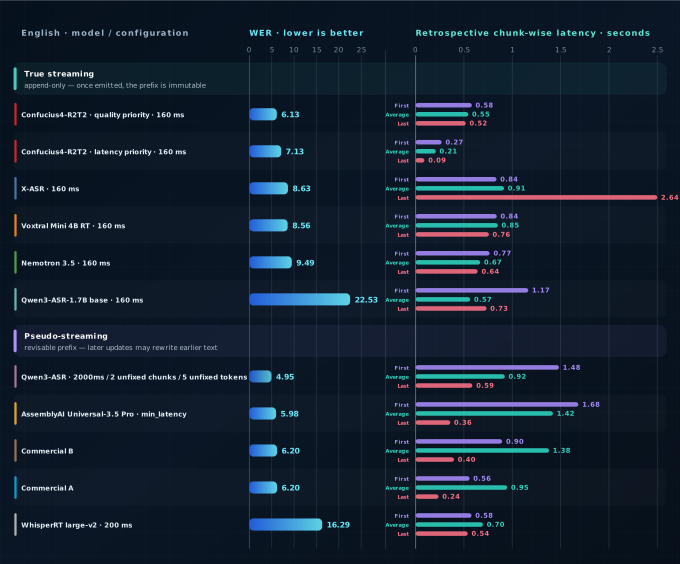
Figure 3. English WER and retrospective chunk-wise latency across model and configuration settings.
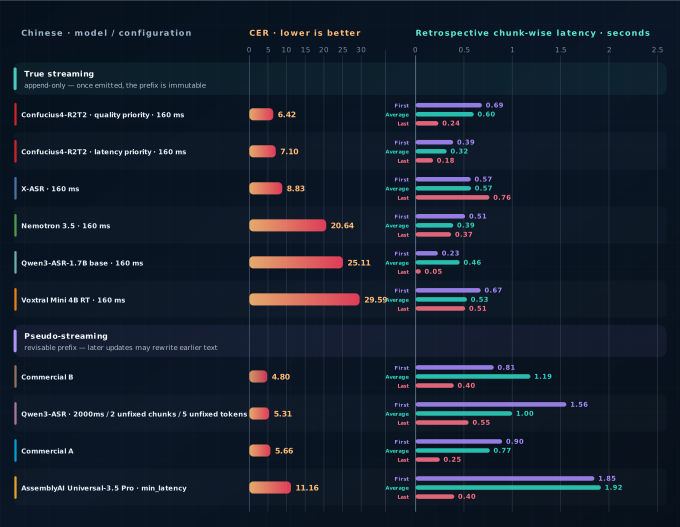
Figure 4. Chinese CER and retrospective chunk-wise latency across model and configuration settings.
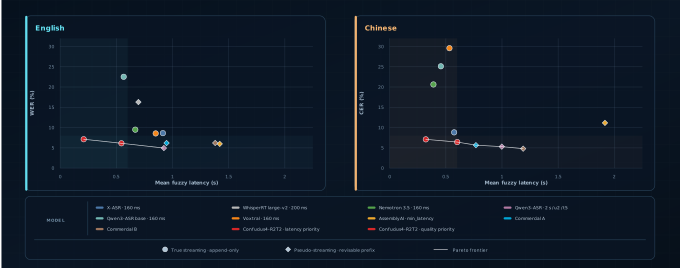
Figure 5. Accuracy-latency Pareto frontier. Lower-left is better; the frontier uses retrospective chunk-wise mean fuzzy latency.
### Accuracy
English results use WER (%), and Chinese results use CER (%); lower is better.
※ Pseudo-streaming model: its partial transcript may revise previously emitted text; unmarked models use true streaming, append-only output.
#### English
| Dataset |
Qwen |
R2T2 (Ours)
160ms |
Open-source |
Proprietary |
Qwen3-ASR※
2s/u2/t5 |
Qwen3-ASR base
160ms |
X-ASR
160ms |
WhisperRT※
200ms |
Nemotron
160ms |
Voxtral
160ms |
AssemblyAI※
min_latency |
Commercial A※ |
Commercial B※ |
| AMI |
9.25 |
24.79 |
11.37 |
14.41 |
24.19 |
18.11 |
15.94 |
12.00 |
13.27 |
8.44 |
| Giga-clean |
8.61 |
24.37 |
9.60 |
10.26 |
13.81 |
12.67 |
11.13 |
9.21 |
8.84 |
9.46 |
| LS-clean |
1.67 |
22.30 |
2.13 |
3.86 |
4.70 |
3.71 |
2.49 |
1.89 |
1.73 |
1.25 |
| LS-other |
3.54 |
25.74 |
4.88 |
9.64 |
9.86 |
8.27 |
7.15 |
3.37 |
3.57 |
2.48 |
| SPGI |
2.90 |
22.25 |
3.00 |
5.14 |
8.66 |
3.93 |
3.06 |
2.14 |
3.06 |
1.74 |
| VoxPopuli |
3.02 |
20.71 |
3.07 |
5.68 |
8.28 |
5.69 |
6.30 |
4.75 |
3.17 |
3.14 |
| Earnings22 |
6.68 |
29.72 |
9.36 |
15.95 |
35.08 |
17.22 |
11.66 |
7.47 |
10.32 |
8.96 |
| TED-LIUM |
2.33 |
19.18 |
3.34 |
3.75 |
6.67 |
5.11 |
4.60 |
3.23 |
3.08 |
3.30 |
| EN-RealSI |
6.54 |
13.75 |
8.40 |
8.97 |
35.36 |
10.69 |
14.75 |
9.73 |
8.73 |
17.05 |
#### Chinese
| Dataset |
Qwen |
R2T2 (Ours)
160ms |
Open-source |
Proprietary |
Qwen3-ASR※
2s/u2/t5 |
Qwen3-ASR base
160ms |
X-ASR
160ms |
WhisperRT※
200ms |
Nemotron
160ms |
Voxtral
160ms |
AssemblyAI※
min_latency |
Commercial A※ |
Commercial B※ |
| Wenet-net |
4.94 |
19.79 |
5.87 |
8.81 |
U |
24.70 |
23.53 |
12.91 |
5.13 |
4.79 |
| Wenet-meeting |
5.97 |
20.38 |
7.27 |
11.33 |
U |
20.18 |
60.54 |
11.84 |
7.07 |
3.75 |
| SPEECHIO-06 |
6.10 |
24.50 |
7.30 |
7.86 |
U |
22.52 |
32.16 |
15.08 |
5.67 |
5.34 |
| SPEECHIO-07 |
6.19 |
21.16 |
8.20 |
11.22 |
U |
24.28 |
22.97 |
10.84 |
6.45 |
6.46 |
| CN-RealSI |
3.34 |
39.72 |
3.48 |
4.92 |
U |
11.52 |
8.74 |
5.15 |
3.99 |
3.64 |
## Installation
We recommend using a **fresh, isolated environment**. For local development and
source installation, use the **Conda** or **uv** environment below. **Docker** is
recommended for quickly running the project with a preconfigured CUDA and runtime
environment — see [Docker](#docker-recommended).
### Clone the repository
```bash
git clone https://github.com/netease-youdao/Confucius4-R2T2.git
cd Confucius4-R2T2
```
### Option 1: Conda
```bash
conda create -n confucius4-r2t2 python=3.12 -y
conda activate confucius4-r2t2
# Install the package with the vLLM backend
pip install -e .
```
### Option 2: uv
```bash
uv venv --python 3.12
source .venv/bin/activate
# Install the package with the vLLM backend
uv pip install -e .
```
Python 3.10+ is supported. Python 3.12 is the version we test against.
vLLM has strict CUDA / PyTorch compatibility requirements. If the install
fails to resolve, check the version matrix on the [vLLM website](https://docs.vllm.ai/)
and pin a combination that matches your CUDA runtime.
## Docker (recommended)
R2T2 runs out of the box on the official **Qwen3-ASR** Docker image, which already ships every runtime library we need.
Pre-built image: [qwenllm/qwen3-asr](https://hub.docker.com/r/qwenllm/qwen3-asr).
Before you begin, install the [NVIDIA Container Toolkit](https://docs.nvidia.com/datacenter/cloud-native/container-toolkit/latest/install-guide.html) to enable GPU access from Docker. If Docker Hub access is slow or unreliable in your region, you may need to configure a registry mirror.
### 1. Start a container
```bash
LOCAL_WORKDIR=/path/to/your/workspace # host path that will be mounted into the container
HOST_PORT=8000
CONTAINER_PORT=80
docker run --gpus all --name confucius4-r2t2 \
-v /var/run/docker.sock:/var/run/docker.sock \
-p $HOST_PORT:$CONTAINER_PORT \
--mount type=bind,source=$LOCAL_WORKDIR,target=/data/shared/confucius4-r2t2 \
--shm-size=4gb \
-it qwenllm/qwen3-asr:latest
```
Your local workspace (`$LOCAL_WORKDIR`) — including a checkout of this repository and the R2T2 checkpoint — will be mounted inside the container at `/data/shared/confucius4-r2t2`. Host port `8000` is mapped to container port `80`; services running inside the container must bind to `0.0.0.0` (not `127.0.0.1`) for port forwarding to work.
### 2. Run the example inside the container
Once inside the container's shell:
```bash
cd /data/shared/confucius4-r2t2/Confucius4-R2T2
MODEL_PATH=/data/shared/confucius4-r2t2/Confucius4-R2T2 \
./run_example.sh /path/to/audio.wav
```
### 3. Manage the container
```bash
# re-enter after exiting
docker start confucius4-r2t2
docker exec -it confucius4-r2t2 bash
# remove completely
docker rm -f confucius4-r2t2
```
## Quick Start
Grab any audio file (mono or stereo, any sample rate — it is resampled to 16 kHz internally) and run:
```bash
./run_example.sh /path/to/audio.wav \
--model_path /path/to/Confucius4-R2T2 \
--infer_mode stream_vllm \
--language Chinese \
--chunk_size_ms 160
```
Logs are written to `run_example.log` by default. Run `./run_example.sh --help` to see the full flag list.
### Configuration
`run_example.sh` reads the following environment variables (all optional):
| Variable | Default | Description |
| --------------------- | ------------------ | ------------------------------------------------------ |
| `MODEL_PATH` | (required) | Path or HF repo id of the R2T2 checkpoint |
| `AUDIO` | first CLI argument | Path to the input audio file |
| `INFER_MODE` | `stream_vllm` | `stream_vllm` or `onetime_vllm` |
| `LANGUAGE` | `Chinese` | Language hint (e.g. `Chinese`, `English`, …) |
| `CHUNK_SIZE_MS` | `160` | Streaming chunk size (80 ms–2 s supported) |
| `UNFIXED_TOKEN_NUM` | `1` | Number of unfixed trailing tokens (rollback window) |
| `CONTEXT` | `""` | Context / hotword hint prepended to the prompt |
| `CUDA_VISIBLE_DEVICES`| `0` | GPU id(s) to expose |
| `LOG_FILE` | `run_example.log` | Where to write logs |
You can also call `example.py` directly and pass any of these as flags (`--audio`, `--model_path`, `--infer_mode`, `--language`, `--chunk_size_ms`, `--lookahead_ms`, `--unfixed_token_num`, `--context`).
## Python API
Audio inputs can be passed as a local path, a URL, base64 data, or a `(np.ndarray, sr)` tuple. Batched inference is supported. Remember to wrap vLLM code under `if __name__ == '__main__':` to avoid the `spawn` error described in [vLLM Troubleshooting](https://docs.vllm.ai/en/latest/usage/troubleshooting/#python-multiprocessing).
### Offline transcription (vLLM backend)
```python
import librosa
from qwen_asr import Qwen3ASRModel
if __name__ == "__main__":
asr = Qwen3ASRModel.LLM(
model="/path/to/Confucius4-R2T2",
gpu_memory_utilization=0.5,
max_inference_batch_size=32,
max_new_tokens=4096,
)
wav, sr = librosa.load("path/to/audio.wav", sr=16000, mono=True)
results = asr.transcribe(
audio=[(wav, 16000)],
language=["Chinese"], # or [None]
return_time_stamps=False,
)
print(results[0].language, results[0].text)
```
### Streaming transcription (vLLM backend)
```python
import librosa
from qwen_asr import Qwen3ASRModel
if __name__ == "__main__":
asr = Qwen3ASRModel.LLM(
model="/path/to/Confucius4-R2T2",
gpu_memory_utilization=0.4,
max_new_tokens=4, # keep small for low-latency streaming
)
wav, sr = librosa.load("path/to/audio.wav", sr=16000, mono=True)
state = asr.init_streaming_state(
context="", # optional hotword / topic hint
language="Chinese", # or None
unfixed_chunk_num=0,
unfixed_token_num=1,
chunk_size_sec=0.16,
)
step = int(0.16 * 16000)
for pos in range(0, len(wav), step):
seg = wav[pos : pos + step]
_, text = asr.streaming_transcribe(seg, state, max_new_tokens=2)
print("text:", text)
asr.finish_streaming_transcribe(state)
print("final:", state.text)
```
For a complete streaming example with adaptive `max_new_tokens` and initial-chunk lookahead handling, see [`example.py`](https://github.com/netease-youdao/Confucius4-R2T2/blob/master/example.py).
## WebSocket Server
For real-time, multi-client streaming ASR, the [GitHub repository](https://github.com/netease-youdao/Confucius4-R2T2) ships a ready-to-run WebSocket server (`ws_server.py`), a launcher script (`run_start_server.sh`), and a reference Python client (`ws_client.py`).
### Start and stop the server
```bash
# Start with a VAD model
./run_start_server.sh start \
--model_path /path/to/Confucius4-R2T2 \
--vad_model_path /path/to/Stream-VAD \
--port 8272 \
--gpu 0
# Stop
./run_start_server.sh kill
# Restart in one step
./run_start_server.sh restart \
--model_path /path/to/Confucius4-R2T2 \
--vad_model_path /path/to/Stream-VAD \
--port 8272 \
--gpu 0
```
| Flag | Env var | Default | Description |
| --------------------- | -------------------- | -------------------------------------------------------------- | ---------------------------------------------------- |
| `-m`, `--model_path` | `ASR_MODEL_PATH` | (required) | Path or HF repo id of the R2T2 checkpoint |
| `-v`,`--vad_model_path` | `VAD_MODEL_PATH` | `checkpoints/vad/Stream-VAD` | Path to the FireRedVAD Stream-VAD model |
| `-p`, `--port` | `PORT` | `8272` | Port the WebSocket server binds to |
| `-g`, `--gpu` | `CUDA_VISIBLE_DEVICES` | `0` | GPU id(s) exposed to the server process |
| `-h`, `--host` | `HOST_TAG` | `localhost` | Host tag used only in the log file name |
The launcher resolves its own directory, so it can be invoked from anywhere. Logs are written to `nohup_service_ws__.log` in the current directory. The FireRedVAD model is available from [Hugging Face](https://huggingface.co/FireRedTeam/FireRedVAD/tree/main). We recommend downloading the model files into this repository's `checkpoints` directory:
```bash
# The FireRedVAD repo ships several detectors, but only the streaming one is
# needed. Both commands below keep the `Stream-VAD/` folder name, so the files
# land in checkpoints/vad/Stream-VAD with no extra nesting.
# Option A — hf CLI (pip install -U "huggingface_hub[cli]")
hf download FireRedTeam/FireRedVAD \
--include "Stream-VAD/*" \
--local-dir checkpoints/vad
# Option B — git clone
git clone https://huggingface.co/FireRedTeam/FireRedVAD
cp -r FireRedVAD/Stream-VAD checkpoints/vad/
```
Either command leaves the model at `checkpoints/vad/Stream-VAD`, which is exactly what `--vad_model_path` defaults to — so you can drop the flag entirely.
### WebSocket endpoint
| Path | Behavior |
| -------------------------- | ------------------------------------------------------------------------ |
| `/asr_stream_api_v1` | Streaming ASR. Each message's `text` is the **new (incremental)** chunk. |
### Message format
**Client → Server:**
- Send raw 16 kHz mono PCM as `int16` binary frames (the reference client uses ≈160 ms per frame, i.e. 2560 samples × 2 bytes).
- Send the string `"YOUDAO_ONETIME_ASR_STREAM_EOS"` to signal end-of-audio; the server will emit any final text and close.
**Server → Client:** JSON messages of the form
```json
{
"status": "success",
"requestId": "",
"msg": {
"text": "hello",
"reset": false,
"asr_cost_ms": 35.4,
"total_cost_ms": 42.0
}
}
```
- `text` is the newly recognized (incremental) segment since the previous message. Concatenate them client-side to get the full transcript.
### Example client
`ws_client.py` is a minimal example that streams a WAV file to the server and prints the responses.
```bash
# Uses the default URI (ws://localhost:8272/asr_stream_api_v1) and built-in sample audio
python ws_client.py
# Point at a custom endpoint and audio file
python ws_client.py \
--uri wss://your.host/asr_stream_api_v1 \
--audio resources/test.wav \
--save service_ws_test \
--audio-id test.wav
```
Command-line options:
| Flag | Env var | Default | Description |
| -------------------- | -------------- | --------------------------------------------- | ------------------------------------------------------------------ |
| `--uri` / `-u` | `ASR_WS_URI` | `ws://localhost:8272/asr_stream_api_v1` | WebSocket endpoint to connect to. |
| `--audio` / `-a` | — | built-in sample path | Input audio file (WAV, 16 kHz mono recommended). |
| `--save` / `-s` | — | `service_ws_test` | File to append the final transcript to. |
| `--audio-id` | — | basename of `--audio` | Identifier written next to the result in `--save`. |
## Supported Languages
R2T2 is optimized for streaming recognition in Chinese and English. Beyond these primary languages, it retains useful cross-lingual streaming capability on languages such as French, German, Italian, Japanese, Korean, Portuguese, Russian, Spanish, Arabic, etc.
## Community & Contact
Join our community to ask questions, share ideas, and connect with other users and developers.
### WeChat Group
Scan the QR code below to join our WeChat group:
 ### Discord Server
[Join our Discord server](https://discord.gg/GfhaWkCyb)
### Business contact
For high-concurrency, production-grade, domestically deployable, or private deployment solutions, as well as business inquiries and partnership opportunities, please feel free to contact us through the channels below.
- **Phone:** +86 010-82558901
- **Email:** [AIcloud_Business@corp.youdao.com](mailto:AIcloud_Business@corp.youdao.com)
### GitHub Issues
We also welcome discussions in this repository’s [Issues](https://github.com/netease-youdao/Confucius4-R2T2/issues) section. Feel free to ask questions, report bugs, or suggest improvements!
---
## Acknowledgements
We sincerely thank the Alibaba Qwen team for open-sourcing the [Qwen3-ASR](https://github.com/QwenLM/Qwen3-ASR) modeling code, which provides the architectural foundation for R2T2.
## Citation
If you use this repository or the R2T2 checkpoint in your research, please cite **Confucius4-R2T2** (this project):
```bibtex
@misc{Confucius4-R2T2,
title = {Confucius4-R2T2: A Low Latency and High Accuracy Real-Time Speech Recognition Model},
author = {NetEase Youdao},
year = {2026},
howpublished = {https://github.com/netease-youdao/Confucius4-R2T2}
}
```
## License
R2T2 uses **dual licensing** to distinguish the source code from the model weights:
- **Code** in the accompanying GitHub repository is released under the [Apache License 2.0](https://github.com/netease-youdao/Confucius4-R2T2/blob/master/LICENSE) and is free to use, modify, and redistribute (including commercially) under the terms of that license.
- **Model weights** are released under the [NetEase Model Use License Agreement](https://github.com/netease-youdao/Confucius4-R2T2/blob/master/MODEL_LICENSE).
### Discord Server
[Join our Discord server](https://discord.gg/GfhaWkCyb)
### Business contact
For high-concurrency, production-grade, domestically deployable, or private deployment solutions, as well as business inquiries and partnership opportunities, please feel free to contact us through the channels below.
- **Phone:** +86 010-82558901
- **Email:** [AIcloud_Business@corp.youdao.com](mailto:AIcloud_Business@corp.youdao.com)
### GitHub Issues
We also welcome discussions in this repository’s [Issues](https://github.com/netease-youdao/Confucius4-R2T2/issues) section. Feel free to ask questions, report bugs, or suggest improvements!
---
## Acknowledgements
We sincerely thank the Alibaba Qwen team for open-sourcing the [Qwen3-ASR](https://github.com/QwenLM/Qwen3-ASR) modeling code, which provides the architectural foundation for R2T2.
## Citation
If you use this repository or the R2T2 checkpoint in your research, please cite **Confucius4-R2T2** (this project):
```bibtex
@misc{Confucius4-R2T2,
title = {Confucius4-R2T2: A Low Latency and High Accuracy Real-Time Speech Recognition Model},
author = {NetEase Youdao},
year = {2026},
howpublished = {https://github.com/netease-youdao/Confucius4-R2T2}
}
```
## License
R2T2 uses **dual licensing** to distinguish the source code from the model weights:
- **Code** in the accompanying GitHub repository is released under the [Apache License 2.0](https://github.com/netease-youdao/Confucius4-R2T2/blob/master/LICENSE) and is free to use, modify, and redistribute (including commercially) under the terms of that license.
- **Model weights** are released under the [NetEase Model Use License Agreement](https://github.com/netease-youdao/Confucius4-R2T2/blob/master/MODEL_LICENSE).







