

File size: 3,016 Bytes
c1e8184 56fc6c4 c1e8184 56fc6c4 c1e8184 56fc6c4 c1e8184 56fc6c4 c1e8184 56fc6c4 c1e8184 56fc6c4 c1e8184 56fc6c4 c1e8184 56fc6c4 c1e8184 56fc6c4 c1e8184 56fc6c4 c1e8184 56fc6c4 c1e8184 56fc6c4 c1e8184 | 1 2 3 4 5 6 7 8 9 10 11 12 13 14 15 16 17 18 19 20 21 22 23 24 25 26 27 28 29 30 31 32 33 34 35 36 37 38 39 40 41 42 43 44 45 46 47 48 49 50 51 52 53 54 55 56 57 58 59 60 61 62 63 64 65 66 67 68 69 70 71 72 73 74 75 76 77 78 79 80 81 82 83 84 85 86 87 88 89 90 91 92 93 94 | ---
license: bsd-3-clause
library_name: braindecode
pipeline_tag: feature-extraction
tags:
- eeg
- biosignal
- pytorch
- neuroscience
- braindecode
- foundation-model
- sleep-staging
---
# BIOT
BIOT from Yang et al (2023) [Yang2023]
> **Architecture-only repository.** Documents the
> `braindecode.models.BIOT` class. **No pretrained weights are
> distributed here.** Instantiate the model and train it on your own
> data.
## Quick start
```bash
pip install braindecode
```
```python
from braindecode.models import BIOT
model = BIOT(
n_chans=16,
sfreq=200,
input_window_seconds=10.0,
n_outputs=2,
)
```
The signal-shape arguments above are illustrative defaults — adjust to
match your recording.
## Documentation
- Full API reference: <https://braindecode.org/stable/generated/braindecode.models.BIOT.html>
- Interactive browser (live instantiation, parameter counts):
<https://huggingface.co/spaces/braindecode/model-explorer>
- Source on GitHub: <https://github.com/braindecode/braindecode/blob/master/braindecode/models/biot.py#L56>
## Architecture
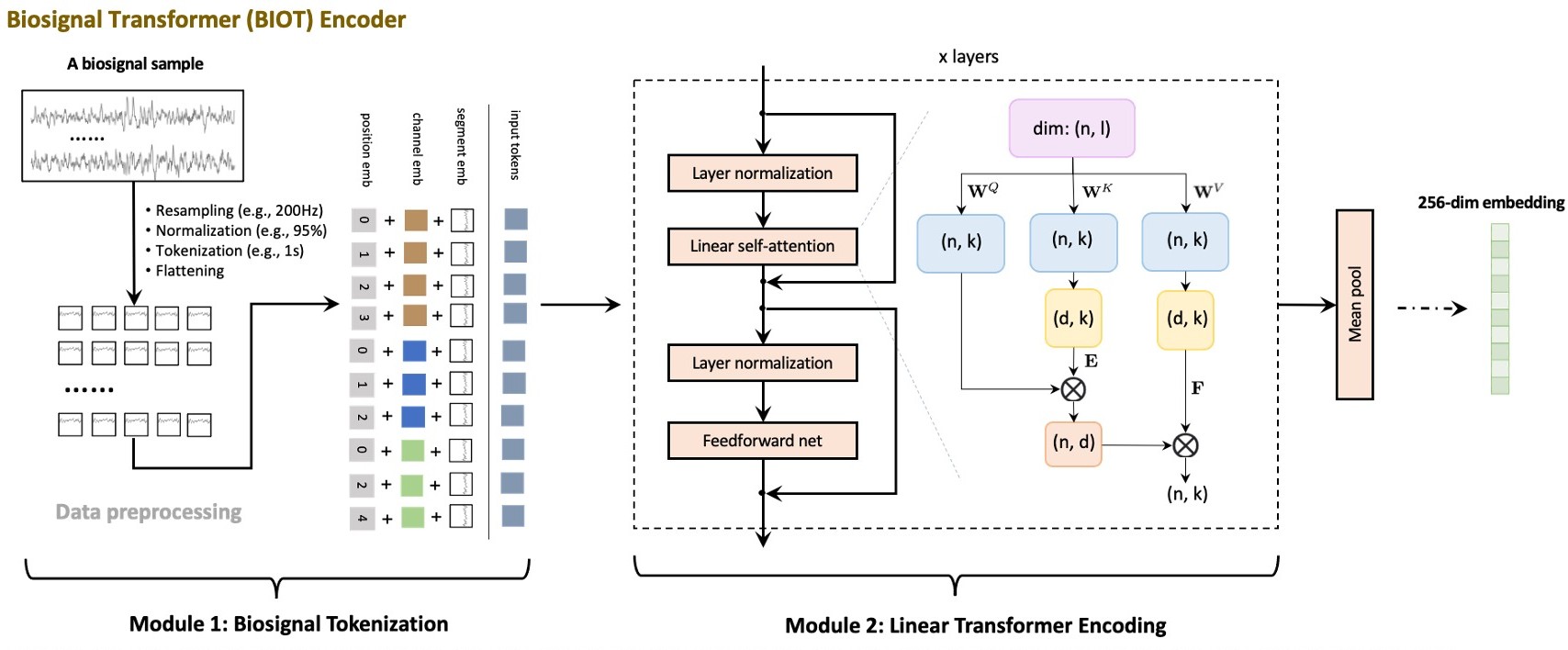
## Parameters
| Parameter | Type | Description |
|---|---|---|
| `embed_dim` | int, optional | The size of the embedding layer, by default 256 |
| `num_heads` | int, optional | The number of attention heads, by default 8 |
| `num_layers` | int, optional | The number of transformer layers, by default 4 |
| `activation: nn.Module, default=nn.ELU` | — | Activation function class to apply. Should be a PyTorch activation module class like `nn.ReLU` or `nn.ELU`. Default is `nn.ELU`. |
| `return_feature: bool, optional` | — | Changing the output for the neural network. Default is single tensor when return_feature is True, return embedding space too. Default is False. |
| `hop_length: int, optional` | — | The hop length for the torch.stft transformation in the encoder. The default is 100. |
| `sfreq: int, optional` | — | The sfreq parameter for the encoder. The default is 200 |
## References
1. Yang, C., Westover, M.B. and Sun, J., 2023, November. BIOT: Biosignal Transformer for Cross-data Learning in the Wild. In Thirty-seventh Conference on Neural Information Processing Systems, NeurIPS.
2. Yang, C., Westover, M.B. and Sun, J., 2023. BIOT Biosignal Transformer for Cross-data Learning in the Wild. GitHub https://github.com/ycq091044/BIOT (accessed 2024-02-13)
## Citation
Cite the original architecture paper (see *References* above) and braindecode:
```bibtex
@article{aristimunha2025braindecode,
title = {Braindecode: a deep learning library for raw electrophysiological data},
author = {Aristimunha, Bruno and others},
journal = {Zenodo},
year = {2025},
doi = {10.5281/zenodo.17699192},
}
```
## License
BSD-3-Clause for the model code (matching braindecode).
Pretraining-derived weights, if you fine-tune from a checkpoint,
inherit the licence of that checkpoint and its training corpus.
|