| {"year": "2005", "tier": "T1", "problem_label": "1", "problem_type": null, "exam": "APMO", "problem": "Prove that for every irrational real number $a$, there are irrational real numbers $b$ and $b^{\\prime}$ so that $a+b$ and $a b^{\\prime}$ are both rational while $a b$ and $a+b^{\\prime}$ are both irrational.", "solution": "Let $a$ be an irrational number. If $a^{2}$ is irrational, we let $b=-a$. Then, $a+b=0$ is rational and $a b=-a^{2}$ is irrational. If $a^{2}$ is rational, we let $b=a^{2}-a$. Then, $a+b=a^{2}$ is rational and $a b=a^{2}(a-1)$. Since\n\n$$\na=\\frac{a b}{a^{2}}+1\n$$\n\nis irrational, so is $a b$.\nNow, we let $b^{\\prime}=\\frac{1}{a}$ or $b^{\\prime}=\\frac{2}{a}$. Then $a b^{\\prime}=1$ or 2 , which is rational. Note that\n\n$$\na+b^{\\prime}=\\frac{a^{2}+1}{a} \\quad \\text { or } \\quad a+b^{\\prime}=\\frac{a^{2}+2}{a} .\n$$\n\nSince,\n\n$$\n\\frac{a^{2}+2}{a}-\\frac{a^{2}+1}{a}=\\frac{1}{a}\n$$\n\nat least one of them is irrational.", "metadata": {"resource_path": "APMO/segmented/en-apmo2005_sol.jsonl", "problem_match": "\nProblem 1.", "solution_match": "(Solution)"}} |
| {"year": "2005", "tier": "T1", "problem_label": "2", "problem_type": null, "exam": "APMO", "problem": "Let $a, b$ and $c$ be positive real numbers such that $a b c=8$. Prove that\n\n$$\n\\frac{a^{2}}{\\sqrt{\\left(1+a^{3}\\right)\\left(1+b^{3}\\right)}}+\\frac{b^{2}}{\\sqrt{\\left(1+b^{3}\\right)\\left(1+c^{3}\\right)}}+\\frac{c^{2}}{\\sqrt{\\left(1+c^{3}\\right)\\left(1+a^{3}\\right)}} \\geq \\frac{4}{3} .\n$$", "solution": "Observe that\n\n$$\n\\frac{1}{\\sqrt{1+x^{3}}} \\geq \\frac{2}{2+x^{2}}\n$$\n\nIn fact, this is equivalent to $\\left(2+x^{2}\\right)^{2} \\geq 4\\left(1+x^{3}\\right)$, or $x^{2}(x-2)^{2} \\geq 0$. Notice that equality holds in (1) if and only if $x=2$.\n\nWe substitute $x$ by $a, b, c$ in (1), respectively, to find\n\n$$\n\\begin{gathered}\n\\frac{a^{2}}{\\sqrt{\\left(1+a^{3}\\right)\\left(1+b^{3}\\right)}}+\\frac{b^{2}}{\\sqrt{\\left(1+b^{3}\\right)\\left(1+c^{3}\\right)}}+\\frac{c^{2}}{\\sqrt{\\left(1+c^{3}\\right)\\left(1+a^{3}\\right)}} \\\\\n\\geq \\frac{4 a^{2}}{\\left(2+a^{2}\\right)\\left(2+b^{2}\\right)}+\\frac{4 b^{2}}{\\left(2+b^{2}\\right)\\left(2+c^{2}\\right)}+\\frac{4 c^{2}}{\\left(2+c^{2}\\right)\\left(2+a^{2}\\right)}\n\\end{gathered}\n$$\n\nWe combine the terms on the right hand side of (2) to obtain\n\n$$\n\\text { Left hand side of }(2) \\geq \\frac{2 S(a, b, c)}{36+S(a, b, c)}=\\frac{2}{1+36 / S(a, b, c)}\n$$\n\nwhere $S(a, b, c):=2\\left(a^{2}+b^{2}+c^{2}\\right)+(a b)^{2}+(b c)^{2}+(c a)^{2}$. By AM-GM inequality, we have\n\n$$\n\\begin{aligned}\na^{2}+b^{2}+c^{2} & \\geq 3 \\sqrt[3]{(a b c)^{2}}=12 \\\\\n(a b)^{2}+(b c)^{2}+(c a)^{2} & \\geq 3 \\sqrt[3]{(a b c)^{4}}=48\n\\end{aligned}\n$$\n\nNote that the equalities holds if and only if $a=b=c=2$. The above inequalities yield\n\n$$\nS(a, b, c)=2\\left(a^{2}+b^{2}+c^{2}\\right)+(a b)^{2}+(b c)^{2}+(c a)^{2} \\geq 72\n$$\n\nTherefore\n\n$$\n\\frac{2}{1+36 / S(a, b, c)} \\geq \\frac{2}{1+36 / 72}=\\frac{4}{3}\n$$\n\nwhich is the required inequality.", "metadata": {"resource_path": "APMO/segmented/en-apmo2005_sol.jsonl", "problem_match": "\nProblem 2.", "solution_match": "(Solution)"}} |
| {"year": "2005", "tier": "T1", "problem_label": "3", "problem_type": null, "exam": "APMO", "problem": "Prove that there exists a triangle which can be cut into 2005 congruent triangles.", "solution": "Suppose that one side of a triangle has length $n$. Then it can be cut into $n^{2}$ congruent triangles which are similar to the original one and whose corresponding sides to the side of length $n$ have lengths 1 .\n\nSince $2005=5 \\times 401$ where 5 and 401 are primes and both primes are of the type $4 k+1$, it is representable as a sum of two integer squares. Indeed, it is easy to see that\n\n$$\n\\begin{aligned}\n2005 & =5 \\times 401=\\left(2^{2}+1\\right)\\left(20^{2}+1\\right) \\\\\n& =40^{2}+20^{2}+2^{2}+1 \\\\\n& =(40-1)^{2}+2 \\times 40+20^{2}+2^{2} \\\\\n& =39^{2}+22^{2}\n\\end{aligned}\n$$\n\nLet $A B C$ be a right-angled triangle with the legs $A B$ and $B C$ having lengths 39 and 22 , respectively. We draw the altitude $B K$, which divides $A B C$ into two similar triangles. Now we divide $A B K$ into $39^{2}$ congruent triangles as described above and $B C K$ into $22^{2}$ congruent triangles. Since $A B K$ is similar to $B K C$, all 2005 triangles will be congruent.", "metadata": {"resource_path": "APMO/segmented/en-apmo2005_sol.jsonl", "problem_match": "\nProblem 3.", "solution_match": "(Solution)"}} |
| {"year": "2005", "tier": "T1", "problem_label": "4", "problem_type": null, "exam": "APMO", "problem": "In a small town, there are $n \\times n$ houses indexed by $(i, j)$ for $1 \\leq i, j \\leq n$ with $(1,1)$ being the house at the top left corner, where $i$ and $j$ are the row and column indices, respectively. At time 0 , a fire breaks out at the house indexed by $(1, c)$, where $c \\leq \\frac{n}{2}$. During each subsequent time interval $[t, t+1]$, the fire fighters defend a house which is not yet on fire while the fire spreads to all undefended neighbors of each house which was on fire at time $t$. Once a house is defended, it remains so all the time. The process ends when the fire can no longer spread. At most how many houses can be saved by the fire fighters? A house indexed by $(i, j)$ is a neighbor of a house indexed by $(k, \\ell)$ if $|i-k|+|j-\\ell|=1$.", "solution": "At most $n^{2}+c^{2}-n c-c$ houses can be saved. This can be achieved under the following order of defending:\n\n$$\n\\begin{gathered}\n(2, c),(2, c+1) ;(3, c-1),(3, c+2) ;(4, c-2),(4, c+3) ; \\ldots \\\\\n(c+1,1),(c+1,2 c) ;(c+1,2 c+1), \\ldots,(c+1, n)\n\\end{gathered}\n$$\n\nUnder this strategy, there are\n2 columns (column numbers $c, c+1$ ) at which $n-1$ houses are saved\n2 columns (column numbers $c-1, c+2$ ) at which $n-2$ houses are saved\n...\n2 columns (column numbers $1,2 c$ ) at which $n-c$ houses are saved\n$n-2 c$ columns (column numbers $n-2 c+1, \\ldots, n$ ) at which $n-c$ houses are saved\nAdding all these we obtain :\n\n$$\n2[(n-1)+(n-2)+\\cdots+(n-c)]+(n-2 c)(n-c)=n^{2}+c^{2}-c n-c\n$$\n\nWe say that a house indexed by $(i, j)$ is at level $t$ if $|i-1|+|j-c|=t$. Let $d(t)$ be the number of houses at level $t$ defended by time $t$, and $p(t)$ be the number of houses at levels greater than $t$ defended by time $t$. It is clear that\n\n$$\np(t)+\\sum_{i=1}^{t} d(i) \\leq t \\text { and } p(t+1)+d(t+1) \\leq p(t)+1\n$$\n\nLet $s(t)$ be the number of houses at level $t$ which are not burning at time $t$. We prove that\n\n$$\ns(t) \\leq t-p(t) \\leq t\n$$\n\nfor $1 \\leq t \\leq n-1$ by induction. It is obvious when $t=1$. Assume that it is true for $t=k$. The union of the neighbors of any $k-p(k)+1$ houses at level $k+1$ contains at least $k-p(k)+1$ vertices at level $k$. Since $s(k) \\leq k-p(k)$, one of these houses at level $k$ is burning. Therefore, at most $k-p(k)$ houses at level $k+1$ have no neighbor burning. Hence we have\n\n$$\n\\begin{aligned}\ns(k+1) & \\leq k-p(k)+d(k+1) \\\\\n& =(k+1)-(p(k)+1-d(k+1)) \\\\\n& \\leq(k+1)-p(k+1)\n\\end{aligned}\n$$\n\nWe now prove that the strategy given above is optimal. Since\n\n$$\n\\sum_{t=1}^{n-1} s(t) \\leq\\binom{ n}{2}\n$$\n\nthe maximum number of houses at levels less than or equal to $n-1$, that can be saved under any strategy is at most $\\binom{n}{2}$, which is realized by the strategy above. Moreover, at levels bigger than $n-1$, every house is saved under the strategy above.\n\nThe following is an example when $n=11$ and $c=4$. The houses with $\\bigcirc$ mark are burned. The houses with $\\otimes$ mark are blocked ones and hence those and the houses below them are saved.\n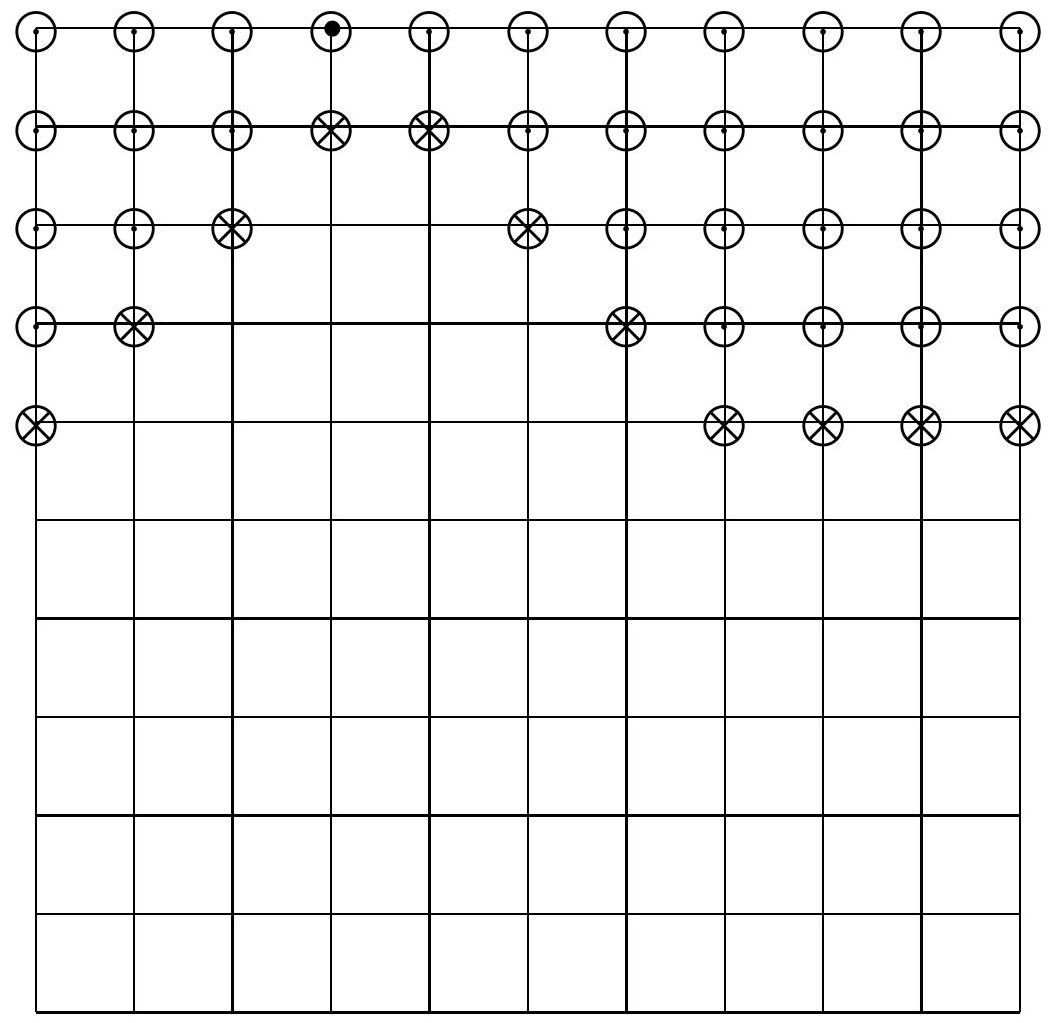", "metadata": {"resource_path": "APMO/segmented/en-apmo2005_sol.jsonl", "problem_match": "\nProblem 4.", "solution_match": "(Solution)"}} |
| {"year": "2005", "tier": "T1", "problem_label": "5", "problem_type": null, "exam": "APMO", "problem": "In a triangle $A B C$, points $M$ and $N$ are on sides $A B$ and $A C$, respectively, such that $M B=B C=C N$. Let $R$ and $r$ denote the circumradius and the inradius of the triangle $A B C$, respectively. Express the ratio $M N / B C$ in terms of $R$ and $r$.", "solution": "Let $\\omega, O$ and $I$ be the circumcircle, the circumcenter and the incenter of $A B C$, respectively. Let $D$ be the point of intersection of the line $B I$ and the circle $\\omega$ such that $D \\neq B$. Then $D$ is the midpoint of the arc $A C$. Hence $O D \\perp C N$ and $O D=R$.\n\nWe first show that triangles $M N C$ and $I O D$ are similar. Because $B C=B M$, the line $B I$ (the bisector of $\\angle M B C$ ) is perpendicular to the line $C M$. Because $O D \\perp C N$ and $I D \\perp M C$, it follows that\n\n$$\n\\angle O D I=\\angle N C M\n$$\n\nLet $\\angle A B C=2 \\beta$. In the triangle $B C M$, we have\n\n$$\n\\frac{C M}{N C}=\\frac{C M}{B C}=2 \\sin \\beta\n$$\n\nSince $\\angle D I C=\\angle D C I$, we have $I D=C D=A D$. Let $E$ be the point of intersection of the line $D O$ and the circle $\\omega$ such that $E \\neq D$. Then $D E$ is a diameter of $\\omega$ and $\\angle D E C=\\angle D B C=\\beta$. Thus we have\n\n$$\n\\frac{D I}{O D}=\\frac{C D}{O D}=\\frac{2 R \\sin \\beta}{R}=2 \\sin \\beta .\n$$\n\nCombining equations (8), (9), and (10) shows that triangles $M N C$ and $I O D$ are similar. It follows that\n\n$$\n\\frac{M N}{B C}=\\frac{M N}{N C}=\\frac{I O}{O D}=\\frac{I O}{R} .\n$$\n\nThe well-known Euler's formula states that\n\n$$\nO I^{2}=R^{2}-2 R r .\n$$\n\nTherefore,\n\n$$\n\\frac{M N}{B C}=\\sqrt{1-\\frac{2 r}{R}}\n$$\n\n(Alternative Solution) Let $a$ (resp., $b, c$ ) be the length of $B C$ (resp., $A C, A B$ ). Let $\\alpha$ (resp., $\\beta, \\gamma$ ) denote the angle $\\angle B A C$ (resp., $\\angle A B C, \\angle A C B$ ). By introducing coordinates $B=(0,0), C=(a, 0)$, it is immediate that the coordinates of $M$ and $N$ are\n\n$$\nM=(a \\cos \\beta, a \\sin \\beta), \\quad N=(a-a \\cos \\gamma, a \\sin \\gamma)\n$$\n\nrespectively. Therefore,\n\n$$\n\\begin{aligned}\n(M N / B C)^{2} & =\\left[(a-a \\cos \\gamma-a \\cos \\beta)^{2}+(a \\sin \\gamma-a \\sin \\beta)^{2}\\right] / a^{2} \\\\\n& =(1-\\cos \\gamma-\\cos \\beta)^{2}+(\\sin \\gamma-\\sin \\beta)^{2} \\\\\n& =3-2 \\cos \\gamma-2 \\cos \\beta+2(\\cos \\gamma \\cos \\beta-\\sin \\gamma \\sin \\beta) \\\\\n& =3-2 \\cos \\gamma-2 \\cos \\beta+2 \\cos (\\gamma+\\beta) \\\\\n& =3-2 \\cos \\gamma-2 \\cos \\beta-2 \\cos \\alpha \\\\\n& =3-2(\\cos \\gamma+\\cos \\beta+\\cos \\alpha) .\n\\end{aligned}\n$$\n\nNow we claim\n\n$$\n\\cos \\gamma+\\cos \\beta+\\cos \\alpha=\\frac{r}{R}+1\n$$\n\nFrom\n\n$$\n\\begin{aligned}\n& a=b \\cos \\gamma+c \\cos \\beta \\\\\n& b=c \\cos \\alpha+a \\cos \\gamma \\\\\n& c=a \\cos \\beta+b \\cos \\alpha\n\\end{aligned}\n$$\n\nwe get\n\n$$\na(1+\\cos \\alpha)+b(1+\\cos \\beta)+c(1+\\cos \\gamma)=(a+b+c)(\\cos \\alpha+\\cos \\beta+\\cos \\gamma)\n$$\n\nThus\n\n$$\n\\begin{aligned}\n& \\cos \\alpha+\\cos \\beta+\\cos \\gamma \\\\\n& =\\frac{1}{a+b+c}(a(1+\\cos \\alpha)+b(1+\\cos \\beta)+c(1+\\cos \\gamma)) \\\\\n& =\\frac{1}{a+b+c}\\left(a\\left(1+\\frac{b^{2}+c^{2}-a^{2}}{2 b c}\\right)+b\\left(1+\\frac{a^{2}+c^{2}-b^{2}}{2 a c}\\right)+c\\left(1+\\frac{a^{2}+b^{2}-c^{2}}{2 a b}\\right)\\right) \\\\\n& =\\frac{1}{a+b+c}\\left(a+b+c+\\frac{a^{2}\\left(b^{2}+c^{2}-a^{2}\\right)+b^{2}\\left(a^{2}+c^{2}-b^{2}\\right)+c^{2}\\left(a^{2}+b^{2}-c^{2}\\right)}{2 a b c}\\right) \\\\\n& =1+\\frac{2 a^{2} b^{2}+2 b^{2} c^{2}+2 c^{2} a^{2}-a^{4}-b^{4}-c^{4}}{2 a b c(a+b+c)}\n\\end{aligned}\n$$\n\nOn the other hand, from $R=\\frac{a}{2 \\sin \\alpha}$ it follows that\n\n$$\n\\begin{aligned}\nR^{2} & =\\frac{a^{2}}{4\\left(1-\\cos ^{2} \\alpha\\right)}=\\frac{a^{2}}{4\\left(1-\\left(\\frac{b^{2}+c^{2}-a^{2}}{2 b c}\\right)^{2}\\right)} \\\\\n& =\\frac{a^{2} b^{2} c^{2}}{2 a^{2} b^{2}+2 b^{2} c^{2}+2 c^{2} a^{2}-a^{4}-b^{4}-c^{4}}\n\\end{aligned}\n$$\n\nAlso from $\\frac{1}{2}(a+b+c) r=\\frac{1}{2} b c \\sin \\alpha$, it follows that\n\n$$\n\\begin{aligned}\nr^{2} & =\\frac{b^{2} c^{2}\\left(1-\\cos ^{2} \\alpha\\right)}{(a+b+c)^{2}}=\\frac{b^{2} c^{2}\\left(1-\\left(\\frac{b^{2}+c^{2}-a^{2}}{2 b c}\\right)^{2}\\right)}{(a+b+c)^{2}} \\\\\n& =\\frac{2 a^{2} b^{2}+2 b^{2} c^{2}+2 c^{2} a^{2}-a^{4}-b^{4}-c^{4}}{4(a+b+c)^{2}}\n\\end{aligned}\n$$\n\nCombining (19), (20) and (21), we get (16) as desired.\nFinally, by (15) and (16) we have\n\n$$\n\\frac{M N}{B C}=\\sqrt{1-\\frac{2 r}{R}}\n$$\n\nAnother proof of (16) from R.A. Johnson's \"Advanced Euclidean Geometry\" ${ }^{1}$ :\nConstruct the perpendicular bisectors $O D, O E, O F$, where $D, E, F$ are the midpoints of $B C, C A, A B$, respectively. By Ptolemy's Theorem applied to the cyclic quadrilateral $O E A F$, we get\n\n$$\n\\frac{a}{2} \\cdot R=\\frac{b}{2} \\cdot O F+\\frac{c}{2} \\cdot O E\n$$\n\nSimilarly\n\n$$\n\\frac{b}{2} \\cdot R=\\frac{c}{2} \\cdot O D+\\frac{a}{2} \\cdot O F, \\quad \\frac{c}{2} \\cdot R=\\frac{a}{2} \\cdot O E+\\frac{b}{2} \\cdot O D .\n$$\n\nAdding, we get\n\n$$\ns R=O D \\cdot \\frac{b+c}{2}+O E \\cdot \\frac{c+a}{2}+O F \\cdot \\frac{a+b}{2}\n$$\n\nwhere $s$ is the semiperimeter. But also, the area of triangle $O B C$ is $O D \\cdot \\frac{a}{2}$, and adding similar formulas for the areas of triangles $O C A$ and $O A B$ gives\n\n$$\nr s=\\triangle A B C=O D \\cdot \\frac{a}{2}+O E \\cdot \\frac{b}{2}+O F \\cdot \\frac{c}{2}\n$$\n\nAdding (23) and (24) gives $s(R+r)=s(O D+O E+O F)$, or\n\n$$\nO D+O E+O F=R+r .\n$$\n\nSince $O D=R \\cos A$ etc., (16) follows.\n\n[^0]\n[^0]: ${ }^{1}$ This proof was introduced to the coordinating country by Professor Bill Sands of Canada.", "metadata": {"resource_path": "APMO/segmented/en-apmo2005_sol.jsonl", "problem_match": "\nProblem 5.", "solution_match": "(Solution)"}} |
|
|


