| {"year": "2014", "tier": "T1", "problem_label": "1", "problem_type": null, "exam": "APMO", "problem": "For a positive integer $m$ denote by $S(m)$ and $P(m)$ the sum and product, respectively, of the digits of $m$. Show that for each positive integer $n$, there exist positive integers $a_{1}, a_{2}, \\ldots, a_{n}$ satisfying the following conditions:\n\n$$\nS\\left(a_{1}\\right)<S\\left(a_{2}\\right)<\\cdots<S\\left(a_{n}\\right) \\text { and } S\\left(a_{i}\\right)=P\\left(a_{i+1}\\right) \\quad(i=1,2, \\ldots, n)\n$$\n\n(We let $\\left.a_{n+1}=a_{1}.\\right)$ (Problem Committee of the Japan Mathematical Olympiad Foundation)", "solution": "Let $k$ be a sufficiently large positive integer. Choose for each $i=2,3, \\ldots, n$, $a_{i}$ to be a positive integer among whose digits the number 2 appears exactly $k+i-2$ times and the number 1 appears exactly $2^{k+i-1}-2(k+i-2)$ times, and nothing else. Then, we have $S\\left(a_{i}\\right)=2^{k+i-1}$ and $P\\left(a_{i}\\right)=2^{k+i-2}$ for each $i, 2 \\leq i \\leq n$. Then, we let $a_{1}$ be a positive integer among whose digits the number 2 appears exactly $k+n-1$ times and the number 1 appears exactly $2^{k}-2(k+n-1)$ times, and nothing else. Then, we see that $a_{1}$ satisfies $S\\left(a_{1}\\right)=2^{k}$ and $P\\left(a_{1}\\right)=2^{k+n-1}$. Such a choice of $a_{1}$ is possible if we take $k$ to be large enough to satisfy $2^{k}>2(k+n-1)$ and we see that the numbers $a_{1}, \\ldots, a_{n}$ chosen this way satisfy the given requirements.", "metadata": {"resource_path": "APMO/segmented/en-apmo2014_sol.jsonl", "problem_match": "\nProblem 1.", "solution_match": "\nSolution."}} |
| {"year": "2014", "tier": "T1", "problem_label": "2", "problem_type": null, "exam": "APMO", "problem": "Let $S=\\{1,2, \\ldots, 2014\\}$. For each non-empty subset $T \\subseteq S$, one of its members is chosen as its representative. Find the number of ways to assign representatives to all non-empty subsets of $S$ so that if a subset $D \\subseteq S$ is a disjoint union of non-empty subsets $A, B, C \\subseteq S$, then the representative of $D$ is also the representative of at least one of $A, B, C$. (Warut Suksompong, Thailand)", "solution": "Answer: 108 - 2014!.\nFor any subset $X$ let $r(X)$ denotes the representative of $X$. Suppose that $x_{1}=r(S)$. First, we prove the following fact:\n\n$$\n\\text { If } x_{1} \\in X \\text { and } X \\subseteq S \\text {, then } x_{1}=r(X) \\text {. }\n$$\n\nIf $|X| \\leq 2012$, then we can write $S$ as a disjoint union of $X$ and two other subsets of $S$, which gives that $x_{1}=r(X)$. If $|X|=2013$, then let $y \\in X$ and $y \\neq x_{1}$. We can write $X$ as a disjoint union of $\\left\\{x_{1}, y\\right\\}$ and two other subsets. We already proved that $r\\left(\\left\\{x_{1}, y\\right\\}\\right)=x_{1}$ (since $\\left|\\left\\{x_{1}, y\\right\\}\\right|=2<2012$ ) and it follows that $y \\neq r(X)$ for every $y \\in X$ except $x_{1}$. We have proved the fact.\n\nNote that this fact is true and can be proved similarly, if the ground set $S$ would contain at least 5 elements.\n\nThere are 2014 ways to choose $x_{1}=r(S)$ and for $x_{1} \\in X \\subseteq S$ we have $r(X)=x_{1}$. Let $S_{1}=S \\backslash\\left\\{x_{1}\\right\\}$. Analogously, we can state that there are 2013 ways to choose $x_{2}=r\\left(S_{1}\\right)$ and for $x_{2} \\in X \\subseteq S_{1}$ we have $r(X)=x_{2}$. Proceeding similarly (or by induction), there are $2014 \\cdot 2013 \\cdots 5$ ways to choose $x_{1}, x_{2}, \\ldots, x_{2010} \\in S$ so that for all $i=1,2 \\ldots, 2010$, $x_{i}=r(X)$ for each $X \\subseteq S \\backslash\\left\\{x_{1}, \\ldots, x_{i-1}\\right\\}$ and $x_{i} \\in X$.\n\nWe are now left with four elements $Y=\\left\\{y_{1}, y_{2}, y_{3}, y_{4}\\right\\}$. There are 4 ways to choose $r(Y)$. Suppose that $y_{1}=r(Y)$. Then we clearly have $y_{1}=r\\left(\\left\\{y_{1}, y_{2}\\right\\}\\right)=r\\left(\\left\\{y_{1}, y_{3}\\right\\}\\right)=r\\left(\\left\\{y_{1}, y_{4}\\right\\}\\right)$. The only subsets whose representative has not been assigned yet are $\\left\\{y_{1}, y_{2}, y_{3}\\right\\},\\left\\{y_{1}, y_{2}, y_{4}\\right\\}$, $\\left\\{y_{1}, y_{3}, y_{4}\\right\\},\\left\\{y_{2}, y_{3}, y_{4}\\right\\},\\left\\{y_{2}, y_{3}\\right\\},\\left\\{y_{2}, y_{4}\\right\\},\\left\\{y_{3}, y_{4}\\right\\}$. These subsets can be assigned in any way, hence giving $3^{4} \\cdot 2^{3}$ more choices.\n\nIn conclusion, the total number of assignments is $2014 \\cdot 2013 \\cdots 4 \\cdot 3^{4} \\cdot 2^{3}=108 \\cdot 2014$ !.", "metadata": {"resource_path": "APMO/segmented/en-apmo2014_sol.jsonl", "problem_match": "\nProblem 2.", "solution_match": "\nSolution."}} |
| {"year": "2014", "tier": "T1", "problem_label": "3", "problem_type": null, "exam": "APMO", "problem": "Find all positive integers $n$ such that for any integer $k$ there exists an integer $a$ for which $a^{3}+a-k$ is divisible by $n$. (Warut Suksompong, Thailand)", "solution": "Answer: All integers $n=3^{b}$, where $b$ is a nonnegative integer.\nWe are looking for integers $n$ such that the set $A=\\left\\{a^{3}+a \\mid a \\in \\mathbf{Z}\\right\\}$ is a complete residue system by modulo $n$. Let us call this property by $\\left(^{*}\\right)$. It is not hard to see that $n=1$ satisfies $\\left({ }^{*}\\right)$ and $n=2$ does not.\n\nIf $a \\equiv b(\\bmod n)$, then $a^{3}+a \\equiv b^{3}+b(\\bmod n)$. So $n$ satisfies $\\left(^{*}\\right)$ iff there are no $a, b \\in\\{0, \\ldots, n-1\\}$ with $a \\neq b$ and $a^{3}+a \\equiv b^{3}+b(\\bmod n)$.\n\nFirst, let us prove that $3^{j}$ satisfies $\\left(^{*}\\right)$ for all $j \\geq 1$. Suppose that $a^{3}+a \\equiv b^{3}+b\\left(\\bmod 3^{j}\\right)$ for $a \\neq b$. Then $(a-b)\\left(a^{2}+a b+b^{2}+1\\right) \\equiv 0\\left(\\bmod 3^{j}\\right)$. We can easily check mod 3 that $a^{2}+a b+b^{2}+1$ is not divisible by 3 .\n\nNext note that if $A$ is not a complete residue system modulo integer $r$, then it is also not a complete residue system modulo any multiple of $r$. Hence it remains to prove that any prime $p>3$ does not satisfy (*).\n\nIf $p \\equiv 1(\\bmod 4)$, there exists $b$ such that $b^{2} \\equiv-1(\\bmod p)$. We then take $a=0$ to obtain the congruence $a^{3}+a \\equiv b^{3}+b(\\bmod p)$.\n\nSuppose now that $p \\equiv 3(\\bmod 4)$. We will prove that there are integers $a, b \\not \\equiv 0(\\bmod p)$ such that $a^{2}+a b+b^{2} \\equiv-1(\\bmod p)$. Note that we may suppose that $a \\not \\equiv b(\\bmod p)$, since otherwise if $a \\equiv b(\\bmod p)$ satisfies $a^{2}+a b+b^{2}+1 \\equiv 0(\\bmod p)$, then $(2 a)^{2}+(2 a)(-a)+$ $a^{2}+1 \\equiv 0(\\bmod p)$ and $2 a \\not \\equiv-a(\\bmod p)$. Letting $c$ be the inverse of $b$ modulo $p$ (i.e. $b c \\equiv 1(\\bmod p)$ ), the relation is equivalent to $(a c)^{2}+a c+1 \\equiv-c^{2}(\\bmod p)$. Note that $-c^{2}$ can take on the values of all non-quadratic residues modulo $p$. If we can find an integer $x$ such that $x^{2}+x+1$ is a non-quadratic residue modulo $p$, the values of $a$ and $c$ will follow immediately. Hence we focus on this latter task.\n\nNote that if $x, y \\in\\{0, \\ldots, p-1\\}=B$, then $x^{2}+x+1 \\equiv y^{2}+y+1(\\bmod p)$ iff $p$ divides $x+y+1$. We can deduce that $x^{2}+x+1$ takes on $(p+1) / 2$ values as $x$ varies in $B$. Since there are $(p-1) / 2$ non-quadratic residues modulo $p$, the $(p+1) / 2$ values that $x^{2}+x+1$ take on must be 0 and all the quadratic residues.\n\nLet $C$ be the set of quadratic residues modulo $p$ and 0 , and let $y \\in C$. Suppose that $y \\equiv z^{2}(\\bmod p)$ and let $z \\equiv 2 w+1(\\bmod p)$ (we can always choose such $\\left.w\\right)$. Then $y+3 \\equiv$ $4\\left(w^{2}+w+1\\right)(\\bmod p)$. From the previous paragraph, we know that $4\\left(w^{2}+w+1\\right) \\in C$. This means that $y \\in C \\Longrightarrow y+3 \\in C$. Unless $p=3$, the relation implies that all elements of $B$ are in $C$, a contradiction. This concludes the proof.", "metadata": {"resource_path": "APMO/segmented/en-apmo2014_sol.jsonl", "problem_match": "\nProblem 3.", "solution_match": "\nSolution."}} |
| {"year": "2014", "tier": "T1", "problem_label": "4", "problem_type": null, "exam": "APMO", "problem": "Let $n$ and $b$ be positive integers. We say $n$ is $b$-discerning if there exists a set consisting of $n$ different positive integers less than $b$ that has no two different subsets $U$ and $V$ such that the sum of all elements in $U$ equals the sum of all elements in $V$.\n(a) Prove that 8 is a 100 -discerning.\n(b) Prove that 9 is not 100-discerning.\n(Senior Problems Committee of the Australian Mathematical Olympiad Committee)", "solution": "(a) Take $S=\\{3,6,12,24,48,95,96,97\\}$, i.e.\n\n$$\nS=\\left\\{3 \\cdot 2^{k}: 0 \\leq k \\leq 5\\right\\} \\cup\\left\\{3 \\cdot 2^{5}-1,3 \\cdot 2^{5}+1\\right\\}\n$$\n\nAs $k$ ranges between 0 to 5 , the sums obtained from the numbers $3 \\cdot 2^{k}$ are $3 t$, where $1 \\leq t \\leq 63$. These are 63 numbers that are divisible by 3 and are at most $3 \\cdot 63=189$.\n\nSums of elements of $S$ are also the numbers $95+97=192$ and all the numbers that are sums of 192 and sums obtained from the numbers $3 \\cdot 2^{k}$ with $0 \\leq k \\leq 5$. These are 64 numbers that are all divisible by 3 and at least equal to 192. In addition, sums of elements of $S$ are the numbers 95 and all the numbers that are sums of 95 and sums obtained from the numbers $3 \\cdot 2^{k}$ with $0 \\leq k \\leq 5$. These are 64 numbers that are all congruent to $-1 \\bmod$ 3.\n\nFinally, sums of elements of $S$ are the numbers 97 and all the numbers that are sums of 97 and sums obtained from the numbers $3 \\cdot 2^{k}$ with $0 \\leq k \\leq 5$. These are 64 numbers that are all congruent to $1 \\bmod 3$.\n\nHence there are at least $63+64+64+64=255$ different sums from elements of $S$. On the other hand, $S$ has $2^{8}-1=255$ non-empty subsets. Therefore $S$ has no two different subsets with equal sums of elements. Therefore, 8 is 100 -discerning.\n(b) Suppose that 9 is 100 -discerning. Then there is a set $S=\\left\\{s_{1}, \\ldots, s_{9}\\right\\}, s_{i}<100$ that has no two different subsets with equal sums of elements. Assume that $0<s_{1}<\\cdots<s_{9}<$ 100.\n\nLet $X$ be the set of all subsets of $S$ having at least 3 and at most 6 elements and let $Y$ be the set of all subsets of $S$ having exactly 2 or 3 or 4 elements greater than $s_{3}$.\n\nThe set $X$ consists of\n\n$$\n\\binom{9}{3}+\\binom{9}{4}+\\binom{9}{5}+\\binom{9}{6}=84+126+126+84=420\n$$\n\nsubsets of $S$. The set in $X$ with the largest sums of elements is $\\left\\{s_{4}, \\ldots, s_{9}\\right\\}$ and the smallest sums is in $\\left\\{s_{1}, s_{2}, s_{3}\\right\\}$. Thus the sum of the elements of each of the 420 sets in $X$ is at least $s_{1}+s_{2}+s_{3}$ and at most $s_{4}+\\cdots+s_{9}$, which is one of $\\left(s_{4}+\\cdots+s_{9}\\right)-\\left(s_{1}+s_{2}+s_{3}\\right)+1$ integers. From the pigeonhole principle it follows that $\\left(s_{4}+\\cdots+s_{9}\\right)-\\left(s_{1}+s_{2}+s_{3}\\right)+1 \\geq 420$, i.e.,\n\n$$\n\\left(s_{4}+\\cdots+s_{9}\\right)-\\left(s_{1}+s_{2}+s_{3}\\right) \\geq 419\n$$\n\nNow let us calculate the number of subsets in $Y$. Observe that $\\left\\{s_{4}, \\ldots, s_{9}\\right\\}$ has $\\binom{6}{2}$ 2-element subsets, $\\binom{6}{3}$ 3-element subsets and $\\binom{6}{4}$ 4-element subsets, while $\\left\\{s_{1}, s_{2}, s_{3}\\right\\}$ has exactly 8 subsets. Hence the number of subsets of $S$ in $Y$ equals\n\n$$\n8\\left(\\binom{6}{2}+\\binom{6}{3}+\\binom{6}{4}\\right)=8(15+20+15)=400\n$$\n\nThe set in $Y$ with the largest sum of elements is $\\left\\{s_{1}, s_{2}, s_{3}, s_{6}, s_{7}, s_{8}, s_{9}\\right\\}$ and the smallest sum is in $\\left\\{s_{4}, s_{5}\\right\\}$. Again, by the pigeonhole principle it follows that $\\left(s_{1}+s_{2}+s_{3}+s_{6}+s_{7}+\\right.$ $\\left.s_{8}+s_{9}\\right)-\\left(s_{4}+s_{5}\\right)+1 \\geq 400$, i.e.,\n\n$$\n\\left(s_{1}+s_{2}+s_{3}+s_{6}+s_{7}+s_{8}+s_{9}\\right)-\\left(s_{4}+s_{5}\\right) \\geq 399\n$$\n\nAdding (1) and (2) yields $2\\left(s_{6}+s_{7}+s_{8}+s_{9}\\right) \\geq 818$, so that $s_{9}+98+97+96 \\geq$ $s_{9}+s_{8}+s_{7}+s_{6} \\geq 409$, i.e. $s_{9} \\geq 118$, a contradiction with $s_{9}<100$. Therefore, 9 is not 100-discerning.", "metadata": {"resource_path": "APMO/segmented/en-apmo2014_sol.jsonl", "problem_match": "\nProblem 4.", "solution_match": "# Solution."}} |
| {"year": "2014", "tier": "T1", "problem_label": "5", "problem_type": null, "exam": "APMO", "problem": "Circles $\\omega$ and $\\Omega$ meet at points $A$ and $B$. Let $M$ be the midpoint of the $\\operatorname{arc} A B$ of circle $\\omega$ ( $M$ lies inside $\\Omega$ ). A chord $M P$ of circle $\\omega$ intersects $\\Omega$ at $Q(Q$ lies inside $\\omega)$. Let $\\ell_{P}$ be the tangent line to $\\omega$ at $P$, and let $\\ell_{Q}$ be the tangent line to $\\Omega$ at $Q$. Prove that the circumcircle of the triangle formed by the lines $\\ell_{P}, \\ell_{Q}$, and $A B$ is tangent to $\\Omega$. (Ilya Bogdanov, Russia and Medeubek Kungozhin, Kazakhstan)", "solution": "Denote $X=A B \\cap \\ell_{P}, Y=A B \\cap \\ell_{Q}$, and $Z=\\ell_{P} \\cap \\ell_{Q}$. Without loss of generality we have $A X<B X$. Let $F=M P \\cap A B$.\n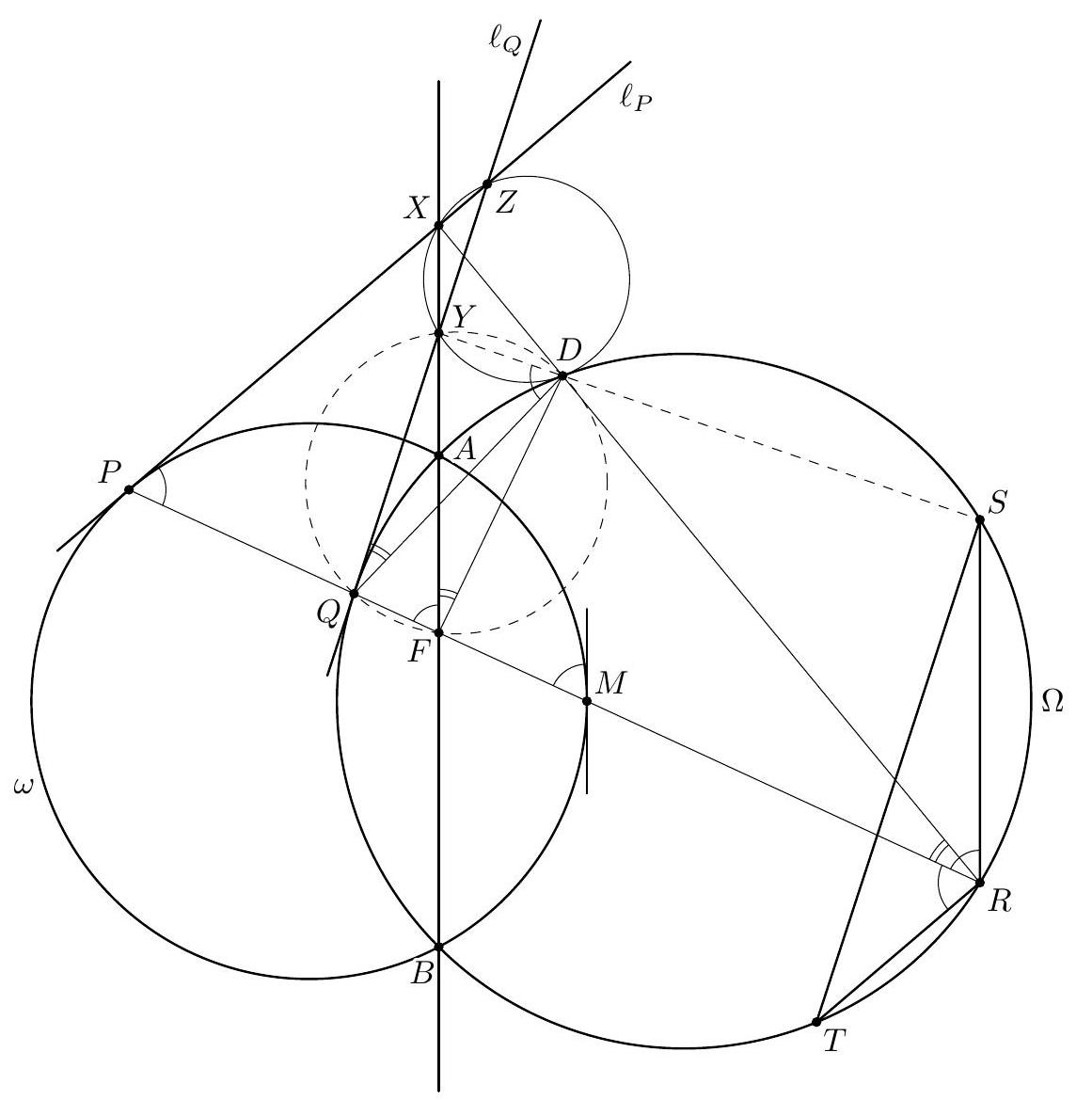\n\nDenote by $R$ the second point of intersection of $P Q$ and $\\Omega$; by $S$ the point of $\\Omega$ such that $S R \\| A B$; and by $T$ the point of $\\Omega$ such that $R T \\| \\ell_{P}$. Since $M$ is the midpoint of arc $A B$, the tangent $\\ell_{M}$ at $M$ to $\\omega$ is parallel to $A B$, so $\\angle(A B, P M)=\\angle\\left(P M, \\ell_{P}\\right)$. Therefore we have $\\angle P R T=\\angle M P X=\\angle P F X=\\angle P R S$. Thus the point $Q$ is the midpoint of the $\\operatorname{arc} T Q S$ of $\\Omega$, hence $S T \\| \\ell_{Q}$. So the corresponding sides of the triangles $R S T$ and $X Y Z$ are parallel, and there exist a homothety $h$ mapping $R S T$ to $X Y Z$.\n\nLet $D$ be the second point of intersection of $X R$ and $\\Omega$. We claim that $D$ is the center of the homothety $h$; since $D \\in \\Omega$, this implies that the circumcircles of triangles $R S T$ and $X Y Z$ are tangent, as required. So, it remains to prove this claim. In order to do this, it suffices to show that $D \\in S Y$.\n\nBy $\\angle P F X=\\angle X P F$ we have $X F^{2}=X P^{2}=X A \\cdot X B=X D \\cdot X R$. Therefore, $\\frac{X F}{X D}=\\frac{X R}{X F}$, so the triangles $X D F$ and $X F R$ are similar, hence $\\angle D F X=\\angle X R F=\\angle D R Q=$ $\\angle D Q Y$; thus the points $D, Y, Q$, and $F$ are concyclic. It follows that $\\angle Y D Q=\\angle Y F Q=$ $\\angle S R Q=180^{\\circ}-\\angle S D Q$ which means exactly that the points $Y, D$, and $S$ are collinear, with $D$ between $S$ and $Y$.", "metadata": {"resource_path": "APMO/segmented/en-apmo2014_sol.jsonl", "problem_match": "\nProblem 5.", "solution_match": "\nSolution."}} |
|
|


