| {"year": "1999", "tier": "T1", "problem_label": "1", "problem_type": null, "exam": "USAMO", "problem": "Some checkers placed on an $n \\times n$ checkerboard satisfy the following conditions: (a) every square that does not contain a checker shares a side with one that does; (b) given any pair of squares that contain checkers, there is a sequence of squares containing checkers, starting and ending with the given squares, such that every two consecutive squares of the sequence share a side. Prove that at least $\\left(n^{2}-2\\right) / 3$ checkers have been placed on the board.", "solution": " Take a spanning tree on the set $V$ of checkers where the $|V|-1$ edges of the tree are given by orthogonal adjacency. By condition (a) we have $$ \\sum_{v \\in V}(4-\\operatorname{deg} v) \\geq n^{2}-|V| $$ and since $\\sum_{v \\in V} \\operatorname{deg} v=2(|V|-1)$ we get $$ 4|V|-(2|V|-2) \\geq n^{2}-|V| $$ which implies $|V| \\geq \\frac{n^{2}-2}{3}$.", "metadata": {"resource_path": "USAMO/segmented/en-USAMO-1999-notes.jsonl"}} |
| {"year": "1999", "tier": "T1", "problem_label": "2", "problem_type": null, "exam": "USAMO", "problem": "Let $A B C D$ be a convex cyclic quadrilateral. Prove that $$ |A B-C D|+|A D-B C| \\geq 2|A C-B D| $$", "solution": "$ Let the diagonals meet at $P$, and let $A P=p q, D P=p r, B P=q s, C P=r s$. Then set $A B=q x, C D=r x, A D=p y, B C=s y$. In this way we compute $$ |A C-B D|=|(p-s)(q-r)| $$ and $$ |A B-C D|=|q-r| x $$ By triangle inequality on $\\triangle A X B$, we have $x \\geq|p-s|$. So $|A B-C D| \\geq|A C-B D|$.", "metadata": {"resource_path": "USAMO/segmented/en-USAMO-1999-notes.jsonl"}} |
| {"year": "1999", "tier": "T1", "problem_label": "3", "problem_type": null, "exam": "USAMO", "problem": "Let $p>2$ be a prime and let $a, b, c, d$ be integers not divisible by $p$, such that $$ \\left\\{\\frac{r a}{p}\\right\\}+\\left\\{\\frac{r b}{p}\\right\\}+\\left\\{\\frac{r c}{p}\\right\\}+\\left\\{\\frac{r d}{p}\\right\\}=2 $$ for any integer $r$ not divisible by $p$. (Here, $\\{t\\}=t-\\lfloor t\\rfloor$ is the fractional part.) Prove that at least two of the numbers $a+b, a+c, a+d, b+c, b+d, c+d$ are divisible by $p$.", "solution": " First of all, we apparently have $r(a+b+c+d) \\equiv 0(\\bmod p)$ for every prime $p$, so it automatically follows that $a+b+c+d \\equiv 0(\\bmod p)$. By scaling appropriately, and also replacing each number with its remainder modulo $p$, we are going to assume that $$ 1=a \\leq b \\leq c \\leq d<p $$ We are going to prove that $d=p-1$, which will solve the problem. Claim - For each integer $r=1,2, \\ldots, p-1$ we have $$ 2(r-1)=\\left\\lfloor\\frac{r b}{p}\\right\\rfloor+\\left\\lfloor\\frac{r c}{p}\\right\\rfloor+\\left\\lfloor\\frac{r d}{p}\\right\\rfloor . $$ $$ 2=\\sum_{\\mathrm{cyc}}\\left(\\frac{r a}{p}-\\left\\lfloor\\frac{r a}{p}\\right\\rfloor\\right) $$ and since $a+b+c+d=2 p$ the conclusion follows. 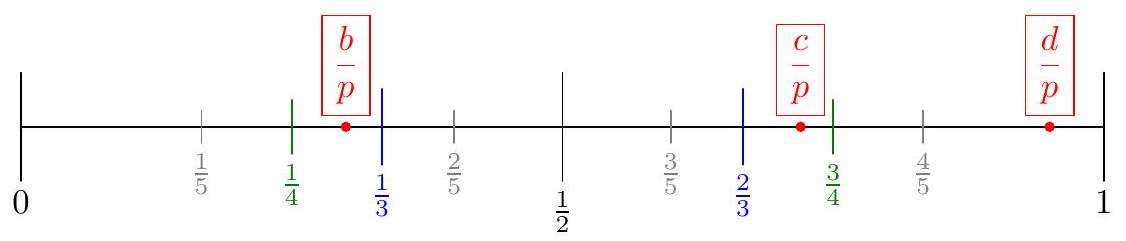 In symbols, it will be enough to prove the following. Claim - For each $r=1,2, \\ldots, p-2$ we have $\\frac{r-1}{r}<\\frac{d}{p}<1$. Equivalently, for each $r=1,2, \\ldots, p-2$ we have $\\left\\lfloor\\frac{r b}{p}\\right\\rfloor+\\left\\lfloor\\frac{r c}{p}\\right\\rfloor=r-1$. $$ r-1>\\left\\lfloor\\frac{r d}{p}\\right\\rfloor \\geq\\left\\lfloor\\frac{(r-1) d}{p}\\right\\rfloor=r-2 $$ Now, we have that $$ 2(r-1)=\\left\\lfloor\\frac{r b}{p}\\right\\rfloor+\\left\\lfloor\\frac{r c}{p}\\right\\rfloor+\\underbrace{\\left\\lfloor\\frac{r d}{p}\\right\\rfloor}_{=r-2} . $$ Thus $\\left\\lfloor\\frac{r b}{p}\\right\\rfloor>\\left\\lfloor\\frac{(r-1) b}{p}\\right\\rfloor$, and $\\left\\lfloor\\frac{r c}{p}\\right\\rfloor>\\left\\lfloor\\frac{(r-1) b}{p}\\right\\rfloor$. An example of this situation is illustrated below with $r=7$ (not to scale). 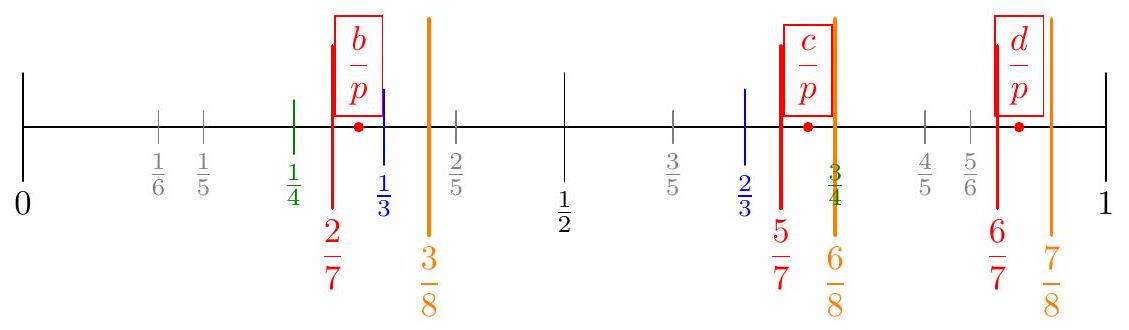 Right now, $\\frac{b}{p}$ and $\\frac{c}{p}$ are just to the right of $\\frac{u}{r}$ and $\\frac{v}{r}$ for some $u$ and $v$ with $u+v=r$. The issue is that the there is some fraction just to the right of $\\frac{b}{p}$ and $\\frac{c}{p}$ from an earlier value of $r$, and by hypothesis its denominator is going to be strictly greater than 1 . It is at this point we are going to use the properties of Farey sequences. When we consider the fractions with denominator $r+1$, they are going to lie outside of the interval they we have constrained $\\frac{b}{p}$ and $\\frac{c}{p}$ to lie in. Indeed, our minimality assumption on $r$ guarantees that there is no fraction with denominator less than $r$ between $\\frac{u}{r}$ and $\\frac{b}{p}$. So if $\\frac{u}{r}<\\frac{b}{p}<\\frac{s}{t}$ (where $\\frac{u}{r}$ and $\\frac{s}{t}$ are the closest fractions with denominator at most $r$ to $\\frac{b}{p}$ ) then Farey theory says the next fraction inside the interval $\\left[\\frac{u}{r}, \\frac{s}{t}\\right]$ is $\\frac{u+s}{r+t}$, and since $t>1$, we have $r+t>r+1$. In other words, we get an inequality of the form $$ \\frac{u}{r}<\\frac{b}{p}<\\underbrace{\\text { something }}_{=s / t} \\leq \\frac{u+1}{r+1} . $$ The same holds for $\\frac{c}{p}$ as $$ \\frac{v}{r}<\\frac{c}{p}<\\text { something } \\leq \\frac{v+1}{r+1} $$ Finally, $$ \\frac{d}{p}<\\frac{r-1}{r}<\\frac{r}{r+1} $$ So now we have that $$ \\left\\lfloor\\frac{(r+1) b}{p}\\right\\rfloor+\\left\\lfloor\\frac{(r+1) c}{p}\\right\\rfloor+\\left\\lfloor\\frac{(r+1) d}{p}\\right\\rfloor \\leq u+v+(r-1)=2 r-1 $$ which is a contradiction. Now, since $$ \\frac{p-3}{p-2}<\\frac{d}{p} \\Longrightarrow d>\\frac{p(p-3)}{p-2}=p-1-\\frac{2}{p-2} $$ which for $p>2$ gives $d=p-1$.", "metadata": {"resource_path": "USAMO/segmented/en-USAMO-1999-notes.jsonl"}} |
| {"year": "1999", "tier": "T1", "problem_label": "4", "problem_type": null, "exam": "USAMO", "problem": "Let $a_{1}, a_{2}, \\ldots, a_{n}$ be a sequence of $n>3$ real numbers such that $$ a_{1}+\\cdots+a_{n} \\geq n \\quad \\text { and } \\quad a_{1}^{2}+\\cdots+a_{n}^{2} \\geq n^{2} $$ Prove that $\\max \\left(a_{1}, \\ldots, a_{n}\\right) \\geq 2$.", "solution": " Proceed by contradiction, assuming $a_{i}<2$ for all $i$. If all $a_{i} \\geq 0$, then $n^{2} \\leq \\sum_{i} a_{i}^{2}<n \\cdot 2^{2}$, contradiction. Otherwise, assume at least one $a_{i}$ is negative. Note that if $-x$ and $-y$ are both present in the sequence $(x, y>0)$, then we can replace them with $-(x+y)$ and 0 . So we may assume that there is exactly one negative term, say $a_{n}=-M$. Now, smooth all the nonnegative $a_{i}$ to be 2 , making all inequalities strict. Now, we have that $$ \\begin{aligned} 2(n-1)-M & >n \\\\ 4(n-1)+M^{2} & >n^{2} \\end{aligned} $$ This gives $n-2<M<n-2$, contradiction. Equality in the original occurs when $n-1$ of the $a_{i}$ are equal to 2 and the last one is equal to $-(n-2)$.", "metadata": {"resource_path": "USAMO/segmented/en-USAMO-1999-notes.jsonl"}} |
| {"year": "1999", "tier": "T1", "problem_label": "5", "problem_type": null, "exam": "USAMO", "problem": "The Y2K Game is played on a $1 \\times 2000$ grid as follows. Two players in turn write either an S or an O in an empty square. The first player who produces three consecutive boxes that spell SOS wins. If all boxes are filled without producing SOS then the game is a draw. Prove that the second player has a winning strategy.", "solution": " The main insight is that a construct of the form $$ S \\square \\square S $$ (here the $\\square$ is blank) will kill any player which plays inside it. We call this a trap accordingly. Claim - The second player can force a trap to exist; in this case the game will never end in a draw. Claim - The second player always has a move which prevents her from losing. Together these two claims finish the problem. Remark. Actually, one can show that the \"only\" way to lose is to be forced to play inside a trap. Indeed, suppose playing in a certain cell $c$ loses. If we wrote $O$, that means $c$ is bordered by exactly one $S$, with a blank cell on the neighbor. But we could also write $S$; checking cases we find $c$ is part of a trap. Thus a player can lose only if all blank cells are in traps; ergo, the number of blank cells is even. This never happens for the second player. Thus this gives an alternative solution, and moreover a reason to believe that all correct solutions must involve traps.", "metadata": {"resource_path": "USAMO/segmented/en-USAMO-1999-notes.jsonl"}} |
| {"year": "1999", "tier": "T1", "problem_label": "6", "problem_type": null, "exam": "USAMO", "problem": "Let $A B C D$ be an isosceles trapezoid with $A B \\| C D$. The inscribed circle $\\omega$ of triangle $B C D$ meets $C D$ at $E$. Let $F$ be a point on the (internal) angle bisector of $\\angle D A C$ such that $E F \\perp C D$. Let the circumscribed circle of triangle $A C F$ meet line $C D$ at $C$ and $G$. Prove that the triangle $A F G$ is isosceles.", "solution": " Note $E$ is contact point of $A$-excircle of $\\triangle A C D$, so $F$ is $A$-excenter. Hence $C F$ is external angle bisector of $\\angle A C G$ which implies $F A=F G$ (since $F$ is the arc midpoint on the circumcircle of $A F G)$.", "metadata": {"resource_path": "USAMO/segmented/en-USAMO-1999-notes.jsonl"}} |
|
|


