| {"year": "2003", "tier": "T1", "problem_label": "1", "problem_type": null, "exam": "USAMO", "problem": "Prove that for every positive integer $n$ there exists an $n$-digit number divisible by $5^{n}$ all of whose digits are odd.", "solution": " This is immediate by induction on $n$. For $n=1$ we take 5 ; moving forward if $M$ is a working $n$-digit number then exactly one of $$ \\begin{aligned} & N_{1}=10^{n}+M \\\\ & N_{3}=3 \\cdot 10^{n}+M \\\\ & N_{5}=5 \\cdot 10^{n}+M \\\\ & N_{7}=7 \\cdot 10^{n}+M \\\\ & N_{9}=9 \\cdot 10^{n}+M \\end{aligned} $$ is divisible by $5^{n+1}$; as they are all divisible by $5^{n}$ and $N_{k} / 5^{n}$ are all distinct.", "metadata": {"resource_path": "USAMO/segmented/en-USAMO-2003-notes.jsonl"}} |
| {"year": "2003", "tier": "T1", "problem_label": "2", "problem_type": null, "exam": "USAMO", "problem": "A convex polygon $\\mathcal{P}$ in the plane is dissected into smaller convex polygons by drawing all of its diagonals. The lengths of all sides and all diagonals of the polygon $\\mathcal{P}$ are rational numbers. Prove that the lengths of all sides of all polygons in the dissection are also rational numbers.", "solution": " Suppose $A B$ is a side of a polygon in the dissection, lying on diagonal $X Y$, with $X, A$, $B, Y$ in that order. Then $$ A B=X Y-X A-Y B $$ In this way, we see that it actually just suffices to prove the result for a quadrilateral. 【 First approach (trig). Consider quadrilateral $A B C D$. There are twelve angles one can obtain using three of its four vertices, three at each vertex; denote this set of 12 angles by $S$ Note that: - The law of cosines implies $\\cos \\theta \\in \\mathbb{Q}$ for each $\\theta \\in S$. - Hence, $(\\sin \\theta)^{2} \\in \\mathbb{Q}$ for $\\theta \\in S$. (This is because $\\sin \\theta^{2}+\\cos ^{2} \\theta$.) We say two angles $\\theta_{1}$ and $\\theta_{2}$ are equivalent if $\\frac{\\sin \\theta_{1}}{\\sin \\theta_{2}}$ This is the same as saying, when $\\sin \\theta_{1}$ and $\\sin \\theta_{2}$ are written in simplest radical form, the part under the square root is the same. Now we contend: Claim - The angles $\\angle B A C, \\angle C A D, \\angle B A D$ are equivalent. $$ \\mathbb{Q} \\ni \\cos (\\angle B A D)=\\cos \\angle B A C \\cos \\angle C A D-\\sin \\angle B A C \\sin \\angle C A D $$ so $\\angle B A C$ and $\\angle C A D$ are equivalent. Then $$ \\sin (\\angle B A D)=\\sin \\angle B A C \\cos \\angle C A D+\\cos \\angle B A C \\sin \\angle C A D $$ implies $\\angle B A D$ is equivalent to those two. Claim - The angles $\\angle B A D, \\angle D B A, \\angle A D B$ are equivalent. Iterating the argument implies that all angles are equivalent. Now, if $A B$ and $C D$ meet at $E$, the law of sines on $\\triangle A E B$, etc. implies the result.", "metadata": {"resource_path": "USAMO/segmented/en-USAMO-2003-notes.jsonl"}} |
| {"year": "2003", "tier": "T1", "problem_label": "2", "problem_type": null, "exam": "USAMO", "problem": "A convex polygon $\\mathcal{P}$ in the plane is dissected into smaller convex polygons by drawing all of its diagonals. The lengths of all sides and all diagonals of the polygon $\\mathcal{P}$ are rational numbers. Prove that the lengths of all sides of all polygons in the dissection are also rational numbers.", "solution": " Suppose $A B$ is a side of a polygon in the dissection, lying on diagonal $X Y$, with $X, A$, $B, Y$ in that order. Then $$ A B=X Y-X A-Y B $$ In this way, we see that it actually just suffices to prove the result for a quadrilateral. I Second approach (barycentric coordinates). To do this, we apply barycentric coordinates. Consider quadrilateral $A B D C$ (note the changed order of vertices), with $A=(1,0,0), B=(0,1,0), C=(0,0,1)$. Let $D=(x, y, z)$, with $x+y+z=1$. By hypothesis, each of the numbers $$ \\begin{aligned} -a^{2} y z+b^{2}(1-x) z+c^{2}(1-x) y & =A D^{2} \\\\ a^{2}(1-y) z+b^{2} z x+c^{2}(1-y) x & =B D^{2} \\\\ -a^{2}(1-z) y-b^{2}(1-z) x+c^{2} x y & =C D^{2} \\end{aligned} $$ is rational. Let $W=a^{2} y z+b^{2} z x+c^{2} x y$. Then, $$ \\begin{aligned} b^{2} z+c^{2} y & =A D^{2}+W \\\\ a^{2} z+c^{2} x & =B D^{2}+W \\\\ a^{2} y+b^{2} x & =C D^{2}+W \\end{aligned} $$ This implies that $A D^{2}+B D^{2}+2 W-c^{2}=2 S_{C} z$ and cyclically (as usual $2 S_{C}=a^{2}+b^{2}-c^{2}$ ). If any of $S_{A}, S_{B}, S_{C}$ are zero, then we deduce $W$ is rational. Otherwise, we have that $$ 1=x+y+z=\\sum_{\\mathrm{cyc}} \\frac{A D^{2}+B D^{2}+2 W-c^{2}}{2 S_{C}} $$ which implies that $W$ is rational, because it appears with coefficient $\\frac{1}{S_{A}}+\\frac{1}{S_{B}}+\\frac{1}{S_{C}} \\neq 0$ (since $S_{B C}+S_{C A}+S_{A B}$ is actually the area of $A B C$ ). Hence from the rationality of $W$, we deduce that $x$ is rational as long as $S_{A} \\neq 0$, and similarly for the others. So at most one of $x, y, z$ is irrational, but since $x+y+z=1$ this implies they are all rational. Finally, if $P=\\overline{A D} \\cap \\overline{B C}$ then $A P=\\frac{1}{y+z} A D$, so $A P$ is rational too, completing the proof. Remark. After the reduction to quadrilateral, a third alternate approach goes by quoting Putnam 2018 A6, reproduced below: Four points are given in the plane, with no three collinear, such that the squares of the $\\binom{4}{2}=6$ pairwise distances are all rational. Show that the ratio of the areas between any two of the $\\binom{4}{3}=4$ triangles determined by these points is also rational. If $A B C D$ is the quadrilateral, the heights from $C$ and $D$ to $A B$ have rational ratio. Letting $P=A C \\cap B D$, we see $A P / A B$ can be shown as rational via coordinates, as needed.", "metadata": {"resource_path": "USAMO/segmented/en-USAMO-2003-notes.jsonl"}} |
| {"year": "2003", "tier": "T1", "problem_label": "3", "problem_type": null, "exam": "USAMO", "problem": "Let $n$ be a positive integer. For every sequence of integers $$ A=\\left(a_{0}, a_{1}, a_{2}, \\ldots, a_{n}\\right) $$ satisfying $0 \\leq a_{i} \\leq i$, for $i=0, \\ldots, n$, we define another sequence $$ t(A)=\\left(t\\left(a_{0}\\right), t\\left(a_{1}\\right), t\\left(a_{2}\\right), \\ldots, t\\left(a_{n}\\right)\\right) $$ by setting $t\\left(a_{i}\\right)$ to be the number of terms in the sequence $A$ that precede the term $a_{i}$ and are different from $a_{i}$. Show that, starting from any sequence $A$ as above, fewer than $n$ applications of the transformation $t$ lead to a sequence $B$ such that $t(B)=B$.", "solution": " We go by strong induction on $n$ with the base cases $n=1$ and $n=2$ done by hand. Consider two cases: - If $a_{0}=0$ and $a_{1}=1$, then $1 \\leq t\\left(a_{i}\\right) \\leq i$ for $i \\geq 1$; now apply induction to $$ \\left(t\\left(a_{1}\\right)-1, t\\left(a_{2}\\right)-1, \\ldots, t\\left(a_{n}\\right)-1\\right) $$ - Otherwise, assume that $a_{0}=a_{1}=\\cdots=a_{k-1}=0$ but $a_{k} \\neq 0$, where $k \\geq 2$. Assume $k<n$ or it's obvious. Then $t\\left(a_{i}\\right) \\neq 0$ for $i \\geq k$, thus $t\\left(t\\left(a_{i}\\right)\\right) \\geq k$ for $i \\geq k$, and we can apply induction hypothesis to $$ \\left(t\\left(t\\left(a_{k}\\right)\\right)-k, \\ldots, t\\left(t\\left(a_{n}\\right)\\right)-k\\right) $$", "metadata": {"resource_path": "USAMO/segmented/en-USAMO-2003-notes.jsonl"}} |
| {"year": "2003", "tier": "T1", "problem_label": "4", "problem_type": null, "exam": "USAMO", "problem": "Let $A B C$ be a triangle. A circle passing through $A$ and $B$ intersects segments $A C$ and $B C$ at $D$ and $E$, respectively. Lines $A B$ and $D E$ intersect at $F$, while lines $B D$ and $C F$ intersect at $M$. Prove that $M F=M C$ if and only if $M B \\cdot M D=M C^{2}$.", "solution": " Ceva theorem plus the similar triangles. 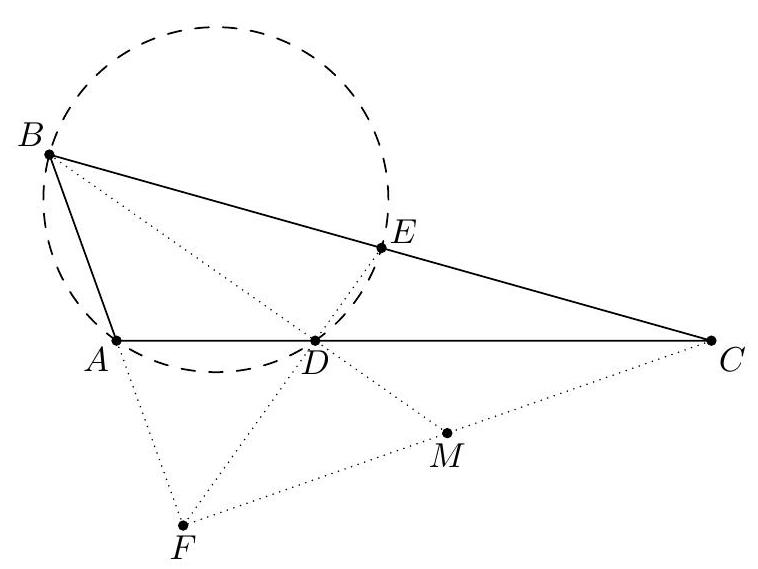 We know unconditionally that $$ \\measuredangle C B D=\\measuredangle E B D=\\measuredangle E A D=\\measuredangle E A C . $$ Moreover, by Ceva's theorem on $\\triangle B C F$, we have $M F=M C \\Longleftrightarrow \\overline{F C} \\| \\overline{A E}$. So we have the equivalences $$ \\begin{aligned} M F=M C & \\Longleftrightarrow \\overline{F C} \\| \\overline{A E} \\\\ & \\Longleftrightarrow \\measuredangle F C A=\\measuredangle E A C \\\\ & \\Longleftrightarrow \\measuredangle M C D=\\measuredangle C B D \\\\ & \\Longleftrightarrow M C^{2}=M B \\cdot M D \\end{aligned} $$", "metadata": {"resource_path": "USAMO/segmented/en-USAMO-2003-notes.jsonl"}} |
| {"year": "2003", "tier": "T1", "problem_label": "5", "problem_type": null, "exam": "USAMO", "problem": "Let $a, b, c$ be positive real numbers. Prove that $$ \\frac{(2 a+b+c)^{2}}{2 a^{2}+(b+c)^{2}}+\\frac{(2 b+c+a)^{2}}{2 b^{2}+(c+a)^{2}}+\\frac{(2 c+a+b)^{2}}{2 c^{2}+(a+b)^{2}} \\leq 8 $$", "solution": " This is a canonical example of tangent line trick. Homogenize so that $a+b+c=3$. The desired inequality reads $$ \\sum_{\\text {cyc }} \\frac{(a+3)^{2}}{2 a^{2}+(3-a)^{2}} \\leq 8 $$ This follows from $$ f(x)=\\frac{(x+3)^{2}}{2 x^{2}+(3-x)^{2}} \\leq \\frac{1}{3}(4 x+4) $$ which can be checked as $\\frac{1}{3}(4 x+4)\\left(2 x^{2}+(3-x)^{2}\\right)-(x+3)^{2}=(x-1)^{2}(4 x+3) \\geq 0$.", "metadata": {"resource_path": "USAMO/segmented/en-USAMO-2003-notes.jsonl"}} |
| {"year": "2003", "tier": "T1", "problem_label": "6", "problem_type": null, "exam": "USAMO", "problem": "At the vertices of a regular hexagon are written six nonnegative integers whose sum is $2003^{2003}$. Bert is allowed to make moves of the following form: he may pick a vertex and replace the number written there by the absolute value of the difference between the numbers written at the two neighboring vertices. Prove that Bert can make a sequence of moves, after which the number 0 appears at all six vertices.", "solution": " If $a \\leq b \\leq c$ are odd integers, the configuration which has $(a, b-a, b, c-b, c, c-a)$ around the hexagon in some order (up to cyclic permutation and reflection) is said to be great (picture below). Claim - We can reach a great configuration from any configuration with odd sum. 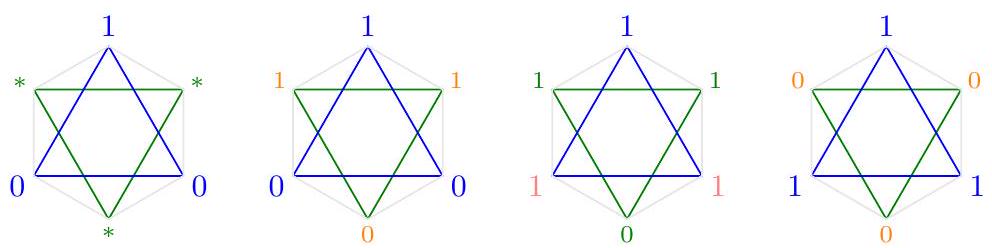 Thus we arrived at a great configuration. Claim - Bert's goal is possible for all great configurations. Otherwise, we can perform the following three operations shown in the figure below, which yield a great configuration whose odd entries are $a, b,|c-2 a|$. 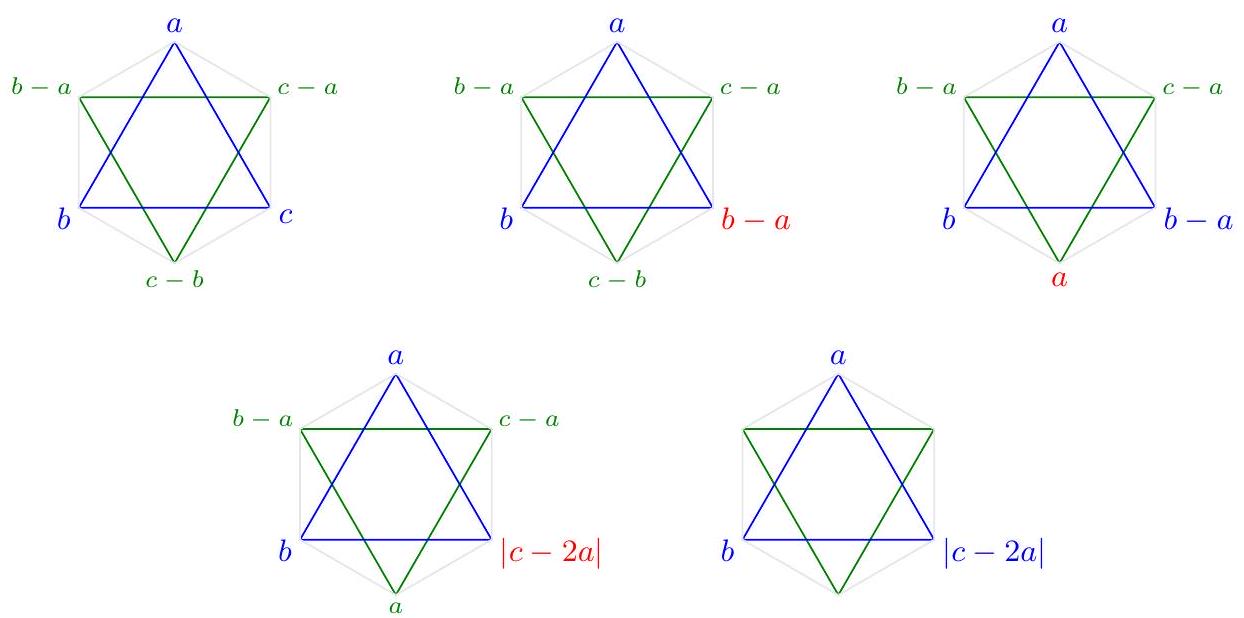 Since $|c-2 a|<c$ unless $a=b=c$, this decreases the sum. So an induction now completes the problem. Remark. One simple idea might be to try to overwrite the maximum number at each point, decreasing the sum. However, this fails on the arrangement $(t, t, 0, t, t, 0)$. Unfortunately, this issue is actually fatal, as the problem has a hidden parity obstruction. The configuration $(1,1,0,1,1,0) \\bmod 2$ is invariant modulo 2, and so Bert can walk into a \"fatal death-trap\" of this shape long before the numbers start becoming equal/zero/etc. In other words, you can mess up on the first move! This is why the initial sum is given to be odd; however, it's not possible for Bert to win so one essentially has to \"tip-toe\" around the 110110 trap any time one leaves the space of odd sum. That's why the great configurations defined above serve as an anchor, making sure we never veer too far from the safe 101010 configuration.", "metadata": {"resource_path": "USAMO/segmented/en-USAMO-2003-notes.jsonl"}} |
|
|


