| {"year": "2014", "tier": "T1", "problem_label": "1", "problem_type": null, "exam": "USAMO", "problem": "Let $a, b, c, d$ be real numbers such that $b-d \\geq 5$ and all zeros $x_{1}, x_{2}, x_{3}$, and $x_{4}$ of the polynomial $P(x)=x^{4}+a x^{3}+b x^{2}+c x+d$ are real. Find the smallest value the product $\\left(x_{1}^{2}+1\\right)\\left(x_{2}^{2}+1\\right)\\left(x_{3}^{2}+1\\right)\\left(x_{4}^{2}+1\\right)$ can take.", "solution": " The answer is 16 . This can be achieved by taking $x_{1}=x_{2}=x_{3}=x_{4}=1$, whence the product is $2^{4}=16$, and $b-d=5$. We now show the quantity is always at least 16. We prove: Claim - We always have $\\left(x_{1}^{2}+1\\right)\\left(x_{2}^{2}+1\\right)\\left(x_{3}^{2}+1\\right)\\left(x_{4}^{2}+1\\right)=(b-d-1)^{2}+(a-c)^{2}$. $$ \\prod_{j=1}^{4}\\left(x_{j}^{2}+1\\right)=\\prod_{j=1}^{4}\\left(x_{j}-i\\right)\\left(x_{j}+i\\right)=P(i) P(-i)=|P(i)|^{2} $$ Since $P(i)=(-1+b-d)+(c-a) i$, the claim follows. Since $b-d-1 \\geq 4$, we get the desired lower bound of $4^{2}+0^{2}=16$.", "metadata": {"resource_path": "USAMO/segmented/en-USAMO-2014-notes.jsonl"}} |
| {"year": "2014", "tier": "T1", "problem_label": "2", "problem_type": null, "exam": "USAMO", "problem": "Find all $f: \\mathbb{Z} \\rightarrow \\mathbb{Z}$ such that $$ x f(2 f(y)-x)+y^{2} f(2 x-f(y))=\\frac{f(x)^{2}}{x}+f(y f(y)) $$ for all $x, y \\in \\mathbb{Z}$ such that $x \\neq 0$.", "solution": " The answer is $f(x) \\equiv 0$ and $f(x) \\equiv x^{2}$. Check that these work. $$ x f(2 f(0)-x)=\\frac{f(x)^{2}}{x}+f(0) . $$ The nicest part of the problem is the following step: $$ \\text { Claim - We have } f(0)=0 \\text {. } $$ $$ f(0)=0 $$ Claim - We have $f(x) \\in\\left\\{0, x^{2}\\right\\}$ for each individual $x$. $$ x^{2} f(-x)=f(x)^{2} $$ holds for all nonzero $x$, but also for $x=0$. Let us now check that $f$ is an even function. In the above, we may also derive $f(-x)^{2}=x^{2} f(x)$. If $f(x) \\neq f(-x)$ (and hence $x \\neq 0$ ), then subtracting the above and factoring implies that $f(x)+f(-x)=-x^{2}$; we can then obtain by substituting the relation $$ \\left[f(x)+\\frac{1}{2} x^{2}\\right]^{2}=-\\frac{3}{4} x^{4}<0 $$ which is impossible. This means $f(x)^{2}=x^{2} f(x)$, thus $$ f(x) \\in\\left\\{0, x^{2}\\right\\} \\quad \\forall x . $$ Now suppose there exists a nonzero integer $t$ with $f(t)=0$. We will prove that $f(x) \\equiv 0$. Put $y=t$ in the given to obtain that $$ t^{2} f(2 x)=0 $$ for any integer $x \\neq 0$, and hence conclude that $f(2 \\mathbb{Z}) \\equiv 0$. Then selecting $x=2 k \\neq 0$ in the given implies that $$ y^{2} f(4 k-f(y))=f(y f(y)) $$ Assume for contradiction that $f(m)=m^{2}$ now for some odd $m \\neq 0$. Evidently $$ m^{2} f\\left(4 k-m^{2}\\right)=f\\left(m^{3}\\right) $$ If $f\\left(m^{3}\\right) \\neq 0$ this forces $f\\left(4 k-m^{2}\\right) \\neq 0$, and hence $m^{2}\\left(4 k-m^{2}\\right)^{2}=m^{6}$ for arbitrary $k \\neq 0$, which is clearly absurd. That means $$ f\\left(4 k-m^{2}\\right)=f\\left(m^{2}-4 k\\right)=f\\left(m^{3}\\right)=0 $$ for each $k \\neq 0$. Since $m$ is odd, $m^{2} \\equiv 1(\\bmod 4)$, and so $f(n)=0$ for all $n$ other than $\\pm m^{2}$ (since we cannot select $\\left.k=0\\right)$. Now $f(m)=m^{2}$ means that $m= \\pm 1$. Hence either $f(x) \\equiv 0$ or $$ f(x)= \\begin{cases}1 & x= \\pm 1 \\\\ 0 & \\text { otherwise }\\end{cases} $$ To show that the latter fails, we simply take $x=5$ and $y=1$ in the given.", "metadata": {"resource_path": "USAMO/segmented/en-USAMO-2014-notes.jsonl"}} |
| {"year": "2014", "tier": "T1", "problem_label": "3", "problem_type": null, "exam": "USAMO", "problem": "Prove that there exists an infinite set of points $$ \\ldots, P_{-3}, P_{-2}, P_{-1}, P_{0}, P_{1}, P_{2}, P_{3}, \\ldots $$ in the plane with the following property: For any three distinct integers $a, b$, and $c$, points $P_{a}, P_{b}$, and $P_{c}$ are collinear if and only if $a+b+c=2014$.", "solution": " The construction $$ P_{n}=\\left(n-\\frac{2014}{3},\\left(n-\\frac{2014}{3}\\right)^{3}\\right) $$ works fine, and follows from the following claim: Claim - If $x, y, z$ are distinct real numbers then the points $\\left(x, x^{3}\\right),\\left(y, y^{3}\\right),\\left(z, z^{3}\\right)$ are collinear if and only if $x+y+z=0$. $$ 0=\\operatorname{det}\\left[\\begin{array}{lll} x & x^{3} & 1 \\\\ y & y^{3} & 1 \\\\ z & z^{3} & 1 \\end{array}\\right] $$ But the determinant equals $$ \\sum_{\\text {cyc }} x\\left(y^{3}-z^{3}\\right)=(x-y)(y-z)(z-x)(x+y+z) $$", "metadata": {"resource_path": "USAMO/segmented/en-USAMO-2014-notes.jsonl"}} |
| {"year": "2014", "tier": "T1", "problem_label": "4", "problem_type": null, "exam": "USAMO", "problem": "Let $k$ be a positive integer. Two players $A$ and $B$ play a game on an infinite grid of regular hexagons. Initially all the grid cells are empty. Then the players alternately take turns with $A$ moving first. In her move, $A$ may choose two adjacent hexagons in the grid which are empty and place a counter in both of them. In his move, $B$ may choose any counter on the board and remove it. If at any time there are $k$ consecutive grid cells in a line all of which contain a counter, $A$ wins. Find the minimum value of $k$ for which $A$ cannot win in a finite number of moves, or prove that no such minimum value exists.", "solution": " The answer is $k=6$.  \\ Example of a strategy for $A$ when $k=5$. We describe a winning strategy for $A$ explicitly. Note that after $B$ 's first turn there is one counter, so then $A$ may create an equilateral triangle, and hence after $B$ 's second turn there are two consecutive counters. Then, on her third turn, $A$ places a pair of counters two spaces away on the same line. Label the two inner cells $x$ and $y$ as shown below.  Now it is $B$ 's turn to move; in order to avoid losing immediately, he must remove either $x$ or $y$. Then on any subsequent turn, $A$ can replace $x$ or $y$ (whichever was removed) and add one more adjacent counter. This continues until either $x$ or $y$ has all its neighbors filled (we ask $A$ to do so in such a way that she avoids filling in the two central cells between $x$ and $y$ as long as possible). So, let's say without loss of generality (by symmetry) that $x$ is completely surrounded by tokens. Again, $B$ must choose to remove $x$ (or $A$ wins on her next turn). After $x$ is removed by $B$, consider the following figure.  We let $A$ play in the two marked green cells. Then, regardless of what move $B$ plays, one of the two choices of moves marked in red lets $A$ win. Thus, we have described a winning strategy when $k=5$ for $A$.", "metadata": {"resource_path": "USAMO/segmented/en-USAMO-2014-notes.jsonl"}} |
| {"year": "2014", "tier": "T1", "problem_label": "5", "problem_type": null, "exam": "USAMO", "problem": "Let $A B C$ be a triangle with orthocenter $H$ and let $P$ be the second intersection of the circumcircle of triangle $A H C$ with the internal bisector of $\\angle B A C$. Let $X$ be the circumcenter of triangle $A P B$ and let $Y$ be the orthocenter of triangle $A P C$. Prove that the length of segment $X Y$ is equal to the circumradius of triangle $A B C$.", "solution": " 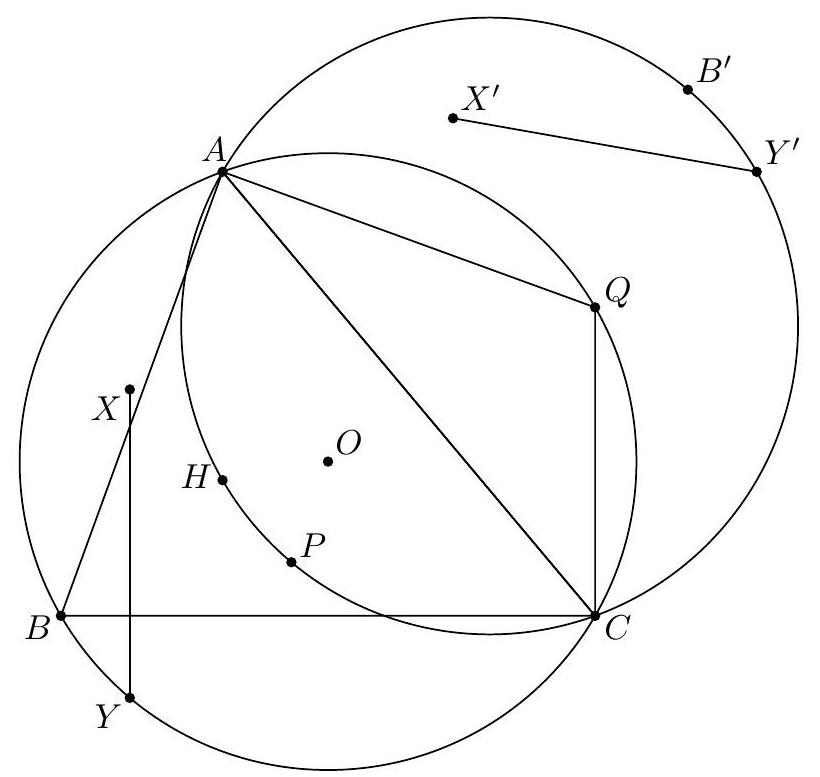 We eliminate the floating orthocenter by reflecting $P$ across $\\overline{A C}$ to $Q$. Then $Q$ lies on ( $A B C$ ) and moreover $\\angle Q A C=\\frac{1}{2} \\angle B A C$. This motivates us to reflect $B, X, Y$ to $B^{\\prime}$, $X^{\\prime}, Y^{\\prime}$ and complex bash with respect to $\\triangle A Q C$. Obviously $$ y^{\\prime}=a+q+c $$ Now we need to compute $x^{\\prime}$. You can get this using the formula $$ x^{\\prime}=a+\\frac{\\left(b^{\\prime}-a\\right)(q-a)\\left(\\overline{q-a}-\\overline{b^{\\prime}-a}\\right)}{\\left(b^{\\prime}-a\\right) \\overline{(q-a)}-\\overline{\\left(b^{\\prime}-a\\right)}(q-a)} . $$ Using the angle condition we know $b=\\frac{c^{3}}{q^{2}}$, and then that $$ b^{\\prime}=a+c-a c \\bar{b}=a+c-\\frac{a q^{2}}{c^{2}} . $$ Therefore $$ \\begin{aligned} x^{\\prime} & =a+\\frac{\\left(c-\\frac{a q^{2}}{c^{2}}\\right)(q-a)\\left(\\frac{1}{q}-\\frac{1}{a}-\\frac{1}{c}+\\frac{c^{2}}{a q^{2}}\\right)}{\\left(c-\\frac{a q^{2}}{c^{2}}\\right)\\left(\\frac{1}{q}-\\frac{1}{a}\\right)-\\left(\\frac{1}{c}-\\frac{c^{2}}{a q^{2}}\\right)(q-a)} \\\\ & =a+\\frac{\\frac{c^{3}-a q^{2}}{c^{2}}(q-a)\\left(\\frac{1}{q}-\\frac{1}{a}-\\frac{1}{c}+\\frac{c^{2}}{a q^{2}}\\right)}{-\\frac{c^{3}-a q^{2}}{c^{2}} \\frac{q-a}{q a}+\\frac{c^{3}-q^{2}}{a q^{2} c}(q-a)} \\end{aligned} $$ $$ \\begin{aligned} & =a+\\frac{\\frac{1}{q}-\\frac{1}{a}-\\frac{1}{c}+\\frac{c^{2}}{a q^{2}}}{-\\frac{1}{q a}+\\frac{c}{a q^{2}}} \\\\ & =a+\\frac{c^{2}-q^{2}+a q-\\frac{a q^{2}}{c}}{c-q} \\\\ & =a+c+q+\\frac{a q}{c} \\end{aligned} $$ whence $$ \\left|x^{\\prime}-y^{\\prime}\\right|=\\left|\\frac{a q}{c}\\right|=1 $$", "metadata": {"resource_path": "USAMO/segmented/en-USAMO-2014-notes.jsonl"}} |
| {"year": "2014", "tier": "T1", "problem_label": "6", "problem_type": null, "exam": "USAMO", "problem": "Prove that there is a constant $c>0$ with the following property: If $a, b, n$ are positive integers such that $\\operatorname{gcd}(a+i, b+j)>1$ for all $i, j \\in\\{0,1, \\ldots, n\\}$, then $$ \\min \\{a, b\\}>(c n)^{n / 2} $$", "solution": " Let $N=n+1$ and assume $N$ is (very) large. We construct an $N \\times N$ with cells $(i, j)$ where $0 \\leq i, j \\leq n$ and in each cell place a prime $p$ dividing $\\operatorname{gcd}(a+i, b+j)$. The central claim is at least $50 \\%$ of the primes in this table exceed $0.001 n^{2}$. We count the maximum number of squares they could occupy: $$ \\sum_{p}\\left\\lceil\\frac{N}{p}\\right\\rceil^{2} \\leq \\sum_{p}\\left(\\frac{N}{p}+1\\right)^{2}=N^{2} \\sum_{p} \\frac{1}{p^{2}}+2 N \\sum_{p} \\frac{1}{p}+\\sum_{p} 1 $$ Here the summation runs over primes $p \\leq 0.001 n^{2}$. Let $r=\\pi\\left(0.001 n^{2}\\right)$ denote the number of such primes. Now we consider the following three estimates. First, $$ \\sum_{p} \\frac{1}{p^{2}}<\\frac{1}{2} $$ which follows by adding all the primes directly with some computation. Moreover, $$ \\sum_{p} \\frac{1}{p}<\\sum_{k=1}^{r} \\frac{1}{k}=O(\\log r)<o(N) $$ using the harmonic series bound, and $$ \\sum_{p} 1<r \\sim O\\left(\\frac{N^{2}}{\\ln N}\\right)<o\\left(N^{2}\\right) $$ via Prime Number Theorem. Hence the sum in question is certainly less than $\\frac{1}{2} N^{2}$ for $N$ large enough, establishing the central claim. Hence some column $a+i$ has at least one half of its primes greater than $0.001 n^{2}$. Because this is greater than $n$ for large $n$, these primes must all be distinct, so $a+i$ exceeds their product, which is larger than $$ \\left(0.001 n^{2}\\right)^{N / 2}>c^{n} \\cdot n^{n} $$ where $c$ is some constant (better than the requested bound).", "metadata": {"resource_path": "USAMO/segmented/en-USAMO-2014-notes.jsonl"}} |
|
|


