| {"year": "2018", "tier": "T1", "problem_label": "1", "problem_type": null, "exam": "USAMO", "problem": "Let $a, b, c$ be positive real numbers such that $a+b+c=4 \\sqrt[3]{a b c}$. Prove that $$ 2(a b+b c+c a)+4 \\min \\left(a^{2}, b^{2}, c^{2}\\right) \\geq a^{2}+b^{2}+c^{2} . $$", "solution": " WLOG let $c=\\min (a, b, c)=1$ by scaling. The given inequality becomes equivalent to $$ 4 a b+2 a+2 b+3 \\geq(a+b)^{2} \\quad \\forall a+b=4(a b)^{1 / 3}-1 $$ Now, let $t=(a b)^{1 / 3}$ and eliminate $a+b$ using the condition, to get $$ 4 t^{3}+2(4 t-1)+3 \\geq(4 t-1)^{2} \\Longleftrightarrow 0 \\leq 4 t^{3}-16 t^{2}+16 t=4 t(t-2)^{2} $$ which solves the problem. Equality occurs only if $t=2$, meaning $a b=8$ and $a+b=7$, which gives $$ \\{a, b\\}=\\left\\{\\frac{7 \\pm \\sqrt{17}}{2}\\right\\} $$ with the assumption $c=1$. Scaling gives the curve of equality cases.", "metadata": {"resource_path": "USAMO/segmented/en-USAMO-2018-notes.jsonl"}} |
| {"year": "2018", "tier": "T1", "problem_label": "2", "problem_type": null, "exam": "USAMO", "problem": "Find all functions $f:(0, \\infty) \\rightarrow(0, \\infty)$ such that $$ f\\left(x+\\frac{1}{y}\\right)+f\\left(y+\\frac{1}{z}\\right)+f\\left(z+\\frac{1}{x}\\right)=1 $$ for all $x, y, z>0$ with $x y z=1$.", "solution": " The main part of the problem is to show all solutions are linear. As always, let $x=b / c$, $y=c / a, z=a / b$ (classical inequality trick). Then the problem becomes $$ \\sum_{\\mathrm{cyc}} f\\left(\\frac{b+c}{a}\\right)=1 $$ Let $f(t)=g\\left(\\frac{1}{t+1}\\right)$, equivalently $g(s)=f(1 / s-1)$. Thus $g:(0,1) \\rightarrow(0,1)$ which satisfies $\\sum_{\\mathrm{cyc}} g\\left(\\frac{a}{a+b+c}\\right)=1$, or equivalently $$ g(a)+g(b)+g(c)=1 \\quad \\forall a+b+c=1 . $$ Claim - The function $g$ is linear. - First, whenever $a+b \\leq 1$ we have $$ 1-g(1-(a+b))=g(a)+g(b)=2 g\\left(\\frac{a+b}{2}\\right) $$ Hence $g$ obeys Jensen's functional equation over $(0,1 / 2)$. - Define $h:[0,1] \\rightarrow \\mathbb{R}$ by $h(t)=g\\left(\\frac{2 t+1}{8}\\right)-(1-t) \\cdot g(1 / 8)-t \\cdot g(3 / 8)$, then $h$ satisfies Jensen's functional equation too over $[0,1]$. We have also arranged that $h(0)=h(1)=0$, hence $h(1 / 2)=0$ as well. - Since $$ h(t)=h(t)+h(1 / 2)=2 h(t / 2+1 / 4)=h(t+1 / 2)+h(0)=h(t+1 / 2) $$ for any $t<1 / 2$, we find $h$ is periodic modulo $1 / 2$. It follows one can extend $\\widetilde{h}$ by $$ \\widetilde{h}: \\mathbb{R} \\rightarrow \\mathbb{R} \\quad \\text { by } \\quad \\widetilde{h}(t)=h(t-\\lfloor t\\rfloor) $$ and still satisfy Jensen's functional equation. Because $\\widetilde{h}(0)=0$, it's well-known this implies $\\widetilde{h}$ is additive (because $\\widetilde{h}(x+y)=2 \\widetilde{h}((x+y) / 2)=\\widetilde{h}(x)+\\widetilde{h}(y)$ for any real numbers $x$ to $y$ ). But $\\widetilde{h}$ is bounded below on $[0,1]$ since $g \\geq 0$, and since $\\widetilde{h}$ is also additive, it follows (well-known) that $\\widetilde{h}$ is linear. Thus $h$ is the zero function. So, the function $g$ is linear over $[1 / 8,3 / 8]$; thus we may write $g(x)=k x+\\ell$, valid for $1 / 8 \\leq x \\leq 3 / 8$. Since $3 g(1 / 3)=1$, it follows $k+3 \\ell=1$. For $0<x<1 / 8$ we have $g(x)=2 g(0.15)-g(0.3-x)=2(0.15 k+\\ell)-(k(0.3-x)+\\ell)=$ $k x+\\ell$, so $g$ is linear over $(0,3 / 8)$ as well. Finally, for $3 / 8<x<1$, we use the given equation $$ 1=g\\left(\\frac{1-x}{2}\\right)+g\\left(\\frac{1-x}{2}\\right)+g(x) \\Longrightarrow g(x)=1-2\\left(k \\cdot \\frac{1-x}{2}+\\ell\\right)=k x+\\ell $$ since $\\frac{1-x}{2}<\\frac{5}{16}<\\frac{3}{8}$. Thus $g$ is linear over all. Putting this back in, we deduce that $g(x)=k x+\\frac{1-k}{3}$ for some $k \\in[-1 / 2,1]$, and so $$ f(x)=\\frac{k}{x+1}+\\frac{1-k}{3} $$ for some $k \\in[-1 / 2,1]$. All such functions work.", "metadata": {"resource_path": "USAMO/segmented/en-USAMO-2018-notes.jsonl"}} |
| {"year": "2018", "tier": "T1", "problem_label": "3", "problem_type": null, "exam": "USAMO", "problem": "Let $n \\geq 2$ be an integer, and let $\\left\\{a_{1}, \\ldots, a_{m}\\right\\}$ denote the $m=\\varphi(n)$ integers less than $n$ and relatively prime to $n$. Assume that every prime divisor of $m$ also divides $n$. Prove that $m$ divides $a_{1}^{k}+\\cdots+a_{m}^{k}$ for every positive integer $k$.", "solution": " For brevity, given any $n$, we let $A(n)=\\{1 \\leq x \\leq n, \\operatorname{gcd}(x, n)=1\\}$ (thus $|A(n)|=\\varphi(n)$ ). Also, let $S(n, k)=\\sum_{a \\in A(n)} a^{k}$. We will prove the stronger statement (which eliminates the hypothesis on $n$ ). Claim - Let $n \\geq 2$ be arbitrary (and $k \\geq 0$ ). If $p \\mid n$, then $$ \\nu_{p}(\\varphi(n)) \\leq \\nu_{p}(S(n, k)) $$ We start with the special case where $n$ is a prime power. ## Lemma Let $p$ be prime, $e \\geq 1, k \\geq 0$. We always have $$ S\\left(p^{e}, k\\right)=\\sum_{x \\in A\\left(p^{e}\\right)} x^{k} \\equiv 0 \\quad\\left(\\bmod p^{e-1}\\right) $$ $$ S\\left(p^{e}, k\\right) \\equiv 1+g^{k}+g^{2 k}+\\cdots+g^{\\left(\\varphi\\left(p^{e}\\right)-1\\right) k} \\equiv \\frac{g^{\\varphi\\left(p^{e}\\right) k}-1}{g^{k}-1} $$ If $p-1 \\nmid k$, then the denominator is not divisible by $p$ and hence the entire expression is $0\\left(\\bmod p^{e}\\right)$. In the other case where $p-1 \\mid k$, since $\\nu_{p}\\left(\\varphi\\left(p^{e}\\right)\\right)=e-1$, the exponent lifting lemma implies $$ \\nu_{p}\\left(\\left(g^{k}\\right)^{\\varphi\\left(p^{e}\\right)}-1\\right)=\\nu_{p}\\left(g^{k}-1\\right)+(e-1) $$ and so the conclusion is true here too. ## Corollary We have $\\nu_{p}\\left(1^{k}+\\cdots+t^{k}\\right) \\geq \\nu_{p}(t)-1$ for any $k, t, p$. Now the idea is to add primes $q$ one at a time to $n$, starting from the base case $n=p^{e}$. So, formally we proceed by induction on the number of prime divisors of $n$. We'll also assume $k \\geq 1$ in what follows since the base case $k=0$ is easy. - First, suppose we want to go from $n$ to $n q$ where $q \\nmid n$. In that case $\\varphi(n q)$ gained $\\nu_{p}(q-1)$ factors of $p$ and then we need to show $\\nu_{p}(S(n q, k)) \\geq \\nu_{p}(\\varphi(n))+\\nu_{p}(q-1)$. The trick is to write $$ A(n q)=\\{a+n h \\mid a \\in A(n) \\text { and } h=0, \\ldots, q-1\\} \\backslash q A(n) $$ and then expand using binomial theorem: $$ \\begin{aligned} S(n q, k) & =\\sum_{a \\in A(n)} \\sum_{h=0}^{q-1}(a+n h)^{k}-\\sum_{a \\in A(n)}(q a)^{k} \\\\ & =-q^{k} S(n, k)+\\sum_{a \\in A(n)} \\sum_{h=0}^{q-1} \\sum_{j=0}^{k}\\left[\\binom{k}{j} a^{k-j} n^{j} h^{j}\\right] \\\\ & =-q^{k} S(n, k)+\\sum_{j=0}^{k}\\left[\\binom{k}{j} n^{j}\\left(\\sum_{a \\in A(n)} a^{k-j}\\right)\\left(\\sum_{h=0}^{q-1} h^{j}\\right)\\right] \\\\ & =-q^{k} S(n, k)+\\sum_{j=0}^{k}\\left[\\binom{k}{j} n^{j} S(n, k-j)\\left(\\sum_{h=1}^{q-1} h^{j}\\right)\\right] \\\\ & =\\left(q-q^{k}\\right) S(n, k)+\\sum_{j=1}^{k}\\left[\\binom{k}{j} n^{j} S(n, k-j)\\left(\\sum_{h=1}^{q-1} h^{j}\\right)\\right] \\end{aligned} $$ We claim every term here has enough powers of $p$. For the first term, $S(n, k)$ has at least $\\nu_{p}(\\varphi(n))$ factors of $p$; and we have the $q-q^{k}$ multiplier out there. For the other terms, we apply induction to $S(n, k-j)$; moreover $\\sum_{h=1}^{q-1} h^{j}$ has at least $\\nu_{p}(q-1)-1$ factors of $p$ by corollary, and we get one more factor of $p$ (at least) from $n^{j}$. - On the other hand, if $q$ already divides $n$, then this time $$ A(n q)=\\{a+n h \\mid a \\in A(n) \\text { and } h=0, \\ldots, q-1\\} $$ and we have no additional burden of $p$ to deal with; the same calculation gives $$ S(n q, k)=q S(n, k)+\\sum_{j=1}^{k}\\left[\\binom{k}{j} n^{j} S(n, k-j)\\left(\\sum_{h=1}^{q-1} h^{j}\\right)\\right] $$ which certainly has enough factors of $p$ already. Remark. A curious bit about the problem is that $\\nu_{p}(\\varphi(n))$ can exceed $\\nu_{p}(n)$, and so it is not true that the residues of $A(n)$ are well-behaved modulo $\\varphi(n)$. As an example, let $n=2 \\cdot 3 \\cdot 7 \\cdot 13=546$, so $m=\\varphi(n)=1 \\cdot 2 \\cdot 6 \\cdot 12=144$. Then $A(n)$ contains 26 elements which are $1 \\bmod 9$ and 23 elements which are $4 \\bmod 9$. Remark. The converse of the problem is true too (but asking both parts would make this too long for exam).", "metadata": {"resource_path": "USAMO/segmented/en-USAMO-2018-notes.jsonl"}} |
| {"year": "2018", "tier": "T1", "problem_label": "4", "problem_type": null, "exam": "USAMO", "problem": "Let $p$ be a prime, and let $a_{1}, \\ldots, a_{p}$ be integers. Show that there exists an integer $k$ such that the numbers $$ a_{1}+k, a_{2}+2 k, \\ldots, a_{p}+p k $$ produce at least $\\frac{1}{2} p$ distinct remainders upon division by $p$.", "solution": " For each $k=0, \\ldots, p-1$ let $G_{k}$ be the graph on $\\{1, \\ldots, p\\}$ where we join $\\{i, j\\}$ if and only if $$ a_{i}+i k \\equiv a_{j}+j k \\quad(\\bmod p) \\Longleftrightarrow k \\equiv-\\frac{a_{i}-a_{j}}{i-j} \\quad(\\bmod p) . $$ So we want a graph $G_{k}$ with at least $\\frac{1}{2} p$ connected components. However, each $\\{i, j\\}$ appears in exactly one graph $G_{k}$, so some graph has at most $\\frac{1}{p}\\binom{p}{2}=\\frac{1}{2}(p-1)$ edges (by \"pigeonhole\"). This graph has at least $\\frac{1}{2}(p+1)$ connected components, as desired. Remark. Here is an example for $p=5$ showing equality can occur: $$ \\left[\\begin{array}{lllll} 0 & 0 & 3 & 4 & 3 \\\\ 0 & 1 & 0 & 2 & 2 \\\\ 0 & 2 & 2 & 0 & 1 \\\\ 0 & 3 & 4 & 3 & 0 \\\\ 0 & 4 & 1 & 1 & 4 \\end{array}\\right] . $$ Ankan Bhattacharya points out more generally that $a_{i}=i^{2}$ is sharp in general.", "metadata": {"resource_path": "USAMO/segmented/en-USAMO-2018-notes.jsonl"}} |
| {"year": "2018", "tier": "T1", "problem_label": "5", "problem_type": null, "exam": "USAMO", "problem": "Let $A B C D$ be a convex cyclic quadrilateral with $E=\\overline{A C} \\cap \\overline{B D}, F=\\overline{A B} \\cap \\overline{C D}$, $G=\\overline{D A} \\cap \\overline{B C}$. The circumcircle of $\\triangle A B E$ intersects line $C B$ at $B$ and $P$, and the circumcircle of $\\triangle A D E$ intersects line $C D$ at $D$ and $Q$. Assume $C, B, P, G$ and $C$, $Q, D, F$ are collinear in that order. Let $M=\\overline{F P} \\cap \\overline{G Q}$. Prove that $\\angle M A C=90^{\\circ}$.", "solution": " We present three general routes. (The second route, using the fact that $\\overline{A C}$ is an angle bisector, has many possible variations.) \\l First solution (Miquel points). This is indeed a Miquel point problem, but the main idea is to focus on the self-intersecting cyclic quadrilateral $P B Q D$ as the key player, rather than on the given $A B C D$. Indeed, we will prove that $A$ is its Miquel point; this follows from the following two claims. Claim - The self-intersecting quadrilateral $P Q D B$ is cyclic. Claim - Point $E$ lies on line $P Q$. 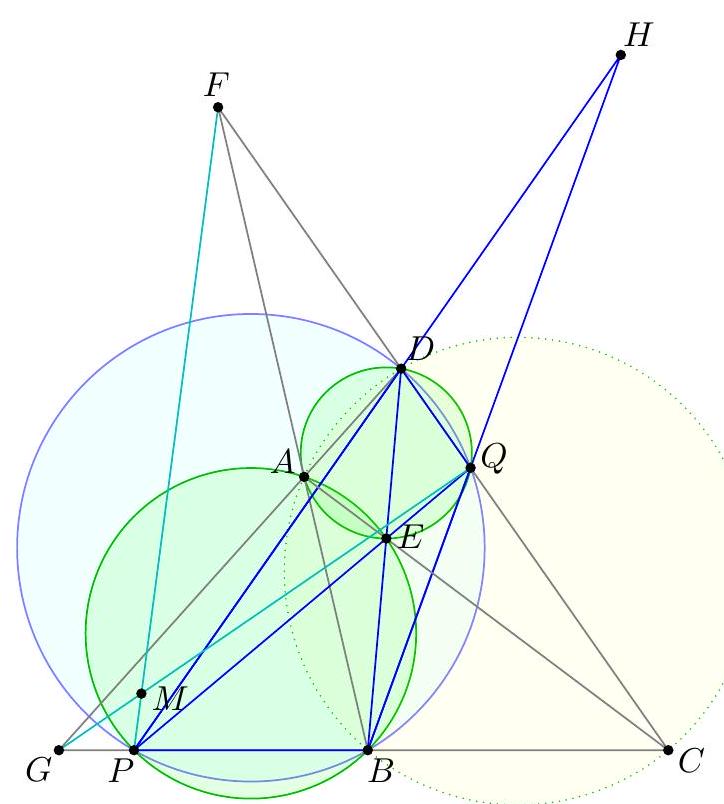 To finish, let $H=\\overline{P D} \\cap \\overline{B Q}$. By properties of the Miquel point, we have $A$ is the foot from $H$ to $\\overline{C E}$. But also, points $M, A, H$ are collinear by Pappus theorem on $\\overline{B P G}$ and $\\overline{D Q F}$, as desired.", "metadata": {"resource_path": "USAMO/segmented/en-USAMO-2018-notes.jsonl"}} |
| {"year": "2018", "tier": "T1", "problem_label": "5", "problem_type": null, "exam": "USAMO", "problem": "Let $A B C D$ be a convex cyclic quadrilateral with $E=\\overline{A C} \\cap \\overline{B D}, F=\\overline{A B} \\cap \\overline{C D}$, $G=\\overline{D A} \\cap \\overline{B C}$. The circumcircle of $\\triangle A B E$ intersects line $C B$ at $B$ and $P$, and the circumcircle of $\\triangle A D E$ intersects line $C D$ at $D$ and $Q$. Assume $C, B, P, G$ and $C$, $Q, D, F$ are collinear in that order. Let $M=\\overline{F P} \\cap \\overline{G Q}$. Prove that $\\angle M A C=90^{\\circ}$.", "solution": " We present three general routes. (The second route, using the fact that $\\overline{A C}$ is an angle bisector, has many possible variations.) 【 Second solution (projective). We start with a synthetic observation. Claim - The line $\\overline{A C}$ bisects $\\angle P A D$ and $\\angle B A Q$. There are three ways to finish from here: - (Michael Kural) Suppose the external bisector of $\\angle P A D$ and $\\angle B A Q$ meet lines $B C$ and $D C$ at $X$ and $Y$. Then $$ -1=(G P ; X C)=(F D ; Y C) $$ which is enough to imply that $\\overline{X Y}, \\overline{G Q}, \\overline{P F}$ are concurrent (by so-called prism lemma). - (Daniel Liu) Alternatively, apply the dual Desargues involution theorem to complete quadrilateral GQFPCM, through the point $A$. This gives that an involutive pairing of $$ (A C, A M)(A P, A Q)(A G, A F) $$ This is easier to see if we project it onto the line $\\ell$ through $C$ perpendicular to $\\overline{A C}$; if we let $P^{\\prime}, Q^{\\prime}, G^{\\prime}, F^{\\prime}$ be the images of the last four lines, we find the involution coincides with negative inversion through $C$ with power $\\sqrt{C P^{\\prime} \\cdot C Q^{\\prime}}$ which implies that $\\overline{A M} \\cap \\ell$ is an infinity point, as desired.", "metadata": {"resource_path": "USAMO/segmented/en-USAMO-2018-notes.jsonl"}} |
| {"year": "2018", "tier": "T1", "problem_label": "5", "problem_type": null, "exam": "USAMO", "problem": "Let $A B C D$ be a convex cyclic quadrilateral with $E=\\overline{A C} \\cap \\overline{B D}, F=\\overline{A B} \\cap \\overline{C D}$, $G=\\overline{D A} \\cap \\overline{B C}$. The circumcircle of $\\triangle A B E$ intersects line $C B$ at $B$ and $P$, and the circumcircle of $\\triangle A D E$ intersects line $C D$ at $D$ and $Q$. Assume $C, B, P, G$ and $C$, $Q, D, F$ are collinear in that order. Let $M=\\overline{F P} \\cap \\overline{G Q}$. Prove that $\\angle M A C=90^{\\circ}$.", "solution": " We present three general routes. (The second route, using the fact that $\\overline{A C}$ is an angle bisector, has many possible variations.) 【 Third solution (inversion, Andrew Wu). Noting that $C E \\cdot C A=C P \\cdot C B=C Q \\cdot C D$, we perform an inversion at $C$ swapping these pairs of points. The point $G$ is mapped to a point $G^{*}$ ray $C B$ for which $Q E G^{*} C$ is cyclic, but then $$ \\measuredangle C G^{*} E=\\measuredangle C Q E=\\measuredangle C Q P=\\measuredangle D B C=\\measuredangle C B E $$ and so we conclude $E B=E G^{*}$. Similarly, $E D=E F^{*}$. Finally, $M^{*}=\\left(C G^{*} D\\right) \\cap\\left(C F^{*} B\\right) \\neq C$, and we wish to show that $\\angle E M^{*} C=90^{\\circ}$. 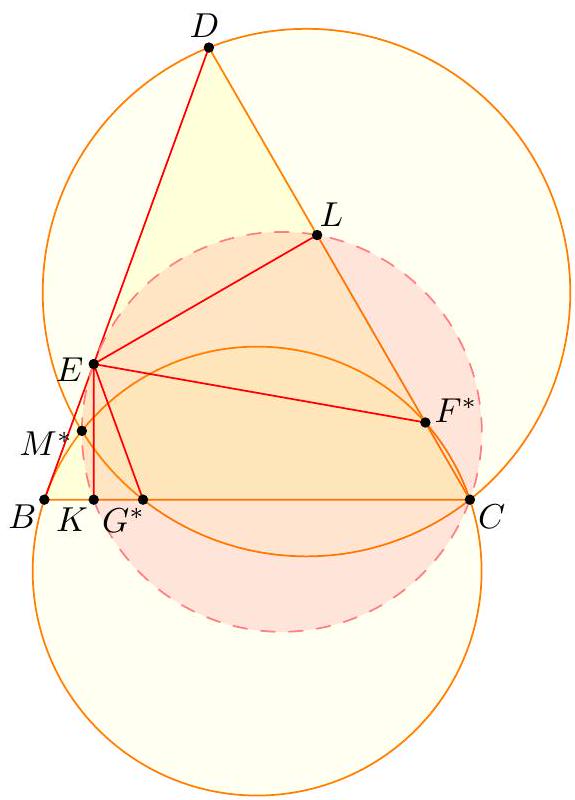 Note that $M^{*}$ is the center of the spiral similarity sending $\\overline{B G^{*}}$ to $\\overline{F^{*} D}$. Hence it also maps the midpoint $K$ of $B G^{*}$ to the midpoint $L$ of $\\overline{F^{*} E}$. Consequently, $M^{*}$ lies on the circumcircle $K L C$ as well. In other words, $E L C K M^{*}$ is a cyclic pentagon with circumdiameter $\\overline{C E}$, as desired.", "metadata": {"resource_path": "USAMO/segmented/en-USAMO-2018-notes.jsonl"}} |
| {"year": "2018", "tier": "T1", "problem_label": "6", "problem_type": null, "exam": "USAMO", "problem": "Let $a_{n}$ be the number of permutations $\\left(x_{1}, \\ldots, x_{n}\\right)$ of $(1, \\ldots, n)$ such that the ratios $x_{k} / k$ are all distinct. Prove that $a_{n}$ is odd for all $n \\geq 1$.", "solution": " The first idea: ## Lemma If a permutation $x$ works, so does the inverse permutation. Thus it suffices to consider permutations $x$ in which all cycles have length at most 2 . Of course, there can be at most one fixed point (since that gives the ratio 1 ), and hence exactly one if $n$ is odd, none if $n$ is even. We consider the graph $K_{n}$ such that the edge $\\{i, j\\}$ is labeled with $i / j$ (for $i<j$ ). The permutations we're considering are then equivalent to maximal matchings of this $K_{n}$. We call such a matching fantastic if it has an all of distinct edge labels. Now the second insight is that if edges $a b$ and $c d$ have the same label for $a<b$ and $c<d$, then so do edges $a c$ and $b d$. Thus: Definition. Given a matching $\\mathcal{M}$ as above we say the neighbors of $\\mathcal{M}$ are those other matchings obtained as follows: for each label $\\ell$, we take some disjoint pairs of edges (possibly none) with label $\\ell$ and apply the above switching operation (in which we replace $a b$ and $c d$ with $a c$ and $b d)$. This neighborship relation is reflexive, and most importantly it is symmetric (because one can simply reverse the moves). But it is not transitive. The second observation is that: Claim - The matching $\\mathcal{M}$ has an odd number of neighbors (including itself) if and only if it is fantastic. If we pick $k$ disjoint pairs and swap them, the number of ways to do this is $\\binom{n_{e}}{2 k}(2 k-1)!!$, and so the total number of ways to perform operations on the edges labeled $\\ell$ is $$ \\sum_{k}\\binom{n_{\\ell}}{2 k}(2 k-1)!!\\equiv \\sum_{k}\\binom{n_{\\ell}}{2 k}=2^{n_{\\ell}-1} \\quad(\\bmod 2) $$ This is even if and only if $n_{\\ell}>1$. Finally, note that the number of neighbors of $\\mathcal{M}$ is the product across all $\\ell$ of the above. So it is odd if and only if each factor is odd, if and only if $n_{\\ell}=1$ for every $\\ell$. To finish, consider a huge simple graph $\\Gamma$ on all the maximal matchings, with edge relations given by neighbor relation (we don't consider vertices to be connected to themselves). Observe that: - Fantastic matchings correspond to isolated vertices (of degree zero, with no other neighbors) of $\\Gamma$. - The rest of the vertices of $\\Gamma$ have odd degrees (one less than the neighbor count) - The graph $\\Gamma$ has an even number of vertices of odd degree (this is true for any simple graph, see \"handshake lemma\"). - The number of vertices of $\\Gamma$ is odd, namely $(2\\lceil n / 2\\rceil-1)!!$", "metadata": {"resource_path": "USAMO/segmented/en-USAMO-2018-notes.jsonl"}} |
|
|


