# Twin Delayed Deep Deterministic Policy Gradient (TD3)
## Overview
TD3 is a popular DRL algorithm for continuous control. It extends DDPG with three techniques: 1) Clipped Double Q-Learning, 2) Delayed Policy Updates, and 3) Target Policy Smoothing Regularization. With these three techniques TD3 shows significantly better performance compared to DDPG.
Original paper:
* [Addressing Function Approximation Error in Actor-Critic Methods](https://arxiv.org/abs/1802.09477)
Reference resources:
* :material-github: [sfujim/TD3](https://github.com/sfujim/TD3)
* [Twin Delayed DDPG | Spinning Up in Deep RL](https://spinningup.openai.com/en/latest/algorithms/td3.html)
## Implemented Variants
| Variants Implemented | Description |
| ----------- | ----------- |
| :material-github: [`td3_continuous_action.py`](https://github.com/vwxyzjn/cleanrl/blob/master/cleanrl/td3_continuous_action.py), :material-file-document: [docs](/rl-algorithms/td3/#td3_continuous_actionpy) | For continuous action space |
| :material-github: [`td3_continuous_action_jax.py`](https://github.com/vwxyzjn/cleanrl/blob/master/cleanrl/td3_continuous_action_jax.py), :material-file-document: [docs](/rl-algorithms/td3/#td3_continuous_action_jaxpy) | For continuous action space |
Below are our single-file implementations of TD3:
## `td3_continuous_action.py`
The [td3_continuous_action.py](https://github.com/vwxyzjn/cleanrl/blob/master/cleanrl/td3_continuous_action.py) has the following features:
* For continuous action space
* Works with the `Box` observation space of low-level features
* Works with the `Box` (continuous) action space
### Usage
=== "poetry"
```bash
uv pip install ".[mujoco]"
uv run python cleanrl/td3_continuous_action.py --help
uv run python cleanrl/td3_continuous_action.py --env-id Hopper-v4
```
=== "pip"
```bash
pip install -r requirements/requirements-mujoco.txt
python cleanrl/td3_continuous_action.py --help
python cleanrl/td3_continuous_action.py --env-id Hopper-v4
```
### Explanation of the logged metrics
Running `python cleanrl/td3_continuous_action.py` will automatically record various metrics such as various losses in Tensorboard. Below are the documentation for these metrics:
* `charts/episodic_return`: episodic return of the game
* `charts/SPS`: number of steps per second
* `losses/qf1_loss`: the MSE between the Q values at timestep $t$ and the target Q values at timestep $t+1$, which minimizes temporal difference.
* `losses/actor_loss`: implemented as `-qf1(data.observations, actor(data.observations)).mean()`; it is the *negative* average Q values calculated based on the 1) observations and the 2) actions computed by the actor based on these observations. By minimizing `actor_loss`, the optimizer updates the actors parameter using the following gradient (Fujimoto et al., 2018, Algorithm 1)[^2]:
$$ \nabla_{\phi} J(\phi)=\left.N^{-1} \sum \nabla_{a} Q_{\theta_{1}}(s, a)\right|_{a=\pi_{\phi}(s)} \nabla_{\phi} \pi_{\phi}(s) $$
* `losses/qf1_values`: implemented as `qf1(data.observations, data.actions).view(-1); it is the average Q values of the sampled data in the replay buffer; useful when gauging if under or over estimations happen
### Implementation details
Our [`td3_continuous_action.py`](https://github.com/vwxyzjn/cleanrl/blob/master/cleanrl/td3_continuous_action.py) is based on the [`TD3.py`](https://github.com/sfujim/TD3/blob/master/TD3.py) from :material-github: [sfujim/TD3](https://github.com/sfujim/TD3). Our [`td3_continuous_action.py`](https://github.com/vwxyzjn/cleanrl/blob/master/cleanrl/td3_continuous_action.py) presents the following implementation differences.
1. [`td3_continuous_action.py`](https://github.com/vwxyzjn/cleanrl/blob/master/cleanrl/td3_continuous_action.py) uses a two separate objects `qf1` and `qf2` to represents the two Q functions in the Clipped Double Q-learning architecture, whereas [`TD3.py`](https://github.com/sfujim/TD3/blob/master/TD3.py) (Fujimoto et al., 2018)[^2] uses a single `Critic` class that contains both Q networks. That said, these two implementations are virtually the same.
2. [`td3_continuous_action.py`](https://github.com/vwxyzjn/cleanrl/blob/master/cleanrl/td3_continuous_action.py) also adds support for handling continuous environments where the lower and higher bounds of the action space are not $[-1,1]$, or are asymmetric.
The case where the bounds are not $[-1,1]$ is handled in [`TD3.py`](https://github.com/sfujim/TD3/blob/385b33ac7de4767bab17eb02ade4a268d3e4e24f/TD3.py#L28) (Fujimoto et al., 2018)[^2] as follows:
```python
class Actor(nn.Module):
...
def forward(self, state):
a = F.relu(self.l1(state))
a = F.relu(self.l2(a))
return self.max_action * torch.tanh(self.l3(a)) # Scale from [-1,1] to [-action_high, action_high]
```
On the other hand, in [`CleanRL's td3_continuous_action.py`](https://github.com/vwxyzjn/cleanrl/blob/master/cleanrl/td3_continuous_action.py), the mean and the scale of the action space are computed as `action_bias` and `action_scale` respectively.
Those scalars are in turn used to scale the output of a `tanh` activation function in the actor to the original action space range:
```python
class Actor(nn.Module):
def __init__(self, env):
...
# action rescaling
self.register_buffer("action_scale", torch.FloatTensor((env.action_space.high - env.action_space.low) / 2.0))
self.register_buffer("action_bias", torch.FloatTensor((env.action_space.high + env.action_space.low) / 2.0))
def forward(self, x):
x = F.relu(self.fc1(x))
x = F.relu(self.fc2(x))
x = torch.tanh(self.fc_mu(x))
return x * self.action_scale + self.action_bias # Scale from [-1,1] to [-action_low, action_high]
```
Additionally, when drawing exploration noise that is added to the actions produced by the actor, [`CleanRL's td3_continuous_action.py`](https://github.com/dosssman/cleanrl/blob/10b606e7bd9bd1b06e455e8ef542df2b7699a20c/cleanrl/td3_continuous_action.py#L180) centers the distribution the sampled from at `action_bias`, and the scale of the distribution is set to `action_scale * exploration_noise`.
???+ info
Note that `Humanoid-v2`, `InvertedPendulum-v2`, `Pusher-v2` have action space bounds that are not the standard `[-1, 1]`. See below and :material-github: [PR #196](https://github.com/vwxyzjn/cleanrl/issues/196)
```
Ant-v2 Observation space: Box(-inf, inf, (111,), float64) Action space: Box(-1.0, 1.0, (8,), float32)
HalfCheetah-v2 Observation space: Box(-inf, inf, (17,), float64) Action space: Box(-1.0, 1.0, (6,), float32)
Hopper-v2 Observation space: Box(-inf, inf, (11,), float64) Action space: Box(-1.0, 1.0, (3,), float32)
Humanoid-v2 Observation space: Box(-inf, inf, (376,), float64) Action space: Box(-0.4, 0.4, (17,), float32)
InvertedDoublePendulum-v2 Observation space: Box(-inf, inf, (11,), float64) Action space: Box(-1.0, 1.0, (1,), float32)
InvertedPendulum-v2 Observation space: Box(-inf, inf, (4,), float64) Action space: Box(-3.0, 3.0, (1,), float32)
Pusher-v2 Observation space: Box(-inf, inf, (23,), float64) Action space: Box(-2.0, 2.0, (7,), float32)
Reacher-v2 Observation space: Box(-inf, inf, (11,), float64) Action space: Box(-1.0, 1.0, (2,), float32)
Swimmer-v2 Observation space: Box(-inf, inf, (8,), float64) Action space: Box(-1.0, 1.0, (2,), float32)
Walker2d-v2 Observation space: Box(-inf, inf, (17,), float64) Action space: Box(-1.0, 1.0, (6,), float32)
```
### Experiment results
To run benchmark experiments, see :material-github: [benchmark/td3.sh](https://github.com/vwxyzjn/cleanrl/blob/master/benchmark/td3.sh). Specifically, execute the following command:
``` title="benchmark/td3.sh" linenums="1"
--8<-- "benchmark/td3.sh::7"
```
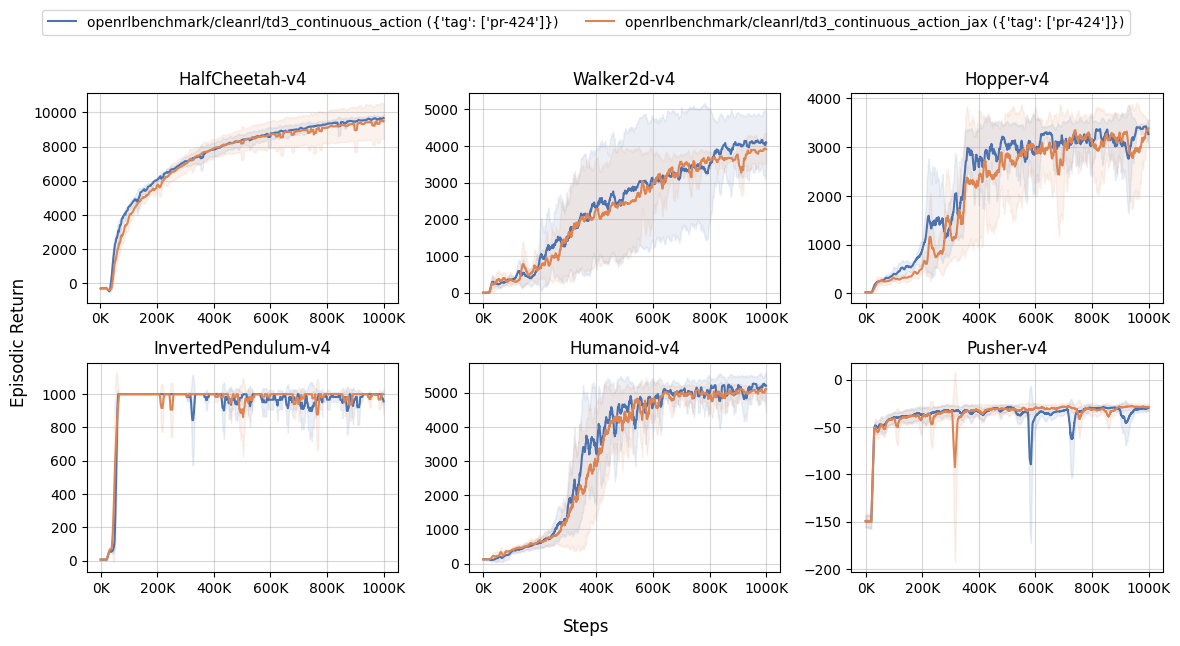
Below are the average episodic returns for [`td3_continuous_action.py`](https://github.com/vwxyzjn/cleanrl/blob/master/cleanrl/td3_continuous_action.py) (3 random seeds). To ensure the quality of the implementation, we compared the results against (Fujimoto et al., 2018)[^2].
| Environment | [`td3_continuous_action.py`](https://github.com/vwxyzjn/cleanrl/blob/master/cleanrl/td3_continuous_action.py) | [`TD3.py`](https://github.com/sfujim/TD3/blob/master/TD3.py) (Fujimoto et al., 2018, Table 1)[^2] |
| ----------- | ----------- | ----------- |
| HalfCheetah-v4 | 9583.22 ± 126.09 |9636.95 ± 859.065 |
| Walker2d-v4 | 4057.59 ± 658.78 | 4682.82 ± 539.64 |
| Hopper-v4 | 3134.61 ± 360.18 | 3564.07 ± 114.74 |
| InvertedPendulum-v4 | 968.99 ± 25.80 | 1000.00 ± 0.00 |
| Humanoid-v4 | 5035.36 ± 21.67 | not available |
| Pusher-v4 | -30.92 ± 1.05 | not available |
???+ info
Note that [`td3_continuous_action.py`](https://github.com/vwxyzjn/cleanrl/blob/master/cleanrl/td3_continuous_action.py) uses gym MuJoCo v4 environments while [`TD3.py`](https://github.com/sfujim/TD3/blob/master/TD3.py) (Fujimoto et al., 2018)[^2] uses the gym MuJoCo v1 environments.
Also note the performance of our `td3_continuous_action.py` seems to be worse than the reference implementation on Walker2d. This is likely due to :material-github: [openai/gym#938](https://github.com/openai/baselines/issues/938). We would have a hard time reproducing gym MuJoCo v1 environments because they have been long deprecated.
One other thing could cause the performance difference: the original code reported the average episodic return using determinisitc evaluation (i.e., without exploration noise), see [`sfujim/TD3/main.py#L15-L32`](https://github.com/sfujim/TD3/blob/385b33ac7de4767bab17eb02ade4a268d3e4e24f/main.py#L15-L32), whereas we reported the episodic return during training and the policy gets updated between environments steps.
Learning curves:
``` title="benchmark/td3_plot.sh" linenums="1"
--8<-- "benchmark/td3_plot.sh::9"
```
 Tracked experiments and game play videos:
## `td3_continuous_action_jax.py`
The [td3_continuous_action_jax.py](https://github.com/vwxyzjn/cleanrl/blob/master/cleanrl/td3_continuous_action_jax.py) has the following features:
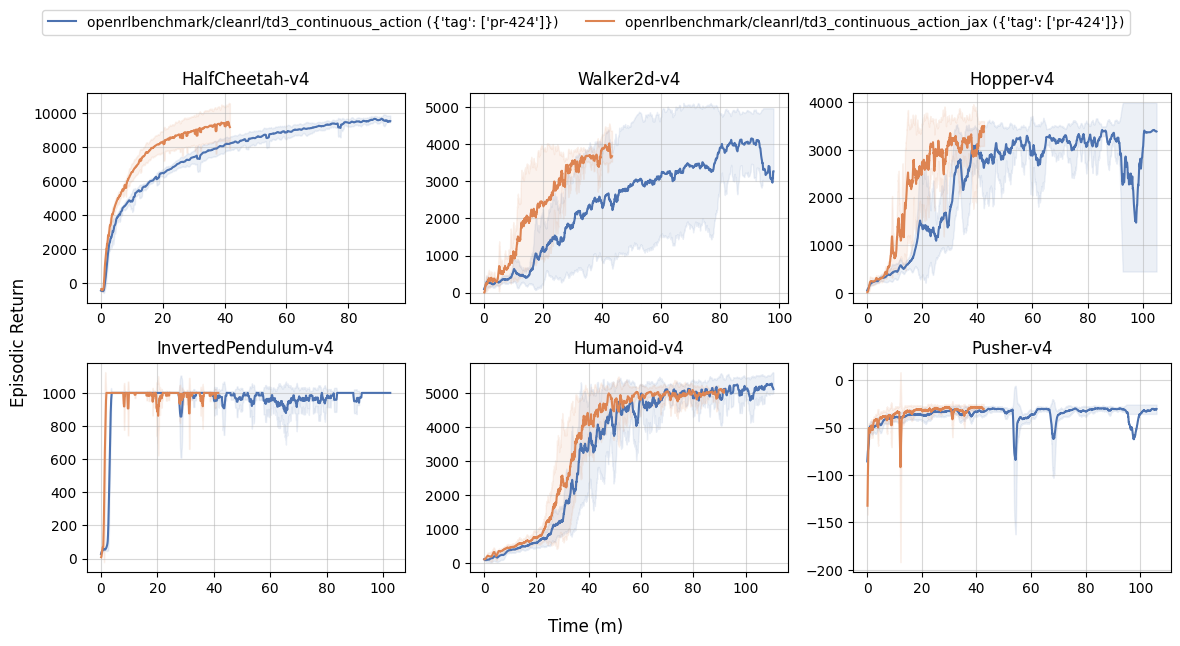
* Uses [Jax](https://github.com/google/jax), [Flax](https://github.com/google/flax), and [Optax](https://github.com/deepmind/optax) instead of `torch`. [td3_continuous_action_jax.py](https://github.com/vwxyzjn/cleanrl/blob/master/cleanrl/td3_continuous_action_jax.py) is roughly 2.5-4x faster than [td3_continuous_action.py](https://github.com/vwxyzjn/cleanrl/blob/master/cleanrl/td3_continuous_action.py)
* For continuous action space
* Works with the `Box` observation space of low-level features
* Works with the `Box` (continuous) action space
### Usage
=== "poetry"
```bash
uv pip install ".[mujoco, jax]"
uv run python cleanrl/td3_continuous_action_jax.py --help
uv run python cleanrl/td3_continuous_action_jax.py --env-id Hopper-v4
```
=== "pip"
```bash
pip install -r requirements/requirements-mujoco.txt
pip install -r requirements/requirements-jax.txt
python cleanrl/td3_continuous_action_jax.py --help
python cleanrl/td3_continuous_action_jax.py --env-id Hopper-v4
```
### Explanation of the logged metrics
See [related docs](/rl-algorithms/td3/#explanation-of-the-logged-metrics) for `td3_continuous_action.py`.
### Implementation details
See [related docs](/rl-algorithms/td3/#implementation-details) for `td3_continuous_action.py`.
### Experiment results
To run benchmark experiments, see :material-github: [benchmark/td3.sh](https://github.com/vwxyzjn/cleanrl/blob/master/benchmark/td3.sh). Specifically, execute the following command:
``` title="benchmark/td3.sh" linenums="1"
--8<-- "benchmark/td3.sh:12:19"
```
Below are the average episodic returns for [`td3_continuous_action_jax.py`](https://github.com/vwxyzjn/cleanrl/blob/master/cleanrl/td3_continuous_action_jax.py) (3 random seeds).
{!benchmark/td3.md!}
Learning curves:
``` title="benchmark/td3_plot.sh" linenums="1"
--8<-- "benchmark/td3_plot.sh:11:20"
```
???+ info
These are some previous experiments with TPUs. Note the results are very similar to the ones above, but the runtime can be different due to different hardware used.
Note that the experiments were conducted on different hardwares, so your mileage might vary. This inconsistency is because 1) re-running expeirments on the same hardware is computationally expensive and 2) requiring the same hardware is not inclusive nor feasible to other contributors who might have different hardwares.
That said, we roughly expect to see a 2-4x speed improvement from using [`td3_continuous_action_jax.py`](https://github.com/vwxyzjn/cleanrl/blob/master/cleanrl/td3_continuous_action_jax.py) under the same hardware. And if you disable the `--capture_video` overhead, the speed improvement will be even higher.
Learning curves:
Tracked experiments and game play videos:
[^1]:Lillicrap, T.P., Hunt, J.J., Pritzel, A., Heess, N.M., Erez, T., Tassa, Y., Silver, D., & Wierstra, D. (2016). Continuous control with deep reinforcement learning. CoRR, abs/1509.02971. https://arxiv.org/abs/1509.02971
[^2]:Fujimoto, S., Hoof, H.V., & Meger, D. (2018). Addressing Function Approximation Error in Actor-Critic Methods. ArXiv, abs/1802.09477. https://arxiv.org/abs/1802.09477
Tracked experiments and game play videos:
## `td3_continuous_action_jax.py`
The [td3_continuous_action_jax.py](https://github.com/vwxyzjn/cleanrl/blob/master/cleanrl/td3_continuous_action_jax.py) has the following features:
* Uses [Jax](https://github.com/google/jax), [Flax](https://github.com/google/flax), and [Optax](https://github.com/deepmind/optax) instead of `torch`. [td3_continuous_action_jax.py](https://github.com/vwxyzjn/cleanrl/blob/master/cleanrl/td3_continuous_action_jax.py) is roughly 2.5-4x faster than [td3_continuous_action.py](https://github.com/vwxyzjn/cleanrl/blob/master/cleanrl/td3_continuous_action.py)
* For continuous action space
* Works with the `Box` observation space of low-level features
* Works with the `Box` (continuous) action space
### Usage
=== "poetry"
```bash
uv pip install ".[mujoco, jax]"
uv run python cleanrl/td3_continuous_action_jax.py --help
uv run python cleanrl/td3_continuous_action_jax.py --env-id Hopper-v4
```
=== "pip"
```bash
pip install -r requirements/requirements-mujoco.txt
pip install -r requirements/requirements-jax.txt
python cleanrl/td3_continuous_action_jax.py --help
python cleanrl/td3_continuous_action_jax.py --env-id Hopper-v4
```
### Explanation of the logged metrics
See [related docs](/rl-algorithms/td3/#explanation-of-the-logged-metrics) for `td3_continuous_action.py`.
### Implementation details
See [related docs](/rl-algorithms/td3/#implementation-details) for `td3_continuous_action.py`.
### Experiment results
To run benchmark experiments, see :material-github: [benchmark/td3.sh](https://github.com/vwxyzjn/cleanrl/blob/master/benchmark/td3.sh). Specifically, execute the following command:
``` title="benchmark/td3.sh" linenums="1"
--8<-- "benchmark/td3.sh:12:19"
```
Below are the average episodic returns for [`td3_continuous_action_jax.py`](https://github.com/vwxyzjn/cleanrl/blob/master/cleanrl/td3_continuous_action_jax.py) (3 random seeds).
{!benchmark/td3.md!}
Learning curves:
``` title="benchmark/td3_plot.sh" linenums="1"
--8<-- "benchmark/td3_plot.sh:11:20"
```
???+ info
These are some previous experiments with TPUs. Note the results are very similar to the ones above, but the runtime can be different due to different hardware used.
Note that the experiments were conducted on different hardwares, so your mileage might vary. This inconsistency is because 1) re-running expeirments on the same hardware is computationally expensive and 2) requiring the same hardware is not inclusive nor feasible to other contributors who might have different hardwares.
That said, we roughly expect to see a 2-4x speed improvement from using [`td3_continuous_action_jax.py`](https://github.com/vwxyzjn/cleanrl/blob/master/cleanrl/td3_continuous_action_jax.py) under the same hardware. And if you disable the `--capture_video` overhead, the speed improvement will be even higher.
Learning curves:
Tracked experiments and game play videos:
[^1]:Lillicrap, T.P., Hunt, J.J., Pritzel, A., Heess, N.M., Erez, T., Tassa, Y., Silver, D., & Wierstra, D. (2016). Continuous control with deep reinforcement learning. CoRR, abs/1509.02971. https://arxiv.org/abs/1509.02971
[^2]:Fujimoto, S., Hoof, H.V., & Meger, D. (2018). Addressing Function Approximation Error in Actor-Critic Methods. ArXiv, abs/1802.09477. https://arxiv.org/abs/1802.09477


