| {"year": "1990", "tier": "T1", "problem_label": "1", "problem_type": null, "exam": "APMO", "problem": "In $\\triangle A B C$, let $D, E, F$ be the midpoints of $B C, A C, A B$ respectively and let $G$ be the centroid of the triangle.\nFor each value of $\\angle B A C$, how many non-similar triangles are there in which $A E G F$ is a cyclic quadrilateral?", "solution": "Let $I$ be the intersection of $A G$ and $E F$.\nLet $\\delta=A I . I G-F I$ IE. Then\n\n$$\nA I=A D / 2, \\quad I G=A D / 6, \\quad F I=B C / 4=I E\n$$\n\nFurther, applying the cosine rule to triangles $A B D, A C D$ we get\n\n$$\n\\begin{aligned}\nA B^{2} & =B C^{2} / 4+A D^{2}-A D \\cdot B C \\cdot \\cos \\angle B D A, \\\\\nA C^{2} & =B C^{2} / 4+A D^{2}+A D \\cdot B C \\cdot \\cos \\angle B D A, \\\\\n\\text { so } \\quad A D^{2} & =\\left(A B^{2}+A C^{2}-B C^{2} / 2\\right) / 2\n\\end{aligned}\n$$\n\nHence\n\n$$\n\\begin{aligned}\n\\delta & =\\left(A B^{2}+A C^{2}-2 B C^{2}\\right) / 24 \\\\\n& =\\left(4 A B \\cdot A C \\cdot \\cos \\angle B A C-A B^{2}-A C^{2}\\right)\n\\end{aligned}\n$$\n\nNow $A E F G$ is a cyclic quadrilateral if and only if $\\delta=0$, i.e. if and only if\n\n$$\n\\begin{aligned}\n\\cos \\angle B A C & =\\left(A B^{2}+A B^{2}\\right) /(4 \\cdot A B \\cdot A C) \\\\\n& =(A B / A C+A C / A B) / 4\n\\end{aligned}\n$$\n\n5\nNow $A B / A C+A C / A B \\geq 2$. Hence $\\cos \\angle B A C \\geq 1 / 2$ and so $\\angle B A C \\leq 60^{\\circ}$.\nFor $\\angle B A C>60^{\\circ}$ there is no triangle with the required property.\nFor $\\angle B A C=60^{\\circ}$ there exists, within similarity, precisely one triangle (which is equilateral) having the required property.\nFor $\\angle B A C<60^{\\circ}$ there exists, within similarity, again precisely one triangle having the required property (even though for fixed median $A E$ there are two, but one arises from the other by interchanging point $B$ with point $C$, thus proving them to be similar).", "metadata": {"resource_path": "APMO/segmented/en-apmo1990_sol.jsonl", "problem_match": "# Question 1 ", "solution_match": "# FIRST SOLUTION\n\n"}} |
| {"year": "1990", "tier": "T1", "problem_label": "1", "problem_type": null, "exam": "APMO", "problem": "In $\\triangle A B C$, let $D, E, F$ be the midpoints of $B C, A C, A B$ respectively and let $G$ be the centroid of the triangle.\nFor each value of $\\angle B A C$, how many non-similar triangles are there in which $A E G F$ is a cyclic quadrilateral?", "solution": "(Mr Marcus Brazil, La Trobe University, Bundoora, Melbourne, Australia):\nWe require, as above,\n\n$$\nA I \\cdot I G=E I \\cdot I F\n$$\n\n(which by (1) is equivalent to $A D^{2} / 3=C D^{2}$, i.e. $A D=C D \\cdot \\sqrt{3}$ ).\nLet, without loss of generality, $C D=1$. Then $A$ lies on the circle of radius $\\sqrt{3}$ with centre $D$. If $C D$ and $D A$ are perpendicular, the angle $B A C$ is $60^{\\circ}$, otherwise it must be less.\nIn this case, for each angle $B A C$ there are two solutions, which are congruent.", "metadata": {"resource_path": "APMO/segmented/en-apmo1990_sol.jsonl", "problem_match": "# Question 1 ", "solution_match": "\nSECOND SOLUTION "}} |
| {"year": "1990", "tier": "T1", "problem_label": "1", "problem_type": null, "exam": "APMO", "problem": "In $\\triangle A B C$, let $D, E, F$ be the midpoints of $B C, A C, A B$ respectively and let $G$ be the centroid of the triangle.\nFor each value of $\\angle B A C$, how many non-similar triangles are there in which $A E G F$ is a cyclic quadrilateral?", "solution": "in the figure as shown below, we first show that it is necessary that $\\angle A$ is less than $90^{\\circ}$ if the quadrilateral $A E G F$ ; cyclic.\n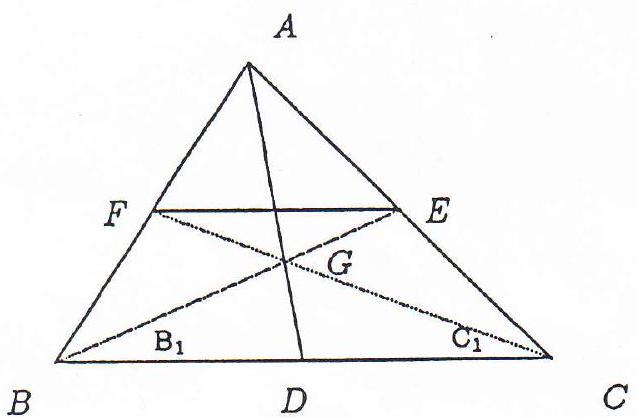\n\nNow, since $E F \\| B C$, we get\n\n$$\n\\begin{aligned}\n\\angle E G F & =180^{\\circ}-\\left(B_{1}+C_{1}\\right) \\\\\n& \\geq 180^{\\circ}-(B+C) \\\\\n& =A .\n\\end{aligned}\n$$\n\n(1)\n\nThus, if $A E G F$ is cyclic, we would have $\\angle E G F+\\angle A=180^{\\circ}$. Therefore it is necessary that $0<\\angle A \\leq 90^{\\circ}$.\n\n## Continuation \"A\"\n\nLet $O$ be the circumcentre of $\\triangle A F E$. Without loss of generality, let the radius of this circle be 1.\nWe then let $A=1, F=z=e^{i \\theta}$ and $E=z e^{2 i \\alpha}=e^{i(\\theta+2 \\alpha)}$.\nThen $\\angle A=\\alpha, 0<\\alpha \\leq 90^{\\circ}$, and $0<\\theta<360^{\\circ}-2 \\alpha$.\nThus,\n\n$$\nB=2 z-1\n$$\n\nand\n\n$$\n\\begin{aligned}\nG & =\\frac{1}{3}(2 z-1)+\\frac{2}{3}\\left(z e^{2 i \\alpha}\\right) \\\\\n& =\\frac{1}{3}\\left(2 e^{i \\theta}+2 e^{i(\\theta+2 \\alpha)}-1\\right)\n\\end{aligned}\n$$\n\nFor quadrilateral $A F G E$ to be cyclic, it is now necessary that\n\n$$\n|G|=1 .\n$$\n\n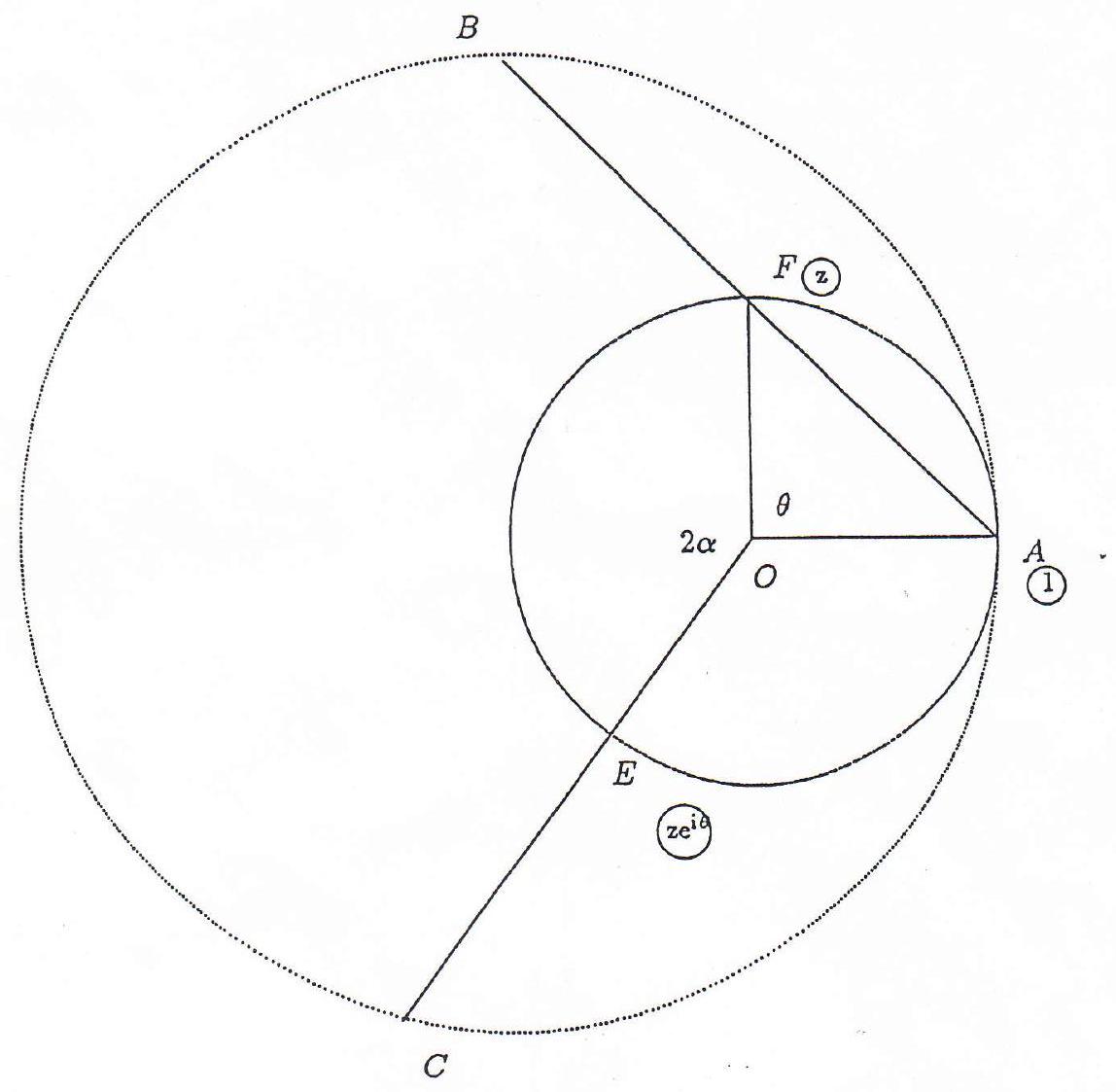\n\nFor $|G|=1$, we must have\n\n$$\n\\begin{aligned}\n9= & (2 \\cos (\\theta)+2 \\cos (\\theta+2 \\alpha)-1)^{2}+(2 \\sin (\\theta)+2 \\sin (\\theta+2 \\alpha))^{2} \\\\\n= & 4\\left(\\cos ^{2}(\\theta)+\\sin ^{2}(\\theta)\\right)+4\\left(\\cos ^{2}(\\theta+2 \\alpha)+\\sin ^{2}(\\theta+2 \\alpha)\\right)+1 \\\\\n& +8(\\cos (\\theta) \\cos (\\theta+2 \\alpha)+\\sin (\\theta) \\sin (\\theta+2 \\alpha))-4 \\cos (\\theta)-4 \\cos (\\theta+2 \\alpha) \\\\\n= & 9+8 \\cos (2 \\alpha)-8 \\cos (\\alpha) \\cos (\\theta+\\alpha)\n\\end{aligned}\n$$\n\nso that\n\n$$\n\\cos (\\theta+\\alpha)=\\frac{\\cos (2 \\alpha)}{\\cos (\\alpha)}\n$$\n\n] Now, $\\left|\\frac{\\cos (2 \\alpha)}{\\cos (\\alpha)}\\right| \\leq 1$ if and only if $\\alpha \\in\\left(0,60^{\\circ}\\right]$ in the range of $\\alpha$ under consideration, that is $\\alpha \\in\\left(0,00^{\\circ}\\right]$. There is equality if and only if $\\alpha=60^{\\circ}$.\n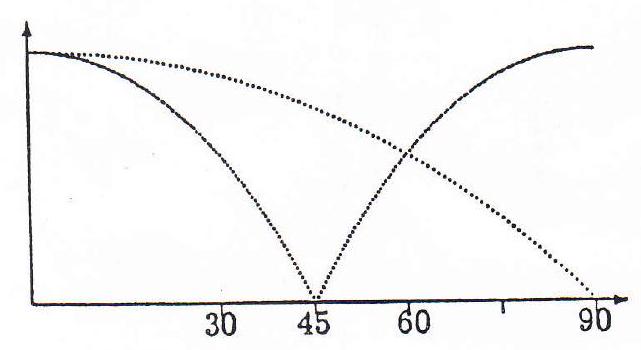\n$\\square$ Note there is only one solution. The apparent other solution is the mirror image of the first. We are solving for $\\alpha+\\theta$. The other solution is $360^{\\circ}-\\alpha-\\theta$.\n\n## Continuation \"B\"\n\nLet $O$ be the circumcentre of triangle $A E F$. Let $A P$ be a diameter of this circle. Construct the circle with centre $P$ and radius $A P$. Then $B$ and $C$ lie on this circle.\n\nIt is clear that the problem is solved if we allow the angle $\\angle B A C=\\alpha$ to vary and restrict $B$ and $C$ to the constructed circle.\n\nLet $\\theta$ be the angle from the drawn axis. Then $\\theta$ lies in the range $\\left(0,180^{\\circ}-\\alpha\\right)$. We must not forget the necessary restriction of $\\alpha$, that is $\\alpha \\in\\left(0,90^{\\circ}\\right.$.\n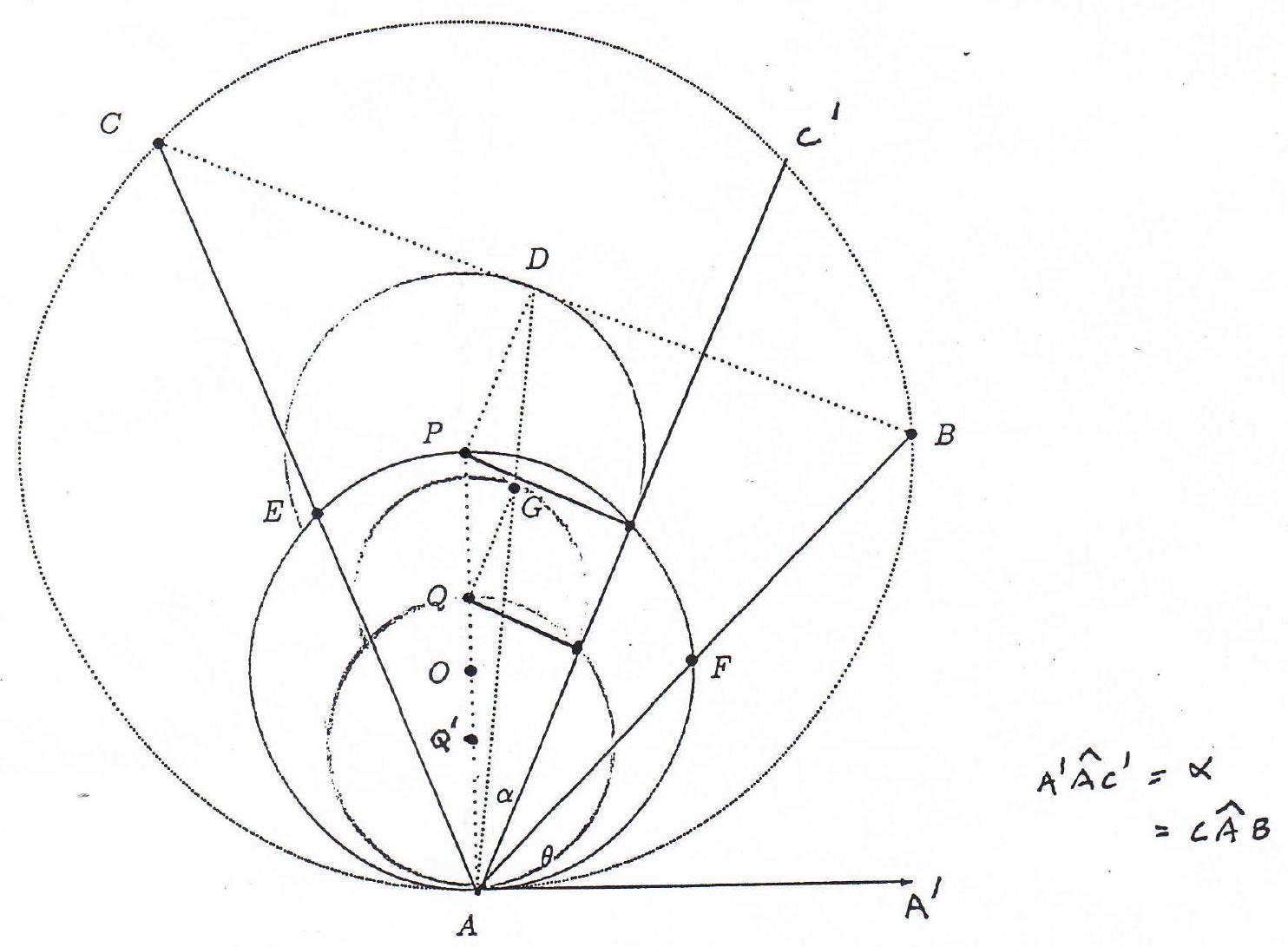\n\nNow, $D$ lies on an arc of a circle, centre $P$, radius $P D$ exterior to the circle, centre $O$, radius $A O$.\nBy similarity, $G$, lies on an arc of a circle, centre $Q$, radius $Q G$ where $A Q=\\frac{2}{3} A P$ and $Q G=\\frac{2}{3} P D$.\nFor the quadrilateral $A F G E$ to be cyclic, we must have that the radius $Q G$ is greater than or equal to $Q P$.\nThe easiest way to calulate these radii is to consider the case in which the diameter $A P$ bisects the angle $\\angle B A C$.\nThus we re-draw the diagram as below. Let $A H$ be a diameter of the larger circle.\n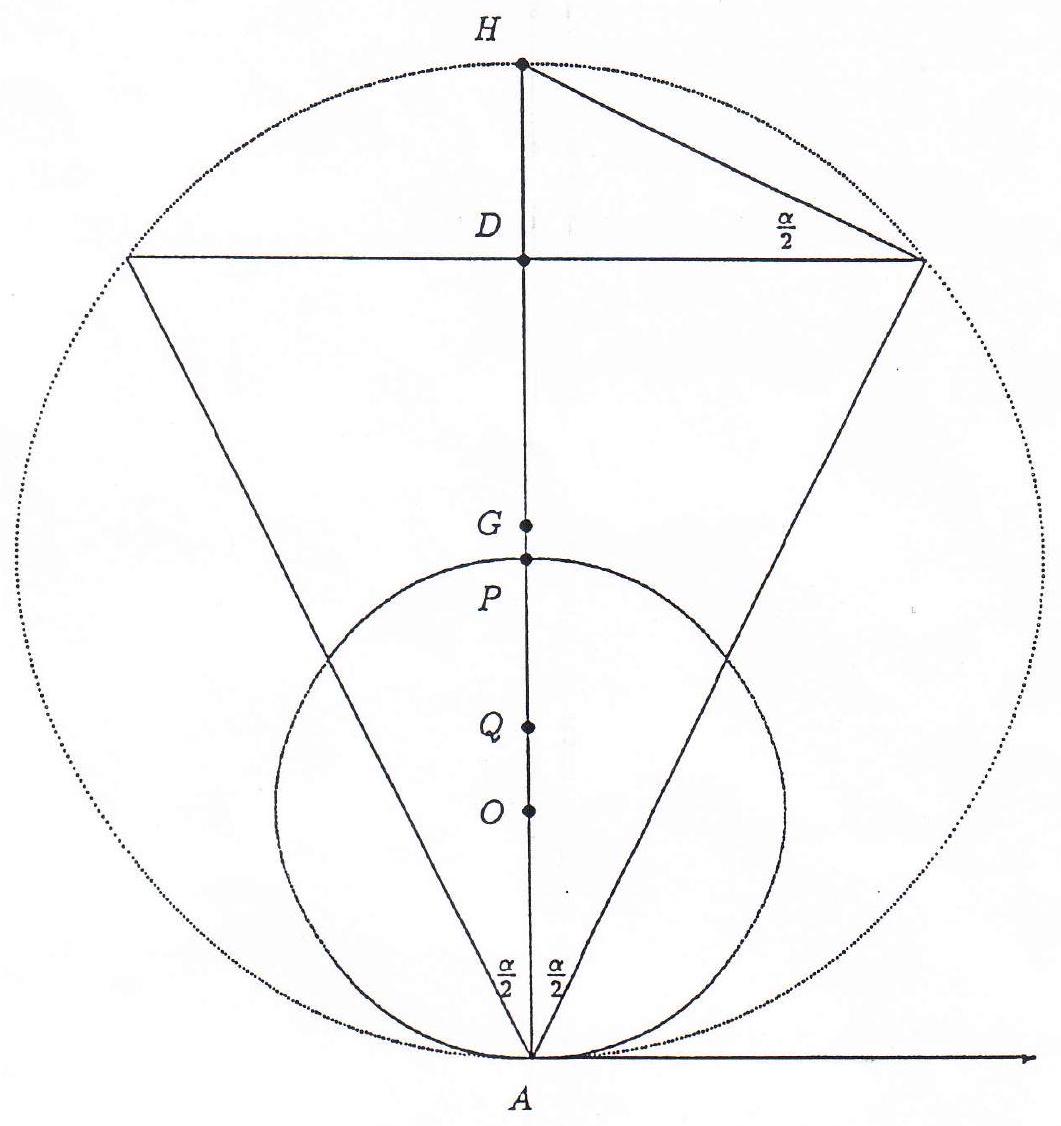\n\nThus we have $A H=4$ and by similar triangles,\n\n$$\n\\frac{A D}{A B}=\\frac{A B}{A H}=\\cos \\left(\\frac{\\alpha}{2}\\right)\n$$\n\nso that\n\n$$\n\\begin{aligned}\nA D & =4 \\cos ^{2}\\left(\\frac{\\alpha}{2}\\right) \\\\\n& =2+2 \\cos (\\alpha) .\n\\end{aligned}\n$$\n\nThus $P D=2 \\cos (\\alpha)$ and $Q G=\\frac{2}{3} 2 \\cos (\\alpha)=\\frac{4}{3} \\cos (\\alpha)$.\nThe necessary condition for a cyclic quadrilateral is then\n\n$$\n\\frac{4}{3}(1+\\cos (\\alpha)) \\geq 2\n$$\n\n[5\n\n$$\n\\cos (\\alpha) \\geq \\frac{1}{2}\n$$\n\n:7\nThus it is clear that there is precisely one (up to similarity) solution for $0<\\alpha \\leq 60^{\\circ}$ and no solutions otherwise.", "metadata": {"resource_path": "APMO/segmented/en-apmo1990_sol.jsonl", "problem_match": "# Question 1 ", "solution_match": "\nTHIRD SOLUTION\n"}} |
| {"year": "1990", "tier": "T1", "problem_label": "2", "problem_type": null, "exam": "APMO", "problem": "Let $a_{1}, a_{2}, \\ldots, a_{n}$ be positive real numbers, and let $S_{k}$ be the sum of products of $a_{1}, a_{2}, \\ldots, a_{n}$ taken $k$ at a time.\nShow that\n\n$$\nS_{k} S_{n-k} \\geq\\binom{ n}{k}^{2} a_{1} a_{2} \\ldots a_{n}, \\quad \\text { for } \\quad k=1,2, \\ldots, n-1\n$$", "solution": "$$\n\\binom{n}{k} a_{1} a_{2} \\ldots a_{n}\n$$\n\n$2=\\sum_{1 \\leq i_{1}<i_{2}<\\ldots<i_{k} \\leq n} a_{i_{1}} a_{i_{2}} \\ldots a_{i_{k}} \\cdot a_{1} a_{2} \\ldots a_{n} / a_{i_{1}} a_{i_{2}} \\ldots a_{i_{k}}$\n(and using the Cauchy-Schwarz inequality)\n\n$$\n\\begin{aligned}\n& \\leq\\left(\\sum_{1 \\leq i_{1}<i_{2}<\\ldots<i_{k} \\leq n} a_{i_{1}} a_{i_{2}} \\ldots a_{i_{k}}\\right)^{\\frac{1}{2}} \\cdot\\left(\\sum_{1 \\leq i_{1}<i_{2}<\\ldots<i_{k} \\leq n} a_{1} a_{2} \\ldots a_{n} / a_{i_{1}} a_{i_{2}} \\ldots a_{i_{k}}\\right)^{\\frac{1}{2}} \\\\\n& =S_{k}^{\\frac{1}{2}} \\cdot S_{n-k}^{\\frac{1}{2}}\n\\end{aligned}\n$$\n\nTherefore\n\n$$\n\\binom{n}{k}^{2} a_{1} a_{2} \\ldots a_{n} \\leq S_{k} S_{n-k}\n$$\n\nq.e.d.", "metadata": {"resource_path": "APMO/segmented/en-apmo1990_sol.jsonl", "problem_match": "# Question 2", "solution_match": "# FIRST SOLUTION\n\n"}} |
| {"year": "1990", "tier": "T1", "problem_label": "2", "problem_type": null, "exam": "APMO", "problem": "Let $a_{1}, a_{2}, \\ldots, a_{n}$ be positive real numbers, and let $S_{k}$ be the sum of products of $a_{1}, a_{2}, \\ldots, a_{n}$ taken $k$ at a time.\nShow that\n\n$$\nS_{k} S_{n-k} \\geq\\binom{ n}{k}^{2} a_{1} a_{2} \\ldots a_{n}, \\quad \\text { for } \\quad k=1,2, \\ldots, n-1\n$$", "solution": "(provided by the Canadian Problems Committee).\nWrite $S_{k}$ as $\\sum_{i=1}^{\\binom{n}{k}} t_{i}$. Then\n주\n\n$$\nS_{n-k}=\\left(\\prod_{m=1}^{n} a_{m}\\right)\\left(\\sum_{i=1}^{\\binom{n}{k}} \\frac{1}{t_{i}}\\right)\n$$\n\n$$\n\\text { so that } \\left.\\begin{array}{rl}\nS_{k} S_{n-k} & =\\left(\\prod_{m=1}^{n} a_{m}\\right) \\cdot\\left(\\begin{array}{l}\n\\binom{n}{k} \\\\\ni=1\n\\end{array} t_{i}\\right)\\left(\\begin{array}{l}\n\\binom{n}{k} \\\\\n\\sum_{j=1}^{2}\n\\end{array} \\frac{1}{t_{j}}\\right) \\\\\n& =\\left(\\prod_{m=1}^{n} a_{m}\\right)\\left[\\sum_{i=1}^{\\binom{n}{k}} 1+\\sum_{i=1}^{\\binom{n}{k}} \\sum_{j=1}^{n} \\begin{array}{l}\nn \\\\\nk\n\\end{array}\\right) \\\\\n\\frac{t_{i}}{} \\\\\nt_{j}\n\\end{array}\\right] .\n$$\n\nAs there are\n\n$$\n\\frac{\\binom{n}{k}^{2}-\\binom{n}{k}}{2}\n$$\n\nterms in the sum\n\n\n$$\n\\begin{aligned}\nS_{k} S_{n-k} & \\geq\\left(\\prod_{m=1}^{n} a_{m}\\right)\\left[\\binom{n}{k}+2 \\cdot \\frac{\\binom{n}{k}^{2}-\\binom{n}{k}}{2}\\right] \\\\\n& =\\binom{n}{k}^{2}\\left(\\prod_{m=1}^{n} a_{m}\\right)\n\\end{aligned}\n$$\n\nsince $\\frac{t_{i}}{t_{j}}+\\frac{t_{j}}{t_{i}} \\geq 2$ for $t_{i}, t_{j}>0$.", "metadata": {"resource_path": "APMO/segmented/en-apmo1990_sol.jsonl", "problem_match": "# Question 2", "solution_match": "\nSECOND SOLUTION "}} |
| {"year": "1990", "tier": "T1", "problem_label": "3", "problem_type": null, "exam": "APMO", "problem": "Consider all the triangles $A B C$ which have a fixed base $A B$ and whose altitude from $C$ is a constant $h$. For which of these triangles is the product of its altitudes a maximum?", "solution": "Let $h_{a}$ and $h_{b}$ be the altitudes from $A$ and $B$, respectively. Then\n\n$$\n\\begin{aligned}\nA B \\cdot h \\cdot A C \\cdot h_{b} \\cdot B C \\cdot h_{a} & =8 . \\text { area of } \\triangle A B C)^{3} \\\\\n& =(A B \\cdot h)^{3},\n\\end{aligned}\n$$\n\n园\nwhich is a constant. So the product $h . h_{a} \\cdot h_{b}$ attains its maximum when the product $A C . B C$ attains its minimum.\nSince\n\n$$\n\\begin{aligned}\n(\\sin C) \\cdot A C \\cdot B C & =B C \\cdot h_{a} \\\\\n& =2 \\cdot \\text { area of } \\triangle A B C\n\\end{aligned}\n$$\n\n(3)\nwhich is a constant, $A C \\cdot B C$ attains its minimum when $\\sin C$ reaches its maximum. There are two cases:\n(a) $h \\leq A B / 2$. Then there exists a triangle $A B C$ which has a right angle at $C$, and for precisely such a triangle $\\sin C$ attains its maximum, namely 1 .\n(b) $h>A B / 2$. In this case the angle at $C$ is acute and assumes its maximum when the triangle is isosceles.\n\nNote that a solution using calculus obviously exists.", "metadata": {"resource_path": "APMO/segmented/en-apmo1990_sol.jsonl", "problem_match": "# Question 3", "solution_match": "# SOLUTION:"}} |
| {"year": "1990", "tier": "T1", "problem_label": "4", "problem_type": null, "exam": "APMO", "problem": "A set of 1990 persons is divided into non-intersecting subsets in such a way that\n(a) no one in a subset knows all the others in the subset;\n(b) among any three persons in a subset, there are always at least two who do not know each other; and\n(c) for any two persons in a subset who do not know each other, there is exactly one person in the same subset knowing both of them.\n(i) Prove that within each subset, every person has the same number of acquaintances.\n(ii) Determine the maximum possible number of subsets.\n\nNote: it is understood that if a person $A$ knows person $B$, then person $B$ will know person $A$; an acquaintance is someone who is known. Every person is assumed to know one's self.", "solution": "(i) Let $S$ be a subset of persons satisfying conditions (a), (b) and (c). Let $x \\in S$ be one who knows the maximum number of persons in $S$.\nAssume that $x$ knows $x_{1}, x_{2}, \\ldots, x_{n}$. By (b), $x_{i}$ and $x_{j}$ are strangers if $i \\neq j$. For each $x_{i}$, let $N_{i}$ be the set of persons in $S$ who know $x_{i}$ but not $x$. Note that, for $i \\neq j, N_{i}$ has no person in common with $N_{j}$, otherwise there would be more than one person knowing $x_{i}$ and $x_{j}$, contradicting (c).\nBy (a) we may assume that $N_{1}$ is not empty.) Let $y_{1} \\in N_{1}$. By (c), for each $k>1$, there is exactly one person $y_{k}$ in $N_{k}$ who knows $y_{1}$. This means that $y_{1}$ knows $n$ persons, namely $x_{1}, y_{2}, \\ldots, y_{n}$.\nBecause $n$ is the maximal number of persons in $S$ a person in $S$ can know, $y_{1}$ knows exactly $n$ persons in $S$. By precisely the same reasoning we find that each person in $N_{i}$, $i=1,2, \\ldots, n$, knows exactly $n$ persons in $S$.\nLetting $y_{1}$ take the role of $x$ in our argument, we see that also each $x_{i}$ knows exactly $n$ persons. Note that, by (c), every person in $S$ other than $x, x_{1}, \\ldots, x_{n}$, must be in some $N_{j}$. Therefore every person in $S$ knows exactly $n$ persons in $S$ and thus has the same number of acquaintances in $S$.\n(ii) To maximize the number of subsets, we have to minimize the size of each group. The smallest possible subset is one in which every person knows exactly two persons, and hence there must be exactly five persons in the subset, forming a cycle where two persons stand side by side only if they know each other. Therefore the maximum possible number of subsets is 1990/5 $=398$.", "metadata": {"resource_path": "APMO/segmented/en-apmo1990_sol.jsonl", "problem_match": "# Question 4", "solution_match": "# SOLUTION:"}} |
| {"year": "1990", "tier": "T1", "problem_label": "5", "problem_type": null, "exam": "APMO", "problem": "Show that for every integer $n \\geq 6$, there exists a convex hexagon which can be dissected into exactly $n$ congruent triangles.", "solution": "(provided by the Canadian Problems Committee).\nThe basic building blocks will be right angled triangles with sides $p, q$ (which are positive integers) adjacent to the right angle.\n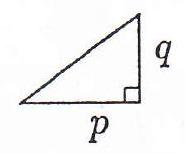\n\nIn the first instance, we take $p=q=1$ and construct five basic building blocks: $L_{1}, L_{2}, M, R_{1}$ and $R_{2}$ 。\n\n## [3)\n\n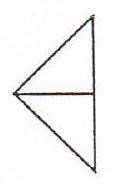\n$L_{1}$\n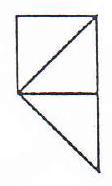\n$L_{2}$\n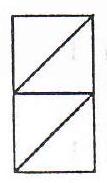\nM\n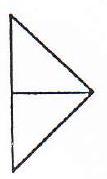\n$R_{1}$\n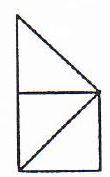\n$R_{2}$\n\nWe shall now build convex hexagons by taking, on the left, one of the blocks $L_{i}$, attaching $n$ copies of the block $M$, and finally attaching one of the blocks $R_{j}$. We must therefore exclude the case when $(i, j)=(2,1)$ for this does not generate a hexagon. Further, for $(i, j)=(1,1)$ or $(i, j)=(1,2)$, we require that $n \\geq 1$, whereas for $(i, j)=$ $(2,2)$, we only need require that $n \\geq 0$.\n\nThus, with the obvious interpretation:\n$L_{1}+n M+R_{1}$ gives a convex hexagon containing $2+4 n+2=4 n+4 \\quad(n \\geq 1)$ congruent triangles;\n$L_{1}+n M+R_{2}$ gives a convex hexagon containing $2+4 n+3=4 n+5(n \\geq 1)$ congruent triangles; and\n$L_{2}+n M+R_{2}$ gives a convex hexagon containing $3+4 n+3=4 n+6 \\quad(n \\geq 0)$ congruent triangles, or $4 n+2(n \\geq 1)$ congruent triangles.\n\nWe shall now modify the lengths of the sides of the right triangle to obtain the case of $4 n+3 \\quad(n \\geq 1)$ congruent triangles.\n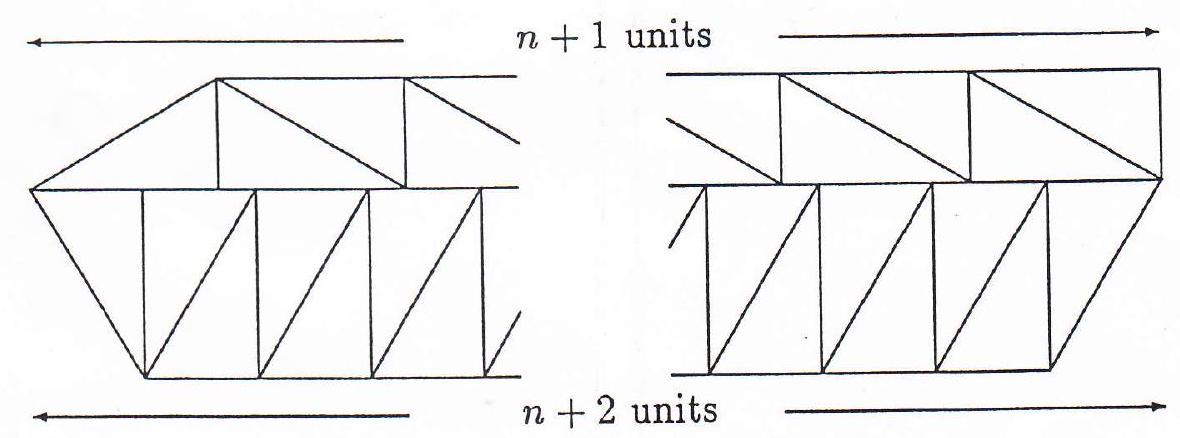\n\nSo we have $2 n+1$ triangles in the top part and $2 n+2$ triangles in the bottom part. In order to match, we need\n\n$$\n(n+1) p=(n+2) q\n$$\n\nso we take\n\n$$\nq=n+1 \\quad \\text { and } \\quad p=n+2\n$$\n\nThis completes the solution.", "metadata": {"resource_path": "APMO/segmented/en-apmo1990_sol.jsonl", "problem_match": "# Question 5", "solution_match": "\nFIRST SOLUTION "}} |
| {"year": "1990", "tier": "T1", "problem_label": "5", "problem_type": null, "exam": "APMO", "problem": "Show that for every integer $n \\geq 6$, there exists a convex hexagon which can be dissected into exactly $n$ congruent triangles.", "solution": "(provided by the Canadian Problems Committee):\nThe basic building blocks will be right angled triangles with sides $m, n$ (which are positive integers) adjacent to the right angle.\n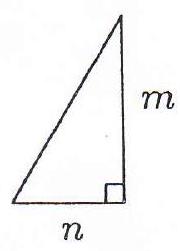\n\nWe construct an \"UPPER CONFIGURATION\", being a rectangle consisting of $m$ building block units of pairs of triangles with the side of length $n$ as base. This gives a base length of $n m$ across the configuration.\n\nWe further construct a \"LOWER CONFIGURATION\", being a triangle with base up, consisting along the base of $n$ building block units. Again, we have a base length of $m n$ across the configuration.\n\nTwo triangles in the upper configuration are shaded horizontally. One triangle in the lower configuration is also shaded horizontally. Another triangle in the lower configuration is shaded vertically.\n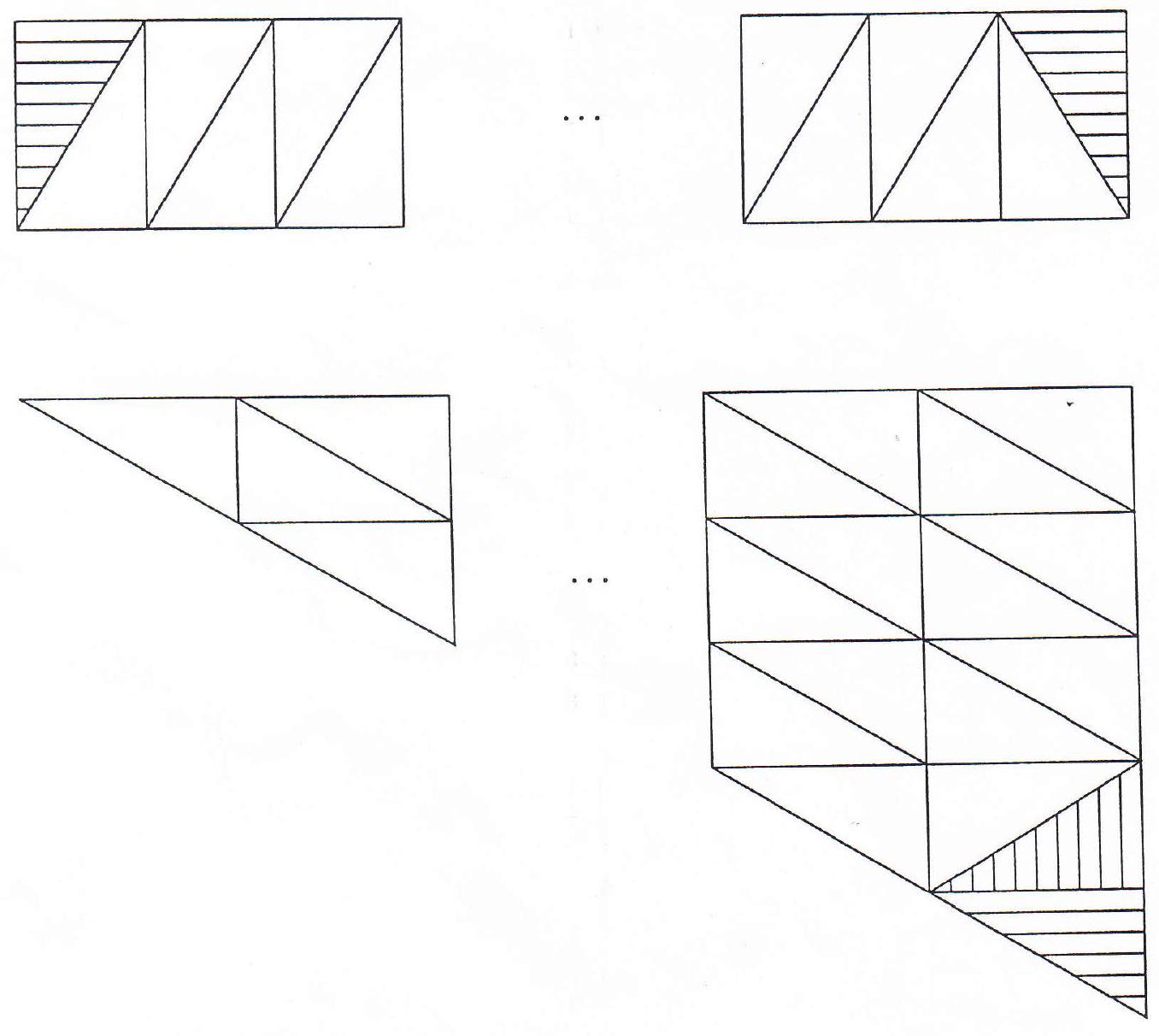\n\nNow consider the figure obtained by joining the two configurations along the base line of common length nm. To create the classes of hexagons defined below, it is necessary that both $n \\geq 3$ and $m \\geq 3$.\n\nWe create a class of convex hexagons (class 1 ) by omitting the three triangles that are shaded horizontally. The other class of convex hexagons (class 2) is obtained by omitting all shaded triangles.\n\nNow count the total number of triangles in the full configuration.\nThe upper configuration gives $2 m$ triangles. The lower configuration gives\n\n$$\n\\sum_{k=1}^{n}(2 k-1)=n^{2} \\quad \\text { triangles. }\n$$\n\nThus the total number of triangles in a hexagon in class 1 is\n\n$$\n2 m-2+n^{2}-1\n$$\n\nand the total number of triangle in a hexagon in class 2 is\n\n$$\n2 m-2+n^{2}-2\n$$\n\nThese, together with the restrictions on $n$ and $m$, generate all positive integers greater than or equal to 11.\n\nFor the integers $6,7,8,9$ and 10 , we give specific examples:\n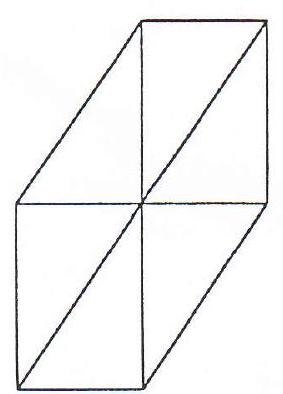\n\n6\n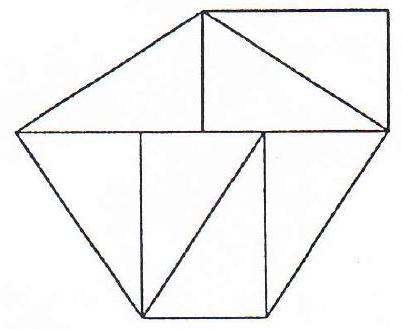\n\n7\n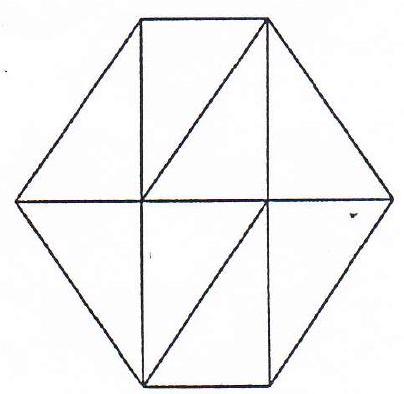\n\n8\n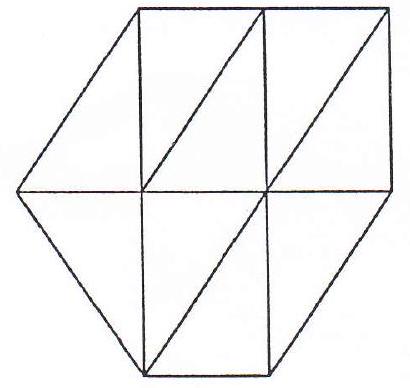\n\n9\n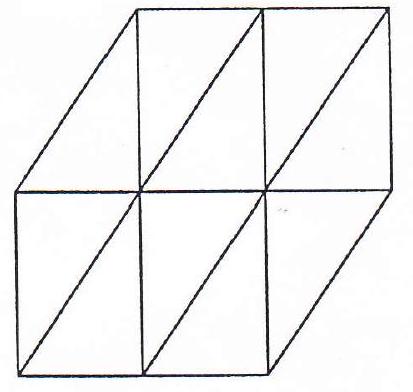\n\n10\n\nThis completes the solution.\n\nThere are $\\binom{n}{k}$ products of the $a_{i}$ taken $k$ at a time. Amongst these products any given $a_{i}$ will appear $\\binom{n-1}{k-1}$ times, since $\\binom{n-1}{k-1}$ is the number of ways of choosing the other factors of the product. So the $\\mathrm{AM} / \\mathrm{GM}$ inequality gives\n\n## ④\n\n$$\n\\frac{S_{k}}{\\binom{n}{k}} \\geq\\left[\\prod_{i=1}^{n} a_{i}^{\\binom{n-1}{k-1}}\\right]^{\\frac{1}{n}\\binom{n}{n}}\n$$\n\nBut $\\binom{n}{k}=\\frac{n}{k}\\binom{n-1}{k-1}$, leading to\n6 S $\\quad S_{k} \\geq\\binom{ n}{k}\\left(\\prod_{i=1}^{n} a_{i}\\right)^{\\frac{k}{n}}$.\nHence\n田\n\n$$\nS_{k} S_{n-k} \\geq\\binom{ n}{k}\\left(\\prod_{i=1}^{n} a_{i}\\right)^{\\frac{k}{n}}\\binom{n}{n-k}\\left(\\prod_{i=1}^{n} a_{i}\\right)^{\\frac{n-k}{n}}=\\binom{n}{k}^{2}\\left(\\prod_{1}^{n} a_{i}\\right) .\n$$", "metadata": {"resource_path": "APMO/segmented/en-apmo1990_sol.jsonl", "problem_match": "# Question 5", "solution_match": "\nSECOND SOLUTION "}} |
|
|


