| {"year": "1992", "tier": "T1", "problem_label": "1", "problem_type": null, "exam": "APMO", "problem": "A triangle with sides $a, b$, and $c$ is given. Denote by $s$ the semiperimeter, that is $s=(a+b+c) / 2$. Construct a triangle with sides $s-a, s-b$, and $s-c$. This process is repeated until a triangle can no longer be constructed with the sidelengths given.\nFor which original triangles can this process be repeated indefinitely?\nAnswer: Only equilateral triangles.", "solution": "The perimeter of each new triangle constructed by the process is $(s-a)+(s-b)+(s-c)=$ $3 s-(a+b+c)=3 s-2 s=s$, that is, it is halved. Consider a new equivalent process in which a similar triangle with sidelengths $2(s-a), 2(s-b), 2(s-c)$ is constructed, so the perimeter is kept invariant.\nSuppose without loss of generality that $a \\leq b \\leq c$. Then $2(s-c) \\leq 2(s-b) \\leq 2(s-a)$, and the difference between the largest side and the smallest side changes from $c-a$ to $2(s-a)-2(s-c)=$ $2(c-a)$, that is, it doubles. Therefore, if $c-a>0$ then eventually this difference becomes larger than $a+b+c$, and it's immediate that a triangle cannot be constructed with the sidelengths. Hence the only possibility is $c-a=0 \\Longrightarrow a=b=c$, and it is clear that equilateral triangles can yield an infinite process, because all generated triangles are equilateral.", "metadata": {"resource_path": "APMO/segmented/en-apmo1992_sol.jsonl", "problem_match": "# Problem 1", "solution_match": "# Solution\n\n"}} |
| {"year": "1992", "tier": "T1", "problem_label": "2", "problem_type": null, "exam": "APMO", "problem": "In a circle $C$ with centre $O$ and radius $r$, let $C_{1}, C_{2}$ be two circles with centres $O_{1}, O_{2}$ and radii $r_{1}, r_{2}$ respectively, so that each circle $C_{i}$ is internally tangent to $C$ at $A_{i}$ and so that $C_{1}, C_{2}$ are externally tangent to each other at $A$.\nProve that the three lines $O A, O_{1} A_{2}$, and $O_{2} A_{1}$ are concurrent.", "solution": "Because of the tangencies, the following triples of points (two centers and a tangency point) are collinear:\n\n$$\nO_{1} ; O_{2} ; A, \\quad O ; O_{1} ; A_{1}, \\quad O ; O_{2} ; A_{2}\n$$\n\nBecause of that we can ignore the circles and only draw their centers and tangency points.\n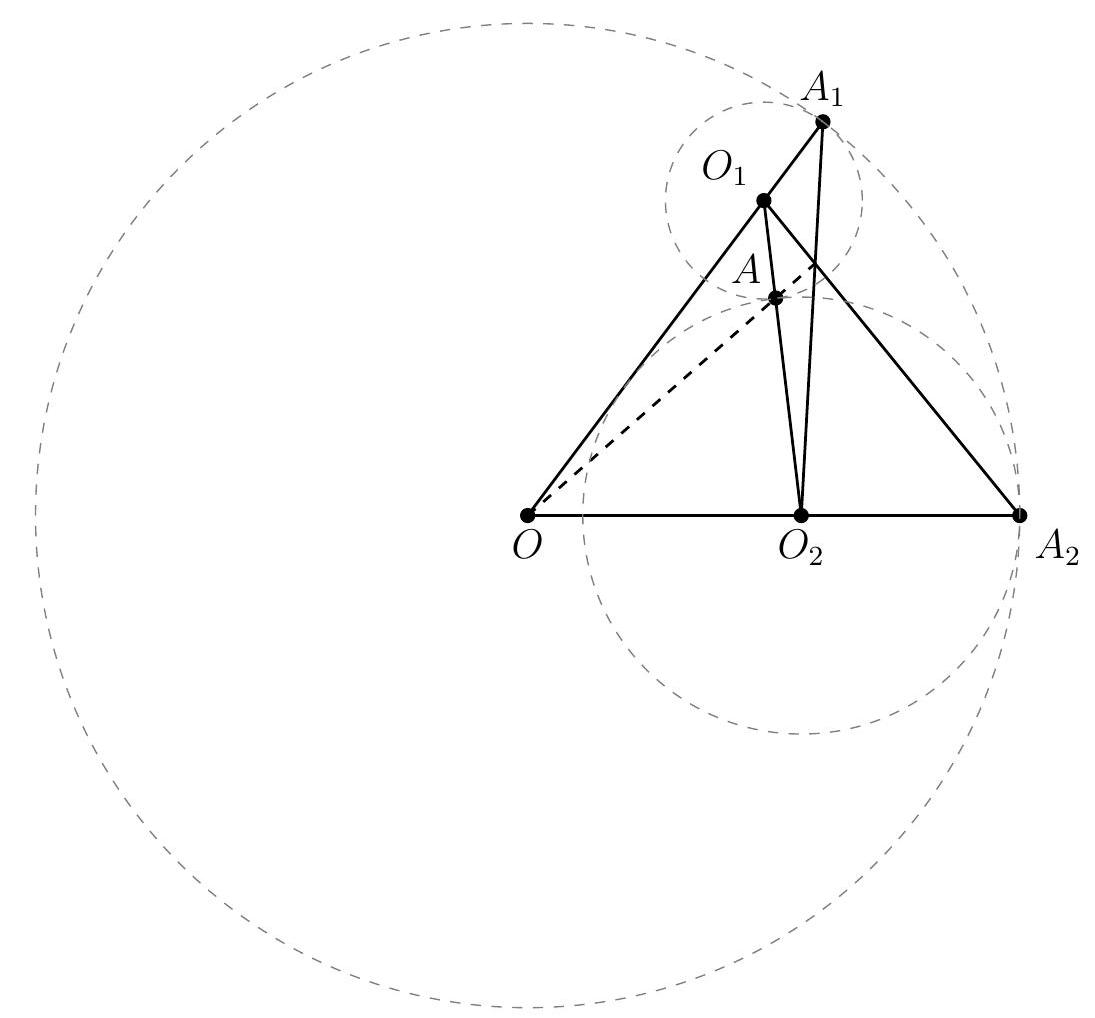\n\nNow the problem is immediate from Ceva's theorem in triangle $O O_{1} O_{2}$, because\n\n$$\n\\frac{O A_{1}}{A_{1} O_{1}} \\cdot \\frac{O_{1} A}{A O_{2}} \\cdot \\frac{O_{2} A_{2}}{A_{2} O}=\\frac{r}{r_{1}} \\cdot \\frac{r_{1}}{r_{2}} \\cdot \\frac{r_{2}}{r}=1\n$$", "metadata": {"resource_path": "APMO/segmented/en-apmo1992_sol.jsonl", "problem_match": "# Problem 2", "solution_match": "# Solution\n\n"}} |
| {"year": "1992", "tier": "T1", "problem_label": "3", "problem_type": null, "exam": "APMO", "problem": "Let $n$ be an integer such that $n>3$. Suppose that we choose three numbers from the set $\\{1,2, \\ldots, n\\}$. Using each of these three numbers only once and using addition, multiplication, and parenthesis, let us form all possible combinations.\n(a) Show that if we choose all three numbers greater than $n / 2$, then the values of these combinations are all distinct.\n(b) Let $p$ be a prime number such that $p \\leq \\sqrt{n}$. Show that the number of ways of choosing three numbers so that the smallest one is $p$ and the values of the combinations are not all distinct is precisely the number of positive divisors of $p-1$.", "solution": "In both items, the smallest chosen number is at least 2: in part (a), $n / 2>1$ and in part (b), $p$ is a prime. So let $1<x<y<z$ be the chosen numbers. Then all possible combinations are\n\n$$\nx+y+z, \\quad x+y z, \\quad x y+z, \\quad y+z x, \\quad(x+y) z, \\quad(z+x) y, \\quad(x+y) z, \\quad x y z\n$$\n\nSince, for $1<m<n$ and $t>1,(m-1)(n-1) \\geq 1 \\cdot 2 \\Longrightarrow m n>m+n, t n+m-(t m+n)=$ $(t-1)(n-m)>0 \\Longrightarrow t n+m>t m+n$, and $(t+m) n-(t+n) m=t(n-m)>0$,\n\n$$\nx+y+z<z+x y<y+z x<x+y z\n$$\n\nand\n\n$$\n(y+z) x<(x+z) y<(x+y) z<x y z .\n$$\n\nAlso, $(y+z) x-(y+z x)=(x-1) y>0 \\Longrightarrow(y+z) x>y+z x$ and $(x+z) y-(x+y z)=$ $(y-1) x>0 \\Longrightarrow(x+z) y>x+y z$. Therefore the only numbers that can be equal are $x+y z$ and $(y+z) x$. In this case,\n\n$$\nx+y z=(y+z) x \\Longleftrightarrow(y-x)(z-x)=x(x-1)\n$$\n\nNow we can solve the items.\n(a) if $n / 2<x<y<z$ then $z-x<n / 2$, and since $y-x<z-x, y-x<n / 2-1$; then\n\n$$\n(y-x)(z-x)<\\frac{n}{2}\\left(\\frac{n}{2}-1\\right)<x(x-1)\n$$\n\nand therefore $x+y z<(y+z) x$.\n(b) if $x=p$, then $(y-p)(z-p)=p(p-1)$. Since $y-p<z-p,(y-p)^{2}<(y-p)(z-p)=$ $p(p-1) \\Longrightarrow y-p<p$, that is, $p$ does not divide $y-p$. Then $y-p$ is a divisor $d$ of $p-1$ and $z-p=\\frac{p(p-1)}{d}$. Therefore,\n\n$$\nx=p, \\quad, y=p+d, \\quad z=p+\\frac{p(p-1)}{d}\n$$\n\nwhich is a solution for every divisor $d$ of $p-1$ because\n\n$$\nx=p<y=p+d<2 p \\leq p+p \\cdot \\frac{p-1}{d}=z .\n$$\n\nComment: If $x=1$ was allowed, then any choice $1, y, z$ would have repeated numbers in the combination, as $1 \\cdot y+z=y+1 \\cdot z$.", "metadata": {"resource_path": "APMO/segmented/en-apmo1992_sol.jsonl", "problem_match": "# Problem 3", "solution_match": "# Solution\n\n"}} |
| {"year": "1992", "tier": "T1", "problem_label": "4", "problem_type": null, "exam": "APMO", "problem": "Determine all pairs $(h, s)$ of positive integers with the following property: If one draws $h$ horizontal lines and another $s$ lines which satisfy\n(i) they are not horizontal,\n(ii) no two of them are parallel,\n(iii) no three of the $h+s$ lines are concurrent,\nthen the number of regions formed by these $h+s$ lines is 1992 .\nAnswer: $(995,1),(176,10)$, and $(80,21)$.", "solution": "Let $a_{h, s}$ the number of regions formed by $h$ horizontal lines and $s$ another lines as described in the problem. Let $\\mathcal{F}_{h, s}$ be the union of the $h+s$ lines and pick any line $\\ell$. If it intersects the other lines in $n$ (distinct!) points then $\\ell$ is partitioned into $n-1$ line segments and 2 rays, which delimit regions. Therefore if we remove $\\ell$ the number of regions decreases by exactly $n-1+2=n+1$.\nThen $a_{0,0}=1$ (no lines means there is only one region), and since every one of $s$ lines intersects the other $s-1$ lines, $a_{0, s}=a_{0, s-1}+s$ for $s \\geq 0$. Summing yields\n\n$$\na_{0, s}=s+(s-1)+\\cdots+1+a_{0,0}=\\frac{s^{2}+s+2}{2} .\n$$\n\nEach horizontal line only intersects the $s$ non-horizontal lines, so $a_{h, s}=a_{h-1, s}+s+1$, which implies\n\n$$\na_{h, s}=a_{0, s}+h(s+1)=\\frac{s^{2}+s+2}{2}+h(s+1) .\n$$\n\nOur final task is solving\n\n$$\na_{h, s}=1992 \\Longleftrightarrow \\frac{s^{2}+s+2}{2}+h(s+1)=1992 \\Longleftrightarrow(s+1)(s+2 h)=2 \\cdot 1991=2 \\cdot 11 \\cdot 181\n$$\n\nThe divisors of $2 \\cdot 1991$ are $1,2,11,22,181,362,1991,3982$. Since $s, h>0,2 \\leq s+1<s+2 h$, so the possibilities for $s+1$ can only be 2,11 and 22 , yielding the following possibilities for $(h, s)$ :\n\n$$\n(995,1), \\quad(176,10), \\quad \\text { and }(80,21) .\n$$", "metadata": {"resource_path": "APMO/segmented/en-apmo1992_sol.jsonl", "problem_match": "# Problem 4", "solution_match": "# Solution\n\n"}} |
| {"year": "1992", "tier": "T1", "problem_label": "5", "problem_type": null, "exam": "APMO", "problem": "Find a sequence of maximal length consisting of non-zero integers in which the sum of any seven consecutive terms is positive and that of any eleven consecutive terms is negative.\n\nAnswer: The maximum length is 16 . There are several possible sequences with this length; one such sequence is $(-7,-7,18,-7,-7,-7,18,-7,-7,18,-7,-7,-7,18,-7,-7)$.", "solution": "Suppose it is possible to have more than 16 terms in the sequence. Let $a_{1}, a_{2}, \\ldots, a_{17}$ be the first 17 terms of the sequence. Consider the following array of terms in the sequence:\n\n| $a_{1}$ | $a_{2}$ | $a_{3}$ | $a_{4}$ | $a_{5}$ | $a_{6}$ | $a_{7}$ | $a_{8}$ | $a_{9}$ | $a_{10}$ | $a_{11}$ |\n| :---: | :---: | :---: | :---: | :---: | :---: | :---: | :---: | :---: | :---: | :---: |\n| $a_{2}$ | $a_{3}$ | $a_{4}$ | $a_{5}$ | $a_{6}$ | $a_{7}$ | $a_{8}$ | $a_{9}$ | $a_{10}$ | $a_{11}$ | $a_{12}$ |\n| $a_{3}$ | $a_{4}$ | $a_{5}$ | $a_{6}$ | $a_{7}$ | $a_{8}$ | $a_{9}$ | $a_{10}$ | $a_{11}$ | $a_{12}$ | $a_{13}$ |\n| $a_{4}$ | $a_{5}$ | $a_{6}$ | $a_{7}$ | $a_{8}$ | $a_{9}$ | $a_{10}$ | $a_{11}$ | $a_{12}$ | $a_{13}$ | $a_{14}$ |\n| $a_{5}$ | $a_{6}$ | $a_{7}$ | $a_{8}$ | $a_{9}$ | $a_{10}$ | $a_{11}$ | $a_{12}$ | $a_{13}$ | $a_{14}$ | $a_{15}$ |\n| $a_{6}$ | $a_{7}$ | $a_{8}$ | $a_{9}$ | $a_{10}$ | $a_{11}$ | $a_{12}$ | $a_{13}$ | $a_{14}$ | $a_{15}$ | $a_{16}$ |\n| $a_{7}$ | $a_{8}$ | $a_{9}$ | $a_{10}$ | $a_{11}$ | $a_{12}$ | $a_{13}$ | $a_{14}$ | $a_{15}$ | $a_{16}$ | $a_{17}$ |\n\nLet $S$ the sum of the numbers in the array. If we sum by rows we obtain negative sums in each row, so $S<0$; however, it we sum by columns we obtain positive sums in each column, so $S>0$, a contradiction. This implies that the sequence cannot have more than 16 terms. One idea to find a suitable sequence with 16 terms is considering cycles of 7 numbers. For instance, one can try\n\n$$\n-a,-a, b,-a,-a,-a, b,-a,-a, b,-a,-a,-a, b,-a,-a .\n$$\n\nThe sum of every seven consecutive numbers is $-5 a+2 b$ and the sum of every eleven consecutive numbers is $-8 a+3 b$, so $-5 a+2 b>0$ and $-8 a+3 b<0$, that is,\n\n$$\n\\frac{5 a}{2}<b<\\frac{8 a}{3} \\Longleftrightarrow 15 a<6 b<16 a\n$$\n\nThen we can choose, say, $a=7$ and $105<6 b<112 \\Longleftrightarrow b=18$. A valid sequence is then\n\n$$\n-7,-7,18,-7,-7,-7,18,-7,-7,18,-7,-7,-7,18,-7,-7\n$$", "metadata": {"resource_path": "APMO/segmented/en-apmo1992_sol.jsonl", "problem_match": "# Problem 5", "solution_match": "# Solution\n\n"}} |
|
|


