| {"year": "1999", "tier": "T1", "problem_label": "1", "problem_type": null, "exam": "APMO", "problem": "Find the smallest positive integer $n$ with the following property : There does not exist an arithmetic progression of 1993 terms of real numbers containing exactly $n$ integers.", "solution": "and Marking Scheme:\nWe first note that the integer terms of any arithmetic progression are \"equally spaced\", because if the $i$ th term $a_{i}$ and the $(i+j)$ th term $a_{i+j}$ of an arithmetic progression are both integers, then so is the $(i+2 j)$ th term $a_{i+2 j}=a_{i+j}+\\left(a_{i+j}-a_{i}\\right)$.\n\n1 POINT for realizing that the integers must be \"equally spaced\".\nThus, by scaling and translation, we can assume that the integer terms of the arithmetic progression are $1,2, \\cdots, n$ and we need only to consider arithmetic progression of the form\n\n$$\n1,1+\\frac{1}{k}, 1+\\frac{2}{k}, \\cdots, 1+\\frac{k-1}{k}, 2,2+\\frac{1}{k}, \\cdots, n-1, \\cdots, n-1+\\frac{k-1}{k}, n\n$$\n\nThis has $k n-k+1$ terms of which exactly $n$ are integers. Moreover we can add up to $k-1$ terms on either end and get another arithmetic progression without changing the number of integer terms.\n\n2 POINTS for noticing that the maximal sequence has an equal number of terms on either side of the integers appearing in the sequence (this includes the 1 POINT above). In other words, 2 POINTS for the scaled and translated form of the progression including the $k-1$ terms on either side.\n\nThus there are arithmetic progressions with $n$ integers whose length is any integer lying in the interval $[k n-k+1, k n+k-1]$, where $k$ is any positive integer. Thus we want to find the smallest $n>0$ so that, if $k$ is the largest integer satisfying $k n+k-1 \\leq 1998$, then $(k+1) n-(k+1)+1 \\geq 2000$.\n\n4 POINTS for clarifying the nature of the number $n$ in this way, which includes counting the terms of the maximal and minimal sequences containing $n$ integers and bounding them accordingly (this includes the 2 POINTS above).\n\nThat is, putting $k=\\lfloor 1999 /(n+1)\\rfloor$, we want the smallest integer $n$ so that\n\n$$\n\\left\\lfloor\\frac{1999}{n+1}\\right\\rfloor(n-1)+n \\geq 2000\n$$\n\nThis inequality does not hold if\n\n$$\n\\frac{1999}{n+1} \\cdot(n-1)+n<2000\n$$\n\n2 POINTS for setting up an inequality for $n$.\nThis simplifies to $n^{2}<3999$, that is, $n \\leq 63$. Now we check integers from $n=64$ on:\n\n$$\n\\begin{aligned}\n& \\text { for } n=64,\\left\\lfloor\\frac{1999}{65}\\right\\rfloor \\cdot 63+64=30 \\cdot 63+64=1954<2000 ; \\\\\n& \\text { for } n=65,\\left\\lfloor\\frac{1999}{66}\\right\\rfloor \\cdot 64+65=30 \\cdot 64+65=1985<2000 ; \\\\\n& \\text { for } n=66,\\left\\lfloor\\frac{1999}{67}\\right\\rfloor \\cdot 65+66=29 \\cdot 65+66=1951<2000 ; \\\\\n& \\text { for } n=67,\\left\\lfloor\\left\\lfloor\\frac{1999}{68}\\right\\rfloor \\cdot 66+67=29 \\cdot 66+67=1981<2000 ;\\right. \\\\\n& \\text { for } n=68,\\left\\lfloor\\frac{1999}{69}\\right\\rfloor \\cdot 67+68=28 \\cdot 67+68=1944<2000 ; \\\\\n& \\text { for } n=69,\\left\\lfloor\\frac{1999}{70}\\right\\rfloor \\cdot 68+69=28 \\cdot 68+69=1973<2000 ; \\\\\n& \\text { for } n=70,\\left\\lfloor\\frac{1999}{71}\\right\\rfloor \\cdot 69+70=28 \\cdot 69+70=2002 \\geq 2000 .\n\\end{aligned}\n$$\n\nThus the answer is $n=70$.\n1.POINT for checking these rumbers and finding that $n=70$.", "metadata": {"resource_path": "APMO/segmented/en-apmo1999_sol.jsonl", "problem_match": "\nProblem 1.", "solution_match": "\nSolution "}} |
| {"year": "1999", "tier": "T1", "problem_label": "4", "problem_type": null, "exam": "APMO", "problem": "Determine all pairs $(a, b)$ of integers with the property that the numbers $a^{2}+4 b$ and $b^{2}+4 a$ are both perfect squares.", "solution": "and Marking Scheme:\n\nWithout loss of generality assume that $|b| \\leq|a|$. Then $a^{2}+4 b \\leq a^{2}+4|a|<a^{2}+4|a|+4=(|a|+2)^{2}$. Given that $a^{2}+4 b$ is a perfect square and since $a^{2}+4 b$ y $a^{2}$ have same parity then $a^{2}+4 b \\neq(|a|+1)^{2}$, so\n\n$$\na^{2}+4 b \\leq a^{2}\n$$\n\n2 POINTS for proving (1).\nLet us consider three cases.\nCase 1. $a^{2}+4 b=a^{2}$. Then $b=0$ and $a$ must be a perfect square. So $a=k^{2}, b=0(k \\in Z)$ is a solution.\nCase 2. $a^{2}+4 b=(|a|-2)^{2}$. Then $b=1-|a|$, therefore $b^{2}+4 a=a^{2}-2|a|+4 a+1$ must be a perfect square.\nIf $a>0$ then $b^{2}+4 a=(a+1)^{2}$ is a perfect square for each $a \\in Z$. Consequently $a=k$ and $b=1-k$ ( $k \\in Z^{+}$) is a solution.\nIf $a=0$ then $b=1$, but from (1) $b$ must be non-positive.\nIf $a<0$ then $b^{2}+4 a=m^{2}-6 m+1$ must be a perfect square, where $m=-a>0$. For $m \\geq 8$\n\n$$\n(m-3)^{2}>m^{2}-6 m+1>(m-4)^{2}\n$$\n\ntherefore $m<8$. If $m=1,2,3,4,5$ then $m^{2}-6 m+1<0$. If $m=6, m^{2}-6 m+1=1$ is a perfect square thus $a=-6$ and $b=-5$ is a solution. If $m=7, m^{2}-6 m+1=8$ is not a perfect square.\n\n2 POINTS for case 1 and case 2.\nCase 3. $a^{2}+4 b \\leq(|a|-4)^{2}$. Since $|b| \\leq|a|$ then $b \\geq-|a|$, thus $a^{2}-4|a| \\leq a^{2}+4 b \\leq(|a|-4)^{2}$. It follows that $|a| \\leq 4$. We have following posibilities:\n\n## 1 POINT for finding that $|a| \\leq 4$ in this case.\n\n(a) $|a|=4$. Then $16+4 b=0$ or $b=-4$. Thus $b^{2}+4 a=16 \\pm 16$ must be a perfect square. So $a=-4$ y $b=-4$.\n(b) $|a|=3$. In this case $a^{2}+4 b=9+4 b \\leq 1$, then $9+4 b=0$ or $9+4 b=1$. The equation $9+4 b=0$ does not have integer solutions. The solution of the second equation is $b=-2$. Then $b^{2}+4 a=4 \\pm 12$ must be a perfect square, thus $a=3$.\n(c) $|a|=2 \\cdot a^{2}+4 b=4+4 b \\leq 4$. Since $4+4 b$ is cven and must be a perfect square then $4+4 b=4$ or $4+4 b=0$. Therefore $b=0$ or $b=-1$. If $b=0, b^{2}+4 a= \\pm 8$ is not a perfect square. If $b=-1$ then $b^{2}+4 a=1 \\pm 8$ is a perfect square if $a=2$. Thus $a=2$ and $b=-1$ is a solution.\n(d) $|a|=1$. Then $a^{2}+4 b=4 b+1 \\leq 9$. Since $4 b+1$ must be an odd perfect square then $4 b+1=1$ or $4 b+1=9$. So $b=0$ or $b=2$. If $b=0, b^{2}+4 a= \\pm 4$, then $a=1$. If $b=2$ then $a=-1$, but this is not possible because $|b| \\leq|a|$. Thus $a=1$ y $b=0$ is a solution in this case.\n(c) $|a|=0$. Since $|b| \\leq|a|$ then $b=0$.\n\n1 POINT for concluding case 3.\n\nTesting these solutions and by symmetry we obtain the following solutions:\n\n$$\n\\left(k^{2}, 0\\right),\\left(0, k^{2}\\right),(k, 1-k),(-6,-5),(-5,-6),(-4,-4)\n$$\n\nwhere $k$ is an arbitrary integer. Note that if $(k, 1-k)$ is a solution with $k>0$, then taking $t=1-k$, $k=1-t$, so $(1-t, t)$ is solution. Thus by symetry $(k, 1-k)$ is a solution for any integer.\n\n1 POINT for writing up the correct answer.\nRemark: I POINT can be given for checking that $(k, 1-k)$ is a solution. However NO POINT is given for finding any other particular solution.", "metadata": {"resource_path": "APMO/segmented/en-apmo1999_sol.jsonl", "problem_match": "\nProblem 4.", "solution_match": "# Second Solution "}} |
| {"year": "1999", "tier": "T1", "problem_label": "5", "problem_type": null, "exam": "APMO", "problem": "Let $S$ be a set of $2 n+1$ points in the plane such that no three are collinear and no four concyclic. A circle will be called good if it has 3 points of $S$ on its circumference, $n-1$ points in its interior and $n-1$ in its exterior. Prove that the number of good circles has the same parity as $n$.", "solution": "and Marking Scheme:\n\nLemma 1. Let $P$ and $Q$ be two points of $S$. The number of good circles that contain $P$ and $Q$ on their circumference is odd.\n\n## Proof of Lemma 1.\n\n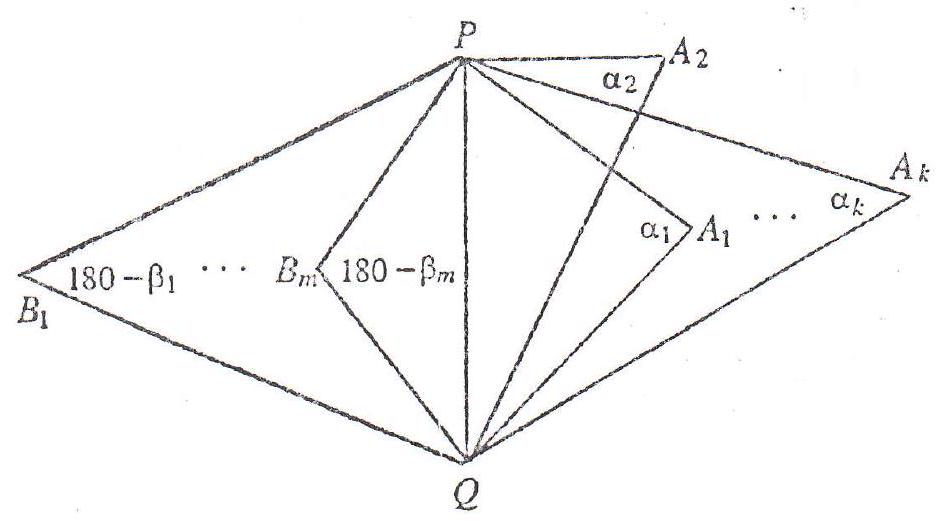\n\nLet $N$ be the number of good circles that pass through $P$ and $Q$. Number the points on one side of the line $P Q$ by $A_{1}, A_{2}, \\ldots, A_{k}$ and those on the other side by $B_{1}, B_{2}, \\ldots, B_{m}$ in such a way that if $\\angle P A_{i} Q=\\alpha_{i}, \\angle P B_{j} Q=180-\\beta_{j}$ then $\\alpha_{1}>\\alpha_{2}>\\ldots>\\alpha_{k}$ and $\\beta_{1}>\\beta_{2}>\\ldots>\\beta_{m}$.\nNote that the angles $\\alpha_{1}, \\alpha_{2}, \\ldots, \\alpha_{k}, \\beta_{1}, \\beta_{2}, \\ldots, \\beta_{m}$ are all distinct since there are no four points in $S$ that are concyclic.\nObserve that the circle that passes through $P, Q$ and $A_{i}$ has $A_{j}$ in its interior when $\\alpha_{j}>\\alpha_{i}$ that is, when $i>j$; and it contains $B_{j}$ in its interior when $\\alpha_{i}+180-\\beta_{j}>180$, that is, when $\\alpha_{i}>\\beta_{j}$. Similar conditions apply to the circle that contains $P, Q$ and $B_{j}$.\n\n1 POINT for characterizing the points that lie inside a given circle ins terms of these angles, or for similar considerations.\nOrder the angles $\\alpha_{1}, \\alpha_{2}, \\ldots, \\alpha_{k}, \\beta_{1}, \\beta_{2}, \\ldots, \\beta_{m}$ from the greatest to least. Now transform $S$ as follows. Consider a $\\beta_{j}$ that bas an $\\alpha_{i}$ immediately to its left in such an ordering ( $\\ldots>\\alpha_{i}>\\beta_{j} \\ldots$ ). Consider a new set $S^{\\prime}$ that contains the same points as $S$ except for $A_{i}$ and $B_{j}$. These two points will be replaced by $A_{i}^{\\prime}$ and $B_{j}^{\\prime}$ that satisfy $\\angle P A_{i}^{\\prime} Q=\\beta_{j}=\\alpha_{i}^{\\prime}$ and $\\angle P B_{j}^{\\prime} Q=180-\\alpha_{i}^{\\prime \\prime}=180-\\beta_{j}^{\\prime}$. Thus $\\beta_{j}$ and $\\alpha_{i}$ have been interchanged and the ordering of the $\\alpha$ 's and $\\beta$ 's has only changed with respect to the relative order of $\\alpha_{i}$ and $\\beta_{j}$; we continue to have\n\n$$\n\\alpha_{1}>\\alpha_{2}>\\ldots>\\alpha_{i-1}>\\alpha_{i}^{\\prime}>\\alpha_{i+1}>\\ldots>\\alpha_{k}\n$$\n\nand\n\n$$\n\\beta_{1}>\\beta_{2}>\\ldots>\\beta_{j-1}>\\beta_{j}^{\\prime}>\\beta_{j+1}>\\ldots>\\beta_{m}\n$$\n\n1 POINT for this or another useful transformation of the set $S$.\nAnalyze the good circles in this new set $S^{\\prime}$. Clearly, a circle through $P, Q, A_{r}(r \\neq i)$ or through $P, Q, B_{s}(s \\neq j)$ that was good in $S$ will also be good in $S^{\\prime}$, because the order of $A_{r}$ (or $B_{s}$ ) relative to the rest of the points has not changed, and therefore the number of points in the interior or exterior of this circle has not changed. The only changes that could have taken place are:\na) If the circle $P, Q, A_{i}$ was good in $S$, the circle $P, Q, A_{i}^{\\prime}$ may not be good in $S^{\\prime}$.\nb) If the circle $P, Q, B_{j}$ was good in $S$, the circle $P, Q, B_{j}^{\\prime}$ may not be good in $S^{\\prime}$.\nc) If the circle $P, Q, A_{i}$ was not good in $S$, the circle $P, Q, A_{i}^{\\prime}$ may be good in $S^{\\prime}$.\nd) If the circle $P, Q, B_{j}$ was not good in $S$, the circle $P, Q, B_{j}^{\\prime}$ may be good in $S^{\\prime}$.\n\n1 POINT for realizing that the transformation can only change the \"goodness\" of these circles. But observe that the circle $P, Q, A_{i}$ contains the points $A_{1}, A_{2}, \\ldots, A_{i-1}, B_{j}, B_{j+1}, \\ldots, B_{m}$ and does not contain the points $A_{i+1}, A_{i+2}, \\ldots, A_{k}, B_{1}, B_{2}, \\ldots, B_{j-1}$ in its interior. Then this circle is good if and only if $i+m-j=k-i+j-1$, which we rewrite as $j-i=\\frac{1}{2}(m-k+1)$. On the other hand, the circle $P, Q, B_{j}$ contains the points $B_{j+1}, B_{j+2}, \\ldots, B_{m}, A_{1}, A_{2}, \\ldots, A_{i}$ and does not contain the points $B_{1}, B_{2}, \\ldots, B_{j-1}, A_{i+1}, A_{i+2}, \\ldots, A_{k}$ in its interior. Hence this circle is good if and only if $m-j+i=j-1+k-i$, which we rewrite as $j-i=\\frac{1}{2}(m-k+1)$.\nTherefore, the circle $P, Q, A_{i}$ is good if and only if the circle $P, Q, B_{j}$ is good. Similarly, the circle $P, Q, A_{i}^{\\prime}$ is good if and only if the circle $P, Q, B_{j}^{\\prime}$ is good. That is to say, transforming $S$ into $S^{\\prime}$ we lose either 0 or 2 good circles of $S$ and we gain either 0 or 2 good circles in $S^{\\prime}$.\n\n1 POINT for realizing that the \"goodness\" of these circles is changed in pairs.\nContinuing in this way, we may continue to transform $S$ until we obtain a new set $S_{0}$ such that the angles $\\alpha_{1}^{\\prime}, \\alpha_{2}^{\\prime}, \\ldots, \\alpha_{k}^{\\prime}, \\beta_{1}^{\\prime}, \\beta_{2}^{\\prime}, \\ldots, \\beta_{m}^{\\prime}$ satisfy\n\n$$\n\\beta_{1}^{\\prime}>\\beta_{2}^{\\prime}>\\ldots>\\beta_{n}^{\\prime}>\\alpha_{1}^{\\prime}>\\alpha_{2}^{\\prime}>\\ldots>\\alpha_{k}^{\\prime}\n$$\n\nand such that the number of good circles in $S_{0}$ has the same parity as $N$. We claim that $S_{0}$ has exactly one good circle. In this configuration, the circle $P, Q, A_{i}$ does not contain any $B_{j}$ and the circle $P, Q, B_{r}$ does not contain any $A_{s}$ (for all $\\left.i, j\\right)$, because $\\alpha_{a}+\\left(180-\\beta_{b}\\right)<180$ for all $a, b$. Hence, the only possible good circles are $P, Q, B_{m-n+1}$ (which contains the $n-1$ points $B_{m-n+2}, B_{m-n+3}, \\ldots, B_{m}$ ), if $m-n+1>0$, and the circle $P, Q, A_{n}$ (which contains the $n-1$ points $A_{1}, A_{2}, \\ldots, A_{n}$ ), if $n \\leq k$. But, since $m+k=2 n-1$, which we rewrite as $m-n+1=n-k$, exactly one of the inequalitites $m-n+1>0$ and $n \\leq k$ is satisfied. It follows that one of the points $B_{m-n+1}$ and $A_{n}$ corresponds to a good circle and the other does not. Hence, $S_{0}$ has exactly one good circle, and $N$ is odd.\n\n1 POINT for showing that this configuration has exactly one good circle.\n\nNow consider the $\\binom{2 n+1}{2}$ pairs of points in $S$. Let $a_{2 k+1}$ be the number of pairs of points through which exactly $2 k+1$ good circles pass. Then\n\n$$\na_{1}+a_{3}+a_{5}+\\ldots=\\binom{2 n+1}{2}\n$$\n\nBut then the number of good circles in $S$ is\n\n$$\n\\begin{aligned}\n\\frac{1}{3}\\left(a_{1}+3 a_{3}+5 a_{5}+7 a_{7}+\\ldots\\right) & \\equiv a_{1}+3 a_{3}+5 a_{5}+7 a_{7}+\\ldots \\\\\n& \\equiv a_{1}+a_{3}+a_{5}+a_{7}+\\ldots \\\\\n& \\equiv\\binom{2 n+1}{2} \\\\\n& \\equiv n(2 n+1) \\\\\n& \\equiv n(\\bmod 2) .\n\\end{aligned}\n$$\n\nHere we have taken into account that each good circle is counted 3 times in the expression $a_{1}+3 a_{3}+$ $5 a_{5}+7 a_{7}+\\ldots$ The desired result follows.\n\n2 POINTS for this computation.\n\n## Alteraative Proof of Lemma 1.\n\nLet, $A_{1}, A_{2}, \\ldots, A_{2 n-1}$ be the $2 n-1$ given points other than $P$ and $Q$.\nInvert the plane with respect to point $P$. Let $O, B_{1}, B_{2}, \\ldots, B_{2 n-1}$ be the images of points $Q, A_{1}, A_{2}, \\ldots, A_{2 n-1}$, respectively, under this inversion. Call point $B_{i}$ \"good\" if the line $O B_{i}$ splits the points $B_{1}, B_{2} \\ldots, B_{i-1}, B_{i+1}, \\ldots, B_{2 n-1}$ evenly, leaving $n-1$ of them to each side of it. (Notice that no other $B_{j}$ can lie on the line $O B_{i}$, or else the points $P, Q, A_{i}$ and $A_{j}$ would be concyclic.) Then it is clear that the circle through $P, Q$ and $A_{i}$ is good if and only if point $B_{i}$ is good. Therefore, it suffices to prove that the number of good points is odd.\n\n1 POINT for inverting and realizing the equivalence between good circles and good points. Notice that the good points depend only on the relative positions of rays $O B_{1}, O B_{2}, \\ldots, O B_{2 n-1}$, and not on the exact positions of points $B_{1}, B_{2}, \\ldots, B_{2 n-1}$. Therefore we may assume, for simplicity, that $B_{1}, B_{2}, \\ldots, B_{2 n-1}$ lie on the unit circle $\\Gamma$ with center $O$.\n\n1 POINT for this or a similar simplification.\nLet $C_{1}, C_{2}, \\ldots, C_{2 n-1}$ be the points diametrically opposite to $B_{1}, B_{2}, \\ldots, B_{2 n-1}$ in $\\Gamma$. As remarked earlier, no $C_{i}$ can coincide with one of the $B_{j}$ 's. We will call the $B_{i}$ 's \"white points\", and the $C_{i}$ 's \"black points\". We will refer to these $4 n-2$ points as the \"colored points\".\nNow we prove that the number of good points is odd, which will complete the proof of the lemma. We proceed by induction on $n$. If $n=1$, the result is trivial. Now assume that the result is true for $n=k$, and consider $2 k+1$ white points $B_{1}, B_{2}, \\ldots, B_{2 k+1}$ on the circle $\\Gamma$ (no two of which are diametrically opposite), and their diametrically opposite black points $C_{1}, C_{2}, \\ldots, C_{2 k+1}$. Call this configuration of points \"configuration 1 \". It is clear that we must have two consecutive colored points on $\\Gamma$ which have different colors, say $B_{i}$ and $C_{j}$. Now remove points $B_{i}, B_{j}, C_{i}$ and $C_{j}$ from $\\Gamma$, to obtain \"configuration 2 \", a configuration with $2 k-1$ points of each color.\n\n1 POINT for this or a similar transformation of the set.\nIt is easy to verify the following two claims:\n\n1. Point $B_{i}$ is good in configuration 1 if and only if point $B_{j}$ is good in configuration 1.\n2. Let $k \\neq i, j$. Then point $B_{k}$ is good in configuration 1 if and only if it is good in configuration 2.\n\nIt follows that, by removing points $B_{i}, B_{j}, C_{i}$ and $C_{j}$, the number of good points can either stay the same, or decreases by two. In any case, its parity remains unchanged. Since we know, by the induction hypothesis, that the number of good points in configuration 2 is odd, it follows that the number of good points in configuration 1 is also odd. This completes the proof.\n\n## Another Approach to Lemma 1.\n\nOne can give another inductive proof of lemma. 1, which combines the ideas of the two proofs that we have given. The idea is to start as in the first proof, with the characterization of the points inside a given circle.\n\n1 POINT\nThen we transform the set $S$ by removing the points $A_{i}$ and $B_{j}$ instead of replacing then by $A_{i}^{p}$ and $B_{j}^{\\prime}$.\n\n1 POINT\nIt can be shown that every one of the romaining circles going through $P$ and $Q$, contained exactly one of $A_{i}$ and $B_{j}$. Therefore, the only good circles we could have gained or lost are $P, Q, A_{i}$ and $P, Q, B_{j}$.\n\n2 POINTS\nFinally, we show that either both or none of these circles were good, so the parity of the number of good circles isn't changed by this transformation.\n\n1 POINT\n\nRemark: 2 POINTS can be given if the result has been fully proved for a particular case with $n>1$. (If more than one particular case has been analyzed completly, only 2 POINTS.) These points are awarded only if no progress has been made in the general solution of the problem.", "metadata": {"resource_path": "APMO/segmented/en-apmo1999_sol.jsonl", "problem_match": "\nProblem 5.", "solution_match": "# Solution "}} |