| {"year": "2004", "tier": "T1", "problem_label": "1", "problem_type": null, "exam": "APMO", "problem": "Determine all finite nonempty sets $S$ of positive integers satisfying\n\n$$\n\\frac{i+j}{(i, j)} \\text { is an element of } S \\text { for all } i, j \\text { in } S \\text {, }\n$$\n\nwhere $(i, j)$ is the greatest common divisor of $i$ and $j$.\nAnswer: $S=\\{2\\}$.", "solution": "Let $k \\in S$. Then $\\frac{k+k}{(k, k)}=2$ is in $S$ as well.\nSuppose for the sake of contradiction that there is an odd number in $S$, and let $k$ be the largest such odd number. Since $(k, 2)=1, \\frac{k+2}{(k, 2)}=k+2>k$ is in $S$ as well, a contradiction. Hence $S$ has no odd numbers.\nNow suppose that $\\ell>2$ is the second smallest number in $S$. Then $\\ell$ is even and $\\frac{\\ell+2}{(\\ell, 2)}=\\frac{\\ell}{2}+1$ is in $S$. Since $\\ell>2 \\Longrightarrow \\frac{\\ell}{2}+1>2, \\frac{\\ell}{2}+1 \\geq \\ell \\Longleftrightarrow \\ell \\leq 2$, a contradiction again.\nTherefore $S$ can only contain 2 , and $S=\\{2\\}$ is the only solution.", "metadata": {"resource_path": "APMO/segmented/en-apmo2004_sol.jsonl", "problem_match": "# Problem 1", "solution_match": "# Solution\n\n"}} |
| {"year": "2004", "tier": "T1", "problem_label": "2", "problem_type": null, "exam": "APMO", "problem": "Let $O$ be the circumcentre and $H$ the orthocentre of an acute triangle $A B C$. Prove that the area of one of the triangles $\\mathrm{AOH}, \\mathrm{BOH}$ and COH is equal to the sum of the areas of the other two.", "solution": "Suppose, without loss of generality, that $B$ and $C$ lies in the same side of line $O H$. Such line is the Euler line of $A B C$, so the centroid $G$ lies in this line.\n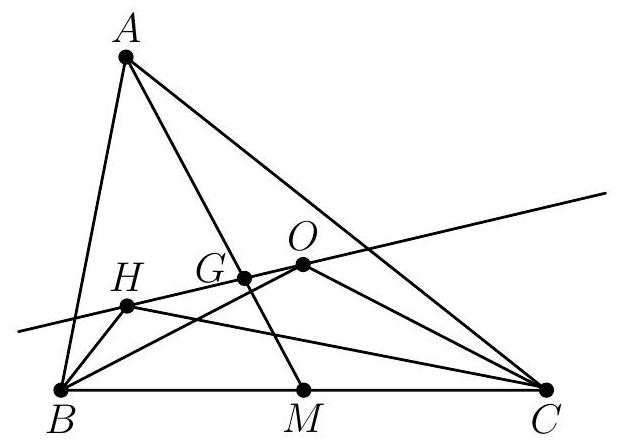\n\nLet $M$ be the midpoint of $B C$. Then the distance between $M$ and the line $O H$ is the average of the distances from $B$ and C to OH , and the sum of the areas of triangles BOH and COH is\n\n$$\n[B O H]+[C O H]=\\frac{O H \\cdot d(B, O H)}{2}+\\frac{O H \\cdot d(C, O H)}{2}=\\frac{O H \\cdot 2 d(M, O H)}{2} .\n$$\n\nSince $A G=2 G M, d(A, O H)=2 d(M, O H)$. Hence\n\n$$\n[B O H]+[C O H]=\\frac{O H \\cdot d(A, O H)}{2}=[A O H]\n$$\n\nand the result follows.", "metadata": {"resource_path": "APMO/segmented/en-apmo2004_sol.jsonl", "problem_match": "# Problem 2", "solution_match": "# Solution 1"}} |
| {"year": "2004", "tier": "T1", "problem_label": "2", "problem_type": null, "exam": "APMO", "problem": "Let $O$ be the circumcentre and $H$ the orthocentre of an acute triangle $A B C$. Prove that the area of one of the triangles $\\mathrm{AOH}, \\mathrm{BOH}$ and COH is equal to the sum of the areas of the other two.", "solution": "One can use barycentric coordinates: it is well known that\n\n$$\n\\begin{gathered}\nA=(1: 0: 0), \\quad B=(0: 1: 0), \\quad C=(0: 0: 1), \\\\\nO=(\\sin 2 A: \\sin 2 B: \\sin 2 C) \\quad \\text { and } \\quad H=(\\tan A: \\tan B: \\tan C) .\n\\end{gathered}\n$$\n\nThen the (signed) area of $A O H$ is proportional to\n\n$$\n\\left|\\begin{array}{ccc}\n1 & 0 & 0 \\\\\n\\sin 2 A & \\sin 2 B & \\sin 2 C \\\\\n\\tan A & \\tan B & \\tan C\n\\end{array}\\right|\n$$\n\nAdding all three expressions we find that the sum of the signed sums of the areas is a constant times\n\n$$\n\\left|\\begin{array}{ccc}\n1 & 0 & 0 \\\\\n\\sin 2 A & \\sin 2 B & \\sin 2 C \\\\\n\\tan A & \\tan B & \\tan C\n\\end{array}\\right|+\\left|\\begin{array}{ccc}\n0 & 1 & 0 \\\\\n\\sin 2 A & \\sin 2 B & \\sin 2 C \\\\\n\\tan A & \\tan B & \\tan C\n\\end{array}\\right|+\\left|\\begin{array}{ccc}\n0 & 0 & 1 \\\\\n\\sin 2 A & \\sin 2 B & \\sin 2 C \\\\\n\\tan A & \\tan B & \\tan C\n\\end{array}\\right|\n$$\n\nBy multilinearity of the determinant, this sum equals\n\n$$\n\\left|\\begin{array}{ccc}\n1 & 1 & 1 \\\\\n\\sin 2 A & \\sin 2 B & \\sin 2 C \\\\\n\\tan A & \\tan B & \\tan C\n\\end{array}\\right|\n$$\n\nwhich contains, in its rows, the coordinates of the centroid, the circumcenter, and the orthocenter. Since these three points lie in the Euler line of $A B C$, the signed sum of the areas is 0 , which means that one of the areas of $A O H, B O H, C O H$ is the sum of the other two areas.\nComment: Both solutions can be adapted to prove a stronger result: if the centroid $G$ of triangle $A B C$ belongs to line $X Y$ then one of the areas of triangles $A X Y, B X Y$, and $C X Y$ is equal to the sum of the other two.", "metadata": {"resource_path": "APMO/segmented/en-apmo2004_sol.jsonl", "problem_match": "# Problem 2", "solution_match": "# Solution 2"}} |
| {"year": "2004", "tier": "T1", "problem_label": "3", "problem_type": null, "exam": "APMO", "problem": "Let a set $S$ of 2004 points in the plane be given, no three of which are collinear. Let $\\mathcal{L}$ denote the set of all lines (extended indefinitely in both directions) determined by pairs of points from the set. Show that it is possible to colour the points of $S$ with at most two colours, such that for any points $p, q$ of $S$, the number of lines in $\\mathcal{L}$ which separate $p$ from $q$ is odd if and only if $p$ and $q$ have the same colour.\nNote: A line $\\ell$ separates two points $p$ and $q$ if $p$ and $q$ lie on opposite sides of $\\ell$ with neither point on $\\ell$.", "solution": "Choose any point $p$ from $S$ and color it, say, blue. Let $n(q, r)$ be the number of lines from $\\mathcal{L}$ that separates $q$ and $r$. Then color any other point $q$ blue if $n(p, q)$ is odd and red if $n(p, q)$ is even.\nNow it remains to show that $q$ and $r$ have the same color if and only if $n(q, r)$ is odd for all $q \\neq p$ and $r \\neq p$, which is equivalent to proving that $n(p, q)+n(p, r)+n(q, r)$ is always odd. For this purpose, consider the seven numbered regions defined by lines $p q$, $p r$, and $q r$ :\n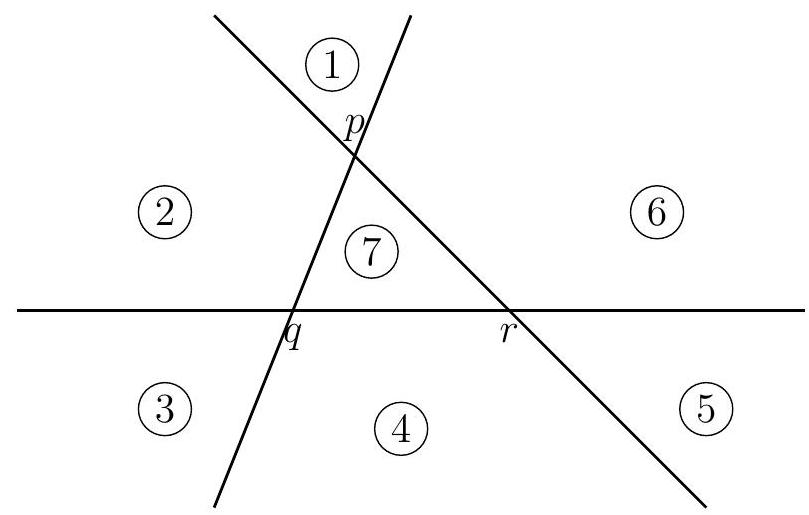\n\nAny line that do not pass through any of points $p, q, r$ meets the sides $p q, q r, p r$ of triangle $p q r$ in an even number of points (two sides or no sides), so these lines do not affect the parity of $n(p, q)+n(p, r)+n(q, r)$. Hence the only lines that need to be considered are the ones that pass through one of vertices $p, q, r$ and cuts the opposite side in the triangle $p q r$.\nLet $n_{i}$ be the number of points in region $i, p, q$, and $r$ excluded, as depicted in the diagram. Then the lines through $p$ that separate $q$ and $r$ are the lines passing through $p$ and points from regions 1,4 , and 7 . The same applies for $p, q$ and regions 2,5 , and 7 ; and $p, r$ and regions 3,6 , and 7. Therefore\n\n$$\n\\begin{aligned}\nn(p, q)+n(q, r)+n(p, r) & \\equiv\\left(n_{2}+n_{5}+n_{7}\\right)+\\left(n_{1}+n_{4}+n_{7}\\right)+\\left(n_{3}+n_{6}+n_{7}\\right) \\\\\n& \\equiv n_{1}+n_{2}+n_{3}+n_{4}+n_{5}+n_{6}+n_{7}=2004-3 \\equiv 1 \\quad(\\bmod 2)\n\\end{aligned}\n$$\n\nand the result follows.\nComment: The problem statement is also true if 2004 is replaced by any even number and is not true if 2004 is replaced by any odd number greater than 1.", "metadata": {"resource_path": "APMO/segmented/en-apmo2004_sol.jsonl", "problem_match": "# Problem 3", "solution_match": "# Solution\n\n"}} |
| {"year": "2004", "tier": "T1", "problem_label": "4", "problem_type": null, "exam": "APMO", "problem": "For a real number $x$, let $\\lfloor x\\rfloor$ stand for the largest integer that is less than or equal to $x$. Prove that\n\n$$\n\\left\\lfloor\\frac{(n-1)!}{n(n+1)}\\right\\rfloor\n$$\n\nis even for every positive integer $n$.", "solution": "Consider four cases:\n\n- $n \\leq 5$. Then $\\left\\lfloor\\frac{(n-1)!}{n(n+1)}\\right\\rfloor=0$ is an even number.\n- $n$ and $n+1$ are both composite (in particular, $n \\geq 8$ ). Then $n=a b$ and $n+1=c d$ for $a, b, c, d \\geq 2$. Moreover, since $n$ and $n+1$ are coprime, $a, b, c, d$ are all distinct and smaller than $n$, and one can choose $a, b, c, d$ such that exactly one of these four numbers is even. Hence $\\frac{(n-1)!}{n(n+1)}$ is an integer. As $n \\geq 8>6,(n-1)!$ has at least three even factors, so $\\frac{(n-1)!}{n(n+1)}$ is an even integer.\n- $n \\geq 7$ is an odd prime. By Wilson's theorem, $(n-1)!\\equiv-1(\\bmod n)$, that is, $\\frac{(n-1)!+1}{n}$ is an integer, as $\\frac{(n-1)!+n+1}{n}=\\frac{(n-1)!+1}{n}+1$ is. As before, $\\frac{(n-1)!}{n+1}$ is an even integer; therefore $\\frac{(n-1)!+n+1}{n+1}=\\frac{(n-1)!}{n+1}+1$ is an odd integer.\nAlso, $n$ and $n+1$ are coprime and $n$ divides the odd integer $\\frac{(n-1)!+n+1}{n+1}$, so $\\frac{(n-1)!+n+1}{n(n+1)}$ is also an odd integer. Then\n\n$$\n\\left\\lfloor\\frac{(n-1)!}{n(n+1)}\\right\\rfloor=\\frac{(n-1)!+n+1}{n(n+1)}-1\n$$\n\nis even.\n\n- $n+1 \\geq 7$ is an odd prime. Again, since $n$ is composite, $\\frac{(n-1)!}{n}$ is an even integer, and $\\frac{(n-1)!+n}{n}$ is an odd integer. By Wilson's theorem, $n!\\equiv-1(\\bmod n+1) \\Longleftrightarrow(n-1)!\\equiv 1$ $(\\bmod n+1)$. This means that $n+1$ divides $(n-1)!+n$, and since $n$ and $n+1$ are coprime, $n+1$ also divides $\\frac{(n-1)!+n}{n}$. Then $\\frac{(n-1)!+n}{n(n+1)}$ is also an odd integer and\n\n$$\n\\left\\lfloor\\frac{(n-1)!}{n(n+1)}\\right\\rfloor=\\frac{(n-1)!+n}{n(n+1)}-1\n$$\n\nis even.", "metadata": {"resource_path": "APMO/segmented/en-apmo2004_sol.jsonl", "problem_match": "# Problem 4", "solution_match": "# Solution\n\n"}} |
| {"year": "2004", "tier": "T1", "problem_label": "5", "problem_type": null, "exam": "APMO", "problem": "Prove that\n\n$$\n\\left(a^{2}+2\\right)\\left(b^{2}+2\\right)\\left(c^{2}+2\\right) \\geq 9(a b+b c+c a)\n$$\n\nfor all real numbers $a, b, c>0$.", "solution": "Let $p=a+b+c, q=a b+b c+c a$, and $r=a b c$. The inequality simplifies to\n\n$$\na^{2} b^{2} c^{2}+2\\left(a^{2} b^{2}+b^{2} c^{2}+c^{2} a^{2}\\right)+4\\left(a^{2}+b^{2}+c^{2}\\right)+8-9(a b+b c+c a) \\geq 0\n$$\n\nSince $a^{2} b^{2}+b^{2} c^{2}+c^{2} a^{2}=q^{2}-2 p r$ and $a^{2}+b^{2}+c^{2}=p^{2}-2 q$,\n\n$$\nr^{2}+2 q^{2}-4 p r+4 p^{2}-8 q+8-9 q \\geq 0\n$$\n\nwhich simplifies to\n\n$$\nr^{2}+2 q^{2}+4 p^{2}-17 q-4 p r+8 \\geq 0\n$$\n\nBearing in mind that equality occurs for $a=b=c=1$, which means that, for instance, $p=3 r$, one can rewrite $(I)$ as\n\n$$\n\\left(r-\\frac{p}{3}\\right)^{2}-\\frac{10}{3} p r+\\frac{35}{9} p^{2}+2 q^{2}-17 q+8 \\geq 0\n$$\n\nSince $(a b-b c)^{2}+(b c-c a)^{2}+(c a-a b)^{2} \\geq 0$ is equivalent to $q^{2} \\geq 3 p r$, rewrite $(I I)$ as\n\n$$\n\\left(r-\\frac{p}{3}\\right)^{2}+\\frac{10}{9}\\left(q^{2}-3 p r\\right)+\\frac{35}{9} p^{2}+\\frac{8}{9} q^{2}-17 q+8 \\geq 0\n$$\n\nFinally, $a=b=c=1$ implies $q=3$; then rewrite (III) as\n\n$$\n\\left(r-\\frac{p}{3}\\right)^{2}+\\frac{10}{9}\\left(q^{2}-3 p r\\right)+\\frac{35}{9}\\left(p^{2}-3 q\\right)+\\frac{8}{9}(q-3)^{2} \\geq 0\n$$\n\nThis final inequality is true because $q^{2} \\geq 3 p r$ and $p^{2}-3 q=\\frac{1}{2}\\left[(a-b)^{2}+(b-c)^{2}+(c-a)^{2}\\right] \\geq 0$.", "metadata": {"resource_path": "APMO/segmented/en-apmo2004_sol.jsonl", "problem_match": "# Problem 5", "solution_match": "# Solution 1"}} |
| {"year": "2004", "tier": "T1", "problem_label": "5", "problem_type": null, "exam": "APMO", "problem": "Prove that\n\n$$\n\\left(a^{2}+2\\right)\\left(b^{2}+2\\right)\\left(c^{2}+2\\right) \\geq 9(a b+b c+c a)\n$$\n\nfor all real numbers $a, b, c>0$.", "solution": "We prove the stronger inequality\n\n$$\n\\left(a^{2}+2\\right)\\left(b^{2}+2\\right)\\left(c^{2}+2\\right) \\geq 3(a+b+c)^{2}\n$$\n\nwhich implies the proposed inequality because $(a+b+c)^{2} \\geq 3(a b+b c+c a)$ is equivalent to $(a-b)^{2}+(b-c)^{2}+(c-a)^{2} \\geq 0$, which is immediate.\nThe inequality $(*)$ is equivalent to\n\n$$\n\\left(\\left(b^{2}+2\\right)\\left(c^{2}+2\\right)-3\\right) a^{2}-6(b+c) a+2\\left(b^{2}+2\\right)\\left(c^{2}+2\\right)-3(b+c)^{2} \\geq 0\n$$\n\nSeeing this inequality as a quadratic inequality in $a$ with positive leading coefficient $\\left(b^{2}+2\\right)\\left(c^{2}+\\right.$ 2) $-3=b^{2} c^{2}+2 b^{2}+2 c^{2}+1$, it suffices to prove that its discriminant is non-positive, which is equivalent to\n\n$$\n(3(b+c))^{2}-\\left(\\left(b^{2}+2\\right)\\left(c^{2}+2\\right)-3\\right)\\left(2\\left(b^{2}+2\\right)\\left(c^{2}+2\\right)-3(b+c)^{2}\\right) \\leq 0\n$$\n\nThis simplifies to\n\n$$\n-2\\left(b^{2}+2\\right)\\left(c^{2}+2\\right)+3(b+c)^{2}+6 \\leq 0\n$$\n\nNow we look $(* *)$ as a quadratic inequality in $b$ with negative leading coefficient $-2 c^{2}-1$ :\n\n$$\n\\left(-2 c^{2}-1\\right) b^{2}+6 c b-c^{2}-2 \\leq 0\n$$\n\nIf suffices to show that the discriminant of $(* *)$ is non-positive, which is equivalent to\n\n$$\n9 c^{2}-\\left(2 c^{2}+1\\right)\\left(c^{2}+2\\right) \\leq 0\n$$\n\nIt simplifies to $-2\\left(c^{2}-1\\right)^{2} \\leq 0$, which is true. The equality occurs for $c^{2}=1$, that is, $c=1$, for which $b=\\frac{6 c}{2\\left(2 c^{2}+1\\right)}=1$, and $a=\\frac{6(b+c)}{2\\left(\\left(b^{2}+2\\right)\\left(c^{2}+2\\right)-3\\right)}=1$.", "metadata": {"resource_path": "APMO/segmented/en-apmo2004_sol.jsonl", "problem_match": "# Problem 5", "solution_match": "# Solution 2"}} |
| {"year": "2004", "tier": "T1", "problem_label": "5", "problem_type": null, "exam": "APMO", "problem": "Prove that\n\n$$\n\\left(a^{2}+2\\right)\\left(b^{2}+2\\right)\\left(c^{2}+2\\right) \\geq 9(a b+b c+c a)\n$$\n\nfor all real numbers $a, b, c>0$.", "solution": "Let $A, B, C$ angles in $(0, \\pi / 2)$ such that $a=\\sqrt{2} \\tan A, b=\\sqrt{2} \\tan B$, and $c=\\sqrt{2} \\tan C$. Then the inequality is equivalent to\n\n$$\n4 \\sec ^{2} A \\sec ^{2} B \\sec ^{2} C \\geq 9(\\tan A \\tan B+\\tan B \\tan C+\\tan C \\tan A)\n$$\n\nSubstituting $\\sec x=\\frac{1}{\\cos x}$ for $x \\in\\{A, B, C\\}$ and clearing denominators, the inequality is equivalent to\n\n$$\n\\cos A \\cos B \\cos C(\\sin A \\sin B \\cos C+\\cos A \\sin B \\sin C+\\sin A \\cos B \\sin C) \\leq \\frac{4}{9}\n$$\n\nSince\n\n$$\n\\begin{aligned}\n& \\cos (A+B+C)=\\cos A \\cos (B+C)-\\sin A \\sin (B+C) \\\\\n= & \\cos A \\cos B \\cos C-\\cos A \\sin B \\sin C-\\sin A \\cos B \\sin C-\\sin A \\sin B \\cos C,\n\\end{aligned}\n$$\n\nwe rewrite our inequality as\n\n$$\n\\cos A \\cos B \\cos C(\\cos A \\cos B \\cos C-\\cos (A+B+C)) \\leq \\frac{4}{9}\n$$\n\nThe cosine function is concave down on $(0, \\pi / 2)$. Therefore, if $\\theta=\\frac{A+B+C}{3}$, by the AM-GM inequality and Jensen's inequality,\n\n$$\n\\cos A \\cos B \\cos C \\leq\\left(\\frac{\\cos A+\\cos B+\\cos C}{3}\\right)^{3} \\leq \\cos ^{3} \\frac{A+B+C}{3}=\\cos ^{3} \\theta\n$$\n\nTherefore, since $\\cos A \\cos B \\cos C-\\cos (A+B+C)=\\sin A \\sin B \\cos C+\\cos A \\sin B \\sin C+$ $\\sin A \\cos B \\sin C>0$, and recalling that $\\cos 3 \\theta=4 \\cos ^{3} \\theta-3 \\cos \\theta$,\n$\\cos A \\cos B \\cos C(\\cos A \\cos B \\cos C-\\cos (A+B+C)) \\leq \\cos ^{3} \\theta\\left(\\cos ^{3} \\theta-\\cos 3 \\theta\\right)=3 \\cos ^{4} \\theta\\left(1-\\cos ^{2} \\theta\\right)$. Finally, by AM-GM (notice that $1-\\cos ^{2} \\theta=\\sin ^{2} \\theta>0$ ),\n$3 \\cos ^{4} \\theta\\left(1-\\cos ^{2} \\theta\\right)=\\frac{3}{2} \\cos ^{2} \\theta \\cdot \\cos ^{2} \\theta\\left(2-2 \\cos ^{2} \\theta\\right) \\leq \\frac{3}{2}\\left(\\frac{\\cos ^{2} \\theta+\\cos ^{2} \\theta+\\left(2-2 \\cos ^{2} \\theta\\right)}{3}\\right)^{3}=\\frac{4}{9}$,\nand the result follows.", "metadata": {"resource_path": "APMO/segmented/en-apmo2004_sol.jsonl", "problem_match": "# Problem 5", "solution_match": "# Solution 3"}} |
|
|


