| {"year": "2013", "tier": "T1", "problem_label": "1", "problem_type": null, "exam": "APMO", "problem": "Let $A B C$ be an acute triangle with altitudes $A D, B E$ and $C F$, and let $O$ be the center of its circumcircle. Show that the segments $O A, O F, O B, O D, O C, O E$ dissect the triangle $A B C$ into three pairs of triangles that have equal areas.", "solution": "Let $M$ and $N$ be midpoints of sides $B C$ and $A C$, respectively. Notice that $\\angle M O C=\\frac{1}{2} \\angle B O C=\\angle E A B, \\angle O M C=90^{\\circ}=\\angle A E B$, so triangles $O M C$ and $A E B$ are similar and we get $\\frac{O M}{A E}=\\frac{O C}{A B}$. For triangles $O N A$ and $B D A$ we also have $\\frac{O N}{B D}=\\frac{O A}{B A}$. Then $\\frac{O M}{A E}=\\frac{O N}{B D}$ or $B D \\cdot O M=A E \\cdot O N$.\n\nDenote by $S(\\Phi)$ the area of the figure $\\Phi$. So, we see that $S(O B D)=\\frac{1}{2} B D \\cdot O M=$ $\\frac{1}{2} A E \\cdot O N=S(O A E)$. Analogously, $S(O C D)=S(O A F)$ and $S(O C E)=S(O B F)$.\n\nAlternative solution. Let $R$ be the circumradius of triangle $A B C$, and as usual write $A, B, C$ for angles $\\angle C A B, \\angle A B C, \\angle B C A$ respectively, and $a, b, c$ for sides $B C, C A, A B$ respectively. Then the area of triangle $O C D$ is\n\n$$\nS(O C D)=\\frac{1}{2} \\cdot O C \\cdot C D \\cdot \\sin (\\angle O C D)=\\frac{1}{2} R \\cdot C D \\cdot \\sin (\\angle O C D)\n$$\n\nNow $C D=b \\cos C$, and\n\n$$\n\\angle O C D=\\frac{180^{\\circ}-2 A}{2}=90^{\\circ}-A\n$$\n\n(since triangle $O B C$ is isosceles, and $\\angle B O C=2 A$ ). So\n\n$$\nS(O C D)=\\frac{1}{2} R b \\cos C \\sin \\left(90^{\\circ}-A\\right)=\\frac{1}{2} R b \\cos C \\cos A\n$$\n\nA similar calculation gives\n\n$$\n\\begin{aligned}\nS(O A F) & =\\frac{1}{2} O A \\cdot A F \\cdot \\sin (\\angle O A F) \\\\\n& =\\frac{1}{2} R \\cdot(b \\cos A) \\sin \\left(90^{\\circ}-C\\right) \\\\\n& =\\frac{1}{2} R b \\cos A \\cos C\n\\end{aligned}\n$$\n\nso $O C D$ and $O A F$ have the same area. In the same way we find that $O B D$ and $O A E$ have the same area, as do $O C E$ and $O B F$.", "metadata": {"resource_path": "APMO/segmented/en-apmo2013_sol.jsonl", "problem_match": "\nProblem 1.", "solution_match": "\nSolution."}} |
| {"year": "2013", "tier": "T1", "problem_label": "2", "problem_type": null, "exam": "APMO", "problem": "Determine all positive integers $n$ for which $\\frac{n^{2}+1}{[\\sqrt{n}]^{2}+2}$ is an integer. Here $[r]$ denotes the greatest integer less than or equal to $r$.", "solution": "We will show that there are no positive integers $n$ satisfying the condition of the problem.\n\nLet $m=[\\sqrt{n}]$ and $a=n-m^{2}$. We have $m \\geq 1$ since $n \\geq 1$. From $n^{2}+1=\\left(m^{2}+a\\right)^{2}+1 \\equiv$ $(a-2)^{2}+1\\left(\\bmod \\left(m^{2}+2\\right)\\right)$, it follows that the condition of the problem is equivalent to the fact that $(a-2)^{2}+1$ is divisible by $m^{2}+2$. Since we have\n\n$$\n0<(a-2)^{2}+1 \\leq \\max \\left\\{2^{2},(2 m-2)^{2}\\right\\}+1 \\leq 4 m^{2}+1<4\\left(m^{2}+2\\right)\n$$\n\nwe see that $(a-2)^{2}+1=k\\left(m^{2}+2\\right)$ must hold with $k=1,2$ or 3 . We will show that none of these can occur.\n\nCase 1. When $k=1$. We get $(a-2)^{2}-m^{2}=1$, and this implies that $a-2= \\pm 1, m=0$ must hold, but this contradicts with fact $m \\geq 1$.\n\nCase 2. When $k=2$. We have $(a-2)^{2}+1=2\\left(m^{2}+2\\right)$ in this case, but any perfect square is congruent to $0,1,4 \\bmod 8$, and therefore, we have $(a-2)^{2}+1 \\equiv 1,2,5(\\bmod 8)$, while $2\\left(m^{2}+2\\right) \\equiv 4,6(\\bmod 8)$. Thus, this case cannot occur either.\n\nCase 3. When $k=3$. We have $(a-2)^{2}+1=3\\left(m^{2}+2\\right)$ in this case. Since any perfect square is congruent to 0 or $1 \\bmod 3$, we have $(a-2)^{2}+1 \\equiv 1,2(\\bmod 3)$, while $3\\left(m^{2}+2\\right) \\equiv 0$ $(\\bmod 3)$, which shows that this case cannot occur either.", "metadata": {"resource_path": "APMO/segmented/en-apmo2013_sol.jsonl", "problem_match": "\nProblem 2.", "solution_match": "\nSolution."}} |
| {"year": "2013", "tier": "T1", "problem_label": "3", "problem_type": null, "exam": "APMO", "problem": "For $2 k$ real numbers $a_{1}, a_{2}, \\ldots, a_{k}, b_{1}, b_{2}, \\ldots, b_{k}$ define the sequence of numbers $X_{n}$ by\n\n$$\nX_{n}=\\sum_{i=1}^{k}\\left[a_{i} n+b_{i}\\right] \\quad(n=1,2, \\ldots)\n$$\n\nIf the sequence $X_{n}$ forms an arithmetic progression, show that $\\sum_{i=1}^{k} a_{i}$ must be an integer. Here $[r]$ denotes the greatest integer less than or equal to $r$.", "solution": "Let us write $A=\\sum_{i=1}^{k} a_{i}$ and $B=\\sum_{i=1}^{k} b_{i}$. Summing the corresponding terms of the following inequalities over $i$,\n\n$$\na_{i} n+b_{i}-1<\\left[a_{i} n+b_{i}\\right] \\leq a_{i} n+b_{i}\n$$\n\nwe obtain $A n+B-k<X_{n}<A n+B$. Now suppose that $\\left\\{X_{n}\\right\\}$ is an arithmetic progression with the common difference $d$, then we have $n d=X_{n+1}-X_{1}$ and $A+B-k<X_{1} \\leq A+B$ Combining with the inequalities obtained above, we get\n\n$$\nA(n+1)+B-k<n d+X_{1}<A(n+1)+B,\n$$\n\nor\n\n$$\nA n-k \\leq A n+\\left(A+B-X_{1}\\right)-k<n d<A n+\\left(A+B-X_{1}\\right)<A n+k,\n$$\n\nfrom which we conclude that $|A-d|<\\frac{k}{n}$ must hold. Since this inequality holds for any positive integer $n$, we must have $A=d$. Since $\\left\\{X_{n}\\right\\}$ is a sequence of integers, $d$ must be an integer also, and thus we conclude that $A$ is also an integer.", "metadata": {"resource_path": "APMO/segmented/en-apmo2013_sol.jsonl", "problem_match": "\nProblem 3.", "solution_match": "\nSolution."}} |
| {"year": "2013", "tier": "T1", "problem_label": "4", "problem_type": null, "exam": "APMO", "problem": "Let $a$ and $b$ be positive integers, and let $A$ and $B$ be finite sets of integers satisfying:\n(i) $A$ and $B$ are disjoint;\n(ii) if an integer $i$ belongs either to $A$ or to $B$, then $i+a$ belongs to $A$ or $i-b$ belongs to $B$.\n\nProve that $a|A|=b|B|$. (Here $|X|$ denotes the number of elements in the set $X$.)", "solution": "Let $A^{*}=\\{n-a: n \\in A\\}$ and $B^{*}=\\{n+b: n \\in B\\}$. Then, by (ii), $A \\cup B \\subseteq A^{*} \\cup B^{*}$ and by (i),\n\n$$\n|A \\cup B| \\leq\\left|A^{*} \\cup B^{*}\\right| \\leq\\left|A^{*}\\right|+\\left|B^{*}\\right|=|A|+|B|=|A \\cup B|\n$$\n\nThus, $A \\cup B=A^{*} \\cup B^{*}$ and $A^{*}$ and $B^{*}$ have no element in common. For each finite set $X$ of integers, let $\\sum(X)=\\sum_{x \\in X} x$. Then\n\n$$\n\\begin{aligned}\n\\sum(A)+\\sum(B) & =\\sum(A \\cup B) \\\\\n& =\\sum\\left(A^{*} \\cup B^{*}\\right)=\\sum\\left(A^{*}\\right)+\\sum\\left(B^{*}\\right) \\\\\n& =\\sum(A)-a|A|+\\sum(B)+b|B|\n\\end{aligned}\n$$\n\nwhich implies $a|A|=b|B|$.\nAlternative solution. Let us construct a directed graph whose vertices are labelled by the members of $A \\cup B$ and such that there is an edge from $i$ to $j$ iff $j \\in A$ and $j=i+a$ or $j \\in B$ and $j=i-b$. From (ii), each vertex has out-degree $\\geq 1$ and, from (i), each vertex has in-degree $\\leq 1$. Since the sum of the out-degrees equals the sum of the in-degrees, each vertex has in-degree and out-degree equal to 1. This is only possible if the graph is the union of disjoint cycles, say $G_{1}, G_{2}, \\ldots, G_{n}$. Let $\\left|A_{k}\\right|$ be the number of elements of $A$ in $G_{k}$ and $\\left|B_{k}\\right|$ be the number of elements of $B$ in $G_{k}$. The cycle $G_{k}$ will involve increasing vertex labels by $a$ a total of $\\left|A_{k}\\right|$ times and decreasing them by $b$ a total of $\\left|B_{k}\\right|$ times. Since it is a cycle, we have $a\\left|A_{k}\\right|=b\\left|B_{k}\\right|$. Summing over all cycles gives the result.", "metadata": {"resource_path": "APMO/segmented/en-apmo2013_sol.jsonl", "problem_match": "\nProblem 4.", "solution_match": "\nSolution."}} |
| {"year": "2013", "tier": "T1", "problem_label": "5", "problem_type": null, "exam": "APMO", "problem": "Let $A B C D$ be a quadrilateral inscribed in a circle $\\omega$, and let $P$ be a point on the extension of $A C$ such that $P B$ and $P D$ are tangent to $\\omega$. The tangent at $C$ intersects $P D$ at $Q$ and the line $A D$ at $R$. Let $E$ be the second point of intersection between $A Q$ and $\\omega$. Prove that $B, E, R$ are collinear.", "solution": "To show $B, E, R$ are collinear, it is equivalent to show the lines $A D, B E, C Q$ are concurrent. Let $C Q$ intersect $A D$ at $R$ and $B E$ intersect $A D$ at $R^{\\prime}$. We shall show $R D / R A=R^{\\prime} D / R^{\\prime} A$ so that $R=R^{\\prime}$.\n\nSince $\\triangle P A D$ is similar to $\\triangle P D C$ and $\\triangle P A B$ is similar to $\\triangle P B C$, we have $A D / D C=$ $P A / P D=P A / P B=A B / B C$. Hence, $A B \\cdot D C=B C \\cdot A D$. By Ptolemy's theorem, $A B \\cdot D C=B C \\cdot A D=\\frac{1}{2} C A \\cdot D B$. Similarly $C A \\cdot E D=C E \\cdot A D=\\frac{1}{2} A E \\cdot D C$.\n\nThus\n\n$$\n\\frac{D B}{A B}=\\frac{2 D C}{C A}\n$$\n\nand\n\n$$\n\\frac{D C}{C A}=\\frac{2 E D}{A E}\n$$\n\n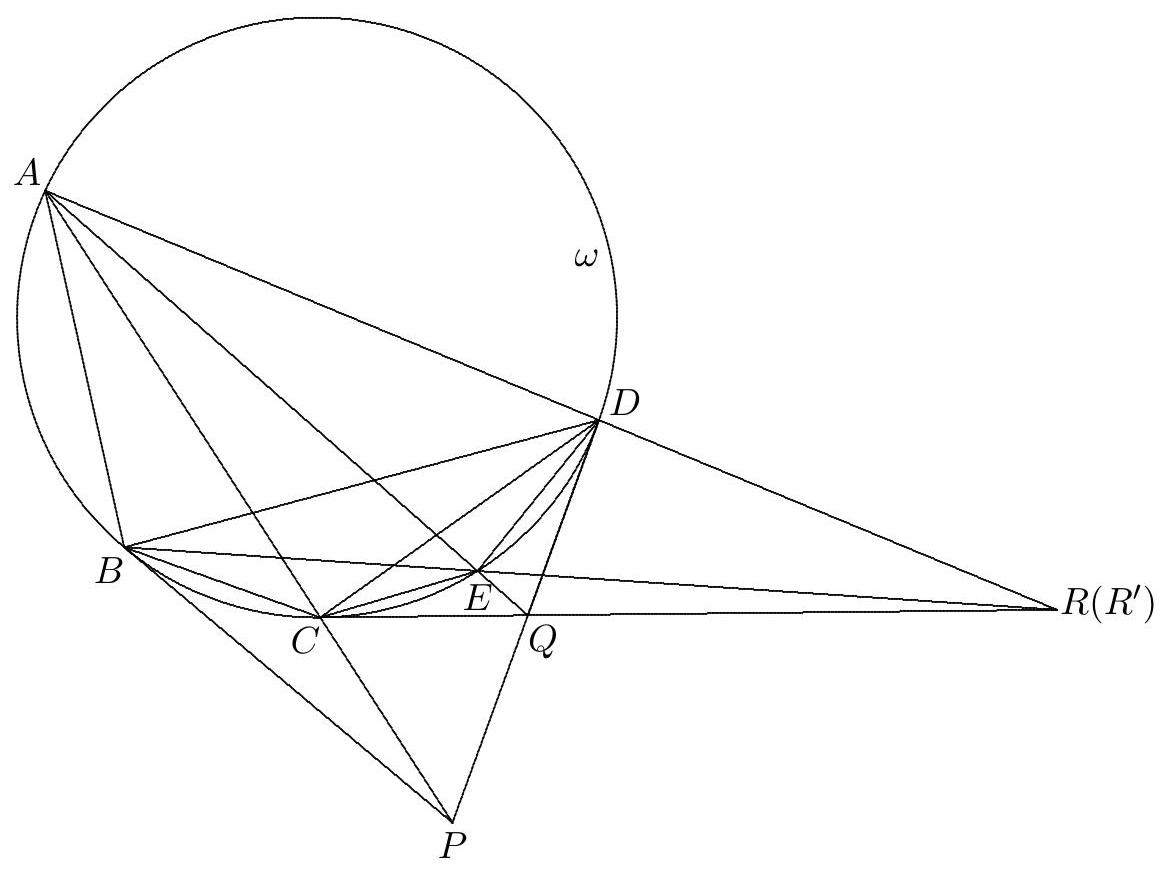\n\nSince the triangles $R D C$ and $R C A$ are similar, we have $\\frac{R D}{R C}=\\frac{D C}{C A}=\\frac{R C}{R A}$. Thus using (4)\n\n$$\n\\frac{R D}{R A}=\\frac{R D \\cdot R A}{R A^{2}}=\\left(\\frac{R C}{R A}\\right)^{2}=\\left(\\frac{D C}{C A}\\right)^{2}=\\left(\\frac{2 E D}{A E}\\right)^{2}\n$$\n\nUsing the similar triangles $A B R^{\\prime}$ and $E D R^{\\prime}$, we have $R^{\\prime} D / R^{\\prime} B=E D / A B$. Using the similar triangles $D B R^{\\prime}$ and $E A R^{\\prime}$ we have $R^{\\prime} A / R^{\\prime} B=E A / D B$. Thus using (3) and (4),\n\n$$\n\\frac{R^{\\prime} D}{R^{\\prime} A}=\\frac{E D \\cdot D B}{E A \\cdot A B}=\\left(\\frac{2 E D}{A E}\\right)^{2}\n$$\n\nIt follows from (5) and (6) that $R=R^{\\prime}$.", "metadata": {"resource_path": "APMO/segmented/en-apmo2013_sol.jsonl", "problem_match": "\nProblem 5.", "solution_match": "\nSolution."}} |
|
|


