| {"year": "2019", "tier": "T1", "problem_label": "1", "problem_type": null, "exam": "APMO", "problem": "Let $\\mathbb{Z}^{+}$be the set of positive integers. Determine all functions $f: \\mathbb{Z}^{+} \\rightarrow \\mathbb{Z}^{+}$ such that $a^{2}+f(a) f(b)$ is divisible by $f(a)+b$ for all positive integers $a$ and $b$.\n\nAnswer: The answer is $f(n)=n$ for all positive integers $n$.\nClearly, $f(n)=n$ for all $n \\in \\mathbb{Z}^{+}$satisfies the original relation. We show some possible approaches to prove that this is the only possible function.", "solution": "First we perform the following substitutions on the original relation:\n\n1. With $a=b=1$, we find that $f(1)+1 \\mid f(1)^{2}+1$, which implies $f(1)=1$.\n2. With $a=1$, we find that $b+1 \\mid f(b)+1$. In particular, $b \\leq f(b)$ for all $b \\in \\mathbb{Z}^{+}$.\n3. With $b=1$, we find that $f(a)+1 \\mid a^{2}+f(a)$, and thus $f(a)+1 \\mid a^{2}-1$. In particular, $f(a) \\leq a^{2}-2$ for all $a \\geq 2$.\n\nNow, let $p$ be any odd prime. Substituting $a=p$ and $b=f(p)$ in the original relation, we find that $2 f(p) \\mid p^{2}+f(p) f(f(p))$. Therefore, $f(p) \\mid p^{2}$. Hence the possible values of $f(p)$ are $1, p$ and $p^{2}$. By (2) above, $f(p) \\geq p$ and by (3) above $f(p) \\leq p^{2}-2$. So $f(p)=p$ for all primes $p$.\n\nSubstituting $a=p$ into the original relation, we find that $b+p \\mid p^{2}+p f(b)$. However, since $(b+p)(f(b)+p-b)=p^{2}-b^{2}+b f(b)+p f(b)$, we have $b+p \\mid b f(b)-b^{2}$. Thus, for any fixed $b$ this holds for arbitrarily large primes $p$ and therefore we must have $b f(b)-b^{2}=0$, or $f(b)=b$, as desired.", "metadata": {"resource_path": "APMO/segmented/en-apmo2019_sol.jsonl", "problem_match": "\nProblem 1.", "solution_match": "\nSolution."}} |
| {"year": "2019", "tier": "T1", "problem_label": "1", "problem_type": null, "exam": "APMO", "problem": "Let $\\mathbb{Z}^{+}$be the set of positive integers. Determine all functions $f: \\mathbb{Z}^{+} \\rightarrow \\mathbb{Z}^{+}$ such that $a^{2}+f(a) f(b)$ is divisible by $f(a)+b$ for all positive integers $a$ and $b$.\n\nAnswer: The answer is $f(n)=n$ for all positive integers $n$.\nClearly, $f(n)=n$ for all $n \\in \\mathbb{Z}^{+}$satisfies the original relation. We show some possible approaches to prove that this is the only possible function.", "solution": ": As above, we have relations (1)-(3). In (2) and (3), for $b=2$ we have $3 \\mid f(2)+1$ and $f(2)+1 \\mid 3$. These imply $f(2)=2$.\n\nNow, using $a=2$ we get $2+b \\mid 4+2 f(b)$. Let $f(b)=x$. We have\n\n$$\n\\begin{aligned}\n1+x & \\equiv 0 \\quad(\\bmod b+1) \\\\\n4+2 x & \\equiv 0 \\quad(\\bmod b+2)\n\\end{aligned}\n$$\n\nFrom the first equation $x \\equiv b(\\bmod b+1)$ so $x=b+(b+1) t$ for some integer $t \\geq 0$. Then\n\n$$\n0 \\equiv 4+2 x \\equiv 4+2(b+(b+1) t) \\equiv 4+2(-2-t) \\equiv-2 t \\quad(\\bmod b+2)\n$$\n\nAlso $t \\leq b-2$ because $1+x \\mid b^{2}-1$ by (3).\nIf $b+2$ is odd, then $t \\equiv 0(\\bmod b+2)$. Then $t=0$, which implies $f(b)=b$.\nIf $b+2$ is even, then $t \\equiv 0(\\bmod (b+2) / 2)$. Then $t=0$ or $t=(b+2) / 2$. But if $t \\neq 0$, then by definition $(b+4) / 2=(1+t)=(x+1) /(b+1)$ and since $x+1 \\mid b^{2}-1$, then $(b+4) / 2$ divides $b-1$. Therefore $b+4 \\mid 10$ and the only possibility is $b=6$. So for even $b, b \\neq 6$ we have $f(b)=b$.\n\nFinally, by (2) and (3), for $b=6$ we have $7 \\mid f(6)+1$ and $f(6)+1 \\mid 35$. This means $f(6)=6$ or $f(6)=34$. The later is discarded as, for $a=5, b=6$, we have by the original equation that $11 \\mid 5(5+f(6))$. Therefore $f(n)=n$ for every positive integer $n$.", "metadata": {"resource_path": "APMO/segmented/en-apmo2019_sol.jsonl", "problem_match": "\nProblem 1.", "solution_match": "\nSolution 2"}} |
| {"year": "2019", "tier": "T1", "problem_label": "1", "problem_type": null, "exam": "APMO", "problem": "Let $\\mathbb{Z}^{+}$be the set of positive integers. Determine all functions $f: \\mathbb{Z}^{+} \\rightarrow \\mathbb{Z}^{+}$ such that $a^{2}+f(a) f(b)$ is divisible by $f(a)+b$ for all positive integers $a$ and $b$.\n\nAnswer: The answer is $f(n)=n$ for all positive integers $n$.\nClearly, $f(n)=n$ for all $n \\in \\mathbb{Z}^{+}$satisfies the original relation. We show some possible approaches to prove that this is the only possible function.", "solution": ": We proceed by induction. As in Solution 1, we have $f(1)=1$. Suppose that $f(n-1)=n-1$ for some integer $n \\geq 2$.\n\nWith the substitution $a=n$ and $b=n-1$ in the original relation we obtain that $f(n)+$ $n-1 \\mid n^{2}+f(n)(n-1)$. Since $f(n)+n-1 \\mid(n-1)(f(n)+n-1)$, then $f(n)+n-1 \\mid 2 n-1$.\n\nWith the substitution $a=n-1$ and $b=n$ in the original relation we obtain that $2 n-$ $1 \\mid(n-1)^{2}+(n-1) f(n)=(n-1)(n-1+f(n))$. Since $(2 n-1, n-1)=1$, we deduce that $2 n-1 \\mid f(n)+n-1$.\n\nTherefore, $f(n)+n-1=2 n-1$, which implies the desired $f(n)=n$.", "metadata": {"resource_path": "APMO/segmented/en-apmo2019_sol.jsonl", "problem_match": "\nProblem 1.", "solution_match": "\nSolution 3"}} |
| {"year": "2019", "tier": "T1", "problem_label": "2", "problem_type": null, "exam": "APMO", "problem": "Let $m$ be a fixed positive integer. The infinite sequence $\\left\\{a_{n}\\right\\}_{n \\geq 1}$ is defined in the following way: $a_{1}$ is a positive integer, and for every integer $n \\geq 1$ we have\n\n$$\na_{n+1}= \\begin{cases}a_{n}^{2}+2^{m} & \\text { if } a_{n}<2^{m} \\\\ a_{n} / 2 & \\text { if } a_{n} \\geq 2^{m}\\end{cases}\n$$\n\nFor each $m$, determine all possible values of $a_{1}$ such that every term in the sequence is an integer.\n\nAnswer: The only value of $m$ for which valid values of $a_{1}$ exist is $m=2$. In that case, the only solutions are $a_{1}=2^{\\ell}$ for $\\ell \\geq 1$.", "solution": "Suppose that for integers $m$ and $a_{1}$ all the terms of the sequence are integers. For each $i \\geq 1$, write the $i$ th term of the sequence as $a_{i}=b_{i} 2^{c_{i}}$ where $b_{i}$ is the largest odd divisor of $a_{i}$ (the \"odd part\" of $a_{i}$ ) and $c_{i}$ is a nonnegative integer.\n\nLemma 1. The sequence $b_{1}, b_{2}, \\ldots$ is bounded above by $2^{m}$.\nProof. Suppose this is not the case and take an index $i$ for which $b_{i}>2^{m}$ and for which $c_{i}$ is minimal. Since $a_{i} \\geq b_{i}>2^{m}$, we are in the second case of the recursion. Therefore, $a_{i+1}=a_{i} / 2$ and thus $b_{i+1}=b_{i}>2^{m}$ and $c_{i+1}=c_{i}-1<c_{i}$. This contradicts the minimality of $c_{i}$.\n\nLemma 2. The sequence $b_{1}, b_{2}, \\ldots$ is nondecreasing.\nProof. If $a_{i} \\geq 2^{m}$, then $a_{i+1}=a_{i} / 2$ and thus $b_{i+1}=b_{i}$. On the other hand, if $a_{i}<2^{m}$, then\n\n$$\na_{i+1}=a_{i}^{2}+2^{m}=b_{i}^{2} 2^{2 c_{i}}+2^{m}\n$$\n\nand we have the following cases:\n\n- If $2 c_{i}>m$, then $a_{i+1}=2^{m}\\left(b_{i}^{2} 2^{2 c_{i}-m}+1\\right)$, so $b_{i+1}=b_{i}^{2} 2^{2 c_{i}-m}+1>b_{i}$.\n- If $2 c_{i}<m$, then $a_{i+1}=2^{2 c_{i}}\\left(b_{i}^{2}+2^{m-2 c_{i}}\\right)$, so $b_{i+1}=b_{i}^{2}+2^{m-2 c_{i}}>b_{i}$.\n- If $2 c_{i}=m$, then $a_{i+1}=2^{m+1} \\cdot \\frac{b_{i}^{2}+1}{2}$, so $b_{i+1}=\\left(b_{i}^{2}+1\\right) / 2 \\geq b_{i}$ since $b_{i}^{2}+1 \\equiv 2(\\bmod 4)$.\n\nBy combining these two lemmas we obtain that the sequence $b_{1}, b_{2}, \\ldots$ is eventually constant. Fix an index $j$ such that $b_{k}=b_{j}$ for all $k \\geq j$. Since $a_{n}$ descends to $a_{n} / 2$ whenever $a_{n} \\geq 2^{m}$, there are infinitely many terms which are smaller than $2^{m}$. Thus, we can choose an $i>j$ such that $a_{i}<2^{m}$. From the proof of Lemma $2, a_{i}<2^{m}$ and $b_{i+1}=b_{i}$ can happen simultaneously only when $2 c_{i}=m$ and $b_{i+1}=b_{i}=1$. By Lemma 2 , the sequence $b_{1}, b_{2}, \\ldots$ is constantly 1 and thus $a_{1}, a_{2}, \\ldots$ are all powers of two. Tracing the sequence starting from $a_{i}=2^{c_{i}}=2^{m / 2}<2^{m}$,\n\n$$\n2^{m / 2} \\rightarrow 2^{m+1} \\rightarrow 2^{m} \\rightarrow 2^{m-1} \\rightarrow 2^{2 m-2}+2^{m}\n$$\n\nNote that this last term is a power of two if and only if $2 m-2=m$. This implies that $m$ must be equal to 2 . When $m=2$ and $a_{1}=2^{\\ell}$ for $\\ell \\geq 1$ the sequence eventually cycles through $2,8,4,2, \\ldots$. When $m=2$ and $a_{1}=1$ the sequence fails as the first terms are $1,5,5 / 2$.", "metadata": {"resource_path": "APMO/segmented/en-apmo2019_sol.jsonl", "problem_match": "\nProblem 2.", "solution_match": "\nSolution."}} |
| {"year": "2019", "tier": "T1", "problem_label": "2", "problem_type": null, "exam": "APMO", "problem": "Let $m$ be a fixed positive integer. The infinite sequence $\\left\\{a_{n}\\right\\}_{n \\geq 1}$ is defined in the following way: $a_{1}$ is a positive integer, and for every integer $n \\geq 1$ we have\n\n$$\na_{n+1}= \\begin{cases}a_{n}^{2}+2^{m} & \\text { if } a_{n}<2^{m} \\\\ a_{n} / 2 & \\text { if } a_{n} \\geq 2^{m}\\end{cases}\n$$\n\nFor each $m$, determine all possible values of $a_{1}$ such that every term in the sequence is an integer.\n\nAnswer: The only value of $m$ for which valid values of $a_{1}$ exist is $m=2$. In that case, the only solutions are $a_{1}=2^{\\ell}$ for $\\ell \\geq 1$.", "solution": ": Let $m$ be a positive integer and suppose that $\\left\\{a_{n}\\right\\}$ consists only of positive integers. Call a number small if it is smaller than $2^{m}$ and large otherwise. By the recursion,\nafter a small number we have a large one and after a large one we successively divide by 2 until we get a small one.\n\nFirst, we note that $\\left\\{a_{n}\\right\\}$ is bounded. Indeed, $a_{1}$ turns into a small number after a finite number of steps. After this point, each small number is smaller than $2^{m}$, so each large number is smaller than $2^{2 m}+2^{m}$. Now, since $\\left\\{a_{n}\\right\\}$ is bounded and consists only of positive integers, it is eventually periodic. We focus only on the cycle.\n\nAny small number $a_{n}$ in the cycle can be writen as $a / 2$ for $a$ large, so $a_{n} \\geq 2^{m-1}$, then $a_{n+1} \\geq 2^{2 m-2}+2^{m}=2^{m-2}\\left(4+2^{m}\\right)$, so we have to divide $a_{n+1}$ at least $m-1$ times by 2 until we get a small number. This means that $a_{n+m}=\\left(a_{n}^{2}+2^{m}\\right) / 2^{m-1}$, so $2^{m-1} \\mid a_{n}^{2}$, and therefore $2^{\\lceil(m-1) / 2\\rceil} \\mid a_{n}$ for any small number $a_{n}$ in the cycle. On the other hand, $a_{n} \\leq 2^{m}-1$, so $a_{n+1} \\leq 2^{2 m}-2^{m+1}+1+2^{m} \\leq 2^{m}\\left(2^{m}-1\\right)$, so we have to divide $a_{n+1}$ at most $m$ times by two until we get a small number. This means that after $a_{n}$, the next small number is either $N=a_{m+n}=\\left(a_{n}^{2} / 2^{m-1}\\right)+2$ or $a_{m+n+1}=N / 2$. In any case, $2^{\\lceil(m-1) / 2\\rceil}$ divides $N$.\n\nIf $m$ is odd, then $x^{2} \\equiv-2\\left(\\bmod 2^{\\lceil(m-1) / 2\\rceil}\\right)$ has a solution $x=a_{n} / 2^{(m-1) / 2}$. If $(m-1) / 2 \\geq$ $2 \\Longleftrightarrow m \\geq 5$ then $x^{2} \\equiv-2(\\bmod 4)$, which has no solution. So if $m$ is odd, then $m \\leq 3$.\n\nIf $m$ is even, then $2^{m-1}\\left|a_{n}^{2} \\Longrightarrow 2^{\\lceil(m-1) / 2\\rceil}\\right| a_{n} \\Longleftrightarrow 2^{m / 2} \\mid a_{n}$. Then if $a_{n}=2^{m / 2} x$, $2 x^{2} \\equiv-2\\left(\\bmod 2^{m / 2}\\right) \\Longleftrightarrow x^{2} \\equiv-1\\left(\\bmod 2^{(m / 2)-1}\\right)$, which is not possible for $m \\geq 6$. So if $m$ is even, then $m \\leq 4$.\n\nThe cases $m=1,2,3,4$ are handed manually, checking the possible small numbers in the cycle, which have to be in the interval $\\left[2^{m-1}, 2^{m}\\right)$ and be divisible by $2^{\\lceil(m-1) / 2\\rceil}$ :\n\n- For $m=1$, the only small number is 1 , which leads to 5 , then $5 / 2$.\n- For $m=2$, the only eligible small number is 2 , which gives the cycle $(2,8,4)$. The only way to get to 2 is by dividing 4 by 2 , so the starting numbers greater than 2 are all numbers that lead to 4 , which are the powers of 2 .\n- For $m=3$, the eligible small numbers are 4 and 6 ; we then obtain $4,24,12,6,44,22,11,11 / 2$.\n- For $m=4$, the eligible small numbers are 8 and 12 ; we then obtain $8,80,40,20,10, \\ldots$ or $12,160,80,40,20,10, \\ldots$, but in either case 10 is not an elegible small number.", "metadata": {"resource_path": "APMO/segmented/en-apmo2019_sol.jsonl", "problem_match": "\nProblem 2.", "solution_match": "\nSolution 2"}} |
| {"year": "2019", "tier": "T1", "problem_label": "3", "problem_type": null, "exam": "APMO", "problem": "Let $A B C$\n\nbe a scalene triangle with circumcircle $\\Gamma$. Let $M$ be the midpoint of $B C$. A variable point $P$ is selected in the line segment $A M$. The circumcircles of triangles $B P M$ and $C P M$ intersect $\\Gamma$ again at points $D$ and $E$, respectively. The lines $D P$ and $E P$ intersect (a second time) the circumcircles to triangles $C P M$ and $B P M$ at $X$ and $Y$, respectively. Prove that as $P$ varies, the circumcircle of $\\triangle A X Y$ passes through a fixed point $T$ distinct from $A$.", "solution": "Let $N$ be the radical center of the circumcircles of triangles $A B C, B M P$ and $C M P$. The pairwise radical axes of these circles are $B D, C E$ and $P M$, and hence they concur at $N$. Now, note that in directed angles:\n\n$$\n\\angle M C E=\\angle M P E=\\angle M P Y=\\angle M B Y .\n$$\n\n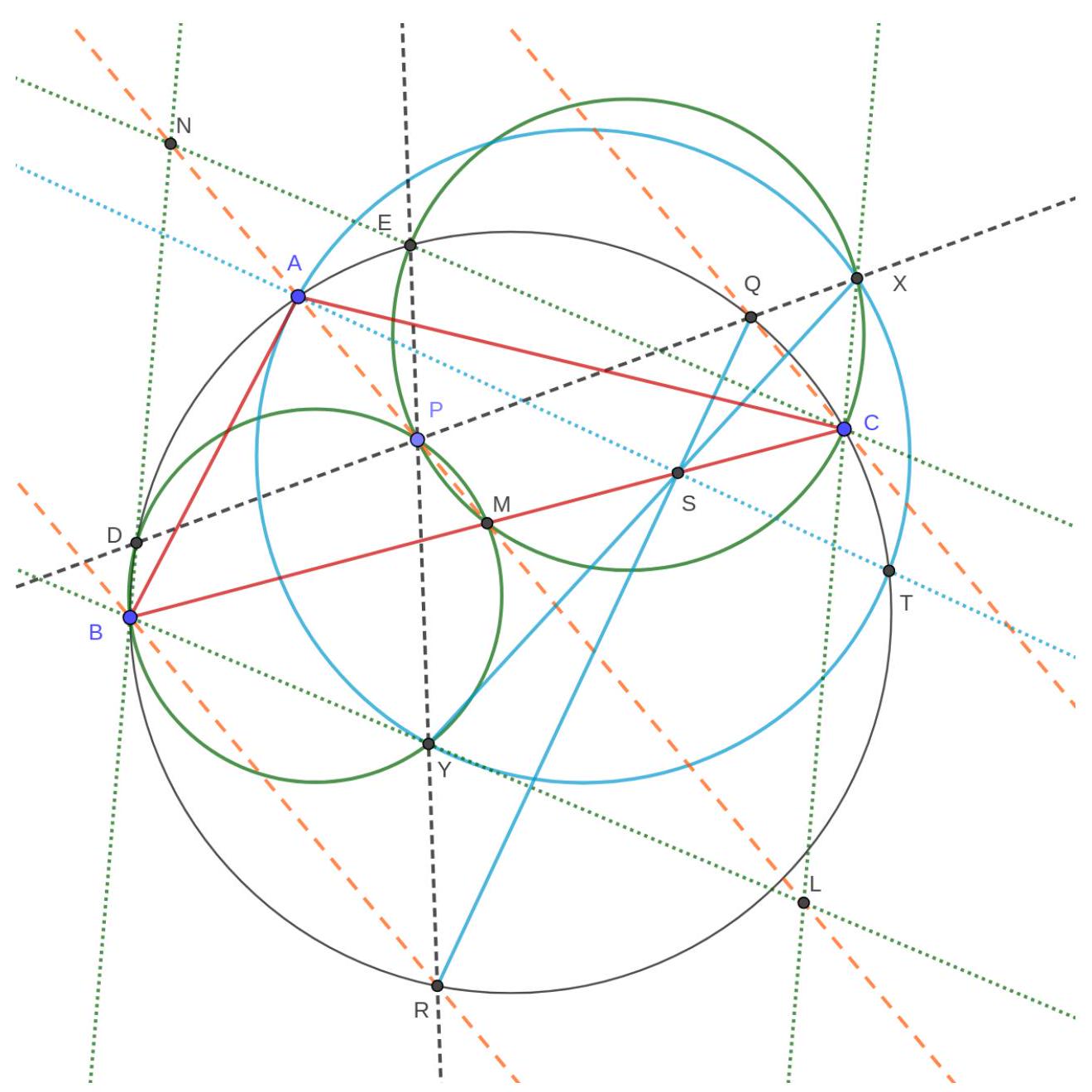\n\nIt follows that $B Y$ is parallel to $C E$, and analogously that $C X$ is parallel to $B D$. Then, if $L$ is the intersection of $B Y$ and $C X$, it follows that $B N C L$ is a parallelogram. Since $B M=M C$ we deduce that $L$ is the reflection of $N$ with respect to $M$, and therefore $L \\in A M$. Using power of a point from $L$ to the circumcircles of triangles $B P M$ and $C P M$, we have\n\n$$\nL Y \\cdot L B=L P \\cdot L M=L X \\cdot L C\n$$\n\nHence, $B Y X C$ is cyclic. Using the cyclic quadrilateral we find in directed angles:\n\n$$\n\\angle L X Y=\\angle L B C=\\angle B C N=\\angle N D E .\n$$\n\nSince $C X \\| B N$, it follows that $X Y \\| D E$.\nLet $Q$ and $R$ be two points in $\\Gamma$ such that $C Q, B R$, and $A M$ are all parallel. Then in directed angles:\n\n$$\n\\angle Q D B=\\angle Q C B=\\angle A M B=\\angle P M B=\\angle P D B .\n$$\n\nThen $D, P, Q$ are collinear. Analogously $E, P, R$ are collinear. From here we get $\\angle P R Q=$ $\\angle P D E=\\angle P X Y$, since $X Y$ and $D E$ are parallel. Therefore $Q R Y X$ is cyclic. Let $S$ be the radical center of the circumcircle of triangle $A B C$ and the circles $B C Y X$ and $Q R Y X$. This point lies in the lines $B C, Q R$ and $X Y$ because these are the radical axes of the circles. Let $T$ be the second intersection of $A S$ with $\\Gamma$. By power of a point from $S$ to the circumcircle of $A B C$ and the circle $B C X Y$ we have\n\n$$\nS X \\cdot S Y=S B \\cdot S C=S T \\cdot S A\n$$\n\nTherefore $T$ is in the circumcircle of triangle $A X Y$. Since $Q$ and $R$ are fixed regardless of the choice of $P$, then $S$ is also fixed, since it is the intersection of $Q R$ and $B C$. This implies $T$ is also fixed, and therefore, the circumcircle of triangle $A X Y$ goes through $T \\neq A$ for any choice of $P$.\n\nNow we show an alternative way to prove that $B C X Y$ and $Q R X T$ are cyclic.", "metadata": {"resource_path": "APMO/segmented/en-apmo2019_sol.jsonl", "problem_match": "# Problem 3.", "solution_match": "\nSolution."}} |
| {"year": "2019", "tier": "T1", "problem_label": "3", "problem_type": null, "exam": "APMO", "problem": "Let $A B C$\n\nbe a scalene triangle with circumcircle $\\Gamma$. Let $M$ be the midpoint of $B C$. A variable point $P$ is selected in the line segment $A M$. The circumcircles of triangles $B P M$ and $C P M$ intersect $\\Gamma$ again at points $D$ and $E$, respectively. The lines $D P$ and $E P$ intersect (a second time) the circumcircles to triangles $C P M$ and $B P M$ at $X$ and $Y$, respectively. Prove that as $P$ varies, the circumcircle of $\\triangle A X Y$ passes through a fixed point $T$ distinct from $A$.", "solution": ". Let the lines $D P$ and $E P$ meet the circumcircle of $A B C$ again at $Q$ and $R$, respectively. Then $\\angle D Q C \\angle D B C=\\angle D P M$, so $Q C \\| P M$. Similarly, $R B \\| P M$.\n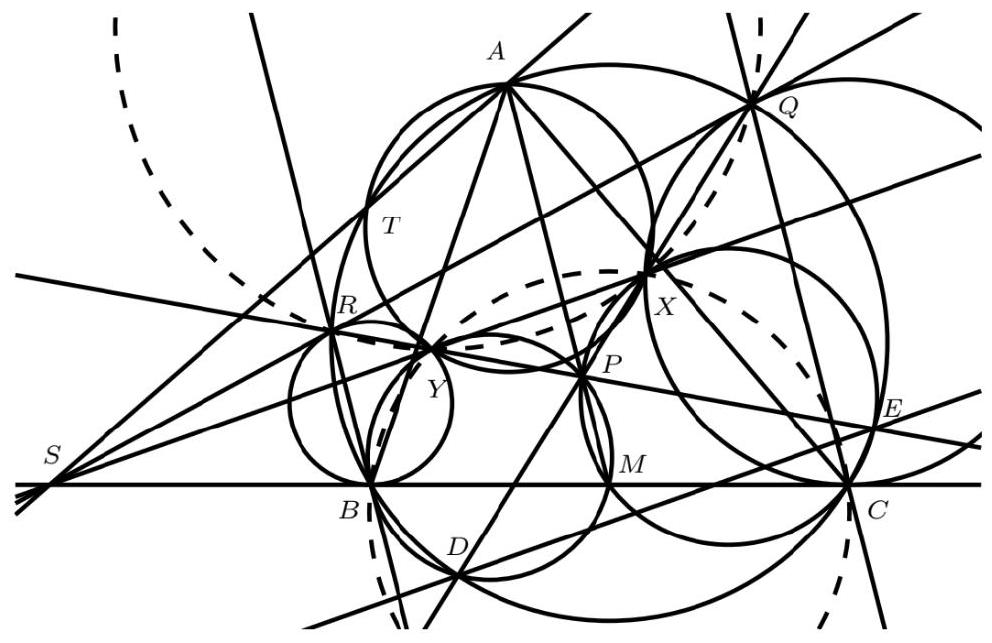\n\nNow, $\\angle Q C B=\\angle P M B=\\angle P X C=\\angle(Q X, C X)$, which is half of the arc $Q C$ in the circumcircle $\\omega_{C}$ of $Q X C$. So $\\omega_{C}$ is tangent to $B S$; analogously, $\\omega_{B}$, the circumcicle of $R Y B$, is also tangent to $B C$. Since $B R \\| C Q$, the inscribed trapezoid $B R Q C$ is isosceles, and by symmetry $Q R$ is also tangent to both circles, and the common perpendicular bisector of $B R$ and $C Q$ passes through the centers of $\\omega_{B}$ and $\\omega_{C}$. Since $M B=M C$ and $P M\\|B R\\| C Q$, the line $P M$ is the radical axis of $\\omega_{B}$ and $\\omega_{C}$.\n\nHowever, $P M$ is also the radical axis of the circumcircles $\\gamma_{B}$ of $P M B$ and $\\gamma_{C}$ of $P M C$. Let $C X$ and $P M$ meet at $Z$. Let $p(K, \\omega)$ denote the power of a point $K$ with respect to a circumference $\\omega$. We have\n\n$$\np\\left(Z, \\gamma_{B}\\right)=p\\left(Z, \\gamma_{C}\\right)=Z X \\cdot Z C=p\\left(Z, \\omega_{B}\\right)=p\\left(Z, \\omega_{C}\\right)\n$$\n\nPoint $Z$ is thus the radical center of $\\gamma_{B}, \\gamma_{C}, \\omega_{B}, \\omega_{C}$. Thus, the radical axes $B Y, C X, P M$ meet at $Z$. From here,\n\n$$\n\\begin{aligned}\n& Z Y \\cdot Z B=Z C \\cdot Z X \\Rightarrow B C X Y \\text { cyclic } \\\\\n& P Y \\cdot P R=P X \\cdot P Q \\Rightarrow Q R X T \\text { cyclic. }\n\\end{aligned}\n$$\n\nWe may now finish as in Solution 1.", "metadata": {"resource_path": "APMO/segmented/en-apmo2019_sol.jsonl", "problem_match": "# Problem 3.", "solution_match": "\nSolution 2"}} |
| {"year": "2019", "tier": "T1", "problem_label": "4", "problem_type": null, "exam": "APMO", "problem": "Consider a $2018 \\times 2019$ board with integers in each unit square. Two unit squares are said to be neighbours if they share a common edge. In each turn, you choose some unit squares. Then for each chosen unit square the average of all its neighbours is calculated. Finally, after these calculations are done, the number in each chosen unit square is replaced by the corresponding average. Is it always possible to make the numbers in all squares become the same after finitely many turns?\n\nAnswer: No", "solution": "Let $n$ be a positive integer relatively prime to 2 and 3 . We may study the whole process modulo $n$ by replacing divisions by $2,3,4$ with multiplications by the corresponding inverses modulo $n$. If at some point the original process makes all the numbers equal, then the process modulo $n$ will also have all the numbers equal. Our aim is to choose $n$ and an initial configuration modulo $n$ for which no process modulo $n$ reaches a board with all numbers equal modulo $n$. We split this goal into two lemmas.\n\nLemma 1. There is a $2 \\times 3$ board that stays constant modulo 5 and whose entries are not all equal.\n\nProof. Here is one such a board:\n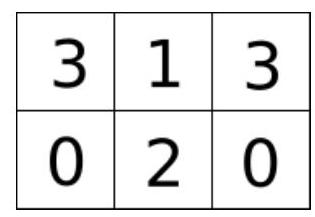\n\nThe fact that the board remains constant regardless of the choice of squares can be checked square by square.\n\nLemma 2. If there is an $r \\times s$ board with $r \\geq 2, s \\geq 2$, that stays constant modulo 5 , then there is also a $k r \\times l s$ board with the same property.\n\nProof. We prove by a case by case analysis that repeateadly reflecting the $r \\times s$ with respect to an edge preserves the property:\n\n- If a cell had 4 neighbors, after reflections it still has the same neighbors.\n- If a cell with $a$ had 3 neighbors $b, c, d$, we have by hypothesis that $a \\equiv 3^{-1}(b+c+d) \\equiv$ $2(b+c+d)(\\bmod 5)$. A reflection may add $a$ as a neighbor of the cell and now\n\n$$\n4^{-1}(a+b+c+d) \\equiv 4(a+b+c+d) \\equiv 4 a+2 a \\equiv a \\quad(\\bmod 5)\n$$\n\n- If a cell with $a$ had 2 neighbors $b, c$, we have by hypothesis that $a \\equiv 2^{-1}(b+c) \\equiv 3(b+c)$ $(\\bmod 5)$. If the reflections add one $a$ as neighbor, now\n\n$$\n3^{-1}(a+b+c) \\equiv 2(3(b+c)+b+c) \\equiv 8(b+c) \\equiv 3(b+c) \\equiv a \\quad(\\bmod 5)\n$$\n\n- If a cell with $a$ had 2 neighbors $b, c$, we have by hypothesis that $a \\equiv 2^{-1}(b+c)(\\bmod 5)$. If the reflections add two $a$ 's as neighbors, now\n\n$$\n4^{-1}(2 a+b+c) \\equiv\\left(2^{-1} a+2^{-1} a\\right) \\equiv a \\quad(\\bmod 5)\n$$\n\nIn the three cases, any cell is still preserved modulo 5 after an operation. Hence we can fill in the $k r \\times l s$ board by $k \\times l$ copies by reflection.\n\nSince 2|2018 and 3|2019, we can get through reflections the following board:\n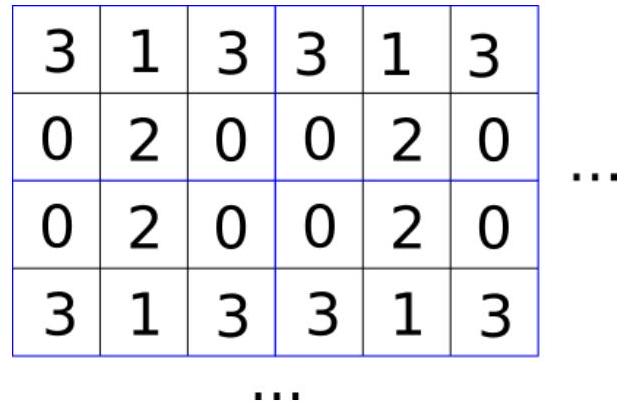\n\nBy the lemmas above, the board is invariant modulo 5, so the answer is no.", "metadata": {"resource_path": "APMO/segmented/en-apmo2019_sol.jsonl", "problem_match": "\nProblem 4.", "solution_match": "\nSolution."}} |
| {"year": "2019", "tier": "T1", "problem_label": "5", "problem_type": null, "exam": "APMO", "problem": "Determine all the functions $f: \\mathbb{R} \\rightarrow \\mathbb{R}$ such that\n\n$$\nf\\left(x^{2}+f(y)\\right)=f(f(x))+f\\left(y^{2}\\right)+2 f(x y)\n$$\n\nfor all real number $x$ and $y$.\nAnswer: The possible functions are $f(x)=0$ for all $x$ and $f(x)=x^{2}$ for all $x$.", "solution": "By substituting $x=y=0$ in the given equation of the problem, we obtain that $f(0)=0$. Also, by substituting $y=0$, we get $f\\left(x^{2}\\right)=f(f(x))$ for any $x$.\n\nFurthermore, by letting $y=1$ and simplifying, we get\n\n$$\n2 f(x)=f\\left(x^{2}+f(1)\\right)-f\\left(x^{2}\\right)-f(1)\n$$\n\nfrom which it follows that $f(-x)=f(x)$ must hold for every $x$.\nSuppose now that $f(a)=f(b)$ holds for some pair of numbers $a, b$. Then, by letting $y=a$ and $y=b$ in the given equation, comparing the two resulting identities and using the fact that $f\\left(a^{2}\\right)=f(f(a))=f(f(b))=f\\left(b^{2}\\right)$ also holds under the assumption, we get the fact that\n\n$$\nf(a)=f(b) \\Rightarrow f(a x)=f(b x) \\quad \\text { for any real number } x\n$$\n\nConsequently, if for some $a \\neq 0, f(a)=0$, then we see that, for any $x, f(x)=f\\left(a \\cdot \\frac{x}{a}\\right)=$ $f\\left(0 \\cdot \\frac{x}{a}\\right)=f(0)=0$, which gives a trivial solution to the problem.\n\nIn the sequel, we shall try to find a non-trivial solution for the problem. So, let us assume from now on that if $a \\neq 0$ then $f(a) \\neq 0$ must hold. We first note that since $f(f(x))=f\\left(x^{2}\\right)$ for all $x$, the right-hand side of the given equation equals $f\\left(x^{2}\\right)+f\\left(y^{2}\\right)+2 f(x y)$, which is invariant if we interchange $x$ and $y$. Therefore, we have\n\n$$\nf\\left(x^{2}\\right)+f\\left(y^{2}\\right)+2 f(x y)=f\\left(x^{2}+f(y)\\right)=f\\left(y^{2}+f(x)\\right) \\quad \\text { for every pair } x, y\n$$\n\nNext, let us show that for any $x, f(x) \\geq 0$ must hold. Suppose, on the contrary, $f(s)=-t^{2}$ holds for some pair $s, t$ of non-zero real numbers. By setting $x=s, y=t$ in the right hand side of (2), we get $f\\left(s^{2}+f(t)\\right)=f\\left(t^{2}+f(s)\\right)=f(0)=0$, so $f(t)=-s^{2}$. We also have $f\\left(t^{2}\\right)=f\\left(-t^{2}\\right)=f(f(s))=f\\left(s^{2}\\right)$. By applying (2) with $x=\\sqrt{s^{2}+t^{2}}$ and $y=s$, we obtain\n\n$$\nf\\left(s^{2}+t^{2}\\right)+2 f\\left(s \\cdot \\sqrt{s^{2}+t^{2}}\\right)=0\n$$\n\nand similarly, by applying (2) with $x=\\sqrt{s^{2}+t^{2}}$ and $y=t$, we obtain\n\n$$\nf\\left(s^{2}+t^{2}\\right)+2 f\\left(t \\cdot \\sqrt{s^{2}+t^{2}}\\right)=0\n$$\n\nConsequently, we obtain\n\n$$\nf\\left(s \\cdot \\sqrt{s^{2}+t^{2}}\\right)=f\\left(t \\cdot \\sqrt{s^{2}+t^{2}}\\right)\n$$\n\nBy applying (1) with $a=s \\sqrt{s^{2}+t^{2}}, b=t \\sqrt{s^{2}+t^{2}}$ and $x=1 / \\sqrt{s^{2}+t^{2}}$, we obtain $f(s)=$ $f(t)=-s^{2}$, from which it follows that\n\n$$\n0=f\\left(s^{2}+f(s)\\right)=f\\left(s^{2}\\right)+f\\left(s^{2}\\right)+2 f\\left(s^{2}\\right)=4 f\\left(s^{2}\\right)\n$$\n\na contradiction to the fact $s^{2}>0$. Thus we conclude that for all $x \\neq 0, f(x)>0$ must be satisfied.\n\nNow, we show the following fact\n\n$$\nk>0, f(k)=1 \\Leftrightarrow k=1\n$$\n\nLet $k>0$ for which $f(k)=1$. We have $f\\left(k^{2}\\right)=f(f(k))=f(1)$, so by $(1), f(1 / k)=f(k)=$ 1 , so we may assume $k \\geq 1$. By applying (2) with $x=\\sqrt{k^{2}-1}$ and $y=k$, and using $f(x) \\geq 0$, we get\n\n$$\nf\\left(k^{2}-1+f(k)\\right)=f\\left(k^{2}-1\\right)+f\\left(k^{2}\\right)+2 f\\left(k \\sqrt{k^{2}-1}\\right) \\geq f\\left(k^{2}-1\\right)+f\\left(k^{2}\\right) .\n$$\n\nThis simplifies to $0 \\geq f\\left(k^{2}-1\\right) \\geq 0$, so $k^{2}-1=0$ and thus $k=1$.\nNext we focus on showing $f(1)=1$. If $f(1)=m \\leq 1$, then we may proceed as above by setting $x=\\sqrt{1-m}$ and $y=1$ to get $m=1$. If $f(1)=m \\geq 1$, now we note that $f(m)=f(f(1))=f\\left(1^{2}\\right)=f(1)=m \\leq m^{2}$. We may then proceed as above with $x=\\sqrt{m^{2}-m}$ and $y=1$ to show $m^{2}=m$ and thus $m=1$.\n\nWe are now ready to finish. Let $x>0$ and $m=f(x)$. Since $f(f(x))=f\\left(x^{2}\\right)$, then $f\\left(x^{2}\\right)=$ $f(m)$. But by (1), $f\\left(m / x^{2}\\right)=1$. Therefore $m=x^{2}$. For $x<0$, we have $f(x)=f(-x)=f\\left(x^{2}\\right)$ as well. Therefore, for all $x, f(x)=x^{2}$.", "metadata": {"resource_path": "APMO/segmented/en-apmo2019_sol.jsonl", "problem_match": "\nProblem 5.", "solution_match": "\nSolution."}} |
| {"year": "2019", "tier": "T1", "problem_label": "5", "problem_type": null, "exam": "APMO", "problem": "Determine all the functions $f: \\mathbb{R} \\rightarrow \\mathbb{R}$ such that\n\n$$\nf\\left(x^{2}+f(y)\\right)=f(f(x))+f\\left(y^{2}\\right)+2 f(x y)\n$$\n\nfor all real number $x$ and $y$.\nAnswer: The possible functions are $f(x)=0$ for all $x$ and $f(x)=x^{2}$ for all $x$.", "solution": "After proving that $f(x)>0$ for $x \\neq 0$ as in the previous solution, we may also proceed as follows. We claim that $f$ is injective on the positive real numbers. Suppose that $a>b>0$ satisfy $f(a)=f(b)$. Then by setting $x=1 / b$ in (1) we have $f(a / b)=f(1)$. Now, by induction on $n$ and iteratively setting $x=a / b$ in (1) we get $f\\left((a / b)^{n}\\right)=1$ for any positive integer $n$.\n\nNow, let $m=f(1)$ and $n$ be a positive integer such that $(a / b)^{n}>m$. By setting $x=$ $\\sqrt{(a / b)^{n}-m}$ and $y=1$ in (2) we obtain that\n$f\\left((a / b)^{n}-m+f(1)\\right)=f\\left((a / b)^{n}-m\\right)+f\\left(1^{2}\\right)+2 f\\left(\\sqrt{\\left.(a / b)^{n}-m\\right)}\\right) \\geq f\\left((a / b)^{n}-m\\right)+f(1)$.\nSince $f\\left((a / b)^{n}\\right)=f(1)$, this last equation simplifies to $f\\left((a / b)^{n}-m\\right) \\leq 0$ and thus $m=$ $(a / b)^{n}$. But this is impossible since $m$ is constant and $a / b>1$. Thus, $f$ is injective on the positive real numbers. Since $f(f(x))=f\\left(x^{2}\\right)$, we obtain that $f(x)=x^{2}$ for any real value $x$.", "metadata": {"resource_path": "APMO/segmented/en-apmo2019_sol.jsonl", "problem_match": "\nProblem 5.", "solution_match": "\nSolution 2"}} |
|
|


