| {"year": "2020", "tier": "T1", "problem_label": "1", "problem_type": null, "exam": "APMO", "problem": "Let $\\Gamma$ be the circumcircle of $\\triangle A B C$. Let $D$ be a point on the side $B C$. The tangent to $\\Gamma$ at $A$ intersects the parallel line to $B A$ through $D$ at point $E$. The segment $C E$ intersects $\\Gamma$ again at $F$. Suppose $B, D, F, E$ are concyclic. Prove that $A C, B F, D E$ are concurrent.", "solution": "From the conditions, we have\n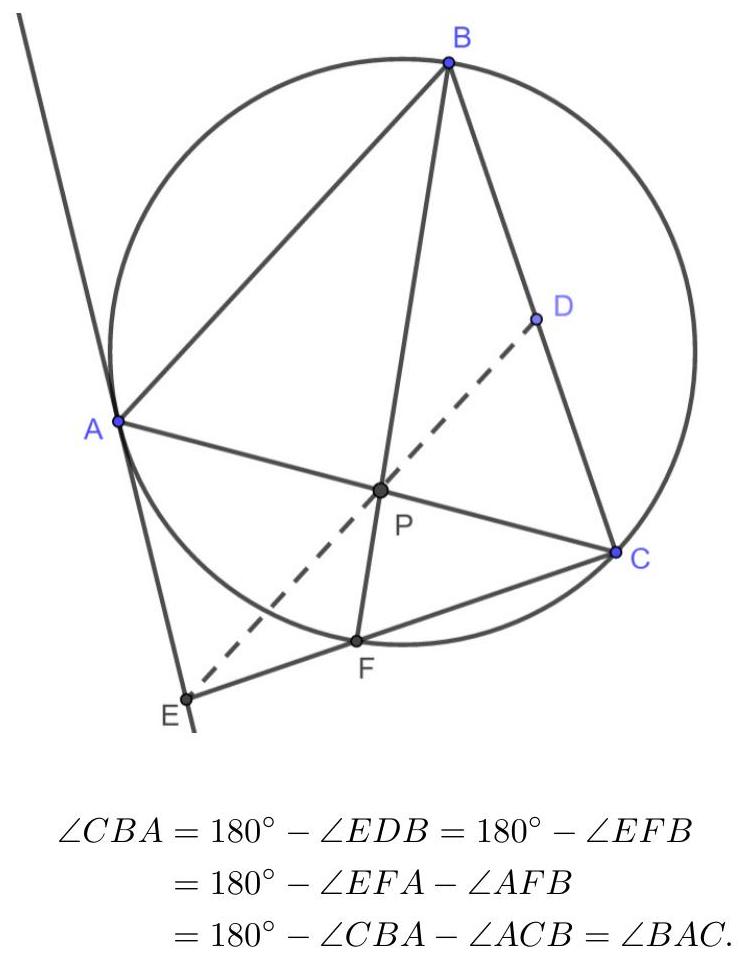\n\nLet $P$ be the intersection of $A C$ and $B F$. Then we have\n\n$$\n\\angle P A E=\\angle C B A=\\angle B A C=\\angle B F C .\n$$\n\nThis implies $A, P, F, E$ are concyclic. It follows that\n\n$$\n\\angle F P E=\\angle F A E=\\angle F B A,\n$$\n\nand hence $A B$ and $E P$ are parallel. So $E, P, D$ are collinear, and the result follows.", "metadata": {"resource_path": "APMO/segmented/en-apmo2020_sol.jsonl", "problem_match": "\nProblem 1.", "solution_match": "\nSolution 1"}} |
| {"year": "2020", "tier": "T1", "problem_label": "1", "problem_type": null, "exam": "APMO", "problem": "Let $\\Gamma$ be the circumcircle of $\\triangle A B C$. Let $D$ be a point on the side $B C$. The tangent to $\\Gamma$ at $A$ intersects the parallel line to $B A$ through $D$ at point $E$. The segment $C E$ intersects $\\Gamma$ again at $F$. Suppose $B, D, F, E$ are concyclic. Prove that $A C, B F, D E$ are concurrent.", "solution": "Let $E^{\\prime}$ be any point on the extension of $E A$. From $\\angle A E D=\\angle E^{\\prime} A B=\\angle A C D$, points $A, D, C, E$ are concyclic.\n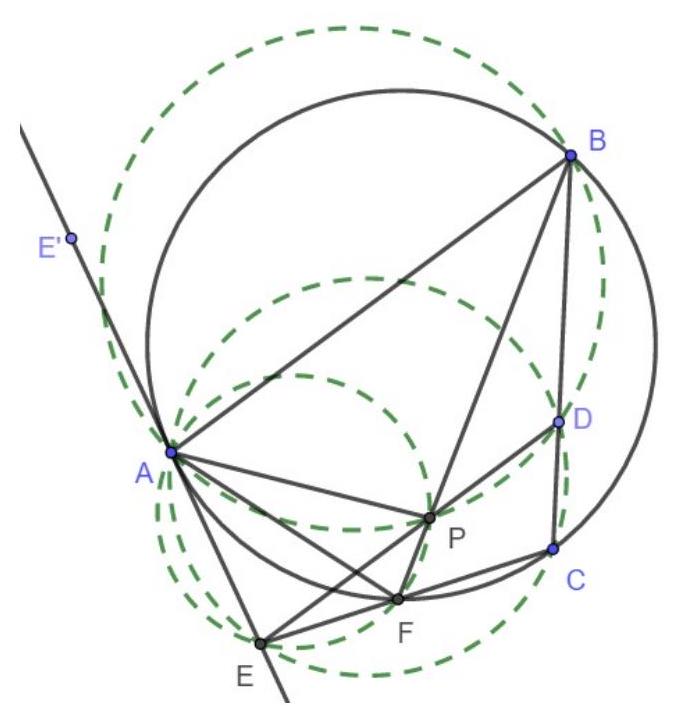\n\nLet $P$ be the intersection of $B F$ and $D E$. From $\\angle A F P=\\angle A C B=\\angle A E P$, the points $A, P, F, E$ are concyclic. In addition, from $\\angle E P A=\\angle E F A=\\angle D B A$, points $A, B, D, P$ are concyclic.\nBy considering the radical centre of $(B D F E),(A P F E)$ and $(B D P A)$, we find that the lines $B D, A P, E F$ are concurrent at $C$. The result follows.", "metadata": {"resource_path": "APMO/segmented/en-apmo2020_sol.jsonl", "problem_match": "\nProblem 1.", "solution_match": "\nSolution 2"}} |
| {"year": "2020", "tier": "T1", "problem_label": "2", "problem_type": null, "exam": "APMO", "problem": "Show that $r=2$ is the largest real number $r$ which satisfies the following condition:\n\nIf a sequence $a_{1}, a_{2}, \\ldots$ of positive integers fulfills the inequalities\n\n$$\na_{n} \\leq a_{n+2} \\leq \\sqrt{a_{n}^{2}+r a_{n+1}}\n$$\n\nfor every positive integer $n$, then there exists a positive integer $M$ such that $a_{n+2}=a_{n}$ for every $n \\geq M$.", "solution": ". First, let us assume that $r>2$, and take a positive integer $a \\geq 1 /(r-2)$.\nThen, if we let $a_{n}=a+\\lfloor n / 2\\rfloor$ for $n=1,2, \\ldots$, the sequence $a_{n}$ satisfies the inequalities\n\n$$\n\\sqrt{a_{n}^{2}+r a_{n+1}} \\geq \\sqrt{a_{n}^{2}+r a_{n}} \\geq \\sqrt{a_{n}^{2}+\\left(2+\\frac{1}{a}\\right) a_{n}} \\geq a_{n}+1=a_{n+2}\n$$\n\nbut since $a_{n+2}>a_{n}$ for any $n$, we see that $r$ does not satisfy the condition given in the problem.\nNow we show that $r=2$ does satisfy the condition of the problem. Suppose $a_{1}, a_{2}, \\ldots$ is a sequence of positive integers satisfying the inequalities given in the problem, and there exists a positive integer $m$ for which $a_{m+2}>a_{m}$ is satisfied.\nBy induction we prove the following assertion:\n\n$$\na_{m+2 k} \\leq a_{m+2 k-1}=a_{m+1} \\text { holds for every positive integer } k\n$$\n\nThe truth of $(\\dagger)$ for $k=1$ follows from the inequalities below\n\n$$\n2 a_{m+2}-1=a_{m+2}^{2}-\\left(a_{m+2}-1\\right)^{2} \\leq a_{m}^{2}+2 a_{m+1}-\\left(a_{m+2}-1\\right)^{2} \\leq 2 a_{m+1}\n$$\n\nLet us assume that $(\\dagger)$ holds for some positive integer $k$. From\n\n$$\na_{m+1}^{2} \\leq a_{m+2 k+1}^{2} \\leq a_{m+2 k-1}^{2}+2 a_{m+2 k} \\leq a_{m+1}^{2}+2 a_{m+1}<\\left(a_{m+1}+1\\right)^{2}\n$$\n\nit follows that $a_{m+2 k+1}=a_{m+1}$ must hold. Furthermore, since $a_{m+2 k} \\leq a_{m+1}$, we have\n\n$$\na_{m+2 k+2}^{2} \\leq a_{m+2 k}^{2}+2 a_{m+2 k+1} \\leq a_{m+1}^{2}+2 a_{m+1}<\\left(a_{m+1}+1\\right)^{2}\n$$\n\nfrom which it follows that $a_{m+2 k+2} \\leq a_{m+1}$, which proves the assertion $(\\dagger)$.\nWe can conclude that for the value of $m$ with which we started our argument above, $a_{m+2 k+1}=a_{m+1}$ holds for every positive integer $k$. Therefore, in order to finish the proof, it is enough to show that $a_{m+2 k}$ becomes constant after some value of $k$. Since every $a_{m+2 k}$ is a positive integer less than or equal to $a_{m+1}$, there exists $k=K$ for which $a_{m+2 K}$ takes the maximum value. By the monotonicity of $a_{m+2 k}$, it then follows that $a_{m+2 k}=a_{m+2 K}$ for all $k \\geq K$.", "metadata": {"resource_path": "APMO/segmented/en-apmo2020_sol.jsonl", "problem_match": "\nProblem 2.", "solution_match": "\nSolution 1"}} |
| {"year": "2020", "tier": "T1", "problem_label": "2", "problem_type": null, "exam": "APMO", "problem": "Show that $r=2$ is the largest real number $r$ which satisfies the following condition:\n\nIf a sequence $a_{1}, a_{2}, \\ldots$ of positive integers fulfills the inequalities\n\n$$\na_{n} \\leq a_{n+2} \\leq \\sqrt{a_{n}^{2}+r a_{n+1}}\n$$\n\nfor every positive integer $n$, then there exists a positive integer $M$ such that $a_{n+2}=a_{n}$ for every $n \\geq M$.", "solution": "We only give an alternative proof of the assertion $(\\dagger)$ in solution 1 . Let $\\left\\{a_{n}\\right\\}$ be a sequence satisfying the inequalities given in the problem. We will use the following key observations:\n(a) If $a_{n+1} \\leq a_{n}$ for some $n \\geq 1$, then\n\n$$\na_{n} \\leq a_{n+2} \\leq \\sqrt{a_{n}^{2}+2 a_{n+1}}<\\sqrt{a_{n}^{2}+2 a_{n}+1}=a_{n}+1,\n$$\n\nhence $a_{n}=a_{n+2}$.\n(b) If $a_{n} \\leq a_{n+1}$ for some $n \\geq 1$, then\n\n$$\na_{n} \\leq a_{n+2} \\leq \\sqrt{a_{n}^{2}+2 a_{n+1}}<\\sqrt{a_{n+1}^{2}+2 a_{n+1}+1}=a_{n+1}+1\n$$\n\nhence $a_{n} \\leq a_{n+2} \\leq a_{n+1}$.\nNow let $m$ be a positive integer such that $a_{m+2}>a_{m}$. By the observations above, we must have $a_{m}<a_{m+2} \\leq a_{m+1}$. Thus the assertion ( $\\dagger$ ) is true for $k=1$. Assume that the assertion holds for some positive integer $k$. Using observation (a), we get $a_{m+2 k+1}=a_{m+2 k-1}=a_{m+1}$. Thus $a_{m+2 k} \\leq a_{m+2 k+1}$, and then using observation (b), we get $a_{m+2 k+2} \\leq a_{m+2 k+1}=a_{m+1}$, which proves the assertion ( $\\dagger$ ).", "metadata": {"resource_path": "APMO/segmented/en-apmo2020_sol.jsonl", "problem_match": "\nProblem 2.", "solution_match": "# Solution 2"}} |
| {"year": "2020", "tier": "T1", "problem_label": "3", "problem_type": null, "exam": "APMO", "problem": "Determine all positive integers $k$ for which there exist a positive integer $m$ and a set $S$ of positive integers such that any integer $n>m$ can be written as a sum of distinct elements of $S$ in exactly $k$ ways.", "solution": "We claim that $k=2^{a}$ for all $a \\geq 0$.\nLet $A=\\{1,2,4,8, \\ldots\\}$ and $B=\\mathbb{N} \\backslash A$. For any set $T$, let $s(T)$ denote the sum of the elements of $T$. (If $T$ is empty, we let $s(T)=0$.)\nWe first show that any positive integer $k=2^{a}$ satisfies the desired property. Let $B^{\\prime}$ be a subset of $B$ with $a$ elements, and let $S=A \\cup B^{\\prime}$. Recall that any nonnegative integer has a unique binary representation. Hence, for any integer $t>s\\left(B^{\\prime}\\right)$ and any subset $B^{\\prime \\prime} \\subseteq B^{\\prime}$, the number $t-s\\left(B^{\\prime \\prime}\\right)$ can be written as a sum of distinct elements of $A$ in a unique way. This means that $t$ can be written as a sum of distinct elements of $B^{\\prime}$ in exactly $2^{a}$ ways.\nNext, assume that some positive integer $k$ satisfies the desired property for a positive integer $m \\geq 2$ and a set $S$. Clearly, $S$ is infinite.\nLemma: For all sufficiently large $x \\in S$, the smallest element of $S$ larger than $x$ is $2 x$.\nProof of Lemma: Let $x \\in S$ with $x>3 m$, and let $x<y<2 x$. We will show that $y \\notin S$. Suppose first that $y>x+m$. Then $y-x$ can be written as a sum of distinct elements of $S$ not including $x$ in $k$ ways. If $y \\in S$, then $y$ can be written as a sum of distinct elements of $S$ in at least $k+1$ ways, a contradiction. Suppose now that $y \\leq x+m$. We consider $z \\in(2 x-m, 2 x)$. Similarly as before, $z-x$ can be written as a sum of distinct elements of $S$ not including $x$ or $y$ in $k$ ways. If $y \\in S$, then since $m<z-y<x, z-y$ can be written as a sum of distinct elements of $S$ not including $x$ or $y$. This means that $z$ can be written as a sum of distinct elements of $S$ in at least $k+1$ ways, a contradiction.\nWe now show that $2 x \\in S$; assume for contradiction that this is not the case. Observe that $2 x$ can be written as a sum of distinct elements of $S$ including $x$ in exactly $k-1$ ways. This means that $2 x$ can also be written as a sum of distinct elements of $S$ not including $x$. If this sum includes any number less than $x-m$, then removing this number, we can write some number $y \\in(x+m, 2 x)$ as a sum of distinct elements of $S$ not including $x$. Now if $y=y^{\\prime}+x$ where $y^{\\prime} \\in(m, x)$ then $y^{\\prime}$ can be written as\na sum of distinct elements of $S$ including $x$ in exactly $k$ ways. Therefore $y$ can be written as a sum of distinct elements of $S$ in at least $k+1$ ways, a contradiction. Hence the sum only includes numbers in the range $[x-m, x)$. Clearly two numbers do not suffice. On the other hand, three such numbers sum to at least $3(x-m)>2 x$, a contradiction.\nFrom the Lemma, we have that $S=T \\cup U$, where $T$ is finite and $U=\\{x, 2 x, 4 x, 8 x, \\ldots\\}$ for some positive integer $x$. Let $y$ be any positive integer greater than $s(T)$. For any subset $T^{\\prime} \\subseteq T$, if $y-s\\left(T^{\\prime}\\right) \\equiv 0(\\bmod x)$, then $y-s\\left(T^{\\prime}\\right)$ can be written as a sum of distinct elements of $U$ in a unique way; otherwise $y-s\\left(T^{\\prime}\\right)$ cannot be written as a sum of distinct elements of $U$. Hence the number of ways to write $y$ as a sum of distinct elements of $S$ is equal to the number of subsets $T^{\\prime} \\subseteq T$ such that $s\\left(T^{\\prime}\\right) \\equiv y(\\bmod x)$. Since this holds for all $y$, for any $0 \\leq a \\leq x-1$ there are exactly $k$ subsets $T^{\\prime} \\subseteq T$ such that $s\\left(T^{\\prime}\\right) \\equiv a(\\bmod x)$. This means that there are $k x$ subsets of $T$ in total. But the number of subsets of $T$ is a power of 2 , and therefore $k$ is a power of 2 , as claimed.", "metadata": {"resource_path": "APMO/segmented/en-apmo2020_sol.jsonl", "problem_match": "\nProblem 3.", "solution_match": "# Solution:"}} |
| {"year": "2020", "tier": "T1", "problem_label": "3", "problem_type": null, "exam": "APMO", "problem": "Determine all positive integers $k$ for which there exist a positive integer $m$ and a set $S$ of positive integers such that any integer $n>m$ can be written as a sum of distinct elements of $S$ in exactly $k$ ways.", "solution": ". We give an alternative proof of the first half of the lemma in the Solution 1 above.\nLet $s_{1}<s_{2}<\\cdots$ be the elements of $S$. For any positive integer $r$, define $A_{r}(x)=\\prod_{n=1}^{r}\\left(1+x^{s_{n}}\\right)$. For each $n$ such that $m \\leq n<s_{r+1}$, all $k$ ways of writing $n$ as a sum of elements of $S$ must only use $s_{1}, \\ldots, s_{r}$, so the coefficient of $x^{n}$ in $A_{r}(x)$ is $k$. Similarly the number of ways of writing $s_{r+1}$ as a sum of elements of $S$ without using $s_{r+1}$ is exactly $k-1$. Hence the coefficient of $x^{s_{r+1}}$ in $A_{r}(x)$ is $k-1$.\nFix a $t$ such that $s_{t}>2(m+1)$. Write\n\n$$\nA_{t-1}(x)=u(x)+k\\left(x^{m+1}+\\cdots+x^{s_{t}-1}\\right)+x^{s_{t}} v(x)\n$$\n\nfor some $u(x), v(x)$ where $u(x)$ is of degree at most $m$.\nNote that\n\n$$\nA_{t+1}(x)=A_{t-1}(x)+x^{s_{t}} A_{t-1}(x)+x^{s_{t+1}} A_{t-1}(x)+x^{s_{t}+s_{t+1}} A_{t-1}(x)\n$$\n\nIf $s_{t+1}+m+1<2 s_{t}$, we can find the term $x^{s_{t+1}+m+1}$ in $x^{s_{t}} A_{t-1}(x)$ and in $x^{s_{t+1}} A_{t-1}(x)$. Hence the coefficient of $x^{s_{t+1}+m+1}$ in $A_{t+1}(x)$ is at least $2 k$, which is impossible. So $s_{t+1} \\geq 2 s_{t}-(m+1)>$ $s_{t}+m+1$.\nNow\n\n$$\nA_{t}(x)=A_{t-1}(x)+x^{s_{t}} u(x)+k\\left(x^{s_{t}+m+1}+\\cdots x^{2 s_{t}-1}\\right)+x^{2 s_{t}} v(x)\n$$\n\nRecall that the coefficent of $x^{s_{t+1}}$ in $A_{t}(x)$ is $k-1$. But if $s_{t}+m+1<s_{t+1}<s_{2 t}$, then the coefficient of $x^{s_{t+1}}$ in $A_{t}(x)$ is at least $k$, which is a contradiction. Therefore $s_{t+1} \\geq 2 s_{t}$.", "metadata": {"resource_path": "APMO/segmented/en-apmo2020_sol.jsonl", "problem_match": "\nProblem 3.", "solution_match": "\nSolution 2"}} |
| {"year": "2020", "tier": "T1", "problem_label": "4", "problem_type": null, "exam": "APMO", "problem": "Let $\\mathbb{Z}$ denote the set of all integers. Find all polynomials $P(x)$ with integer coefficients that satisfy the following property:\nFor any infinite sequence $a_{1}, a_{2}, \\ldots$ of integers in which each integer in $\\mathbb{Z}$ appears exactly once, there exist indices $i<j$ and an integer $k$ such that $a_{i}+a_{i+1}+\\cdots+a_{j}=P(k)$.", "solution": "Part 1: All polynomials with $\\operatorname{deg} P=1$ satisfy the given property.\nSuppose $P(x)=c x+d$, and assume without loss of generality that $c>d \\geq 0$. Denote $s_{i}=a_{1}+a_{2}+$ $\\cdots+a_{i}(\\bmod c)$. It suffices to show that there exist indices $i$ and $j$ such that $j-i \\geq 2$ and $s_{j}-s_{i} \\equiv d$ $(\\bmod c)$.\nConsider $c+1$ indices $e_{1}, e_{2}, \\ldots, e_{c+1}>1$ such that $a_{e_{l}} \\equiv d(\\bmod c)$. By the pigeonhole principle, among the $n+1$ pairs $\\left(s_{e_{1}-1}, s_{e_{1}}\\right),\\left(s_{e_{2}-1}, s_{e_{2}}\\right), \\ldots,\\left(s_{e_{n+1}-1}, s_{e_{n+1}}\\right)$, some two are equal, say $\\left(s_{m-1}, s_{m}\\right)$ and $\\left(s_{n-1}, s_{n}\\right)$. We can then take $i=m-1$ and $j=n$.\nPart 2: All polynomials with $\\operatorname{deg} P \\neq 1$ do not satisfy the given property.\nLemma: If $\\operatorname{deg} P \\neq 1$, then for any positive integers $A, B$, and $C$, there exists an integer $y$ with $|y|>C$ such that no value in the range of $P$ falls within the interval $[y-A, y+B]$.\nProof of Lemma: The claim is immediate when $P$ is constant or when $\\operatorname{deg} P$ is even since $P$ is bounded from below. Let $P(x)=a_{n} x^{n}+\\cdots+a_{1} x+a_{0}$ be of odd degree greater than 1 , and assume without\nloss of generality that $a_{n}>0$. Since $P(x+1)-P(x)=a_{n} n x^{n-1}+\\ldots$, and $n-1>0$, the gap between $P(x)$ and $P(x+1)$ grows arbitrarily for large $x$. The claim follows.\nSuppose $\\operatorname{deg} P \\neq 1$. We will inductively construct a sequence $\\left\\{a_{i}\\right\\}$ such that for any indices $i<j$ and any integer $k$ it holds that $a_{i}+a_{i+1}+\\cdots+a_{j} \\neq P(k)$. Suppose that we have constructed the sequence up to $a_{i}$, and $m$ is an integer with smallest magnitude yet to appear in the sequence. We will add two more terms to the sequence. Take $a_{i+2}=m$. Consider all the new sums of at least two consecutive terms; each of them contains $a_{i+1}$. Hence all such sums are in the interval $\\left[a_{i+1}-A, a_{i+1}+B\\right]$ for fixed constants $A, B$. The lemma allows us to choose $a_{i+1}$ so that all such sums avoid the range of $P$.\nAlternate Solution for Part 1: Again, suppose $P(x)=c x+d$, and assume without loss of generality that $c>d \\geq 0$. Let $S_{i}=\\left\\{a_{j}+a_{j+1}+\\cdots+a_{i}(\\bmod c) \\mid j=1,2, \\ldots, i\\right\\}$. Then $S_{i+1}=\\left\\{s_{i}+a_{i+1}\\right.$ $\\left.(\\bmod c) \\mid s_{i} \\in S_{i}\\right\\} \\cup\\left\\{a_{i+1}(\\bmod c)\\right\\}$. Hence $\\left|S_{i+1}\\right|=\\left|S_{i}\\right|$ or $S_{i+1}=\\left|S_{i}\\right|+1$, with the former occuring exactly when $0 \\in S_{i}$. Since $\\left|S_{i}\\right| \\leq c$, the latter can only occur finitely many times, so there exists $I$ such that $0 \\in S_{i}$ for all $i \\geq I$. Let $t>I$ be an index with $a_{t} \\equiv d(\\bmod c)$. Then we can find a sum of at least two consecutive terms ending at $a_{t}$ and congruent to $d(\\bmod c)$.\nAlternate Construction when $P(x)$ is constant or of even degree\nIf $P(x)$ is of even degree, then $P$ is bounded from below or from above. In case of $P$ is constant or bounded from above, then there exists a positive integer $c$ such that $P(x)<c$. Let $\\left\\{a_{i}\\right\\}$ be the sequence\n\n$$\n0,1,-1,2,3,-2,4,5,-3, \\cdots\n$$\n\nwhich is given by $a_{3 n+1}=2 n, a_{3 n+2}=2 n+1, a_{3 n+3}=-(n+1)$ for all $n \\geq 0$. Notice that for any $i<j$ we have $a_{i}+\\cdots+a_{j} \\geq 0$. Then for the sequence $\\left\\{b_{n}\\right\\}$ defined by $b_{n}=a_{n}+c$, clearly $b_{i}+\\cdots+b_{j} \\geq\\left(a_{i}+\\cdots+a_{j}\\right)+2 c>c$ which is out side the range of $P(x)$.\n\nNow if $P$ is bounded from below, there exist a positive integer $c$ such that $P(x)>-c$. In this case, take $b_{n}$ to be $b_{n}=-a_{n}-c$. Then for all $i<j$ we have $b_{i}+\\cdots+b_{j} \\leq-\\left(a_{1}+\\cdots a_{n}\\right)-2 c<-c$ which is again out side the range of $P(x)$.", "metadata": {"resource_path": "APMO/segmented/en-apmo2020_sol.jsonl", "problem_match": "\nProblem 4.", "solution_match": "# Solution:"}} |
| {"year": "2020", "tier": "T1", "problem_label": "5", "problem_type": null, "exam": "APMO", "problem": "Let $n \\geq 3$ be a fixed integer. The number 1 is written $n$ times on a blackboard. Below the blackboard, there are two buckets that are initially empty. A move consists of erasing two of the numbers $a$ and $b$, replacing them with the numbers 1 and $a+b$, then adding one stone to the first bucket and $\\operatorname{gcd}(a, b)$ stones to the second bucket. After some finite number of moves, there are $s$ stones in the first bucket and $t$ stones in the second bucket, where $s$ and $t$ are positive integers. Find all possible values of the ratio $\\frac{t}{s}$.", "solution": "The answer is the set of all rational numbers in the interval $[1, n-1)$. First, we show that no other numbers are possible. Clearly the ratio is at least 1, since for every move, at least one stone is added to the second bucket. Note that the number $s$ of stones in the first bucket is always equal to $p-n$, where $p$ is the sum of the numbers on the blackboard. We will assume that the numbers are written in a row, and whenever two numbers $a$ and $b$ are erased, $a+b$ is written in the place of the number on the right. Let $a_{1}, a_{2}, \\ldots, a_{n}$ be the numbers on the blackboard from left to right, and let\n\n$$\nq=0 \\cdot a_{1}+1 \\cdot a_{2}+\\cdots+(n-1) a_{n}\n$$\n\nSince each number $a_{i}$ is at least 1 , we always have\n\n$$\nq \\leq(n-1) p-(1+\\cdots+(n-1))=(n-1) p-\\frac{n(n-1)}{2}=(n-1) s+\\frac{n(n-1)}{2}\n$$\n\nAlso, if a move changes $a_{i}$ and $a_{j}$ with $i<j$, then $t$ changes by $\\operatorname{gcd}\\left(a_{i}, a_{j}\\right) \\leq a_{i}$ and $q$ increases by\n\n$$\n(j-1) a_{i}-(i-1)\\left(a_{i}-1\\right) \\geq i a_{i}-(i-1)\\left(a_{i}-1\\right) \\geq a_{i}\n$$\n\nHence $q-t$ never decreases. We may assume without loss of generality that the first move involves the rightmost 1. Then immediately after this move, $q=0+1+\\cdots+(n-2)+(n-1) \\cdot 2=\\frac{(n+2)(n-1)}{2}$ and\n$t=1$. So after that move, we always have\n\n$$\n\\begin{aligned}\nt & \\leq q+1-\\frac{(n+2)(n-1)}{2} \\\\\n& \\leq(n-1) s+\\frac{n(n-1)}{2}-\\frac{(n+2)(n-1)}{2}+1 \\\\\n& =(n-1) s-(n-2)<(n-1) s\n\\end{aligned}\n$$\n\nHence, $\\frac{t}{s}<n-1$. So $\\frac{t}{s}$ must be a rational number in $[1, n-1)$.\n\nAfter a single move, we have $\\frac{t}{s}=1$, so it remains to prove that $\\frac{t}{s}$ can be any rational number in $(1, n-1)$. We will now show by induction on $n$ that for any positive integer $a$, it is possible to reach a situation where there are $n-1$ occurrences of 1 on the board and the number $a^{n-1}$, with $t$ and $s$ equal to $a^{n-2}(a-1)(n-1)$ and $a^{n-1}-1$, respectively. For $n=2$, this is clear as there is only one possible move at each step, so after $a-1$ moves $s$ and $t$ will both be equal to $a-1$. Now assume that the claim is true for $n-1$, where $n>2$. Call the algorithm which creates this situation using $n-1$ numbers algorithm $A$. Then to reach the situation for size $n$, we apply algorithm $A$, to create the number $a^{n-2}$. Next, apply algorithm $A$ again and then add the two large numbers, repeat until we get the number $a^{n-1}$. Then algorithm $A$ was applied $a$ times and the two larger numbers were added $a-1$ times. Each time the two larger numbers are added, $t$ increases by $a^{n-2}$ and each time algorithm $A$ is applied, $t$ increases by $a^{n-3}(a-1)(n-2)$. Hence, the final value of $t$ is\n\n$$\nt=(a-1) a^{n-2}+a \\cdot a^{n-3}(a-1)(n-2)=a^{n-2}(a-1)(n-1)\n$$\n\nThis completes the induction.\nNow we can choose 1 and the large number $b$ times for any positive integer $b$, and this will add $b$ stones to each bucket. At this point we have\n\n$$\n\\frac{t}{s}=\\frac{a^{n-2}(a-1)(n-1)+b}{a^{n-1}-1+b}\n$$\n\nSo we just need to show that for any rational number $\\frac{p}{q} \\in(1, n-1)$, there exist positive integers $a$ and $b$ such that\n\n$$\n\\frac{p}{q}=\\frac{a^{n-2}(a-1)(n-1)+b}{a^{n-1}-1+b}\n$$\n\nRearranging, we see that this happens if and only if\n\n$$\nb=\\frac{q a^{n-2}(a-1)(n-1)-p\\left(a^{n-1}-1\\right)}{p-q} .\n$$\n\nIf we choose $a \\equiv 1(\\bmod p-q)$, then this will be an integer, so we just need to check that the numerator is positive for sufficiently large $a$.\n\n$$\n\\begin{aligned}\nq a^{n-2}(a-1)(n-1)-p\\left(a^{n-1}-1\\right) & >q a^{n-2}(a-1)(n-1)-p a^{n-1} \\\\\n& =a^{n-2}(a(q(n-1)-p)-(n-1))\n\\end{aligned}\n$$\n\nwhich is positive for sufficiently large $a$ since $q(n-1)-p>0$.\n\nAlternative solution for the upper bound. Rather than starting with $n$ occurrences of 1 , we may start with infinitely many 1 s , but we are restricted to having at most $n-1$ numbers which are not equal to 1 on the board at any time. It is easy to see that this does not change the problem. Note also that we can ignore the 1 we write on the board each move, so the allowed move is to rub off two numbers and write their sum. We define the width and score of a number on the board as follows. Colour that number red, then reverse every move up to that point all the way back to the situation when the numbers are all 1 s . Whenever a red number is split, colour the two replacement numbers\nred. The width of the original number is equal to the maximum number of red integers greater than 1 which appear on the board at the same time. The score of the number is the number of stones which were removed from the second bucket during these splits. Then clearly the width of any number is at most $n-1$. Also, $t$ is equal to the sum of the scores of the final numbers. We claim that if a number $p>1$ has a width of at most $w$, then its score is at most $(p-1) w$. We will prove this by strong induction on $p$. If $p=1$, then clearly $p$ has a score of 0 , so the claim is true. If $p>1$, then $p$ was formed by adding two smaller numbers $a$ and $b$. Clearly $a$ and $b$ both have widths of at most $w$. Moreover, if $a$ has a width of $w$, then at some point in the reversed process there will be $w$ numbers in the set $\\{2,3,4, \\ldots\\}$ that have split from $a$, and hence there can be no such numbers at this point which have split from $b$. Between this point and the final situation, there must always be at least one number in the set $\\{2,3,4, \\ldots\\}$ that split from $a$, so the width of $b$ is at most $w-1$. Therefore, $a$ and $b$ cannot both have widths of $w$, so without loss of generality, $a$ has width at most $w$ and $b$ has width at most $w-1$. Then by the inductive hypothesis, $a$ has score at most $(a-1) w$ and $b$ has score at most $(b-1)(w-1)$. Hence, the score of $p$ is at most\n\n$$\n\\begin{aligned}\n(a-1) w+(b-1)(w-1)+\\operatorname{gcd}(a, b) & \\leq(a-1) w+(b-1)(w-1)+b \\\\\n& =(p-1) w+1-w \\\\\n& \\leq(p-1) w .\n\\end{aligned}\n$$\n\nThis completes the induction.\nNow, since each number $p$ in the final configuration has width at most $(n-1)$, it has score less than $(n-1)(p-1)$. Hence the number $t$ of stones in the second bucket is less than the sum over the values of $(n-1)(p-1)$, and $s$ is equal to the sum of the the values of $(p-1)$. Therefore, $\\frac{t}{s}<n-1$.", "metadata": {"resource_path": "APMO/segmented/en-apmo2020_sol.jsonl", "problem_match": "\nProblem 5.", "solution_match": "# Solution:"}} |
|
|


