| {"year": "2023", "tier": "T1", "problem_label": "1", "problem_type": null, "exam": "APMO", "problem": "Let $n \\geq 5$ be an integer. Consider $n$ squares with side lengths $1,2, \\ldots, n$, respectively. The squares are arranged in the plane with their sides parallel to the $x$ and $y$ axes. Suppose that no two squares touch, except possibly at their vertices.\nShow that it is possible to arrange these squares in a way such that every square touches exactly two other squares.", "solution": "Set aside the squares with sidelengths $n-3, n-2, n-1$, and $n$ and suppose we can split the remaining squares into two sets $A$ and $B$ such that the sum of the sidelengths of the squares in $A$ is 1 or 2 units larger than the sum of the sidelengths of the squares in $B$.\nString the squares of each set $A, B$ along two parallel diagonals, one for each diagonal. Now use the four largest squares along two perpendicular diagonals to finish the construction: one will have sidelengths $n$ and $n-3$, and the other, sidelengths $n-1$ and $n-2$. If the sum of the sidelengths of the squares in $A$ is 1 unit larger than the sum of the sidelengths of the squares in $B$, attach the squares with sidelengths $n-3$ and $n-1$ to the $A$-diagonal, and the other two squares to the $B$-diagonal. The resulting configuration, in which the $A$ and $B$-diagonals are represented by unit squares, and the sidelengths $a_{i}$ of squares from $A$ and $b_{j}$ of squares from $B$ are indicated within each square, follows:\n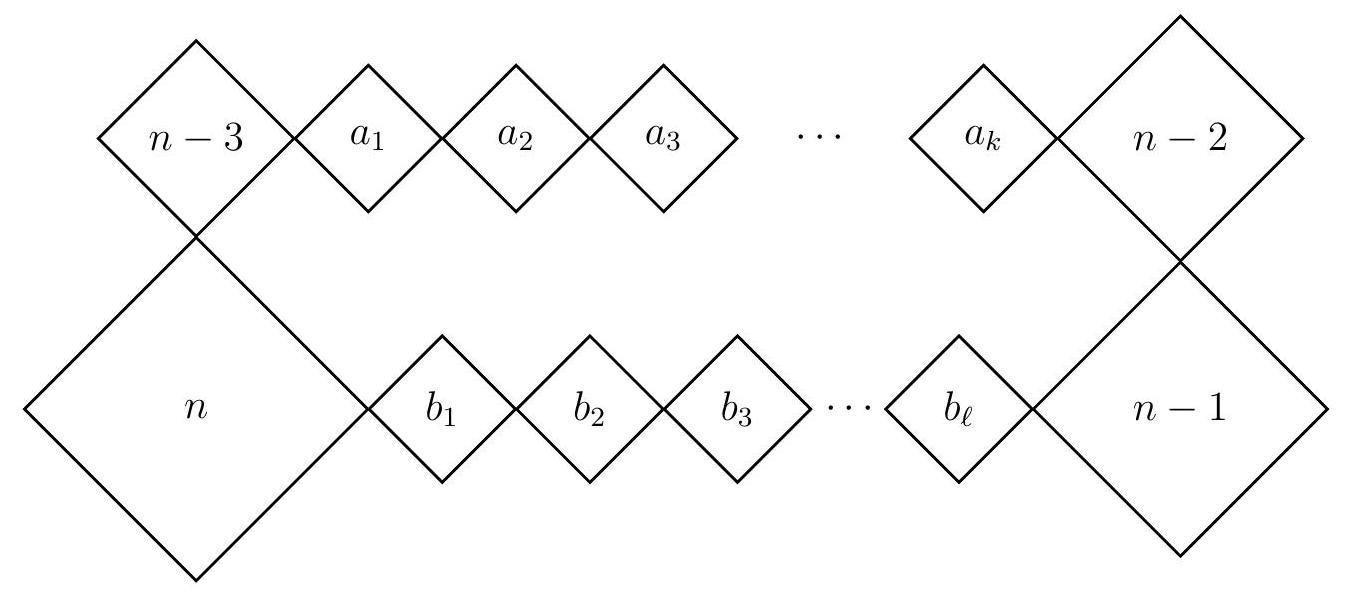\n\nSince $\\left(a_{1}+a_{2}+\\cdots+a_{k}\\right) \\sqrt{2}+\\frac{((n-3)+(n-2)) \\sqrt{2}}{2}=\\left(b_{1}+b_{2}+\\cdots+b_{\\ell}+2\\right) \\sqrt{2}+\\frac{(n+(n-1)) \\sqrt{2}}{2}$, this case is done.\nIf the sum of the sidelengths of the squares in $A$ is 1 unit larger than the sum of the sidelengths of the squares in $B$, attach the squares with sidelengths $n-3$ and $n-2$ to the $A$-diagonal, and the other two squares to the $B$-diagonal. The resulting configuration follows:\n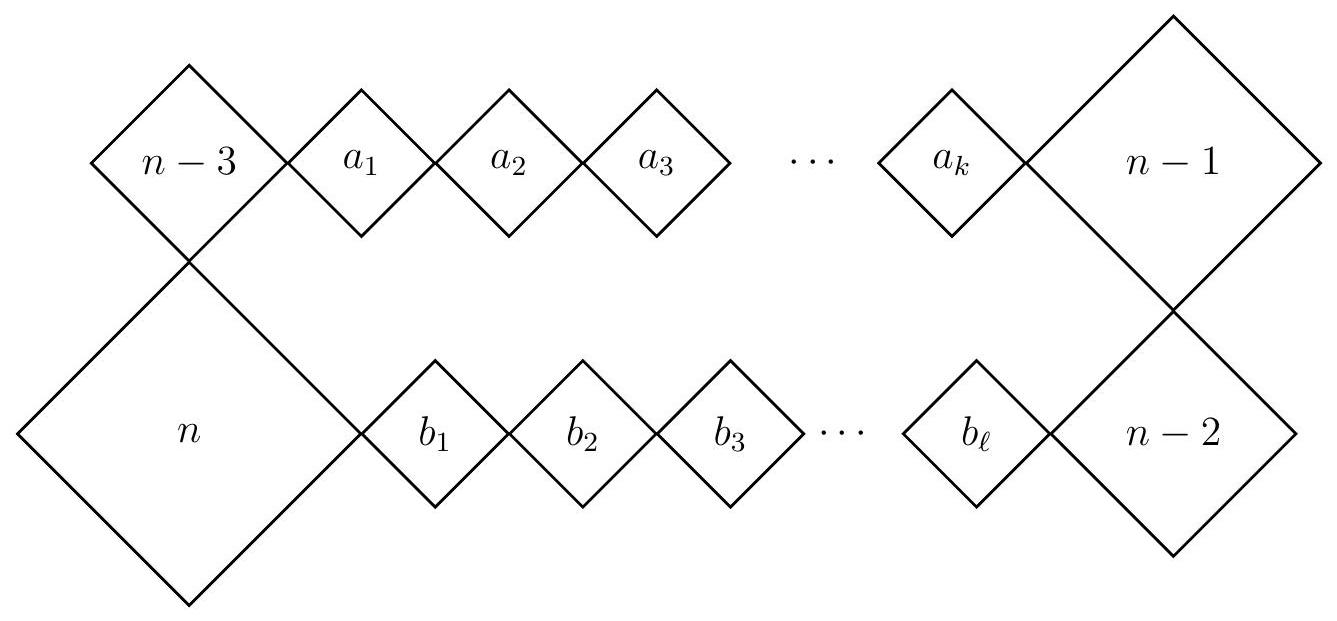\n\nSince $\\left(a_{1}+a_{2}+\\cdots+a_{k}\\right) \\sqrt{2}+\\frac{((n-3)+(n-1)) \\sqrt{2}}{2}=\\left(b_{1}+b_{2}+\\cdots+b_{\\ell}+1\\right) \\sqrt{2}+\\frac{(n+(n-2)) \\sqrt{2}}{2}$, this case is also done.\nIn both cases, the distance between the $A$-diagonal and the $B$-diagonal is $\\frac{((n-3)+n) \\sqrt{2}}{2}=\\frac{(2 n-3) \\sqrt{2}}{2}$. Since $a_{i}, b_{j} \\leq n-4, \\frac{\\left(a_{i}+b_{j}\\right) \\sqrt{2}}{2}<\\frac{(2 n-4) \\sqrt{2}}{2}<\\frac{(2 n-3) \\sqrt{2}}{2}$, and therefore the $A$ - and $B$-diagonals do not overlap.\nFinally, we prove that it is possible to split the squares of sidelengths 1 to $n-4$ into two sets $A$ and $B$ such that the sum of the sidelengths of the squares in $A$ is 1 or 2 units larger than the sum of the sidelengths of the squares in $B$. One can do that in several ways; we present two possibilities:\n\n- Direct construction: Split the numbers from 1 to $n-4$ into several sets of four consecutive numbers $\\{t, t+1, t+2, t+3\\}$, beginning with the largest numbers; put squares of sidelengths $t$ and $t+3$ in $A$ and squares of sidelengths $t+1$ and $t+2$ in $B$. Notice that $t+(t+3)=$ $(t+1)+(t+2)$. In the end, at most four numbers remain.\n- If only 1 remains, put the corresponding square in $A$, so the sum of the sidelengths of the squares in $A$ is one unit larger that those in $B$;\n- If 1 and 2 remains, put the square of sidelength 2 in $A$ and the square of sidelength 1 in $B$ (the difference is 1 );\n- If 1,2 , and 3 remains, put the squares of sidelengths 1 and 3 in $A$, and the square of sidelength 2 in $B$ (the difference is 2 );\n- If $1,2,3$, and 4 remains, put the squares of sidelengths 2 and 4 in $A$, and the squares of sidelengths 1 and 3 in $B$ (the difference is 2 ).\n- Indirect construction: Starting with $A$ and $B$ as empty sets, add the squares of sidelengths $n-4, n-3, \\ldots, 2$ to either $A$ or $B$ in that order such that at each stage the difference between the sum of the sidelengths in $A$ and the sum of the sidelengths of B is minimized. By induction it is clear that after adding an integer $j$ to one of the sets, this difference is at most $j$. In particular, the difference is 0,1 or 2 at the end. Finally adding the final 1 to one of the sets can ensure that the final difference is 1 or 2 . If necessary, flip $A$ and $B$.", "metadata": {"resource_path": "APMO/segmented/en-apmo2023_sol.jsonl", "problem_match": "# Problem 1", "solution_match": "# Solution 1"}} |
| {"year": "2023", "tier": "T1", "problem_label": "1", "problem_type": null, "exam": "APMO", "problem": "Let $n \\geq 5$ be an integer. Consider $n$ squares with side lengths $1,2, \\ldots, n$, respectively. The squares are arranged in the plane with their sides parallel to the $x$ and $y$ axes. Suppose that no two squares touch, except possibly at their vertices.\nShow that it is possible to arrange these squares in a way such that every square touches exactly two other squares.", "solution": "Solve the problem by induction in $n$. Construct examples for $n=5,6,7,8,9,10$ (one can use the constructions from the previous solution, for instance). For $n>10$, set aside the six larger squares and arrange them in the following fashion:\n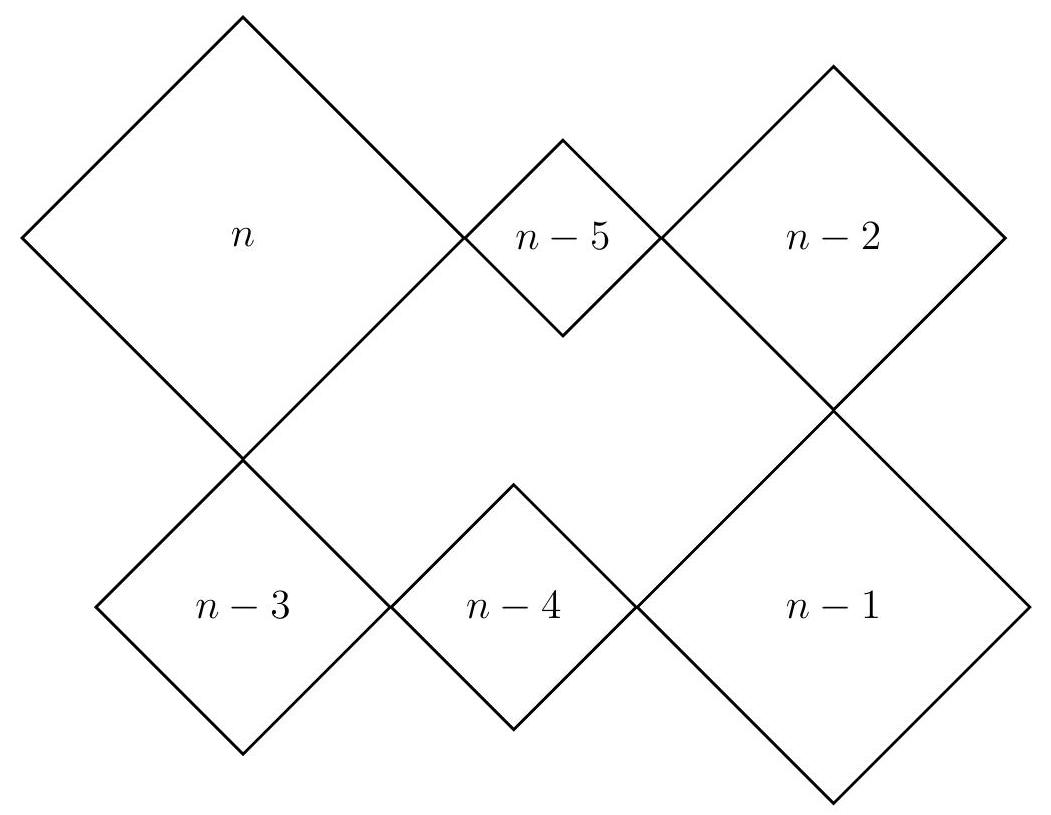\n\nBy the induction hypothesis, one can arrange the remaining $n-6$ squares away from the six larger squares, so we are done.", "metadata": {"resource_path": "APMO/segmented/en-apmo2023_sol.jsonl", "problem_match": "# Problem 1", "solution_match": "# Solution 2"}} |
| {"year": "2023", "tier": "T1", "problem_label": "2", "problem_type": null, "exam": "APMO", "problem": "Find all integers $n$ satisfying $n \\geq 2$ and $\\frac{\\sigma(n)}{p(n)-1}=n$, in which $\\sigma(n)$ denotes the sum of all positive divisors of $n$, and $p(n)$ denotes the largest prime divisor of $n$.\n\nAnswer: $n=6$.", "solution": "Let $n=p_{1}^{\\alpha_{1}} \\cdot \\ldots \\cdot p_{k}^{\\alpha_{k}}$ be the prime factorization of $n$ with $p_{1}<\\ldots<p_{k}$, so that $p(n)=p_{k}$ and $\\sigma(n)=\\left(1+p_{1}+\\cdots+p_{1}^{\\alpha_{1}}\\right) \\ldots\\left(1+p_{k}+\\cdots+p_{k}^{\\alpha_{k}}\\right)$. Hence\n$p_{k}-1=\\frac{\\sigma(n)}{n}=\\prod_{i=1}^{k}\\left(1+\\frac{1}{p_{i}}+\\cdots+\\frac{1}{p_{i}^{\\alpha_{i}}}\\right)<\\prod_{i=1}^{k} \\frac{1}{1-\\frac{1}{p_{i}}}=\\prod_{i=1}^{k}\\left(1+\\frac{1}{p_{i}-1}\\right) \\leq \\prod_{i=1}^{k}\\left(1+\\frac{1}{i}\\right)=k+1$,\nthat is, $p_{k}-1<k+1$, which is impossible for $k \\geq 3$, because in this case $p_{k}-1 \\geq 2 k-2 \\geq k+1$. Then $k \\leq 2$ and $p_{k}<k+2 \\leq 4$, which implies $p_{k} \\leq 3$.\nIf $k=1$ then $n=p^{\\alpha}$ and $\\sigma(n)=1+p+\\cdots+p^{\\alpha}$, and in this case $n \\nmid \\sigma(n)$, which is not possible. Thus $k=2$, and $n=2^{\\alpha} 3^{\\beta}$ with $\\alpha, \\beta>0$. If $\\alpha>1$ or $\\beta>1$,\n\n$$\n\\frac{\\sigma(n)}{n}>\\left(1+\\frac{1}{2}\\right)\\left(1+\\frac{1}{3}\\right)=2 .\n$$\n\nTherefore $\\alpha=\\beta=1$ and the only answer is $n=6$.\nComment: There are other ways to deal with the case $n=2^{\\alpha} 3^{\\beta}$. For instance, we have $2^{\\alpha+2} 3^{\\beta}=\\left(2^{\\alpha+1}-1\\right)\\left(3^{\\beta+1}-1\\right)$. Since $2^{\\alpha+1}-1$ is not divisible by 2 , and $3^{\\beta+1}-1$ is not divisible by 3 , we have\n\n$$\n\\left\\{\\begin{array} { l } \n{ 2 ^ { \\alpha + 1 } - 1 = 3 ^ { \\beta } } \\\\\n{ 3 ^ { \\beta + 1 } - 1 = 2 ^ { \\alpha + 2 } }\n\\end{array} \\Longleftrightarrow \\left\\{\\begin{array} { c } \n{ 2 ^ { \\alpha + 1 } - 1 = 3 ^ { \\beta } } \\\\\n{ 3 \\cdot ( 2 ^ { \\alpha + 1 } - 1 ) - 1 = 2 \\cdot 2 ^ { \\alpha + 1 } }\n\\end{array} \\Longleftrightarrow \\left\\{\\begin{array}{r}\n2^{\\alpha+1}=4 \\\\\n3^{\\beta}=3\n\\end{array}\\right.\\right.\\right.\n$$\n\nand $n=2^{\\alpha} 3^{\\beta}=6$.", "metadata": {"resource_path": "APMO/segmented/en-apmo2023_sol.jsonl", "problem_match": "# Problem 2", "solution_match": "# Solution\n\n"}} |
| {"year": "2023", "tier": "T1", "problem_label": "3", "problem_type": null, "exam": "APMO", "problem": "Let $A B C D$ be a parallelogram. Let $W, X, Y$, and $Z$ be points on sides $A B, B C, C D$, and $D A$, respectively, such that the incenters of triangles $A W Z, B X W, C Y X$ and $D Z Y$ form a parallelogram. Prove that $W X Y Z$ is a parallelogram.", "solution": "Let the four incenters be $I_{1}, I_{2}, I_{3}$, and $I_{4}$ with inradii $r_{1}, r_{2}, r_{3}$, and $r_{4}$ respectively (in the order given in the question). Without loss of generality, let $I_{1}$ be closer to $A B$ than $I_{2}$. Let the acute angle between $I_{1} I_{2}$ and $A B$ (and hence also the angle between $I_{3} I_{4}$ and $C D$ ) be $\\theta$. Then\n\n$$\nr_{2}-r_{1}=I_{1} I_{2} \\sin \\theta=I_{3} I_{4} \\sin \\theta=r_{4}-r_{3}\n$$\n\nwhich implies $r_{1}+r_{4}=r_{2}+r_{3}$. Similar arguments show that $r_{1}+r_{2}=r_{3}+r_{4}$. Thus we obtain $r_{1}=r_{3}$ and $r_{2}=r_{4}$.\n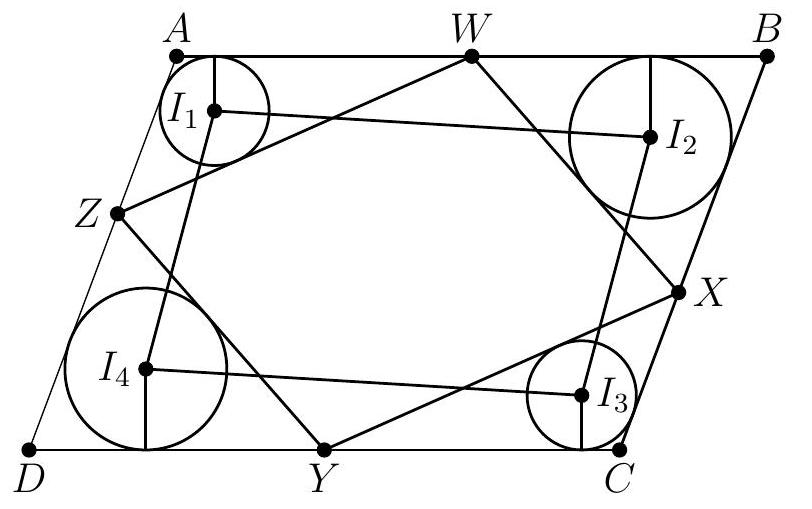\n\nNow let's consider the possible positions of $W, X, Y, Z$. Suppose $A Z \\neq C X$. Without loss of generality assume $A Z>C X$. Since the incircles of $A W Z$ and $C Y X$ are symmetric about the centre of the parallelogram $A B C D$, this implies $C Y>A W$. Using similar arguments, we have\n\n$$\nC Y>A W \\Longrightarrow B W>D Y \\Longrightarrow D Z>B X \\Longrightarrow C X>A Z\n$$\n\nwhich is a contradiction. Therefore $A Z=C X \\Longrightarrow A W=C Y$ and $W X Y Z$ is a parallelogram.\nComment: There are several ways to prove that $r_{1}=r_{3}$ and $r_{2}=r_{4}$. The proposer shows the following three alternative approaches:\nUsing parallel lines: Let $O$ be the centre of parallelogram $A B C D$ and $P$ be the centre of parallelogram $I_{1} I_{2} I_{3} I_{4}$. Since $A I_{1}$ and $C I_{3}$ are angle bisectors, we must have $A I_{1} \\| C I_{3}$. Let $\\ell_{1}$ be the line through $O$ parallel to $A I_{1}$. Since $A O=O C, \\ell_{1}$ is halfway between $A I_{1}$ and $C I_{3}$. Hence $P$ must lie on $\\ell_{1}$.\nSimilarly, $P$ must also lie on $\\ell_{2}$, the line through $O$ parallel to $B I_{2}$. Thus $P$ is the intersection of $\\ell_{1}$ and $\\ell_{2}$, which must be $O$. So the four incentres and hence the four incircles must be symmetric about $O$, which implies $r_{1}=r_{3}$ and $r_{2}=r_{4}$.\nUsing a rotation: Let the bisectors of $\\angle D A B$ and $\\angle A B C$ meet at $X$ and the bisectors of $\\angle B C D$ and $\\angle C D A$ meet at $Y$. Then $I_{1}$ is on $A X, I_{2}$ is on $B X, I_{3}$ is on $C Y$, and $I_{4}$ is on $D Y$. Let $O$ be the centre of $A B C D$. Then a 180 degree rotation about $O$ takes $\\triangle A X B$ to $\\triangle C Y D$. Under the same transformation $I_{1} I_{2}$ is mapped to a parallel segment $I_{1}^{\\prime} I_{2}^{\\prime}$ with $I_{1}^{\\prime}$ on $C Y$ and $I_{2}^{\\prime}$ on $D Y$. Since $I_{1} I_{2} I_{3} I_{4}$ is a parallelogram, $I_{3} I_{4}=I_{1} I_{2}$ and $I_{3} I_{4} \\| I_{1} I_{2}$. Hence $I_{1}^{\\prime} I_{2}^{\\prime}$ and $I_{3} I_{4}$ are parallel, equal length segments on sides $C Y, D Y$ and we conclude that $I_{1}^{\\prime}=I_{3}, I_{2}^{\\prime}=I_{4}$. Hence the centre of $I_{1} I_{2} I_{3} I_{4}$ is also $O$ and we establish that by rotational symmetry that $r_{1}=r_{3}$ and $r_{2}=r_{4}$.\nUsing congruent triangles: Let $A I_{1}$ and $B I_{2}$ intersect at $E$ and let $C I_{3}$ and $D I_{4}$ intersect at $F$. Note that $\\triangle A B E$ and $\\triangle C D F$ are congruent, since $A B=C D$ and corresponding pairs of angles are equal (equal opposite angles parallelogram $A B C D$ are each bisected).\n\nSince $A I_{1} \\| C I_{3}$ and $I_{1} I_{2} \\| I_{4} I_{3}, \\angle I_{2} I_{1} E=\\angle I_{4} I_{3} F$. Similarly $\\angle I_{1} I_{2} E=\\angle I_{3} I_{4} F$. Furthermore $I_{1} I_{2}=I_{3} I_{4}$. Hence triangles $I_{2} I_{1} E$ and $I 4 I_{3} F$ are also congruent.\nHence $A B E I_{1} I_{2}$ and $D C F I_{3} I_{4}$ are congruent. Therefore, the perpendicular distance from $I_{1}$ to $A B$ equals the perpendicular distance from $I_{3}$ to $C D$, that is, $r_{1}=r_{3}$. Similarly $r_{2}=r_{4}$.", "metadata": {"resource_path": "APMO/segmented/en-apmo2023_sol.jsonl", "problem_match": "# Problem 3", "solution_match": "# Solution\n\n"}} |
| {"year": "2023", "tier": "T1", "problem_label": "4", "problem_type": null, "exam": "APMO", "problem": "Let $c>0$ be a given positive real and $\\mathbb{R}_{>0}$ be the set of all positive reals. Find all functions $f: \\mathbb{R}_{>0} \\rightarrow \\mathbb{R}_{>0}$ such that\n\n$$\nf((c+1) x+f(y))=f(x+2 y)+2 c x \\quad \\text { for all } x, y \\in \\mathbb{R}_{>0}\n$$\n\nAnswer: $f(x)=2 x$ for all $x>0$.", "solution": "We first prove that $f(x) \\geq 2 x$ for all $x>0$. Suppose, for the sake of contradiction, that $f(y)<2 y$ for some positive $y$. Choose $x$ such that $f((c+1) x+f(y))$ and $f(x+2 y)$ cancel out, that is,\n\n$$\n(c+1) x+f(y)=x+2 y \\Longleftrightarrow x=\\frac{2 y-f(y)}{c}\n$$\n\nNotice that $x>0$ because $2 y-f(y)>0$. Then $2 c x=0$, which is not possible. This contradiction yields $f(y) \\geq 2 y$ for all $y>0$.\nNow suppose, again for the sake of contradiction, that $f(y)>2 y$ for some $y>0$. Define the following sequence: $a_{0}$ is an arbitrary real greater than $2 y$, and $f\\left(a_{n}\\right)=f\\left(a_{n-1}\\right)+2 c x$, so that\n\n$$\n\\left\\{\\begin{array}{r}\n(c+1) x+f(y)=a_{n} \\\\\nx+2 y=a_{n-1}\n\\end{array} \\Longleftrightarrow x=a_{n-1}-2 y \\quad \\text { and } \\quad a_{n}=(c+1)\\left(a_{n-1}-2 y\\right)+f(y) .\\right.\n$$\n\nIf $x=a_{n-1}-2 y>0$ then $a_{n}>f(y)>2 y$, so inductively all the substitutions make sense.\nFor the sake of simplicity, let $b_{n}=a_{n}-2 y$, so $b_{n}=(c+1) b_{n-1}+f(y)-2 y \\quad(*)$. Notice that $x=b_{n-1}$ in the former equation, so $f\\left(a_{n}\\right)=f\\left(a_{n-1}\\right)+2 c b_{n-1}$. Telescoping yields\n\n$$\nf\\left(a_{n}\\right)=f\\left(a_{0}\\right)+2 c \\sum_{i=0}^{n-1} b_{i} .\n$$\n\nOne can find $b_{n}$ from the recurrence equation $(*): b_{n}=\\left(b_{0}+\\frac{f(y)-2 y}{c}\\right)(c+1)^{n}-\\frac{f(y)-2 y}{c}$, and then\n\n$$\n\\begin{aligned}\nf\\left(a_{n}\\right) & =f\\left(a_{0}\\right)+2 c \\sum_{i=0}^{n-1}\\left(\\left(b_{0}+\\frac{f(y)-2 y}{c}\\right)(c+1)^{i}-\\frac{f(y)-2 y}{c}\\right) \\\\\n& =f\\left(a_{0}\\right)+2\\left(b_{0}+\\frac{f(y)-2 y}{c}\\right)\\left((c+1)^{n}-1\\right)-2 n(f(y)-2 y)\n\\end{aligned}\n$$\n\nSince $f\\left(a_{n}\\right) \\geq 2 a_{n}=2 b_{n}+4 y$,\n\n$$\n\\begin{aligned}\n& f\\left(a_{0}\\right)+2\\left(b_{0}+\\frac{f(y)-2 y}{c}\\right)\\left((c+1)^{n}-1\\right)-2 n(f(y)-2 y) \\geq 2 b_{n}+4 y \\\\\n= & 2\\left(b_{0}+\\frac{f(y)-2 y}{c}\\right)(c+1)^{n}-2 \\frac{f(y)-2 y}{c}\n\\end{aligned}\n$$\n\nwhich implies\n\n$$\nf\\left(a_{0}\\right)+2 \\frac{f(y)-2 y}{c} \\geq 2\\left(b_{0}+\\frac{f(y)-2 y}{c}\\right)+2 n(f(y)-2 y)\n$$\n\nwhich is not true for sufficiently large $n$.\nA contradiction is reached, and thus $f(y)=2 y$ for all $y>0$. It is immediate that this function satisfies the functional equation.", "metadata": {"resource_path": "APMO/segmented/en-apmo2023_sol.jsonl", "problem_match": "# Problem 4", "solution_match": "# Solution 1"}} |
| {"year": "2023", "tier": "T1", "problem_label": "4", "problem_type": null, "exam": "APMO", "problem": "Let $c>0$ be a given positive real and $\\mathbb{R}_{>0}$ be the set of all positive reals. Find all functions $f: \\mathbb{R}_{>0} \\rightarrow \\mathbb{R}_{>0}$ such that\n\n$$\nf((c+1) x+f(y))=f(x+2 y)+2 c x \\quad \\text { for all } x, y \\in \\mathbb{R}_{>0}\n$$\n\nAnswer: $f(x)=2 x$ for all $x>0$.", "solution": "After proving that $f(y) \\geq 2 y$ for all $y>0$, one can define $g(x)=f(x)-2 x, g: \\mathbb{R}_{>0} \\rightarrow \\mathbb{R}_{\\geq 0}$, and our goal is proving that $g(x)=0$ for all $x>0$. The problem is now rewritten as\n\n$$\n\\begin{aligned}\n& g((c+1) x+g(y)+2 y)+2((c+1) x+g(y)+2 y)=g(x+2 y)+2(x+2 y)+2 c x \\\\\n\\Longleftrightarrow & g((c+1) x+g(y)+2 y)+2 g(y)=g(x+2 y) .\n\\end{aligned}\n$$\n\nThis readily implies that $g(x+2 y) \\geq 2 g(y)$, which can be interpreted as $z>2 y \\Longrightarrow g(z) \\geq$ $2 g(y)$, by plugging $z=x+2 y$.\nNow we prove by induction that $z>2 y \\Longrightarrow g(z) \\geq 2 m \\cdot g(y)$ for any positive integer $2 m$. In fact, since $(c+1) x+g(y)+2 y>2 y, g((c+1) x+g(y)+2 y) \\geq 2 m \\cdot g(y)$, and by (??),\n\n$$\ng(x+2 y) \\geq 2 m \\cdot g(y)+2 g(y)=2(m+1) g(y)\n$$\n\nand we are done by plugging $z=x+2 y$ again.\nThe problem now is done: if $g(y)>0$ for some $y>0$, choose a fixed $z>2 y$ arbitrarily and and integer $m$ such that $m>\\frac{g(z)}{2 g(y)}$. Then $g(z)<2 m \\cdot g(y)$, contradiction.", "metadata": {"resource_path": "APMO/segmented/en-apmo2023_sol.jsonl", "problem_match": "# Problem 4", "solution_match": "# Solution 2"}} |
| {"year": "2023", "tier": "T1", "problem_label": "5", "problem_type": null, "exam": "APMO", "problem": "There are $n$ line segments on the plane, no three intersecting at a point, and each pair intersecting once in their respective interiors. Tony and his $2 n-1$ friends each stand at a distinct endpoint of a line segment. Tony wishes to send Christmas presents to each of his friends as follows:\nFirst, he chooses an endpoint of each segment as a \"sink\". Then he places the present at the endpoint of the segment he is at. The present moves as follows:\n\n- If it is on a line segment, it moves towards the sink.\n- When it reaches an intersection of two segments, it changes the line segment it travels on and starts moving towards the new sink.\n\nIf the present reaches an endpoint, the friend on that endpoint can receive their present. Prove Tony can send presents to exactly $n$ of his $2 n-1$ friends.", "solution": "Draw a circle that encloses all the intersection points between line segments and extend all line segments until they meet the circle, and then move Tony and all his friends to the circle. Number the intersection points with the circle from 1 to $2 n$ anticlockwise, starting from Tony (Tony has number 1). We will prove that the friends eligible to receive presents are the ones on even-numbered intersection points.\nFirst part: at most $n$ friends can receive a present.\nThe solution relies on a well-known result: the $n$ lines determine regions inside the circle; then it is possible to paint the regions with two colors such that no regions with a common (line) boundary have the same color. The proof is an induction on $n$ : the fact immediately holds for $n=0$, and the induction step consists on taking away one line $\\ell$, painting the regions obtained with $n-1$ lines, drawing $\\ell$ again and flipping all colors on exactly one half plane determined by $\\ell$.\nNow consider the line starting on point 1. Color the regions in red and blue such that neighboring regions have different colors, and such that the two regions that have point 1 as a vertex are red on the right and blue on the left, from Tony's point of view. Finally, assign to each red region the clockwise direction and to each blue region the anticlockwise direction. Because of the coloring, every boundary will have two directions assigned, but the directions are the same since every boundary divides regions of different colors. Then the present will follow the directions assigned to the regions: it certainly does for both regions in the beginning, and when the present reaches an intersection it will keep bordering one of the two regions it was dividing. To finish this part of the problem, consider the regions that share a boundary with the circle. The directions alternate between outcoming and incoming, starting from 1 (outcoming), so all even-numbered vertices are directed as incoming and are the only ones able to receive presents. Second part: all even-numbered vertices can receive a present.\nFirst notice that, since every two chords intersect, every chord separates the endpoints of each of the other $n-1$ chords. Therefore, there are $n-1$ vertices on each side of every chord, and each chord connects vertices $k$ and $k+n, 1 \\leq k \\leq n$.\nWe prove a stronger result by induction in $n$ : let $k$ be an integer, $1 \\leq k \\leq n$. Direct each chord from $i$ to $i+n$ if $1 \\leq i \\leq k$ and from $i+n$ to $i$ otherwise; in other words, the sinks are $k+1, k+2, \\ldots, k+n$. Now suppose that each chord sends a present, starting from the vertex opposite to each sink, and all presents move with the same rules. Then $k-i$ sends a present to $k+i+1, i=0,1, \\ldots, n-1$ (indices taken modulo $2 n$ ). In particular, for $i=k-1$, Tony, in vertex 1 , send a present to vertex $2 k$. Also, the $n$ paths the presents make do not cross (but they may touch.) More formally, for all $i, 1 \\leq i \\leq n$, if one path takes a present from $k-i$ to $k+i+1$, separating the circle into two regions, all paths taking a present from $k-j$ to $k+j+1, j<i$, are completely contained in one region, and all paths taking a present from\n$k-j$ to $k+j+1, j>i$, are completely contained in the other region. For instance, possible ${ }^{1}$ paths for $k=3$ and $n=5$ follow:\n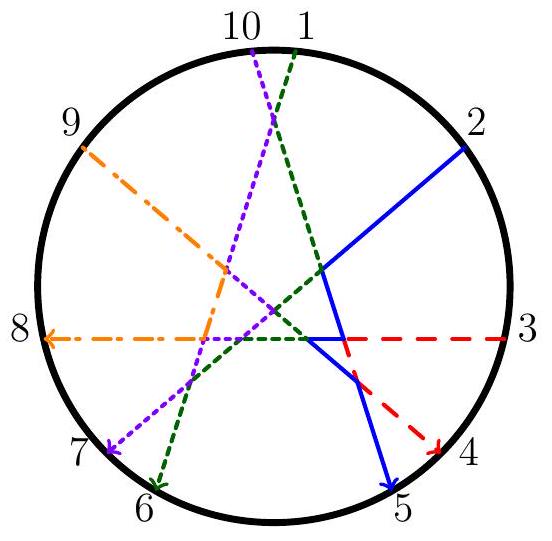\n\nThe result is true for $n=1$. Let $n>1$ and assume the result is true for less chords. Consider the chord that takes $k$ to $k+n$ and remove it. Apply the induction hypothesis to the remaining $n-1$ lines: after relabeling, presents would go from $k-i$ to $k+i+2,1 \\leq i \\leq n-1$ if the chord were not there.\nReintroduce the chord that takes $k$ to $k+n$. From the induction hypothesis, the chord intersects the paths of the presents in the following order: the $i$-th path the chord intersects is the the one that takes $k-i$ to $k+i, i=1,2, \\ldots, n-1$.\n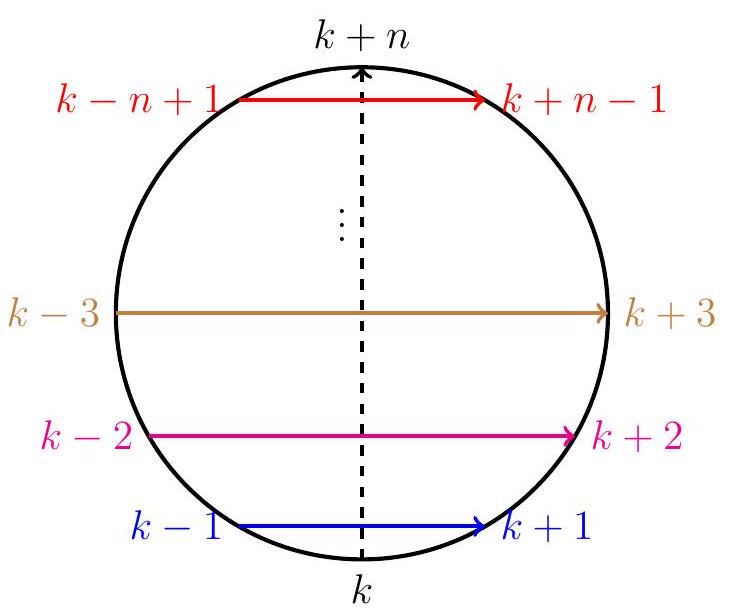\n\nPaths without chord $k \\rightarrow k+n$\n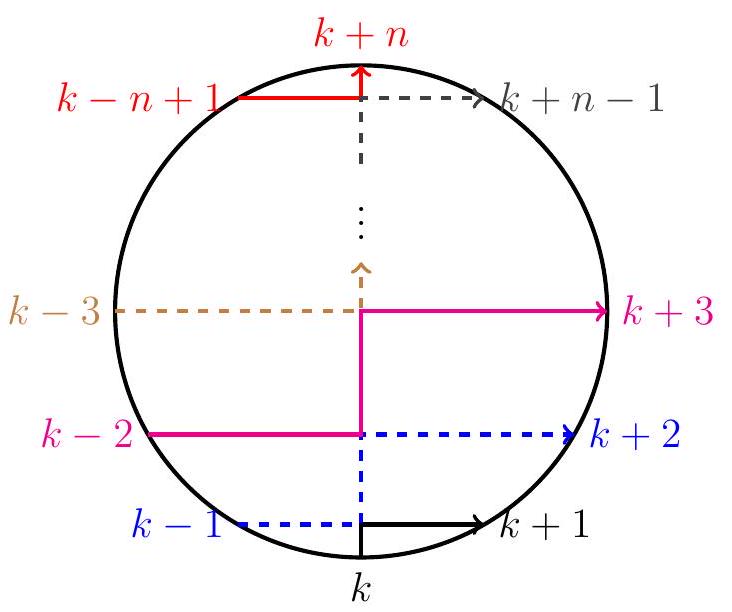\n\nCorrected paths with chord $k \\rightarrow k+n$\n\nThen the presents cover the following new paths: the present from $k$ will leave its chord and take the path towards $k+1$; then, for $i=1,2, \\ldots, n-1$, the present from $k-i$ will meet the chord from $k$ to $k+n$, move towards the intersection with the path towards $k+i+1$ and go to $k+i+1$, as desired. Notice that the paths still do not cross. The induction (and the solution) is now complete.", "metadata": {"resource_path": "APMO/segmented/en-apmo2023_sol.jsonl", "problem_match": "# Problem 5", "solution_match": "# Solution 1"}} |
| {"year": "2023", "tier": "T1", "problem_label": "5", "problem_type": null, "exam": "APMO", "problem": "There are $n$ line segments on the plane, no three intersecting at a point, and each pair intersecting once in their respective interiors. Tony and his $2 n-1$ friends each stand at a distinct endpoint of a line segment. Tony wishes to send Christmas presents to each of his friends as follows:\nFirst, he chooses an endpoint of each segment as a \"sink\". Then he places the present at the endpoint of the segment he is at. The present moves as follows:\n\n- If it is on a line segment, it moves towards the sink.\n- When it reaches an intersection of two segments, it changes the line segment it travels on and starts moving towards the new sink.\n\nIf the present reaches an endpoint, the friend on that endpoint can receive their present. Prove Tony can send presents to exactly $n$ of his $2 n-1$ friends.", "solution": "First part: at most n friends can receive a present.\nSimilarly to the first solution, consider a circle that encompasses all line segments, extend the lines, and use the endpoints of the chords instead of the line segments, and prove that each chord connects vertices $k$ and $k+n$. We also consider, even in the first part, $n$ presents leaving from $n$ outcoming vertices.\nFirst we prove that a present always goes to a sink. If it does not, then it loops; let it first enter the loop at point $P$ after turning from chord $a$ to chord $b$. Therefore after it loops once,\n\n[^0]it must turn to chord $b$ at $P$. But $P$ is the intersection of $a$ and $b$, so the present should turn from chord $a$ to chord $b$, which can only be done in one way - the same way it came in first. This means that some part of chord $a$ before the present enters the loop at $P$ is part of the loop, which contradicts the fact that $P$ is the first point in the loop. So no present enters a loop, and every present goes to a sink.\n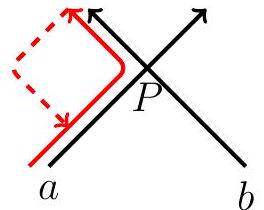\n\nThere are no loops\n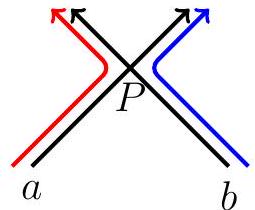\n\nNo two paths cross\n\nThe present paths also do not cross: in fact, every time two paths share a point $P$, intersection of chords $a$ and $b$, one path comes from $a$ to $b$ and the other path comes from $b$ to $a$, and they touch at $P$. This implies the following sequence of facts:\n\n- Every path divides the circle into two regions with paths connecting vertices within each region.\n- All $n$ presents will be delivered to $n$ different persons; that is, all sinks receive a present. This implies that every vertex is an endpoint of a path.\n- The number of chord endpoints inside each region is even, because they are connected within their own region.\n\nNow consider the path starting at vertex 1 , with Tony. It divides the circle into two regions with an even number of vertices in their interior. Then there is an even number of vertices between Tony and the recipient of his present, that is, their vertex is an even numbered one. Second part: all even-numbered vertices can receive a present.\nThe construction is the same as the in the previous solution: direct each chord from $i$ to $i+n$ if $1 \\leq i \\leq k$ and from $i+n$ to $i$ otherwise; in other words, the sinks are $k+1, k+2, \\ldots, k+n$. Then, since the paths do not cross, $k$ will send a present to $k+1, k-1$ will send a present to $k+2$, and so on, until 1 sends a present to $(k+1)+(k-1)=2 k$.\n\n\n[^0]: ${ }^{1}$ The paths do not depend uniquely on $k$ and $n$; different chord configurations and vertex labelings may change the paths.", "metadata": {"resource_path": "APMO/segmented/en-apmo2023_sol.jsonl", "problem_match": "# Problem 5", "solution_match": "# Solution 2"}} |
|
|


