| {"year": "2000", "tier": "T3", "problem_label": "1", "problem_type": null, "exam": "BalticWay", "problem": "Let $K$ be a point inside the triangle $A B C$. Let $M$ and $N$ be points such that $M$ and $K$ are on opposite sides of the line $A B$, and $N$ and $K$ are on opposite sides of the line $B C$. Assume that\n\n$$\n\\angle M A B=\\angle M B A=\\angle N B C=\\angle N C B=\\angle K A C=\\angle K C A .\n$$\n\nShow that $M B N K$ is a parallelogram.", "solution": "Denote $\\angle M A B=\\angle M B A=\\cdots=\\alpha$. Then\n\n$$\n\\angle M A K=\\alpha+(\\angle B A C-\\alpha)=\\angle B A C,\n$$\n\n$\\frac{|A M|}{|A B|}=\\frac{1}{2 \\cos \\alpha}$ and $\\frac{|A K|}{|A C|}=\\frac{1}{2 \\cos \\alpha}$ (see Figure 1). Hence the triangles $M A K$ and $B A C$ are similar, implying $|M K|=\\frac{|B C|}{2 \\cos \\alpha}$. Since $|B N|=\\frac{|B C|}{2 \\cos \\alpha}$, we have $|M K|=|B N|$. Similarly we can show that $|B M|=|N K|$, and the result follows.\n\n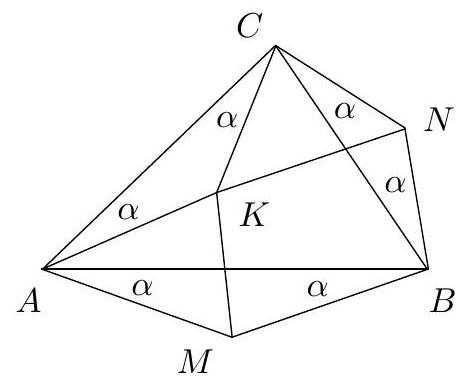\n\nFigure 1\n\n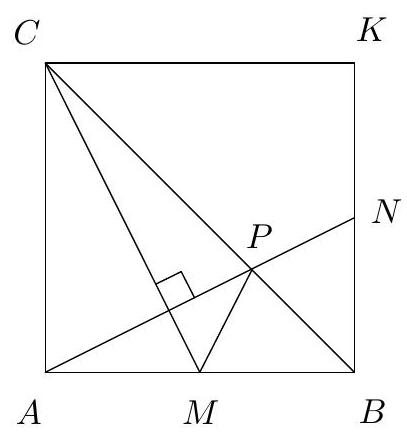\n\nFigure 2", "metadata": {"resource_path": "BalticWay/segmented/en-bw00sol.jsonl", "problem_match": "\n1.", "solution_match": "\n1."}} |
| {"year": "2000", "tier": "T3", "problem_label": "2", "problem_type": null, "exam": "BalticWay", "problem": "Given an isosceles triangle $A B C$ with $\\angle A=90^{\\circ}$. Let $M$ be the midpoint of $A B$. The line passing through $A$ and perpendicular to $C M$ intersects the side $B C$ at $P$. Prove that $\\angle A M C=\\angle B M P$.", "solution": "Choose the point $K$ such that $A B K C$ is a square. Let $N$ be the point of intersection of $A P$ and $B K$ (see Figure 2). Since the lines $A N$ and $C M$ are perpendicular, $N$ is the midpoint of $B K$. Moreover, triangles $A M C$ and $B N A$ are congruent, which gives\n\n$$\n\\angle A M C=\\angle B N A\n$$\n\nSince $|B M|=|B N|$ and $\\angle M B P=\\angle N B P$, it follows that triangles $M B P$ and $N B P$ are congruent. This implies that\n\n$$\n\\angle B M P=\\angle B N P\n$$\n\nCombining (1) ja (2) yields the required equality.", "metadata": {"resource_path": "BalticWay/segmented/en-bw00sol.jsonl", "problem_match": "\n2.", "solution_match": "\n2."}} |
| {"year": "2000", "tier": "T3", "problem_label": "3", "problem_type": null, "exam": "BalticWay", "problem": "Given a triangle $A B C$ with $\\angle A=90^{\\circ}$ and $|A B| \\neq|A C|$. The points $D, E, F$ lie on the sides $B C, C A, A B$, respectively, in such a way that $A F D E$ is a square. Prove that the line $B C$, the line $F E$ and the line tangent at the point $A$ to the circumcircle of the triangle $A B C$ intersect in one point.", "solution": "Let $B C$ and $F E$ meet at $P$ (see Figure 3 ). It suffices to show that the line $A P$ is tangent to the circumcircle of the triangle $A B C$.\n\n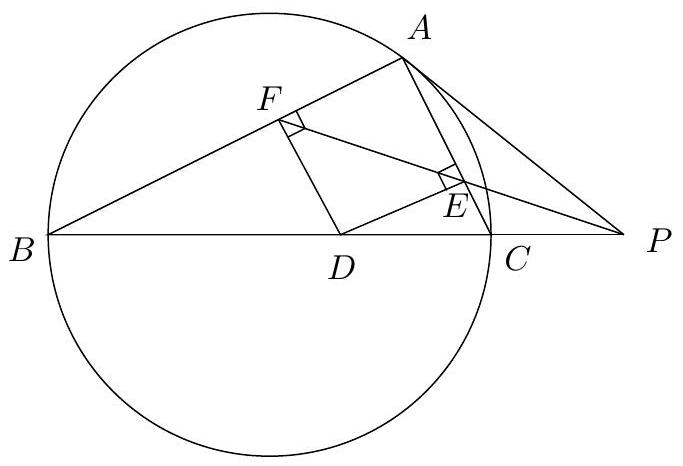\n\nFigure 3\n\nSince $F E$ is the axis of symmetry of the square $A F D E$, we have $\\angle A P E=\\angle B P F$. Moreover, $\\angle A E P=135^{\\circ}=\\angle B F P$. Hence triangles $A P E$ and $B P F$ are similar, and $\\angle C A P=\\angle A B C$, i.e. the line $A P$ is tangent to the circumcircle of $A B C$.", "metadata": {"resource_path": "BalticWay/segmented/en-bw00sol.jsonl", "problem_match": "\n3.", "solution_match": "\n3."}} |
| {"year": "2000", "tier": "T3", "problem_label": "4", "problem_type": null, "exam": "BalticWay", "problem": "Given a triangle $A B C$ with $\\angle A=120^{\\circ}$. The points $K$ and $L$ lie on the sides $A B$ and $A C$, respectively. Let $B K P$ and $C L Q$ be equilateral triangles constructed outside the triangle $A B C$. Prove that\n\n$$\n|P Q| \\geqslant \\frac{\\sqrt{3}}{2} \\cdot(|A B|+|A C|) .\n$$", "solution": "Since $\\angle A B C+\\angle A C B=60^{\\circ}$, the lines $B P$ and $C Q$ are parallel. Let $X$ and $Y$ be the feet of perpendiculars from $A$ to $B P$ and $C Q$, respectively (see Figure 4). Then $|A X|=\\frac{\\sqrt{3}}{2}|A B|$ and $|A Y|=\\frac{\\sqrt{3}}{2}|A C|$. Since the points $X, A$ and $Y$ are collinear, we get\n\n$$\n|P Q| \\geqslant|X Y|=\\frac{\\sqrt{3}}{2}(|A B|+|A C|)\n$$\n\n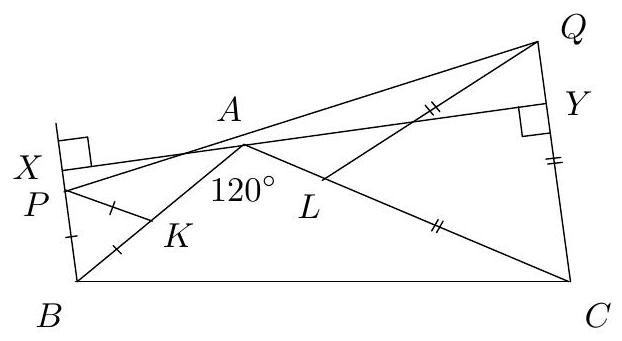\n\nFigure 4", "metadata": {"resource_path": "BalticWay/segmented/en-bw00sol.jsonl", "problem_match": "\n4.", "solution_match": "\n4."}} |
| {"year": "2000", "tier": "T3", "problem_label": "5", "problem_type": null, "exam": "BalticWay", "problem": "Let $A B C$ be a triangle such that $\\frac{|B C|}{|A B|-|B C|}=\\frac{|A B|+|B C|}{|A C|}$. Determine the ratio $\\angle A: \\angle C$.", "solution": "Answer: $1: 2$.\n\nDenote $|B C|=a,|A C|=b,|A B|=c$. The condition $\\frac{a}{c-a}=\\frac{c+a}{b}$ implies $c^{2}=a^{2}+a b$ and\n\n$$\n\\frac{c}{a+b}=\\frac{a}{c} .\n$$\n\nLet $D$ be a point on $A B$ such that $|B D|=\\frac{a}{a+b} \\cdot c$ (see Figure 5). Then\n\n$$\n\\frac{|B D|}{|B C|}=\\frac{c}{a+b}=\\frac{a}{c}=\\frac{|B C|}{|B A|}\n$$\n\nso triangles $B C D$ and $B A C$ are similar, implying $\\angle B C D=\\angle B A C$. Also, $\\frac{|A C|}{|B C|}=\\frac{|A D|}{|B D|}$ yields $\\frac{|B C|}{|B D|}=\\frac{|A C|}{|A D|}$, and hence by the bisector theorem $C D$ is the bisector of $\\angle B C A$. So the ratio asked for is $1: 2$.\n\n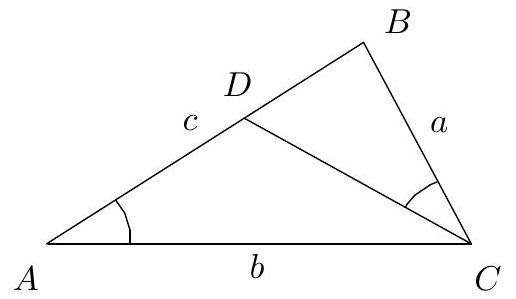\n\nFigure 5", "metadata": {"resource_path": "BalticWay/segmented/en-bw00sol.jsonl", "problem_match": "\n5.", "solution_match": "\n5."}} |
| {"year": "2000", "tier": "T3", "problem_label": "6", "problem_type": null, "exam": "BalticWay", "problem": "Fredek runs a private hotel. He claims that whenever $n \\geqslant 3$ guests visit the hotel, it is possible to select two guests who have equally many acquaintances among the other guests, and who also have a common acquaintance or a common unknown among the guests. For which values of $n$ is Fredek right?\n\n(Acquaintance is a symmetric relation.)", "solution": "Answer: Fredek is right for all $n \\neq 4$.\n\nSuppose that any two guests of Fredek having the same number of acquaintances have neither a common acquaintance nor a common unknown. From the set $\\mathcal{K}$ of Fredek's guests choose any two guests $A$ and $B$ having the same number of acquaintances (the existence of such two guests follows from the pigeonhole principle). It then follows from our assumption that $A$ and $B$ have both either $\\frac{1}{2} n$ or $\\frac{1}{2} n-1$ acquaintances in $\\mathcal{K}$, depending on whether $A$ and $B$ are acquainted or not. This proves in particular that for any odd $n$ Fredek is right.\n\nAssume now that $n$ is even, and $n \\geqslant 6$. Choose from $\\mathcal{K} \\backslash\\{A, B\\}$ two\nguests $C, D$ with the same number of acquaintances in $\\mathcal{K} \\backslash\\{A, B\\}$. Since every guest in $\\mathcal{K} \\backslash\\{A, B\\}$ is acquaintance either with $A$ or with $B$ but not with both, $C$ and $D$ have the same number of acquaintances in $\\mathcal{K}$, which implies that they both have either $\\frac{1}{2} n$ or $\\frac{1}{2} n-1$ acquaintances in $\\mathcal{K}$.\n\nFinally, choose from $\\mathcal{K} \\backslash\\{A, B, C, D\\}$ two guests $E, F$ with the same number of acquaintances in $\\mathcal{K} \\backslash\\{A, B, C, D\\}$ (this is possible as $n \\geqslant 6$ ). Since every guest in $\\mathcal{K} \\backslash\\{A, B, C, D\\}$ has exactly two acquaintances in the set $\\{A, B, C, D\\}$, the guests $E$ and $F$ have the same number of acquaintances in $\\mathcal{K}$, which means that they both have either $\\frac{1}{2} n$ or $\\frac{1}{2} n-1$ acquaintances in $\\mathcal{K}$. Thus at least four people among $A, B, C, D, E, F$ have the same number of acquaintances in $\\mathcal{K}$. Select any three of these four guests - then one of these three is either a common acquaintance or a common unknown for the other two.\n\nFor $n=4$ Fredek is not right. The diagram on Figure 6 gives the counterexample (where points indicate guests and lines show acquaintances).\n\n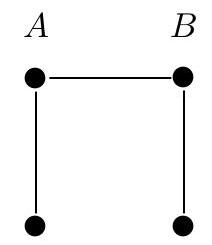\n\nFigure 6", "metadata": {"resource_path": "BalticWay/segmented/en-bw00sol.jsonl", "problem_match": "\n6.", "solution_match": "\n6."}} |
| {"year": "2000", "tier": "T3", "problem_label": "7", "problem_type": null, "exam": "BalticWay", "problem": "In a $40 \\times 50$ array of control buttons, each button has two states: $\\mathrm{ON}$ and OFF. By touching a button, its state and the states of all buttons in the same row and in the same column are switched. Prove that the array of control buttons may be altered from the all-OFF state to the all-ON state by touching buttons successively, and determine the least number of touches needed to do so.", "solution": "Answer: 2000 .\n\nAltering the state from all-OFF to all-ON requires that the state of each button is changed an odd number of times. This is achieved by touching each button once. We prove that the desired result cannot be achieved if some button is never touched. In order to turn this button ON, the total number of touches of the other buttons in its row and column must be odd. Hence either the other buttons in its row or in its column - say, in its row - must be touched an odd number of times altogether. In order to change the state of each of these (odd number of) buttons an odd number of times, the total number of touches of all the other buttons on the panel (i.e. outside of the selected row) must be even. But then we have an even\ntotal number of state changes for the (odd number of) other buttons in the selected column, whereas an odd number is required to alter the state of all these buttons. Hence the minimal number of touches is $40 \\cdot 50=2000$.", "metadata": {"resource_path": "BalticWay/segmented/en-bw00sol.jsonl", "problem_match": "\n7.", "solution_match": "\n7."}} |
| {"year": "2000", "tier": "T3", "problem_label": "8", "problem_type": null, "exam": "BalticWay", "problem": "Fourteen friends met at a party. One of them, Fredek, wanted to go to bed early. He said goodbye to 10 of his friends, forgot about the remaining 3 , and went to bed. After a while he returned to the party, said goodbye to 10 of his friends (not necessarily the same as before), and went to bed. Later Fredek came back a number of times, each time saying goodbye to exactly 10 of his friends, and then went back to bed. As soon as he had said goodbye to each of his friends at least once, he did not come back again. In the morning Fredek realised that he had said goodbye a different number of times to each of his thirteen friends! What is the smallest possible number of times that Fredek returned to the party?", "solution": "Answer: Fredek returned at least 32 times.\n\nAssume Fredek returned $k$ times, i.e. he was saying good-bye $k+1$ times to his friends. There exists a friend of Fredek, call him $X_{13}$, about whom Fredek forgot $k$ times in a row, starting from the very first time - otherwise Fredek would have come back less than $k$ times.\n\nConsider the remaining friends of Fredek: $X_{1}, X_{2}, \\ldots, X_{12}$. Assume that Fredek forgot $x_{j}$ times about each friend $X_{j}$. Since Fredek forgot a different number of times about each of his friends, so we can assume w.l.o.g. that $x_{j} \\geqslant j-1$ for $j=1,2, \\ldots, 12$. Since $X_{13}$ was forgotten by Fredek $k$ times, and since Fredek forgot about exactly three of his friends each time, we have\n\n$$\n\\begin{aligned}\n3(k+1) & =x_{1}+x_{2}+x_{3}+\\ldots+x_{12}+k \\geqslant \\\\\n& \\geqslant 0+1+2+3+\\ldots+11+k= \\\\\n& =66+k .\n\\end{aligned}\n$$\n\nTherefore $2 k \\geqslant 63$, which gives $k \\geqslant 32$.\n\nIt is possible that Fredek returned 32 times, i.e. he was saying good-bye 33 times to his friends. The following table shows this. The $i$-th column displays the three friends Fredek forgot while saying good-bye for the $i$-th time (i.e. before his $i$-th return). For simplicity we write $j$ in place of $X_{j}$.\n\n$$\n\\begin{aligned}\n& 13 \\ldots .131313 \\ldots .1313 \\ldots .131313131313131311\n\\end{aligned}\n$$\n\n\n\n", "metadata": {"resource_path": "BalticWay/segmented/en-bw00sol.jsonl", "problem_match": "\n8.", "solution_match": "\n8."}} |
| {"year": "2000", "tier": "T3", "problem_label": "9", "problem_type": null, "exam": "BalticWay", "problem": "There is a frog jumping on a $2 k \\times 2 k$ chessboard, composed of unit squares. The frog's jumps are of length $\\sqrt{1+k^{2}}$ and they carry the frog from the center of a square to the center of another square. Some $m$ squares of the board are marked with an $x$, and all the squares into which the frog can jump from an $x$ 'd square (whether they carry an $x$ or not) are marked with an $\\circ$. There are $n \\circ$ 'd squares. Prove that $n \\geqslant m$.", "solution": "Label the squares by pairs of integers $(i, j)$ where $1 \\leqslant i, j \\leqslant 2 k$. Let $L$ be the set of all such pairs. Define a function $f: L \\rightarrow L$ by\n\n$$\nf(i, j)= \\begin{cases}(i+1, j+k) & \\text { for } i \\text { odd and } j \\leqslant k \\\\ (i-1, j+k) & \\text { for } i \\text { even and } j \\leqslant k, \\\\ (i+1, j-k) & \\text { for } i \\text { odd and } j>k, \\\\ (i-1, j-k) & \\text { for } i \\text { even and } j>k\\end{cases}\n$$\n\nIt is easy to see that $f$ is one-to-one. Let $X \\subset L$ be the set of $\\times^{\\prime} \\mathrm{d}$ squares and $O \\subset L$ the set of o'd squares. Since the distance from $(i, j)$ to\n$(i \\pm 1, j \\pm k)$ is $\\sqrt{1+k^{2}}$, we have $f(i, j) \\in O$ for every $(i, j) \\in X$. Now, since $f$ is one-to-one, the number of elements in $f(S)$ is the same as the number of elements in $S$. As $f(X) \\subset O$, the number of elements in $X$ is at most the number of elements in $O$, or $m \\leqslant n$.", "metadata": {"resource_path": "BalticWay/segmented/en-bw00sol.jsonl", "problem_match": "\n9.", "solution_match": "\n9."}} |
| {"year": "2000", "tier": "T3", "problem_label": "10", "problem_type": null, "exam": "BalticWay", "problem": "Two positive integers are written on the blackboard. Initially, one of them is 2000 and the other is smaller than 2000. If the arithmetic mean $m$ of the two numbers on the blackboard is an integer, the following operation is allowed: one of the two numbers is erased and replaced by $m$. Prove that this operation cannot be performed more than ten times. Give an example where the operation can be performed ten times.", "solution": "Each time the operation is performed, the difference between the two numbers on the blackboard will become one half of its previous value (regardless of which number was erased). The mean value of two integers is an integer if and only if their difference is an even number. Suppose the initial numbers were $a=2000$ and $b$. It follows that the operation can be performed $n$ times if and only if $a-b$ is of the form $2^{n} u$. This shows that $n \\leqslant 10$ since $2^{11}>2000$. Choosing $b=976$ so that $a-b=1024=2^{10}$, the operation can be performed 10 times.", "metadata": {"resource_path": "BalticWay/segmented/en-bw00sol.jsonl", "problem_match": "\n10.", "solution_match": "\n10."}} |
| {"year": "2000", "tier": "T3", "problem_label": "11", "problem_type": null, "exam": "BalticWay", "problem": "A sequence of positive integers $a_{1}, a_{2}, \\ldots$ is such that for each $m$ and $n$ the following holds: if $m$ is a divisor of $n$ and $m<n$, then $a_{m}$ is a divisor of $a_{n}$ and $a_{m}<a_{n}$. Find the least possible value of $a_{2000}$.", "solution": "Answer: 128.\n\nLet $d$ denote the least possible value of $a_{2000}$. We shall prove that $d=128$.\n\nClearly the sequence defined by $a_{1}=1$ and $a_{n}=2^{\\alpha_{1}+\\alpha_{2}+\\cdots+\\alpha_{k}}$ for $n=p_{1}^{\\alpha_{1}} p_{2}^{\\alpha_{2}} \\cdots \\cdots p_{k}^{\\alpha_{k}}$ has the required property. Since $2000=2^{4} \\cdot 5^{3}$, we have $a_{2000}=2^{4+3}=128$ and therefore $d \\leqslant 128$.\n\nNote that in the sequence $1<5<25<125<250<500<1000<2000$ each term is divisible by the previous one. As $a_{1} \\geqslant 1$ it follows that\n\n$$\na_{2000} \\geqslant 2 \\cdot a_{1000} \\geqslant 2^{2} \\cdot a_{500} \\geqslant 2^{3} \\cdot a_{250} \\geqslant \\ldots \\geqslant 2^{7} \\cdot a_{1} \\geqslant 2^{7}=128 .\n$$", "metadata": {"resource_path": "BalticWay/segmented/en-bw00sol.jsonl", "problem_match": "\n11.", "solution_match": "\n11."}} |
| {"year": "2000", "tier": "T3", "problem_label": "12", "problem_type": null, "exam": "BalticWay", "problem": "Let $x_{1}, x_{2}, \\ldots, x_{n}$ be positive integers such that no one of them is an initial fragment of any other (for example, 12 is an initial fragment of $\\underline{12}, \\underline{12} 5$ and\n\n12405). Prove that\n\n$$\n\\frac{1}{x_{1}}+\\frac{1}{x_{2}}+\\cdots+\\frac{1}{x_{n}}<3\n$$", "solution": "Let $\\left\\{y_{1}, \\ldots, y_{k}\\right\\} \\subset\\left\\{x_{1}, \\ldots, x_{n}\\right\\}$ be a subset of numbers with the maximal number of digits, and differing from one another only by their last digits: $y_{1}=\\overline{y \\alpha_{1}}, y_{2}=\\overline{y \\alpha_{2}}, \\ldots, y_{k}=\\overline{y \\alpha_{k}}$ (here $\\overline{y \\alpha_{i}}$ denotes the number consisting of $y$ as its initial fragment and $\\alpha_{i}$ as its last digit). Then we have\n\n$$\n\\frac{1}{y_{1}}+\\ldots+\\frac{1}{y_{k}} \\leqslant \\frac{1}{\\overline{y 0}}+\\ldots+\\frac{1}{\\overline{y 9}}<10 \\cdot \\frac{1}{\\overline{y 0}}=\\frac{1}{y}\n$$\n\nLet's replace all numbers $y_{1}, y_{2}, \\ldots, y_{k}$ by a single $y$ in the set $\\left\\{x_{1}, \\ldots, x_{n}\\right\\}$. Then the obtained set of numbers still has the property mentioned in the statement of the problem, and the sum of their reciprocals does not decrease. Continuing to reduce the given set of numbers in the same way, we finally obtain\n\n$$\n\\frac{1}{x_{1}}+\\frac{1}{x_{2}}+\\cdots+\\frac{1}{x_{n}} \\leqslant \\frac{1}{1}+\\frac{1}{2}+\\ldots+\\frac{1}{9}<3\n$$", "metadata": {"resource_path": "BalticWay/segmented/en-bw00sol.jsonl", "problem_match": "\n12.", "solution_match": "\n12."}} |
| {"year": "2000", "tier": "T3", "problem_label": "13", "problem_type": null, "exam": "BalticWay", "problem": "Let $a_{1}, a_{2}, \\ldots, a_{n}$ be an arithmetic progression of integers such that $i$ divides $a_{i}$ for $i=1,2, \\ldots, n-1$ and $n$ does not divide $a_{n}$. Prove that $n$ is a power of a prime.", "solution": "Assume $a_{i}=k+d i$ for $i=1,2, \\ldots, n$. Then $k$ is a multiple of every $i \\in\\{1,2, \\ldots, n-1\\}$ but not a multiple of $n$. If $n=a b$ with $a, b>1$ and $\\operatorname{gcd}(a, b)=1$, then $k$ is divisible by both $a$ and $b$, but not by $n$, which is a contradiction. Hence, $n$ has only one prime factor.", "metadata": {"resource_path": "BalticWay/segmented/en-bw00sol.jsonl", "problem_match": "\n13.", "solution_match": "\n13."}} |
| {"year": "2000", "tier": "T3", "problem_label": "14", "problem_type": null, "exam": "BalticWay", "problem": "Find all positive integers $n$ such that $n$ is equal to 100 times the number of positive divisors of $n$.", "solution": "Answer: 2000 is the only such integer.\n\nLet $d(n)$ denote the number of positive divisors of $n$ and $p \\triangleright n$ denote the exponent of the prime $p$ in the canonical representation of $n$. Let $\\delta(n)=\\frac{n}{d(n)}$. Using this notation, the problem reformulates as follows: Find all positive integers $n$ such that $\\delta(n)=100$.\n\nLemma: Let $n$ be an integer and $m$ its proper divisor. Then $\\delta(m) \\leqslant \\delta(n)$ and the equality holds if and only if $m$ is odd and $n=2 m$.\n\nProof. Let $n=m p$ for a prime $p$. By the well-known formula\n\n$$\nd(n)=\\prod_{p}(1+p \\triangleright n)\n$$\n\nwe have\n\n$$\n\\frac{\\delta(n)}{\\delta(m)}=\\frac{n}{m} \\cdot \\frac{d(m)}{d(n)}=p \\cdot \\frac{1+p \\triangleright m}{1+p \\triangleright n}=p \\cdot \\frac{p \\triangleright n}{1+p \\triangleright n} \\geqslant 2 \\cdot \\frac{1}{2}=1,\n$$\n\nhence $\\delta(m) \\leqslant \\delta(n)$. It is also clear that equality holds if and only if $p=2$ and $p \\triangleright n=1$, i.e. $m$ is odd and $n=2 m$.\n\nFor the general case $n=m s$ where $s>1$ is an arbitrary positive integer, represent $s$ as a product of primes. By elementary induction on the number of factors in the representation we prove $\\delta(m) \\leqslant \\delta(n)$. The equality can hold only if all factors are equal to 2 and the number $m$ as well as any intermediate result of multiplying it by these factors is odd, i.e. the representation of $s$ consists of a single prime 2, which gives $n=2 m$. This proves the lemma.\n\nNow assume that $\\delta(n)=100$ for some $n$, i.e. $n=100 \\cdot d(n)=2^{2} \\cdot 5^{2} \\cdot d(n)$. In the following, we estimate the exponents of primes in the canonical representation of $n$, using the fact that 100 is a divisor of $n$.\n\n(1) Observe that $\\delta\\left(2^{7} \\cdot 5^{2}\\right)=\\frac{2^{5} \\cdot 100}{8 \\cdot 3}=\\frac{3200}{24}>100$. Hence $2 \\triangleright n \\leqslant 6$, since otherwise $2^{7} \\cdot 5^{2}$ divides $n$ and, by the lemma, $\\delta(n)>100$.\n\n(2) Observe that $\\delta\\left(2^{2} \\cdot 5^{4}\\right)=\\frac{5^{2} \\cdot 100}{3 \\cdot 5}=\\frac{2500}{15}>100$. Hence $5 \\triangleright n \\leqslant 3$, since otherwise $2^{2} \\cdot 5^{4}$ divides $n$ and, by the lemma, $\\delta(n)>100$.\n\n(3) Observe that $\\delta\\left(2^{2} \\cdot 5^{2} \\cdot 3^{4}\\right)=\\frac{3^{4} \\cdot 100}{3 \\cdot 3 \\cdot 5}=\\frac{8100}{45}>100$. Hence $3 \\triangleright n \\leqslant 3$, since otherwise $2^{2} \\cdot 5^{2} \\cdot 3^{4}$ divides $n$ and, by the lemma, $\\delta(n)>100$.\n\n(4) Take a prime $q>5$ and an integer $k \\geqslant 4$. Then\n\n$$\n\\begin{aligned}\n\\delta\\left(2^{2} \\cdot 5^{2} \\cdot q^{k}\\right) & =\\frac{2^{2} \\cdot 5^{2} \\cdot q^{k}}{d\\left(2^{2} \\cdot 5^{2} \\cdot q^{k}\\right)}=\\frac{2^{2} \\cdot 5^{2} \\cdot q^{k}}{d\\left(2^{2} \\cdot 5^{2} \\cdot 3^{k}\\right)}>\\frac{2^{2} \\cdot 5^{2} \\cdot 3^{k}}{d\\left(2^{2} \\cdot 5^{2} \\cdot 3^{k}\\right)}= \\\\\n& =\\delta\\left(2^{2} \\cdot 5^{2} \\cdot 3^{k}\\right)>100 .\n\\end{aligned}\n$$\n\nHence, similarly to the previous cases, we get $q \\triangleright n \\leqslant 3$.\n\n(5) If a prime $q>7$ divides $n$, then $q$ divides $d(n)$. Thus $q$ divides $1+p \\triangleright n$ for some prime $p$. But this is impossible because, as the previous cases showed, $p \\triangleright n \\leqslant 6$ for all $p$. So $n$ is not divisible by primes greater than 7 .\n\n(6) If 7 divides $n$, then 7 divides $d(n)$ and hence divides $1+p \\triangleright n$ for some prime $p$. By (1)-(4), this implies $p=2$ and $2 \\triangleright n=6$. At the same time, if $2 \\triangleright n=6$, then 7 divides $d(n)$ and $n$. So 7 divides $n$ if and only if $2 \\triangleright n=6$. Since $\\delta\\left(2^{6} \\cdot 5^{2} \\cdot 7\\right)=\\frac{2^{4} \\cdot 7 \\cdot 100}{7 \\cdot 3 \\cdot 2}=\\frac{11200}{42}>100$, both of these conditions cannot hold simultaneously. So $n$ is not divisible by 7 and $2 \\triangleright n \\leqslant 5$.\n\n(7) If $5 \\triangleright n=3$, then 5 divides $d(n)$ and hence divides $1+p \\triangleright n$ for some prime $p$. By (1)-(4), this implies $p=2$ and $2 \\triangleright n=4$. At the same time, if $2 \\triangleright n=4$, then 5 divides $d(n), 5^{3}$ divides $n$ and, by (2), $5 \\triangleright n=3$. So $5 \\triangleright n=3$ if and only if $2 \\triangleright n=4$. Since $\\delta\\left(2^{4} \\cdot 5^{3}\\right)=\\frac{2^{2} \\cdot 5 \\cdot 100}{5 \\cdot 4}=100$, we find that $n=2^{4} \\cdot 5^{3}=2000$ satisfies the required condition. On the other hand, if $2 \\triangleright n=4$ and $5 \\triangleright n=3$ for some $n \\neq 2000$, then $n=2000 s$ for some $s>1$ and, by the lemma, $\\delta(n)>100$.\n\n(8) The case $5 \\triangleright n=2$ has remained. By (7), we have $2 \\triangleright n \\neq 4$, so $2 \\triangleright n \\in\\{2,3,5\\}$. The condition $5 \\triangleright n=2$ implies that 3 divides $d(n)$ and $n$, thus $3 \\triangleright n \\in\\{1,2,3\\}$. If $2 \\triangleright n=3$, then $d(n)$ is divisible by 2 but not by 4 . At the same time $2 \\triangleright n=3$ implies $3+1=4$ divides $d(n)$, a contradiction. Thus $2 \\triangleright n \\in\\{2,5\\}$, and $3^{2}$ divides $d(n)$ and $n$, i.e.\n$3 \\triangleright n \\in\\{2,3\\}$. Now $3 \\triangleright n=2$ would imply that $3^{3}$ divides $d(n)$ and $n$, a contradiction; on the other hand $3 \\triangleright n=3$ would imply $3 \\triangleright d(n)=2$ and hence $3 \\triangleright n=2$, a contradiction.", "metadata": {"resource_path": "BalticWay/segmented/en-bw00sol.jsonl", "problem_match": "\n14.", "solution_match": "\n14."}} |
| {"year": "2000", "tier": "T3", "problem_label": "15", "problem_type": null, "exam": "BalticWay", "problem": "Let $n$ be a positive integer not divisible by 2 or 3 . Prove that for all integers $k$, the number $(k+1)^{n}-k^{n}-1$ is divisible by $k^{2}+k+1$.", "solution": "Note that $n$ must be congruent to 1 or 5 modulo 6 , and proceed by induction on $\\lfloor n / 6\\rfloor$. It can easily be checked that the assertion holds for $n \\in\\{1,5\\}$. Let $n>6$, and put $t=k^{2}+k+1$. The claim follows by:\n\n$$\n\\begin{aligned}\n(k+1)^{n}-k^{n}-1 & =(t+k)(k+1)^{n-2}-(t-(k+1)) k^{n-2}-1 \\\\\n& \\equiv k(k+1)^{n-2}+(k+1) k^{n-2}-1 \\\\\n& \\equiv(t-1)\\left((k+1)^{n-3}+k^{n-3}\\right)-1 \\\\\n& \\equiv-(k+1)^{n-3}-k^{n-3}-1 \\\\\n& \\equiv-(t+k)(k+1)^{n-5}-(t-(k+1)) k^{n-5}-1 \\\\\n& \\equiv-k(k+1)^{n-5}+(k+1) k^{n-5}-1 \\\\\n& \\equiv-(t-1)\\left((k+1)^{n-6}-k^{n-6}\\right)-1 \\\\\n& \\equiv(k+1)^{n-6}-k^{n-6}-1(\\bmod t) .\n\\end{aligned}\n$$\n\nAlternative solution. Let $P(k)=(k+1)^{n}-k^{n}-1$, and let $\\omega_{1}, \\omega_{2}$ be the two roots of the quadratic polynomial $k^{2}+k+1$. The problem is then equivalent to showing that $P\\left(\\omega_{1}\\right)=P\\left(\\omega_{2}\\right)=0$ when $\\operatorname{gcd}(n, 6)=1$, which is easy to check.\n\n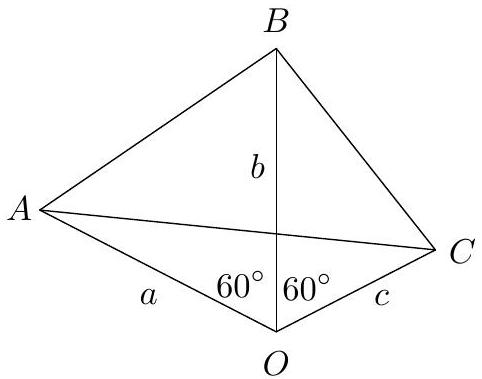\n\nFigure 7", "metadata": {"resource_path": "BalticWay/segmented/en-bw00sol.jsonl", "problem_match": "\n15.", "solution_match": "\n15."}} |
| {"year": "2000", "tier": "T3", "problem_label": "16", "problem_type": null, "exam": "BalticWay", "problem": "Prove that for all positive real numbers $a, b, c$ we have\n\n$$\n\\sqrt{a^{2}-a b+b^{2}}+\\sqrt{b^{2}-b c+c^{2}} \\geqslant \\sqrt{a^{2}+a c+c^{2}} .\n$$", "solution": "If $|O A|=a,|O B|=b,|O C|=c$ (see Figure 7), then the inequality follows from $|A C| \\leqslant|A B|+|B C|$ by applying the cosine theorem to triangles $A O B$,\n$B O C$ and $A O C$. The same argument holds if the quadrangle $O A B C$ is concave.", "metadata": {"resource_path": "BalticWay/segmented/en-bw00sol.jsonl", "problem_match": "\n16.", "solution_match": "\n16."}} |
| {"year": "2000", "tier": "T3", "problem_label": "17", "problem_type": null, "exam": "BalticWay", "problem": "Find all real solutions to the following system of equations:\n\n$$\n\\left\\{\\begin{aligned}\nx+y+z+t & =5 \\\\\nx y+y z+z t+t x & =4 \\\\\nx y z+y z t+z t x+t x y & =3 \\\\\nx y z t & =-1\n\\end{aligned}\\right.\n$$", "solution": "Answer: $x=\\frac{1 \\pm \\sqrt{2}}{2}, y=2, z=\\frac{1 \\mp \\sqrt{2}}{2}, t=2$ or $x=2, y=\\frac{1 \\pm \\sqrt{2}}{2}$, $z=2, t=\\frac{1 \\mp \\sqrt{2}}{2}$.\n\nLet $A=x+z$ and $B=y+t$. Then the system of equations is equivalent to\n\n$$\n\\left\\{\\begin{aligned}\nA+B & =5 \\\\\nA B & =4 \\\\\nB x z+A y t & =3 \\\\\n(B x z) \\cdot(A y t) & =-4 .\n\\end{aligned}\\right.\n$$\n\nThe first two of these equations imply $\\{A, B\\}=\\{1,4\\}$ and the last two give $\\{B x z, A y t\\}=\\{-1,4\\}$. Once $A=x+z, B=y+t, B x z$ and Ayt are known, it is easy to find the corresponding values of $x, y, z$ and $t$. The solutions are shown in the following table.\n\n| $A$ | $B$ | Bxz | Ayt | $x, z$ | $y, t$ |\n| :---: | :---: | :---: | :---: | :---: | :---: |\n| 1 | 4 | -1 | 4 | $\\frac{1 \\pm \\sqrt{2}}{2}$ | 2 |\n| 1 | 4 | 4 | -1 | - | - |\n| 4 | 1 | -1 | 4 | - | - |\n| 4 | 1 | 4 | -1 | 2 | $\\frac{1 \\pm \\sqrt{2}}{2}$ |", "metadata": {"resource_path": "BalticWay/segmented/en-bw00sol.jsonl", "problem_match": "\n17.", "solution_match": "\n17."}} |
| {"year": "2000", "tier": "T3", "problem_label": "18", "problem_type": null, "exam": "BalticWay", "problem": "Determine all positive real numbers $x$ and $y$ satisfying the equation\n\n$$\nx+y+\\frac{1}{x}+\\frac{1}{y}+4=2 \\cdot(\\sqrt{2 x+1}+\\sqrt{2 y+1}) .\n$$", "solution": "Answer: $x=y=1+\\sqrt{2}$.\n\nNote that\n\n$$\nx+\\frac{1}{x}+2-2 \\sqrt{2 x+1}=\\frac{x^{2}+2 x+1-2 x \\sqrt{2 x+1}}{x}=\\frac{1}{x}(x-\\sqrt{2 x+1})^{2} .\n$$\n\nHence the original equation can be rewritten as\n\n$$\n\\frac{1}{x}(x-\\sqrt{2 x+1})^{2}+\\frac{1}{y}(y-\\sqrt{2 y+1})^{2}=0 .\n$$\n\nFor $x, y>0$ this gives $x-\\sqrt{2 x+1}=0$ and $y-\\sqrt{2 y+1}$. It follows that the only solution is $x=y=1+\\sqrt{2}$.", "metadata": {"resource_path": "BalticWay/segmented/en-bw00sol.jsonl", "problem_match": "\n18.", "solution_match": "\n18."}} |
| {"year": "2000", "tier": "T3", "problem_label": "19", "problem_type": null, "exam": "BalticWay", "problem": "Let $t \\geqslant \\frac{1}{2}$ be a real number and $n$ a positive integer. Prove that\n\n$$\nt^{2 n} \\geqslant(t-1)^{2 n}+(2 t-1)^{n}\n$$", "solution": "Use induction. For $n=1$ the inequality reads $t^{2} \\geqslant(t-1)^{2}+(2 t-1)$ which is obviously true. To prove the induction step it suffices to show that\n\n$$\nt^{2}(t-1)^{2 n}+t^{2}(2 t-1)^{n} \\geqslant(t-1)^{2 n+2}+(2 t-1)^{n+1}\n$$\n\nThis easily follows from $t^{2} \\geqslant(t-1)^{2}$ (which is true for $t \\geqslant \\frac{1}{2}$ ) and $t^{2} \\geqslant 2 t-1$ (which is true for any real $t$ ).\n\nAlternative solution. Note that\n\n$$\nt^{2 n}=\\left(t^{2}\\right)^{n}=\\left((t-1)^{2}+(2 t-1)\\right)^{n} .\n$$\n\nApplying the binomial formula to the right-hand side we obtain a sum containing both summands of the right-hand side of the given equality and other summands each of which is clearly non-negative.", "metadata": {"resource_path": "BalticWay/segmented/en-bw00sol.jsonl", "problem_match": "\n19.", "solution_match": "\n19."}} |
| {"year": "2000", "tier": "T3", "problem_label": "20", "problem_type": null, "exam": "BalticWay", "problem": "For every positive integer $n$, let\n\n$$\nx_{n}=\\frac{(2 n+1) \\cdot(2 n+3) \\cdots \\cdots \\cdot(4 n-1) \\cdot(4 n+1)}{2 n \\cdot(2 n+2) \\cdots \\cdots \\cdot(4 n-2) \\cdot 4 n}\n$$\n\nProve that $\\frac{1}{4 n}<x_{n}-\\sqrt{2}<\\frac{2}{n}$.\n\n## Solutions", "solution": "Squaring both sides of the given equality and applying $x(x+2) \\leqslant(x+1)^{2}$ to the numerator of the obtained fraction and cancelling we have\n\n$$\nx_{n}^{2} \\leqslant \\frac{(2 n+1) \\cdot(4 n+1)}{(2 n)^{2}}<2+\\frac{2}{n} .\n$$\n\nSimilarly (applying $x(x+2) \\leqslant(x+1)^{2}$ to the denominator and cancelling) we get\n\n$$\nx_{n}^{2} \\geqslant \\frac{(4 n+1)^{2}}{2 n \\cdot 4 n}>2+\\frac{1}{n}\n$$\n\nHence\n\n$$\n\\frac{1}{n}<x_{n}^{2}-2<\\frac{2}{n}\n$$\n\nand\n\n$$\n\\frac{1}{n\\left(x_{n}+\\sqrt{2}\\right)}<x_{n}-\\sqrt{2}<\\frac{2}{n\\left(x_{n}+\\sqrt{2}\\right)} .\n$$\n\nFrom the first chain of inequalities we get $x_{n}>\\sqrt{2}$ and $x_{n}<2$. The result then follows from the second chain of inequalities.\n\nComment. These inequalities can easily be improved. For example, the inequalities in the solution involving $x_{n}^{2}$ can immediately be replaced by $\\frac{3}{2 n}<x_{n}^{2}-2<\\frac{2}{n}$.", "metadata": {"resource_path": "BalticWay/segmented/en-bw00sol.jsonl", "problem_match": "\n20.", "solution_match": "\n20."}} |
|
|


