| {"year": "2004", "tier": "T3", "problem_label": "1", "problem_type": null, "exam": "BalticWay", "problem": "Given a sequence $a_{1}, a_{2}, a_{3}, \\ldots$ of non-negative real numbers satisfying the conditions\n\n(1) $a_{n}+a_{2 n} \\geq 3 n$\n\n(2) $a_{n+1}+n \\leq 2 \\sqrt{a_{n} \\cdot(n+1)}$\n\nfor all indices $n=1,2 \\ldots$\n\n(a) Prove that the inequality $a_{n} \\geq n$ holds for every $n \\in \\mathbb{N}$.\n\n(b) Give an example of such a sequence.", "solution": "(a) Note that the inequality\n\n$$\n\\frac{a_{n+1}+n}{2} \\geq \\sqrt{a_{n+1} \\cdot n}\n$$\n\nholds, which together with the second condition of the problem gives\n\n$$\n\\sqrt{a_{n+1} \\cdot n} \\leq \\sqrt{a_{n} \\cdot(n+1)}\n$$\n\nThis inequality simplifies to\n\n$$\n\\frac{a_{n+1}}{a_{n}} \\leq \\frac{n+1}{n}\n$$\n\nNow, using the last inequality for the index $n$ replaced by $n, n+1, \\ldots, 2 n-1$ and multiplying the results, we obtain\n\n$$\n\\frac{a_{2 n}}{a_{n}} \\leq \\frac{2 n}{n}=2\n$$\n\nor $2 a_{n} \\geq a_{2 n}$. Taking into account the first condition of the problem, we have\n\n$$\n3 a_{n}=a_{n}+2 a_{n} \\geq a_{n}+a_{2 n} \\geq 3 n\n$$\n\nwhich implies $a_{n} \\geq n$. (b) The sequence defined by $a_{n}=n+1$ satisfies all the conditions of the problem.", "metadata": {"resource_path": "BalticWay/segmented/en-bw04sol.jsonl", "problem_match": "\n1.", "solution_match": "\nSolution:"}} |
| {"year": "2004", "tier": "T3", "problem_label": "2", "problem_type": null, "exam": "BalticWay", "problem": "Let $P(x)$ be a polynomial with non-negative coefficients. Prove that if $P\\left(\\frac{1}{x}\\right) P(x) \\geq 1$ for $x=1$, then the same inequality holds for each positive $x$.", "solution": "For $x>0$ we have $P(x)>0$ (because at least one coefficient is non-zero). From the given condition we have $(P(1))^{2} \\geq 1$. Further, let's denote $P(x)=a_{n} x^{n}+a_{n-1} x^{n-1}+$ $\\cdots+a_{0}$. Then\n\n$$\n\\begin{aligned}\nP(x) P\\left(\\frac{1}{x}\\right) & =\\left(a_{n} x^{n}+\\cdots+a_{0}\\right)\\left(a_{n} x^{-n}+\\cdots+a_{0}\\right) \\\\\n& =\\sum_{i=0}^{n} a_{i}^{2}+\\sum_{i=1}^{n} \\sum_{j=0}^{i-1}\\left(a_{i-j} a_{j}\\right)\\left(x^{i}+x^{-i}\\right) \\\\\n& \\geq \\sum_{i=0}^{n} a_{i}^{2}+2 \\sum_{i>j} a_{i} a_{j} \\\\\n& =(P(1))^{2} \\geq 1 .\n\\end{aligned}\n$$", "metadata": {"resource_path": "BalticWay/segmented/en-bw04sol.jsonl", "problem_match": "\n2.", "solution_match": "\nSolution:"}} |
| {"year": "2004", "tier": "T3", "problem_label": "3", "problem_type": null, "exam": "BalticWay", "problem": "Let $p, q, r$ be positive real numbers and $n \\in \\mathbb{N}$. Show that if $p q r=1$, then\n\n$$\n\\frac{1}{p^{n}+q^{n}+1}+\\frac{1}{q^{n}+r^{n}+1}+\\frac{1}{r^{n}+p^{n}+1} \\leq 1\n$$", "solution": "The key idea is to deal with the case $n=3$. Put $a=p^{n / 3}, b=q^{n / 3}$, and $c=r^{n / 3}$, so $a b c=(p q r)^{n / 3}=1$ and\n\n$$\n\\frac{1}{p^{n}+q^{n}+1}+\\frac{1}{q^{n}+r^{n}+1}+\\frac{1}{r^{n}+p^{n}+1}=\\frac{1}{a^{3}+b^{3}+1}+\\frac{1}{b^{3}+c^{3}+1}+\\frac{1}{c^{3}+a^{3}+1} .\n$$\n\nNow\n\n$$\n\\frac{1}{a^{3}+b^{3}+1}=\\frac{1}{(a+b)\\left(a^{2}-a b+b^{2}\\right)+1}=\\frac{1}{(a+b)\\left((a-b)^{2}+a b\\right)+1} \\leq \\frac{1}{(a+b) a b+1} .\n$$\n\nSince $a b=c^{-1}$,\n\n$$\n\\frac{1}{a^{3}+b^{3}+1} \\leq \\frac{1}{(a+b) a b+1}=\\frac{c}{a+b+c}\n$$\n\nSimilarly we obtain\n\n$$\n\\frac{1}{b^{3}+c^{3}+1} \\leq \\frac{a}{a+b+c} \\quad \\text { and } \\quad \\frac{1}{c^{3}+a^{3}+1} \\leq \\frac{b}{a+b+c}\n$$\n\nHence\n\n$$\n\\frac{1}{a^{3}+b^{3}+1}+\\frac{1}{b^{3}+c^{3}+1}+\\frac{1}{c^{3}+a^{3}+1} \\leq \\frac{c}{a+b+c}+\\frac{a}{a+b+c}+\\frac{b}{a+b+c}=1,\n$$\n\nwhich was to be shown.", "metadata": {"resource_path": "BalticWay/segmented/en-bw04sol.jsonl", "problem_match": "\n3.", "solution_match": "\nSolution:"}} |
| {"year": "2004", "tier": "T3", "problem_label": "4", "problem_type": null, "exam": "BalticWay", "problem": "Let $x_{1}, x_{2}, \\ldots, x_{n}$ be real numbers with arithmetic mean $X$. Prove that there is a positive integer $K$ such that the arithmetic mean of each of the lists $\\left\\{x_{1}, x_{2}, \\ldots, x_{K}\\right\\},\\left\\{x_{2}, x_{3}, \\ldots, x_{K}\\right\\}$, $\\ldots,\\left\\{x_{K-1}, x_{K}\\right\\},\\left\\{x_{K}\\right\\}$ is not greater than $X$.", "solution": "Suppose the conclusion is false. This means that for every $K \\in\\{1,2, \\ldots, n\\}$, there exists a $k \\leq K$ such that the arithmetic mean of $x_{k}, x_{k+1}, \\ldots, x_{K}$ exceeds $X$. We now define a decreasing sequence $b_{1} \\geq a_{1}>a_{1}-1=b_{2} \\geq a_{2}>\\cdots$ as follows: Put $b_{1}=n$, and for each $i$, let $a_{i}$ be the largest largest $k \\leq b_{i}$ such that the arithmetic mean of $x_{a_{i}}, \\ldots, x_{b_{i}}$ exceeds $X$; then put $b_{i+1}=a_{i}-1$ and repeat. Clearly for some $m, a_{m}=1$. Now, by construction, each of the sets $\\left\\{x_{a_{m}}, \\ldots, x_{b_{m}}\\right\\},\\left\\{x_{a_{m-1}}, \\ldots, x_{b_{m-1}}\\right\\}, \\ldots,\\left\\{x_{a_{1}}, \\ldots, x_{b_{1}}\\right\\}$ has arithmetic mean strictly greater than $X$, but then the union $\\left\\{x_{1}, x_{2}, \\ldots, x_{n}\\right\\}$ of these sets has arithmetic mean strictly greater than $X$; a contradiction.", "metadata": {"resource_path": "BalticWay/segmented/en-bw04sol.jsonl", "problem_match": "\n4.", "solution_match": "\nSolution:"}} |
| {"year": "2004", "tier": "T3", "problem_label": "5", "problem_type": null, "exam": "BalticWay", "problem": "Determine the range of the function $f$ defined for integers $k$ by\n\n$$\nf(k)=(k)_{3}+(2 k)_{5}+(3 k)_{7}-6 k\n$$\n\nwhere $(k)_{2 n+1}$ denotes the multiple of $2 n+1$ closest to $k$.", "solution": "For odd $n$ we have\n\n$$\n(k)_{n}=k+\\frac{n-1}{2}-\\left[k+\\frac{n-1}{2}\\right]_{n^{\\prime}}\n$$\n\nwhere $[m]_{n}$ denotes the principal remainder of $m$ modulo $n$. Hence we get\n\n$$\nf(k)=6-[k+1]_{3}-[2 k+2]_{5}-[3 k+3]_{7}\n$$\n\nThe condition that the principal remainders take the values $a, b$ and $c$, respectively, may be written\n\n$$\n\\begin{aligned}\nk+1 \\equiv a & (\\bmod 3) \\\\\n2 k+2 \\equiv b & (\\bmod 5) \\\\\n3 k+3 & \\equiv c \\quad(\\bmod 7)\n\\end{aligned}\n$$\n\nor\n\n$$\n\\begin{aligned}\n& k \\equiv a-1 \\quad(\\bmod 3) \\\\\n& k \\equiv-2 b-1 \\quad(\\bmod 5) \\\\\n& k \\equiv-2 c-1 \\quad(\\bmod 7)\n\\end{aligned}\n$$\n\nBy the Chinese Remainder Theorem, these congruences have a solution for any set of $a, b, c$. Hence $f$ takes all the integer values between $6-2-4-6=-6$ and $6-0-0-0=$ 6. (In fact, this proof also shows that $f$ is periodic with period $3 \\cdot 5 \\cdot 7=105$.)", "metadata": {"resource_path": "BalticWay/segmented/en-bw04sol.jsonl", "problem_match": "\n5.", "solution_match": "\nSolution:"}} |
| {"year": "2004", "tier": "T3", "problem_label": "6", "problem_type": null, "exam": "BalticWay", "problem": "A positive integer is written on each of the six faces of a cube. For each vertex of the cube we compute the product of the numbers on the three adjacent faces. The sum of these products is 1001. What is the sum of the six numbers on the faces?", "solution": "Let the numbers on the faces be $a_{1}, a_{2}, b_{1}, b_{2}, c_{1}, c_{2}$, placed so that $a_{1}$ and $a_{2}$ are on opposite faces etc. Then the sum of the eight products is equal to\n\n$$\n\\left(a_{1}+a_{2}\\right)\\left(b_{1}+b_{2}\\right)\\left(c_{1}+c_{2}\\right)=1001=7 \\cdot 11 \\cdot 13 .\n$$\n\nHence the sum of the numbers on the faces is $a_{1}+a_{2}+b_{1}+b_{2}+c_{1}+c_{2}=7+11+13=$ 31.", "metadata": {"resource_path": "BalticWay/segmented/en-bw04sol.jsonl", "problem_match": "\n6.", "solution_match": "\nSolution:"}} |
| {"year": "2004", "tier": "T3", "problem_label": "7", "problem_type": null, "exam": "BalticWay", "problem": "Find all sets $X$ consisting of at least two positive integers such that for every pair $m, n \\in X$, where $n>m$, there exists $k \\in X$ such that $n=m k^{2}$.\n\nAnswer: The sets $\\left\\{m, m^{3}\\right\\}$, where $m>1$.", "solution": "Let $X$ be a set satisfying the condition of the problem and let $n>m$ be the two smallest elements in the set $X$. There has to exist a $k \\in X$ so that $n=m k^{2}$, but as $m \\leq k \\leq n$, either $k=n$ or $k=m$. The first case gives $m=n=1$, a contradiction; the second case implies $n=m^{3}$ with $m>1$.\n\nSuppose there exists a third smallest element $q \\in X$. Then there also exists $k_{0} \\in X$, such that $q=m k_{0}^{2}$. We have $q>k_{0} \\geq m$, but $k_{0}=m$ would imply $q=n$, thus $k_{0}=n=m^{3}$ and $q=m^{7}$. Now for $q$ and $n$ there has to exist $k_{1} \\in X$ such that $q=n k_{1}^{2}$, which gives $k_{1}=m^{2}$. Since $m^{2} \\notin X$, we have a contradiction.\n\nThus we see that the only possible sets are those of the form $\\left\\{m, m^{3}\\right\\}$ with $m>1$, and these are easily seen to satisfy the conditions of the problem.", "metadata": {"resource_path": "BalticWay/segmented/en-bw04sol.jsonl", "problem_match": "\n7.", "solution_match": "\nSolution:"}} |
| {"year": "2004", "tier": "T3", "problem_label": "8", "problem_type": null, "exam": "BalticWay", "problem": "Let $f$ be a non-constant polynomial with integer coefficients. Prove that there is an integer $n$ such that $f(n)$ has at least 2004 distinct prime factors.", "solution": "Suppose the contrary. Choose an integer $n_{0}$ so that $f\\left(n_{0}\\right)$ has the highest number of prime factors. By translating the polynomial we may assume $n_{0}=0$. Setting $k=f(0)$, we have $f\\left(w k^{2}\\right) \\equiv k\\left(\\bmod k^{2}\\right)$, or $f\\left(w k^{2}\\right)=a k^{2}+k=(a k+1) k$. Since $\\operatorname{gcd}(a k+1, k)=1$ and $k$ alone achieves the highest number of prime factors of $f$, we must have $a k+1= \\pm 1$. This cannot happen for every $w$ since $f$ is non-constant, so we have a contradiction.", "metadata": {"resource_path": "BalticWay/segmented/en-bw04sol.jsonl", "problem_match": "\n8.", "solution_match": "\nSolution:"}} |
| {"year": "2004", "tier": "T3", "problem_label": "9", "problem_type": null, "exam": "BalticWay", "problem": "$A$ set $S$ of $n-1$ natural numbers is given ( $n \\geq 3$ ). There exists at least two elements in this set whose difference is not divisible by $n$. Prove that it is possible to choose a non-empty subset of $S$ so that the sum of its elements is divisible by $n$.", "solution": "Suppose to the contrary that there exists a set $X=\\left\\{a_{1}, a_{2}, \\ldots, a_{n-1}\\right\\}$ violating the statement of the problem, and let $a_{n-2} \\not \\equiv a_{n-1}(\\bmod n)$. Denote $S_{i}=a_{1}+a_{2}+$ $\\cdots+a_{i}, i=1, \\ldots, n-1$. The conditions of the problem imply that all the numbers $S_{i}$ must give different remainders when divided by $n$. Indeed, if for some $j<k$ we had $S_{j} \\equiv S_{k}(\\bmod n)$, then $a_{j+1}+a_{j+2}+\\cdots+a_{k}=S_{k}-S_{j} \\equiv 0(\\bmod n)$. Consider now the sum $S^{\\prime}=S_{n-3}+a_{n-1}$. We see that $S^{\\prime}$ can not be congruent to any of the sums $S_{i}$ (for $i \\neq n-2$ the above argument works and for $i=n-2$ we use the assumption $a_{n-2} \\not \\equiv a_{n-1}$ $(\\bmod n))$. Thus we have $n$ sums that give pairwise different remainders when divided by $n$, consequently one of them has to give the remainder 0 , a contradiction.", "metadata": {"resource_path": "BalticWay/segmented/en-bw04sol.jsonl", "problem_match": "\n9.", "solution_match": "\nSolution:"}} |
| {"year": "2004", "tier": "T3", "problem_label": "10", "problem_type": null, "exam": "BalticWay", "problem": "Is there an infinite sequence of prime numbers $p_{1}, p_{2}, \\ldots$ such that $\\left|p_{n+1}-2 p_{n}\\right|=1$ for each $n \\in \\mathbb{N}$ ?\n\nAnswer: No, there is no such sequence.", "solution": "Suppose the contrary. Clearly $p_{3}>3$. There are two possibilities: If $p_{3} \\equiv 1$ $(\\bmod 3)$ then necessarily $p_{4}=2 p_{3}-1\\left(\\right.$ otherwise $\\left.p_{4} \\equiv 0(\\bmod 3)\\right)$, so $p_{4} \\equiv 1(\\bmod 3)$. Analogously $p_{5}=2 p_{4}-1, p_{6}=2 p_{5}-1$ etc. By an easy induction we have\n\n$$\np_{n+1}-1=2^{n-2}\\left(p_{3}-1\\right), \\quad n=3,4,5, \\ldots\n$$\n\nIf we set $n=p_{3}+1$ we have $p_{p_{3}+2}-1=2^{p_{3}-1}\\left(p_{3}-1\\right)$, from which\n\n$$\np_{p_{3}+2} \\equiv 1+1 \\cdot\\left(p_{3}-1\\right)=p_{3} \\equiv 0 \\quad\\left(\\bmod p_{3}\\right)\n$$\n\na contradiction. The case $p_{3} \\equiv 2(\\bmod 3)$ is treated analogously.", "metadata": {"resource_path": "BalticWay/segmented/en-bw04sol.jsonl", "problem_match": "\n10.", "solution_match": "\nSolution:"}} |
| {"year": "2004", "tier": "T3", "problem_label": "11", "problem_type": null, "exam": "BalticWay", "problem": "An $m \\times n$ table is given, in each cell of which a number +1 or -1 is written. It is known that initially exactly one -1 is in the table, all the other numbers being +1 . During a move, it is allowed to choose any cell containing -1 , replace this -1 by 0 , and simultaneously multiply all the numbers in the neighboring cells by -1 (we say that two cells are neighboring if they have a common side). Find all $(m, n)$ for which using such moves one can obtain the table containing zeroes only, regardless of the cell in which the initial -1 stands.\n\nAnswer: Those $(m, n)$ for which at least one of $m, n$ is odd.", "solution": "Let us erase a unit segment which is the common side of any two cells in which two zeroes appear. If the final table consists of zeroes only, all the unit segments (except those which belong to the boundary of the table) are erased. We must erase a total of\n\n$$\nm(n-1)+n(m-1)=2 m n-m-n\n$$\n\nsuch unit segments.\n\nOn the other hand, in order to obtain 0 in a cell with initial +1 one must first obtain -1 in this cell, that is, the sign of the number in this cell must change an odd number of times (namely, 1 or 3 ). Hence, any cell with -1 (except the initial one) has an odd number of neighboring zeroes. So, any time we replace -1 by 0 we erase an odd number of unit segments. That is, the total number of unit segments is congruent modulo 2 to the initial number of +1 's in the table. Therefore $2 m n-m-n \\equiv m n-1$ $(\\bmod 2)$, implying that $(m-1)(n-1) \\equiv 0(\\bmod 2)$, so at least one of $m, n$ is odd.\n\nIt remains to show that if, for example, $n$ is odd, we can obtain a zero table. First, if -1 is in the $i^{\\prime}$ th row, we may easily make the $i^{\\prime}$ th row contain only zeroes, while its one or two neighboring rows contain only -1 's. Next, in any row containing only -1 's, we first change the -1 in the odd-numbered columns (that is, the columns $1,3, \\ldots, n$ ) to zeroes, resulting in a row consisting of alternating 0 and -1 (since the -1 's in the\neven-numbered columns have been changed two times), and we then easily obtain an entire row of zeroes. The effect of this on the next neighboring row is to create a new row of -1 's, while the original row is clearly unchanged. In this way we finally obtain a zero table.", "metadata": {"resource_path": "BalticWay/segmented/en-bw04sol.jsonl", "problem_match": "\n11.", "solution_match": "\nSolution:"}} |
| {"year": "2004", "tier": "T3", "problem_label": "12", "problem_type": null, "exam": "BalticWay", "problem": "There are $2 n$ different numbers in a row. By one move we can interchange any two numbers or interchange any three numbers cyclically (choose $a, b, c$ and place a instead of $b, b$ instead of $c$ and $c$ instead of $a$ ). What is the minimal number of moves that is always sufficient to arrange the numbers in increasing order?", "solution": "If a number $y$ occupies the place where $x$ should be at the end, we draw an arrow $x \\rightarrow y$. Clearly at the beginning all numbers are arranged in several cycles: Loops\n\n$\\bullet \\bullet$, binary cycles $\\bullet \\rightleftarrows \\bullet$ and \"long\" cycles $\\bullet_{\\nwarrow}^{\\nearrow} \\succeq \\bullet$ (at least three numbers). Our aim is to obtain $2 n$ loops.\n\nClearly each binary cycle can be rearranged into two loops by one move. If there is a long cycle with a fragment $\\cdots \\rightarrow a \\rightarrow b \\rightarrow c \\rightarrow \\cdots$, interchange $a, b, c$ cyclically so that at least two loops, $a \\oslash, b \\oslash$, appear. By each of these moves, the number of loops increase by 2 , so at most $n$ moves are needed.\n\nOn the other hand, by checking all possible ways the two or three numbers can be distributed among disjoint cycles, it is easy to see that each of the allowed moves increases the number of disjoint cycles by at most two. Hence if the initial situation is one single loop, at least $n$ moves are needed.", "metadata": {"resource_path": "BalticWay/segmented/en-bw04sol.jsonl", "problem_match": "\n12.", "solution_match": "\nSolution:"}} |
| {"year": "2004", "tier": "T3", "problem_label": "13", "problem_type": null, "exam": "BalticWay", "problem": "The 25 member states of the European Union set up a committee with the following rules: (1) the committee should meet daily; (2) at each meeting, at least one member state should be represented; (3) at any two different meetings, a different set of member states should be represented; and (4) at the $n$ 'th meeting, for every $k<n$, the set of states represented should include at least one state that was represented at the k'th meeting. For how many days can the committee have its meetings?\n\nAnswer: At most $2^{24}=16777216$ days.", "solution": "If one member is always represented, rules 2 and 4 will be fulfilled. There are $2^{24}$ different subsets of the remaining 24 members, so there can be at least $2^{24}$ meetings. Rule 3 forbids complementary sets at two different meetings, so the maximal number of meetings cannot exceed $\\frac{1}{2} \\cdot 2^{25}=2^{24}$. So the maximal number of meetings for the committee is exactly $2^{24}=16777216$.", "metadata": {"resource_path": "BalticWay/segmented/en-bw04sol.jsonl", "problem_match": "\n13.", "solution_match": "\nSolution:"}} |
| {"year": "2004", "tier": "T3", "problem_label": "14", "problem_type": null, "exam": "BalticWay", "problem": "We say that a pile is a set of four or more nuts. Two persons play the following game. They start with one pile of $n \\geq 4$ nuts. During a move a player takes one of the piles that they have and split it into two non-empty subsets (these sets are not necessarily piles, they can contain an arbitrary number of nuts). If the player cannot move, he loses. For which values of $n$ does the first player have a winning strategy?\n\nAnswer: The first player has a winning strategy when $n \\equiv 0,1,2(\\bmod 4)$; otherwise the second player has a winning strategy.", "solution": "Let $n=4 k+r$, where $0 \\leq r \\leq 3$. We will prove the above answer by induction on $k$; clearly it holds for $k=1$. We are also going to need the following useful fact:\n\nIf at some point there are exactly two piles with $4 s+1$ and $4 t+1$ nuts, $s+t \\leq k$, then the second player to move from that point wins.\n\nThis holds vacuously when $k=1$.\n\nNow assume that we know the answer when the starting pile consists of at most $4 k-1$ nuts, and that the useful fact holds for $s+t \\leq k$. We will prove the answer is\ncorrect for $4 k, 4 k+1,4 k+2$ and $4 k+3$, and that the useful fact holds for $s+t \\leq k+1$. For the sake of bookkeeping, we will refer to the first player as A and the second player as B.\n\nIf the pile consists of $4 k, 4 k+1$ or $4 k+2$ nuts, A simply makes one pile consisting of $4 k-1$ nuts, and another consisting of 1,2 or 3 nuts, respectively. This makes $A$ the second player in a game starting with $4 k-1 \\equiv 3(\\bmod 4)$ nuts, so A wins.\n\nNow assume the pile contains $4 k+3$ nuts. A can split the pile in two ways: Either as $(4 p+1,4 q+2)$ or $(4 p, 4 q+3)$. In the former case, if either $p$ or $q$ is $0, \\mathrm{~B}$ wins by the above paragraph. Otherwise, $\\mathrm{B}$ removes one nut from the $4 q+2$ pile, making B the second player in a game where we may apply the useful fact (since $p+q=k$ ), so B wins. If A splits the original pile as $(4 p, 4 q+3)$, B removes one nut from the $4 p$ pile, so the situation is two piles with $4(p-1)+3$ and $4 q+3$ nuts. Then $\\mathrm{B}$ can use the winning strategy for the second player just described on each pile seperately, ultimately making B the winner.\n\nIt remains to prove the useful fact when $s+t=k+1$. Due to symmetry, there are two possibilities for the first move: Assume the first player moves $(4 s+1,4 t+1) \\rightarrow$ $(4 s+1,4 p, 4 q+1)$. The second player then splits the middle pile into $(4 p-1,1)$, so the situation is $(4 s+1,4 q+1,4 p-1)$. Since the second player has a winning strategy both when the initial situtation is $(4 s+1,4 q+1)$ and when it is $4 p-1$, he wins (this also holds when $p=1$ ).\n\nNow assume the first player makes the move $(4 s+1,4 t+1) \\rightarrow(4 s+1,4 p+2,4 q+3)$. If $p=0$, the second player splits the third pile as $4 q+3=(4 q+1)+2$ and wins by the useful fact. If $p>0$, the second player splits the second pile as $4 p+2=(4 p+1)+1$, and wins because he wins in each of the situations $(4 s+1,4 p+1)$ and $4 q+3$.", "metadata": {"resource_path": "BalticWay/segmented/en-bw04sol.jsonl", "problem_match": "\n14.", "solution_match": "\nSolution:"}} |
| {"year": "2004", "tier": "T3", "problem_label": "15", "problem_type": null, "exam": "BalticWay", "problem": "A circle is divided into 13 segments, numbered consecutively from 1 to 13. Five fleas called $A, B, C, D$ and $E$ are sitting in the segments 1,2,3,4 and 5. A flea is allowed to jump to an empty segment five positions away in either direction around the circle. Only one flea jumps at the same time, and two fleas cannot be in the same segment. After some jumps, the fleas are back in the segments 1,2,3,4,5, but possibly in some other order than they started. Which orders are possible?", "solution": "Write the numbers from 1 to 13 in the order $\\mathbf{1}, 6,11, \\mathbf{3}, 8,13,5,10,2,7,12,4$, 9. Then each time a flea jumps it moves between two adjacent numbers or between the first and the last number in this row. Since a flea can never move past another flea, the possible permutations are\n\n| 3 | 5 | 2 | 4 | | 1 | 2 | 3 | 4 |\n| :---: | :---: | :---: | :---: | :---: | :---: | :---: | :---: | :---: |\n| C | $\\mathrm{E}$ | B | $\\mathrm{D}$ | | A | B | C | D |\n| A | C | $\\mathrm{E}$ | B | | $\\mathrm{D}$ | $\\mathrm{E}$ | A | B |\n| D | A | C | E | or equivalently | B | C | $\\mathrm{D}$ | E |\n| B | $\\mathrm{D}$ | A | C | | $\\mathrm{E}$ | A | B | C |\n| C E | B | $\\mathrm{D}$ | A | | C | $\\mathrm{D}$ | $\\mathrm{E}$ | A |\n\nthat is, exactly the cyclic permutations of the original order.", "metadata": {"resource_path": "BalticWay/segmented/en-bw04sol.jsonl", "problem_match": "\n15.", "solution_match": "\nSolution:"}} |
| {"year": "2004", "tier": "T3", "problem_label": "16", "problem_type": null, "exam": "BalticWay", "problem": "Through a point $P$ exterior to a given circle pass a secant and a tangent to the circle. The secant intersects the circle at $A$ and $B$, and the tangent touches the circle at $C$ on the same side of the diameter thorugh $P$ as $A$ and $B$. The projection of $C$ on the diameter is $Q$. Prove that $Q C$ bisects $\\angle A Q B$.", "solution": "Denoting the centre of the circle by $O$, we have $O Q \\cdot O P=O A^{2}=O B^{2}$. Hence $\\triangle O A Q \\sim \\triangle O P A$ and $\\triangle O B Q \\sim \\triangle O P B$. Since $\\triangle A O B$ is isosceles, we have\n$\\angle O A P+\\angle O B P=180^{\\circ}$, and therefore\n\n$$\n\\begin{aligned}\n\\angle A Q P+\\angle B Q P & =\\angle A O P+\\angle O A Q+\\angle B O P+\\angle O B Q \\\\\n& =\\angle A O P+\\angle O P A+\\angle B O P+\\angle O P B \\\\\n& =180^{\\circ}-\\angle O A P+180^{\\circ}-\\angle O B P \\\\\n& =180^{\\circ} .\n\\end{aligned}\n$$\n\nThus $Q C$, being perpendicular to $Q P$, bisects $\\angle A Q B$.", "metadata": {"resource_path": "BalticWay/segmented/en-bw04sol.jsonl", "problem_match": "\n16.", "solution_match": "\nSolution:"}} |
| {"year": "2004", "tier": "T3", "problem_label": "17", "problem_type": null, "exam": "BalticWay", "problem": "Consider a rectangle with side lengths 3 and 4 , and pick an arbitrary inner point on each side. Let $x, y, z$ and $u$ denote the side lengths of the quadrilateral spanned by these points. Prove that $25 \\leq x^{2}+y^{2}+z^{2}+u^{2} \\leq 50$.", "solution": "Let $a, b, c$ and $d$ be the distances of the chosen points from the midpoints of the sides of the rectangle (with $a$ and $c$ on the sides of length 3). Then\n\n$$\n\\begin{aligned}\nx^{2}+y^{2}+z^{2}+u^{2}= & \\left(\\frac{3}{2}+a\\right)^{2}+\\left(\\frac{3}{2}-a\\right)^{2}+\\left(\\frac{3}{2}+c\\right)^{2}+\\left(\\frac{3}{2}-c\\right)^{2} \\\\\n& +(2+b)^{2}+(2-b)^{2}+(2+d)^{2}+(2-d)^{2} \\\\\n= & 4 \\cdot\\left(\\frac{3}{2}\\right)^{2}+4 \\cdot 2^{2}+2\\left(a^{2}+b^{2}+c^{2}+d^{2}\\right) \\\\\n= & 25+2\\left(a^{2}+b^{2}+c^{2}+d^{2}\\right) .\n\\end{aligned}\n$$\n\nSince $0 \\leq a^{2}, c^{2} \\leq(3 / 2)^{2}, 0 \\leq b^{2}, d^{2} \\leq 2^{2}$, the desired inequalities follow.", "metadata": {"resource_path": "BalticWay/segmented/en-bw04sol.jsonl", "problem_match": "\n17.", "solution_match": "\nSolution:"}} |
| {"year": "2004", "tier": "T3", "problem_label": "18", "problem_type": null, "exam": "BalticWay", "problem": "A ray emanating from the vertex $A$ of the triangle $A B C$ intersects the side $B C$ at $X$ and the circumcircle of $A B C$ at $Y$. Prove that $\\frac{1}{A X}+\\frac{1}{X Y} \\geq \\frac{4}{B C}$.", "solution": "From the GM-HM inequality we have\n\n$$\n\\frac{1}{A X}+\\frac{1}{X Y} \\geq \\frac{2}{\\sqrt{A X \\cdot X Y}}\n$$\n\nAs $B C$ and $A Y$ are chords intersecting at $X$ we have $A X \\cdot X Y=B X \\cdot X C$. Therefore (1) transforms into\n\n$$\n\\frac{1}{A X}+\\frac{1}{X Y} \\geq \\frac{2}{\\sqrt{B X \\cdot X C}}\n$$\n\nWe also have\n\n$$\n\\sqrt{B X \\cdot X C} \\leq \\frac{B X+X C}{2}=\\frac{B C}{2}\n$$\n\nso from (2) the result follows.", "metadata": {"resource_path": "BalticWay/segmented/en-bw04sol.jsonl", "problem_match": "\n18.", "solution_match": "\nSolution:"}} |
| {"year": "2004", "tier": "T3", "problem_label": "19", "problem_type": null, "exam": "BalticWay", "problem": "$D$ is the midpoint of the side $B C$ of the given triangle $A B C . M$ is a point on the side $B C$ such that $\\angle B A M=\\angle D A C$. $L$ is the second intersection point of the circumcircle of the triangle $C A M$ with the side $A B . K$ is the second intersection point of the circumcircle of the triangle $B A M$ with the side $A C$. Prove that $K L \\| B C$.", "solution": "It is sufficient to prove that $C K: L B=A C: A B$.\n\nThe triangles $A B C$ and $M K C$ are similar beacuse they have common angle $C$ and $\\angle C M K=180^{\\circ}-\\angle B M K=\\angle K A B$ (the latter equality is due to the observation that $\\angle B M K$ and $\\angle K A B$ are the opposite angles in the insecribed quadrilateral $A K M B$ ).\n\nBy analogous reasoning the triangles $A B C$ and $M B L$ are similar. Therefore the triangles $M K C$ and $M B L$ are also similar and we have\n\n$$\n\\frac{C K}{L B}=\\frac{K M}{B M}=\\frac{\\frac{A M \\sin K A M}{\\sin A K M}}{\\frac{A M \\sin M A B}{\\sin M B A}}=\\frac{\\sin K A M}{\\sin M A B}=\\frac{\\sin D A B}{\\sin D A C}=\\frac{\\frac{B D \\sin B D A}{A B}}{\\frac{C D \\sin C D A}{A C}}=\\frac{A C}{A B} .\n$$\n\nThe second equality is due to the sinus theorem for triangles $A K M$ and $A B M$; the third is due to the equality $\\angle A K M=180^{\\circ}-\\angle M B A$ in the inscribed quadrilateral $A K M B$; the fourth is due to the definition of the point $M$; and the fifth is due to the sinus theorem for triangles $A C D$ and $A B D$.", "metadata": {"resource_path": "BalticWay/segmented/en-bw04sol.jsonl", "problem_match": "\n19.", "solution_match": "\nSolution:"}} |
| {"year": "2004", "tier": "T3", "problem_label": "20", "problem_type": null, "exam": "BalticWay", "problem": "Three circular arcs $w_{1}, w_{2}, w_{3}$ with common endpoints $A$ and $B$ are on the same side of the line $A B ; w_{2}$ lies between $w_{1}$ and $w_{3}$. Two rays emanating from $B$ intersect these arcs at $M_{1}, M_{2}, M_{3}$ and $K_{1}, K_{2}, K_{3}$, respectively. Prove that $\\frac{M_{1} M_{2}}{M_{2} M_{3}}=\\frac{K_{1} K_{2}}{K_{2} K_{3}}$.", "solution": "From inscribed angles we have $\\angle A K_{1} B=\\angle A M_{1} B$ and $\\angle A K_{2} B=\\angle A M_{2} B$. From this it follows that $\\triangle A K_{1} K_{2} \\sim \\triangle A M_{1} M_{2}$, so\n\n$$\n\\frac{K_{1} K_{2}}{M_{1} M_{2}}=\\frac{A K_{2}}{A M_{2}}\n$$\n\nSimilarly $\\triangle A K_{2} K_{3} \\sim \\triangle A M_{2} M_{3}$, so\n\n$$\n\\frac{K_{2} K_{3}}{M_{2} M_{3}}=\\frac{A K_{2}}{A M_{2}}\n$$\n\nFrom these equations we get $\\frac{K_{1} K_{2}}{M_{1} M_{2}}=\\frac{K_{2} K_{3}}{M_{2} M_{3}}$, from which the desired property follows.\n\n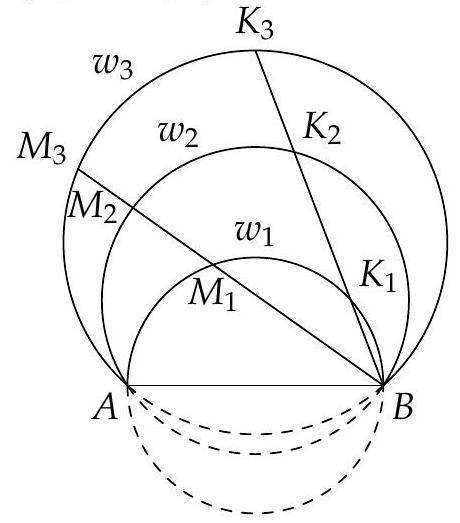", "metadata": {"resource_path": "BalticWay/segmented/en-bw04sol.jsonl", "problem_match": "\n20.", "solution_match": "\nSolution:"}} |
|
|