| {"year": "2005", "tier": "T3", "problem_label": "1", "problem_type": null, "exam": "BalticWay", "problem": "Let $a_{0}$ be a positive integer. Define the sequence $a_{n}, n \\geq 0$, as follows: If\n\n$$\na_{n}=\\sum_{i=0}^{j} c_{i} 10^{i}\n$$\n\nwhere $c_{i}$ are integers with $0 \\leq c_{i} \\leq 9$, then\n\n$$\na_{n+1}=c_{0}^{2005}+c_{1}^{2005}+\\cdots+c_{j}^{2005} .\n$$\n\nIs it possible to choose $a_{0}$ so that all the terms in the sequence are distinct?\n\nAnswer: No, the sequence must contain two equal terms.", "solution": "It is clear that there exists a smallest positive integer $k$ such that\n\n$$\n10^{k}>(k+1) \\cdot 9^{2005} .\n$$\n\nWe will show that there exists a positive integer $N$ such that $a_{n}$ consists of less than $k+1$ decimal digits for all $n \\geq N$. Let $a_{i}$ be a positive integer which consists of exactly $j+1$ digits, that is,\n\n$$\n10^{j} \\leq a_{i}<10^{j+1} .\n$$\n\nWe need to prove two statements:\n\n- $a_{i+1}$ has less than $k+1$ digits if $j<k$; and\n- $a_{i}>a_{i+1}$ if $j \\geq k$.\n\nTo prove the first statement, notice that\n\n$$\na_{i+1} \\leq(j+1) \\cdot 9^{2005}<(k+1) \\cdot 9^{2005}<10^{k}\n$$\n\nand hence $a_{i+1}$ consists of less than $k+1$ digits. To prove the second statement, notice that $a_{i}$ consists of $j+1$ digits, none of which exceeds 9 . Hence $a_{i+1} \\leq(j+1) \\cdot 9^{2005}$ and because $j \\geq k$, we get $a_{i} \\geq 10^{j}>(j+1) \\cdot 9^{2005} \\geq a_{i+1}$, which proves the second statement. It is now easy to derive the result from this statement. Assume that $a_{0}$ consists of $k+1$ or more digits (otherwise we are done, because then it follows inductively that all terms of the sequence consist of less than $k+1$ digits, by the first statement). Then the sequence starts with a strictly decreasing segment $a_{0}>a_{1}>a_{2}>\\cdots$ by the second statement, so for some index $N$ the number $a_{N}$ has less than $k+1$ digits. Then, by the first statement, each number $a_{n}$ with $n \\geq N$ consists of at most $k$ digits. By the Pigeonhole Principle, there are two different indices $n, m \\geq N$ such that $a_{n}=a_{m}$.", "metadata": {"resource_path": "BalticWay/segmented/en-bw05sol.jsonl", "problem_match": "\n1.", "solution_match": "\nSolution:"}} |
| {"year": "2005", "tier": "T3", "problem_label": "2", "problem_type": null, "exam": "BalticWay", "problem": "Let $\\alpha, \\beta$ and $\\gamma$ be three angles with $0 \\leq \\alpha, \\beta, \\gamma<90^{\\circ}$ and $\\sin \\alpha+\\sin \\beta+\\sin \\gamma=1$. Show that\n\n$$\n\\tan ^{2} \\alpha+\\tan ^{2} \\beta+\\tan ^{2} \\gamma \\geq \\frac{3}{8}\n$$", "solution": "Since $\\tan ^{2} x=1 / \\cos ^{2} x-1$, the inequality to be proved is equivalent to\n\n$$\n\\frac{1}{\\cos ^{2} \\alpha}+\\frac{1}{\\cos ^{2} \\beta}+\\frac{1}{\\cos ^{2} \\gamma} \\geq \\frac{27}{8}\n$$\n\nThe AM-HM inequality implies\n\n$$\n\\begin{aligned}\n\\frac{3}{\\frac{1}{\\cos ^{2} \\alpha}+\\frac{1}{\\cos ^{2} \\beta}+\\frac{1}{\\cos ^{2} \\gamma}} & \\leq \\frac{\\cos ^{2} \\alpha+\\cos ^{2} \\beta+\\cos ^{2} \\gamma}{3} \\\\\n& =\\frac{3-\\left(\\sin ^{2} \\alpha+\\sin ^{2} \\beta+\\sin ^{2} \\gamma\\right)}{3} \\\\\n& \\leq 1-\\left(\\frac{\\sin \\alpha+\\sin \\beta+\\sin \\gamma}{3}\\right)^{2} \\\\\n& =\\frac{8}{9}\n\\end{aligned}\n$$\n\nand the result follows.", "metadata": {"resource_path": "BalticWay/segmented/en-bw05sol.jsonl", "problem_match": "\n2.", "solution_match": "\nSolution:"}} |
| {"year": "2005", "tier": "T3", "problem_label": "3", "problem_type": null, "exam": "BalticWay", "problem": "Consider the sequence $a_{k}$ defined by $a_{1}=1, a_{2}=\\frac{1}{2}$,\n\n$$\na_{k+2}=a_{k}+\\frac{1}{2} a_{k+1}+\\frac{1}{4 a_{k} a_{k+1}} \\quad \\text { for } k \\geq 1\n$$\n\nProve that\n\n$$\n\\frac{1}{a_{1} a_{3}}+\\frac{1}{a_{2} a_{4}}+\\frac{1}{a_{3} a_{5}}+\\cdots+\\frac{1}{a_{98} a_{100}}<4\n$$", "solution": "Note that\n\n$$\n\\frac{1}{a_{k} a_{k+2}}<\\frac{2}{a_{k} a_{k+1}}-\\frac{2}{a_{k+1} a_{k+2}}\n$$\n\nbecause this inequality is equivalent to the inequality\n\n$$\na_{k+2}>a_{k}+\\frac{1}{2} a_{k+1}\n$$\n\nwhich is evident for the given sequence. Now we have\n\n$$\n\\begin{aligned}\n\\frac{1}{a_{1} a_{3}}+\\frac{1}{a_{2} a_{4}} & +\\frac{1}{a_{3} a_{5}}+\\cdots+\\frac{1}{a_{98} a_{100}} \\\\\n& <\\frac{2}{a_{1} a_{2}}-\\frac{2}{a_{2} a_{3}}+\\frac{2}{a_{2} a_{3}}-\\frac{2}{a_{3} a_{4}}+\\cdots \\\\\n& <\\frac{2}{a_{1} a_{2}}=4\n\\end{aligned}\n$$", "metadata": {"resource_path": "BalticWay/segmented/en-bw05sol.jsonl", "problem_match": "\n3.", "solution_match": "\nSolution:"}} |
| {"year": "2005", "tier": "T3", "problem_label": "4", "problem_type": null, "exam": "BalticWay", "problem": "Find three different polynomials $P(x)$ with real coefficients such that $P\\left(x^{2}+1\\right)=P(x)^{2}+1$ for all real $x$.\n\nAnswer: For example, $P(x)=x, P(x)=x^{2}+1$ and $P(x)=x^{4}+2 x^{2}+2$.", "solution": "Let $Q(x)=x^{2}+1$. Then the equation that $P$ must satisfy can be written $P(Q(x))=Q(P(x))$, and it is clear that this will be satisfied for $P(x)=x, P(x)=Q(x)$ and $P(x)=Q(Q(x))$.", "metadata": {"resource_path": "BalticWay/segmented/en-bw05sol.jsonl", "problem_match": "\n4.", "solution_match": "\nSolution:"}} |
| {"year": "2005", "tier": "T3", "problem_label": "4", "problem_type": null, "exam": "BalticWay", "problem": "Find three different polynomials $P(x)$ with real coefficients such that $P\\left(x^{2}+1\\right)=P(x)^{2}+1$ for all real $x$.\n\nAnswer: For example, $P(x)=x, P(x)=x^{2}+1$ and $P(x)=x^{4}+2 x^{2}+2$.", "solution": "For all reals $x$ we have $P(x)^{2}+1=P\\left(x^{2}+1\\right)=P(-x)^{2}+1$ and consequently, $(P(x)+P(-x))(P(x)-P(-x))=0$. Now one of the three cases holds:\n\n(a) If both $P(x)+P(-x)$ and $P(x)-P(-x)$ are not identically 0 , then they are nonconstant polynomials and have a finite numbers of roots, so this case cannot hold.\n(b) If $P(x)+P(-x)$ is identically 0 then obviously, $P(0)=0$. Consider the infinite sequence of integers $a_{0}=0$ and $a_{n+1}=a_{n}^{2}+1$. By induction it is easy to see that $P\\left(a_{n}\\right)=a_{n}$ for all non-negative integers $n$. Also, $Q(x)=x$ has that property, so $P(x)-Q(x)$ is a polynomial with infinitely many roots, whence $P(x)=x$.\n\n(c) If $P(x)-P(-x)$ is identically 0 then\n\n$$\nP(x)=x^{2 n}+b_{n-1} x^{2 n-2}+\\cdots+b_{1} x^{2}+b_{0}\n$$\n\nfor some integer $n$ since $P(x)$ is even and it is easy to see that the coefficient of $x^{2 n}$ must be 1 . Putting $n=1$ and $n=2$ yield the solutions $P(x)=x^{2}+1$ and $P(x)=x^{4}+2 x^{2}+2$.\n\nRemark: For $n=3$ there is no solution, whereas for $n=4$ there is the unique solution $P(x)=x^{8}+6 x^{6}+8 x^{4}+8 x^{2}+5$.", "metadata": {"resource_path": "BalticWay/segmented/en-bw05sol.jsonl", "problem_match": "\n4.", "solution_match": "\nSolution 2:"}} |
| {"year": "2005", "tier": "T3", "problem_label": "5", "problem_type": null, "exam": "BalticWay", "problem": "Let $a, b, c$ be positive real numbers with $a b c=1$. Prove that\n\n$$\n\\frac{a}{a^{2}+2}+\\frac{b}{b^{2}+2}+\\frac{c}{c^{2}+2} \\leq 1\n$$", "solution": "For any positive real $x$ we have $x^{2}+1 \\geq 2 x$. Hence\n\n$$\n\\begin{aligned}\n\\frac{a}{a^{2}+2}+\\frac{b}{b^{2}+2}+\\frac{c}{c^{2}+2} & \\leq \\frac{a}{2 a+1}+\\frac{b}{2 b+1}+\\frac{c}{2 c+1} \\\\\n& =\\frac{1}{2+1 / a}+\\frac{1}{2+1 / b}+\\frac{1}{2+1 / c}=: R .\n\\end{aligned}\n$$\n\n$R \\leq 1$ is equivalent to\n\n$$\n\\left(2+\\frac{1}{b}\\right)\\left(2+\\frac{1}{c}\\right)+\\left(2+\\frac{1}{a}\\right)\\left(2+\\frac{1}{c}\\right)+\\left(2+\\frac{1}{a}\\right)\\left(2+\\frac{1}{b}\\right) \\leq\\left(2+\\frac{1}{a}\\right)\\left(2+\\frac{1}{b}\\right)\\left(2+\\frac{1}{c}\\right)\n$$\n\nand to $4 \\leq \\frac{1}{a b}+\\frac{1}{a c}+\\frac{1}{b c}+\\frac{1}{a b c}$. By $a b c=1$ and by the AM-GM inequality\n\n$$\n\\frac{1}{a b}+\\frac{1}{a c}+\\frac{1}{b c} \\geq 3 \\sqrt[3]{\\left(\\frac{1}{a b c}\\right)^{2}}=3\n$$\n\nthe last inequality follows. Equality appears exactly when $a=b=c=1$.", "metadata": {"resource_path": "BalticWay/segmented/en-bw05sol.jsonl", "problem_match": "\n5.", "solution_match": "\nSolution:"}} |
| {"year": "2005", "tier": "T3", "problem_label": "6", "problem_type": null, "exam": "BalticWay", "problem": "Let $K$ and $N$ be positive integers with $1 \\leq K \\leq N$. A deck of $N$ different playing cards is shuffled by repeating the operation of reversing the order of the $K$ topmost cards and moving these to the bottom of the deck. Prove that the deck will be back in its initial order after a number of operations not greater than $4 \\cdot N^{2} / K^{2}$.", "solution": "Let $N=q \\cdot K+r, 0 \\leq r<K$, and let us number the cards $1,2, \\ldots, N$, starting from the one at the bottom of the deck. First we find out how the cards $1,2, \\ldots K$ are moving in the deck.\n\nIf $i \\leq r$ then the card $i$ is moving along the cycle\n\n$$\n\\begin{aligned}\n& i \\rightarrow K+i \\rightarrow 2 K+i \\rightarrow \\cdots \\rightarrow q K+i \\rightarrow(r+1-i) \\rightarrow \\\\\n& K+(r+1-i) \\rightarrow \\cdots \\rightarrow q K+(r+1-i),\n\\end{aligned}\n$$\n\nbecause $N-K<q K+i \\leq N$ and $N-K<q K+(r+1-i) \\leq N$. The length of this cycle is $2 q+2$. In the special case of $i=r+i-1$, it actually consists of two smaller cycles of length $q+1$.\n\nIf $r<i \\leq K$ then the card $i$ is moving along the cycle\n\n$$\n\\begin{aligned}\ni \\rightarrow K+i \\rightarrow 2 K+i \\rightarrow & \\cdots \\rightarrow(q-1) K+i \\rightarrow \\\\\n& K+r+1-i \\rightarrow K+(K+r+1-i) \\rightarrow \\\\\n& 2 K+(K+r+1-i) \\rightarrow \\cdots \\rightarrow(q-1) K+(K+r+1-i),\n\\end{aligned}\n$$\n\nbecause $N-K<(q-1) K+i \\leq N$ and $N-K<(q-1) K+(K+r+1-i) \\leq N$. The length of this cycle is $2 q$. In the special case of $i=K+r+1-i$, it actually consists of two smaller cycles of length $q$.\n\nSince these cycles cover all the numbers $1, \\ldots, N$, we can say that every card returns to its initial position after either $2 q+2$ or $2 q$ operations. Therefore, all the cards are simultaneously at their initial position after at most $\\operatorname{lcm}(2 q+2,2 q)=2 \\operatorname{lcm}(q+1, q)=$ $2 q(q+1)$ operations. Finally,\n\n$$\n2 q(q+1) \\leq(2 q)^{2}=4 q^{2} \\leq 4\\left(\\frac{N}{K}\\right)^{2}\n$$\n\nwhich concludes the proof.", "metadata": {"resource_path": "BalticWay/segmented/en-bw05sol.jsonl", "problem_match": "\n6.", "solution_match": "\nSolution:"}} |
| {"year": "2005", "tier": "T3", "problem_label": "7", "problem_type": null, "exam": "BalticWay", "problem": "A rectangular array has $n$ rows and six columns, where $n>2$. In each cell there is written either 0 or 1 . All rows in the array are different from each other. For each pair of rows $\\left(x_{1}, x_{2}, \\ldots, x_{6}\\right)$ and $\\left(y_{1}, y_{2}, \\ldots, y_{6}\\right)$, the row $\\left(x_{1} y_{1}, x_{2} y_{2}, \\ldots, x_{6} y_{6}\\right)$ can also be found in the array. Prove that there is a column in which at least half of the entries are zeroes.", "solution": "Clearly there must be rows with some zeroes. Consider the case when there is a row with just one zero; we can assume it is $(0,1,1,1,1,1)$. Then for each row $\\left(1, x_{2}, x_{3}, x_{4}, x_{5}, x_{6}\\right)$ there is also a row $\\left(0, x_{2}, x_{3}, x_{4}, x_{5}, x_{6}\\right)$; the conclusion follows. Consider the case when there is a row with just two zeroes; we can assume it is $(0,0,1,1,1,1)$. Let $n_{i j}$ be the number of rows with first two elements $i, j$. As in the first case $n_{00} \\geq n_{11}$. Let $n_{01} \\geq n_{10}$; the other subcase is analogous. Now there are $n_{00}+n_{01}$ zeroes in the first column and $n_{10}+n_{11}$ ones in the first column; the conclusion follows. Consider now the case when each row contains at least three zeroes (except $(1,1,1,1,1,1$ ), if such a row exists). Let us prove that it is impossible that each such row contains exactly three zeroes. Assume the opposite. As $n>2$ there are at least two rows with zeroes; they are different, so their product contains at least four zeroes, a contradiction. So there are more then $3(n-1)$ zeroes in the array; so in some column there are more than $(n-1) / 2$ zeroes; so there are at least $n / 2$ zeroes.", "metadata": {"resource_path": "BalticWay/segmented/en-bw05sol.jsonl", "problem_match": "\n7.", "solution_match": "\nSolution:"}} |
| {"year": "2005", "tier": "T3", "problem_label": "8", "problem_type": null, "exam": "BalticWay", "problem": "Consider a grid of $25 \\times 25$ unit squares. Draw with a red pen contours of squares of any size on the grid. What is the minimal number of squares we must draw in order to colour all the lines of the grid?\n\nAnswer: 48 squares.", "solution": "Consider a diagonal of the square grid. For any grid vertex $A$ on this diagonal denote by $C$ the farthest endpoint of this diagonal. Let the square with the diagonal $A C$ be red. Thus, we have defined the set of 48 red squares (24 for each diagonal). It is clear that if we draw all these squares, all the lines in the grid will turn red.\n\nIn order to show that 48 is the minimum, consider all grid segments of length 1 that have exactly one endpoint on the border of the grid. Every horizontal and every vertical line that cuts the grid into two parts determines two such segments. So we have $4 \\cdot 24=96$ segments. It is evident that every red square can contain at most two of these segments.", "metadata": {"resource_path": "BalticWay/segmented/en-bw05sol.jsonl", "problem_match": "\n8.", "solution_match": "\nSolution:"}} |
| {"year": "2005", "tier": "T3", "problem_label": "9", "problem_type": null, "exam": "BalticWay", "problem": "A rectangle is divided into $200 \\times 3$ unit squares. Prove that the number of ways of splitting this rectangle into rectangles of size $1 \\times 2$ is divisible by 3 .", "solution": "Let us denote the number of ways to split some figure into dominos by a small picture of this figure with a sign \\#. For example, $\\# \\boxplus=2$.\n\nLet $N_{n}=\\#$ ( $n$ rows) and $\\gamma_{n}=\\#$ ( $n-2$ full rows and one row with two cells).\n\nWe are going to find a recurrence relation for the numbers $N_{n}$.\n\nObserve that\n\n\n\nWe can generalize our observations by writing the equalities\n\n$$\n\\begin{aligned}\nN_{n} & =2 \\gamma_{n}+N_{n-2}, \\\\\n2 \\gamma_{n-2} & =N_{n-2}-N_{n-4}, \\\\\n2 \\gamma_{n} & =2 \\gamma_{n-2}+2 N_{n-2} .\n\\end{aligned}\n$$\n\nIf we sum up these equalities we obtain the desired recurrence\n\n$$\nN_{n}=4 N_{n-2}-N_{n-4}\n$$\n\nIt is easy to find that $N_{2}=3, N_{4}=11$. Now by the recurrence relation it is trivial to check that $N_{6 k+2} \\equiv 0(\\bmod 3)$.", "metadata": {"resource_path": "BalticWay/segmented/en-bw05sol.jsonl", "problem_match": "\n9.", "solution_match": "\nSolution:"}} |
| {"year": "2005", "tier": "T3", "problem_label": "10", "problem_type": null, "exam": "BalticWay", "problem": "Let $m=30030=2 \\cdot 3 \\cdot 5 \\cdot 7 \\cdot 11 \\cdot 13$ and let $M$ be the set of its positive divisors which have exactly two prime factors. Determine the minimal integer $n$ with the following property: for any choice of numbers from $M$, there exist three numbers $a, b, c$ among them satisfying $a \\cdot b \\cdot c=m$.\n\nAnswer: $n=11$.", "solution": "Taking the 10 divisors without the prime 13 shows that $n \\geq 11$. Consider the following partition of the 15 divisors into five groups of three each with the property that the product of the numbers in every group equals $m$.\n\n$$\n\\begin{array}{ll}\n\\{2 \\cdot 3,5 \\cdot 13,7 \\cdot 11\\}, & \\{2 \\cdot 5,3 \\cdot 7,11 \\cdot 13\\}, \\\\\n\\{2 \\cdot 11,3 \\cdot 5,7 \\cdot 13\\}, & \\{2 \\cdot 13,3 \\cdot 11,5 \\cdot 7\\} .\n\\end{array}\n$$\n\nIf $n=11$, there is a group from which we take all three numbers, that is, their product equals $m$.", "metadata": {"resource_path": "BalticWay/segmented/en-bw05sol.jsonl", "problem_match": "\n10.", "solution_match": "\nSolution:"}} |
| {"year": "2005", "tier": "T3", "problem_label": "11", "problem_type": null, "exam": "BalticWay", "problem": "Let the points $D$ and $E$ lie on the sides $B C$ and $A C$, respectively, of the triangle $A B C$, satisfying $B D=A E$. The line joining the circumcentres of the triangles $A D C$ and $B E C$ meets the lines $A C$ and $B C$ at $K$ and $L$, respectively. Prove that $K C=L C$.", "solution": "Assume that the circumcircles of triangles $A D C$ and $B E C$ meet at $C$ and $P$. The problem is to show that the line $K L$ makes equal angles with the lines $A C$ and $B C$. Since the line joining the circumcentres of triangles $A D C$ and $B E C$ is perpendicular to the line $C P$, it suffices to show that $C P$ is the angle-bisector of $\\angle A C B$.\n\n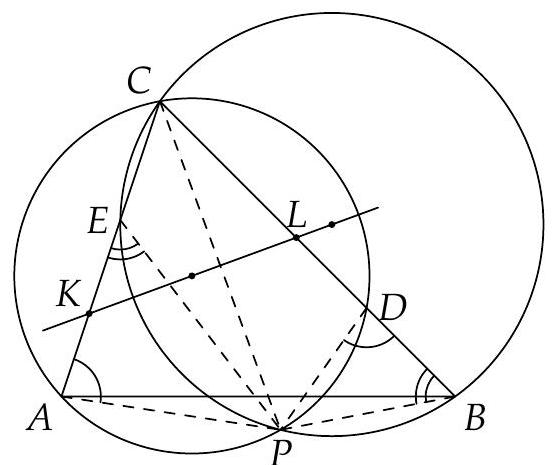\n\nSince the points $A, P, D, C$ are concyclic, we obtain $\\angle E A P=\\angle B D P$. Analogously, we have $\\angle A E P=\\angle D B P$. These two equalities together with $A E=B D$ imply that triangles $A P E$ and $D P B$ are congruent. This means that the distance from $P$ to $A C$ is equal to the distance from $P$ to $B C$, and thus $C P$ is the angle-bisector of $\\angle A C B$, as desired.", "metadata": {"resource_path": "BalticWay/segmented/en-bw05sol.jsonl", "problem_match": "\n11.", "solution_match": "\nSolution:"}} |
| {"year": "2005", "tier": "T3", "problem_label": "12", "problem_type": null, "exam": "BalticWay", "problem": "Let $A B C D$ be a convex quadrilateral such that $B C=A D$. Let $M$ and $N$ be the midpoints of $A B$ and $C D$, respectively. The lines $A D$ and $B C$ meet the line $M N$ at $P$ and $Q$, respectively. Prove that $C Q=D P$.", "solution": "Let $A^{\\prime}, B^{\\prime}, C^{\\prime}, D^{\\prime}$ be the feet of the perpendiculars from $A, B, C, D$, respectively, onto the line $M N$. Then\n\n$$\nA A^{\\prime}=B B^{\\prime} \\quad \\text { and } \\quad C C^{\\prime}=D D^{\\prime} \\text {. }\n$$\n\nDenote by $X, Y$ the feet of the perpendiculars from $C, D$ onto the lines $B B^{\\prime}, A A^{\\prime}$, respectively. We infer from the above equalities that $A Y=B X$. Since also $B C=A D$, the right-angled triangles $B X C$ and $A Y D$ are congruent. This shows that\n\n$$\n\\angle C^{\\prime} C Q=\\angle B^{\\prime} B Q=\\angle A^{\\prime} A P=\\angle D^{\\prime} D P .\n$$\n\nTherefore, since $C C^{\\prime}=D D^{\\prime}$, the triangles $C C^{\\prime} Q$ and $D D^{\\prime} P$ are congruent. Thus $C Q=$ $D P$.\n\n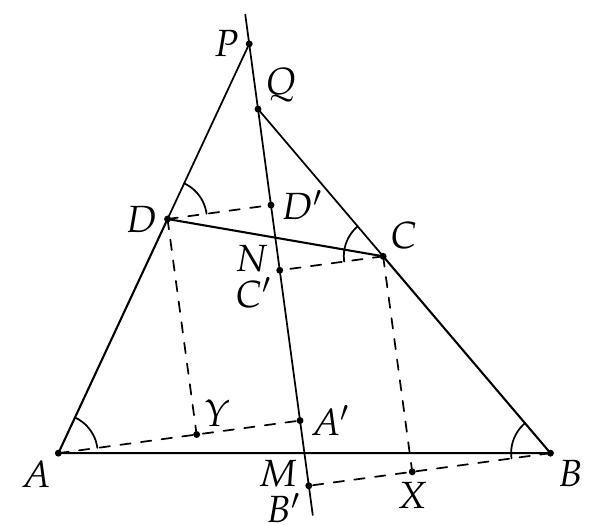", "metadata": {"resource_path": "BalticWay/segmented/en-bw05sol.jsonl", "problem_match": "\n12.", "solution_match": "\nSolution:"}} |
| {"year": "2005", "tier": "T3", "problem_label": "13", "problem_type": null, "exam": "BalticWay", "problem": "What is the smallest number of circles of radius $\\sqrt{2}$ that are needed to cover a rectangle\n\n(a) of size $6 \\times 3$ ?\n\n(b) of size $5 \\times 3$ ?\n\nAnswer: (a) Six circles, (b) five circles.", "solution": "(a) Consider the four corners and the two midpoints of the sides of length 6 . The distance between any two of these six points is 3 or more, so one circle cannot cover two of these points, and at least six circles are needed.\n\nOn the other hand one circle will cover a $2 \\times 2$ square, and it is easy to see that six such squares can cover the rectangle.\n\n(b) Consider the four corners and the centre of the rectangle. The minimum distance between any two of these points is the distance between the centre and one of the corners, which is $\\sqrt{34} / 2$. This is greater than the diameter of the circle $(\\sqrt{34 / 4}>\\sqrt{32 / 4})$, so one circle cannot cover two of these points, and at least five circles are needed.\n\n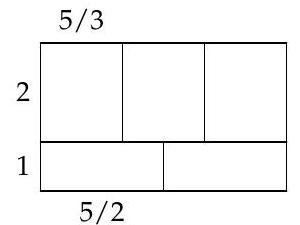\n\nPartition the rectangle into three rectangles of size $5 / 3 \\times 2$ and two rectangles of size $5 / 2 \\times 1$ as shown on the right. It is easy to check that each has a diagonal of length less than $2 \\sqrt{2}$, so five circles can cover the five small rectangles and hence the $5 \\times 3$ rectangle.", "metadata": {"resource_path": "BalticWay/segmented/en-bw05sol.jsonl", "problem_match": "\n13.", "solution_match": "\nSolution:"}} |
| {"year": "2005", "tier": "T3", "problem_label": "14", "problem_type": null, "exam": "BalticWay", "problem": "Let the medians of the triangle $A B C$ meet at $M$. Let $D$ and $E$ be different points on the line $B C$ such that $D C=C E=A B$, and let $P$ and $Q$ be points on the segments $B D$ and $B E$, respectively, such that $2 B P=P D$ and $2 B Q=Q E$. Determine $\\angle P M Q$.\n\nAnswer: $\\angle P M Q=90^{\\circ}$.", "solution": "Draw the parallelogram $A B C A^{\\prime}$, with $A A^{\\prime} \\| B C$. Then $M$ lies on $B A^{\\prime}$, and $B M=\\frac{1}{3} B A^{\\prime}$. So $M$ is on the homothetic image (centre $B$, dilation $1 / 3$ ) of the circle with centre $C$ and radius $A B$, which meets $B C$ at $D$ and $E$. The image meets $B C$ at $P$ and $Q$. So $\\angle P M Q=90^{\\circ}$.\n\n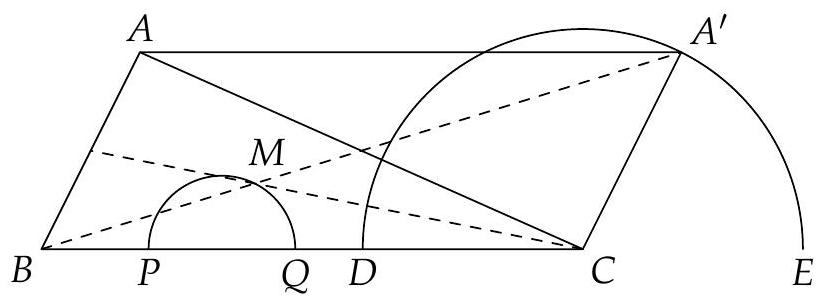", "metadata": {"resource_path": "BalticWay/segmented/en-bw05sol.jsonl", "problem_match": "\n14.", "solution_match": "\nSolution:"}} |
| {"year": "2005", "tier": "T3", "problem_label": "15", "problem_type": null, "exam": "BalticWay", "problem": "Let the lines $e$ and $f$ be perpendicular and intersect each other at $O$. Let $A$ and $B$ lie on $e$ and $C$ and $D$ lie on $f$, such that all the five points $A, B, C, D$ and $O$ are distinct. Let the lines $b$ and $d$ pass through $B$ and $D$ respectively, perpendicularly to $A C$; let the lines $a$ and $c$ pass through $A$ and $C$ respectively, perpendicularly to $B D$. Let $a$ and $b$ intersect $a t X$ and $c$ and $d$ intersect at $Y$. Prove that $X Y$ passes through $O$.", "solution": "Let $A_{1}$ be the intersection of $a$ with $B D, B_{1}$ the intersection of $b$ with $A C, C_{1}$ the intersection of $c$ with $B D$ and $D_{1}$ the intersection of $d$ with $A C$. It follows easily by the given right angles that the following three sets each are concyclic:\n\n- $A, A_{1}, D, D_{1}, O$ lie on a circle $w_{1}$ with diameter $A D$.\n- $B, B_{1}, C, C 1, O$ lie on a circle $w_{2}$ with diameter $B C$.\n- $C, C_{1}, D, D_{1}$ lie on a circle $w_{3}$ with diameter $D C$.\n\nWe see that $O$ lies on the radical axis of $w_{1}$ and $w_{2}$. Also, $Y$ lies on the radical axis of $w_{1}$ and $w_{3}$, and on the radical axis of $w_{2}$ and $w_{3}$, so $Y$ is the radical centre of $w_{1}, w_{2}$ and $w_{3}$, so it lies on the radical axis of $w_{1}$ and $w_{2}$. Analogously we prove that $X$ lies on the radical axis of $w_{1}$ and $w_{2}$.\n\n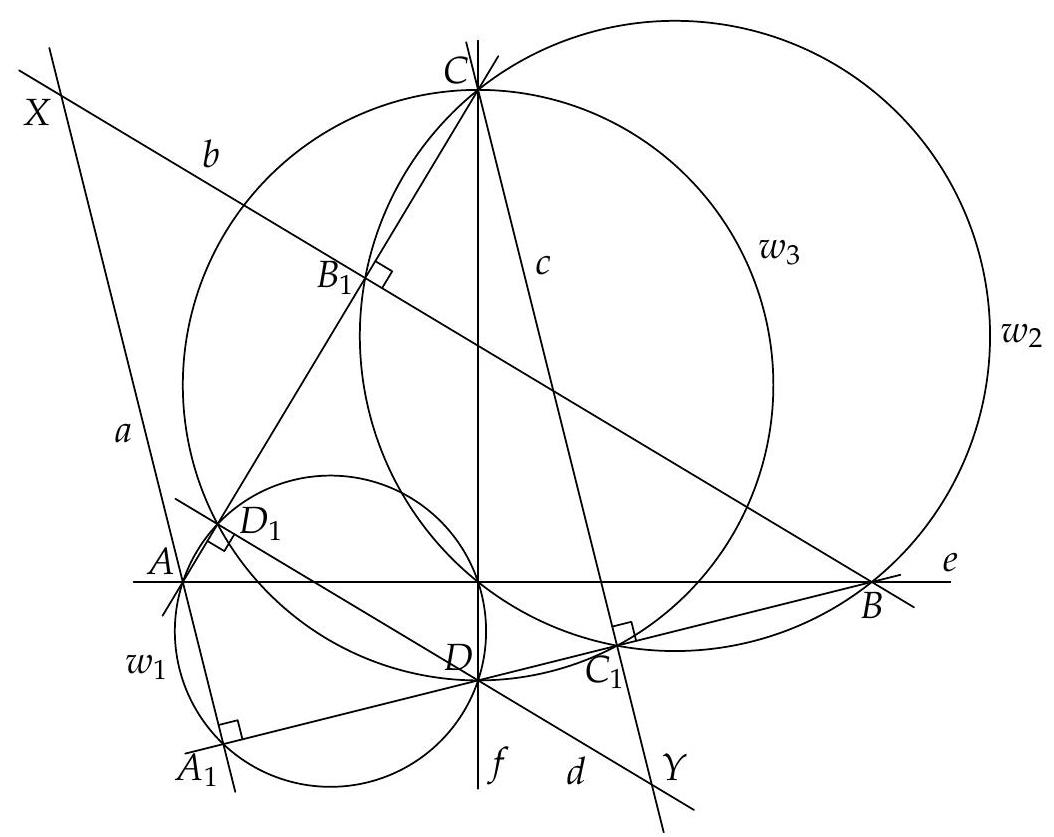", "metadata": {"resource_path": "BalticWay/segmented/en-bw05sol.jsonl", "problem_match": "\n15.", "solution_match": "\nSolution:"}} |
| {"year": "2005", "tier": "T3", "problem_label": "16", "problem_type": null, "exam": "BalticWay", "problem": "Let $p$ be a prime number and let $n$ be a positive integer. Let $q$ be a positive divisor of $(n+1)^{p}-n^{p}$. Show that $q-1$ is divisible by $p$.", "solution": "It is sufficient to show the statement for $q$ prime. We need to prove that\n\n$$\n(n+1)^{p} \\equiv n^{p} \\quad(\\bmod q) \\Longrightarrow q \\equiv 1 \\quad(\\bmod p) .\n$$\n\nIt is obvious that $\\operatorname{gcd}(n, q)=\\operatorname{gcd}(n+1, q)=1$ (as $n$ and $n+1$ cannot be divisible by $q$ simultaneously). Hence there exists a positive integer $m$ such that $m n \\equiv 1(\\bmod q)$. In fact, $m$ is just the multiplicative inverse of $n(\\bmod q)$. Take $s=m(n+1)$. It is easy to see that\n\n$$\ns^{p} \\equiv 1 \\quad(\\bmod q)\n$$\n\nLet $t$ be the smallest positive integer which satisfies $s^{t} \\equiv 1(\\bmod q)(t$ is the order of $s(\\bmod q)$ ). One can easily prove that $t$ divides $p$. Indeed, write $p=a t+b$ where $0 \\leq b<t$. Then\n\n$$\n1 \\equiv s^{p} \\equiv s^{a t+b} \\equiv\\left(s^{t}\\right)^{a} \\cdot s^{b} \\equiv s^{b} \\quad(\\bmod q) .\n$$\n\nBy the definition of $t$, we must have $b=0$. Hence $t$ divides $p$. This means that $t=1$ or $t=p$. However, $t=1$ is easily seen to give a contradiction since then we would have\n\n$$\nm(n+1) \\equiv 1 \\quad(\\bmod q) \\quad \\text { or } \\quad n+1 \\equiv n \\quad(\\bmod q)\n$$\n\nTherefore $t=p$, and $p$ is the order of $s(\\bmod q)$. By Fermat's little theorem,\n\n$$\ns^{q-1} \\equiv 1 \\quad(\\bmod q)\n$$\n\nSince $p$ is the order of $s(\\bmod q)$, we have that $p$ divides $q-1$, and we are done.", "metadata": {"resource_path": "BalticWay/segmented/en-bw05sol.jsonl", "problem_match": "\n16.", "solution_match": "\nSolution:"}} |
| {"year": "2005", "tier": "T3", "problem_label": "17", "problem_type": null, "exam": "BalticWay", "problem": "A sequence $\\left(x_{n}\\right), n \\geq 0$, is defined as follows: $x_{0}=a, x_{1}=2$ and $x_{n}=2 x_{n-1} x_{n-2}-$ $x_{n-1}-x_{n-2}+1$ for $n>1$. Find all integers a such that $2 x_{3 n}-1$ is a perfect square for all $n \\geq 1$.\n\nAnswer: $a=\\frac{(2 m-1)^{2}+1}{2}$ where $m$ is an arbitrary positive integer.", "solution": "Let $y_{n}=2 x_{n}-1$. Then\n\n$$\n\\begin{aligned}\ny_{n} & =2\\left(2 x_{n-1} x_{n-2}-x_{n-1}-x_{n-2}+1\\right)-1 \\\\\n& =4 x_{n-1} x_{n-2}-2 x_{n-1}-2 x_{n-2}+1 \\\\\n& =\\left(2 x_{n-1}-1\\right)\\left(2 x_{n-2}-1\\right)=y_{n-1} y_{n-2}\n\\end{aligned}\n$$\n\nwhen $n>1$. Notice that $y_{n+3}=y_{n+2} y_{n+1}=y_{n+1}^{2} y_{n}$. We see that $y_{n+3}$ is a perfect square if and only if $y_{n}$ is a perfect square. Hence $y_{3 n}$ is a perfect square for all $n \\geq 1$ exactly when $y_{0}$ is a perfect square. Since $y_{0}=2 a-1$, the result is obtained when $a=\\frac{(2 m-1)^{2}+1}{2}$ for all positive integers $m$.", "metadata": {"resource_path": "BalticWay/segmented/en-bw05sol.jsonl", "problem_match": "\n17.", "solution_match": "\nSolution:"}} |
| {"year": "2005", "tier": "T3", "problem_label": "18", "problem_type": null, "exam": "BalticWay", "problem": "Let $x$ and $y$ be positive integers and assume that $z=4 x y /(x+y)$ is an odd integer. Prove that at least one divisor of $z$ can be expressed in the form $4 n-1$ where $n$ is a positive integer.", "solution": "Let $x=2^{s} x_{1}$ and $y=2^{t} y_{1}$ where $x_{1}$ and $y_{1}$ are odd integers. Without loss of generality we can assume that $s \\geq t$. We have\n\n$$\nz=\\frac{2^{s+t+2} x_{1} y_{1}}{2^{t}\\left(2^{s-t} x_{1}+y_{1}\\right)}=\\frac{2^{s+2} x_{1} y_{1}}{2^{s-t} x_{1}+y_{1}}\n$$\n\nIf $s \\neq t$, then the denominator is odd and therefore $z$ is even. So we have $s=t$ and $z=2^{s+2} x_{1} y_{1} /\\left(x_{1}+y_{1}\\right)$. Let $x_{1}=d x_{2}, y_{1}=d y_{2}$ with $\\operatorname{gcd}\\left(x_{2}, y_{2}\\right)=1$. So $z=$ $2^{s+2} d x_{2} y_{2} /\\left(x_{2}+y_{2}\\right)$. As $z$ is odd, it must be that $x_{2}+y_{2}$ is divisible by $2^{s+2} \\geq 4$, so $x_{2}+y_{2}$ is divisible by 4 . As $x_{2}$ and $y_{2}$ are odd integers, one of them, say $x_{2}$ is congruent to 3 modulo 4. But $\\operatorname{gcd}\\left(x_{2}, x_{2}+y_{2}\\right)=1$, so $x_{2}$ is a divisor of $z$.", "metadata": {"resource_path": "BalticWay/segmented/en-bw05sol.jsonl", "problem_match": "\n18.", "solution_match": "\nSolution:"}} |
| {"year": "2005", "tier": "T3", "problem_label": "19", "problem_type": null, "exam": "BalticWay", "problem": "Is it possible to find 2005 different positive square numbers such that their sum is also a square number?\n\nAnswer: Yes, it is possible.", "solution": "Start with a simple Pythagorian identity such as $3^{2}+4^{2}=5^{2}$. Multiply it by $5^{2}$\n\n$$\n3^{2} \\cdot 5^{2}+4^{2} \\cdot 5^{2}=5^{2} \\cdot 5^{2}\n$$\n\nand insert the identity for the first\n\n$$\n3^{2} \\cdot\\left(3^{2}+4^{2}\\right)+4^{2} \\cdot 5^{2}=5^{2} \\cdot 5^{2}\n$$\n\nwhich gives\n\n$$\n3^{2} \\cdot 3^{2}+3^{2} \\cdot 4^{2}+4^{2} \\cdot 5^{2}=5^{2} \\cdot 5^{2} .\n$$\n\nMultiply again by $5^{2}$\n\n$$\n3^{2} \\cdot 3^{2} \\cdot 5^{2}+3^{2} \\cdot 4^{2} \\cdot 5^{2}+4^{2} \\cdot 5^{2} \\cdot 5^{2}=5^{2} \\cdot 5^{2} \\cdot 5^{2}\n$$\n\nand split the first term\n\n$$\n3^{2} \\cdot 3^{2} \\cdot\\left(3^{2}+4^{2}\\right)+3^{2} \\cdot 4^{2} \\cdot 5^{2}+4^{2} \\cdot 5^{2} \\cdot 5^{2}=5^{2} \\cdot 5^{2} \\cdot 5^{2}\n$$\n\nthat is\n\n$$\n3^{2} \\cdot 3^{2} \\cdot 3^{2}+3^{2} \\cdot 3^{2} \\cdot 4^{2}+3^{2} \\cdot 4^{2} \\cdot 5^{2}+4^{2} \\cdot 5^{2} \\cdot 5^{2}=5^{2} \\cdot 5^{2} \\cdot 5^{2} .\n$$\n\nThis (multiplying by $5^{2}$ and splitting the first term) can be repeated as often as needed, each time increasing the number of terms by one.\n\nClearly, each term is a square number and the terms are strictly increasing from left to right.", "metadata": {"resource_path": "BalticWay/segmented/en-bw05sol.jsonl", "problem_match": "\n19.", "solution_match": "\nSolution:"}} |
| {"year": "2005", "tier": "T3", "problem_label": "20", "problem_type": null, "exam": "BalticWay", "problem": "Find all positive integers $n=p_{1} p_{2} \\cdots p_{k}$ which divide $\\left(p_{1}+1\\right)\\left(p_{2}+1\\right) \\cdots\\left(p_{k}+1\\right)$, where $p_{1} p_{2} \\cdots p_{k}$ is the factorization of $n$ into prime factors (not necessarily distinct).\n\nAnswer: All numbers $2^{r} 3^{s}$ where $r$ and $s$ are non-negative integers and $s \\leq r \\leq 2 s$.", "solution": "Let $m=\\left(p_{1}+1\\right)\\left(p_{2}+1\\right) \\cdots\\left(p_{k}+1\\right)$. We may assume that $p_{k}$ is the largest prime factor. If $p_{k}>3$ then $p_{k}$ cannot divide $m$, because if $p_{k}$ divides $m$ it is a prime factor of $p_{i}+1$ for some $i$, but if $p_{i}=2$ then $p_{i}+1<p_{k}$, and otherwise $p_{i}+1$ is an even number with factors 2 and $\\frac{1}{2}\\left(p_{i}+1\\right)$ which are both strictly smaller than $p_{k}$. Thus the only primes that can divide $n$ are 2 and 3 , so we can write $n=2^{r} 3^{s}$. Then $m=3^{r} 4^{s}=2^{2 s} 3^{r}$ which is divisible by $n$ if and only if $s \\leq r \\leq 2 s$.", "metadata": {"resource_path": "BalticWay/segmented/en-bw05sol.jsonl", "problem_match": "\n20.", "solution_match": "\nSolution:"}} |
|
|