| {"year": "2005", "tier": "T2", "problem_label": "1", "problem_type": null, "exam": "Canada_MO", "problem": "Consider an equilateral triangle of side length $n$, which is divided into unit triangles, as shown. Let $f(n)$ be the number of paths from the triangle in the top row to the middle triangle in the bottom row, such that adjacent triangles in our path share a common edge and the path never travels up (from a lower row to a higher row) or revisits a triangle. An example of one such path is illustrated below for $n=5$. Determine the value of $f(2005)$.\n\n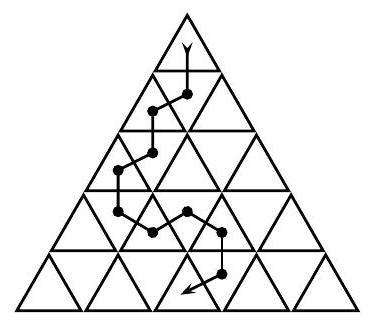", "solution": "We shall show that $f(n)=(n-1)$ !.\n\nLabel the horizontal line segments in the triangle $l_{1}, l_{2}, \\ldots$ as in the diagram below. Since the path goes from the top triangle to a triangle in the bottom row and never travels up, the path must cross each of $l_{1}, l_{2}, \\ldots, l_{n-1}$ exactly once. The diagonal lines in the triangle divide $l_{k}$ into $k$ unit line segments and the path must cross exactly one of these $k$ segments for each $k$. (In the diagram below, these line segments have been highlighted.) The path is completely determined by the set of $n-1$ line segments which are crossed. So as the path moves from the $k$ th row to the $(k+1)$ st row, there are $k$ possible line segments where the path could cross $l_{k}$. Since there are $1 \\cdot 2 \\cdot 3 \\cdots(n-1)=(n-1)$ ! ways that the path could cross the $n-1$ horizontal lines, and each one corresponds to a unique path, we get $f(n)=(n-1)$ !.\n\nTherefore $f(2005)=(2004)$ !.\n\n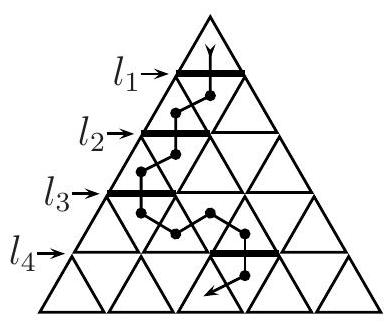", "metadata": {"resource_path": "Canada_MO/segmented/en-sol2005.jsonl", "problem_match": "\n1.", "solution_match": "\n## Solution\n\n"}} |
| {"year": "2005", "tier": "T2", "problem_label": "2", "problem_type": null, "exam": "Canada_MO", "problem": "Let $(a, b, c)$ be a Pythagorean triple, i.e., a triplet of positive integers with $a^{2}+b^{2}=c^{2}$.\n\na) Prove that $(c / a+c / b)^{2}>8$.\n\nb) Prove that there does not exist any integer $n$ for which we can find a Pythagorean triple $(a, b, c)$ satisfying $(c / a+c / b)^{2}=n$.\n\n## a) Solution 1\n\nLet $(a, b, c)$ be a Pythagorean triple. View $a, b$ as lengths of the legs of a right angled triangle with hypotenuse of length $c$; let $\\theta$ be the angle determined by the sides with lengths $a$ and $c$. Then\n\n$$\n\\begin{aligned}\n\\left(\\frac{c}{a}+\\frac{c}{b}\\right)^{2} & =\\left(\\frac{1}{\\cos \\theta}+\\frac{1}{\\sin \\theta}\\right)^{2}=\\frac{\\sin ^{2} \\theta+\\cos ^{2} \\theta+2 \\sin \\theta \\cos \\theta}{(\\sin \\theta \\cos \\theta)^{2}} \\\\\n& =4\\left(\\frac{1+\\sin 2 \\theta}{\\sin ^{2} 2 \\theta}\\right)=\\frac{4}{\\sin ^{2} 2 \\theta}+\\frac{4}{\\sin 2 \\theta}\n\\end{aligned}\n$$\n\nNote that because $0<\\theta<90^{\\circ}$, we have $0<\\sin 2 \\theta \\leq 1$, with equality only if $\\theta=45^{\\circ}$. But then $a=b$ and we obtain $\\sqrt{2}=c / a$, contradicting $a, c$ both being integers. Thus, $0<\\sin 2 \\theta<1$ which gives $(c / a+c / b)^{2}>8$.", "solution": "Defining $\\theta$ as in Solution 1, we have $c / a+c / b=\\sec \\theta+\\csc \\theta$. By the AM-GM inequality, we have $(\\sec \\theta+\\csc \\theta) / 2 \\geq \\sqrt{\\sec \\theta \\csc \\theta}$. So\n\n$$\nc / a+c / b \\geq \\frac{2}{\\sqrt{\\sin \\theta \\cos \\theta}}=\\frac{2 \\sqrt{2}}{\\sqrt{\\sin 2 \\theta}} \\geq 2 \\sqrt{2}\n$$\n\nSince $a, b, c$ are integers, we have $c / a+c / b>2 \\sqrt{2}$ which gives $(c / a+c / b)^{2}>8$.", "metadata": {"resource_path": "Canada_MO/segmented/en-sol2005.jsonl", "problem_match": "\n2.", "solution_match": "\n## Solution 2"}} |
| {"year": "2005", "tier": "T2", "problem_label": "2", "problem_type": null, "exam": "Canada_MO", "problem": "Let $(a, b, c)$ be a Pythagorean triple, i.e., a triplet of positive integers with $a^{2}+b^{2}=c^{2}$.\n\na) Prove that $(c / a+c / b)^{2}>8$.\n\nb) Prove that there does not exist any integer $n$ for which we can find a Pythagorean triple $(a, b, c)$ satisfying $(c / a+c / b)^{2}=n$.\n\n## a) Solution 1\n\nLet $(a, b, c)$ be a Pythagorean triple. View $a, b$ as lengths of the legs of a right angled triangle with hypotenuse of length $c$; let $\\theta$ be the angle determined by the sides with lengths $a$ and $c$. Then\n\n$$\n\\begin{aligned}\n\\left(\\frac{c}{a}+\\frac{c}{b}\\right)^{2} & =\\left(\\frac{1}{\\cos \\theta}+\\frac{1}{\\sin \\theta}\\right)^{2}=\\frac{\\sin ^{2} \\theta+\\cos ^{2} \\theta+2 \\sin \\theta \\cos \\theta}{(\\sin \\theta \\cos \\theta)^{2}} \\\\\n& =4\\left(\\frac{1+\\sin 2 \\theta}{\\sin ^{2} 2 \\theta}\\right)=\\frac{4}{\\sin ^{2} 2 \\theta}+\\frac{4}{\\sin 2 \\theta}\n\\end{aligned}\n$$\n\nNote that because $0<\\theta<90^{\\circ}$, we have $0<\\sin 2 \\theta \\leq 1$, with equality only if $\\theta=45^{\\circ}$. But then $a=b$ and we obtain $\\sqrt{2}=c / a$, contradicting $a, c$ both being integers. Thus, $0<\\sin 2 \\theta<1$ which gives $(c / a+c / b)^{2}>8$.", "solution": "By simplifying and using the AM-GM inequality,\n\n$$\n\\left(\\frac{c}{a}+\\frac{c}{b}\\right)^{2}=c^{2}\\left(\\frac{a+b}{a b}\\right)^{2}=\\frac{\\left(a^{2}+b^{2}\\right)(a+b)^{2}}{a^{2} b^{2}} \\geq \\frac{2 \\sqrt{a^{2} b^{2}}(2 \\sqrt{a b})^{2}}{a^{2} b^{2}}=8\n$$\n\nwith equality only if $a=b$. By using the same argument as in Solution $1, a$ cannot equal $b$ and the inequality is strict.", "metadata": {"resource_path": "Canada_MO/segmented/en-sol2005.jsonl", "problem_match": "\n2.", "solution_match": "\n## Solution 3"}} |
| {"year": "2005", "tier": "T2", "problem_label": "2", "problem_type": null, "exam": "Canada_MO", "problem": "Let $(a, b, c)$ be a Pythagorean triple, i.e., a triplet of positive integers with $a^{2}+b^{2}=c^{2}$.\n\na) Prove that $(c / a+c / b)^{2}>8$.\n\nb) Prove that there does not exist any integer $n$ for which we can find a Pythagorean triple $(a, b, c)$ satisfying $(c / a+c / b)^{2}=n$.\n\n## a) Solution 1\n\nLet $(a, b, c)$ be a Pythagorean triple. View $a, b$ as lengths of the legs of a right angled triangle with hypotenuse of length $c$; let $\\theta$ be the angle determined by the sides with lengths $a$ and $c$. Then\n\n$$\n\\begin{aligned}\n\\left(\\frac{c}{a}+\\frac{c}{b}\\right)^{2} & =\\left(\\frac{1}{\\cos \\theta}+\\frac{1}{\\sin \\theta}\\right)^{2}=\\frac{\\sin ^{2} \\theta+\\cos ^{2} \\theta+2 \\sin \\theta \\cos \\theta}{(\\sin \\theta \\cos \\theta)^{2}} \\\\\n& =4\\left(\\frac{1+\\sin 2 \\theta}{\\sin ^{2} 2 \\theta}\\right)=\\frac{4}{\\sin ^{2} 2 \\theta}+\\frac{4}{\\sin 2 \\theta}\n\\end{aligned}\n$$\n\nNote that because $0<\\theta<90^{\\circ}$, we have $0<\\sin 2 \\theta \\leq 1$, with equality only if $\\theta=45^{\\circ}$. But then $a=b$ and we obtain $\\sqrt{2}=c / a$, contradicting $a, c$ both being integers. Thus, $0<\\sin 2 \\theta<1$ which gives $(c / a+c / b)^{2}>8$.", "solution": "$$\n\\begin{aligned}\n\\left(\\frac{c}{a}+\\frac{c}{b}\\right)^{2} & =\\frac{c^{2}}{a^{2}}+\\frac{c^{2}}{b^{2}}+\\frac{2 c^{2}}{a b}=1+\\frac{b^{2}}{a^{2}}+\\frac{a^{2}}{b^{2}}+1+\\frac{2\\left(a^{2}+b^{2}\\right)}{a b} \\\\\n& =2+\\left(\\frac{a}{b}-\\frac{b}{a}\\right)^{2}+2+\\frac{2}{a b}\\left((a-b)^{2}+2 a b\\right) \\\\\n& =4+\\left(\\frac{a}{b}-\\frac{b}{a}\\right)^{2}+\\frac{2(a-b)^{2}}{a b}+4 \\geq 8,\n\\end{aligned}\n$$\n\nwith equality only if $a=b$, which (as argued previously) cannot occur.\n\n## b) Solution 1\n\nSince $c / a+c / b$ is rational, $(c / a+c / b)^{2}$ can only be an integer if $c / a+c / b$ is an integer. Suppose $c / a+c / b=m$. We may assume that $\\operatorname{gcd}(a, b)=1$. (If not, divide the common factor from $(a, b, c)$, leaving $m$ unchanged.)\n\nSince $c(a+b)=m a b$ and $\\operatorname{gcd}(a, a+b)=1$, $a$ must divide $c$, say $c=a k$. This gives $a^{2}+b^{2}=a^{2} k^{2}$ which implies $b^{2}=\\left(k^{2}-1\\right) a^{2}$. But then $a$ divides $b$ contradicting the fact that $\\operatorname{gcd}(a, b)=1$. Therefore $(c / a+c / b)^{2}$ is not equal to any integer $n$.", "metadata": {"resource_path": "Canada_MO/segmented/en-sol2005.jsonl", "problem_match": "\n2.", "solution_match": "\n## Solution 4"}} |
| {"year": "2005", "tier": "T2", "problem_label": "2", "problem_type": null, "exam": "Canada_MO", "problem": "Let $(a, b, c)$ be a Pythagorean triple, i.e., a triplet of positive integers with $a^{2}+b^{2}=c^{2}$.\n\na) Prove that $(c / a+c / b)^{2}>8$.\n\nb) Prove that there does not exist any integer $n$ for which we can find a Pythagorean triple $(a, b, c)$ satisfying $(c / a+c / b)^{2}=n$.\n\n## a) Solution 1\n\nLet $(a, b, c)$ be a Pythagorean triple. View $a, b$ as lengths of the legs of a right angled triangle with hypotenuse of length $c$; let $\\theta$ be the angle determined by the sides with lengths $a$ and $c$. Then\n\n$$\n\\begin{aligned}\n\\left(\\frac{c}{a}+\\frac{c}{b}\\right)^{2} & =\\left(\\frac{1}{\\cos \\theta}+\\frac{1}{\\sin \\theta}\\right)^{2}=\\frac{\\sin ^{2} \\theta+\\cos ^{2} \\theta+2 \\sin \\theta \\cos \\theta}{(\\sin \\theta \\cos \\theta)^{2}} \\\\\n& =4\\left(\\frac{1+\\sin 2 \\theta}{\\sin ^{2} 2 \\theta}\\right)=\\frac{4}{\\sin ^{2} 2 \\theta}+\\frac{4}{\\sin 2 \\theta}\n\\end{aligned}\n$$\n\nNote that because $0<\\theta<90^{\\circ}$, we have $0<\\sin 2 \\theta \\leq 1$, with equality only if $\\theta=45^{\\circ}$. But then $a=b$ and we obtain $\\sqrt{2}=c / a$, contradicting $a, c$ both being integers. Thus, $0<\\sin 2 \\theta<1$ which gives $(c / a+c / b)^{2}>8$.", "solution": "We begin as in Solution 1, supposing that $c / a+c / b=m$ with $\\operatorname{gcd}(a, b)=1$. Hence $a$ and $b$ are not both even. It is also the case that $a$ and $b$ are not both odd, for then $c^{2}=a^{2}+b^{2} \\equiv 2(\\bmod 4)$, and perfect squares are congruent to either 0 or 1 modulo 4. So one of $a, b$ is odd and the other is even. Therefore $c$ must be odd.\n\nNow $c / a+c / b=m$ implies $c(a+b)=m a b$, which cannot be true because $c(a+b)$ is odd and mab is even.", "metadata": {"resource_path": "Canada_MO/segmented/en-sol2005.jsonl", "problem_match": "\n2.", "solution_match": "\n## Solution 2"}} |
| {"year": "2005", "tier": "T2", "problem_label": "3", "problem_type": null, "exam": "Canada_MO", "problem": "Let $S$ be a set of $n \\geq 3$ points in the interior of a circle.\n\na) Show that there are three distinct points $a, b, c \\in S$ and three distinct points $A, B, C$ on the circle such that $a$ is (strictly) closer to $A$ than any other point in $S, b$ is closer to $B$ than any other point in $S$ and $c$ is closer to $C$ than any other point in $S$.\n\nb) Show that for no value of $n$ can four such points in $S$ (and corresponding points on the circle) be guaranteed.", "solution": "a) Let $H$ be the smallest convex set of points in the plane which contains $S . \\dagger$ Take 3 points $a, b, c \\in S$ which lie on the boundary of $H$. (There must always be at least 3 (but not necessarily 4) such points.)\n\nSince $a$ lies on the boundary of the convex region $H$, we can construct a chord $L$ such that no two points of $H$ lie on opposite sides of $L$. Of the two points where the perpendicular to $L$ at $a$ meets the circle, choose one which is on a side of $L$ not containing any points of $H$ and call this point $A$. Certainly $A$ is closer to $a$ than to any other point on $L$ or on the other side of $L$. Hence $A$ is closer to $a$ than to any other point of $S$. We can find the required points $B$ and $C$ in an analogous way and the proof is complete.\n\n[Note that this argument still holds if all the points of $S$ lie on a line.]\n\n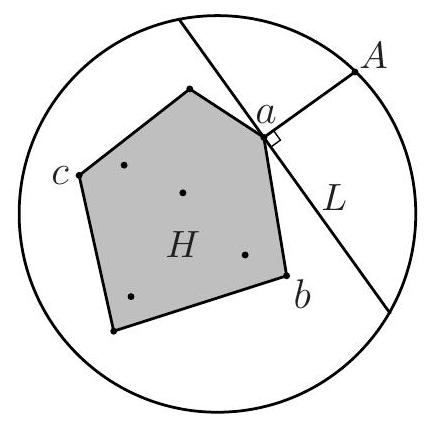\n\n(a)\n\n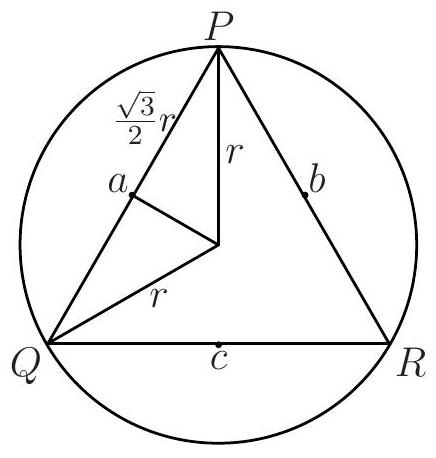\n\n(b)\n\nb) Let $P Q R$ be an equilateral triangle inscribed in the circle and let $a, b, c$ be midpoints of the three sides of $\\triangle P Q R$. If $r$ is the radius of the circle, then every point on the circle is within $(\\sqrt{3} / 2) r$ of one of $a, b$ or $c$. (See figure (b) above.) Now $\\sqrt{3} / 2<9 / 10$, so if $S$ consists of $a, b, c$ and a cluster of points within $r / 10$ of the centre of the circle, then we cannot select 4 points from $S$ (and corresponding points on the circle) having the desired property.[^0]", "metadata": {"resource_path": "Canada_MO/segmented/en-sol2005.jsonl", "problem_match": "\n3.", "solution_match": "\n## Solution 1"}} |
| {"year": "2005", "tier": "T2", "problem_label": "3", "problem_type": null, "exam": "Canada_MO", "problem": "Let $S$ be a set of $n \\geq 3$ points in the interior of a circle.\n\na) Show that there are three distinct points $a, b, c \\in S$ and three distinct points $A, B, C$ on the circle such that $a$ is (strictly) closer to $A$ than any other point in $S, b$ is closer to $B$ than any other point in $S$ and $c$ is closer to $C$ than any other point in $S$.\n\nb) Show that for no value of $n$ can four such points in $S$ (and corresponding points on the circle) be guaranteed.", "solution": "a) If all the points of $S$ lie on a line $L$, then choose any 3 of them to be $a, b, c$. Let $A$ be a point on the circle which meets the perpendicular to $L$ at $a$. Clearly $A$ is closer to $a$ than to any other point on $L$, and hence closer than other other point in $S$. We find $B$ and $C$ in an analogous way.\n\nOtherwise, choose $a, b, c$ from $S$ so that the triangle formed by these points has maximal area. Construct the altitude from the side $b c$ to the point $a$ and extend this line until it meets the circle at $A$. We claim that $A$ is closer to $a$ than to any other point in $S$.\n\nSuppose not. Let $x$ be a point in $S$ for which the distance from $A$ to $x$ is less than the distance from $A$ to $a$. Then the perpendicular distance from $x$ to the line $b c$ must be greater than the perpendicular distance from $a$ to the line $b c$. But then the triangle formed by the points $x, b, c$ has greater area than the triangle formed by $a, b, c$, contradicting the original choice of these 3 points. Therefore $A$ is closer to $a$ than to any other point in $S$.\n\nThe points $B$ and $C$ are found by constructing similar altitudes through $b$ and $c$, respectively.\n\nb) See Solution 1.", "metadata": {"resource_path": "Canada_MO/segmented/en-sol2005.jsonl", "problem_match": "\n3.", "solution_match": "\n## Solution 2"}} |
| {"year": "2005", "tier": "T2", "problem_label": "4", "problem_type": null, "exam": "Canada_MO", "problem": "Let $A B C$ be a triangle with circumradius $R$, perimeter $P$ and area $K$. Determine the maximum value of $K P / R^{3}$.", "solution": "Since similar triangles give the same value of $K P / R^{3}$, we can fix $R=1$ and maximize $K P$ over all triangles inscribed in the unit circle. Fix points $A$ and $B$ on the unit circle. The locus of points $C$ with a given perimeter $P$ is an ellipse that meets the circle in at most four points. The area $K$ is maximized (for a fixed $P$ ) when $C$ is chosen on the perpendicular bisector of $A B$, so we get a maximum value for $K P$ if $C$ is where the perpendicular bisector of $A B$ meets the circle. Thus the maximum value of $K P$ for a given $A B$ occurs when $A B C$ is an isosceles triangle. Repeating this argument with $B C$ fixed, we have that the maximum occurs when $A B C$ is an equilateral triangle.\n\nConsider an equilateral triangle with side length $a$. It has $P=3 a$. It has height equal to $a \\sqrt{3} / 2$ giving $K=a^{2} \\sqrt{3} / 4$. ¿From the extended law of sines, $2 R=a / \\sin (60)$ giving $R=a / \\sqrt{3}$. Therefore the maximum value we seek is\n\n$$\nK P / R^{3}=\\left(\\frac{a^{2} \\sqrt{3}}{4}\\right)(3 a)\\left(\\frac{\\sqrt{3}}{a}\\right)^{3}=\\frac{27}{4} .\n$$", "metadata": {"resource_path": "Canada_MO/segmented/en-sol2005.jsonl", "problem_match": "\n4.", "solution_match": "\n## Solution 1"}} |
| {"year": "2005", "tier": "T2", "problem_label": "4", "problem_type": null, "exam": "Canada_MO", "problem": "Let $A B C$ be a triangle with circumradius $R$, perimeter $P$ and area $K$. Determine the maximum value of $K P / R^{3}$.", "solution": "From the extended law of sines, the lengths of the sides of the triangle are $2 R \\sin A$, $2 R \\sin B$ and $2 R \\sin C$. So\n\n$$\nP=2 R(\\sin A+\\sin B+\\sin C) \\text { and } K=\\frac{1}{2}(2 R \\sin A)(2 R \\sin B)(\\sin C),\n$$\n\ngiving\n\n$$\n\\frac{K P}{R^{3}}=4 \\sin A \\sin B \\sin C(\\sin A+\\sin B+\\sin C)\n$$\n\nWe wish to find the maximum value of this expression over all $A+B+C=180^{\\circ}$. Using well-known identities for sums and products of sine functions, we can write\n\n$$\n\\frac{K P}{R^{3}}=4 \\sin A\\left(\\frac{\\cos (B-C)}{2}-\\frac{\\cos (B+C)}{2}\\right)\\left(\\sin A+2 \\sin \\left(\\frac{B+C}{2}\\right) \\cos \\left(\\frac{B-C}{2}\\right)\\right) .\n$$\n\nIf we first consider $A$ to be fixed, then $B+C$ is fixed also and this expression takes its maximum value when $\\cos (B-C)$ and $\\cos \\left(\\frac{B-C}{2}\\right)$ equal 1 ; i.e. when $B=C$. In a similar way, one can show that for any fixed value of $B, K P / R^{3}$ is maximized when $A=C$. Therefore the maximum value of $K P / R^{3}$ occurs when $A=B=C=60^{\\circ}$, and it is now an easy task to substitute this into the above expression to obtain the maximum value of $27 / 4$.", "metadata": {"resource_path": "Canada_MO/segmented/en-sol2005.jsonl", "problem_match": "\n4.", "solution_match": "\n## Solution 2"}} |
| {"year": "2005", "tier": "T2", "problem_label": "4", "problem_type": null, "exam": "Canada_MO", "problem": "Let $A B C$ be a triangle with circumradius $R$, perimeter $P$ and area $K$. Determine the maximum value of $K P / R^{3}$.", "solution": "As in Solution 2, we obtain\n\n$$\n\\frac{K P}{R^{3}}=4 \\sin A \\sin B \\sin C(\\sin A+\\sin B+\\sin C)\n$$\n\nFrom the AM-GM inequality, we have\n\n$$\n\\sin A \\sin B \\sin C \\leq\\left(\\frac{\\sin A+\\sin B+\\sin C}{3}\\right)^{3},\n$$\n\ngiving\n\n$$\n\\frac{K P}{R^{3}} \\leq \\frac{4}{27}(\\sin A+\\sin B+\\sin C)^{4}\n$$\n\nwith equality when $\\sin A=\\sin B=\\sin C$. Since the sine function is concave on the interval from 0 to $\\pi$, Jensen's inequality gives\n\n$$\n\\frac{\\sin A+\\sin B+\\sin C}{3} \\leq \\sin \\left(\\frac{A+B+C}{3}\\right)=\\sin \\frac{\\pi}{3}=\\frac{\\sqrt{3}}{2} .\n$$\n\nSince equality occurs here when $\\sin A=\\sin B=\\sin C$ also, we can conclude that the maximum value of $K P / R^{3}$ is $\\frac{4}{27}\\left(\\frac{3 \\sqrt{3}}{2}\\right)^{4}=27 / 4$.", "metadata": {"resource_path": "Canada_MO/segmented/en-sol2005.jsonl", "problem_match": "\n4.", "solution_match": "\n## Solution 3"}} |
| {"year": "2005", "tier": "T2", "problem_label": "5", "problem_type": null, "exam": "Canada_MO", "problem": "Let's say that an ordered triple of positive integers $(a, b, c)$ is $n$-powerful if $a \\leq b \\leq c$, $\\operatorname{gcd}(a, b, c)=1$, and $a^{n}+b^{n}+c^{n}$ is divisible by $a+b+c$. For example, $(1,2,2)$ is 5 -powerful.\n\na) Determine all ordered triples (if any) which are $n$-powerful for all $n \\geq 1$.\n\nb) Determine all ordered triples (if any) which are 2004-powerful and 2005-powerful, but not 2007-powerful.\n\n[Note that $\\operatorname{gcd}(a, b, c)$ is the greatest common divisor of $a, b$ and $c$.]", "solution": "Let $T_{n}=a^{n}+b^{n}+c^{n}$ and consider the polynomial\n\n$$\nP(x)=(x-a)(x-b)(x-c)=x^{3}-(a+b+c) x^{2}+(a b+a c+b c) x-a b c .\n$$\n\nSince $P(a)=0$, we get $a^{3}=(a+b+c) a^{2}-(a b+a c+b c) a+a b c$ and multiplying both sides by $a^{n-3}$ we obtain $a^{n}=(a+b+c) a^{n-1}-(a b+a c+b c) a^{n-2}+(a b c) a^{n-3}$. Applying the same reasoning, we can obtain similar expressions for $b^{n}$ and $c^{n}$ and adding the three identities we get that $T_{n}$ satisfies the following 3 -term recurrence:\n\n$$\nT_{n}=(a+b+c) T_{n-1}-(a b+a c+b c) T_{n-2}+(a b c) T_{n-3} \\text {, for all } n \\geq 3\n$$\n\n¿From this we see that if $T_{n-2}$ and $T_{n-3}$ are divisible by $a+b+c$, then so is $T_{n}$. This immediately resolves part (b) - there are no ordered triples which are 2004-powerful and 2005-powerful, but not 2007-powerful-and reduces the number of cases to be considered in part (a): since all triples are 1-powerful, the recurrence implies that any ordered triple which is both 2 -powerful and 3 -powerful is $n$-powerful for all $n \\geq 1$.\n\nPutting $n=3$ in the recurrence, we have\n\n$$\na^{3}+b^{3}+c^{3}=(a+b+c)\\left(a^{2}+b^{2}+c^{2}\\right)-(a b+a c+b c)(a+b+c)+3 a b c\n$$\n\nwhich implies that $(a, b, c)$ is 3 -powerful if and only if $3 a b c$ is divisible by $a+b+c$. Since\n\n$$\na^{2}+b^{2}+c^{2}=(a+b+c)^{2}-2(a b+a c+b c),\n$$\n\n$(a, b, c)$ is 2 -powerful if and only if $2(a b+a c+b c)$ is divisible by $a+b+c$.\n\nSuppose a prime $p \\geq 5$ divides $a+b+c$. Then $p$ divides $a b c$. Since $\\operatorname{gcd}(a, b, c)=1, p$ divides exactly one of $a, b$ or $c$; but then $p$ doesn't divide $2(a b+a c+b c)$.\n\nSuppose $3^{2}$ divides $a+b+c$. Then 3 divides $a b c$, implying 3 divides exactly one of $a$, $b$ or $c$. But then 3 doesn't divide $2(a b+a c+b c)$.\n\nSuppose $2^{2}$ divides $a+b+c$. Then 4 divides $a b c$. Since $\\operatorname{gcd}(a, b, c)=1$, at most one of $a, b$ or $c$ is even, implying one of $a, b, c$ is divisible by 4 and the others are odd. But then $a b+a c+b c$ is odd and 4 doesn't divide $2(a b+a c+b c)$.\n\nSo if $(a, b, c)$ is 2 - and 3 -powerful, then $a+b+c$ is not divisible by 4 or 9 or any prime greater than 3. Since $a+b+c$ is at least $3, a+b+c$ is either 3 or 6 . It is now a simple matter to check the possibilities and conclude that the only triples which are $n$-powerful for all $n \\geq 1$ are $(1,1,1)$ and $(1,1,4)$.", "metadata": {"resource_path": "Canada_MO/segmented/en-sol2005.jsonl", "problem_match": "\n5.", "solution_match": "\n## Solution 1"}} |
| {"year": "2005", "tier": "T2", "problem_label": "5", "problem_type": null, "exam": "Canada_MO", "problem": "Let's say that an ordered triple of positive integers $(a, b, c)$ is $n$-powerful if $a \\leq b \\leq c$, $\\operatorname{gcd}(a, b, c)=1$, and $a^{n}+b^{n}+c^{n}$ is divisible by $a+b+c$. For example, $(1,2,2)$ is 5 -powerful.\n\na) Determine all ordered triples (if any) which are $n$-powerful for all $n \\geq 1$.\n\nb) Determine all ordered triples (if any) which are 2004-powerful and 2005-powerful, but not 2007-powerful.\n\n[Note that $\\operatorname{gcd}(a, b, c)$ is the greatest common divisor of $a, b$ and $c$.]", "solution": "Let $p$ be a prime. By Fermat's Little Theorem,\n\n$$\na^{p-1} \\equiv \\begin{cases}1(\\bmod p), & \\text { if } p \\text { doesn't divide } a \\\\ 0(\\bmod p), & \\text { if } p \\text { divides } a\\end{cases}\n$$\n\nSince $\\operatorname{gcd}(a, b, c)=1$, we have that $a^{p-1}+b^{p-1}+c^{p-1} \\equiv 1,2$ or $3(\\bmod p)$. Therefore if $p$ is a prime divisor of $a^{p-1}+b^{p-1}+c^{p-1}$, then $p$ equals 2 or 3 . So if $(a, b, c)$ is $n$-powerful for all $n \\geq 1$, then the only primes which can divide $a+b+c$ are 2 or 3 .\n\nWe can proceed in a similar fashion to show that $a+b+c$ is not divisible by 4 or 9 .\n\nSince\n\n$$\na^{2} \\equiv \\begin{cases}0(\\bmod 4), & \\text { if } p \\text { is even; } \\\\ 1(\\bmod 4), & \\text { if } p \\text { is odd }\\end{cases}\n$$\n\nand $a, b, c$ aren't all even, we have that $a^{2}+b^{2}+c^{2} \\equiv 1,2$ or $3(\\bmod 4)$.\n\nBy expanding $(3 k)^{3},(3 k+1)^{3}$ and $(3 k+2)^{3}$, we find that $a^{3}$ is congruent to 0,1 or -1 modulo 9. Hence\n\n$$\na^{6} \\equiv \\begin{cases}0(\\bmod 9), & \\text { if } 3 \\text { divides } a ; \\\\ 1(\\bmod 9), & \\text { if } 3 \\text { doesn't divide } a .\\end{cases}\n$$\n\nSince $a, b, c$ aren't all divisible by 3 , we have that $a^{6}+b^{6}+c^{6} \\equiv 1,2$ or $3(\\bmod 9)$.\n\nSo $a^{2}+b^{2}+c^{2}$ is not divisible by 4 and $a^{6}+b^{6}+c^{6}$ is not divisible by 9 . Thus if $(a, b, c)$ is $n$-powerful for all $n \\geq 1$, then $a+b+c$ is not divisible by 4 or 9 . Therefore $a+b+c$ is either 3 or 6 and checking all possibilities, we conclude that the only triples which are $n$-powerful for all $n \\geq 1$ are $(1,1,1)$ and $(1,1,4)$.\n\nSee Solution 1 for the (b) part.\n\n\n[^0]: ${ }^{\\dagger}$ By the way, $H$ is called the convex hull of $S$. If the points of $S$ lie on a line, then $H$ will be the shortest line segment containing the points of $S$. Otherwise, $H$ is a polygon whose vertices are all elements of $S$ and such that all other points in $S$ lie inside or on this polygon.", "metadata": {"resource_path": "Canada_MO/segmented/en-sol2005.jsonl", "problem_match": "\n5.", "solution_match": "\n## Solution 2"}} |
|
|