| {"year": "2006", "tier": "T2", "problem_label": "1", "problem_type": null, "exam": "Canada_MO", "problem": "Let $f(n, k)$ be the number of ways of distributing $k$ candies to $n$ children so that each child receives at most 2 candies. For example, if $n=3$, then $f(3,7)=0, f(3,6)=1$ and $f(3,4)=6$.\n\nDetermine the value of\n\n$$\nf(2006,1)+f(2006,4)+f(2006,7)+\\cdots+f(2006,1000)+f(2006,1003) .\n$$\n\nComment. Unfortunately, there was an error in the statement of this problem. It was intended that the sum should continue to $f(2006,4012)$.", "solution": "The number of ways of distributing $k$ candies to 2006 children is equal to the number of ways of distributing 0 to a particular child and $k$ to the rest, plus the number of ways of distributing 1 to the particular child and $k-1$ to the rest, plus the number of ways of distributing 2 to the particular child and $k-2$ to the rest. Thus $f(2006, k)=$ $f(2005, k)+f(2005, k-1)+f(2005, k-2)$, so that the required sum is\n\n$$\n1+\\sum_{k=1}^{1003} f(2005, k)\n$$\n\nIn evaluating $f(n, k)$, suppose that there are $r$ children who receive 2 candies; these $r$ children can be chosen in $\\left(\\begin{array}{l}n \\\\ r\\end{array}\\right)$ ways. Then there are $k-2 r$ candies from which at most one is given to each of $n-r$ children. Hence\n\n$$\nf(n, k)=\\sum_{r=0}^{\\lfloor k / 2\\rfloor}\\left(\\begin{array}{l}\nn \\\\\nr\n\\end{array}\\right)\\left(\\begin{array}{c}\nn-r \\\\\nk-2 r\n\\end{array}\\right)=\\sum_{r=0}^{\\infty}\\left(\\begin{array}{l}\nn \\\\\nr\n\\end{array}\\right)\\left(\\begin{array}{c}\nn-r \\\\\nk-2 r\n\\end{array}\\right)\n$$\n\nwith $\\left(\\begin{array}{l}x \\\\ y\\end{array}\\right)=0$ when $x<y$ and when $y<0$. The answer is\n\n$$\n\\sum_{k=0}^{1003} \\sum_{r=0}^{\\infty}\\left(\\begin{array}{c}\n2005 \\\\\nr\n\\end{array}\\right)\\left(\\begin{array}{c}\n2005-r \\\\\nk-2 r\n\\end{array}\\right)=\\sum_{r=0}^{\\infty}\\left(\\begin{array}{c}\n2005 \\\\\nr\n\\end{array}\\right) \\sum_{k=0}^{1003}\\left(\\begin{array}{c}\n2005-r \\\\\nk-2 r\n\\end{array}\\right)\n$$", "metadata": {"resource_path": "Canada_MO/segmented/en-sol2006.jsonl", "problem_match": "\n1.", "solution_match": "\nSolution 1."}} |
| {"year": "2006", "tier": "T2", "problem_label": "1", "problem_type": null, "exam": "Canada_MO", "problem": "Let $f(n, k)$ be the number of ways of distributing $k$ candies to $n$ children so that each child receives at most 2 candies. For example, if $n=3$, then $f(3,7)=0, f(3,6)=1$ and $f(3,4)=6$.\n\nDetermine the value of\n\n$$\nf(2006,1)+f(2006,4)+f(2006,7)+\\cdots+f(2006,1000)+f(2006,1003) .\n$$\n\nComment. Unfortunately, there was an error in the statement of this problem. It was intended that the sum should continue to $f(2006,4012)$.", "solution": "The desired number is the sum of the coefficients of the terms of degree not exceeding 1003 in the expansion of $\\left(1+x+x^{2}\\right)^{2005}$, which is equal to the coefficient of $x^{1003}$ in the expansion of\n\n$$\n\\begin{aligned}\n\\left(1+x+x^{2}\\right)^{2005}\\left(1+x+\\cdots+x^{1003}\\right) & =\\left[\\left(1-x^{3}\\right)^{2005}(1-x)^{-2005}\\right]\\left(1-x^{1004}\\right)(1-x)^{-1} \\\\\n& =\\left(1-x^{3}\\right)^{2005}(1-x)^{-2006}-\\left(1-x^{3}\\right)^{2005}(1-x)^{-2006} x^{1004}\n\\end{aligned}\n$$\n\nSince the degree of every term in the expansion of the second member on the right exceeds 1003, we are looking for the coefficient of $x^{1003}$ in the expansion of the first member:\n\n$$\n\\left(1-x^{3}\\right)^{2005}(1-x)^{-2006}=\\sum_{i=0}^{2005}(-1)^{i}\\left(\\begin{array}{c}\n2005 \\\\\ni\n\\end{array}\\right) x^{3 i} \\sum_{j=0}^{\\infty}(-1)^{j}\\left(\\begin{array}{c}\n-2006 \\\\\nj\n\\end{array}\\right) x^{j}\n$$\n\n$$\n\\begin{aligned}\n& =\\sum_{i=0}^{2005} \\sum_{j=0}^{\\infty}(-1)^{i}\\left(\\begin{array}{c}\n2005 \\\\\ni\n\\end{array}\\right)\\left(\\begin{array}{c}\n2005+j \\\\\nj\n\\end{array}\\right) x^{3 i+j} \\\\\n& =\\sum_{k=0}^{\\infty}\\left(\\sum_{i=1}^{2005}(-1)^{i}\\left(\\begin{array}{c}\n2005 \\\\\ni\n\\end{array}\\right)\\left(\\begin{array}{c}\n2005+k-3 i \\\\\n2005\n\\end{array}\\right)\\right) x^{k} .\n\\end{aligned}\n$$\n\nThe desired number is\n\n$$\n\\sum_{i=1}^{334}(-1)^{i}\\left(\\begin{array}{c}\n2005 \\\\\ni\n\\end{array}\\right)\\left(\\begin{array}{c}\n3008-3 i \\\\\n2005\n\\end{array}\\right)=\\sum_{i=1}^{334}(-1)^{i} \\frac{(3008-3 i) !}{i !(2005-i) !(1003-3 i) !} .\n$$\n\n(Note that $\\left(\\begin{array}{c}3008-3 i \\\\ 2005\\end{array}\\right)=0$ when $i \\geq 335$.)", "metadata": {"resource_path": "Canada_MO/segmented/en-sol2006.jsonl", "problem_match": "\n1.", "solution_match": "\nSolution 2."}} |
| {"year": "2006", "tier": "T2", "problem_label": "2", "problem_type": null, "exam": "Canada_MO", "problem": "Let $A B C$ be an acute-angled triangle. Inscribe a rectangle $D E F G$ in this triangle so that $D$ is on $A B, E$ is on $A C$ and both $F$ and $G$ are on $B C$. Describe the locus of (i.e., the curve occupied by) the intersections of the diagonals of all possible rectangles $D E F G$.", "solution": "The locus is the line segment joining the midpoint $M$ of $B C$ to the midpoint $K$ of the altitude $A H$. Note that a segment $D E$ with $D$ on $A B$ and $E$ on $A C$ determines an inscribed rectangle; the midpoint $F$ of $D E$ lies on the median $A M$, while the midpoint of the perpendicular from $F$ to $B C$ is the centre of the rectangle. This lies on the median $M K$ of the triangle $A M H$.\n\nConversely, any point $P$ on $M K$ is the centre of a rectangle with base along $B C$ whose height is double the distance from $K$ to $B C$.", "metadata": {"resource_path": "Canada_MO/segmented/en-sol2006.jsonl", "problem_match": "\n2.", "solution_match": "\nSolution."}} |
| {"year": "2006", "tier": "T2", "problem_label": "3", "problem_type": null, "exam": "Canada_MO", "problem": "In a rectangular array of nonnegative real numbers with $m$ rows and $n$ columns, each row and each column contains at least one positive element. Moreover, if a row and a column intersect in a positive element, then the sums of their elements are the same. Prove that $m=n$.", "solution": "Consider first the case where all the rows have the same positive sum $s$; this covers the particular situation in which $m=1$. Then each column, sharing a positive element with some row, must also have the sum $s$. Then the sum of all the entries in the matrix is $m s=n s$, whence $m=n$.\n\nWe prove the general case by induction on $m$. The case $m=1$ is already covered. Suppose that we have an $m \\times n$ array not all of whose rows have the same sum. Let $r<m$ of the rows have the sum $s$, and each of the of the other rows have a different sum. Then every column sharing a positive entry with one of these rows must also have sum $s$, and these are the only columns with the sum $s$. Suppose there are $c$ columns with sum $s$. The situation is essentially unchanged if we permute the rows and then the column so that the first $r$ rows have the sum $s$ and the first $c$ columns have the sum $s$. Since all the entries of the first $r$ rows not in the first $c$ columns and in the first $c$ columns not in the first $r$ rows must be 0 , we can partition the array into a $r \\times c$ array in which all rows and columns have sum $s$ and which satisfies the hypothesis of the problem, two rectangular arrays of zeros in the upper right and lower left and a rectangular $(m-r) \\times(n-c)$ array in the lower right that satisfies the conditions of the problem. By the induction hypothesis, we see that $r=c$ and so $m=n$.", "metadata": {"resource_path": "Canada_MO/segmented/en-sol2006.jsonl", "problem_match": "\n3.", "solution_match": "\nSolution 1."}} |
| {"year": "2006", "tier": "T2", "problem_label": "3", "problem_type": null, "exam": "Canada_MO", "problem": "In a rectangular array of nonnegative real numbers with $m$ rows and $n$ columns, each row and each column contains at least one positive element. Moreover, if a row and a column intersect in a positive element, then the sums of their elements are the same. Prove that $m=n$.", "solution": "[Y. Zhao] Let the term in the $i$ th row and the $j$ th column of the array be denoted by $a_{i j}$, and let $S=\\{(i, j)$ : $\\left.a_{i j}>0\\right\\}$. Suppose that $r_{i}$ is the sum of the $i$ th row and $c_{j}$ the sum of the $j$ th column. Then $r_{i}=c_{j}$ whenever $(i, j) \\in S$. Then we have that\n\n$$\n\\sum\\left\\{\\frac{a_{i j}}{r_{i}}:(i, j) \\in S\\right\\}=\\sum\\left\\{\\frac{a_{i j}}{c_{j}}:(i, j) \\in S\\right\\}\n$$\n\nWe evaluate the sums on either side independently.\n\n$$\n\\begin{aligned}\n& \\sum\\left\\{\\frac{a_{i j}}{r_{i}}:(i, j) \\in S\\right\\}=\\sum\\left\\{\\frac{a_{i j}}{r_{i}}: 1 \\leq i \\leq m, 1 \\leq j \\leq n\\right\\}=\\sum_{i=1}^{m} \\frac{1}{r_{i}} \\sum_{j=1}^{n} a_{i j}=\\sum_{i=1}^{m}\\left(\\frac{1}{r_{i}}\\right) r_{i}=\\sum_{i=1}^{m} 1=m . \\\\\n& \\sum\\left\\{\\frac{a_{i j}}{c_{j}}:(i, j) \\in S\\right\\}=\\sum\\left\\{\\frac{a_{i j}}{c_{j}}: 1 \\leq i \\leq m, 1 \\leq j \\leq n\\right\\}=\\sum_{j=1}^{n} \\frac{1}{c_{j}} \\sum_{i=1}^{m} a_{i j}=\\sum_{j=1}^{n}\\left(\\frac{1}{c_{j}}\\right) c_{j}=\\sum_{j=1}^{n} 1=n .\n\\end{aligned}\n$$\n\nHence $m=n$.\n\nComment. The second solution can be made cleaner and more elegant by defining $u_{i j}=a_{i j} / r_{i}$ for all $(i, j)$. When $a_{i j}=0$, then $u_{i j}=0$. When $a_{i j}>0$, then, by hypothesis, $u_{i j}=a_{i j} / c_{j}$, a relation that in fact holds for all $(i, j)$. We find that\n\n$$\n\\sum_{j=1}^{n} u_{i j}=1 \\quad \\text { and } \\quad \\sum_{i=1}^{n} u_{i j}=1\n$$\n\nfor $1 \\leq i \\leq m$ and $1 \\leq j \\leq n$, so that $\\left(u_{i j}\\right)$ is an $m \\times n$ array whose row sums and column sums are all equal to 1 . Hence\n\n$$\nm=\\sum_{i=1}^{m}\\left(\\sum_{j=1}^{n} u_{i j}\\right)=\\sum\\left\\{u_{i j}: 1 \\leq i \\leq m, 1 \\leq j \\leq n\\right\\}=\\sum_{j=1}^{n}\\left(\\sum_{i=1}^{m} u_{i j}\\right)=n\n$$\n\n(being the sum of all the entries in the array).", "metadata": {"resource_path": "Canada_MO/segmented/en-sol2006.jsonl", "problem_match": "\n3.", "solution_match": "\nSolution 2."}} |
| {"year": "2006", "tier": "T2", "problem_label": "4", "problem_type": null, "exam": "Canada_MO", "problem": "Consider a round-robin tournament with $2 n+1$ teams, where each team plays each other team exactly once. We say that three teams $X, Y$ and $Z$, form a cycle triplet if $X$ beats $Y, Y$ beats $Z$, and $Z$ beats $X$. There are no ties.\n\n(a) Determine the minimum number of cycle triplets possible.\n\n(b) Determine the maximum number of cycle triplets possible.", "solution": "(a) The minimum is 0 , which is achieved by a tournament in which team $T_{i}$ beats $T_{j}$ if and only if $i>j$.\n\n(b) Any set of three teams constitutes either a cycle triplet or a \"dominated triplet\" in which one team beats the other two; let there be $c$ of the former and $d$ of the latter. Then $c+d=\\left(\\begin{array}{c}2 n+1 \\\\ 3\\end{array}\\right)$. Suppose that team $T_{i}$ beats $x_{i}$ other teams; then it is the winning team in exactly $\\left(\\begin{array}{c}x_{i} \\\\ 2\\end{array}\\right)$ dominated triples. Observe that $\\sum_{i=1}^{2 n+1} x_{i}=\\left(\\begin{array}{c}2 n+1 \\\\ 2\\end{array}\\right)$, the total number of games. Hence\n\n$$\nd=\\sum_{i=1}^{2 n+1}\\left(\\begin{array}{c}\nx_{i} \\\\\n2\n\\end{array}\\right)=\\frac{1}{2} \\sum_{i=1}^{2 n+1} x_{i}^{2}-\\frac{1}{2}\\left(\\begin{array}{c}\n2 n+1 \\\\\n2\n\\end{array}\\right)\n$$\n\nBy the Cauchy-Schwarz Inequality, $(2 n+1) \\sum_{i=1}^{2 n+1} x_{i}^{2} \\geq\\left(\\sum_{i=1}^{2 n+1} x_{i}\\right)^{2}=n^{2}(2 n+1)^{2}$, whence\n\n$$\nc=\\left(\\begin{array}{c}\n2 n+1 \\\\\n3\n\\end{array}\\right)-\\sum_{i=1}^{2 n+1}\\left(\\begin{array}{c}\nx_{i} \\\\\n2\n\\end{array}\\right) \\leq\\left(\\begin{array}{c}\n2 n+1 \\\\\n3\n\\end{array}\\right)-\\frac{n^{2}(2 n+1)}{2}+\\frac{1}{2}\\left(\\begin{array}{c}\n2 n+1 \\\\\n2\n\\end{array}\\right)=\\frac{n(n+1)(2 n+1)}{6} .\n$$\n\nTo realize the upper bound, let the teams be $T_{1}=T_{2 n+2}, T_{2}=T_{2 n+3}$. $\\cdots, T_{i}=T_{2 n+1+i}, \\cdots, T_{2 n+1}=T_{4 n+2}$. For each $i$, let team $T_{i}$ beat $T_{i+1}, T_{i+2}, \\cdots, T_{i+n}$ and lose to $T_{i+n+1}, \\cdots, T_{i+2 n}$. We need to check that this is a consistent assignment of wins and losses, since the result for each pair of teams is defined twice. This can be seen by noting that $(2 n+1+i)-(i+j)=2 n+1-j \\geq n+1$ for $1 \\leq j \\leq n$. The cycle triplets are $\\left(T_{i}, T_{i+j}, T_{i+j+k}\\right)$ where $1 \\leq j \\leq n$ and $(2 n+1+i)-(i+j+k) \\leq n$, i.e., when $1 \\leq j \\leq n$ and $n+1-j \\leq k \\leq n$. For each $i$, this counts $1+2+\\cdots+n=\\frac{1}{2} n(n+1)$ cycle triplets. When we range over all $i$, each cycle triplet gets counted three times, so the number of cycle triplets is\n\n$$\n\\frac{2 n+1}{3}\\left(\\frac{n(n+1)}{2}\\right)=\\frac{n(n+1)(2 n+1)}{6} .\n$$", "metadata": {"resource_path": "Canada_MO/segmented/en-sol2006.jsonl", "problem_match": "\n4.", "solution_match": "\nSolution 1."}} |
| {"year": "2006", "tier": "T2", "problem_label": "4", "problem_type": null, "exam": "Canada_MO", "problem": "Consider a round-robin tournament with $2 n+1$ teams, where each team plays each other team exactly once. We say that three teams $X, Y$ and $Z$, form a cycle triplet if $X$ beats $Y, Y$ beats $Z$, and $Z$ beats $X$. There are no ties.\n\n(a) Determine the minimum number of cycle triplets possible.\n\n(b) Determine the maximum number of cycle triplets possible.", "solution": "[S. Eastwood] (b) Let $t$ be the number of cycle triplets and $u$ be the number of ordered triplets of teams $(X, Y, Z)$ where $X$ beats $Y$ and $Y$ beats $Z$. Each cycle triplet generates three ordered triplets while other triplets generate exactly one. The total number of triplets is\n\n$$\n\\left(\\begin{array}{c}\n2 n+1 \\\\\n3\n\\end{array}\\right)=\\frac{n\\left(4 n^{2}-1\\right)}{3} .\n$$\n\nThe number of triples that are not cycle is\n\n$$\n\\frac{n\\left(4 n^{2}-1\\right)}{3}-t\n$$\n\nHence\n\n$$\nu=3 t+\\left(\\frac{n\\left(4 n^{2}-1\\right)}{3}-t\\right) \\Longrightarrow\n$$\n\n$$\nt=\\frac{3 u-n\\left(4 n^{2}-1\\right)}{6}=\\frac{u-(2 n+1) n^{2}}{2}+\\frac{n(n+1)(2 n+1)}{6}\n$$\n\nIf team $Y$ beats $a$ teams and loses to $b$ teams, then the number of ordered triples with $Y$ as the central element is $a b$. Since $a+b=2 n$, by the Arithmetic-Geometric Means Inequality, we have that $a b \\leq n 2$. Hence $u \\leq(2 n+1) n 2$, so that\n\n$$\nt \\leq \\frac{n(n+1)(2 n+1)}{6}\n$$\n\nThe maximum is attainable when $u=(2 n+1) n 2$, which can occur when we arrange all the teams in a circle with each team beating exactly the $n$ teams in the clockwise direction.\n\nComment. Interestingly enough, the maximum is $\\sum_{i=1}^{n} i^{2}$; is there a nice argument that gives the answer in this form?", "metadata": {"resource_path": "Canada_MO/segmented/en-sol2006.jsonl", "problem_match": "\n4.", "solution_match": "\nSolution 2."}} |
| {"year": "2006", "tier": "T2", "problem_label": "5", "problem_type": null, "exam": "Canada_MO", "problem": "The vertices of a right triangle $A B C$ inscribed in a circle divide the circumference into three arcs. The right angle is at $A$, so that the opposite $\\operatorname{arc} B C$ is a semicircle while $\\operatorname{arc} A B$ and $\\operatorname{arc} A C$ are supplementary. To each of the three arcs, we draw a tangent such that its point of tangency is the midpoint of that portion of the tangent intercepted by the extended lines $A B$ and $A C$. More precisely, the point $D$ on $\\operatorname{arc} B C$ is the midpoint of the segment joining the points $D^{\\prime}$ and $D^{\\prime \\prime}$ where the tangent at $D$ intersects the extended lines $A B$ and $A C$. Similarly for $E$ on arc $A C$ and $F$ on arc $A B$.\n\nProve that triangle $D E F$ is equilateral.\n\n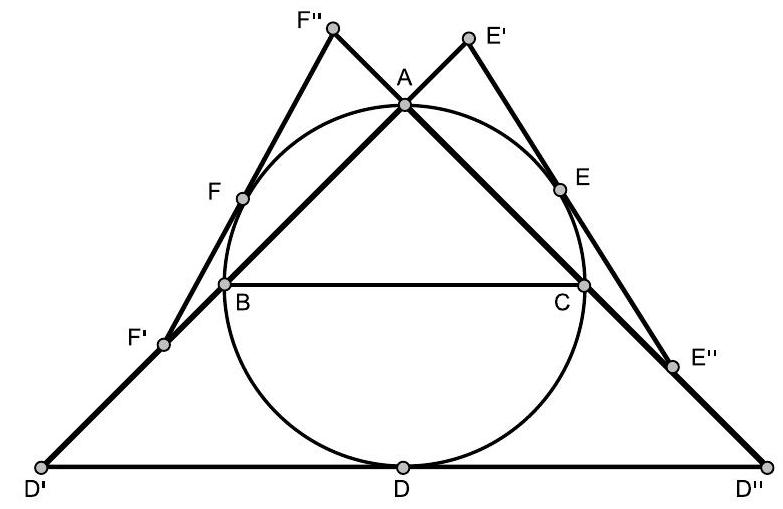", "solution": "A prime indicates where a tangent meets $A B$ and a double prime where it meets $A C$. It is given that $D D^{\\prime}=D D^{\\prime \\prime}, E E^{\\prime}=E E^{\\prime \\prime}$ and $F F^{\\prime}=F F^{\\prime \\prime}$. It is required to show that arc $E F$ is a third of the circumference as is arc $D B F$.\n\n$A F$ is the median to the hypotenuse of right triangle $A F^{\\prime} F^{\\prime \\prime}$, so that $F F^{\\prime}=F A$ and therefore\n\n$$\n\\operatorname{arc} A F=2 \\angle F^{\\prime \\prime} F A=2\\left(\\angle F F^{\\prime} A+\\angle F A F^{\\prime}\\right)=4 \\angle F A F^{\\prime}=4 \\angle F A B=2 \\text { arc } B F \\text {, }\n$$\n\nwhence $\\operatorname{arc} F A=(2 / 3)$ arc $B F A$. Similarly, arc $A E=(2 / 3)$ arc $A E C$. Therefore, $\\operatorname{arc} F E$ is $2 / 3$ of the semicircle, or $1 / 3$ of the circumference as desired.\n\nAs for arc $D B F$, arc $B D=2 \\angle B A D=\\angle B A D+\\angle B D^{\\prime} D=\\angle A D D^{\\prime \\prime}=(1 / 2)$ arc $A C D$. But, arc $B F=(1 / 2)$ arc $A F$, so arc $D B F=(1 / 2)$ arc $F A E D$. That is, arc $D B F$ is $1 / 3$ the circumference and the proof is complete.", "metadata": {"resource_path": "Canada_MO/segmented/en-sol2006.jsonl", "problem_match": "\n5.", "solution_match": "\nSolution 1."}} |
| {"year": "2006", "tier": "T2", "problem_label": "5", "problem_type": null, "exam": "Canada_MO", "problem": "The vertices of a right triangle $A B C$ inscribed in a circle divide the circumference into three arcs. The right angle is at $A$, so that the opposite $\\operatorname{arc} B C$ is a semicircle while $\\operatorname{arc} A B$ and $\\operatorname{arc} A C$ are supplementary. To each of the three arcs, we draw a tangent such that its point of tangency is the midpoint of that portion of the tangent intercepted by the extended lines $A B$ and $A C$. More precisely, the point $D$ on $\\operatorname{arc} B C$ is the midpoint of the segment joining the points $D^{\\prime}$ and $D^{\\prime \\prime}$ where the tangent at $D$ intersects the extended lines $A B$ and $A C$. Similarly for $E$ on arc $A C$ and $F$ on arc $A B$.\n\nProve that triangle $D E F$ is equilateral.\n\n", "solution": "Since $A E^{\\prime} E^{\\prime \\prime}$ is a right triangle, $A E=E E^{\\prime}=E E^{\\prime \\prime}$ so that $\\angle C A E=\\angle C E^{\\prime \\prime} E$. Also $A D=D^{\\prime} D=D D^{\\prime \\prime}$, so that $\\angle C D D^{\\prime \\prime}=\\angle C A D=\\angle C D^{\\prime \\prime} D$. As $E A D C$ is a concyclic quadrilateral,\n\n$$\n\\begin{aligned}\n180^{\\circ} & =\\angle E A D+\\angle E C D \\\\\n& =\\angle D A C+\\angle C A E+\\angle E C A+\\angle A C D \\\\\n& =\\angle D A C+\\angle C A E+\\angle C E E^{\\prime \\prime}+\\angle C E^{\\prime \\prime} E+\\angle C D D^{\\prime \\prime}+\\angle C D^{\\prime \\prime} D \\\\\n& =\\angle D A C+\\angle C A E+\\angle C A E+\\angle C A E+\\angle C A D+\\angle C A D \\\\\n& =3(\\angle D A C+\\angle D A E)=3(\\angle D A E)\n\\end{aligned}\n$$\n\nHence $\\angle D F E=\\angle D A E=60^{\\circ}$. Similarly, $\\angle D E F=60^{\\circ}$. It follows that triangle $D E F$ is equilateral.", "metadata": {"resource_path": "Canada_MO/segmented/en-sol2006.jsonl", "problem_match": "\n5.", "solution_match": "\nSolution 2."}} |
|
|


