| {"year": "2016", "tier": "T2", "problem_label": "1", "problem_type": null, "exam": "Canada_MO", "problem": "The integers $1,2,3, \\ldots, 2016$ are written on a board. You can choose any two numbers on the board and replace them with their average. For example, you can replace 1 and 2 with 1.5 , or you can replace 1 and 3 with a second copy of 2 . After 2015 replacements of this kind, the board will have only one number left on it.\n\n(a) Prove that there is a sequence of replacements that will make the final number equal to 2 .\n\n(b) Prove that there is a sequence of replacements that will make the final number equal to 1000 .", "solution": "(a) First replace 2014 and 2016 with 2015, and then replace the two copies of 2015 with a single copy. This leaves us with $\\{1,2, \\ldots, 2013,2015\\}$. From here, we can replace 2013 and 2015 with 2014 to get $\\{1,2, \\ldots, 2012,2014\\}$. We can then replace 2012 and 2014 with 2013 , and so on, until we eventually get to $\\{1,3\\}$. We finish by replacing 1 and 3 with 2.\n\n(b) Using the same construction as in (a), we can find a sequence of replacements that reduces $\\{a, a+1, \\ldots, b\\}$ to just $\\{a+1\\}$. Similarly, can also find a sequence of replacements that reduces $\\{a, a+1, \\ldots, b\\}$ to just $\\{b-1\\}$.\n\nIn particular, we can find sequences of replacements that reduce $\\{1,2, \\ldots, 999\\}$\n\nto just $\\{998\\}$, and that reduce $\\{1001,1002, \\ldots, 2016\\}$ to just $\\{1002\\}$. This leaves us with $\\{998,1000,1002\\}$. We can replace 998 and 1002 with a second copy of 1000 , and then replace the two copies of 1000 with a single copy to complete the construction.", "metadata": {"resource_path": "Canada_MO/segmented/en-sol2016.jsonl", "problem_match": "\n1.", "solution_match": "\nSolution:"}} |
| {"year": "2016", "tier": "T2", "problem_label": "2", "problem_type": null, "exam": "Canada_MO", "problem": "Consider the following system of 10 equations in 10 real variables $v_{1}, \\ldots, v_{10}$ :\n\n$$\nv_{i}=1+\\frac{6 v_{i}^{2}}{v_{1}^{2}+v_{2}^{2}+\\cdots+v_{10}^{2}} \\quad(i=1, \\ldots, 10) .\n$$\n\nFind all 10-tuples $\\left(v_{1}, v_{2}, \\ldots, v_{10}\\right)$ that are solutions of this system.\n\n## Sun\n\nLife Financial", "solution": "For a particular solution $\\left(v_{1}, v_{2}, \\ldots, v_{10}\\right)$, let $s=v_{1}^{2}+v_{2}^{2}+\\cdots+v_{10}^{2}$. Then\n\n$$\nv_{i}=1+\\frac{6 v_{i}^{2}}{s} \\Rightarrow 6 v_{i}^{2}-s v_{i}+s=0\n$$\n\nLet $a$ and $b$ be the roots of the quadratic $6 x^{2}-s x+s=0$, so for each $i, v_{i}=a$ or $v_{i}=b$. We also have $a b=s / 6$ (by Vieta's formula, for example).\n\nIf all the $v_{i}$ are equal, then\n\n$$\nv_{i}=1+\\frac{6}{10}=\\frac{8}{5}\n$$\n\nfor all $i$. Otherwise, let $5+k$ of the $v_{i}$ be $a$, and let $5-k$ of the $v_{i}$ be $b$, where $0<k \\leq 4$. Then by the AM-GM inequality,\n\n$$\n6 a b=s=(5+k) a^{2}+(5-k) b^{2} \\geq 2 a b \\sqrt{25-k^{2}}\n$$\n\nFrom the given equations, $v_{i} \\geq 1$ for all $i$, so $a$ and $b$ are positive. Then $\\sqrt{25-k^{2}} \\leq 3 \\Rightarrow 25-k^{2} \\leq 9 \\Rightarrow k^{2} \\geq 16 \\Rightarrow k=4$. Hence, $6 a b=9 a^{2}+b^{2} \\Rightarrow(b-3 a)^{2}=0 \\Rightarrow b=3 a$.\n\nAdding all given ten equations, we get\n\n$$\nv_{1}+v_{2}+\\cdots+v_{10}=16\n$$\n\nBut $v_{1}+v_{2}+\\cdots+v_{10}=9 a+b=12 a$, so $a=16 / 12=4 / 3$ and $b=4$. Therefore, the solutions are $(8 / 5,8 / 5, \\ldots, 8 / 5)$ and all ten permutations of $(4 / 3,4 / 3, \\ldots, 4 / 3,4)$.", "metadata": {"resource_path": "Canada_MO/segmented/en-sol2016.jsonl", "problem_match": "\n2.", "solution_match": "\n## Solution:"}} |
| {"year": "2016", "tier": "T2", "problem_label": "3", "problem_type": null, "exam": "Canada_MO", "problem": "Find all polynomials $P(x)$ with integer coefficients such that $P(P(n)+$ $n$ ) is a prime number for infinitely many integers $n$.\n\nAnswer: $P(n)=p$ where $p$ is a prime number and $P(n)=-2 n+b$ where $b$ is odd.", "solution": "Note that if $P(n)=0$ then $P(P(n)+n)=P(n)=0$ which is not prime. Let $P(x)$ be a degree $k$ polynomial of the form $P(x)=a_{k} x^{k}+a_{k-1} x^{k-1}+\\cdots+a_{0}$ and note that if $P(n) \\neq 0$ then\n\n$$\n\\begin{aligned}\n& P(P(n)+n)-P(n)= \\\\\n& \\quad a_{k}\\left[(P(n)+n)^{k}-n^{k}\\right]+a_{k-1}\\left[(P(n)+n)^{k-1}-n^{k-1}\\right]+\\cdots+a_{1} P(n)\n\\end{aligned}\n$$\n\nwhich is divisible by $(P(n)+n)-n=P(n)$. Therefore if $P(P(n)+n)$ is prime then either $P(n)= \\pm 1$ or $P(P(n)+n)= \\pm P(n)=p$ for some prime number $p$. Since $P(x)$ is a polynomial, it follows that $P(n)= \\pm 1$ for only finitely many integers $n$. Therefore either $P(n)=P(P(n)+n)$ for infinitely many integers $n$ or $P(n)=-P(P(n)+n)$ for infinitely many integers $n$. Suppose that $P(n)=P(P(n)+n)$ for infinitely many integers $n$. This implies that the polynomial $P(P(x)+x)-P(x)$ has infinitely many roots and thus is identically zero. Therefore $P(P(x)+$ $x)=P(x)$ holds identically. Now note that if $k \\geq 2$ then $P(P(x)+x)$ has degree $k^{2}$ while $P(x)$ has degree $k$, which is not possible. Therefore $P(x)$ is at most linear with $P(x)=a x+b$ for some integers $a$ and $b$. Now note that\n\n$$\nP(P(x)+x)=a(a+1) x+a b+b\n$$\n\nand thus $a=a(a+1)$ and $a b+b=b$. It follows that $a=0$ which leads to the solution $P(n)=p$ where $p$ is a prime number. By the same argument if $P(n)=-P(P(n)+n)$ for infinitely many integers $n$ then $P(x)=-P(P(x)+x)$ holds identically and $P(x)$ is linear with $P(x)=a x+b$. In this case it follows that $a=-a(a+1)$ and $a b+b=-b$. This implies that either $a=0$ or $a=-2$. If $a=-2$ then $P(n)=-2 n+b$ which is prime for some integers $n$ only if $b$ is odd. Note that in this case $P(P(n)+n)=2 n-b$ which is indeed prime for infinitely many integers $n$ as long as $b$ is odd.", "metadata": {"resource_path": "Canada_MO/segmented/en-sol2016.jsonl", "problem_match": "\n3.", "solution_match": "\nSolution:"}} |
| {"year": "2016", "tier": "T2", "problem_label": "4", "problem_type": null, "exam": "Canada_MO", "problem": "Lavaman versus the Flea. Let $A, B$, and $F$ be positive integers, and assume $A<B<2 A$. A flea is at the number 0 on the number line. The flea can move by jumping to the right by $A$ or by $B$. Before the flea starts jumping, Lavaman chooses finitely many intervals $\\{m+$ $1, m+2, \\ldots, m+A\\}$ consisting of $A$ consecutive positive integers, and places lava at all of the integers in the intervals. The intervals must be chosen so that:\n\n(i) any two distinct intervals are disjoint and not adjacent;\n\n(ii) there are at least $F$ positive integers with no lava between any two intervals; and\n\n(iii) no lava is placed at any integer less than $F$.\n\nProve that the smallest $F$ for which the flea can jump over all the intervals and avoid all the lava, regardless of what Lavaman does,\nis $F=(n-1) A+B$, where $n$ is the positive integer such that $\\frac{A}{n+1} \\leq B-A<\\frac{A}{n}$.", "solution": "Let $B=A+C$ where $A /(n+1) \\leq C<A / n$.\n\nFirst, here is an informal sketch of the proof.\n\nLavaman's strategy: Use only safe intervals with $n A+C-1$ integers. The flea will start at position $[1, C]$ from the left, which puts him at position $[n A, n A+C-1]$ from the right. After $n-1$ jumps, he will still have $n A-(n-1)(A+C)=A-(n-1) C>C$ distance to go, which is not enough for a big jump to clear the lava. Thus, he must do at least $n$ jumps in the safe interval, but that's possible only with all small jumps, and furthermore is impossible if the starting position is $C$. This gives him starting position 1 higher in the next safe interval, so sooner or later the flea is going to hit the lava.\n\nFlea's strategy: The flea just does one interval at a time. If the safe interval has at least $n A+C$ integers in it, the flea has distance $d>n A$ to go to the next lava when it starts. Repeatedly do big jumps until $d$ is between 1 and $C \\bmod A$, then small jumps until the remaining distance is between 1 and $C$, then a final big jump. This works as long as the first part does. However, we get at least $n$ big jumps since floor $((d-1) / A)$ can never go down two from a big jump (or we'd be done doing big jumps), so we get $n$ big jumps, and thus we are good if $d \\bmod A$ is in any of $[1, C],[C+1,2 C], \\ldots[n C+1,(n+1) C]$, but that's everything.\n\nLet $C=B-A$. We shall write our intervals of lava in the form $\\left(L_{i}, R_{i}\\right]=\\left\\{L_{i}+1, L_{i}+2, \\ldots, R_{i}\\right\\}$, where $R_{i}=L_{i}+A$ and $R_{i-1}<L_{i}$ for every $i \\geq 1$. We also let $R_{0}=0$. We shall also represent a path for the flea as a sequence of integers $x_{0}, x_{1}, x_{2}, \\ldots$ where $x_{0}=0$ and $x_{j}-x_{j-1} \\in\\{A, B\\}$ for every $j \\geq 0$.\n\nNow here is a detailed proof.\n\nFirst, assume $F<(n-1) A+B(=n A+C)$ : we must prove that Lavaman has a winning strategy. Let $L_{i}=R_{i-1}+n A+C-1$ for every $i \\geq 1$. (Observe that $n A+C-1 \\geq F$.)\n\nAssume that the flea has an infinite path that avoids all the lava, which\nmeans that $x_{j} \\notin\\left(L_{i}, R_{i}\\right]$ for all $i, j \\geq 1$. For each $i \\geq 1$, let\n\n$$\n\\begin{gathered}\nM_{i}=\\max \\left\\{x_{j}: x_{j} \\leq L_{i}\\right\\}, \\quad m_{i}=\\min \\left\\{x_{j}: x_{j}>R_{i}\\right\\}, \\\\\n\\text { and } J(i)=\\max \\left\\{j: x_{j} \\leq L_{i}\\right\\}\n\\end{gathered}\n$$\n\nAlso let $m_{0}=0$. Then for $i \\geq 1$ we have\n\n$$\nM_{i}=x_{J(i)} \\quad \\text { and } \\quad m_{i}=x_{J(i)+1} .\n$$\n\nAlso, for every $i \\geq 1$, we have\n\n(a) $m_{i}=M_{i}+B$ (because $M_{i}+A \\leq L_{i}+A=R_{i}$ );\n\n(b) $L_{i} \\geq M_{i}>L_{i}-C\\left(\\right.$ since $\\left.M_{i}=m_{i}-B>R_{i}-B=L_{i}+A-B\\right)$;\n\nand\n\n(c) $R_{i}<m_{i} \\leq R_{i}+C\\left(\\right.$ since $\\left.m_{i}=M_{i}+B \\leq L_{i}+B=R_{i}+C\\right)$.\n\nClaim 1: $J(i+1)=J(i)+n+1$ for every $i \\geq 1$. (That is, after jumping over one interval of lava, the flea must make exactly $n$ jumps before jumping over the next interval of lava.)\n\nProof:\n\n$$\n\\begin{aligned}\nx_{J(i)+n+1} & \\leq x_{J(i)+1}+B n \\\\\n& =m_{i}+B n \\\\\n& <R_{i}+C+\\left(A+\\frac{A}{n}\\right) n \\\\\n& =L_{i+1}+A+1\n\\end{aligned}\n$$\n\nBecause of the strict inequality, we have $x_{J(i)+n+1} \\leq R_{i+1}$, and hence $x_{J(i)+n+1} \\leq L_{i+1}$. Therefore $J(i)+n+1 \\leq J(i+1)$. Next, we have\n\n$$\n\\begin{aligned}\nx_{J(i)+n+1} & \\geq x_{J(i)+1}+A n \\\\\n& =m_{i}+A n \\\\\n& >R_{i}+A n \\\\\n& =L_{i+1}-C+1 \\\\\n& >L_{i+1}-A+1 \\quad(\\text { since } C<A) .\n\\end{aligned}\n$$\n\nTherefore $x_{J(i)+n+2} \\geq x_{J(i)+n+1}+A>L_{i+1}$, and hence $J(i+1)<$ $J(i)+n+2$. Claim 1 follows.\n\nClaim 2: $x_{j+1}-x_{j}=A$ for all $j=J(i)+1, \\ldots, J(i+1)-1$, for all $i \\geq 1$. (That is, the $n$ intermediate jumps of Claim 1 must all be of\nlength $A$.)\n\nProof: If Claim 2 is false, then\n\n$$\n\\begin{aligned}\nM_{i+1}=x_{J(i+1)}=x_{J(i)+n+1} & \\geq x_{J(i)+1}+(n-1) A+B \\\\\n& >R_{i}+n A+C \\\\\n& =L_{i+1}+1 \\\\\n& >M_{i+1}\n\\end{aligned}\n$$\n\nwhich is a contradiction. This proves Claim 2.\n\nWe can now conclude that\n\n$$\n\\begin{aligned}\n& x_{J(i+1)+1}=x_{J(i)+n+2}=x_{J(i)+1}+n A+B \\\\\n& \\text { i.e., } \\quad m_{i+1}=m_{i}+n A+B \\quad \\text { for each } i \\geq 1\n\\end{aligned}\n$$\n\nTherefore\n\n$$\n\\begin{aligned}\nm_{i+1}-R_{i+1} & =m_{i}+n A+B-\\left(R_{i}+n A+C-1+A\\right) \\\\\n& =m_{i}-R_{i}+1\n\\end{aligned}\n$$\n\nHence\n\n$$\nC \\geq m_{C+1}-R_{C+1}=m_{1}-R_{1}+C>C\n$$\n\nwhich is a contradiction. Therefore no path for the flea avoids all the lava. We observe that Lavaman only needs to put lava on the first $C+1$ intervals.\n\nNow assume $F \\geq(n-1) A+B$. We will show that the flea can avoid all the lava. We shall need the following result:\n\nClaim 3: Let $d \\geq n A$. Then there exist nonnegative integers $s$ and $t$ such that $s A+t B \\in(d-C, d]$.\n\nWe shall prove this result at the end.\n\nFirst, observe that $L_{1} \\geq n A$. By Claim 3 , it is possible for the flea to make a sequence of jumps starting from 0 and ending at a point of $\\left(L_{1}-C, L_{1}\\right]$. From any point of this interval, a single jump of size $B$ takes the flea over ( $L_{1}, R_{]}$to a point in $\\left(R_{1}, R_{1}+C\\right]$, which corresponds to the point $x_{J(1)+1}\\left(=m_{1}\\right)$ on the flea's path.\n\nNow we use induction to prove that, for every $i \\geq 1$, there is a path such that $x_{j}$ avoids lava for all $j \\leq J(i)+1$. The case $i=1$ is done, so\nassume that the assertion holds for a given $i$. Then $x_{J(i)+1}=m_{i} \\in$ $\\left(R_{i}, R_{i}+C\\right]$. Therefore\n\n$$\nL_{i+1}-m_{i} \\geq R_{i}+F-\\left(R_{i}+C\\right)=F-C \\geq n A\n$$\n\nApplying Claim 3 with $d=L_{i+1}-m_{i}$ shows that the flea can jump from $m_{i}$ to a point of $\\left(L_{i+1}-C, L_{i+1}\\right]$. A single jump of size $B$ then takes the flea to a point of $\\left(R_{i+1}, R_{i+1}+C\\right]$ (without visiting $\\left(L_{i+1}, R_{i+1}\\right]$ ), and this point serves as $x_{J(i+1)+1}$. This completes the induction.\n\nProof of Claim 3: Let $u$ be the greatest integer that is less than or equal to $d / A$. Then $u \\geq n$ and $u A \\leq d<(u+1) A$. For $v=0, \\ldots, n$, let\n\n$$\nz_{v}=(u-v) A+v B=u A+v C .\n$$\n\nThen\n\n$$\n\\begin{aligned}\n& \\quad z_{0}=u A \\leq d \\\\\n& z_{n}=u A+n C=u A+(n+1) C-C \\geq(u+1) A-C>d-C . \\\\\n& \\text { and } z_{v+1}-z_{v}=C \\quad \\text { for } v=0, \\ldots, n-1\n\\end{aligned}\n$$\n\nTherefore we must have $z_{v} \\in(d-C, d]$ for some $v$ in $\\{0,1, \\ldots, n\\}$.", "metadata": {"resource_path": "Canada_MO/segmented/en-sol2016.jsonl", "problem_match": "\n4.", "solution_match": "\nSolution:"}} |
| {"year": "2016", "tier": "T2", "problem_label": "5", "problem_type": null, "exam": "Canada_MO", "problem": "Let $\\triangle A B C$ be an acute-angled triangle with altitudes $A D$ and $B E$ meeting at $H$. Let $M$ be the midpoint of segment $A B$, and suppose that the circumcircles of $\\triangle D E M$ and $\\triangle A B H$ meet at points $P$ and $Q$ with $P$ on the same side of $C H$ as $A$. Prove that the lines $E D$, $P H$, and $M Q$ all pass through a single point on the circumcircle of $\\triangle A B C$.", "solution": "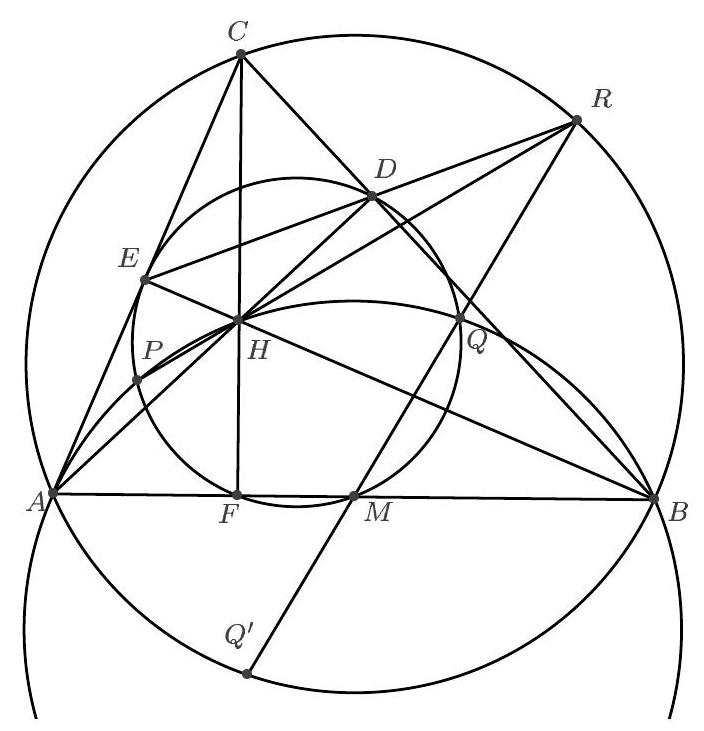\n\nLet $R$ denote the intersection of lines $E D$ and $P H$. Since quadrilaterals $E C D H$ and $A P H B$ are cyclic, we have $\\angle R D A=180^{\\circ}-\\angle E D A=$ $180^{\\circ}-\\angle E D H=180^{\\circ}-\\angle E C H=90^{\\circ}+A$, and $\\angle R P A=\\angle H P A=$ $180^{\\circ}-\\angle H B A=90^{\\circ}+A$. Therefore, $A P D R$ is cyclic. This in turn implies that $\\angle P B E=\\angle P B H=\\angle P A H=\\angle P A D=\\angle P R D=\\angle P R E$, and so $P B R E$ is also cyclic.\n\nLet $F$ denote the base of the altitude from $C$ to $A B$. Then $D, E, F$, and $M$ all lie on the 9-point circle of $\\triangle A B C$, and so are cyclic. We also know $A P D R, P B R E, B C E F$, and $A C D F$ are cyclic, which implies $\\angle A R B=\\angle P R B-\\angle P R A=\\angle P E B-\\angle P D A=\\angle P E F+\\angle F E B-$ $\\angle P D F+\\angle A D F=\\angle F E B+\\angle A D F=\\angle F C B+\\angle A C F=C$. Therefore, $R$ lies on the circumcircle of $\\triangle A B C$.\n\nNow let $Q^{\\prime}$ and $R^{\\prime}$ denote the intersections of line $M Q$ with the circumcircle of $\\triangle A B C$, chosen so that $Q^{\\prime}, M, Q, R^{\\prime}$ lie on the line in that order. We will show that $R^{\\prime}=R$, which will complete the proof. However, first note that the circumcircle of $\\triangle A B C$ has radius $\\frac{A B}{2 \\sin C}$, and the circumcircle of $\\triangle A B H$ has radius $\\frac{A B}{2 \\sin \\angle A H B}=\\frac{A B}{2 \\sin \\left(180^{\\circ}-C\\right)}$. Thus the two circles have equal radius, and so they must be symmetrical about the point $M$. In particular, $M Q=M Q^{\\prime}$.\n\nSince $\\angle A E B=\\angle A D B=90^{\\circ}$, we furthermore know that $M$ is the circumcenter of both $\\triangle A E B$ and $\\triangle A D B$. Thus, $M A=M E=M D=$ $M B$. By Power of a Point, we then have $M Q \\cdot M R^{\\prime}=M Q^{\\prime} \\cdot M R^{\\prime}=$ $M A \\cdot M B=M D^{2}$. In particular, this means that the circumcircle of\n$\\triangle D R^{\\prime} Q$ is tangent to $M D$ at $D$, which means $\\angle M R^{\\prime} D=\\angle M D Q$. Similarly $M Q \\cdot M R^{\\prime}=M E^{2}$, and so $\\angle M R^{\\prime} E=\\angle M E Q=\\angle M D Q=$ $\\angle M R^{\\prime} D$. Therefore, $R^{\\prime}$ also lies on the line $E D$.\n\nFinally, the same argument shows that $M P$ also intersects the circumcircle of $\\triangle A B C$ at a point $R^{\\prime \\prime}$ on line $E D$. Thus, $R, R^{\\prime}$, and $R^{\\prime \\prime}$ are all chosen from the intersection of the circumcircle of $\\triangle A B C$ and the line $E D$. In particular, two of $R, R^{\\prime}$, and $R^{\\prime \\prime}$ must be equal. However, $R^{\\prime \\prime} \\neq R$ since $M P$ and $P H$ already intersect at $P$, and $R^{\\prime \\prime} \\neq R^{\\prime}$ since $M P$ and $M Q$ already intersect at $M$. Thus, $R^{\\prime}=R$, and the proof is complete.", "metadata": {"resource_path": "Canada_MO/segmented/en-sol2016.jsonl", "problem_match": "\n5.", "solution_match": "\n## Solution:"}} |
|
|


