| {"year": "2019", "tier": "T2", "problem_label": "1", "problem_type": null, "exam": "Canada_MO", "problem": "Amy has drawn three points in a plane, $A, B$, and $C$, such that $A B=B C=C A=6$. Amy is allowed to draw a new point if it is the circumcenter of a triangle whose vertices she has already drawn. For example, she can draw the circumcenter $O$ of triangle $A B C$, and then afterwards she can draw the circumcenter of triangle $A B O$.\n\n(a) Prove that Amy can eventually draw a point whose distance from a previously drawn point is greater than 7 .\n\n(b) Prove that Amy can eventually draw a point whose distance from a previously drawn point is greater than 2019.\n\n(Recall that the circumcenter of a triangle is the center of the circle that passes through its three vertices.)", "solution": "(a) Given triangle $\\triangle A B C$, Amy can draw the following points:\n\n- $O$ is the circumcenter of $\\triangle A B C$\n- $A_{1}$ is the circumcenter of $\\triangle B O C$\n- $A_{2}$ is the circumcenter of $\\triangle O B A_{1}$\n- $A_{3}$ is the circumcenter of $\\triangle B A_{2} A_{1}$\n\nWe claim that $A A_{3}>7$. We present two ways to prove this claim.\n\nFirst Method: By symmetry of the equilateral triangle $\\triangle A B C$, we have $\\angle A O B=\\angle B O C=\\angle C O A=120^{\\circ}$. Since $O B=O C$ and $A_{1} B=A_{1} O=A_{1} C$, we deduce that $\\triangle A_{1} O B \\cong \\triangle A_{1} O C$, and hence $\\angle B O A_{1}=\\angle C O A_{1}=60^{\\circ}$. Therefore, since $\\triangle A_{1} O B$ is isosceles, it must be equilateral. As we found for our original triangle, we find $\\angle B A_{2} A_{1}=120^{\\circ}$, and so $\\angle A_{2} B A_{1}=\\angle A_{2} A_{1} B=30^{\\circ}$ (since\n\n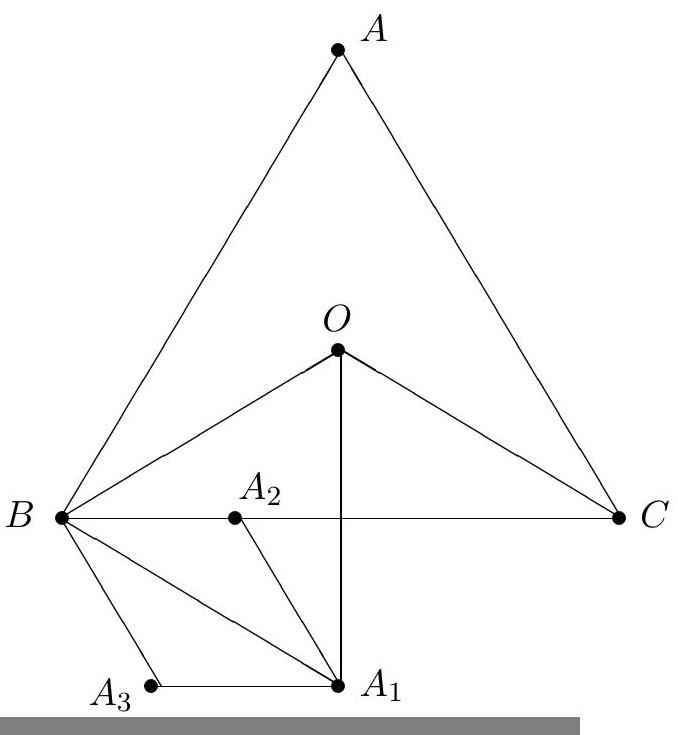\n\nA competition of the Canadian Mathematical Society and supported by the Actuarial Profession.\n\n$\\left.A_{2} B=A_{2} A_{1}\\right)$. Also we see that $\\angle O B A_{2}=30^{\\circ}=\\angle O B C$, which shows that $A_{2}$ lies on the segment $B C$.\n\nApplying the Law of Sines to $\\triangle B O C$, we obtain\n\n$$\nO C=\\frac{B C \\sin (\\angle O B C)}{\\sin (\\angle B O C)}=\\frac{6(1 / 2)}{\\sqrt{3} / 2}=2 \\sqrt{3} .\n$$\n\nBy symmetry, we see that (i) $O A_{1}$ is the bisector of $\\angle B O C$ and the perpendicular bisector of $B C$, and (ii) the three points $A, O$, and $A_{1}$ are collinear. Therefore $A_{1} A=A_{1} O+O A=2 O A=4 \\sqrt{3}$.\n\nThe same argument that we used to show $\\triangle A_{1} O B$ is equilateral with side $A C / \\sqrt{3}$ shows that $\\triangle A_{3} A_{2} A_{1}$ is equilateral with side $O B / \\sqrt{3}=2$. Thus $\\angle A_{3} A_{1} O=\\angle O A_{1} B+\\angle A_{3} A_{1} A_{2}-\\angle A_{2} A_{1} B=$ $60^{\\circ}+60^{\\circ}-30^{\\circ}=90^{\\circ}$. Hence we can apply the Pythagorean Theorem:\n\n$$\nA_{3} A=\\sqrt{\\left(A_{3} A_{1}\\right)^{2}+\\left(A_{1} A\\right)^{2}}=\\sqrt{2^{2}+(4 \\sqrt{3})^{2}}=\\sqrt{52}>\\sqrt{49}=7 .\n$$\n\nSecond Method: (An alternative to writing the justifications of the constructions in the First Method is to use analytic geometry. Once the following coordinates are found using the kind of reasoning in the First Method or by other means, the writeup can justify them succinctly by computing distances.) Label $(0,0)$ as $B,(6,0)$ as $C$, and $(3, \\sqrt{3})$ as $A$. Then we have $A B=B C=C A=6$.\n\nThe circumcenter $O$ of $\\triangle A B C$ is $(3, \\sqrt{3})$; this can be verified by observing $O A=O B=O C=2 \\sqrt{3}$. Next, the point $A_{1}=(3,-\\sqrt{3})$ satisfies $A_{1} O=A_{1} B=A_{1} C=2 \\sqrt{3}$, so $A_{1}$ is the circumcenter of $\\triangle B O C$.\n\nThe point $A_{2}=(2,0)$ satisfies $A_{2} O=A_{2} B=A_{2} A_{1}=2$, so this is the circumcenter of $\\triangle O B A_{1}$.\n\nAnd the point $A_{3}=(1,-\\sqrt{3})$ satisfies $A_{3} B=A_{3} A_{2}=A_{3} A_{1}=2$, so this is the circumcenter of $\\triangle B A_{2} A_{1}$.\n\nFinally, we compute $A_{3} A=\\sqrt{52}>\\sqrt{49}=7$, and part (a) is proved.\n\n(b) In part (a), using either method we find that $O A_{3}=4>2 \\sqrt{3}=O A$. By rotating the construction of part (a) by $\\pm 120^{\\circ}$ about $O$, Amy can construct $B_{3}$ and $C_{3}$ such that $\\triangle A_{3} B_{3} C_{3}$ is equilateral with circumcenter $O$ and circumradius 4 , which is strictly bigger than the circumradius $2 \\sqrt{3}$ of $\\triangle A B C$. Amy can repeat this process starting from $\\triangle A_{3} B_{3} C_{3}$. After $n$ iterations of the process, Amy will have drawn the vertices of an equilateral triangle whose circumradius is $2 \\sqrt{3}\\left(\\frac{4}{2 \\sqrt{3}}\\right)^{n}$, which is bigger than 2019 when $n$ is sufficiently large.", "metadata": {"resource_path": "Canada_MO/segmented/en-sol2019.jsonl", "problem_match": "\n1.", "solution_match": "\n## Solution."}} |
| {"year": "2019", "tier": "T2", "problem_label": "2", "problem_type": null, "exam": "Canada_MO", "problem": "Let $a$ and $b$ be positive integers such that $a+b^{3}$ is divisible by $a^{2}+3 a b+3 b^{2}-1$. Prove that $a^{2}+3 a b+3 b^{2}-1$ is divisible by the cube of an integer greater than 1 .", "solution": "Let $Z=a^{2}+3 a b+3 b^{2}-1$. By assumption, there is a positive integer $c$ such that $c Z=a+b^{3}$. Noticing the resemblance between the first three terms of $Z$ and those of the expansion of $(a+b)^{3}$, we are led to\n\n$$\n(a+b)^{3}=a\\left(a^{2}+3 a b+3 b^{2}\\right)+b^{3}=a(Z+1)+b^{3}=a Z+a+b^{3}=a Z+c Z .\n$$\n\nThus $Z$ divides $(a+b)^{3}$.\n\nLet the prime factorization of $a+b$ be $p_{1}^{e_{1}} p_{2}^{e_{2}} \\cdots p_{k}^{e_{k}}$ and let $Z=p_{1}^{f_{1}} p_{2}^{f_{2}} \\cdots p_{k}^{f_{k}}$, where $f_{i} \\leq 3 e_{i}$ for each $i$ since $Z$ divides $(a+b)^{3}$. If $Z$ is not divisible by a perfect cube greater than one, then $0 \\leq f_{i} \\leq 2$ and hence $f_{i} \\leq 2 e_{i}$ for each $i$. This implies that $Z$ divides $(a+b)^{2}$. However, $(a+b)^{2}<a^{2}+3 a b+3 b^{2}-1=Z$ since $a, b \\geq 1$, which is a contradiction. Thus $Z$ must be divisible by a perfect cube greater than one.\n\nRemark. A brute force search yields many pairs $(a, b)$ satisfying this divisibility property. Examples include $(3,5),(19,11),(111,29)$ as well as twelve others satisfying that $a, b \\leq 1000$. The values of $a^{2}+3 a b+3 b^{2}-1$ for these three pairs are $128=2^{7}, 1350=2 \\times 3^{3} \\times 5^{2}$ and $24500=2^{2} \\times 5^{3} \\times 7^{2}$, all of which have different perfect cube divisors.", "metadata": {"resource_path": "Canada_MO/segmented/en-sol2019.jsonl", "problem_match": "\n2.", "solution_match": "\n## Solution."}} |
| {"year": "2019", "tier": "T2", "problem_label": "3", "problem_type": null, "exam": "Canada_MO", "problem": "Let $m$ and $n$ be positive integers. A $2 m \\times 2 n$ grid of squares is coloured in the usual chessboard fashion. Find the number of ways of placing $m n$ counters on the white squares, at most one counter per square, so that no two counters are on white squares that are diagonally adjacent. An example of a way to place the counters when $m=2$ and $n=3$ is shown below.\n\n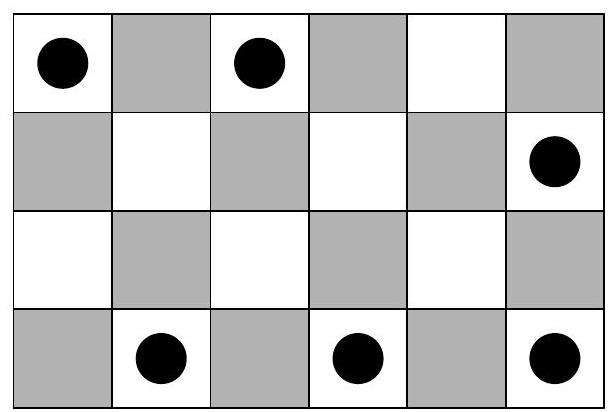", "solution": "Divide the chessboard into $m n 2 \\times 2$ squares.\n\n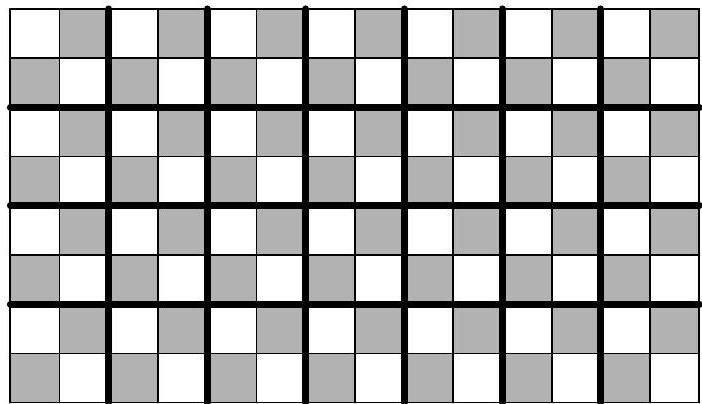\n\nEach $2 \\times 2$ square can contain at most one counter. Since we want to place $m n$ counters, each $2 \\times 2$ square must contain exactly one counter.\n\nAssume that the lower-right corner of the $2 m \\times 2 n$ chessboard is white, so in each $2 \\times 2$ square, the upper-left and lower-right squares are white. Call a $2 \\times 2$ square UL if the counter it contains is on the upper-left white square, and call it LR if the counter it contains is on the lower-right white square.\n\nSuppose some $2 \\times 2$ square is UL. Then the $2 \\times 2$ square above it (if it exists) must also be UL, and the $2 \\times 2$ square to the left of it (if it exists) must also be UL.\n\n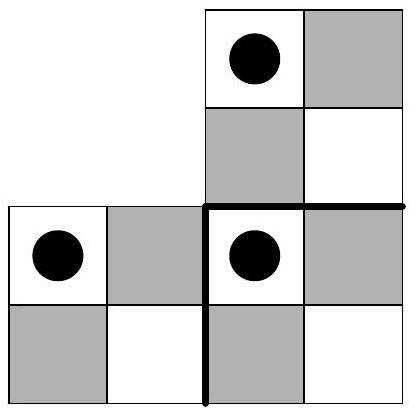\n\nSimilarly, if some $2 \\times 2$ square is LR, then the $2 \\times 2$ square below it (if it exists) must also be LR, and the $2 \\times 2$ square to the right of it (if it exists) must also be LR.\n\n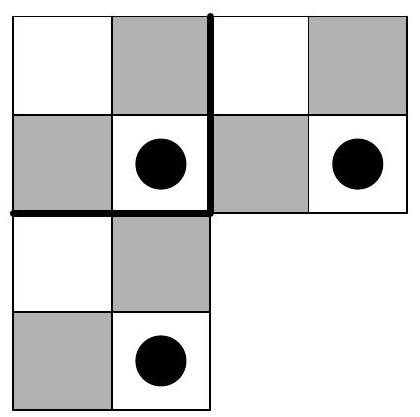\n\nThen the collection of UL $2 \\times 2$ squares form a region that is top-justified and left-justified, and the collection of LR $2 \\times 2$ squares form a region that is bottom-justified and right-justified. This means that the boundary between the two regions forms a path between the lower-left corner and upper-right corner of the $2 m \\times 2 n$ chessboard.\n\n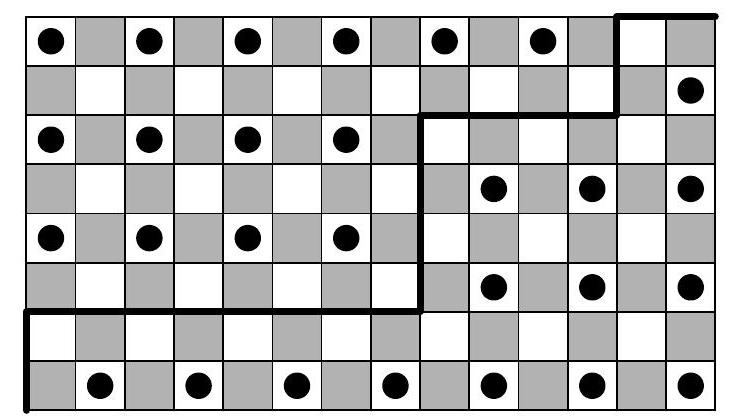\n\nConversely, any path from the lower-left corner to the upper-right corner, where each step consists of two units, can serve as the boundary of the UL squares and LR squares. Thus, the number of ways of placing the counters is equal to the number of paths, which is $\\left(\\begin{array}{c}m+n \\\\ m\\end{array}\\right)$.", "metadata": {"resource_path": "Canada_MO/segmented/en-sol2019.jsonl", "problem_match": "\n3.", "solution_match": "\n## Solution."}} |
| {"year": "2019", "tier": "T2", "problem_label": "4", "problem_type": null, "exam": "Canada_MO", "problem": "Let $n$ be an integer greater than 1 , and let $a_{0}, a_{1}, \\ldots, a_{n}$ be real numbers with $a_{1}=a_{n-1}=0$. Prove that for any real number $k$,\n\n$$\n\\left|a_{0}\\right|-\\left|a_{n}\\right| \\leq \\sum_{i=0}^{n-2}\\left|a_{i}-k a_{i+1}-a_{i+2}\\right|\n$$", "solution": "Let $Q(x)=x^{2}-k x-1$ and let $P(x)=a_{0}+a_{1} x+\\cdots+a_{n} x^{n}$. Note that the product of the two roots of $Q(x)$ is -1 and thus one of the two roots has magnitude at most 1. Let $z$ be this root. Now note that since $a_{1}=a_{n-1}=0$, we have that\n\n$$\n\\begin{aligned}\n0=Q(z) P(z) & =-a_{0}-k a_{0} z+\\sum_{i=0}^{n-2}\\left(a_{i}-k a_{i+1}-a_{i+2}\\right) z^{i+2}-k a_{n} z^{n+1}+a_{n} z^{n+2} \\\\\n& =a_{0}(-1-k z)+\\sum_{i=0}^{n-2}\\left(a_{i}-k a_{i+1}-a_{i+2}\\right) z^{i+2}+a_{n} z^{n}\\left(z^{2}-k z\\right) \\\\\n& =-a_{0} z^{2}+\\sum_{i=0}^{n-2}\\left(a_{i}-k a_{i+1}-a_{i+2}\\right) z^{i+2}+a_{n} z^{n}\n\\end{aligned}\n$$\n\nwhere the third equality follows since $z^{2}-k z-1=0$. The triangle inequality now implies\n\n$$\n\\begin{aligned}\n\\left|a_{0}\\right| \\cdot|z|^{2} & \\leq\\left|a_{n}\\right| \\cdot|z|^{n}+\\sum_{i=0}^{n-2}\\left|a_{i}-k a_{i+1}-a_{i+2}\\right| \\cdot|z|^{i+2} \\\\\n& \\leq\\left|a_{n}\\right| \\cdot|z|^{2}+\\sum_{i=0}^{n-2}\\left|a_{i}-k a_{i+1}-a_{i+2}\\right| \\cdot|z|^{2}\n\\end{aligned}\n$$\n\nsince $|z| \\leq 1$ and $n \\geq 2$. Since $z \\neq 0$, the inequality is obtained on dividing by $|z|^{2}$.", "metadata": {"resource_path": "Canada_MO/segmented/en-sol2019.jsonl", "problem_match": "\n4.", "solution_match": "\n## First Solution."}} |
| {"year": "2019", "tier": "T2", "problem_label": "4", "problem_type": null, "exam": "Canada_MO", "problem": "Let $n$ be an integer greater than 1 , and let $a_{0}, a_{1}, \\ldots, a_{n}$ be real numbers with $a_{1}=a_{n-1}=0$. Prove that for any real number $k$,\n\n$$\n\\left|a_{0}\\right|-\\left|a_{n}\\right| \\leq \\sum_{i=0}^{n-2}\\left|a_{i}-k a_{i+1}-a_{i+2}\\right|\n$$", "solution": "Let $k$ be a real number. Put\n\n$$\nR= \\begin{cases}\\sqrt{k^{2}+4} & \\text { if } k \\geq 0 \\\\ -\\sqrt{k^{2}+4} & \\text { if } k<0\\end{cases}\n$$\n\nDefine the polynomial\n\n$$\nS(x)=x^{2}+R x+1\n$$\n\nThe roots of $S$ are\n\n$$\nb=\\frac{-R-k}{2} \\quad \\text { and } \\quad c=\\frac{-R+k}{2}\n$$\n\nThen we have\n\n$$\nb-c=-k, \\quad b c=1, \\quad \\text { and } \\quad|c| \\leq 1\n$$\n\n(the inequality follows from $b c=1$ and $|c| \\leq|b|$ ).\n\nPut $d_{i}=a_{i}+b a_{i+1}$ for $i=0,1, \\ldots, n-1$. Then, for $i=0,1, \\ldots, n-2$, we have\n\n$$\n\\begin{aligned}\nd_{i}-c d_{i+1} & =a_{i}+(b-c) a_{i+1}-b c a_{i+2} \\\\\n& =a_{i}-k a_{i+1}-a_{i+2}\n\\end{aligned}\n$$\n\nTherefore\n\n$$\n\\begin{aligned}\n\\sum_{i=0}^{n-2}\\left|a_{i}-k a_{i+1}-a_{i+2}\\right| & =\\sum_{i=0}^{n-2}\\left|d_{i}-c d_{i+1}\\right| \\\\\n& \\geq \\sum_{i=0}^{n-2}\\left(\\left|d_{i}\\right|-|c|\\left|d_{i+1}\\right|\\right) \\\\\n& =\\left|d_{0}\\right|+(1-|c|) \\sum_{i=1}^{n-2}\\left|d_{i}\\right|-|c|\\left|d_{n-1}\\right| \\\\\n& \\geq\\left|d_{0}\\right|-|c|\\left|d_{n-1}\\right| \\\\\n& =\\left|a_{0}+b a_{1}\\right|-|c|\\left|a_{n-1}+b a_{n}\\right| \\\\\n& =\\left|a_{0}\\right|-|b c|\\left|a_{n}\\right| \\\\\n& =\\left|a_{0}\\right|-\\left|a_{n}\\right|\n\\end{aligned}\n$$", "metadata": {"resource_path": "Canada_MO/segmented/en-sol2019.jsonl", "problem_match": "\n4.", "solution_match": "\n## Second Solution."}} |
| {"year": "2019", "tier": "T2", "problem_label": "5", "problem_type": null, "exam": "Canada_MO", "problem": "David and Jacob are playing a game of connecting $n \\geq 3$ points drawn in a plane. No three of the points are collinear. On each player's turn, he chooses two points to connect by a new line segment. The first player to complete a cycle consisting of an odd number of line segments loses the game. (Both endpoints of each line segment in the cycle must be among the $n$ given points, not points which arise later as intersections of segments.) Assuming David goes first, determine all $n$ for which he has a winning strategy.", "solution": "Answer: David has a winning strategy if and only if $n \\equiv 2(\\bmod 4)$.\n\nCall a move illegal if it would cause an odd cycle to be formed for the first time. First we show that if $n$ is odd, then any strategy where Jacob picks a legal move if one is available to him causes him to win. Assume for contradiction that Jacob at some point has no legal moves remaining. Since the graph representing the game state has no odd cycle, it must be bipartite. Let $a$ and $b$ be the sizes of the two sets in the bipartition of the graph. If there is some edge not already added between the two sets, adding this edge would be a legal move for Jacob. Therefore the graph must be a complete bipartite graph with all of its $a b$ edges present. However, since $a+b=n$ which is odd, one of $a$ or $b$ must be even and thus the graph contains an even number of edges. Moreover, since it is Jacob's turn, the graph must contain an odd number of edges, which is a contradiction. Therefore Jacob has a winning strategy for all odd $n$.\n\nNow consider the case where $n$ is even. Call a graph good if the set of vertices of degree at least 1 are in a perfect matching (a set of non-adjacent edges that includes every vertex of the graph). The key observation is that either player has a strategy to preserve that the graph is good while increasing the number of vertices of degree at least 1 . More precisely, if the graph was good at the end of a player's previous turn and there are fewer than $n$ vertices of degree at least 1 , then at the end of his current turn he can always ensure that: (1) the graph is good and (2) there are at least two more vertices of degree 1 since the end of his previous turn. Let $A$ be the set of vertices of degree at least 1 at the end of the player's previous turn and $B$ be the set of remaining vertices where $|B|>0$. Since the vertices of $A$ have a perfect matching, $|A|$ is even, and since $n$ is even, so is $|B|$. If the other player adds an edge between two vertices of $A$, add an edge between two vertices of $B$. If the other player adds an edge between two vertices of $B$, add an edge between one of those vertices an a vertex of $A$ (but on the first round, when $A$ is empty, respond by adding an edge between two other vertices of $B)$. If the other player adds an edge between a vertex in $A$ and a vertex in $B$, then since $|B|$ is even, there must be another vertex of $B$. Connect these two vertices in $B$ with an edge. None of these moves can form a cycle and thus are legal. Furthermore, all of them achieve (1) and (2), proving the claim.\n\nWe now show that David has a winning strategy if $n \\equiv 2(\\bmod 4)$. Since the graph begins empty and therefore good, David has a strategy of legal moves to ensure that the graph contains a perfect matching after no more than $n$ moves. After this, let David implement any strategy where he picks a legal move if one is available to him. Assume for contradiction that there is a turn where David has no legal moves. This graph must be a complete bipartite graph containing a perfect matching. If one of the sets in the bipartition has size greater than $n / 2$, it must contain two vertices matched in the perfect matching, which is impossible. Therefore there are $n / 2$ vertices in each part and $n^{2} / 4$ edges have been added in total, which is an odd number. This contradicts the fact that it is David's turn, and proves the result for $n \\equiv 2(\\bmod 4)$.\n\nFinally, consider the case that $n \\equiv 0(\\bmod 4)$. Note that after David's first turn, the graph contains a single edge and thus is good. This implies that Jacob can ensure the graph contains a perfect matching and win by the above parity argument.", "metadata": {"resource_path": "Canada_MO/segmented/en-sol2019.jsonl", "problem_match": "\n5.", "solution_match": "\n## Solution:"}} |
|
|


