| {"year": "2020", "tier": "T2", "problem_label": "1", "problem_type": null, "exam": "Canada_MO", "problem": "Let $S$ be a set of $n \\geq 3$ positive real numbers. Show that the largest possible number of distinct integer powers of three that can be written as the sum of three distinct elements of $S$ is $n-2$.", "solution": "We will show by induction that for all $n \\geq 3$, it holds that at most $n-2$ powers of three are sums of three distinct elements of $S$ for any set $S$ of positive real numbers with $|S|=n$. This is trivially true when $n=3$. Let $n \\geq 4$ and consider the largest element $x \\in S$. The sum of $x$ and any two other elements of $S$ is strictly between $x$ and $3 x$. Therefore $x$ can be used as a summand for at most one power of three. By the induction hypothesis, at most $n-3$ powers of three are sums of three distinct elements of $S \\backslash\\{x\\}$. This completes the induction.\n\nEven if it was not asked to prove, we will now show that the optimal answer $n-2$ is reached. Observe that the set $S=\\left\\{1,2,3^{2}-3,3^{3}-3, \\ldots, 3^{n}-3\\right\\}$ is such that $3^{2}, 3^{3}, \\ldots, 3^{n}$ can be expressed as sums of three distinct elements of $S$. This makes use of the fact that each term of the form $3^{k}-3$ can be used in exactly one sum of three terms equal to $3^{k}$.\n\n## A competition of the Canadian Mathematical Society and\n\n supported by the Actuarial Profession.\n\n## Expertise. Insight. Solutions.", "metadata": {"resource_path": "Canada_MO/segmented/en-sol2020.jsonl", "problem_match": "\n1.", "solution_match": "\nSolution:"}} |
| {"year": "2020", "tier": "T2", "problem_label": "2", "problem_type": null, "exam": "Canada_MO", "problem": "A circle is inscribed in a rhombus $A B C D$. Points $P$ and $Q$ vary on line segments $\\overline{A B}$ and $\\overline{A D}$, respectively, so that $\\overline{P Q}$ is tangent to the circle. Show that for all such line segments $\\overline{P Q}$, the area of triangle $C P Q$ is constant.\n\n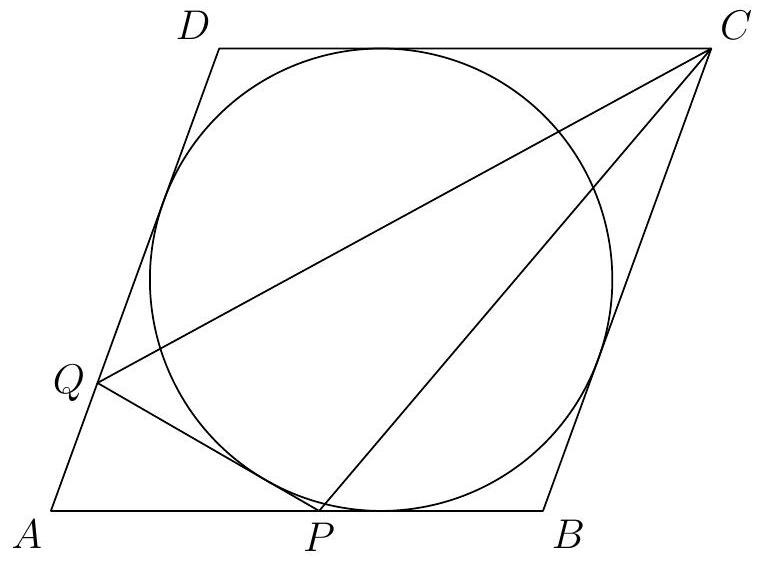", "solution": "Let the circle be tangent to $\\overline{P Q}, \\overline{A B}, \\overline{A D}$ at $T, U$, and $V$, respectively. Let $p=P T=P U$ and $q=Q T=Q V$. Let $a=A U=A V$ and $b=B U=D V$. Then the side length of the rhombus is $a+b$.\n\n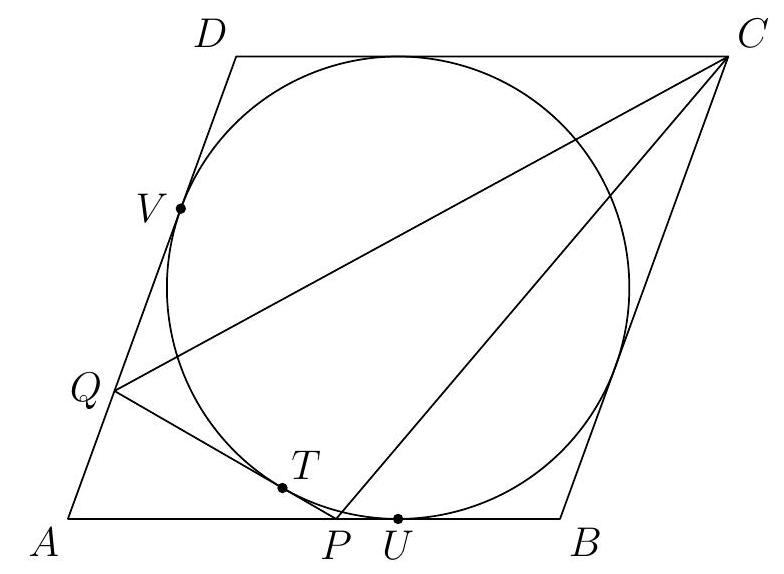\n\nLet $\\theta=\\angle B A D$, so $\\angle A B C=\\angle A D C=180^{\\circ}-\\theta$. Then (using the notation [XYZ] for the area of a triangle of vertices $X, Y, Z$ )\n\n$$\n\\begin{aligned}\n& {[A P Q]=\\frac{1}{2} \\cdot A P \\cdot A Q \\cdot \\sin \\theta=\\frac{1}{2}(a-p)(a-q) \\sin \\theta} \\\\\n& {[B C P]=\\frac{1}{2} \\cdot B P \\cdot B C \\cdot \\sin \\left(180^{\\circ}-\\theta\\right)=\\frac{1}{2}(b+p)(a+b) \\sin \\theta} \\\\\n& {[C D Q]=\\frac{1}{2} \\cdot D Q \\cdot C D \\cdot \\sin \\left(180^{\\circ}-\\theta\\right)=\\frac{1}{2}(b+q)(a+b) \\sin \\theta}\n\\end{aligned}\n$$\n\nSO\n\n$$\n\\begin{aligned}\n{[C P Q] } & =[A B C D]-[A P Q]-[B C P]-[C D Q] \\\\\n& =(a+b)^{2} \\sin \\theta-\\frac{1}{2}(a-p)(a-q) \\sin \\theta-\\frac{1}{2}(b+p)(a+b) \\sin \\theta-\\frac{1}{2}(b+q)(a+b) \\sin \\theta \\\\\n& =\\frac{1}{2}\\left(a^{2}+2 a b-b p-b q-p q\\right) \\sin \\theta\n\\end{aligned}\n$$\n\nLet $O$ be the center of the circle, and let $r$ be the radius of the circle. Let $x=\\angle T O P=\\angle U O P$ and $y=\\angle T O Q=\\angle V O Q$. Then $\\tan x=\\frac{p}{r}$ and $\\tan y=\\frac{q}{r}$.\n\n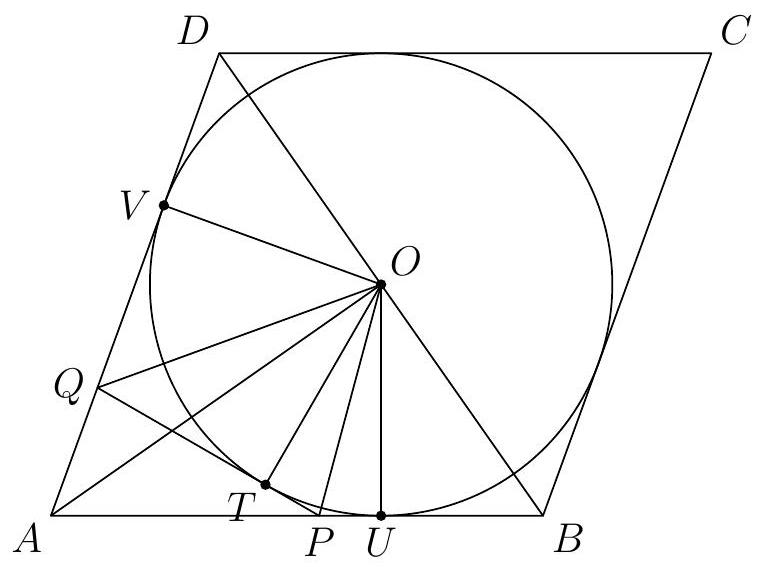\n\nNote that $\\angle U O V=2 x+2 y$, so $\\angle A O U=x+y$. Also, $\\angle A O B=90^{\\circ}$, so $\\angle O B U=x+y$. Therefore,\n\n$$\n\\tan (x+y)=\\frac{a}{r}=\\frac{r}{b}\n$$\n\nso $r^{2}=a b$. But\n\n$$\n\\frac{r}{b}=\\tan (x+y)=\\frac{\\tan x+\\tan y}{1-\\tan x \\tan y}=\\frac{\\frac{p}{r}+\\frac{q}{r}}{1-\\frac{p}{r} \\cdot \\frac{q}{r}}=\\frac{r(p+q)}{r^{2}-p q}=\\frac{r(p+q)}{a b-p q} .\n$$\n\nHence, $a b-p q=b p+b q$, so $b p+b q+p q=a b$. Therefore,\n\n$$\n[C P Q]=\\frac{1}{2}\\left(a^{2}+2 a b-b p-b q-p q\\right) \\sin \\theta=\\frac{1}{2}\\left(a^{2}+a b\\right) \\sin \\theta\n$$\n\nwhich is constant.", "metadata": {"resource_path": "Canada_MO/segmented/en-sol2020.jsonl", "problem_match": "\n2.", "solution_match": "\n## Solution."}} |
| {"year": "2020", "tier": "T2", "problem_label": "2", "problem_type": null, "exam": "Canada_MO", "problem": "A circle is inscribed in a rhombus $A B C D$. Points $P$ and $Q$ vary on line segments $\\overline{A B}$ and $\\overline{A D}$, respectively, so that $\\overline{P Q}$ is tangent to the circle. Show that for all such line segments $\\overline{P Q}$, the area of triangle $C P Q$ is constant.\n\n", "solution": "Let $O$ be the center of the circle and $r$ its radius. Then $[C P Q]=[C D Q P B]-$ $[C D Q]-[C B P]$, where $[\\ldots]$ denotes area of the polygon with given vertices. Note that $[C D Q P B]$ is half $r$ times the perimeter of $C D Q P B$. Note that the heights of $C D Q$ and $C B P$ are $2 r$ so $[C D Q]=r \\cdot D Q$ and $[C B P]=r \\cdot P B$. Using the fact that $Q T=Q V$ and $P U=P T$, it now follows that $[C P Q]=[O V D C B U]-[C D V]-[C B U]$, which is independent of $P$ and $Q$.", "metadata": {"resource_path": "Canada_MO/segmented/en-sol2020.jsonl", "problem_match": "\n2.", "solution_match": "\nAlternate Solution:"}} |
| {"year": "2020", "tier": "T2", "problem_label": "3", "problem_type": null, "exam": "Canada_MO", "problem": "A purse contains a finite number of coins, each with distinct positive integer values. Is it possible that there are exactly 2020 ways to use coins from the purse to make the value 2020 ?", "solution": "It is possible.\n\nConsider a coin purse with coins of values 2,4,8,2014,2016,2018, 2020 and every odd number between 503 and 1517. Call such a coin big if its value is between 503 and 1517. Call a coin small if its value is 2,4 or 8 and huge if its value is 2014,2016,2018 or 2020. Suppose some subset of these coins contains no huge coins and sums to 2020. If it contains at least four big coins, then its value must be at least $503+505+507+509>2020$. Furthermore since all of the small coins are even in value, if the subset contains exactly one or three big coins, then its value must be odd. Thus the subset must contain exactly two big coins. The eight possible subsets of the small coins have values $0,2,4,6,8,10,12,14$. Therefore the ways to make the value 2020 using no huge coins correspond to the pairs of big coins with sums 2006,2008,2010,2012,2014,2016,2018 and 2020. The numbers of such pairs are $250,251,251,252,252,253,253,254$, respectively. Thus there are exactly 2016 subsets of this coin purse with value 2020 using no huge coins. There are exactly four ways to make a value of 2020 using huge coins; these are $\\{2020\\},\\{2,2018\\},\\{4,2016\\}$ and $\\{2,4,2014\\}$. Thus there are exactly 2020 ways to make the value 2020 .\n\nAlternate construction: Take the coins $1,2, \\ldots, 11,1954,1955, \\ldots, 2019$. The only way to get 2020 is a non-empty subset of $1, \\ldots, 11$ and a single large coin. There are 2047 non-empty such subsets of sums between 1 and 66 . Thus they each correspond to a unique large coin making 2020, so we have 2047 ways. Thus we only need to remove some large coins, so that we remove exactly 27 small sums. This can be done, for example, by removing coins $2020-n$ for $n=1,5,6,7,8,9$, as these correspond to $1+3+4+5+6+8=27$ partitions into distinct numbers that are at most 11 .", "metadata": {"resource_path": "Canada_MO/segmented/en-sol2020.jsonl", "problem_match": "\n3.", "solution_match": "\nSolution:"}} |
| {"year": "2020", "tier": "T2", "problem_label": "4", "problem_type": null, "exam": "Canada_MO", "problem": "Let $S=\\{1,4,8,9,16, \\ldots\\}$ be the set of perfect powers of integers, i.e. numbers of the form $n^{k}$ where $n, k$ are positive integers and $k \\geq 2$. Write $S=\\left\\{a_{1}, a_{2}, a_{3} \\ldots\\right\\}$ with terms in increasing order, so that $a_{1}<a_{2}<a_{3} \\cdots$. Prove that there exist infinitely many integers $m$ such that 9999 divides the difference $a_{m+1}-a_{m}$.", "solution": "The idea is that most perfect powers are squares. If $a_{n}=x^{2}$ and $a_{n+1}=(x+1)^{2}$, then $a_{n+1}-a_{n}=2 x+1$. Note that $9999 \\mid 2 x+1$ is equivalent to $x \\equiv 4999(\\bmod 9999)$. Hence we will be done if we can show that there exist infinitely many $x \\equiv 4999(\\bmod 9999)$ such that there are no perfect powers strictly between $x^{2}$ and $(x+1)^{2}$.\n\nAssume otherwise, so that there exists a positive integer $N$ such that: for $x \\equiv 4999(\\bmod 9999)$ and $x \\geq N$, there is a perfect power $b_{x}^{e_{x}}\\left(e_{x} \\geq 2\\right)$ between $x^{2}$ and $(x+1)^{2}$. Without loss of generality, we can take $N$ to be $\\equiv 4999(\\bmod 9999)$. Note that $x^{2}$ and $(x+1)^{2}$ are consecutive squares, hence $e_{x}$ is odd, and thus $e_{x} \\geq 3$. Let $t_{n}$ be the number of odd perfect powers that are at most $n$.\n\nBy tallying the $b_{x}^{e_{x}}$ up (clearly they are all distinct), for any $m \\geq 1$ we have at least $m$ perfect odd powers between 1 and $(N+9999 m)^{2}$, so that\n\n$$\nt_{(N+9999 m)^{2}} \\geq m\n$$\n\nIn particular, for large enough $n$ we have\n\n$$\nt_{n} \\geq \\frac{\\sqrt{n}}{10000}\n$$\n\nNow, if $x^{f} \\leq n$ then $x \\leq \\sqrt[f]{n}$. Also, $n \\geq x^{f} \\geq 2^{f}$ so $f \\leq \\log _{2}(n)$ So we have\n\n$$\nt_{n} \\leq \\sum_{i=3}^{\\log _{2}(n)} \\sqrt[i]{n} \\leq \\log _{2}(n) \\sqrt[3]{n}\n$$\n\nCombining with the previous inequality, we have\n\n$$\n\\sqrt[6]{n} \\leq 10000 \\log _{2}(n)\n$$\n\nfor all large enough $n$. However, this inequality is false for all large $n$, contradiction. Therefore the problem statement holds.", "metadata": {"resource_path": "Canada_MO/segmented/en-sol2020.jsonl", "problem_match": "\n4.", "solution_match": "\nSolution:"}} |
| {"year": "2020", "tier": "T2", "problem_label": "5", "problem_type": null, "exam": "Canada_MO", "problem": "There are 19,998 people on a social media platform, where any pair of them may or may not be friends. For any group of 9,999 people, there are at least 9,999 pairs of them that are friends. What is the least number of friendships, that is, the least number of pairs of people that are friends, that must be among the 19,998 people?", "solution": "It is $5 \\cdot 9999=49995$. One possible construction is as follows: have the 19,998 people form 3,333 groups of 6 people, and within each group every pair of people are friends. Now, for any group of 9,999 people, say that there are $x_{1}, x_{2}, \\ldots, x_{3333}$ people in each of the 6 groups, respectively. Then there are\n\n$$\n\\frac{1}{2} \\sum_{i=1}^{3333} x_{i}\\left(x_{i}-1\\right)\n$$\n\npairs of friendships total. But we have that\n\n$$\nx_{i}\\left(x_{i}-1\\right) \\geq 5 x_{i}-9,\n$$\n\nso\n\n$$\n\\frac{1}{2} \\sum_{i=1}^{3333} x_{i}\\left(x_{i}-1\\right) \\geq \\frac{1}{2} \\sum_{i=1}^{3333}\\left(5 x_{i}-9\\right)=\\frac{1}{2}(9999 \\cdot 5-9 \\cdot 3333)=9999\n$$\n\nas desired.\n\nIt remains to show that 49995 pairs of friends is optimal. For what follows, let $9999=N$, so that $19,998=2 N$, and assume that the condition is satisfied. Let the number of pairs of friends be $e$. Designate half of the people as red and the other half as blue, so that the number of pairs of friends who are both red is minimized.\n\nNote that this means that for every pair of people, one red and one blue, we have that the number of red friends of the blue person is at least as many as the number of red friends of the red person, and the inequality is strict if the two people are friends. This is because we can otherwise swap the two people. Now, if every blue person is friends with at least 3 red people, then the total number of friendships, $e$, is at least $N+3 N+N=5 N$ ( $N$ each from the red people and blue people and $3 N$ from the pairs), as desired. If some blue person is friends with at most 2 red people, then every red person is friends with at most 2 red people, so the number of pairs of red friends is at most $N$, with equality only if every red person is friends with exactly 2 red people. But then consider a blue person with 2 red friends; then, they must have a red friend with exactly 2 red friends too, a contradiction.", "metadata": {"resource_path": "Canada_MO/segmented/en-sol2020.jsonl", "problem_match": "\n5.", "solution_match": "\nSolution:"}} |
|
|


