| {"year": "2017", "tier": "T2", "problem_label": "1", "problem_type": null, "exam": "EGMO", "problem": "Let $A B C D$ be a convex quadrilateral with $\\angle D A B=\\angle B C D=90^{\\circ}$ and $\\angle A B C>\\angle C D A$. Let $Q$ and $R$ be points on the segments $B C$ and $C D$, respectively, such that the line $Q R$ intersects lines $A B$ and $A D$ at points $P$ and $S$, respectively. It is given that $P Q=R S$. Let the midpoint of $B D$ be $M$ and the midpoint of $Q R$ be $N$. Prove that $M, N, A$ and $C$ lie on a circle.\n\nMark Mordechai Etkind, Israel", "solution": "1\n\nNote that $N$ is also the midpoint of $P S$. From right-angled triangles $P A S$ and $C Q R$ we obtain $\\angle A N P=$ $2 \\angle A S P, \\angle C N Q=2 \\angle C R Q$, hence $\\angle A N C=\\angle A N P+\\angle C N Q=2(\\angle A S P+\\angle C R Q)=2(\\angle R S D+\\angle D R S)=$ $2 \\angle A D C$.\nSimilarly, using right-angled triangles $B A D$ and $B C D$, we obtain $\\angle A M C=2 \\angle A D C$.\nThus $\\angle A M C=\\angle A N C$, and the required statement follows.\n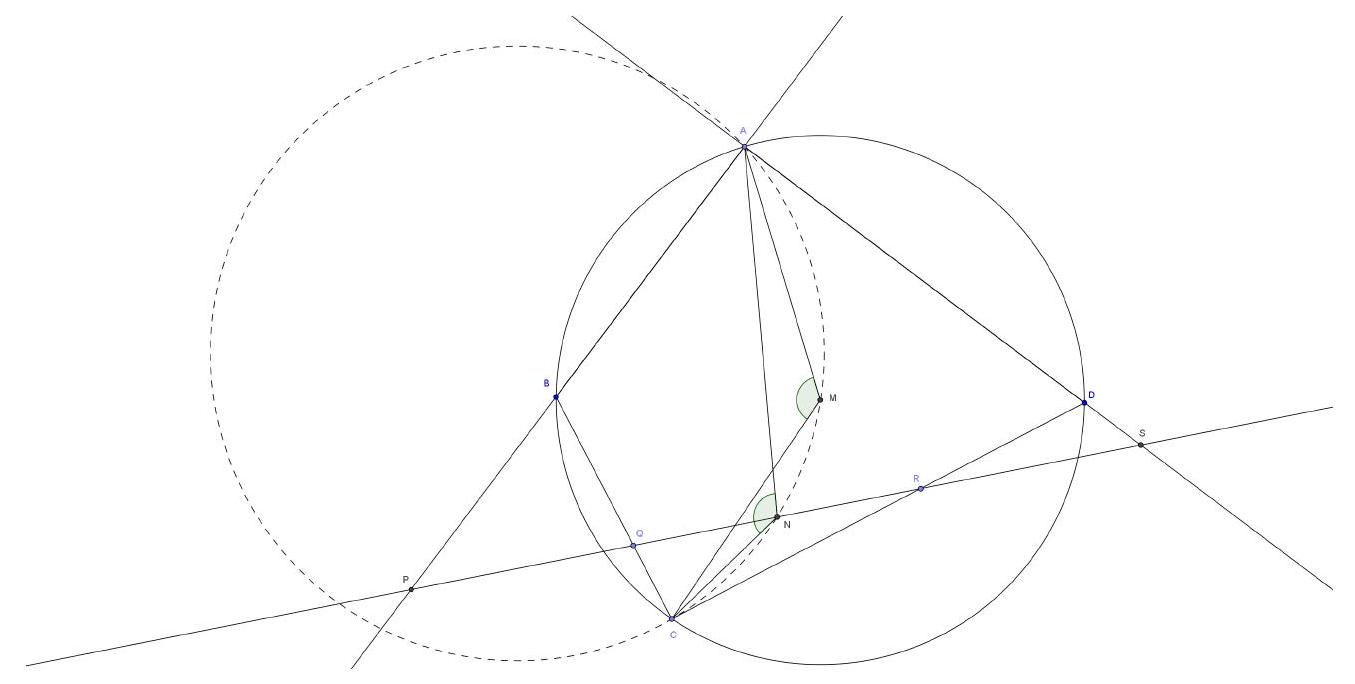", "metadata": {"resource_path": "EGMO/segmented/en-2017-solutions.jsonl", "problem_match": "# Problem 1", "solution_match": "# Solution "}} |
| {"year": "2017", "tier": "T2", "problem_label": "1", "problem_type": null, "exam": "EGMO", "problem": "Let $A B C D$ be a convex quadrilateral with $\\angle D A B=\\angle B C D=90^{\\circ}$ and $\\angle A B C>\\angle C D A$. Let $Q$ and $R$ be points on the segments $B C$ and $C D$, respectively, such that the line $Q R$ intersects lines $A B$ and $A D$ at points $P$ and $S$, respectively. It is given that $P Q=R S$. Let the midpoint of $B D$ be $M$ and the midpoint of $Q R$ be $N$. Prove that $M, N, A$ and $C$ lie on a circle.\n\nMark Mordechai Etkind, Israel", "solution": "2\n\nIn this proof we show that we have $\\angle N C M=\\angle N A M$ instead. From right-angled triangles $B C D$ and $Q C R$ we get $\\angle D R S=\\angle C R Q=\\angle R C N$ and $\\angle B D C=\\angle D C M$. Hence $\\angle N C M=\\angle D C M-\\angle R C N$. From rightangled triangle $A P S$ we get $\\angle P S A=\\angle S A N$. From right-angled triangle $B A D$ we have $\\angle M A D=\\angle B D A$. Moreover, $\\angle B D A=\\angle D R S+\\angle R S D-\\angle R D B$.\nTherefore $\\angle N A M=\\angle N A S-\\angle M A D=\\angle C D B-\\angle D R S=\\angle N C M$, and the required statement follows.", "metadata": {"resource_path": "EGMO/segmented/en-2017-solutions.jsonl", "problem_match": "# Problem 1", "solution_match": "# Solution "}} |
| {"year": "2017", "tier": "T2", "problem_label": "1", "problem_type": null, "exam": "EGMO", "problem": "Let $A B C D$ be a convex quadrilateral with $\\angle D A B=\\angle B C D=90^{\\circ}$ and $\\angle A B C>\\angle C D A$. Let $Q$ and $R$ be points on the segments $B C$ and $C D$, respectively, such that the line $Q R$ intersects lines $A B$ and $A D$ at points $P$ and $S$, respectively. It is given that $P Q=R S$. Let the midpoint of $B D$ be $M$ and the midpoint of $Q R$ be $N$. Prove that $M, N, A$ and $C$ lie on a circle.\n\nMark Mordechai Etkind, Israel", "solution": "3\n\nAs $N$ is also the midpoint of $P S$, we can shrink triangle $A P S$ to a triangle $A_{0} Q R$ (where $P$ is sent to $Q$ and $S$ is sent to $R$ ). Then $A_{0}, Q, R$ and $C$ lie on a circle with center $N$. According to the shrinking the line $A_{0} R$ is parallel to the line $A D$. Therefore $\\angle C N A=\\angle C N A_{0}=2 \\angle C R A_{0}=2 \\angle C D A=\\angle C M A$. The required statement follows.", "metadata": {"resource_path": "EGMO/segmented/en-2017-solutions.jsonl", "problem_match": "# Problem 1", "solution_match": "# Solution "}} |
| {"year": "2017", "tier": "T2", "problem_label": "2", "problem_type": null, "exam": "EGMO", "problem": "Find the smallest positive integer $k$ for which there exist a colouring of the positive integers $\\mathbb{Z}_{>0}$ with $k$ colours and a function $f: \\mathbb{Z}_{>0} \\rightarrow \\mathbb{Z}_{>0}$ with the following two properties:\n(i) For all positive integers $m, n$ of the same colour, $f(m+n)=f(m)+f(n)$.\n(ii) There are positive integers $m, n$ such that $f(m+n) \\neq f(m)+f(n)$.\n\nIn a colouring of $\\mathbb{Z}_{>0}$ with $k$ colours, every integer is coloured in exactly one of the $k$ colours. In both (i) and (ii) the positive integers $m, n$ are not necessarily different.\n\nMerlijn Staps, the Netherlands", "solution": "The answer is $k=3$.\nFirst we show that there is such a function and coloring for $k=3$. Consider $f: \\mathbb{Z}_{>0} \\rightarrow \\mathbb{Z}_{>0}$ given by $f(n)=n$ for all $n \\equiv 1$ or 2 modulo 3 , and $f(n)=2 n$ for $n \\equiv 0$ modulo 3 . Moreover, give a positive integer $n$ the $i$-th color if $n \\equiv i$ (3).\nBy construction we have $f(1+2)=6 \\neq 3=f(1)+f(2)$ and hence $f$ has property (ii).\nNow let $n, m$ be positive integers with the same color $i$. If $i=0$, then $n+m$ has color 0 , so $f(n+m)=$ $2(n+m)=2 n+2 m=f(n)+f(m)$. If $i=1$, then $n+m$ has color 2 , so $f(n+m)=n+m=f(n)+f(m)$. Finally, if $i=2$, then $n+m$ has color 1 , so $f(n+m)=n+m=f(n)+f(m)$. Therefore $f$ also satisfies condition (i).\n\nNext we show that there is no such function and coloring for $k=2$.\nConsider any coloring of $\\mathbb{Z}_{>0}$ with 2 colors and any function $f: \\mathbb{Z}_{>0} \\rightarrow \\mathbb{Z}_{>0}$ satisfying conditions (i) and (ii). Then there exist positive integers $m$ and $n$ such that $f(m+n) \\neq f(m)+f(n)$. Choose $m$ and $n$ such that their sum is minimal among all such $m, n$ and define $a=m+n$. Then in particular for every $b<a$ we have $f(b)=b f(1)$ and $f(a) \\neq a f(1)$.\nIf $a$ is even, then condition (i) for $m=n=\\frac{a}{2}$ implies $f(a)=f\\left(\\frac{a}{2}\\right)+f\\left(\\frac{a}{2}\\right)=f(1) a$, a contradiction. Hence $a$ is odd. We will prove two lemmas.\n\nLemma 1. Any odd integer $b<a$ has a different color than $a$.\nProof. Suppose that $b<a$ is an odd integer, and that $a$ and $b$ have the same color. Then on the one hand, $f(a+b)=f(a)+b f(1)$. On the other hand, we also have $f(a+b)=f\\left(\\frac{a+b}{2}\\right)+f\\left(\\frac{a+b}{2}\\right)=(a+b) f(1)$, as $\\frac{a+b}{2}$ is a positive integer smaller than $a$. Hence $f(a)=f(a+b)-b f(1)=(a+b) f(1)-b f(1)=a f(1)$, which is again a contradiction. Therefore all odd integers smaller than $a$ have a color different from that of $a$.\n\nLemma 2. Any even integer $b<a$ has the same color as $a$\nProof. Suppose $b<a$ is an even integer, and that $a$ and $b$ have different colors. Then $a-b$ is an odd integer smaller than $a$, so it has the same color as $b$. Thus $f(a)=f(a-b)+f(b)=(a-b) f(1)+b f(1)=a f(1)$, a contradiction. Hence all even integers smaller than $a$ have the same color as $a$.\n\nSuppose now $a+1$ has the same color as $a$. As $a>1$, we have $\\frac{a+1}{2}<a$ and therefore $f(a+1)=2 f\\left(\\frac{a+1}{2}\\right)=$ $(a+1) f(1)$. As $a-1$ is an even integer smaller than $a$, we have by Lemma 2 that $a-1$ also has the same color as $a$. Hence $2 f(a)=f(2 a)=f(a+1)+f(a-1)=(a+1) f(1)+(a-1) f(1)=2 a f(1)$, which implies that $f(a)=a f(1)$, a contradiction. So $a$ and $a+1$ have different colors.\nSince $a-2$ is an odd integer smaller than $a$, by Lemma 1 it has a color different from that of $a$, so $a-2$ and $a+1$ have the same color. Also, we have seen by Lemma 2 that $a-1$ and $a$ have the same color. So $f(a)+f(a-1)=f(2 a-1)=f(a+1)+f(a-2)=(a+1) f(1)+(a-2) f(1)=(2 a-1) f(1)$, from which it follows that $f(a)=(2 a-1) f(1)-f(a-1)=(2 a-1) f(1)-(a-1) f(1)=a f(1)$, which contradicts our choice of $a$ and finishes the proof.", "metadata": {"resource_path": "EGMO/segmented/en-2017-solutions.jsonl", "problem_match": "# Problem 2", "solution_match": "# Solution 1:"}} |
| {"year": "2017", "tier": "T2", "problem_label": "2", "problem_type": null, "exam": "EGMO", "problem": "Find the smallest positive integer $k$ for which there exist a colouring of the positive integers $\\mathbb{Z}_{>0}$ with $k$ colours and a function $f: \\mathbb{Z}_{>0} \\rightarrow \\mathbb{Z}_{>0}$ with the following two properties:\n(i) For all positive integers $m, n$ of the same colour, $f(m+n)=f(m)+f(n)$.\n(ii) There are positive integers $m, n$ such that $f(m+n) \\neq f(m)+f(n)$.\n\nIn a colouring of $\\mathbb{Z}_{>0}$ with $k$ colours, every integer is coloured in exactly one of the $k$ colours. In both (i) and (ii) the positive integers $m, n$ are not necessarily different.\n\nMerlijn Staps, the Netherlands", "solution": "We prove that $k \\leq 3$ just as in first solution.\nNext we show that there is no such function and coloring for $k=2$.\nConsider any coloring of $\\mathbb{Z}_{>0}$ with 2 colors and any function $f: \\mathbb{Z}_{>0} \\rightarrow \\mathbb{Z}_{>0}$ satisfying conditions (i) and (ii). We first notice with $m=n$ that $f(2 n)=2 f(n)$.\n\nLemma 3. For every $n \\in \\mathbb{Z}_{>0}, f(3 n)=3 f(n)$ holds.\nProof. Define $c=f(n), d=f(3 n)$. Then we have the relations\n\n$$\nf(2 n)=2 c, \\quad f(4 n)=4 c, \\quad f(6 n)=2 d\n$$\n\n- If $n$ and $2 n$ have the same color, then $f(3 n)=f(n)+f(2 n)=3 c=3 f(n)$.\n- If $n$ and $3 n$ have the same color, then $4 c=f(4 n)=f(n)+f(3 n)=c+f(3 n)$, so $f(3 n)=3 f(n)$.\n- If $2 n$ and $4 n$ have the same color, then $2 d=f(6 n)=f(2 n)+f(4 n)=2 c+4 c=6 c$, so $f(3 n)=d=3 c$.\n- Otherwise $n$ and $4 n$ have the same color, and $2 n$ and $3 n$ both have the opposite color to $n$. Therefore we compute $5 c=f(n)+f(4 n)=f(5 n)=f(2 n)+f(3 n)=2 c+f(3 n)$ so $f(3 n)=3 f(n)$.\n\nConsequently, for $k=2$ we necessarily have $f(3 n)=3 f(n)$.\nNow let $a$ be the smallest integer such that $f(a) \\neq a f(1)$. In particular $a$ is odd and $a>3$. Consider the three integers $a, \\frac{a-3}{2}, \\frac{a+3}{2}$. By pigeonhole principle two of them have the same color.\n\n- If $\\frac{a-3}{2}$ and $\\frac{a+3}{2}$ have the same color, then $f(a)=\\frac{a-3}{2} f(1)+\\frac{a+3}{2} f(1)=a f(1)$.\n- If $a$ and $\\frac{a-3}{2}$ have the same color, then $3 \\frac{a-1}{2} f(1)=3 f\\left(\\frac{a-1}{2}\\right)=f\\left(\\frac{3 a-3}{2}\\right)=f(a)+f\\left(\\frac{a-3}{2}\\right)=f(a)+$ $\\frac{a-3}{2} f(1)$, so $f(a)=a f(1)$.\n- If $a$ and $\\frac{a+3}{2}$ have the same color, then $3 \\frac{a+1}{2} f(1)=3 f\\left(\\frac{a+1}{2}\\right)=f\\left(\\frac{3 a+3}{2}\\right)=f(a)+f\\left(\\frac{a+3}{2}\\right)=f(a)+$ $\\frac{a+3}{2} f(1)$, so $f(a)=a f(1)$.\n\nIn the three cases we find a contradiction with $f(a) \\neq a f(1)$, so it finishes the proof.", "metadata": {"resource_path": "EGMO/segmented/en-2017-solutions.jsonl", "problem_match": "# Problem 2", "solution_match": "# Solution 2:"}} |
| {"year": "2017", "tier": "T2", "problem_label": "2", "problem_type": null, "exam": "EGMO", "problem": "Find the smallest positive integer $k$ for which there exist a colouring of the positive integers $\\mathbb{Z}_{>0}$ with $k$ colours and a function $f: \\mathbb{Z}_{>0} \\rightarrow \\mathbb{Z}_{>0}$ with the following two properties:\n(i) For all positive integers $m, n$ of the same colour, $f(m+n)=f(m)+f(n)$.\n(ii) There are positive integers $m, n$ such that $f(m+n) \\neq f(m)+f(n)$.\n\nIn a colouring of $\\mathbb{Z}_{>0}$ with $k$ colours, every integer is coloured in exactly one of the $k$ colours. In both (i) and (ii) the positive integers $m, n$ are not necessarily different.\n\nMerlijn Staps, the Netherlands", "solution": "As before we prove that $k \\leq 3$ and for any such function and colouring we have $f(2 n)=2 f(n)$.\nNow we show that there is no such function and coloring for $k=2$.\nConsider any coloring of $\\mathbb{Z}_{>0}$ with 2 colors and any function $f: \\mathbb{Z}_{>0} \\rightarrow \\mathbb{Z}_{>0}$ satisfying conditions (i) and (ii). Say the two colors are white (W) and black (B). Pick $m, n$ any two integers such that $f(m+n)=f(m)+f(n)$. Without loss of generality we may assume that $m+n, m$ are black and $n$ is white.\n\nLemma 4. For all $l \\in \\mathbb{Z}_{>0}$ and every $x$ whose color is black, we have $x+\\operatorname{lm}$ is black and $f(x+\\operatorname{lm})=$ $f(x)+l f(m)$.\n\nProof. We proceed by induction. It is clearly true for $l=0$. If $x+\\operatorname{lm}$ is black and satisfies $f(x+\\operatorname{lm})=$ $f(x)+l f(m)$, then $f(x+(l+1) m)=f(x+l m)+f(m)=f(x)+(l+1) f(m)$ and $f(x+(l+1) m+n)=$ $f(x+l m)+f(m+n)=f(x)+l f(m)+f(m+n) \\neq f(x)+(l+1) f(m)+f(n)=f(x+(l+1) m)+f(n)$, so $x+(l+1) m$ is not the same color of $n$, therefore $x+(l+1) m$ is black. Thjs completes the induction.\nIn particular we then must have that $2^{l} n$ is white for every $l$, because otherwise since $2^{l} m$ is black we would have $2^{l} f(m+n)=f\\left(2^{l} m+2^{l} n\\right)=f\\left(2^{l} m\\right)+f\\left(2^{l} n\\right)=2^{l}(f(m)+f(n))$, and consequently $f(m+n)=$ $f(m)+f(n)$.\nLemma 5. For every $l \\geq 1,2^{l} m+2^{l-1} n$ is black.\n\nProof. On the one hand we have $2^{l} f(m+n)=f\\left(2^{l} m+2^{l} n\\right)=f\\left(2^{l-1}(2 m+n)+2^{l-1} n\\right)$. On the other hand we have\n$\\left.2^{l} f(m+n)=2^{l-1} \\cdot 2 f(m+n) \\neq 2^{l-1}(f(m+n)+f(m)+f(n))=2^{l-1}(f(2 m+n)+f(n))=f\\left(2^{l} m+2^{l-1} n\\right)\\right)+f\\left(2^{l-1} n\\right)$.\nTherefore $2^{l} m+2^{l-1} n$ and $2^{l-1} n$ have different color, which means $2^{l} m+2^{l-1} n$ is black.\nCombining the two lemmas give $j m+2^{l-1} n$ is black for all $j \\geq 2^{l}$ and every $l \\geq 1$.\nNow write $m=2^{l-1} m^{\\prime}$ with $m^{\\prime}$ odd. Let $t$ be a number such that $\\frac{2^{t}-1}{m^{\\prime}}$ is an integer and $j=\\frac{2^{t}-1}{m^{\\prime}} n \\geq 2^{l}$, i.e. $t$ is some multiple of $\\phi\\left(m^{\\prime}\\right)$. Then we must have that $j m+2^{l-1} n$ is black, but by definition ${ }_{j m}^{m^{\\prime}}+\\overline{2}^{l-1} n=$ $\\left(2^{t}-1\\right) 2^{l-1} n+2^{l-1} n=2^{t+l-1} n$ is white. This is a contradiction, so $k=2$ is impossible.", "metadata": {"resource_path": "EGMO/segmented/en-2017-solutions.jsonl", "problem_match": "# Problem 2", "solution_match": "# Solution 3:"}} |
| {"year": "2017", "tier": "T2", "problem_label": "3", "problem_type": null, "exam": "EGMO", "problem": "There are 2017 lines in a plane such that no 3 of them go through the same point. Turbo the snail can slide along the lines in the following fashion: she initially moves on one of the lines and continues moving on a given line until she reaches an intersection of 2 lines. At the intersection, she follows her journey on the other line turning left or right, alternating the direction she chooses at each intersection point she passes. Can it happen that she slides through a line segment for a second time in her journey but in the opposite direction as she did for the first time?\n\nMárk Di Giovanni, Hungary", "solution": "We show that this is not possible.\nThe lines divide the plane into disjoint regions. We claim that there exists an alternating 2-coloring of these regions, that is each region can be colored in black or white, such that if two regions share a line segment, they have a different color. We show this inductively.\nIf there are no lines, this is obvious. Consider now an arrangement of $n$ lines in the plane and an alternating 2-coloring of the regions. If we add a line $g$, we can simply switch the colors of all regions in one of the half planes divided by $g$ from white to black and vice versa. Any line segment not in $g$ will still be between two regions of different color. Any line segment in $g$ cuts a region determined by the $n$ lines in two, and since we switched colors on one side of $g$ this segment will also lie between two regions of different color.\nNow without loss of generality we may assume, that Turbo starts on a line segment with a white region on her left and a black one on her right. At any intersection, if she turns right, she will keep the black tile to her right. If she turns left, she will keep the white tile to her left. Thus wherever she goes, she will always have a white tile on her left and a black tile on her right. As a consequence, she can cross every line segment only in the direction where she has a white tile to her left, and never the opposite direction where she would have a black tile to the left.", "metadata": {"resource_path": "EGMO/segmented/en-2017-solutions.jsonl", "problem_match": "# Problem 3", "solution_match": "\n## 1. Solution"}} |
| {"year": "2017", "tier": "T2", "problem_label": "3", "problem_type": null, "exam": "EGMO", "problem": "There are 2017 lines in a plane such that no 3 of them go through the same point. Turbo the snail can slide along the lines in the following fashion: she initially moves on one of the lines and continues moving on a given line until she reaches an intersection of 2 lines. At the intersection, she follows her journey on the other line turning left or right, alternating the direction she chooses at each intersection point she passes. Can it happen that she slides through a line segment for a second time in her journey but in the opposite direction as she did for the first time?\n\nMárk Di Giovanni, Hungary", "solution": "Suppose the assumption is true.\nLet's label each segment in the snail's path with $\\mathbf{L}$ or $\\mathbf{R}$ depending on the direction that Turbo chose at the start point of this segment (one segment can have several labels if it has been visited several times).\nConsider the first segment that has been visited twice in different directions, name this segment $s_{1}$. Assume without loss of generality that it is labeled with $\\mathbf{L}$. Then next segment must be labeled with $\\mathbf{R}$, name this one $s_{2}$.\nLet's look at the label which $s_{1}$ can get on the second visit. If it gets $\\mathbf{L}$ then the previous segment in the path must be $s_{2}$. But in this case $s_{1}$ is not the first segment that has been visited twice in different directions because $s_{2}$ has been visited earlier. So the second label of $s_{1}$ must be $\\mathbf{R}$, and Turbo must have come from the opposite side of $s_{2}$.\n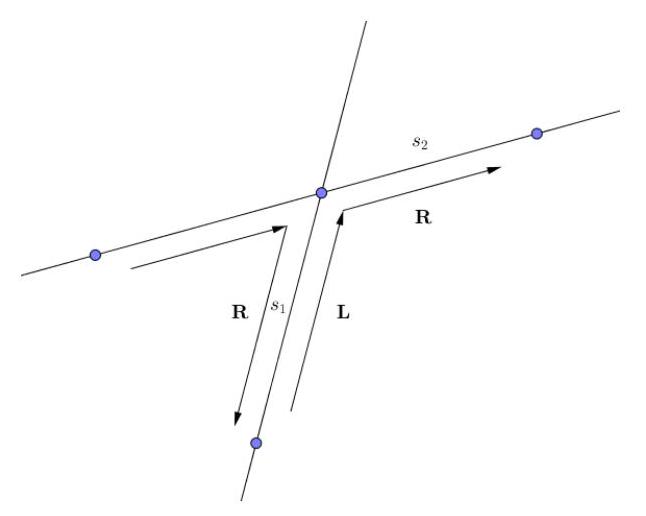\n\nSince Turbo alters directions at each point, labels in her path also alter. And because two labels of $s_{1}$ are different, the number of visited segments between these two visits must be even.\nNow let's make the following observation: each segment in the path corresponds to exactly one line, and its previous and next segments are on opposite sides of this line.\n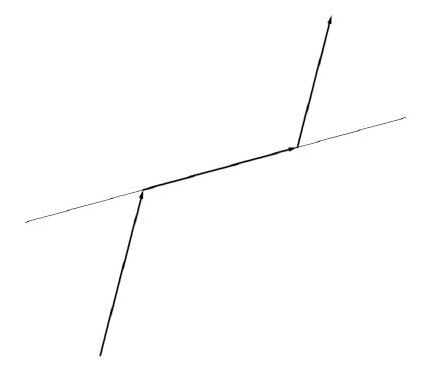\n\nAgain consider the path between two visits of $s_{1}$.\nEach line intersecting this path must be crossed an even number of times because Turbo has to return to the initial side of each line. Therefore, an even number of segments of Turbo's path are contained on each of these lines. But the line containing $s_{1}$ must be crossed an odd number times. Since each crossing corresponds to exactly one segment in the path, the number of segments must be odd.\nHere we get the contradiction. Therefore, the assumption is false.", "metadata": {"resource_path": "EGMO/segmented/en-2017-solutions.jsonl", "problem_match": "# Problem 3", "solution_match": "\n## 2. Solution"}} |
| {"year": "2017", "tier": "T2", "problem_label": "3", "problem_type": null, "exam": "EGMO", "problem": "There are 2017 lines in a plane such that no 3 of them go through the same point. Turbo the snail can slide along the lines in the following fashion: she initially moves on one of the lines and continues moving on a given line until she reaches an intersection of 2 lines. At the intersection, she follows her journey on the other line turning left or right, alternating the direction she chooses at each intersection point she passes. Can it happen that she slides through a line segment for a second time in her journey but in the opposite direction as she did for the first time?\n\nMárk Di Giovanni, Hungary", "solution": "Suppose that the snail always slides slightly to the right of the line segments on her path. When turning to the right, she does not cross any line, whereas when turning to the left, she crosses exactly two lines. This means that at any time of her journey, she has crossed an even number of lines.\nAssuming that at some point she slides along a segment for the second time, but in the opposite direction, we argue that she needs to cross an odd number of lines. Let $\\ell$ be the line on which the revisit happens. In order to get to the other side of $\\ell$, the snail has to cross $\\ell$ an odd number of times. To visit the same segment of $\\ell$, she must cross every other line an even number of times.", "metadata": {"resource_path": "EGMO/segmented/en-2017-solutions.jsonl", "problem_match": "# Problem 3", "solution_match": "\n## 3. Solution"}} |
| {"year": "2017", "tier": "T2", "problem_label": "3", "problem_type": null, "exam": "EGMO", "problem": "There are 2017 lines in a plane such that no 3 of them go through the same point. Turbo the snail can slide along the lines in the following fashion: she initially moves on one of the lines and continues moving on a given line until she reaches an intersection of 2 lines. At the intersection, she follows her journey on the other line turning left or right, alternating the direction she chooses at each intersection point she passes. Can it happen that she slides through a line segment for a second time in her journey but in the opposite direction as she did for the first time?\n\nMárk Di Giovanni, Hungary", "solution": "Let us color in red all intersection points of the given lines and let us choose one of two possible directions on each segment (draw an arrow on each segment). Consider a red point $R$ where two given lines $a$ and $b$ meet, and the four segments $a_{1}, a_{2}, b_{1}, b_{2}$ with endpoint $R$ (so that $a_{i} \\subset a, b_{j} \\subset b$ ). $R$ is called a saddle if on $a_{1}, a_{2}$ the arrows go out of $R$ while on $b_{1}, b_{2}$ the arrows enter $R$, or visa versa, on $b_{1}, b_{2}$ the arrows go out of $R$ while on $a_{1}, a_{2}$ the arrows enter $R$. The set of arrows (chosen on all segments) is said to be good if all red points are saddles. It is sufficient to prove that there exists a good set of arrows. Indeed, if initially Turbo is moving along (or opposite) the arrow, then this condition holds after she turns at a red point.\nThe given lines cut the plane into regions. Further we need the following property of the good set of arrows (this property directly follows from the definition): the boundary of any bounded region is a directed cycle of arrows; the boundary of any unbounded region is a directed chain of arrows.\nWe construct a good set of arrows by induction on $n$ with trivial base $n=1$. Now erase one of $n$ given lines and assume we have a good set of arrows for remaining $n-1$ lines. Now restore the $n$-th line $\\ell$, assume that $\\ell$ is horizontal. Denote by $A_{1}, \\ldots, A_{n-1}$ all new red points on $\\ell$ from the left to the right. Each of $A_{i}$ belongs to some old segment $m_{i}$ of the line $\\ell_{i}$. Let us call $A_{i}$ ascending if the arrow on $m_{i}$ goes up, and descending if the arrow on $m_{i}$ goes down. Consider the region containing the segment $A_{i} A_{i+1}$. By the property, $A_{i}$ and $A_{i+1}$ can not be both ascending or both descending. Thus we can choose arrows on all pieces of $\\ell$ so that each arrow goes from a descending to an ascending vertex.\n\nEach of points $A_{i}$ cuts $m_{i}$ into two new pieces; the direction of new pieces supposed to be the same as on $m_{i}$. Now simultaneously change the direction of arrows on all pieces below the line $\\ell$. It is easy to see that $A_{1}, \\ldots, A_{n-1}$ become saddles, while the other red points remain saddles. This completes the induction step.", "metadata": {"resource_path": "EGMO/segmented/en-2017-solutions.jsonl", "problem_match": "# Problem 3", "solution_match": "\n## 4. Solution"}} |
| {"year": "2017", "tier": "T2", "problem_label": "4", "problem_type": null, "exam": "EGMO", "problem": "Let $n \\geq 1$ be an integer and let $t_{1}<t_{2}<\\ldots<t_{n}$ be positive integers. In a group of $t_{n}+1$ people, some games of chess are played. Two people can play each other at most once. Prove that it is possible for the following conditions to hold at the same time:\ni) The number of games played by each person is one of $t_{1}, t_{2}, \\ldots, t_{n}$,\nii) For every $i$ with $1 \\leq i \\leq n$, there is someone who has played exactly $t_{i}$ games of chess.\n\nGerhard Wöginger, Luxembourg\n\n## Comment\n\nIn graph theory terms the problem is to prove that for any finite nonempty set $\\mathcal{T}$ of positive integers there exists a graph of size $\\max \\mathcal{T}+1$ such that the degree set of the graph is equal to $\\mathcal{T}$.\n\nAmong graph theory specialists a generalization of this problem is known [1]. Nevertheless, the problem still suited the contest.", "solution": "Let $\\mathcal{T}=\\left\\{t_{1}, \\ldots, t_{n}\\right\\}$. The proof proceeds by induction on $n=|\\mathcal{T}|$. If $n=1$ and $\\mathcal{T}=\\{t\\}$, choose a group of $t+1$ people and let every pair of two persons play against each other. Then every person has played $t$ games and the conditions of the problem are satisfied.\n\nIn the inductive step, suppose that $\\mathcal{T}$ has $n \\geq 2$ elements $t_{1}<t_{2}<\\cdots<t_{n}$. Consider the set\n\n$$\n\\mathcal{T}^{\\prime}=\\left\\{t_{n}-t_{n-1}, t_{n}-t_{n-2}, \\ldots, t_{n}-t_{1}\\right\\} .\n$$\n\nBy the inductive hypothesis, there exists a group $G^{\\prime}$ of $t_{n}-t_{1}+1$ people that satisfies the conditions of the problem for $T^{\\prime}$.\n\nNext construct a group $G^{\\prime \\prime}$ of $t_{n}+1$ people by adding $t_{1}$ people who do not know any of the other $t_{n}-t_{1}+1$ people in $G^{\\prime}$. Finally, construct a group $G$ by complementing the knowledge relation in $G^{\\prime \\prime}$ : two persons play against each other in $G$ if and only if they do not play against each other in $G^{\\prime \\prime}$.\n\nBy construction $t \\in \\mathcal{T}$ if and only if there exists a person in $G^{\\prime \\prime}$ that played against exactly $t_{n}-t$ other people (if $t=t_{n}$, choose one of the $t_{1}$ people added to $\\left.G^{\\prime}\\right)$. That person knows $t_{n}-\\left(t_{n}-t\\right)=t$ other students in $G$, completing the proof.", "metadata": {"resource_path": "EGMO/segmented/en-2017-solutions.jsonl", "problem_match": "# Problem 4", "solution_match": "\n## 1. Solution (see also [2])"}} |
| {"year": "2017", "tier": "T2", "problem_label": "4", "problem_type": null, "exam": "EGMO", "problem": "Let $n \\geq 1$ be an integer and let $t_{1}<t_{2}<\\ldots<t_{n}$ be positive integers. In a group of $t_{n}+1$ people, some games of chess are played. Two people can play each other at most once. Prove that it is possible for the following conditions to hold at the same time:\ni) The number of games played by each person is one of $t_{1}, t_{2}, \\ldots, t_{n}$,\nii) For every $i$ with $1 \\leq i \\leq n$, there is someone who has played exactly $t_{i}$ games of chess.\n\nGerhard Wöginger, Luxembourg\n\n## Comment\n\nIn graph theory terms the problem is to prove that for any finite nonempty set $\\mathcal{T}$ of positive integers there exists a graph of size $\\max \\mathcal{T}+1$ such that the degree set of the graph is equal to $\\mathcal{T}$.\n\nAmong graph theory specialists a generalization of this problem is known [1]. Nevertheless, the problem still suited the contest.", "solution": "Let $\\mathcal{T}=\\left\\{t_{1}, \\ldots, t_{n}\\right\\}$. The proof proceeds by induction on $n=|\\mathcal{T}|$. If $n=1$ and $\\mathcal{T}=\\{t\\}$, we choose a group of $t+1$ people such that everyone plays with\neveryone else. If $n=2$ and $\\mathcal{T}=\\left\\{t_{1}, t_{2}\\right\\}$ with $t_{1}<t_{2}$, divide the $t_{2}+1$ people into groups $A$ resp. $B$ of size $t_{1}$ resp. $t_{2}-t_{1}+1$ such that everyone from group $A$ played with everyone else whereas people from group $B$ only played with the people from group $A$. Then the people from group $A$ resp. $B$ played with exactly $t_{2}$ resp. $t_{1}$ other people. In the inductive step, suppose that $T$ has $n>2$ elements $t_{1}<\\ldots<t_{n}$. Consider the set\n\n$$\n\\mathcal{T}^{\\prime}=\\left(\\mathcal{T} \\backslash\\left\\{t_{1}, t_{n}\\right\\}\\right)-t_{1}=\\left\\{t_{n-1}-t_{1}, t_{n-1}-t_{1}, \\ldots, t_{2}-t_{1}\\right\\}\n$$\n\nBy the induction hypothesis there exists a group $C$ of $t_{n-1}-t_{1}+1$ people that satisfies the conditions of the problem for $T^{\\prime}$. Next add groups $D$ resp. $E$ of $t_{1}$ resp. $t_{n}-t_{n-1}$ people such that people from group $D$ played with everyone else whereas people from group $E$ only played with the people from group $D$. Then the people from group $C$ played with $t$ other people if and only if they played with $t-t_{1}$ many people among $C$, i.e. if and only if $t \\in\\left\\{t_{2}, \\ldots, t_{n-1}\\right\\}=$ $\\mathcal{T} \\backslash\\left\\{t_{1}, t_{n}\\right\\}$. People from group $D$ resp. $E$ played with $t_{n}$ resp $t_{1}$ peoples, which completes the proof.", "metadata": {"resource_path": "EGMO/segmented/en-2017-solutions.jsonl", "problem_match": "# Problem 4", "solution_match": "\n## 2. Solution"}} |
| {"year": "2017", "tier": "T2", "problem_label": "4", "problem_type": null, "exam": "EGMO", "problem": "Let $n \\geq 1$ be an integer and let $t_{1}<t_{2}<\\ldots<t_{n}$ be positive integers. In a group of $t_{n}+1$ people, some games of chess are played. Two people can play each other at most once. Prove that it is possible for the following conditions to hold at the same time:\ni) The number of games played by each person is one of $t_{1}, t_{2}, \\ldots, t_{n}$,\nii) For every $i$ with $1 \\leq i \\leq n$, there is someone who has played exactly $t_{i}$ games of chess.\n\nGerhard Wöginger, Luxembourg\n\n## Comment\n\nIn graph theory terms the problem is to prove that for any finite nonempty set $\\mathcal{T}$ of positive integers there exists a graph of size $\\max \\mathcal{T}+1$ such that the degree set of the graph is equal to $\\mathcal{T}$.\n\nAmong graph theory specialists a generalization of this problem is known [1]. Nevertheless, the problem still suited the contest.", "solution": "The proof proceeds by induction on $\\left|t_{n}\\right|$. If $t_{n}=1$ we have $n=1$ and we can consider two persons that play against each other. Then every player has played 1 game and the conditions of the problem are satisfied. If $t_{n}>1$ we distinguish the two cases $t_{1}>1$ and $t_{1}=1$. If $t_{1}>1$ there exists, by the induction hypothesis, a group $A$ of size $t_{n}$ that satisfies the conditions of the problem for $t_{1}^{\\prime}=t_{1}-1, \\ldots, t_{n}^{\\prime}=t_{n}-1$. Now add a new person to $A$ and let him/her play against everyone from $A$. The new group will be of size $t_{n}+1$ and there exists a person which has played $t$ games if and only if there exists a person that has played $t-1$ games within $A$, i.e. if and only if $t \\in\\left\\{t_{1}, \\ldots, t_{n}\\right\\}$. Hence the conditions of the problem are satisfied.\n\nIf $t_{1}=1$ there exists, by the induction hypothesis, a group $B$ of size $t_{n-1}$ that satisfies the conditions of the problem for $t_{1}^{\\prime}=t_{2}-1, \\ldots, t_{n-2}^{\\prime}=t_{n-1}-1$. Now add a new person $P$ and let him/her play with everyone from group $B$ and a group $C$ of size $t_{n}-t_{n-1}>0$ and let them play with $P$. The new group will be of size $t_{n-1}+1+\\left(t_{n}-t_{n-1}\\right)+1=t_{n}+1$. Since person $P$ has played against everyone he will have played $t_{n}$ games. The people in $C$ will have played $1=t_{1}$ games. There exists a person in $B$ that has played $t$ games if and only if there exist a person in $B$ that has played $t-1$ games within $B$, i.e. if and only if $t \\in\\left\\{t_{2}, \\ldots, t_{n-1}\\right\\}$. Hence the conditions of the problem are satisfied.", "metadata": {"resource_path": "EGMO/segmented/en-2017-solutions.jsonl", "problem_match": "# Problem 4", "solution_match": "\n## 3. Solution"}} |
| {"year": "2017", "tier": "T2", "problem_label": "4", "problem_type": null, "exam": "EGMO", "problem": "Let $n \\geq 1$ be an integer and let $t_{1}<t_{2}<\\ldots<t_{n}$ be positive integers. In a group of $t_{n}+1$ people, some games of chess are played. Two people can play each other at most once. Prove that it is possible for the following conditions to hold at the same time:\ni) The number of games played by each person is one of $t_{1}, t_{2}, \\ldots, t_{n}$,\nii) For every $i$ with $1 \\leq i \\leq n$, there is someone who has played exactly $t_{i}$ games of chess.\n\nGerhard Wöginger, Luxembourg\n\n## Comment\n\nIn graph theory terms the problem is to prove that for any finite nonempty set $\\mathcal{T}$ of positive integers there exists a graph of size $\\max \\mathcal{T}+1$ such that the degree set of the graph is equal to $\\mathcal{T}$.\n\nAmong graph theory specialists a generalization of this problem is known [1]. Nevertheless, the problem still suited the contest.", "solution": "We generalize the construction for $\\mathcal{T}=\\{1, \\ldots, n\\}$\n\n## Construction\n\nTake sets of people $A_{1}, \\ldots, A_{n}$. Let all people of $A_{i}$ play chess with all people in $A_{j}$ with $j \\geq n-i+1$\n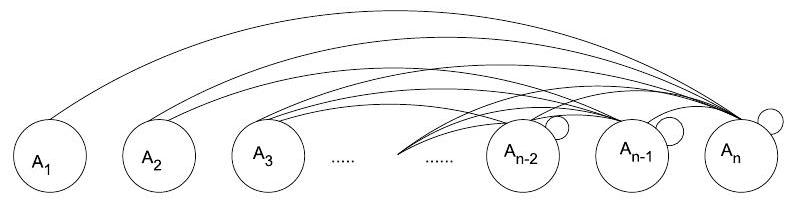\n\nNow the number of games played by anyone in $A_{i}$ is\n$\\left(\\sum_{j \\geq n-i+1}\\left|A_{j}\\right|\\right)$ or $\\left(\\sum_{j \\geq n-i+1}\\left|A_{j}\\right|\\right)-1$ if $i \\geq n-i+1$.\nNow if we start with one person in each $A_{i}$ and two people in $A_{\\left\\lceil\\frac{n}{2}\\right\\rceil}$. The number of played games for anyone in $A_{i}$ is equal to $i$. In particular this is a construction for $\\mathcal{T}=\\{1, . ., n\\}$\nNow to get to numbers of general sets $\\mathcal{T}$ of size $n$ we can change the sizes of $A_{i}$ but keep the construction.\n\n## Variant 1\n\nObservation 1 Adding a person to a set $A_{i}$ increases the number of games played in $A_{j}$ for $j \\geq n-i+1$, by exactly one.\n\nStart with the construction above and then add $t_{1}-1$ people to group $A_{n}$, making the new set of games played equal to $\\left\\{t_{1}, t_{1}+1, \\ldots, n+t_{1}-1\\right\\}$. Then add $t_{2}-t_{1}-1$ to $A_{n-1}$ to get set of games played to $\\left\\{t_{1}, t_{2}, t_{2}+1, \\ldots, n+t_{2}-2\\right\\}$ and repeat until we get to the set $\\mathcal{T}$ adding a total of $\\sum_{j=1}^{n} t_{j}-t_{j-1}-1=t_{n}-n$ people (let $t_{0}=0$ ), so we get $t_{n}+1$ people in the end.\nClearly we can start by adding vertices to $A_{1}$ or any other set instead of $A_{n}$ first and obtain an equivalent construction with the same number of people.\n\n## Variant 2\n\nIt is also possible to calculate the necessary sizes of $A_{i}$ 's all at once. We have by construction the number of games played in $A_{1}$ is less than the number of games played in $A_{2}$ etc. So we have that in the end we want the games played in $A_{i}$ to be exactly $t_{i}$.\nSo $\\left(t_{t}, t_{2}, t_{3}, \\ldots, t_{n}\\right) \\stackrel{!}{=}\\left(\\left|A_{n}\\right|,\\left|A_{n}\\right|+\\left|A_{n-1}\\right|, \\ldots,\\left(\\sum_{j=2}^{n}\\left|A_{j}\\right|\\right)-1,\\left(\\sum_{j=1}^{n}\\left|A_{j}\\right|\\right)-\\right.$ 1).\n\nThis gives us by induction that $\\left|A_{n}\\right| \\stackrel{!}{=} t_{1},\\left|A_{n-1}\\right| \\stackrel{!}{=} t_{2}-t_{1}, \\ldots,\\left|A_{\\left\\lceil\\frac{n}{2}\\right\\rceil}\\right| \\stackrel{!}{=}$ $t_{n-\\left\\lceil\\frac{n}{2}\\right\\rceil+1}-t_{n-\\left\\lceil\\frac{n}{2}\\right\\rceil}+1, \\ldots,\\left|A_{1}\\right| \\stackrel{!}{=} t_{n}-t_{n-1}$ and a quick calculation shows that the sum of all sets is exactly $1+\\sum_{j=1}^{n}\\left(t_{j}-t_{j-1}\\right)=t_{n}+1$. (where the +1 comes from the set $A_{\\left\\lceil\\frac{n}{2}\\right\\rceil}$ and $t_{0}=0$.)\n\n## References\n\n[1] Timothy A. Sipka. The orders of graphs with prescribed degree sets. Journal of Graph Theory, 4(3):301-307, 1980.\n[2] Amitabha Tripathi and Sujith Vijay. A short proof of a theorem on degree sets of graphs. Discrete Appl. Math., 155(5):670-671, 2007.", "metadata": {"resource_path": "EGMO/segmented/en-2017-solutions.jsonl", "problem_match": "# Problem 4", "solution_match": "\n## 4. Solution"}} |
| {"year": "2017", "tier": "T2", "problem_label": "5", "problem_type": null, "exam": "EGMO", "problem": "Let $n \\geq 2$ be an integer. An $n$-tuple $\\left(a_{1}, a_{2}, \\ldots, a_{n}\\right)$ of positive integers is expensive if there exists a positive integer $k$ such that\n\n$$\n\\left(a_{1}+a_{2}\\right)\\left(a_{2}+a_{3}\\right) \\cdots \\cdots\\left(a_{n-1}+a_{n}\\right)\\left(a_{n}+a_{1}\\right)=2^{2 k-1} .\n$$\n\na) Find all positive integers $n \\geq 2$ for which there exists an expensive $n$-tuple.\nb) Prove that for every positive integer $m$ there exists an integer $n \\geq 2$ such that $m$ belongs to an expensive $n$-tuple.\n\nThere are exactly $n$ factors in the product on the left hand side.\nHarun Hindija, Bosnia and Herzegovina", "solution": "1\n\na) Notice that for odd integers $n>2$, the tuple $(1,1, \\ldots, 1)$ is expensive. We will prove that there are no expensive $n$-tuples for even $n$.\n\nLemma 0.1. If an expensive $n$-tuple exists for some $n \\geq 4$, then also an expensive $n-2$-tuple.\nProof. In what follows all indices are considered modulo $n$. Let $\\left(a_{1}, a_{2}, \\ldots, a_{n}\\right)$ be an expensive $n$-tuple and $a_{t}$ the largest element of the tuple. We have the inequalities\n\n$$\n\\begin{aligned}\na_{t-1}+a_{t} & \\leq 2 a_{t}<2\\left(a_{t}+a_{t+1}\\right) \\\\\na_{t}+a_{t+1} & \\leq 2 a_{t}<2\\left(a_{t-1}+a_{t}\\right) .\n\\end{aligned}\n$$\n\nSince both $a_{t-1}+a_{t}$ and $a_{t}+a_{t+1}$ are powers of 2 (they are divisors of a power of 2), we deduce from (1) and (2)\n\n$$\na_{t-1}+a_{t}=a_{t}+a_{t+1}=2^{r}\n$$\n\nfor some positive integer $r$, and in particular $a_{t-1}=a_{t+1}$.\nConsider now the $n$-2-tuple $\\left(b_{1}, \\ldots, b_{n-2}\\right)$ obtained by removing $a_{t}$ and $a_{t+1}$ from $\\left(a_{1}, a_{2}, \\ldots, a_{n}\\right)$. By what we just said we have\n\n$$\n\\prod_{i=1}^{n-2}\\left(b_{i}+b_{i+1}\\right)=\\frac{\\prod_{i=1}^{n}\\left(a_{i}+a_{i+1}\\right)}{\\left(a_{t-1}+a_{t}\\right)\\left(a_{t}+a_{t+1}\\right)}=2^{2(k-r)-1}\n$$\n\nand hence $\\left(b_{1}, \\ldots, b_{n-2}\\right)$ is again expensive.\nFrom the lemma we now conclude that if there exists an expensive $n$-tuple for some even $n$, then also an expensive 2 -tuple i.e.\n\n$$\n\\left(a_{1}+a_{2}\\right)^{2}=2^{2 k-1}\n$$\n\nfor some positive integers $a_{1}, a_{2}$, which is impossible since the right hand side is not a square.\nb) We prove this by induction. In $a$ ) we saw that 1 belongs to an expensive $n$-tuple. Assume now that all odd positive integers less that $2^{k}$ belong to an expensive $n$-tuple, for some $k \\geq 1$. Hence for any odd $r<2^{k}$ there is an integer $n$ and an expensive $n$-tuple $\\left(a_{1}, \\ldots, r, \\ldots, a_{n}\\right)$. We notice that then also ( $a_{1}, \\ldots, r, 2^{k+1}-$ $\\left.r, r, \\ldots, a_{n}\\right)$ is expensive. Since $2^{k+1}-r$ can take all odd values between $2^{k}$ and $2^{k+1}$ the induction step is complete.", "metadata": {"resource_path": "EGMO/segmented/en-2017-solutions.jsonl", "problem_match": "# Problem 5", "solution_match": "# Solution "}} |
| {"year": "2017", "tier": "T2", "problem_label": "5", "problem_type": null, "exam": "EGMO", "problem": "Let $n \\geq 2$ be an integer. An $n$-tuple $\\left(a_{1}, a_{2}, \\ldots, a_{n}\\right)$ of positive integers is expensive if there exists a positive integer $k$ such that\n\n$$\n\\left(a_{1}+a_{2}\\right)\\left(a_{2}+a_{3}\\right) \\cdots \\cdots\\left(a_{n-1}+a_{n}\\right)\\left(a_{n}+a_{1}\\right)=2^{2 k-1} .\n$$\n\na) Find all positive integers $n \\geq 2$ for which there exists an expensive $n$-tuple.\nb) Prove that for every positive integer $m$ there exists an integer $n \\geq 2$ such that $m$ belongs to an expensive $n$-tuple.\n\nThere are exactly $n$ factors in the product on the left hand side.\nHarun Hindija, Bosnia and Herzegovina", "solution": "2\n\na) For odd $n$ the tuple $(1,1, \\ldots, 1)$ is a solution.\n\nNow consider $n$ even. Since the product $\\prod\\left(a_{i}+a_{i+1}\\right)$ is a power of two, every factor needs to be a power of two. We are going to prove that for all tuples $\\left(a_{1}, \\ldots, a_{n}\\right)$ such that $a_{i}+a_{i+1}$ is always a power of two , it is the case that $\\prod\\left(a_{i}+a_{i+1}\\right)$ is equal to an even power of two. We are going to prove this with strong induction on $\\sum a_{i}$. When all $a_{i}$ are equal to one this is certainly the case. Since $a_{i}+a_{i+1}>1$ it is even and we conclude that the $a_{i}$ are either all odd or all even. In the case they are all even, then consider the tuple $\\left(b_{1}, \\ldots, b_{n}\\right)$ with $b_{i}=a_{i} / 2$. This tuple clearly satisfies the hypothesis as well and we have $\\sum b_{i}<\\sum a_{i}$. Furthermore we have $\\prod\\left(a_{i}+a_{i+1}\\right)=2^{n} \\prod\\left(b_{i}+b_{i+1}\\right)$ and since $n$ is even we are done in this case.\nNow all $a_{i}$ are odd. Suppose none of are one, then consider the tuple $\\left(b_{1}, \\ldots, b_{n}\\right)$ with $b_{i}=\\left(a_{i}+(-1)^{i}\\right) / 2$. Since all $a_{i}$ are odd and strictly larger than one, the $b_{i}$ are positive integers and satisfy $b_{i}+b_{i+1}=\\left(a_{i}+a_{i+1}\\right) / 2$, a power of two. Since $\\sum b_{i}<\\sum a_{i}$ and $\\prod\\left(a_{i}+a_{i+1}\\right)=2^{n} \\prod\\left(b_{i}+b_{i+1}\\right)$ we are done in this case again. Now there is at least one $a_{i}$ being one. We may assume $i=1$, because the condition is cyclic. Moreover we may also assume that $a_{2}>1$ since not all of the $a_{i}$ are equal to one. Let now $k$ be the smallest index larger than one such that $a_{k}$ is equal to one. We are not excluding the case $k=n+1$, yet. Now for $i=1, \\ldots, k-1$ we have $a_{i}+a_{i+1}>2$ and thus divisible by four. By induction it easily follows that $a_{i} \\equiv(-1)^{i+1} \\bmod$ (4) for $i=1, \\ldots, k-1$. In particular, since $a_{k}=1$ we find that $k$ is odd and at least three. Now consider the tuple $\\left(b_{1}, \\ldots, b_{n}\\right)$ with $b_{i}=\\left(a_{i}-(-1)^{i}\\right) / 2$ for $i=1, \\ldots, k$ and $b_{i}=a_{i}$ otherwise. This is again a tuple that satisfies the hypothesis, since $b_{1}=a_{1}=1=b_{k}=a_{k}$. Moreover $b_{2}<a_{2}$ and thus $\\sum b_{i}<\\sum a_{i}$. Finally we have $\\prod\\left(a_{i}+a_{i+1}\\right)=2^{k-1} \\prod\\left(b_{i}+b_{i+1}\\right)$ and since $k$ is odd we conclude the proof.\nb) We use some of the ideas from a). Consider the operators $T_{ \\pm}(n)=2 n \\pm 1$. We claim that for every odd integer $m$ there is an integer $r$ and signs $\\epsilon_{i} \\in\\{+,-\\}$ for $i=1, \\ldots r$ such that $T_{\\epsilon_{r}} \\circ \\ldots \\circ T_{\\epsilon_{1}}(1)=m$. This is certainly true for $m=1$ and for $m>1$ we find that $m=T_{-}((m+1) / 2)$ if $m \\equiv 1 \\bmod (4)$ and $m=T_{+}((m-1) / 2)$ if $m \\equiv 3 \\bmod (4)$. Note that both $(m+1) / 2$ and $(m-1) / 2$ are odd integers in their respective cases and $(m-1) / 2 \\leq(m+1) / 2<m$ for $m>1$. Therefore iterating the procedure will eventually terminate in one.\nFor the construction it is most convenient to set $n=2 l+1$ and label the tuple $\\left(a_{-l}, a_{-l+1}, \\ldots, a_{l}\\right)$. For $m=1$ we have the expensive tuple $(1,1,1)$. For $m>1$ we will define operators $T_{ \\pm}$on expensive tuples with the condition $a_{-l}=a_{l}=1$ that give rise to a new expensive tuple $\\left(b_{-l^{\\prime}}, \\ldots, b_{l^{\\prime}}\\right)$ with $b_{-l^{\\prime}}=b_{l^{\\prime}}=1$ and $b_{0}=T_{ \\pm} a_{0}$. It is then clear that $T_{\\epsilon_{r}} \\circ \\cdots \\circ T_{\\epsilon_{1}}((1,1,1))$ is an expensive tuple containing $m$. We define $T_{ \\pm}$as follows: set $l^{\\prime}=l+1$ and $b_{-l^{\\prime}}=b_{l^{\\prime}}=1$ and $b_{i}=T_{ \\pm(-1)^{i}}\\left(a_{i}\\right)$ for $i=-l, \\ldots, l$. Here we identify + with +1 and - with -1 . We are left to prove that the new tuple is indeed expensive. If $\\pm(-1)^{l}=-1$, then $\\prod\\left(b_{i}+b_{i+1}\\right)=4 \\cdot 2^{2 l} \\prod\\left(a_{i}+a_{i+1}\\right)$, and if $\\pm(-1)^{l}=+1$, then $\\prod\\left(b_{i}+b_{i+1}\\right)=4 \\cdot 2^{2 l+2} \\prod\\left(a_{i}+a_{i+1}\\right)$. In both cases we end up with an expensive tuple again.", "metadata": {"resource_path": "EGMO/segmented/en-2017-solutions.jsonl", "problem_match": "# Problem 5", "solution_match": "# Solution "}} |
| {"year": "2017", "tier": "T2", "problem_label": "6", "problem_type": null, "exam": "EGMO", "problem": "Let $A B C$ be an acute-angled triangle in which no two sides have the same length. The reflections of the centroid $G$ and the circumcentre $O$ of $A B C$ in its sides $B C, C A, A B$ are denoted by $G_{1}, G_{2}, G_{3}$, and $O_{1}, O_{2}, O_{3}$, respectively. Show that the circumcircles of the triangles $G_{1} G_{2} C, G_{1} G_{3} B, G_{2} G_{3} A, O_{1} O_{2} C, O_{1} O_{3} B, O_{2} O_{3} A$ and $A B C$ have a common point.\n\nThe centroid of a triangle is the intersection point of the three medians. A median is a line connecting a vertex of the triangle to the midpoint of the opposite side.\n\nCharles Leytem, Luxembourg", "solution": "Let $H$ denote the orthocenter of $A B C$, and let $e$ denote its Euler line. Let $e_{1}, e_{2}, e_{3}$ denote the respective reflections of $e$ in $B C, C A, A B$. The proof naturally divides into two parts: we first show that pairwise intersections of the circles in question correspond to pairwise intersections of $e_{1}, e_{2}, e_{3}$, and then prove that $e_{1}, e_{2}, e_{3}$ intersect in a single point on the circumcircle of $A B C$.\n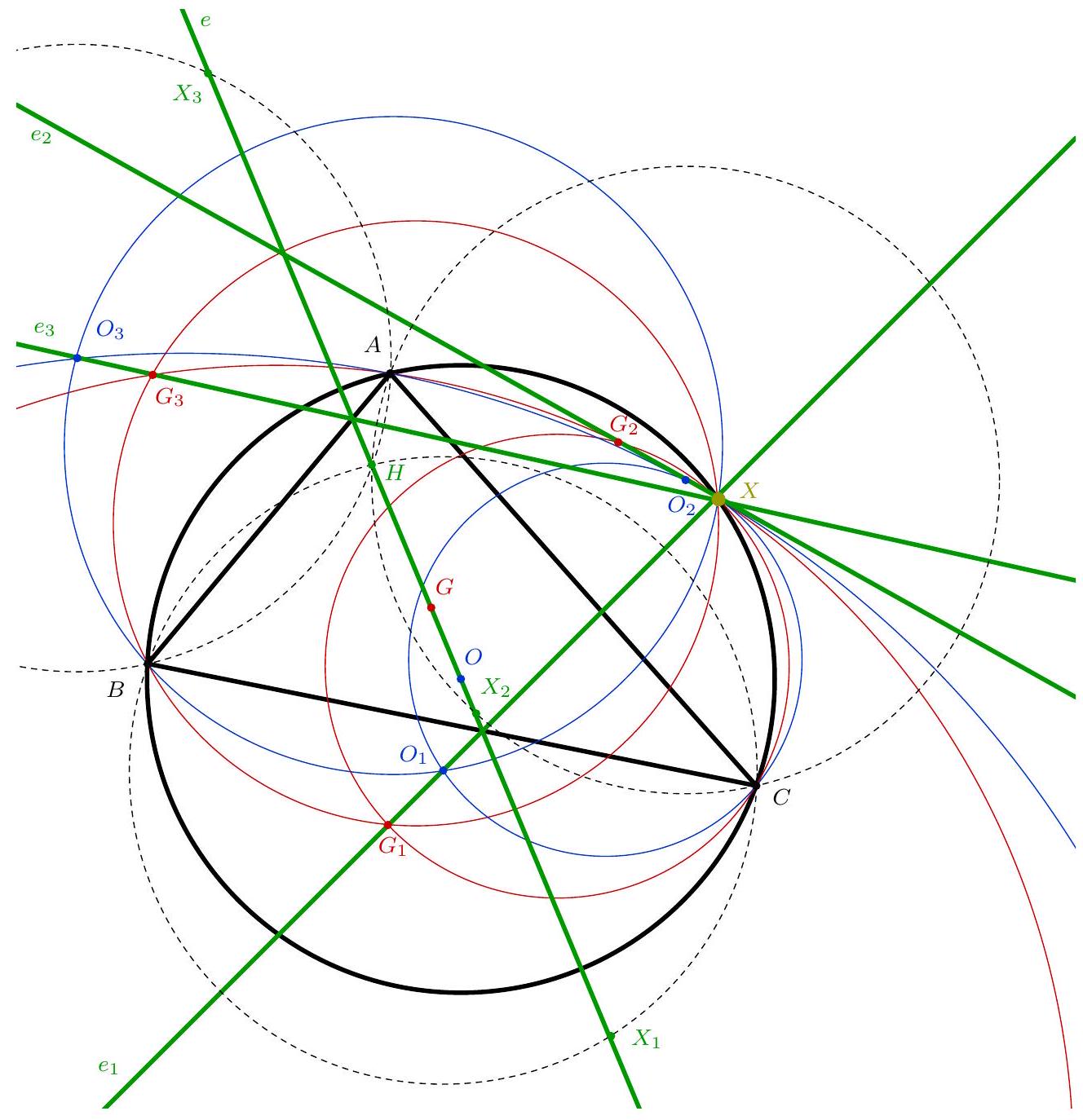\n\nNow consider for example the circumcircles of $O_{1} O_{2} C$ and $G_{1} G_{2} C$. By construction, it is clear that $\\angle O_{2} C O_{1}=\\angle G_{2} C G_{1}=2 \\angle A C B$. Let $G_{1} O_{1}$ and $G_{2} O_{2}$ meet at $X$, and let $e$ meet $e_{1}, e_{2}$ at $E_{1}, E_{2}$, respectively, as shown in the diagram below. Chasing angles,\n\n$$\n\\begin{aligned}\n\\angle G_{2} X G_{1}=\\angle O_{2} X O_{1} & =\\angle E_{2} X E_{1}=180^{\\circ}-\\angle E_{1} E_{2} X-\\angle X E_{1} E_{2} \\\\\n& =180^{\\circ}-2 \\angle E_{1} E_{2} C-\\left(\\angle C E_{1} E_{2}-\\angle C E_{1} X\\right) .\n\\end{aligned}\n$$\n\nBut $\\angle C E_{1} X=\\angle B E_{1} O_{1}=\\angle B E_{1} O=180^{\\circ}-\\angle C E_{1} E_{2}$, and thus\n\n$$\n\\angle G_{2} X G_{1}=\\angle O_{2} X O_{1}=2\\left(180^{\\circ}-\\angle E_{1} E_{2} C-\\angle C E_{1} E_{2}\\right)=2 \\angle A C B\n$$\n\n\n\nIt follows from this that $X$ lies on the circumcircles of $G_{1} G_{2} C$ and $O_{1} O_{2} C$. In other words, the second point of intersection of the circumcircles of $G_{1} G_{2} C$ and $O_{1} O_{2} C$ is the intersection of $e_{1}$ and $e_{2}$. Similarly, the circumcircles of $G_{1} G_{3} B$ and $O_{1} O_{3} B$ meet again at the intersection of $e_{1}$ and $e_{3}$, and those of $G_{2} G_{3} A$ and $O_{2} O_{3} A$ meet again at the intersection of $e_{2}$ and $e_{3}$.\n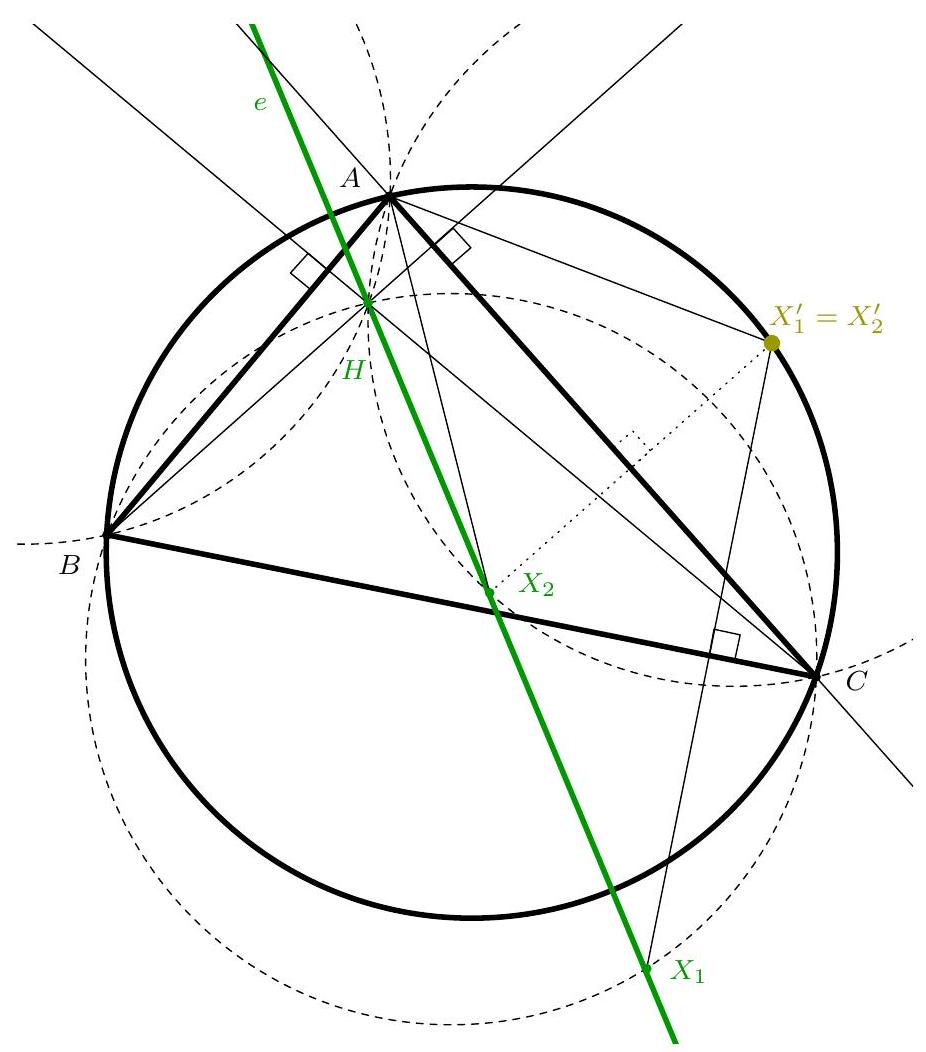\n\nIt thus remains to show that $e_{1}, e_{2}, e_{3}$ are concurrent, and intersect on the circumcircle of $A B C$. Let $e$ meet the circumcircles of the triangles $B C H, A C H, A B H$ at $X_{1}, X_{2}, X_{3}$, respectively. It is well known that the reflections of $H$ in the sides of $A B C$ lie on the circumcircle of $A B C$. For this reason, the circumcircles of $B C H, A C H, A B H$ have the same radius as the circumcircle of $A B C$, and hence the reflections $X_{1}^{\\prime}, X_{2}^{\\prime}, X_{3}^{\\prime}$ of $X_{1}, X_{2}, X_{3}$ in the sides $[B C],[C A],[A B]$ lie on the circumcircle of $A B C$. By definition, $X_{1}^{\\prime}, X_{2}^{\\prime}, X_{3}^{\\prime}$ lie on $e_{1}, e_{2}, e_{3}$, respectively. It thus remains to show that they coincide.\nTo show that, for example, $X_{1}^{\\prime}=X_{2}^{\\prime}$, it will be sufficient to show that $\\angle X_{2} A C=\\angle X_{1}^{\\prime} A C$, since we have already shown that $X_{1}^{\\prime}$ and $X_{2}^{\\prime}$ lie on the circumcircle of $A B C$. But, chasing angles in the diagram above,\n\n$$\n\\begin{aligned}\n\\angle X_{1}^{\\prime} A C & =\\angle X_{1}^{\\prime} A B-\\angle B A C=\\left(180^{\\circ}-\\angle X_{1}^{\\prime} C B\\right)-\\angle B A C \\\\\n& =180^{\\circ}-\\angle X_{1} C B-\\angle B A C=\\left(180^{\\circ}-\\angle B A C\\right)-\\angle X_{1} H B \\\\\n& =\\angle B H C-\\angle X_{1} H B=\\angle X_{2} H C=\\angle X_{2} A C\n\\end{aligned}\n$$\n\nwhere we have used the fact that $B H C X_{1}$ and $A H X_{2} C$ are cyclic by construction, and the fact that $\\angle B H C=180^{\\circ}-\\angle B A C$. This shows that $X_{1}^{\\prime}=X_{2}^{\\prime}$. Similarly, $X_{1}^{\\prime}=X_{3}^{\\prime}$, which completes the proof.\n\nRemark. The statement of the problem remains true if $O$ and $G$ are replaced with two points that are aligned with the orthocenter $H$ of the triangle, and indeed, the proof above did not require any property of $G$ and $O$ other than the fact that they lie on a line through $H$, the Euler line.", "metadata": {"resource_path": "EGMO/segmented/en-2017-solutions.jsonl", "problem_match": "# Problem 6", "solution_match": "# Solution 1 (Euler lines)"}} |
| {"year": "2017", "tier": "T2", "problem_label": "6", "problem_type": null, "exam": "EGMO", "problem": "Let $A B C$ be an acute-angled triangle in which no two sides have the same length. The reflections of the centroid $G$ and the circumcentre $O$ of $A B C$ in its sides $B C, C A, A B$ are denoted by $G_{1}, G_{2}, G_{3}$, and $O_{1}, O_{2}, O_{3}$, respectively. Show that the circumcircles of the triangles $G_{1} G_{2} C, G_{1} G_{3} B, G_{2} G_{3} A, O_{1} O_{2} C, O_{1} O_{3} B, O_{2} O_{3} A$ and $A B C$ have a common point.\n\nThe centroid of a triangle is the intersection point of the three medians. A median is a line connecting a vertex of the triangle to the midpoint of the opposite side.\n\nCharles Leytem, Luxembourg", "solution": "2\n\nThe proof consists of two parts. First, we show that if $P$ is any point inside the triangle $A B C$ and $P_{1}, P_{2}, P_{3}$ are its reflections in the sides $B C, C A, A B$, then the circumcircles of the triangles $P_{1} P_{2} C, P_{1} P_{3} B, P_{2} P_{3} A$ intersect in a point $T_{P}$ on the circumcircle of the triangle $A B C$. In the second part, we show that $T_{G}$ coincides with $T_{O}$.\nNow let $P$ be any point inside the triangle $A B C$ and let $P_{1}, P_{2}, P_{3}$ be the reflections in the sides as above. Let $T_{P}$ be the second intersection of the circumcircles of the triangles $P_{1} P_{2} C$ and $A B C$. We want to show that $T_{P}$ lies on the circumcircles of the triangles $P_{1} P_{3} B$ and $P_{2} P_{3} A$.\n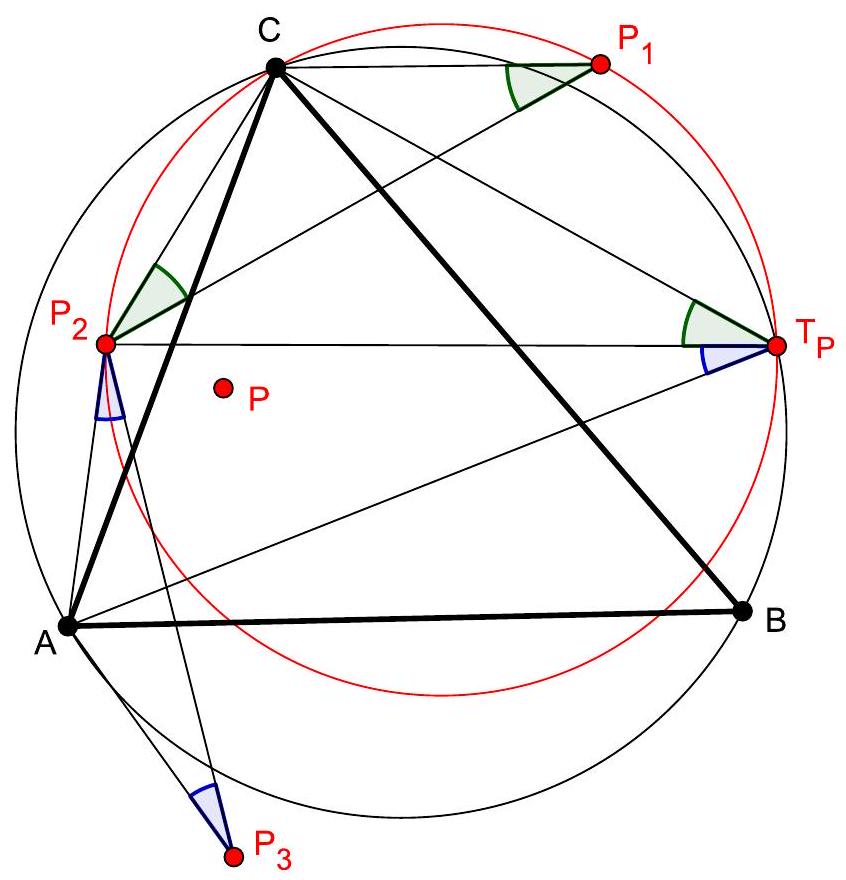\n\nBy construction, we have $P_{1} C=P_{2} C$, hence\n\n$$\n\\angle C P_{1} P_{2}=90^{\\circ}-\\frac{1}{2} \\angle P_{2} C P_{1}=90^{\\circ}-\\angle A C B\n$$\n\nSimilarly, $\\angle P_{2} P_{3} A=90^{\\circ}-\\angle B A C$. This gives us\n\n$$\n\\begin{aligned}\n\\angle P_{2} T_{P} A & =\\angle C T_{P} A-\\angle C T_{P} P_{2}=\\angle C B A-\\angle C P_{1} P_{2} \\\\\n& =\\angle C B A-90^{\\circ}+\\angle A C B=90^{\\circ}-\\angle B A C=\\angle P_{2} P_{3} A,\n\\end{aligned}\n$$\n\nso $T_{P}$ lies on the circumcircle of the triangle $P_{2} P_{3} A$. Similarly, $T_{P}$ lies on the circumcircle of the triangle $P_{1} P_{3} B$ which completes the first part.\nNote that if $P_{2}$ is given, then $T_{P}$ is the unique point on the circumcircle of the triangle $A B C$ with $\\angle C T_{P} P_{2}=90^{\\circ}-\\angle A C B$. In the second part, we will use this as follows: If we can find a point $T$ on the circumcircle of the triangle $A B C$ with $\\angle C T G_{2}=\\angle C T O_{2}=90^{\\circ}-\\angle A C B$,\nthen $T=T_{G}=T_{O}$ and we are done.\nLet $H$ be the orthocenter of the triangle $A B C$ and let $H_{2}$ be the reflection in the side $A C$. It is known that $H_{2}$ lies on the circumcircle of the triangle $A B C . G, O, H$ lie on the Euler line, so $G_{2}, O_{2}, H_{2}$ are collinear as well. Let $T$ be the second intersection of $G_{2} H_{2}$ and the circumcircle of the triangle $A B C$. We can now complete the proof by seeing that\n\n$$\n\\angle C T G_{2}=\\angle C T O_{2}=\\angle C T H_{2}=\\angle C B H_{2}=90^{\\circ}-\\angle A C B .\n$$\n\n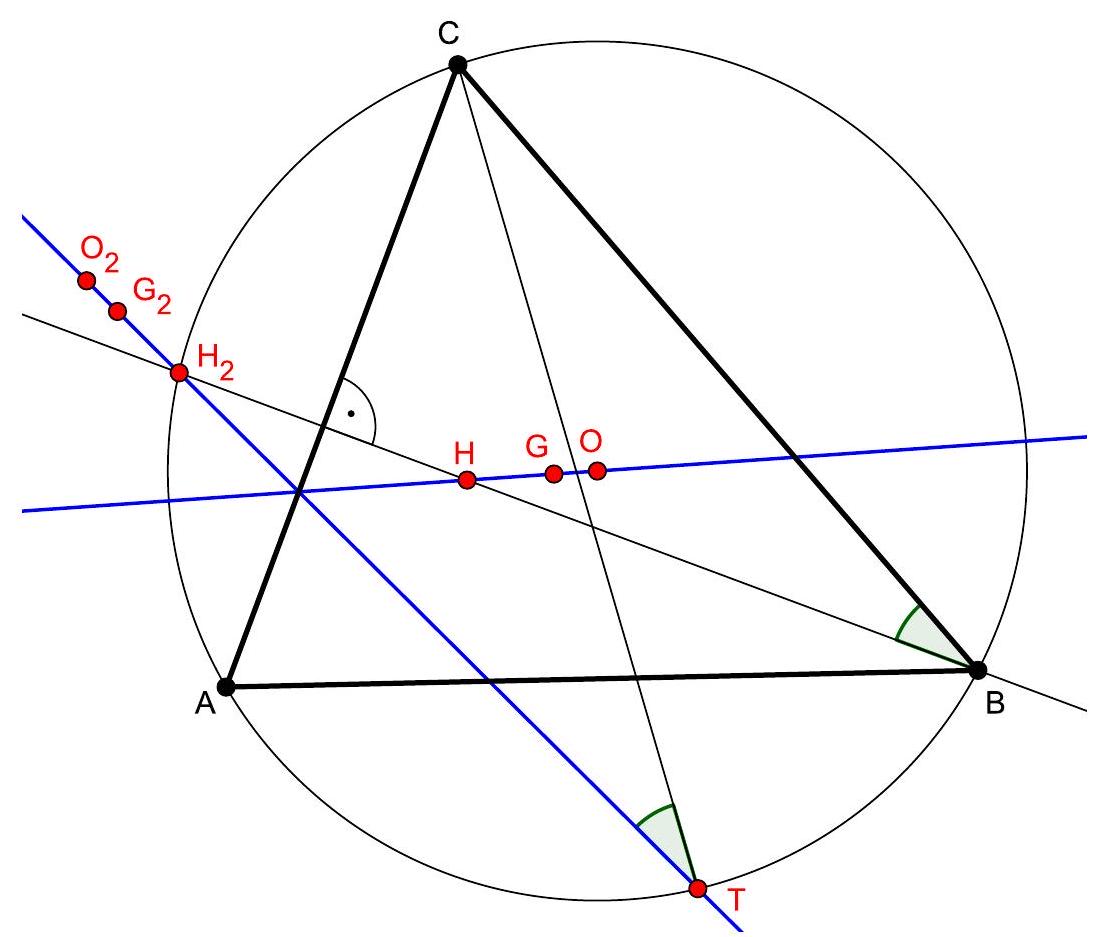", "metadata": {"resource_path": "EGMO/segmented/en-2017-solutions.jsonl", "problem_match": "# Problem 6", "solution_match": "# Solution "}} |
| {"year": "2017", "tier": "T2", "problem_label": "6", "problem_type": null, "exam": "EGMO", "problem": "Let $A B C$ be an acute-angled triangle in which no two sides have the same length. The reflections of the centroid $G$ and the circumcentre $O$ of $A B C$ in its sides $B C, C A, A B$ are denoted by $G_{1}, G_{2}, G_{3}$, and $O_{1}, O_{2}, O_{3}$, respectively. Show that the circumcircles of the triangles $G_{1} G_{2} C, G_{1} G_{3} B, G_{2} G_{3} A, O_{1} O_{2} C, O_{1} O_{3} B, O_{2} O_{3} A$ and $A B C$ have a common point.\n\nThe centroid of a triangle is the intersection point of the three medians. A median is a line connecting a vertex of the triangle to the midpoint of the opposite side.\n\nCharles Leytem, Luxembourg", "solution": "For every point $P$, let $p$ denote the corresponding complex number. Set $O$ to be the origin, so $o=0$, and without loss of generality we can assume that $a, b$ and $c$ lie on the unit circle. Then the centroid can be expressed as $g=\\frac{a+b+c}{3}$.\nThe segments $O o_{1}$ and $b c$ have a common midpoint, so $o_{1}+o=b+c$, and then $o_{1}=b+c$. Similarly $o_{2}=a+c$ and $o_{3}=a+b$. In order to compute $g_{1}$, define $y$ to be the projection of $g$ onto $b c$. Since $b$ and $c$ are on the unit circle, it is well known that $y$ can be expressed as\n\n$$\ny=\\frac{1}{2}(b+c+g-b c \\bar{g}) .\n$$\n\nBy using $\\bar{a}=\\frac{1}{a}, \\bar{b}=\\frac{1}{b}$ and $\\bar{c}=\\frac{1}{c}$ (points on the unit circle), we obtain\n\n$$\ng_{1}=b+c-\\frac{a b+b c+c a}{3 a} .\n$$\n\nSimilarly, we get $g_{2}=a+c-\\frac{a b+b c+c a}{3 b}$ and $g_{3}=a+b-\\frac{a b+b c+c a}{3 c}$.\n\n1) Proof that circumcircles of triangles $a b c, o_{1} O_{2} c, o_{1} O_{3} b$ and $o_{2} O_{3} a$ have common point.\n\nLet $x$ be the point of intersection of circumcircles of triangles $o_{1} O_{2} c$ and $a b c(x \\neq c)$. We know that $x, o_{1}, o_{2}$ and $c$ are concyclic if and only if $\\frac{x-c}{o_{1}-c}: \\frac{x-o_{2}}{o_{1}-o_{2}}$ is real number, which is equivalent to\n\n$$\n\\frac{x-c}{\\bar{x}-\\bar{c}} \\cdot \\frac{o_{1}-o_{2}}{\\overline{o_{1}}-\\overline{o_{2}}}=\\frac{o_{1}-c}{\\overline{o_{1}}-\\bar{c}} \\cdot \\frac{x-o_{2}}{\\bar{x}-\\overline{o_{2}}}\n$$\n\nSince $x$ and $c$ are on the unit circle $\\frac{x-c}{\\bar{x}-\\bar{c}}=-x c$. Also, $\\frac{o_{1}-o_{2}}{\\overline{o_{1}-\\overline{o_{2}}}}=\\frac{b-a}{\\bar{b}-\\bar{a}}=-a b$, and $\\frac{o_{1}-c}{\\overline{o_{1}}-\\bar{c}}=\\frac{b}{\\bar{b}}=b^{2}$. Since $\\bar{x}=\\frac{1}{x}$, from (1) and previous relations, we have:\n\n$$\nx=\\frac{a b+b c+c a}{a+b+c}\n$$\n\nThis formula is symmetric, so we conclude that $x$ also belongs to circumcircles of $o_{1} O_{3} b$ and $o_{2} O_{3} a$.\n2) Proof that $x$ belongs to circumcircles of $g_{1} g_{2} c, g_{1} g_{3} b$ and $g_{2} g_{3} a$.\n\nBecause of symmetry, it is enough to prove that $x$ belongs to circumcircle of $g_{1} g_{2} c$, i.e. to prove the following:\n\n$$\n\\frac{x-c}{\\bar{x}-\\bar{c}} \\cdot \\frac{g_{1}-g_{2}}{\\overline{g_{1}}-\\overline{g_{2}}}=\\frac{g_{1}-c}{\\overline{g_{1}}-\\bar{c}} \\cdot \\frac{x-g_{2}}{\\bar{x}-\\overline{g_{2}}}\n$$\n\nEasy computations give that\n\n$$\ng_{1}-g_{2}=(b-a) \\frac{2 a b-b c-a c}{3 a b}, \\quad \\overline{g_{1}}-\\overline{g_{2}}=(\\bar{b}-\\bar{a}) \\frac{2-\\frac{a}{c}-\\frac{b}{c}}{3}\n$$\n\nand then\n\n$$\n\\frac{g_{1}-g_{2}}{\\overline{g_{1}}-\\overline{g_{2}}}=\\frac{c(b c+a c-2 a b)}{2 c-a-b}\n$$\n\nOn the other hand we have\n\n$$\ng_{1}-c=\\frac{2 a b-b c-a c}{3 a}, \\quad \\overline{g_{1}}-\\bar{c}=\\frac{2 c-a-b}{3 b c} .\n$$\n\nThis implies\n\n$$\n\\frac{g_{1}-c}{\\overline{g_{1}-\\bar{c}}}=\\frac{2 a b-b c-a c}{2 c-a-b} \\cdot \\frac{b c}{a}\n$$\n\nThen (2) is equivalent to\n\n$$\n\\begin{aligned}\n-x c \\cdot \\frac{c(b c+a c-2 a b)}{2 c-a-b} & =\\frac{2 a b-b c-a c}{2 c-a-b} \\cdot \\frac{b c}{a} \\cdot \\frac{x-g_{2}}{\\bar{x}-\\overline{g_{2}}} \\\\\n\\Longleftrightarrow x c a\\left(\\bar{x}-\\bar{g}_{2}\\right) & =b\\left(x-g_{2}\\right)\n\\end{aligned}\n$$\n\nwhich is also equivalent to\n$\\frac{a b+b c+c a}{a+b+c} \\cdot c a\\left(\\frac{a+b+c}{a b+b c+c a}-\\frac{1}{a}-\\frac{1}{c}+\\frac{a+b+c}{3 a c}\\right)=b \\cdot\\left(\\frac{a b+b c+c a}{a+b+c}-a-c+\\frac{a b+b c+c a}{3 b}\\right)$.\nThe last equality can easily be verified, which implies that $x$ belongs to circumcircle of triangle $g_{1} g_{2} c$. This concludes our proof.", "metadata": {"resource_path": "EGMO/segmented/en-2017-solutions.jsonl", "problem_match": "# Problem 6", "solution_match": "# Solution 3 (complex numbers)"}} |
| {"year": "2017", "tier": "T2", "problem_label": "6", "problem_type": null, "exam": "EGMO", "problem": "Let $A B C$ be an acute-angled triangle in which no two sides have the same length. The reflections of the centroid $G$ and the circumcentre $O$ of $A B C$ in its sides $B C, C A, A B$ are denoted by $G_{1}, G_{2}, G_{3}$, and $O_{1}, O_{2}, O_{3}$, respectively. Show that the circumcircles of the triangles $G_{1} G_{2} C, G_{1} G_{3} B, G_{2} G_{3} A, O_{1} O_{2} C, O_{1} O_{3} B, O_{2} O_{3} A$ and $A B C$ have a common point.\n\nThe centroid of a triangle is the intersection point of the three medians. A median is a line connecting a vertex of the triangle to the midpoint of the opposite side.\n\nCharles Leytem, Luxembourg", "solution": "The first part of the first solution and the second part of the second solution can also be done by the following rotation argument: The rotation through $2 \\angle B A C$ about $A$ takes $O_{3}$ to $O_{2}, G_{3}$ to $G_{2}$ and $H_{3}$ to $H_{2}$ (again, $H_{2}, H_{3}$ are the reflections of the orthocenter $H$ in the sides $C A, A B$ ). Let $X$ be the intersection of the Euler line reflections $e_{2}$ (going through $O_{2}, G_{2}, H_{2}$ ) and $e_{3}$ (going through $O_{3}, G_{3}, H_{3}$ ). We now use the well-known fact that if a rotation about a point $A$ takes a line $l$ and a point $P$ on $l$ to the line $l^{\\prime}$ and the point $P^{\\prime}$, then the quadrilateral $A P P^{\\prime} X$ is cyclic, where $X$ is the intersection of $l$ and $l^{\\prime}$. For this reason, $A O_{3} O_{2} X, A G_{3} G_{2} X$ and $A H_{3} H_{2} X$ are cyclic quadrilaterals. Since $H_{2}$ and $H_{3}$ lie on the circumcircle of the triangle $A B C$, the circumcircles of the triangles $A H_{3} H_{2}$ and $A B C$ are the same, hence $X$ lies on the circumcircle of $A B C$.\nThis proves the first part of the first solution as well as the second part of the second solution.\n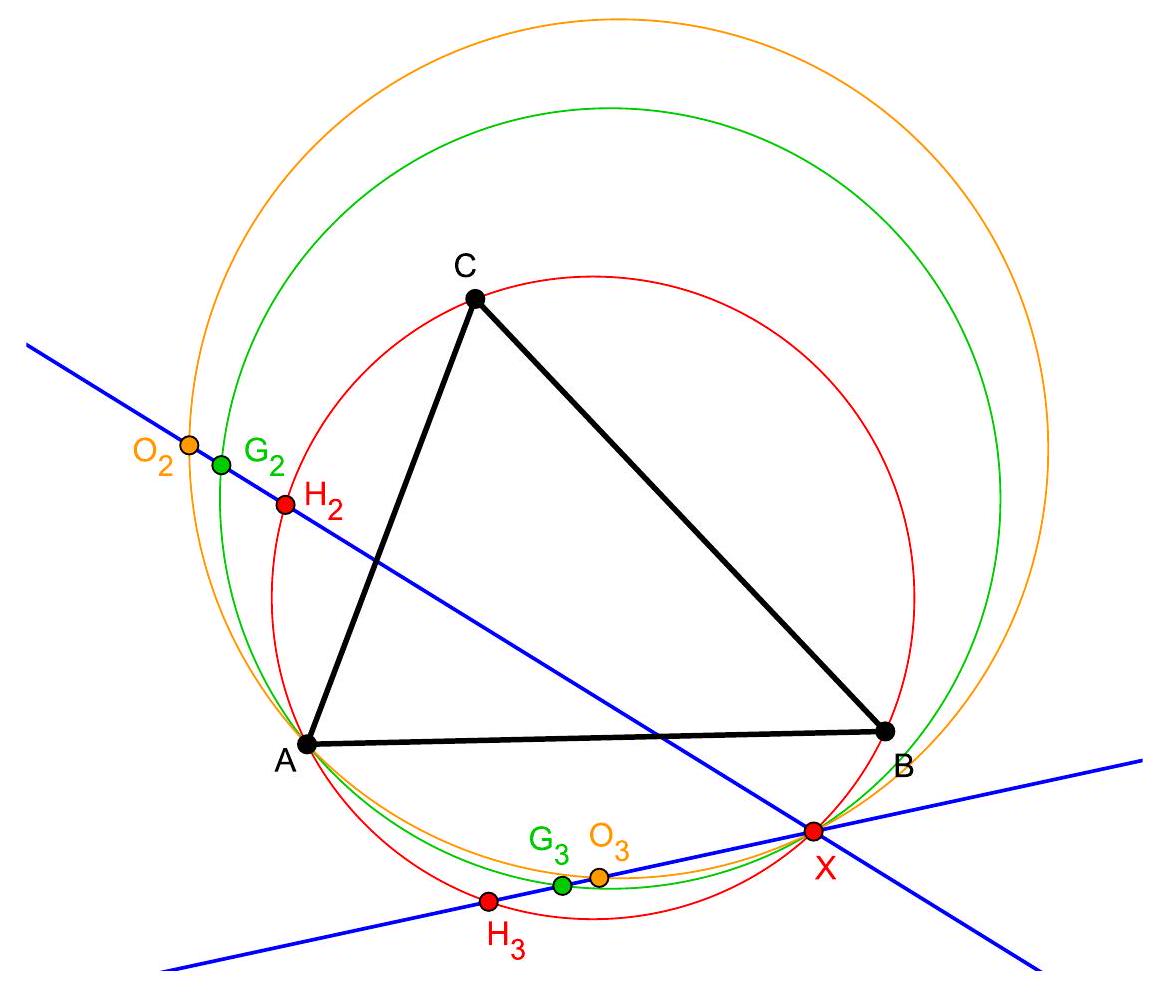\n\nRemark: Problem 6 is a special case of Corollary 3 in Darij Grinberg's paper Anti-Steiner points with respect to a triangle.", "metadata": {"resource_path": "EGMO/segmented/en-2017-solutions.jsonl", "problem_match": "# Problem 6", "solution_match": "# Solution 4 (rotation)"}} |
|
|


