| {"year": "2018", "tier": "T2", "problem_label": "1", "problem_type": null, "exam": "EGMO", "problem": "Let $A B C$ be a triangle with $C A=C B$ and $\\angle A C B=120^{\\circ}$, and let $M$ be the midpoint of $A B$. Let $P$ be a variable point on the circumcircle of $A B C$, and let $Q$ be the point on the segment $C P$ such that $Q P=2 Q C$. It is given that the line through $P$ and perpendicular to $A B$ intersects the line $M Q$ at a unique point $N$.\n\nProve that there exists a fixed circle such that $N$ lies on this circle for all possible positions of $P$.\n(Velina Ivanova, Bulgaria)", "solution": "Let $O$ be the circumcenter of $A B C$. From the assumption that $\\angle A C B=120^{\\circ}$ it follows that $M$ is the midpoint of $C O$.\n\nLet $\\omega$ denote the circle with center in $C$ and radius $C O$. This circle in the image of the circumcircle of $A B C$ through the translation that sends $O$ to $C$. We claim that $N$ lies on $\\omega$.\n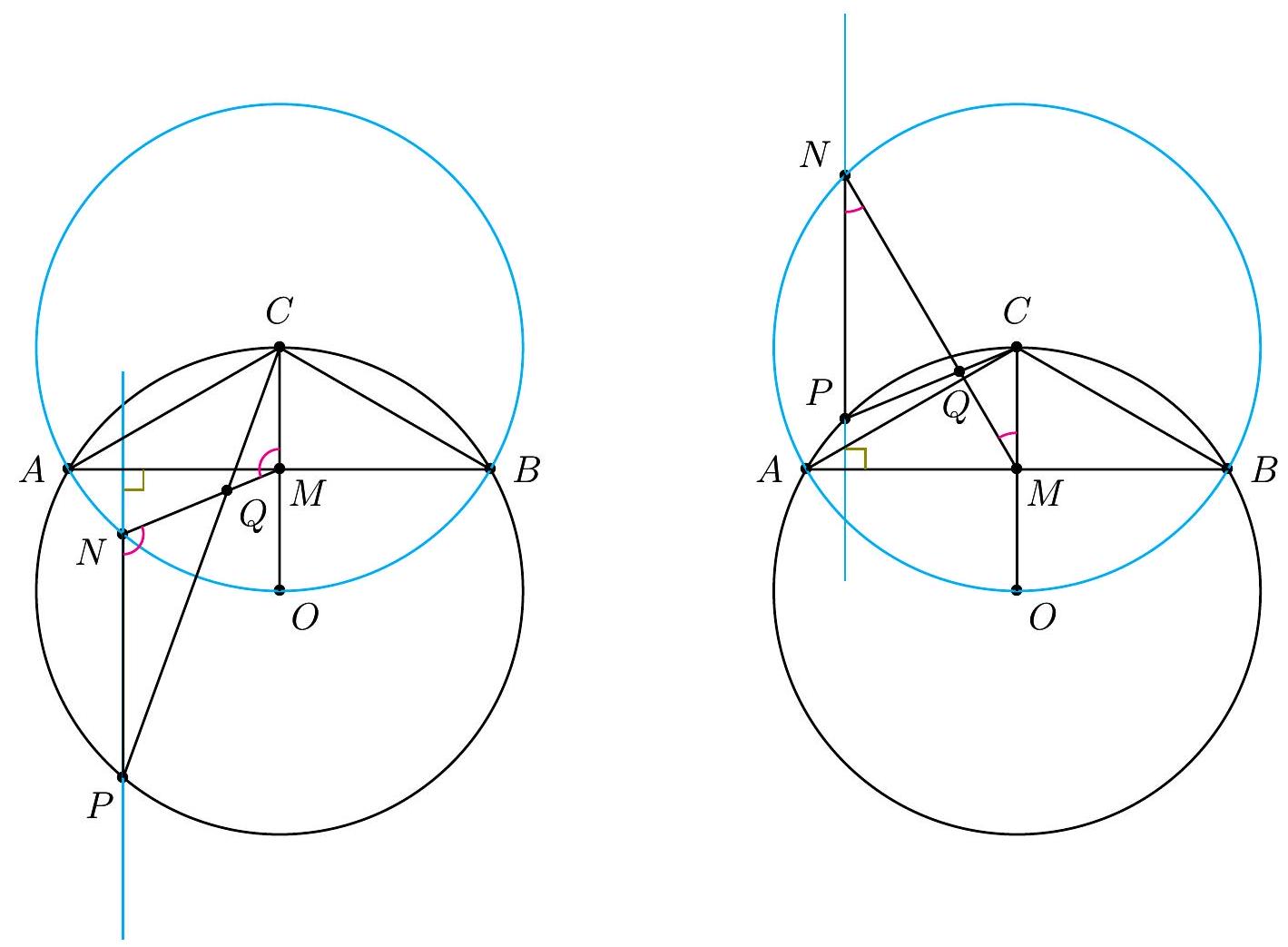\n\nLet us consider the triangles $Q N P$ and $Q M C$. The angles in $Q$ are equal. Since $N P$ is parallel to $M C$ (both lines are perpendicular to $A B$ ), it turns out that $\\angle Q N P=\\angle Q M C$, and hence the two triangles are similar. Since $Q P=2 Q C$, it follows that\n\n$$\nN P=2 M C=C O\n$$\n\nwhich proves that $N$ lies on $\\omega$.\nComment The possible positions of $N$ are all the points of $\\omega$ with the exception of the two points lying on the line $C O$. Indeed, $P$ does not lie on the line $C O$ because otherwise the point $N$ is not well-defined, and therefore also $N$ does not lie on the same line.\n\nConversely, let $N$ be any point on $\\omega$ and not lying on the line $C O$. Let $P$ be the corresponding point on the circumcircle of $A B C$, namely such that $N P$ is parallel and equal to $C O$. Let $Q$ be\nthe intersection of $C P$ and $N M$. As before, the triangles $Q N P$ and $Q M C$ are similar, and now from the relation $N P=2 M C$ we deduce that $Q P=2 Q C$. This proves that $N$ can be obtained from $P$ through the construction described in the statement of the problem.\n\nAlternative solution Let $M^{\\prime}$ denote the symmetric of $M$ with respect to $O$.\nLet us consider the quadrilateral $M M^{\\prime} P N$. The lines $M M^{\\prime}$ and $N P$ are parallel by construction. Also the lines $P M^{\\prime}$ and $N M$ are parallel (homothety from $C$ with coefficient 3). It follows that $M M^{\\prime} P N$ is a parallelogram, and hence $P N=M M^{\\prime}=O C$.\n\nComputational solution There are many computation approaches to this problem. For example, we can set Cartesian coordinates so that\n\n$$\nA=\\left(-\\frac{\\sqrt{3}}{2}, \\frac{1}{2}\\right), \\quad B=\\left(\\frac{\\sqrt{3}}{2}, \\frac{1}{2}\\right), \\quad C=(0,1), \\quad M=\\left(0, \\frac{1}{2}\\right)\n$$\n\nSetting $P=(a, b)$, we obtain that $Q=(a / 3,(2+b) / 3)$. The equation of the line through $P$ and perpendicular to $A B$ is $x=a$. The equation of the line $M Q$ (if $a \\neq 0$ ) is\n\n$$\ny-\\frac{1}{2}=\\frac{x}{a}\\left(\\frac{1}{2}+b\\right) .\n$$\n\nThe intersection of the two lines is therefore\n\n$$\nN=(a, 1+b)=P+(0,1)\n$$\n\nThis shows that the map $P \\rightarrow N$ in the translation by the vector $(0,1)$. This result is independent of the position of $P$ (provided that $a \\neq 0$, because otherwise $N$ is not well-defined).\n\nWhen $P$ lies on the circumcircle of $A B C$, with the exception of the two points with $a=0$, then necessarily $N$ lies on the translated circle (which is the circle with center in $C$ and radius 1).", "metadata": {"resource_path": "EGMO/segmented/en-2018-solutions.jsonl", "problem_match": "\nProblem 1", "solution_match": "\nSolution "}} |
| {"year": "2018", "tier": "T2", "problem_label": "2", "problem_type": null, "exam": "EGMO", "problem": "Consider the set\n\n$$\nA=\\left\\{1+\\frac{1}{k}: k=1,2,3, \\ldots\\right\\}\n$$\n\n(a) Prove that every integer $x \\geq 2$ can be written as the product of one or more elements of $A$, which are not necessarily different.\n(b) For every integer $x \\geq 2$, let $f(x)$ denote the minimum integer such that $x$ can be written as the product of $f(x)$ elements of $A$, which are not necessarily different.\nProve that there exist infinitely many pairs $(x, y)$ of integers with $x \\geq 2, y \\geq 2$, and\n\n$$\nf(x y)<f(x)+f(y) .\n$$\n\n(Pairs $\\left(x_{1}, y_{1}\\right)$ and $\\left(x_{2}, y_{2}\\right)$ are different if $x_{1} \\neq x_{2}$ or $\\left.y_{1} \\neq y_{2}\\right)$.\n(Mihail Baluna, Romania)", "solution": "Every integer $x \\geq 2$ can be written as the telescopic product of $x-1$ elements of $A$ as\n\n$$\nx=\\left(1+\\frac{1}{x-1}\\right) \\cdot\\left(1+\\frac{1}{x-2}\\right) \\cdot \\ldots \\cdot\\left(1+\\frac{1}{2}\\right) \\cdot\\left(1+\\frac{1}{1}\\right)\n$$\n\nwhich is enough to establish part (a). We now consider part (b). Notice that for any positive integer $k$ we have\n\n$$\nf\\left(2^{k}+1\\right) \\leq k+1\n$$\n\nbecause $2^{k}+1=\\left(1+\\frac{1}{2^{k}}\\right) \\cdot 2^{k}$ is a representation of $2^{k}+1$ as a product of $k+1$ elements of $A$. We claim that all the pairs $(x, y)$ of the form\n\n$$\nx=5, \\quad y=\\frac{2^{4 k+2}+1}{5}\n$$\n\nsatisfy the required inequality. Notice that $y$ is an integer for any positive value of $k$, because $2^{4 k+2}+1 \\equiv 16^{k} \\cdot 4+1 \\equiv 5 \\equiv 0(\\bmod 5)$. Furthermore, $f(x y)=f\\left(2^{4 k+2}+1\\right) \\leq 4 k+3$ (and $f(x)=f\\left(2^{2}+1\\right) \\leq 3$ ) by the above. We now need some lower bounds on the values of $f$. Notice that no element of $A$ exceeds 2, and therefore the product of at most $k$ elements of $A$ does not exceed $2^{k}$ : it follows that\n\n$$\nf(n) \\geq\\left\\lceil\\log _{2}(n)\\right\\rceil\n$$\n\nand in particular that\n\n$$\nf(5)=f\\left(2^{2}+1\\right) \\geq\\left\\lceil\\log _{2}(5)\\right\\rceil=3\n$$\n\nWe have thus proven $f(x)=f(5)=3$. We want to show $f(x y)<f(x)+f(y)$, and since we know $f(x y) \\leq 4 k+3$ and $f(x)=3$ we are reduced to showing $f(y)>4 k$. Since $y>2^{4 k-1}$, from (Q2.1) we already know that $f(y) \\geq 4 k$, and hence we just need to exclude that $f(y)=4 k$. Let us assume that we can represent $y$ in the form $a_{1} \\cdot \\ldots a_{4 k}$ with every $a_{i}$ in $A$. At least one of the $a_{i}$ is not 2 (otherwise the product would be a power of 2 , while $y$ is odd), and hence it is less than or equal to $3 / 2$. It follows that\n\n$$\na_{1} \\cdot \\ldots \\cdot a_{4 k} \\leq 2^{4 k-1} \\cdot \\frac{3}{2}=15 \\cdot \\frac{2^{4 k-2}}{5}<\\frac{2^{4 k+2}}{5}<y\n$$\n\nwhich contradicts the fact that $a_{1} \\cdot \\ldots \\cdot a_{4 k}$ is a representation of $y$.\nNote. Using a similar approach one can also prove that all pairs of the form\n\n$$\n\\left(3, \\frac{2^{2 k+1}+1}{3}\\right) \\quad \\text { and } \\quad\\left(11, \\frac{2^{10 k+5}+1}{11}\\right)\n$$\n\nsatisfy the required inequality.\nSecond solution As in the previous solution we obtain the lower bound (Q2.1).\nNow we claim that all the pairs of the form\n\n$$\nx=2^{k}+1, \\quad y=4^{k}-2^{k}+1\n$$\n\nsatisfy the required inequality when $k$ is large enough. To begin with, it is easy to see that\n\n$$\n2^{k}+1=\\frac{2^{k}+1}{2^{k}} \\cdot \\underbrace{2 \\cdot \\ldots \\cdot 2}_{k \\text { terms }} \\quad \\text { and } \\quad 2^{3 k}+1=\\frac{2^{3 k}+1}{2^{3 k}} \\cdot \\underbrace{2 \\cdot \\ldots \\cdot 2}_{3 k \\text { terms }}\n$$\n\nwhich shows that $f\\left(2^{k}+1\\right) \\leq k+1$ and $f\\left(2^{3 k}+1\\right) \\leq 3 k+1$. On the other hand, from (Q2.1) we deduce that the previous inequalities are actually equalities, and therefore\n\n$$\nf(x)=k+1 \\quad \\text { and } \\quad f(x y)=3 k+1\n$$\n\nTherefore, it remain to show that $f(y)>2 k$. Since $y>2^{2 k-1}$ (for $k \\geq 1$ ), from (Q2.1) we already know that $f(y) \\geq 2 k$, and hence we just need to exclude that $f(y)=2 k$. Let us assume that we can represent $y$ in the form $a_{1} \\cdot \\ldots \\cdot a_{2 k}$. At least one of the factors is not 2 , and hence it is less than or equal to $3 / 2$. Thus when $k$ is large enough it follows that\n\n$$\na_{1} \\cdot \\ldots \\cdot a_{2 k} \\leq 2^{2 k-1} \\cdot \\frac{3}{2}=\\frac{3}{4} \\cdot 2^{2 k}<2^{2 k}-2^{k}<y\n$$\n\nwhich contradicts the fact that $a_{1} \\cdot \\ldots \\cdot a_{2 k}$ is a representation of $y$.\nThird solution Let's start by showing that $(x, y)=(7,7)$ satisfies $f(x y)<f(x)+f(y)$. We have $f(7) \\geq 4$ since 7 cannot be written as the product of 3 or fewer elements of $A$ : indeed $2^{3}>7$, and any other product of at most three elements of $A$ does not exceed $2^{2} \\cdot \\frac{3}{2}=6<7$. On the other hand, $f(49) \\leq 7$ since $49=2 \\cdot 2 \\cdot 2 \\cdot 2 \\cdot 2 \\cdot \\frac{3}{2} \\cdot \\frac{49}{48}$.\n\nSuppose by contradiction that there exist only finitely many pairs $(x, y)$ that satisfy $f(x y)<$ $f(x)+f(y)$. This implies that there exists $M$ large enough so that whenever $a>M$ or $b>M$ holds we have $f(a b)=f(a)+f(b)$ (indeed, it is clear that the reverse inequality $f(a b) \\leq f(a)+f(b)$ is always satisfied).\n\nNow take any pair $(x, y)$ that satisfies $f(x y)<f(x)+f(y)$ and let $n>M$ be any integer. We obtain\n\n$$\nf(n)+f(x y)=f(n x y)=f(n x)+f(y)=f(n)+f(x)+f(y),\n$$\n\nwhich contradicts $f(x y)<f(x)+f(y)$.", "metadata": {"resource_path": "EGMO/segmented/en-2018-solutions.jsonl", "problem_match": "\nProblem 2", "solution_match": "\nSolution "}} |
| {"year": "2018", "tier": "T2", "problem_label": "3", "problem_type": null, "exam": "EGMO", "problem": "The $n$ contestants of an EGMO are named $C_{1}, \\ldots, C_{n}$. After the competition they queue in front of the restaurant according to the following rules.\n\n- The Jury chooses the initial order of the contestants in the queue.\n- Every minute, the Jury chooses an integer $i$ with $1 \\leq i \\leq n$.\n- If contestant $C_{i}$ has at least $i$ other contestants in front of her, she pays one euro to the Jury and moves forward in the queue by exactly $i$ positions.\n- If contestant $C_{i}$ has fewer than $i$ other contestants in front of her, the restaurant opens and the process ends.\n(a) Prove that the process cannot continue indefinitely, regardless of the Jury's choices.\n(b) Determine for every $n$ the maximum number of euros that the Jury can collect by cunningly choosing the initial order and the sequence of moves.\n(Hungary)", "solution": "The maximal number of euros is $2^{n}-n-1$.\nTo begin with, we show that it is possible for the Jury to collect this number of euros. We argue by induction. Let us assume that the Jury can collect $M_{n}$ euros in a configuration with $n$ contestants. Then we show that the Jury can collect at least $2 M_{n}+n$ moves in a configuration with $n+1$ contestants. Indeed, let us begin with all the contestants lined up in reverse order. In the first $M_{n}$ moves the Jury keeps $C_{n+1}$ in first position and reverses the order of the remaining contestants, then in the next $n$ moves all contestants $C_{1}, \\ldots, C_{n}$ (in this order) jump over $C_{n+1}$ and end up in the first $n$ positions of the line in reverse order, and finally in the last $M_{n}$ moves the Jury rearranges the first $n$ positions.\n\nSince $M_{1}=0$ and $M_{n+1} \\geq 2 M_{n}+n$, an easy induction shows that $M_{n} \\geq 2^{n}-n-1$.\n\nLet us show now that at most $2^{n}-n-1$ moves are possible. To this end, let us identify a line of contestants with a permutation $\\sigma$ of $\\{1, \\ldots, n\\}$. To each permutation we associate the set of reverse pairs\n\n$$\nR(\\sigma):=\\{(i, j): 1 \\leq i<j \\leq n \\text { and } \\sigma(i)>\\sigma(j)\\}\n$$\n\nand the nonnegative integer\n\n$$\nW(\\sigma):=\\sum_{(i, j) \\in R(\\sigma)} 2^{i}\n$$\n\nwhich we call the total weight of the permutation. We claim that the total weight decreases after any move of the contestants. Indeed, let us assume that $C_{i}$ moves forward in the queue, let $\\sigma$ be the permutation before the move, and let $\\sigma^{\\prime}$ denote the permutation after the move. Since $C_{i}$ jumps over exactly $i$ contestants, necessarily she jumps over at least one contestant $C_{j}$ with index\n$j>i$. This means that the pair $(i, j)$ is reverse with respect to $\\sigma$ but not with respect to $\\sigma^{\\prime}$, and this yields a reduction of $2^{i}$ in the total weight. On the other hand, the move by $C_{i}$ can create new reverse pairs of the form $(k, i)$ with $k<i$, but their total contribution is at most\n\n$$\n2^{0}+2^{1}+\\ldots+2^{i-1}=2^{i}-1\n$$\n\nIn conclusion, when passing from $\\sigma$ to $\\sigma^{\\prime}$, at least one term $2^{i}$ disappears from the computation of the total weight, and the sum of all the new terms that might have been created is at most $2^{i}-1$. This shows that $W\\left(\\sigma^{\\prime}\\right) \\leq W(\\sigma)-1$.\n\nWe conclude by observing that the maximum possible value of $W(\\sigma)$ is realized when all pairs are reverse, in which case\n\n$$\nW(\\sigma)=\\sum_{i=1}^{n}(i-1) 2^{i}=2^{n}-n-1 .\n$$\n\nThis proves that the number of moves is less than or equal to $2^{n}-n-1$, and in particular it is finite.\n\nAlternative solution As in the previous solution, the fundamental observation is again that, when a contestant $C_{i}$ moves forward, necessarily she has to jump over at least one contestant $C_{j}$ with $j>i$.\n\nLet us show now that the process ends after a finite number of moves. Let us assume that this is not the case. Then at least one contestant moves infinitely many times. Let $i_{0}$ be the largest index such that $C_{i_{0}}$ moves infinitely many times. Then necessarily $C_{i_{0}}$ jumps infinitely many times over some fixed $C_{j_{0}}$ with $j_{0}>i_{0}$. On the other hand, we know that $C_{j_{0}}$ makes only a finite number of moves, and therefore she can precede $C_{i_{0}}$ in the line only a finite number of times, which is absurd.\n\nIn order to estimate from above the maximal number of moves, we show that the contestant $C_{i}$ can make at most $2^{n-i}-1$ moves. Indeed, let us argue by \"backward extended induction\". To begin with, we observe that the estimate is trivially true for $C_{n}$ because she has no legal move.\n\nLet us assume now that the estimate has been proved for $C_{i}, C_{i+1}, \\ldots, C_{n}$, and let us prove it for $C_{i-1}$. When $C_{i-1}$ moves, at least one contestant $C_{j}$ with $j>i-1$ must precede her in the line. The initial configuration can provide at most $n-i$ contestants with larger index in front of $C_{i-1}$, which means at most $n-i$ moves for $C_{i-1}$. All other moves are possible only if some contestant in the range $C_{i}, C_{i+1}, \\ldots, C_{n}$ jumps over $C_{i-1}$ during her moves. As a consequence, the total number of moves of $C_{i-1}$ is at most\n\n$$\nn-i+\\sum_{k=i}^{n}\\left(2^{n-k}-1\\right)=2^{n-i+1}-1\n$$\n\nSumming over all indices we obtain that\n\n$$\n\\sum_{i=1}^{n}\\left(2^{n-i}-1\\right)=2^{n}-n-1\n$$\n\nwhich gives an estimate for the total number of moves.\nThe same example of the first solution shows that this upper bound can actually be achieved.\nComment In every move of the example, the moving contestant jumps over exactly one contestant with larger index (and as a consequence over all contestants with smaller index).", "metadata": {"resource_path": "EGMO/segmented/en-2018-solutions.jsonl", "problem_match": "\nProblem 3", "solution_match": "\nSolution "}} |
| {"year": "2018", "tier": "T2", "problem_label": "4", "problem_type": null, "exam": "EGMO", "problem": "A domino is a $1 \\times 2$ or $2 \\times 1$ tile.\nLet $n \\geq 3$ be an integer. Dominoes are placed on an $n \\times n$ board in such a way that each domino covers exactly two cells of the board, and dominoes do not overlap.\n\nThe value of a row or column is the number of dominoes that cover at least one cell of this row or column. The configuration is called balanced if there exists some $k \\geq 1$ such that each row and each column has a value of $k$.\n\nProve that a balanced configuration exists for every $n \\geq 3$, and find the minimum number of dominoes needed in such a configuration.\n(Merlijn Staps, The Netherlands)", "solution": "The minimal number of dominoes required in a balanced configuration is $2 n / 3$ if $n$ is a multiple of 3 , and $2 n$ otherwise.\n\nIn order to show that this number is necessary, we count in two different ways the number of elements of the set $S$ of all pairs $(\\ell, d)$, where $\\ell$ is a row or a column of the board, and $d$ is a domino that covers at least one cell of that row or column. On the one hand, since each row or column intersects the same number $k$ of dominoes, the set $S$ has $2 n k$ elements. On the other hand, since each domino intersects 3 rows/columns, the set $S$ has $3 D$ elements, where $D$ is the total number of dominoes on the board. This leads to the equality\n\n$$\n2 n k=3 D\n$$\n\nIf $n$ is a multiple of 3 , from the trivial inequality $k \\geq 1$ we obtain that $D \\geq 2 n / 3$. If $n$ is not a multiple of 3 , then $k$ is a multiple of 3 , which means that $k \\geq 3$ and hence $D \\geq 2 n$.\n\nNow we need to exhibit a balanced configuration with this number of dominoes. The following diagram shows a balanced configuration with $n=3$ and $k=1$.\n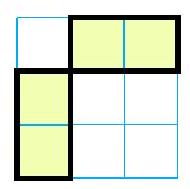\n\nIf $n$ is any multiple of 3 , we can obtain a balanced configuration with $k=1$ by using $n / 3$ of these $3 \\times 3$ blocks along the principal diagonal of the board.\n\nThe following diagrams show balanced configurations with $k=3$ and $n \\in\\{4,5,6,7\\}$.\n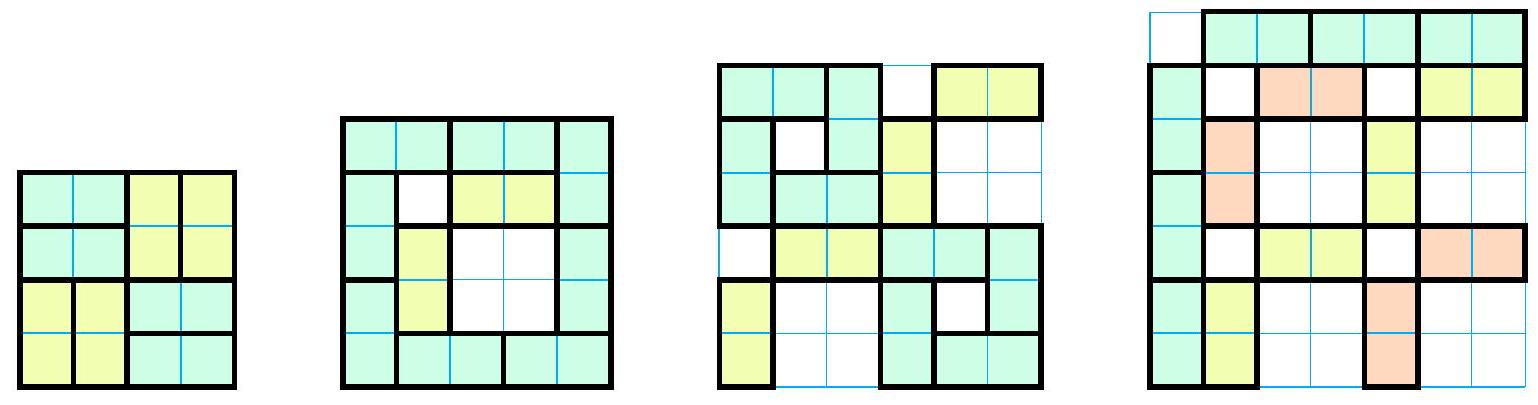\n\nAny $n \\geq 8$ can be written in the form $4 A+r$ where $A$ is a positive integer and $r \\in\\{4,5,6,7\\}$. Therefore, we can obtain a balanced configuration with $n \\geq 8$ and $k=3$ by using one block with size $r \\times r$, and $A$ blocks with size $4 \\times 4$ along the principal diagonal of the board. In particular, this construction covers all the cases where $n$ is not a multiple of 3 .", "metadata": {"resource_path": "EGMO/segmented/en-2018-solutions.jsonl", "problem_match": "\nProblem 4", "solution_match": "\nSolution "}} |
| {"year": "2018", "tier": "T2", "problem_label": "5", "problem_type": null, "exam": "EGMO", "problem": "Let $\\Gamma$ be the circumcircle of triangle $A B C$. A circle $\\Omega$ is tangent to the line segment $A B$ and is tangent to $\\Gamma$ at a point lying on the same side of the line $A B$ as $C$. The angle bisector of $\\angle B C A$ intersects $\\Omega$ at two different points $P$ and $Q$.\n\nProve that $\\angle A B P=\\angle Q B C$.\n(Dominika Regiec, Poland)", "solution": "1 Let $M$ be the midpoint of the arc $A B$ that does not contain $C$, let $V$ be the intersection of $\\Omega$ and $\\Gamma$, and let $U$ be the intersection of $\\Omega$ and $A B$.\n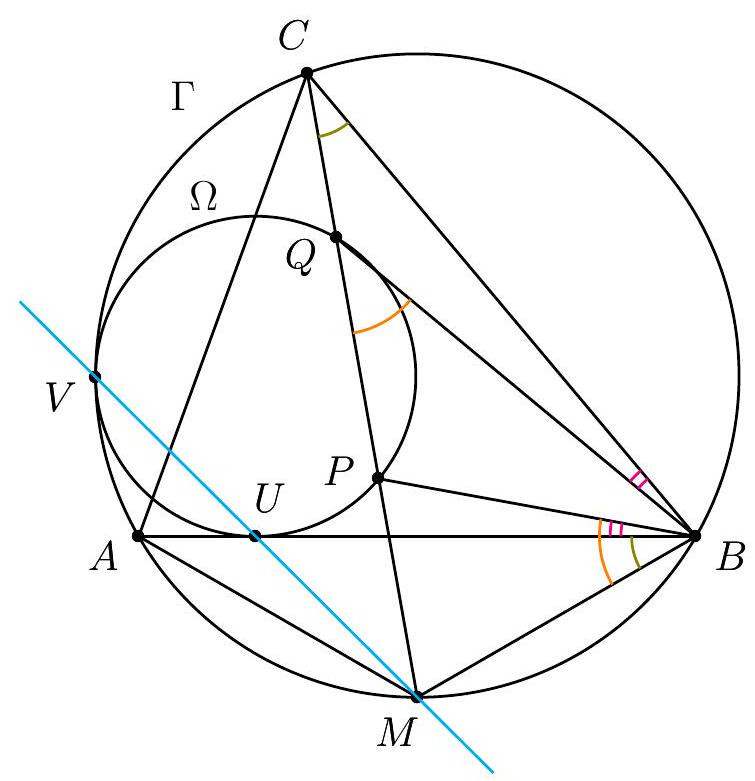\n\nThe proof can be divided in two steps:\n\n1). Proving that $M P \\cdot M Q=M B^{2}$.\n\nIt is well-known that $V, U$ and $M$ are collinear (indeed the homothety with center in $V$ that sends $\\Omega$ to $\\Gamma$ sends $U$ to the point of $\\Gamma$ where the tangent to $\\Gamma$ is parallel to $A B$, and this point is $M$ ), and\n\n$$\nM V \\cdot M U=M A^{2}=M B^{2}\n$$\n\nThis follows from the similitude between the triangles $\\triangle M A V$ and $\\triangle M U A$. Alternatively, it is a consequence of the following well-known lemma: Given a circle $\\Gamma$ with a chord $A B$, let $M$ be the middle point of one of the two arcs $A B$. Take a line through $M$ which intersects $\\Gamma$ again at $X$ and $A B$ at $Y$. Then $M X \\cdot M Y$ is independent of the choice of the line.\nComputing the power of $M$ with respect to $\\Omega$ we obtain that\n\n$$\nM P \\cdot M Q=M U \\cdot M V=M B^{2}\n$$\n\n2). Conclude the proof given that $M P \\cdot M Q=M B^{2}$.\n\nThe relation $M P \\cdot M Q=M B^{2}$ in turn implies that triangle $\\triangle M B P$ is similar to triangle $\\triangle M Q B$, and in particular $\\angle M B P=\\angle M Q B$. Keeping into account that $\\angle M C B=$ $\\angle M B A$, we finally conclude that\n\n$$\n\\angle Q B C=\\angle M Q B-\\angle M C B=\\angle M B P-\\angle M B A=\\angle P B A\n$$\n\nas required.", "metadata": {"resource_path": "EGMO/segmented/en-2018-solutions.jsonl", "problem_match": "\nProblem 5", "solution_match": "\nSolution "}} |
| {"year": "2018", "tier": "T2", "problem_label": "5", "problem_type": null, "exam": "EGMO", "problem": "Let $\\Gamma$ be the circumcircle of triangle $A B C$. A circle $\\Omega$ is tangent to the line segment $A B$ and is tangent to $\\Gamma$ at a point lying on the same side of the line $A B$ as $C$. The angle bisector of $\\angle B C A$ intersects $\\Omega$ at two different points $P$ and $Q$.\n\nProve that $\\angle A B P=\\angle Q B C$.\n(Dominika Regiec, Poland)", "solution": "2 The second solution is in fact a different proof of the first part of Solution 1.\nLet us consider the inversion with respect to circle with center $M$ and radius $M A=M B$. This inversion switches $A B$ and $\\Gamma$, and fixes the line passing through $M, U, V$. As a consequence, it keeps $\\Omega$ fixed, and therefore it switches $P$ and $Q$. This is because they are the intersections between the fixed line $M C$ and $\\Omega$, and the only fixed point on the segment $M C$ is its intersection with the inversion circle (thus $P$ and $Q$ are switched). This implies that $M P \\cdot M Q=M B^{2}$.", "metadata": {"resource_path": "EGMO/segmented/en-2018-solutions.jsonl", "problem_match": "\nProblem 5", "solution_match": "\nSolution "}} |
| {"year": "2018", "tier": "T2", "problem_label": "5", "problem_type": null, "exam": "EGMO", "problem": "Let $\\Gamma$ be the circumcircle of triangle $A B C$. A circle $\\Omega$ is tangent to the line segment $A B$ and is tangent to $\\Gamma$ at a point lying on the same side of the line $A B$ as $C$. The angle bisector of $\\angle B C A$ intersects $\\Omega$ at two different points $P$ and $Q$.\n\nProve that $\\angle A B P=\\angle Q B C$.\n(Dominika Regiec, Poland)", "solution": "3 This solution is instead a different proof of the second step of Solution 1.\nLet $I$ and $J$ be the incenter and the $C$-excenter of $\\triangle A B C$ respectively. It is well-known that $M A=M I=M J$, therefore the relation $M P \\cdot M Q=M A^{2}$ implies that $(P, Q, I, J)=-1$.\n\nNow observe that $\\angle I B J=90^{\\circ}$, thus $B I$ is the angle bisector of $\\angle P B Q$ as it is well-known from the theory of harmonic pencils, and this leads easily to the conclusion.", "metadata": {"resource_path": "EGMO/segmented/en-2018-solutions.jsonl", "problem_match": "\nProblem 5", "solution_match": "\nSolution "}} |
| {"year": "2018", "tier": "T2", "problem_label": "5", "problem_type": null, "exam": "EGMO", "problem": "Let $\\Gamma$ be the circumcircle of triangle $A B C$. A circle $\\Omega$ is tangent to the line segment $A B$ and is tangent to $\\Gamma$ at a point lying on the same side of the line $A B$ as $C$. The angle bisector of $\\angle B C A$ intersects $\\Omega$ at two different points $P$ and $Q$.\n\nProve that $\\angle A B P=\\angle Q B C$.\n(Dominika Regiec, Poland)", "solution": "4 Let $D$ denote the intersection of $A B$ and $C M$. Let us consider an inversion with respect to $B$, and let us use primes to denote corresponding points in the transformed diagram, with the gentlemen agreement that $B^{\\prime}=B$.\n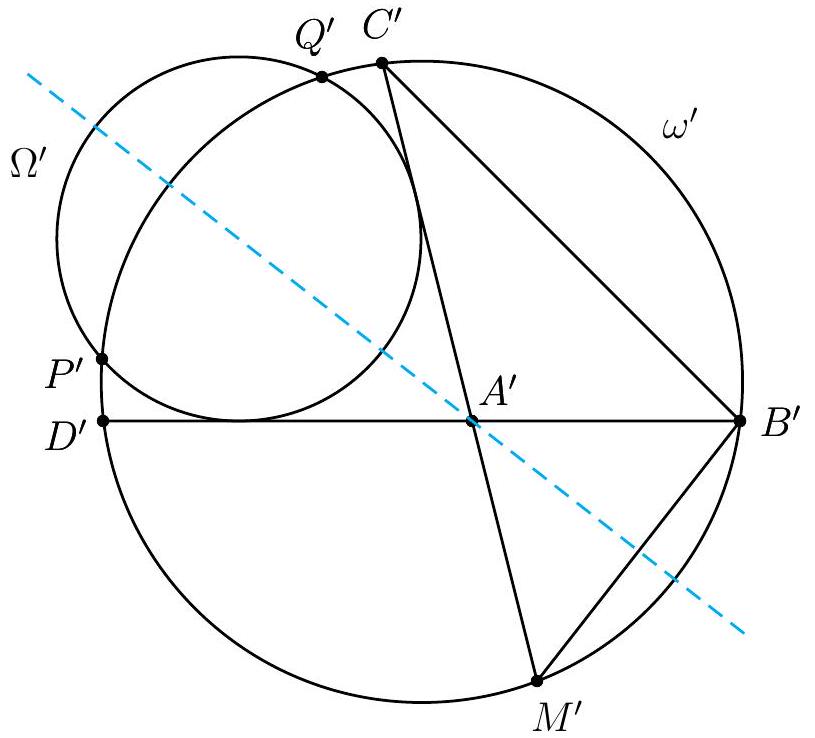\n\nSince inversion preserves angles, it turns out that\n\n$$\n\\angle A^{\\prime} B^{\\prime} M^{\\prime}=\\angle A^{\\prime} M^{\\prime} B^{\\prime}=\\angle A C B,\n$$\n\nand in particular triangle $A^{\\prime} B^{\\prime} M^{\\prime}$ is isosceles with basis $B^{\\prime} M^{\\prime}$.\nThe image of $C M$ is the circumcircle of $B^{\\prime} C^{\\prime} M^{\\prime}$, which we denote by $\\omega^{\\prime}$. It follows that the centers of both $\\omega^{\\prime}$ and the image $\\Omega^{\\prime}$ of $\\Omega$ lie on the perpendicular bisector of $B^{\\prime} M^{\\prime}$. Therefore, the whole transformed diagram is symmetric with respect to the perpendicular bisector of $B^{\\prime} M^{\\prime}$, and in particular the $\\operatorname{arcs} D^{\\prime} P^{\\prime}$ and $Q^{\\prime} C^{\\prime}$ of $\\omega^{\\prime}$ are equal.\n\nThis is enough to conclude that $\\angle D^{\\prime} B^{\\prime} P^{\\prime}=\\angle Q^{\\prime} B^{\\prime} C^{\\prime}$, which implies the conclusion.", "metadata": {"resource_path": "EGMO/segmented/en-2018-solutions.jsonl", "problem_match": "\nProblem 5", "solution_match": "\nSolution "}} |
| {"year": "2018", "tier": "T2", "problem_label": "6", "problem_type": null, "exam": "EGMO", "problem": "(a) Prove that for every real number $t$ such that $0<t<\\frac{1}{2}$ there exists a positive integer $n$ with the following property: for every set $S$ of $n$ positive integers there exist two different elements $x$ and $y$ of $S$, and a non-negative integer $m$ (i.e. $m \\geq 0$ ), such that\n\n$$\n|x-m y| \\leq t y\n$$\n\n(b) Determine whether for every real number $t$ such that $0<t<\\frac{1}{2}$ there exists an infinite set $S$ of positive integers such that\n\n$$\n|x-m y|>t y\n$$\n\nfor every pair of different elements $x$ and $y$ of $S$ and every positive integer $m$ (i.e. $m>0$ ).\n(Merlijn Staps, The Netherlands)", "solution": "Part (a) Let $n$ be any positive integer such that\n\n$$\n(1+t)^{n-1} \\geq \\frac{1}{t}\n$$\n\n(this inequality is actually true for every large enough $n$ due to Bernoulli's inequality).\nLet $S$ be any set of $n$ distinct positive integers, which we denote by\n\n$$\ns_{1}<s_{2}<\\ldots<s_{n}\n$$\n\nWe distinguish two cases.\n\n- If $s_{i+1} \\leq(1+t) s_{i}$ for some $i \\in\\{1, \\ldots, n-1\\}$, then\n\n$$\n\\left|s_{i+1}-s_{i}\\right|=s_{i+1}-s_{i} \\leq t s_{i}\n$$\n\nand therefore the required inequality is satisfied with $x=s_{i+1}, y=s_{i}$, and $m=1$.\n\n- If $s_{i+1}>(1+t) s_{i}$ for every $i \\in\\{1, \\ldots, n-1\\}$, then by induction we obtain that\n\n$$\ns_{n}>(1+t)^{n-1} s_{1} .\n$$\n\nAs a consequence, from (Q6.1) it follows that\n\n$$\n\\left|s_{1}\\right|=s_{1}<\\frac{1}{(1+t)^{n-1}} \\cdot s_{n} \\leq t s_{n}\n$$\n\nand therefore the required inequality is satisfied with $x=s_{1}, y=s_{n}$, and $m=0$.\n\nPart (b) (Explicit formula) We claim that an infinite set with the required property exists. To this end, we rewrite the required condition in the form\n\n$$\n\\left|\\frac{x}{y}-m\\right|>t\n$$\n\nThis is equivalent to saying that the distance between the ratio $x / y$ and the set of positive integers is greater than $t$.\n\nNow we construct an increasing sequence $s_{n}$ of odd coprime positive integers satisfying\n\n$$\n\\frac{1}{2}-\\frac{1}{2 s_{n}}>t \\quad \\forall n \\geq 1\n$$\n\nand such that for every $j>i$ it turns out that\n\n$$\n\\frac{s_{i}}{s_{j}}<\\frac{1}{2} \\quad \\text { and } \\quad t<\\left\\{\\frac{s_{j}}{s_{i}}\\right\\}<\\frac{1}{2}\n$$\n\nwhere $\\{\\alpha\\}$ denotes the fractional part of $\\alpha$. This is enough to show that the set $S:=\\left\\{s_{n}: n \\geq 1\\right\\}$ has the required property.\n\nTo this end, we consider the sequence defined recursively by\n\n$$\ns_{n+1}=\\frac{\\left(s_{1} \\cdot \\ldots \\cdot s_{n}\\right)^{2}+1}{2}\n$$\n\nwith $s_{1}$ large enough. An easy induction shows that this is an increasing sequence of odd positive integers. For every $i \\in\\{1, \\ldots, n\\}$ it turns out that\n\n$$\n\\frac{s_{i}}{s_{n+1}} \\leq \\frac{2}{s_{i}} \\leq \\frac{2}{s_{1}}<\\frac{1}{2}\n$$\n\nbecause $s_{1}$ is large enough, which proves the first relation in (Q6.3). Moreover, it turns out that\n\n$$\n\\frac{s_{n+1}}{s_{i}}=\\frac{\\left(s_{1} \\cdot \\ldots \\cdot s_{n}\\right)^{2}}{2 s_{i}}+\\frac{1}{2 s_{i}}\n$$\n\nThe first term is a positive integer plus $1 / 2$, from which it follows that the distance of $s_{n+1} / s_{i}$ from the positive integers is greater than or equal to\n\n$$\n\\frac{1}{2}-\\frac{1}{2 s_{i}} \\geq \\frac{1}{2}-\\frac{1}{2 s_{1}}\n$$\n\nwhich is greater than $t$ if $s_{1}$ is large enough. This proves the second relation in (Q6.3).\nPart (b) (Arithmetic approach) We produce an increasing sequence $s_{n}$ of odd and coprime positive integers that satisfies (Q6.3) every $j>i$. As in the previous solution, this is enough to conclude.\n\nWe argue by induction. To begin with, we choose $s_{1}$ to be any odd integer satisfying the inequality in (Q6.2). Let us assume now that $s_{1}, \\ldots, s_{n}$ have already been chosen, and let us choose $s_{n+1}$ in such a way that\n\n$$\ns_{n+1} \\equiv \\frac{s_{i}-1}{2} \\quad\\left(\\bmod s_{i}\\right) \\quad \\forall i \\in\\{1, \\ldots, n\\}\n$$\n\nWe can solve this system because the previously chosen integers are odd and coprime. Moreover, any solution of this system is coprime with $s_{1}, \\ldots, s_{n}$. Indeed, for every $1 \\leq i \\leq n$ it turns out that\n\n$$\ns_{n+1}=\\frac{s_{i}-1}{2}+k_{i} s_{i}\n$$\n\nfor some positive integer $k_{i}$. Therefore, any prime $p$ that divides both $s_{n+1}$ and $s_{i}$ divides also $\\left(2 k_{i}+1\\right) s_{i}-2 s_{n+1}=1$, which is absurd. Finally, we observe that we can assume that $s_{n+1}$ is odd and large enough. In this way we can guarantee that\n\n$$\n\\frac{s_{i}}{s_{n+1}}<\\frac{1}{2} \\quad \\forall i \\in\\{1, \\ldots, n\\}\n$$\n\nwhich is the first requirement in (Q6.3), and\n\n$$\nk_{i}+t<k_{i}+\\frac{1}{2}-\\frac{1}{2 s_{i}}=\\frac{s_{n+1}}{s_{i}}<k_{i}+\\frac{1}{2} \\quad \\forall i \\in\\{1, \\ldots, n\\}\n$$\n\nwhich implies the second requirement in (Q6.3).\nPart (b) (Algebraic approach) Again we produce an increasing sequence $s_{n}$ of positive integers that satisfies (Q6.3) every $j>i$.\n\nTo this end, for every positive integer $x$, we define its security region\n\n$$\nS(x):=\\bigcup_{n \\geq 1}\\left((n+t) x,\\left(n+\\frac{1}{2}\\right) x\\right) .\n$$\n\nThe security region $S(x)$ is a periodic countable union of intervals of length $\\left(\\frac{1}{2}-t\\right) x$, whose left-hand or right-hand endpoints form an arithmetic sequence. It has the property that\n\n$$\nt<\\left\\{\\frac{y}{x}\\right\\}<\\frac{1}{2} \\quad \\forall y \\in S(x)\n$$\n\nNow we prove by induction that we can choose a sequence $s_{n}$ of positive integers satisfying (Q6.3) and in addition the fact that every interval of the security region $S\\left(s_{n}\\right)$ contains at least one interval of $S\\left(s_{n-1}\\right)$.\n\nTo begin with, we choose $s_{1}$ large enough so that the length of the intervals of $S\\left(s_{1}\\right)$ is larger than 1. This guarantees that any interval of $S\\left(s_{1}\\right)$ contains at least a positive integer. Now let us choose a positive integer $s_{2} \\in S\\left(s_{1}\\right)$ that is large enough. This guarantees that $s_{1} / s_{2}$ is small enough, that the fractional part of $s_{2} / s_{1}$ is in $(t, 1 / 2)$, and that every interval of the security region $S\\left(s_{2}\\right)$ contains at least one interval of $S\\left(s_{1}\\right)$, and hence at least one positive integer.\n\nLet us now assume that $s_{1}, \\ldots, s_{n}$ have been already chosen with the required properties. We know that every interval of $S\\left(s_{n}\\right)$ contains at least one interval of $S\\left(s_{n-1}\\right)$, which in turn contains an interval in $S\\left(s_{n-2}\\right)$, and so on up to $S\\left(s_{1}\\right)$. As a consequence, we can choose a large enough positive integer $s_{n+1}$ that lies in $S\\left(s_{k}\\right)$ for every $k \\in\\{1, \\ldots, n\\}$. Since $s_{n+1}$ is large enough, we are sure that\n\n$$\n\\frac{s_{k}}{s_{n+1}}<t \\quad \\forall k \\in\\{1, \\ldots, n\\}\n$$\n\nMoreover, we are sure also that all the intervals of $S\\left(s_{n+1}\\right)$ are large enough, and therefore they contain at least one interval of $S\\left(s_{n}\\right)$, which in turn contains at least one interval of $S\\left(s_{n-1}\\right)$, and so on. Finally, the condition\n\n$$\nt<\\left\\{\\frac{s_{n-1}}{s_{n}}\\right\\}<\\frac{1}{2}\n$$\n\nis guaranteed by the fact that $s_{n+1}$ was chosen in an interval that is contained in $S\\left(s_{k}\\right)$ for every $k \\in\\{1, \\ldots, n\\}$. This completes the induction.", "metadata": {"resource_path": "EGMO/segmented/en-2018-solutions.jsonl", "problem_match": "# Problem 6", "solution_match": "# Solution"}} |
|
|


