| {"year": "2006", "tier": "T0", "problem_label": "A1", "problem_type": "Algebra", "exam": "IMO-SL", "problem": "A sequence of real numbers $a_{0}, a_{1}, a_{2}, \\ldots$ is defined by the formula $$ a_{i+1}=\\left\\lfloor a_{i}\\right\\rfloor \\cdot\\left\\langle a_{i}\\right\\rangle \\quad \\text { for } \\quad i \\geq 0 \\text {; } $$ here $a_{0}$ is an arbitrary real number, $\\left\\lfloor a_{i}\\right\\rfloor$ denotes the greatest integer not exceeding $a_{i}$, and $\\left\\langle a_{i}\\right\\rangle=a_{i}-\\left\\lfloor a_{i}\\right\\rfloor$. Prove that $a_{i}=a_{i+2}$ for $i$ sufficiently large. (Estonia)", "solution": "First note that if $a_{0} \\geq 0$, then all $a_{i} \\geq 0$. For $a_{i} \\geq 1$ we have (in view of $\\left\\langle a_{i}\\right\\rangle<1$ and $\\left\\lfloor a_{i}\\right\\rfloor>0$ ) $$ \\left\\lfloor a_{i+1}\\right\\rfloor \\leq a_{i+1}=\\left\\lfloor a_{i}\\right\\rfloor \\cdot\\left\\langle a_{i}\\right\\rangle<\\left\\lfloor a_{i}\\right\\rfloor $$ the sequence $\\left\\lfloor a_{i}\\right\\rfloor$ is strictly decreasing as long as its terms are in $[1, \\infty)$. Eventually there appears a number from the interval $[0,1)$ and all subsequent terms are 0 . Now pass to the more interesting situation where $a_{0}<0$; then all $a_{i} \\leq 0$. Suppose the sequence never hits 0 . Then we have $\\left\\lfloor a_{i}\\right\\rfloor \\leq-1$ for all $i$, and so $$ 1+\\left\\lfloor a_{i+1}\\right\\rfloor>a_{i+1}=\\left\\lfloor a_{i}\\right\\rfloor \\cdot\\left\\langle a_{i}\\right\\rangle>\\left\\lfloor a_{i}\\right\\rfloor $$ this means that the sequence $\\left\\lfloor a_{i}\\right\\rfloor$ is nondecreasing. And since all its terms are integers from $(-\\infty,-1]$, this sequence must be constant from some term on: $$ \\left\\lfloor a_{i}\\right\\rfloor=c \\quad \\text { for } \\quad i \\geq i_{0} ; \\quad c \\text { a negative integer. } $$ The defining formula becomes $$ a_{i+1}=c \\cdot\\left\\langle a_{i}\\right\\rangle=c\\left(a_{i}-c\\right)=c a_{i}-c^{2} . $$ Consider the sequence $$ b_{i}=a_{i}-\\frac{c^{2}}{c-1} $$ It satisfies the recursion rule $$ b_{i+1}=a_{i+1}-\\frac{c^{2}}{c-1}=c a_{i}-c^{2}-\\frac{c^{2}}{c-1}=c b_{i} $$ implying $$ b_{i}=c^{i-i_{0}} b_{i_{0}} \\quad \\text { for } \\quad i \\geq i_{0} . $$ Since all the numbers $a_{i}$ (for $i \\geq i_{0}$ ) lie in $\\left[c, c+1\\right.$ ), the sequence $\\left(b_{i}\\right)$ is bounded. The equation (2) can be satisfied only if either $b_{i_{0}}=0$ or $|c|=1$, i.e., $c=-1$. In the first case, $b_{i}=0$ for all $i \\geq i_{0}$, so that $$ a_{i}=\\frac{c^{2}}{c-1} \\quad \\text { for } \\quad i \\geq i_{0} $$ In the second case, $c=-1$, equations (1) and (2) say that $$ a_{i}=-\\frac{1}{2}+(-1)^{i-i_{0}} b_{i_{0}}= \\begin{cases}a_{i_{0}} & \\text { for } i=i_{0}, i_{0}+2, i_{0}+4, \\ldots \\\\ 1-a_{i_{0}} & \\text { for } i=i_{0}+1, i_{0}+3, i_{0}+5, \\ldots\\end{cases} $$ Summarising, we see that (from some point on) the sequence $\\left(a_{i}\\right)$ either is constant or takes alternately two values from the interval $(-1,0)$. The result follows. Comment. There is nothing mysterious in introducing the sequence $\\left(b_{i}\\right)$. The sequence $\\left(a_{i}\\right)$ arises by iterating the function $x \\mapsto c x-c^{2}$ whose unique fixed point is $c^{2} /(c-1)$.", "metadata": {"resource_path": "IMO_SL/segmented/en-IMO2006SL.jsonl"}} |
| {"year": "2006", "tier": "T0", "problem_label": "A2", "problem_type": "Algebra", "exam": "IMO-SL", "problem": "The sequence of real numbers $a_{0}, a_{1}, a_{2}, \\ldots$ is defined recursively by $$ a_{0}=-1, \\quad \\sum_{k=0}^{n} \\frac{a_{n-k}}{k+1}=0 \\quad \\text { for } \\quad n \\geq 1 $$ Show that $a_{n}>0$ for $n \\geq 1$. (Poland)", "solution": "The proof goes by induction. For $n=1$ the formula yields $a_{1}=1 / 2$. Take $n \\geq 1$, assume $a_{1}, \\ldots, a_{n}>0$ and write the recurrence formula for $n$ and $n+1$, respectively as $$ \\sum_{k=0}^{n} \\frac{a_{k}}{n-k+1}=0 \\quad \\text { and } \\quad \\sum_{k=0}^{n+1} \\frac{a_{k}}{n-k+2}=0 $$ Subtraction yields $$ \\begin{aligned} 0=(n+2) \\sum_{k=0}^{n+1} & \\frac{a_{k}}{n-k+2}-(n+1) \\sum_{k=0}^{n} \\frac{a_{k}}{n-k+1} \\\\ = & (n+2) a_{n+1}+\\sum_{k=0}^{n}\\left(\\frac{n+2}{n-k+2}-\\frac{n+1}{n-k+1}\\right) a_{k} . \\end{aligned} $$ The coefficient of $a_{0}$ vanishes, so $$ a_{n+1}=\\frac{1}{n+2} \\sum_{k=1}^{n}\\left(\\frac{n+1}{n-k+1}-\\frac{n+2}{n-k+2}\\right) a_{k}=\\frac{1}{n+2} \\sum_{k=1}^{n} \\frac{k}{(n-k+1)(n-k+2)} a_{k} . $$ The coefficients of $a_{1}, \\ldots, a_{n}$ are all positive. Therefore, $a_{1}, \\ldots, a_{n}>0$ implies $a_{n+1}>0$. Comment. Students familiar with the technique of generating functions will immediately recognise $\\sum a_{n} x^{n}$ as the power series expansion of $x / \\ln (1-x)$ (with value -1 at 0 ). But this can be a trap; attempts along these lines lead to unpleasant differential equations and integrals hard to handle. Using only tools from real analysis (e.g. computing the coefficients from the derivatives) seems very difficult. On the other hand, the coefficients can be approached applying complex contour integrals and some other techniques from complex analysis and an attractive formula can be obtained for the coefficients: $$ a_{n}=\\int_{1}^{\\infty} \\frac{\\mathrm{d} x}{x^{n}\\left(\\pi^{2}+\\log ^{2}(x-1)\\right)} \\quad(n \\geq 1) $$ which is evidently positive.", "metadata": {"resource_path": "IMO_SL/segmented/en-IMO2006SL.jsonl"}} |
| {"year": "2006", "tier": "T0", "problem_label": "A3", "problem_type": "Algebra", "exam": "IMO-SL", "problem": "The sequence $c_{0}, c_{1}, \\ldots, c_{n}, \\ldots$ is defined by $c_{0}=1, c_{1}=0$ and $c_{n+2}=c_{n+1}+c_{n}$ for $n \\geq 0$. Consider the set $S$ of ordered pairs $(x, y)$ for which there is a finite set $J$ of positive integers such that $x=\\sum_{j \\in J} c_{j}, y=\\sum_{j \\in J} c_{j-1}$. Prove that there exist real numbers $\\alpha, \\beta$ and $m, M$ with the following property: An ordered pair of nonnegative integers $(x, y)$ satisfies the inequality $$ m<\\alpha x+\\beta y<M $$ if and only if $(x, y) \\in S$. N. B. A sum over the elements of the empty set is assumed to be 0 . (Russia)", "solution": "Let $\\varphi=(1+\\sqrt{5}) / 2$ and $\\psi=(1-\\sqrt{5}) / 2$ be the roots of the quadratic equation $t^{2}-t-1=0$. So $\\varphi \\psi=-1, \\varphi+\\psi=1$ and $1+\\psi=\\psi^{2}$. An easy induction shows that the general term $c_{n}$ of the given sequence satisfies $$ c_{n}=\\frac{\\varphi^{n-1}-\\psi^{n-1}}{\\varphi-\\psi} \\quad \\text { for } n \\geq 0 \\text {. } $$ Suppose that the numbers $\\alpha$ and $\\beta$ have the stated property, for appropriately chosen $m$ and $M$. Since $\\left(c_{n}, c_{n-1}\\right) \\in S$ for each $n$, the expression $\\alpha c_{n}+\\beta c_{n-1}=\\frac{\\alpha}{\\sqrt{5}}\\left(\\varphi^{n-1}-\\psi^{n-1}\\right)+\\frac{\\beta}{\\sqrt{5}}\\left(\\varphi^{n-2}-\\psi^{n-2}\\right)=\\frac{1}{\\sqrt{5}}\\left[(\\alpha \\varphi+\\beta) \\varphi^{n-2}-(\\alpha \\psi+\\beta) \\psi^{n-2}\\right]$ is bounded as $n$ grows to infinity. Because $\\varphi>1$ and $-1<\\psi<0$, this implies $\\alpha \\varphi+\\beta=0$. To satisfy $\\alpha \\varphi+\\beta=0$, one can set for instance $\\alpha=\\psi, \\beta=1$. We now find the required $m$ and $M$ for this choice of $\\alpha$ and $\\beta$. Note first that the above displayed equation gives $c_{n} \\psi+c_{n-1}=\\psi^{n-1}, n \\geq 1$. In the sequel, we denote the pairs in $S$ by $\\left(a_{J}, b_{J}\\right)$, where $J$ is a finite subset of the set $\\mathbb{N}$ of positive integers and $a_{J}=\\sum_{j \\in J} c_{j}, b_{J}=\\sum_{j \\in J} c_{j-1}$. Since $\\psi a_{J}+b_{J}=\\sum_{j \\in J}\\left(c_{j} \\psi+c_{j-1}\\right)$, we obtain $$ \\psi a_{J}+b_{J}=\\sum_{j \\in J} \\psi^{j-1} \\quad \\text { for each }\\left(a_{J}, b_{J}\\right) \\in S $$ On the other hand, in view of $-1<\\psi<0$, $$ -1=\\frac{\\psi}{1-\\psi^{2}}=\\sum_{j=0}^{\\infty} \\psi^{2 j+1}<\\sum_{j \\in J} \\psi^{j-1}<\\sum_{j=0}^{\\infty} \\psi^{2 j}=\\frac{1}{1-\\psi^{2}}=1-\\psi=\\varphi $$ Therefore, according to (1), $$ -1<\\psi a_{J}+b_{J}<\\varphi \\quad \\text { for each }\\left(a_{J}, b_{J}\\right) \\in S $$ Thus $m=-1$ and $M=\\varphi$ is an appropriate choice. Conversely, we prove that if an ordered pair of nonnegative integers $(x, y)$ satisfies the inequality $-1<\\psi x+y<\\varphi$ then $(x, y) \\in S$. Lemma. Let $x, y$ be nonnegative integers such that $-1<\\psi x+y<\\varphi$. Then there exists a subset $J$ of $\\mathbb{N}$ such that $$ \\psi x+y=\\sum_{j \\in J} \\psi^{j-1} $$ Proof. For $x=y=0$ it suffices to choose the empty subset of $\\mathbb{N}$ as $J$, so let at least one of $x, y$ be nonzero. There exist representations of $\\psi x+y$ of the form $$ \\psi x+y=\\psi^{i_{1}}+\\cdots+\\psi^{i_{k}} $$ where $i_{1} \\leq \\cdots \\leq i_{k}$ is a sequence of nonnegative integers, not necessarily distinct. For instance, we can take $x$ summands $\\psi^{1}=\\psi$ and $y$ summands $\\psi^{0}=1$. Consider all such representations of minimum length $k$ and focus on the ones for which $i_{1}$ has the minimum possible value $j_{1}$. Among them, consider the representations where $i_{2}$ has the minimum possible value $j_{2}$. Upon choosing $j_{3}, \\ldots, j_{k}$ analogously, we obtain a sequence $j_{1} \\leq \\cdots \\leq j_{k}$ which clearly satisfies $\\psi x+y=\\sum_{r=1}^{k} \\psi^{j_{r}}$. To prove the lemma, it suffices to show that $j_{1}, \\ldots, j_{k}$ are pairwise distinct. Suppose on the contrary that $j_{r}=j_{r+1}$ for some $r=1, \\ldots, k-1$. Let us consider the case $j_{r} \\geq 2$ first. Observing that $2 \\psi^{2}=1+\\psi^{3}$, we replace $j_{r}$ and $j_{r+1}$ by $j_{r}-2$ and $j_{r}+1$, respectively. Since $$ \\psi^{j_{r}}+\\psi^{j_{r+1}}=2 \\psi^{j_{r}}=\\psi^{j_{r}-2}\\left(1+\\psi^{3}\\right)=\\psi^{j_{r}-2}+\\psi^{j_{r}+1} $$ the new sequence also represents $\\psi x+y$ as needed, and the value of $i_{r}$ in it contradicts the minimum choice of $j_{r}$. Let $j_{r}=j_{r+1}=0$. Then the sum $\\psi x+y=\\sum_{r=1}^{k} \\psi^{j_{r}}$ contains at least two summands equal to $\\psi^{0}=1$. On the other hand $j_{s} \\neq 1$ for all $s$, because the equality $1+\\psi=\\psi^{2}$ implies that a representation of minimum length cannot contain consecutive $i_{r}$ 's. It follows that $$ \\psi x+y=\\sum_{r=1}^{k} \\psi^{j_{r}}>2+\\psi^{3}+\\psi^{5}+\\psi^{7}+\\cdots=2-\\psi^{2}=\\varphi $$ contradicting the condition of the lemma. Let $j_{r}=j_{r+1}=1$; then $\\sum_{r=1}^{k} \\psi^{j_{r}}$ contains at least two summands equal to $\\psi^{1}=\\psi$. Like in the case $j_{r}=j_{r+1}=0$, we also infer that $j_{s} \\neq 0$ and $j_{s} \\neq 2$ for all $s$. Therefore $$ \\psi x+y=\\sum_{r=1}^{k} \\psi^{j_{r}}<2 \\psi+\\psi^{4}+\\psi^{6}+\\psi^{8}+\\cdots=2 \\psi-\\psi^{3}=-1 $$ which is a contradiction again. The conclusion follows. Now let the ordered pair $(x, y)$ satisfy $-1<\\psi x+y<\\varphi$; hence the lemma applies to $(x, y)$. Let $J \\subset \\mathbb{N}$ be such that (2) holds. Comparing (1) and (2), we conclude that $\\psi x+y=\\psi a_{J}+b_{J}$. Now, $x, y, a_{J}$ and $b_{J}$ are integers, and $\\psi$ is irrational. So the last equality implies $x=a_{J}$ and $y=b_{J}$. This shows that the numbers $\\alpha=\\psi, \\beta=1, m=-1, M=\\varphi$ meet the requirements. Comment. We present another way to prove the lemma, constructing the set $J$ inductively. For $x=y=0$, choose $J=\\emptyset$. We induct on $n=3 x+2 y$. Suppose that an appropriate set $J$ exists when $3 x+2 y<n$. Now assume $3 x+2 y=n>0$. The current set $J$ should be $$ \\text { either } 1 \\leq j_{1}<j_{2}<\\cdots<j_{k} \\quad \\text { or } \\quad j_{1}=0,1 \\leq j_{2}<\\cdots<j_{k} \\text {. } $$ These sets fulfil the condition if $$ \\frac{\\psi x+y}{\\psi}=\\psi^{i_{1}-1}+\\cdots+\\psi^{i_{k}-1} \\quad \\text { or } \\quad \\frac{\\psi x+y-1}{\\psi}=\\psi^{i_{2}-1}+\\cdots+\\psi^{i_{k}-1} \\text {, } $$ respectively; therefore it suffices to find an appropriate set for $\\frac{\\psi x+y}{\\psi}$ or $\\frac{\\psi x+y-1}{\\psi}$, respectively. Consider $\\frac{\\psi x+y}{\\psi}$. Knowing that $$ \\frac{\\psi x+y}{\\psi}=x+(\\psi-1) y=\\psi y+(x-y) $$ let $x^{\\prime}=y, y^{\\prime}=x-y$ and test the induction hypothesis on these numbers. We require $\\frac{\\psi x+y}{\\psi} \\in(-1, \\varphi)$ which is equivalent to $$ \\psi x+y \\in(\\varphi \\cdot \\psi,(-1) \\cdot \\psi)=(-1,-\\psi) . $$ Relation (3) implies $y^{\\prime}=x-y \\geq-\\psi x-y>\\psi>-1$; therefore $x^{\\prime}, y^{\\prime} \\geq 0$. Moreover, we have $3 x^{\\prime}+2 y^{\\prime}=2 x+y \\leq \\frac{2}{3} n$; therefore, if (3) holds then the induction applies: the numbers $x^{\\prime}, y^{\\prime}$ are represented in the form as needed, hence $x, y$ also. Now consider $\\frac{\\psi x+y-1}{\\psi}$. Since $$ \\frac{\\psi x+y-1}{\\psi}=x+(\\psi-1)(y-1)=\\psi(y-1)+(x-y+1) $$ we set $x^{\\prime}=y-1$ and $y^{\\prime}=x-y+1$. Again we require that $\\frac{\\psi x+y-1}{\\psi} \\in(-1, \\varphi)$, i.e. $$ \\psi x+y \\in(\\varphi \\cdot \\psi+1,(-1) \\cdot \\psi+1)=(0, \\varphi) . $$ If (4) holds then $y-1 \\geq \\psi x+y-1>-1$ and $x-y+1 \\geq-\\psi x-y+1>-\\varphi+1>-1$, therefore $x^{\\prime}, y^{\\prime} \\geq 0$. Moreover, $3 x^{\\prime}+2 y^{\\prime}=2 x+y-1<\\frac{2}{3} n$ and the induction works. Finally, $(-1,-\\psi) \\cup(0, \\varphi)=(-1, \\varphi)$ so at least one of (3) and (4) holds and the induction step is justified.", "metadata": {"resource_path": "IMO_SL/segmented/en-IMO2006SL.jsonl"}} |
| {"year": "2006", "tier": "T0", "problem_label": "A4", "problem_type": "Algebra", "exam": "IMO-SL", "problem": "Prove the inequality $$ \\sum_{i<j} \\frac{a_{i} a_{j}}{a_{i}+a_{j}} \\leq \\frac{n}{2\\left(a_{1}+a_{2}+\\cdots+a_{n}\\right)} \\sum_{i<j} a_{i} a_{j} $$ for positive real numbers $a_{1}, a_{2}, \\ldots, a_{n}$. (Serbia)", "solution": "Let $S=\\sum_{i} a_{i}$. Denote by $L$ and $R$ the expressions on the left and right hand side of the proposed inequality. We transform $L$ and $R$ using the identity $$ \\sum_{i<j}\\left(a_{i}+a_{j}\\right)=(n-1) \\sum_{i} a_{i} $$ And thus: $$ L=\\sum_{i<j} \\frac{a_{i} a_{j}}{a_{i}+a_{j}}=\\sum_{i<j} \\frac{1}{4}\\left(a_{i}+a_{j}-\\frac{\\left(a_{i}-a_{j}\\right)^{2}}{a_{i}+a_{j}}\\right)=\\frac{n-1}{4} \\cdot S-\\frac{1}{4} \\sum_{i<j} \\frac{\\left(a_{i}-a_{j}\\right)^{2}}{a_{i}+a_{j}} . $$ To represent $R$ we express the sum $\\sum_{i<j} a_{i} a_{j}$ in two ways; in the second transformation identity (1) will be applied to the squares of the numbers $a_{i}$ : $$ \\begin{gathered} \\sum_{i<j} a_{i} a_{j}=\\frac{1}{2}\\left(S^{2}-\\sum_{i} a_{i}^{2}\\right) \\\\ \\sum_{i<j} a_{i} a_{j}=\\frac{1}{2} \\sum_{i<j}\\left(a_{i}^{2}+a_{j}^{2}-\\left(a_{i}-a_{j}\\right)^{2}\\right)=\\frac{n-1}{2} \\cdot \\sum_{i} a_{i}^{2}-\\frac{1}{2} \\sum_{i<j}\\left(a_{i}-a_{j}\\right)^{2} . \\end{gathered} $$ Multiplying the first of these equalities by $n-1$ and adding the second one we obtain $$ n \\sum_{i<j} a_{i} a_{j}=\\frac{n-1}{2} \\cdot S^{2}-\\frac{1}{2} \\sum_{i<j}\\left(a_{i}-a_{j}\\right)^{2} $$ Hence $$ R=\\frac{n}{2 S} \\sum_{i<j} a_{i} a_{j}=\\frac{n-1}{4} \\cdot S-\\frac{1}{4} \\sum_{i<j} \\frac{\\left(a_{i}-a_{j}\\right)^{2}}{S} . $$ Now compare (2) and (3). Since $S \\geq a_{i}+a_{j}$ for any $i<j$, the claim $L \\geq R$ results.", "metadata": {"resource_path": "IMO_SL/segmented/en-IMO2006SL.jsonl"}} |
| {"year": "2006", "tier": "T0", "problem_label": "A4", "problem_type": "Algebra", "exam": "IMO-SL", "problem": "Prove the inequality $$ \\sum_{i<j} \\frac{a_{i} a_{j}}{a_{i}+a_{j}} \\leq \\frac{n}{2\\left(a_{1}+a_{2}+\\cdots+a_{n}\\right)} \\sum_{i<j} a_{i} a_{j} $$ for positive real numbers $a_{1}, a_{2}, \\ldots, a_{n}$. (Serbia)", "solution": "Let $S=a_{1}+a_{2}+\\cdots+a_{n}$. For any $i \\neq j$, $$ 4 \\frac{a_{i} a_{j}}{a_{i}+a_{j}}=a_{i}+a_{j}-\\frac{\\left(a_{i}-a_{j}\\right)^{2}}{a_{i}+a_{j}} \\leq a_{i}+a_{j}-\\frac{\\left(a_{i}-a_{j}\\right)^{2}}{a_{1}+a_{2}+\\cdots+a_{n}}=\\frac{\\sum_{k \\neq i} a_{i} a_{k}+\\sum_{k \\neq j} a_{j} a_{k}+2 a_{i} a_{j}}{S} . $$ The statement is obtained by summing up these inequalities for all pairs $i, j$ : $$ \\begin{gathered} \\sum_{i<j} \\frac{a_{i} a_{j}}{a_{i}+a_{j}}=\\frac{1}{2} \\sum_{i} \\sum_{j \\neq i} \\frac{a_{i} a_{j}}{a_{i}+a_{j}} \\leq \\frac{1}{8 S} \\sum_{i} \\sum_{j \\neq i}\\left(\\sum_{k \\neq i} a_{i} a_{k}+\\sum_{k \\neq j} a_{j} a_{k}+2 a_{i} a_{j}\\right) \\\\ =\\frac{1}{8 S}\\left(\\sum_{k} \\sum_{i \\neq k} \\sum_{j \\neq i} a_{i} a_{k}+\\sum_{k} \\sum_{j \\neq k} \\sum_{i \\neq j} a_{j} a_{k}+\\sum_{i} \\sum_{j \\neq i} 2 a_{i} a_{j}\\right) \\\\ =\\frac{1}{8 S}\\left(\\sum_{k} \\sum_{i \\neq k}(n-1) a_{i} a_{k}+\\sum_{k} \\sum_{j \\neq k}(n-1) a_{j} a_{k}+\\sum_{i} \\sum_{j \\neq i} 2 a_{i} a_{j}\\right) \\\\ =\\frac{n}{4 S} \\sum_{i} \\sum_{j \\neq i} a_{i} a_{j}=\\frac{n}{2 S} \\sum_{i<j} a_{i} a_{j} . \\end{gathered} $$ Comment. Here is an outline of another possible approach. Examine the function $R-L$ subject to constraints $\\sum_{i} a_{i}=S, \\sum_{i<j} a_{i} a_{j}=U$ for fixed constants $S, U>0$ (which can jointly occur as values of these symmetric forms). Suppose that among the numbers $a_{i}$ there are some three, say $a_{k}, a_{l}, a_{m}$ such that $a_{k}<a_{l} \\leq a_{m}$. Then it is possible to decrease the value of $R-L$ by perturbing this triple so that in the new triple $a_{k}^{\\prime}, a_{l}^{\\prime}, a_{m}^{\\prime}$ one has $a_{k}^{\\prime}=a_{l}^{\\prime} \\leq a_{m}^{\\prime}$, without touching the remaining $a_{i} \\mathrm{~s}$ and without changing the values of $S$ and $U$; this requires some skill in algebraic manipulations. It follows that the constrained minimum can be only attained for $n-1$ of the $a_{i}$ s equal and a single one possibly greater. In this case, $R-L \\geq 0$ holds almost trivially.", "metadata": {"resource_path": "IMO_SL/segmented/en-IMO2006SL.jsonl"}} |
| {"year": "2006", "tier": "T0", "problem_label": "A5", "problem_type": "Algebra", "exam": "IMO-SL", "problem": "Let $a, b, c$ be the sides of a triangle. Prove that $$ \\frac{\\sqrt{b+c-a}}{\\sqrt{b}+\\sqrt{c}-\\sqrt{a}}+\\frac{\\sqrt{c+a-b}}{\\sqrt{c}+\\sqrt{a}-\\sqrt{b}}+\\frac{\\sqrt{a+b-c}}{\\sqrt{a}+\\sqrt{b}-\\sqrt{c}} \\leq 3 . $$ (Korea)", "solution": "Note first that the denominators are all positive, e.g. $\\sqrt{a}+\\sqrt{b}>\\sqrt{a+b}>\\sqrt{c}$. Let $x=\\sqrt{b}+\\sqrt{c}-\\sqrt{a}, y=\\sqrt{c}+\\sqrt{a}-\\sqrt{b}$ and $z=\\sqrt{a}+\\sqrt{b}-\\sqrt{c}$. Then $b+c-a=\\left(\\frac{z+x}{2}\\right)^{2}+\\left(\\frac{x+y}{2}\\right)^{2}-\\left(\\frac{y+z}{2}\\right)^{2}=\\frac{x^{2}+x y+x z-y z}{2}=x^{2}-\\frac{1}{2}(x-y)(x-z)$ and $$ \\frac{\\sqrt{b+c-a}}{\\sqrt{b}+\\sqrt{c}-\\sqrt{a}}=\\sqrt{1-\\frac{(x-y)(x-z)}{2 x^{2}}} \\leq 1-\\frac{(x-y)(x-z)}{4 x^{2}} $$ applying $\\sqrt{1+2 u} \\leq 1+u$ in the last step. Similarly we obtain $$ \\frac{\\sqrt{c+a-b}}{\\sqrt{c}+\\sqrt{a}-\\sqrt{b}} \\leq 1-\\frac{(z-x)(z-y)}{4 z^{2}} \\quad \\text { and } \\quad \\frac{\\sqrt{a+b-c}}{\\sqrt{a}+\\sqrt{b}-\\sqrt{c}} \\leq 1-\\frac{(y-z)(y-x)}{4 y^{2}} $$ Substituting these quantities into the statement, it is sufficient to prove that $$ \\frac{(x-y)(x-z)}{x^{2}}+\\frac{(y-z)(y-x)}{y^{2}}+\\frac{(z-x)(z-y)}{z^{2}} \\geq 0 . $$ By symmetry we can assume $x \\leq y \\leq z$. Then $$ \\begin{gathered} \\frac{(x-y)(x-z)}{x^{2}}=\\frac{(y-x)(z-x)}{x^{2}} \\geq \\frac{(y-x)(z-y)}{y^{2}}=-\\frac{(y-z)(y-x)}{y^{2}} \\\\ \\frac{(z-x)(z-y)}{z^{2}} \\geq 0 \\end{gathered} $$ and (1) follows. Comment 1. Inequality (1) is a special case of the well-known inequality $$ x^{t}(x-y)(x-z)+y^{t}(y-z)(y-x)+z^{t}(z-x)(z-y) \\geq 0 $$ which holds for all positive numbers $x, y, z$ and real $t$; in our case $t=-2$. Case $t>0$ is called Schur's inequality. More generally, if $x \\leq y \\leq z$ are real numbers and $p, q, r$ are nonnegative numbers such that $q \\leq p$ or $q \\leq r$ then $$ p(x-y)(x-z)+q(y-z)(y-x)+r(z-x)(z-y) \\geq 0 \\text {. } $$ Comment 2. One might also start using Cauchy-Schwarz' inequality (or the root mean square vs. arithmetic mean inequality) to the effect that $$ \\left(\\sum \\frac{\\sqrt{b+c-a}}{\\sqrt{b}+\\sqrt{c}-\\sqrt{a}}\\right)^{2} \\leq 3 \\cdot \\sum \\frac{b+c-a}{(\\sqrt{b}+\\sqrt{c}-\\sqrt{a})^{2}} $$ in cyclic sum notation. There are several ways to prove that the right-hand side of (2) never exceeds 9 (and this is just what we need). One of them is to introduce new variables $x, y, z$, as in Solution 1, which upon some manipulation brings the problem again to inequality (1). Alternatively, the claim that right-hand side of (2) is not greater than 9 can be expressed in terms of the symmetric forms $\\sigma_{1}=\\sum x, \\sigma_{2}=\\sum x y, \\sigma_{3}=x y z$ equivalently as $$ 4 \\sigma_{1} \\sigma_{2} \\sigma_{3} \\leq \\sigma_{2}^{3}+9 \\sigma_{3}^{2} $$ which is a known inequality. A yet different method to deal with the right-hand expression in (2) is to consider $\\sqrt{a}, \\sqrt{b}, \\sqrt{c}$ as sides of a triangle. Through standard trigonometric formulas the problem comes down to showing that $$ p^{2} \\leq 4 R^{2}+4 R r+3 r^{2} $$ $p, R$ and $r$ standing for the semiperimeter, the circumradius and the inradius of that triangle. Again, (4) is another known inequality. Note that the inequalities (1), (3), (4) are equivalent statements about the same mathematical situation.", "metadata": {"resource_path": "IMO_SL/segmented/en-IMO2006SL.jsonl"}} |
| {"year": "2006", "tier": "T0", "problem_label": "A5", "problem_type": "Algebra", "exam": "IMO-SL", "problem": "Let $a, b, c$ be the sides of a triangle. Prove that $$ \\frac{\\sqrt{b+c-a}}{\\sqrt{b}+\\sqrt{c}-\\sqrt{a}}+\\frac{\\sqrt{c+a-b}}{\\sqrt{c}+\\sqrt{a}-\\sqrt{b}}+\\frac{\\sqrt{a+b-c}}{\\sqrt{a}+\\sqrt{b}-\\sqrt{c}} \\leq 3 . $$ (Korea)", "solution": "Due to the symmetry of variables, it can be assumed that $a \\geq b \\geq c$. We claim that $$ \\frac{\\sqrt{a+b-c}}{\\sqrt{a}+\\sqrt{b}-\\sqrt{c}} \\leq 1 \\quad \\text { and } \\quad \\frac{\\sqrt{b+c-a}}{\\sqrt{b}+\\sqrt{c}-\\sqrt{a}}+\\frac{\\sqrt{c+a-b}}{\\sqrt{c}+\\sqrt{a}-\\sqrt{b}} \\leq 2 . $$ The first inequality follows from $$ \\sqrt{a+b-c}-\\sqrt{a}=\\frac{(a+b-c)-a}{\\sqrt{a+b-c}+\\sqrt{a}} \\leq \\frac{b-c}{\\sqrt{b}+\\sqrt{c}}=\\sqrt{b}-\\sqrt{c} . $$ For proving the second inequality, let $p=\\sqrt{a}+\\sqrt{b}$ and $q=\\sqrt{a}-\\sqrt{b}$. Then $a-b=p q$ and the inequality becomes $$ \\frac{\\sqrt{c-p q}}{\\sqrt{c}-q}+\\frac{\\sqrt{c+p q}}{\\sqrt{c}+q} \\leq 2 $$ From $a \\geq b \\geq c$ we have $p \\geq 2 \\sqrt{c}$. Applying the Cauchy-Schwarz inequality, $$ \\begin{gathered} \\left(\\frac{\\sqrt{c-p q}}{\\sqrt{c}-q}+\\frac{\\sqrt{c+p q}}{\\sqrt{c}+q}\\right)^{2} \\leq\\left(\\frac{c-p q}{\\sqrt{c}-q}+\\frac{c+p q}{\\sqrt{c}+q}\\right)\\left(\\frac{1}{\\sqrt{c}-q}+\\frac{1}{\\sqrt{c}+q}\\right) \\\\ =\\frac{2\\left(c \\sqrt{c}-p q^{2}\\right)}{c-q^{2}} \\cdot \\frac{2 \\sqrt{c}}{c-q^{2}}=4 \\cdot \\frac{c^{2}-\\sqrt{c} p q^{2}}{\\left(c-q^{2}\\right)^{2}} \\leq 4 \\cdot \\frac{c^{2}-2 c q^{2}}{\\left(c-q^{2}\\right)^{2}} \\leq 4 . \\end{gathered} $$", "metadata": {"resource_path": "IMO_SL/segmented/en-IMO2006SL.jsonl"}} |
| {"year": "2006", "tier": "T0", "problem_label": "A6", "problem_type": "Algebra", "exam": "IMO-SL", "problem": "Determine the smallest number $M$ such that the inequality $$ \\left|a b\\left(a^{2}-b^{2}\\right)+b c\\left(b^{2}-c^{2}\\right)+c a\\left(c^{2}-a^{2}\\right)\\right| \\leq M\\left(a^{2}+b^{2}+c^{2}\\right)^{2} $$ holds for all real numbers $a, b, c$. (Ireland)", "solution": "We first consider the cubic polynomial $$ P(t)=t b\\left(t^{2}-b^{2}\\right)+b c\\left(b^{2}-c^{2}\\right)+c t\\left(c^{2}-t^{2}\\right) . $$ It is easy to check that $P(b)=P(c)=P(-b-c)=0$, and therefore $$ P(t)=(b-c)(t-b)(t-c)(t+b+c), $$ since the cubic coefficient is $b-c$. The left-hand side of the proposed inequality can therefore be written in the form $$ \\left|a b\\left(a^{2}-b^{2}\\right)+b c\\left(b^{2}-c^{2}\\right)+c a\\left(c^{2}-a^{2}\\right)\\right|=|P(a)|=|(b-c)(a-b)(a-c)(a+b+c)| . $$ The problem comes down to finding the smallest number $M$ that satisfies the inequality $$ |(b-c)(a-b)(a-c)(a+b+c)| \\leq M \\cdot\\left(a^{2}+b^{2}+c^{2}\\right)^{2} \\text {. } $$ Note that this expression is symmetric, and we can therefore assume $a \\leq b \\leq c$ without loss of generality. With this assumption, $$ |(a-b)(b-c)|=(b-a)(c-b) \\leq\\left(\\frac{(b-a)+(c-b)}{2}\\right)^{2}=\\frac{(c-a)^{2}}{4} $$ with equality if and only if $b-a=c-b$, i.e. $2 b=a+c$. Also $$ \\left(\\frac{(c-b)+(b-a)}{2}\\right)^{2} \\leq \\frac{(c-b)^{2}+(b-a)^{2}}{2} $$ or equivalently, $$ 3(c-a)^{2} \\leq 2 \\cdot\\left[(b-a)^{2}+(c-b)^{2}+(c-a)^{2}\\right], $$ again with equality only for $2 b=a+c$. From (2) and (3) we get $$ \\begin{aligned} & |(b-c)(a-b)(a-c)(a+b+c)| \\\\ \\leq & \\frac{1}{4} \\cdot\\left|(c-a)^{3}(a+b+c)\\right| \\\\ = & \\frac{1}{4} \\cdot \\sqrt{(c-a)^{6}(a+b+c)^{2}} \\\\ \\leq & \\frac{1}{4} \\cdot \\sqrt{\\left(\\frac{2 \\cdot\\left[(b-a)^{2}+(c-b)^{2}+(c-a)^{2}\\right]}{3}\\right)^{3} \\cdot(a+b+c)^{2}} \\\\ = & \\frac{\\sqrt{2}}{2} \\cdot\\left(\\sqrt[4]{\\left(\\frac{(b-a)^{2}+(c-b)^{2}+(c-a)^{2}}{3}\\right)^{3} \\cdot(a+b+c)^{2}}\\right)^{2} . \\end{aligned} $$ By the weighted AM-GM inequality this estimate continues as follows: $$ \\begin{aligned} & |(b-c)(a-b)(a-c)(a+b+c)| \\\\ \\leq & \\frac{\\sqrt{2}}{2} \\cdot\\left(\\frac{(b-a)^{2}+(c-b)^{2}+(c-a)^{2}+(a+b+c)^{2}}{4}\\right)^{2} \\\\ = & \\frac{9 \\sqrt{2}}{32} \\cdot\\left(a^{2}+b^{2}+c^{2}\\right)^{2} . \\end{aligned} $$ We see that the inequality (1) is satisfied for $M=\\frac{9}{32} \\sqrt{2}$, with equality if and only if $2 b=a+c$ and $$ \\frac{(b-a)^{2}+(c-b)^{2}+(c-a)^{2}}{3}=(a+b+c)^{2} $$ Plugging $b=(a+c) / 2$ into the last equation, we bring it to the equivalent form $$ 2(c-a)^{2}=9(a+c)^{2} . $$ The conditions for equality can now be restated as $$ 2 b=a+c \\quad \\text { and } \\quad(c-a)^{2}=18 b^{2} \\text {. } $$ Setting $b=1$ yields $a=1-\\frac{3}{2} \\sqrt{2}$ and $c=1+\\frac{3}{2} \\sqrt{2}$. We see that $M=\\frac{9}{32} \\sqrt{2}$ is indeed the smallest constant satisfying the inequality, with equality for any triple $(a, b, c)$ proportional to $\\left(1-\\frac{3}{2} \\sqrt{2}, 1,1+\\frac{3}{2} \\sqrt{2}\\right)$, up to permutation. Comment. With the notation $x=b-a, y=c-b, z=a-c, s=a+b+c$ and $r^{2}=a^{2}+b^{2}+c^{2}$, the inequality (1) becomes just $|s x y z| \\leq M r^{4}$ (with suitable constraints on $s$ and $r$ ). The original asymmetric inequality turns into a standard symmetric one; from this point on the solution can be completed in many ways. One can e.g. use the fact that, for fixed values of $\\sum x$ and $\\sum x^{2}$, the product $x y z$ is a maximum/minimum only if some of $x, y, z$ are equal, thus reducing one degree of freedom, etc. As observed by the proposer, a specific attraction of the problem is that the maximum is attained at a point $(a, b, c)$ with all coordinates distinct.", "metadata": {"resource_path": "IMO_SL/segmented/en-IMO2006SL.jsonl"}} |
| {"year": "2006", "tier": "T0", "problem_label": "C1", "problem_type": "Combinatorics", "exam": "IMO-SL", "problem": "We have $n \\geq 2$ lamps $L_{1}, \\ldots, L_{n}$ in a row, each of them being either on or off. Every second we simultaneously modify the state of each lamp as follows: - if the lamp $L_{i}$ and its neighbours (only one neighbour for $i=1$ or $i=n$, two neighbours for other $i$ ) are in the same state, then $L_{i}$ is switched off; - otherwise, $L_{i}$ is switched on. Initially all the lamps are off except the leftmost one which is on. (a) Prove that there are infinitely many integers $n$ for which all the lamps will eventually be off. (b) Prove that there are infinitely many integers $n$ for which the lamps will never be all off. (France)", "solution": "(a) Experiments with small $n$ lead to the guess that every $n$ of the form $2^{k}$ should be good. This is indeed the case, and more precisely: let $A_{k}$ be the $2^{k} \\times 2^{k}$ matrix whose rows represent the evolution of the system, with entries 0,1 (for off and on respectively). The top row shows the initial state $[1,0,0, \\ldots, 0]$; the bottom row shows the state after $2^{k}-1$ steps. The claim is that: $$ \\text { The bottom row of } A_{k} \\text { is }[1,1,1, \\ldots, 1] \\text {. } $$ This will of course suffice because one more move then produces $[0,0,0, \\ldots, 0]$, as required. The proof is by induction on $k$. The base $k=1$ is obvious. Assume the claim to be true for a $k \\geq 1$ and write the matrix $A_{k+1}$ in the block form $\\left(\\begin{array}{ll}A_{k} & O_{k} \\\\ B_{k} & C_{k}\\end{array}\\right)$ with four $2^{k} \\times 2^{k}$ matrices. After $m$ steps, the last 1 in a row is at position $m+1$. Therefore $O_{k}$ is the zero matrix. According to the induction hypothesis, the bottom row of $\\left[A_{k} O_{k}\\right]$ is $[1, \\ldots, 1,0, \\ldots, 0]$, with $2^{k}$ ones and $2^{k}$ zeros. The next row is thus $$ [\\underbrace{0, \\ldots, 0}_{2^{k}-1}, 1,1, \\underbrace{0, \\ldots, 0}_{2^{k}-1}] $$ It is symmetric about its midpoint, and this symmetry is preserved in all subsequent rows because the procedure described in the problem statement is left/right symmetric. Thus $B_{k}$ is the mirror image of $C_{k}$. In particular, the rightmost column of $B_{k}$ is identical with the leftmost column of $C_{k}$. Imagine the matrix $C_{k}$ in isolation from the rest of $A_{k+1}$. Suppose it is subject to evolution as defined in the problem: the first (leftmost) term in a row depends only on the two first terms in the preceding row, according as they are equal or not. Now embed $C_{k}$ again in $A_{k}$. The 'leftmost' terms in the rows of $C_{k}$ now have neighbours on their left side- but these neighbours are their exact copies. Consequently the actual evolution within $C_{k}$ is the same, whether or not $C_{k}$ is considered as a piece of $A_{k+1}$ or in isolation. And since the top row of $C_{k}$ is $[1,0, \\ldots, 0]$, it follows that $C_{k}$ is identical with $A_{k}$. The bottom row of $A_{k}$ is $[1,1, \\ldots, 1]$; the same is the bottom row of $C_{k}$, hence also of $B_{k}$, which mirrors $C_{k}$. So the bottom row of $A_{k+1}$ consists of ones only and the induction is complete. (b) There are many ways to produce an infinite sequence of those $n$ for which the state $[0,0, \\ldots, 0]$ will never be achieved. As an example, consider $n=2^{k}+1$ (for $k \\geq 1$ ). The evolution of the system can be represented by a matrix $\\mathcal{A}$ of width $2^{k}+1$ with infinitely many rows. The top $2^{k}$ rows form the matrix $A_{k}$ discussed above, with one column of zeros attached at its right. In the next row we then have the vector $[0,0, \\ldots, 0,1,1]$. But this is just the second row of $\\mathcal{A}$ reversed. Subsequent rows will be mirror copies of the foregoing ones, starting from the second one. So the configuration $[1,1,0, \\ldots, 0,0]$, i.e. the second row of $\\mathcal{A}$, will reappear. Further rows will periodically repeat this pattern and there will be no row of zeros.", "metadata": {"resource_path": "IMO_SL/segmented/en-IMO2006SL.jsonl"}} |
| {"year": "2006", "tier": "T0", "problem_label": "C2", "problem_type": "Combinatorics", "exam": "IMO-SL", "problem": "A diagonal of a regular 2006-gon is called odd if its endpoints divide the boundary into two parts, each composed of an odd number of sides. Sides are also regarded as odd diagonals. Suppose the 2006-gon has been dissected into triangles by 2003 nonintersecting diagonals. Find the maximum possible number of isosceles triangles with two odd sides. (Serbia)", "solution": "Call an isosceles triangle odd if it has two odd sides. Suppose we are given a dissection as in the problem statement. A triangle in the dissection which is odd and isosceles will be called iso-odd for brevity. Lemma. Let $A B$ be one of dissecting diagonals and let $\\mathcal{L}$ be the shorter part of the boundary of the 2006-gon with endpoints $A, B$. Suppose that $\\mathcal{L}$ consists of $n$ segments. Then the number of iso-odd triangles with vertices on $\\mathcal{L}$ does not exceed $n / 2$. Proof. This is obvious for $n=2$. Take $n$ with $2<n \\leq 1003$ and assume the claim to be true for every $\\mathcal{L}$ of length less than $n$. Let now $\\mathcal{L}$ (endpoints $A, B$ ) consist of $n$ segments. Let $P Q$ be the longest diagonal which is a side of an iso-odd triangle $P Q S$ with all vertices on $\\mathcal{L}$ (if there is no such triangle, there is nothing to prove). Every triangle whose vertices lie on $\\mathcal{L}$ is obtuse or right-angled; thus $S$ is the summit of $P Q S$. We may assume that the five points $A, P, S, Q, B$ lie on $\\mathcal{L}$ in this order and partition $\\mathcal{L}$ into four pieces $\\mathcal{L}_{A P}, \\mathcal{L}_{P S}, \\mathcal{L}_{S Q}, \\mathcal{L}_{Q B}$ (the outer ones possibly reducing to a point). By the definition of $P Q$, an iso-odd triangle cannot have vertices on both $\\mathcal{L}_{A P}$ and $\\mathcal{L}_{Q B}$. Therefore every iso-odd triangle within $\\mathcal{L}$ has all its vertices on just one of the four pieces. Applying to each of these pieces the induction hypothesis and adding the four inequalities we get that the number of iso-odd triangles within $\\mathcal{L}$ other than $P Q S$ does not exceed $n / 2$. And since each of $\\mathcal{L}_{P S}, \\mathcal{L}_{S Q}$ consists of an odd number of sides, the inequalities for these two pieces are actually strict, leaving a $1 / 2+1 / 2$ in excess. Hence the triangle $P S Q$ is also covered by the estimate $n / 2$. This concludes the induction step and proves the lemma. The remaining part of the solution in fact repeats the argument from the above proof. Consider the longest dissecting diagonal $X Y$. Let $\\mathcal{L}_{X Y}$ be the shorter of the two parts of the boundary with endpoints $X, Y$ and let $X Y Z$ be the triangle in the dissection with vertex $Z$ not on $\\mathcal{L}_{X Y}$. Notice that $X Y Z$ is acute or right-angled, otherwise one of the segments $X Z, Y Z$ would be longer than $X Y$. Denoting by $\\mathcal{L}_{X Z}, \\mathcal{L}_{Y Z}$ the two pieces defined by $Z$ and applying the lemma to each of $\\mathcal{L}_{X Y}, \\mathcal{L}_{X Z}, \\mathcal{L}_{Y Z}$ we infer that there are no more than 2006/2 iso-odd triangles in all, unless $X Y Z$ is one of them. But in that case $X Z$ and $Y Z$ are odd diagonals and the corresponding inequalities are strict. This shows that also in this case the total number of iso-odd triangles in the dissection, including $X Y Z$, is not greater than 1003 . This bound can be achieved. For this to happen, it just suffices to select a vertex of the 2006-gon and draw a broken line joining every second vertex, starting from the selected one. Since 2006 is even, the line closes. This already gives us the required 1003 iso-odd triangles. Then we can complete the triangulation in an arbitrary fashion.", "metadata": {"resource_path": "IMO_SL/segmented/en-IMO2006SL.jsonl"}} |
| {"year": "2006", "tier": "T0", "problem_label": "C2", "problem_type": "Combinatorics", "exam": "IMO-SL", "problem": "A diagonal of a regular 2006-gon is called odd if its endpoints divide the boundary into two parts, each composed of an odd number of sides. Sides are also regarded as odd diagonals. Suppose the 2006-gon has been dissected into triangles by 2003 nonintersecting diagonals. Find the maximum possible number of isosceles triangles with two odd sides. (Serbia)", "solution": "Let the terms odd triangle and iso-odd triangle have the same meaning as in the first solution. Let $A B C$ be an iso-odd triangle, with $A B$ and $B C$ odd sides. This means that there are an odd number of sides of the 2006-gon between $A$ and $B$ and also between $B$ and $C$. We say that these sides belong to the iso-odd triangle $A B C$. At least one side in each of these groups does not belong to any other iso-odd triangle. This is so because any odd triangle whose vertices are among the points between $A$ and $B$ has two sides of equal length and therefore has an even number of sides belonging to it in total. Eliminating all sides belonging to any other iso-odd triangle in this area must therefore leave one side that belongs to no other iso-odd triangle. Let us assign these two sides (one in each group) to the triangle $A B C$. To each iso-odd triangle we have thus assigned a pair of sides, with no two triangles sharing an assigned side. It follows that at most 1003 iso-odd triangles can appear in the dissection. This value can be attained, as shows the example from the first solution.", "metadata": {"resource_path": "IMO_SL/segmented/en-IMO2006SL.jsonl"}} |
| {"year": "2006", "tier": "T0", "problem_label": "C3", "problem_type": "Combinatorics", "exam": "IMO-SL", "problem": "Let $S$ be a finite set of points in the plane such that no three of them are on a line. For each convex polygon $P$ whose vertices are in $S$, let $a(P)$ be the number of vertices of $P$, and let $b(P)$ be the number of points of $S$ which are outside $P$. Prove that for every real number $x$ $$ \\sum_{P} x^{a(P)}(1-x)^{b(P)}=1 $$ where the sum is taken over all convex polygons with vertices in $S$. NB. A line segment, a point and the empty set are considered as convex polygons of 2,1 and 0 vertices, respectively. (Colombia)", "solution": "For each convex polygon $P$ whose vertices are in $S$, let $c(P)$ be the number of points of $S$ which are inside $P$, so that $a(P)+b(P)+c(P)=n$, the total number of points in $S$. Denoting $1-x$ by $y$, $$ \\sum_{P} x^{a(P)} y^{b(P)}=\\sum_{P} x^{a(P)} y^{b(P)}(x+y)^{c(P)}=\\sum_{P} \\sum_{i=0}^{c(P)}\\left(\\begin{array}{c} c(P) \\\\ i \\end{array}\\right) x^{a(P)+i} y^{b(P)+c(P)-i} . $$ View this expression as a homogeneous polynomial of degree $n$ in two independent variables $x, y$. In the expanded form, it is the sum of terms $x^{r} y^{n-r}(0 \\leq r \\leq n)$ multiplied by some nonnegative integer coefficients. For a fixed $r$, the coefficient of $x^{r} y^{n-r}$ represents the number of ways of choosing a convex polygon $P$ and then choosing some of the points of $S$ inside $P$ so that the number of vertices of $P$ and the number of chosen points inside $P$ jointly add up to $r$. This corresponds to just choosing an $r$-element subset of $S$. The correspondence is bijective because every set $T$ of points from $S$ splits in exactly one way into the union of two disjoint subsets, of which the first is the set of vertices of a convex polygon - namely, the convex hull of $T$ - and the second consists of some points inside that polygon. So the coefficient of $x^{r} y^{n-r}$ equals $\\left(\\begin{array}{l}n \\\\ r\\end{array}\\right)$. The desired result follows: $$ \\sum_{P} x^{a(P)} y^{b(P)}=\\sum_{r=0}^{n}\\left(\\begin{array}{l} n \\\\ r \\end{array}\\right) x^{r} y^{n-r}=(x+y)^{n}=1 . $$", "metadata": {"resource_path": "IMO_SL/segmented/en-IMO2006SL.jsonl"}} |
| {"year": "2006", "tier": "T0", "problem_label": "C3", "problem_type": "Combinatorics", "exam": "IMO-SL", "problem": "Let $S$ be a finite set of points in the plane such that no three of them are on a line. For each convex polygon $P$ whose vertices are in $S$, let $a(P)$ be the number of vertices of $P$, and let $b(P)$ be the number of points of $S$ which are outside $P$. Prove that for every real number $x$ $$ \\sum_{P} x^{a(P)}(1-x)^{b(P)}=1 $$ where the sum is taken over all convex polygons with vertices in $S$. NB. A line segment, a point and the empty set are considered as convex polygons of 2,1 and 0 vertices, respectively. (Colombia)", "solution": "Apply induction on the number $n$ of points. The case $n=0$ is trivial. Let $n>0$ and assume the statement for less than $n$ points. Take a set $S$ of $n$ points. Let $C$ be the set of vertices of the convex hull of $S$, let $m=|C|$. Let $X \\subset C$ be an arbitrary nonempty set. For any convex polygon $P$ with vertices in the set $S \\backslash X$, we have $b(P)$ points of $S$ outside $P$. Excluding the points of $X-$ all outside $P$ — the set $S \\backslash X$ contains exactly $b(P)-|X|$ of them. Writing $1-x=y$, by the induction hypothesis $$ \\sum_{P \\subset S \\backslash X} x^{a(P)} y^{b(P)-|X|}=1 $$ (where $P \\subset S \\backslash X$ means that the vertices of $P$ belong to the set $S \\backslash X$ ). Therefore $$ \\sum_{P \\subset S \\backslash X} x^{a(P)} y^{b(P)}=y^{|X|} $$ All convex polygons appear at least once, except the convex hull $C$ itself. The convex hull adds $x^{m}$. We can use the inclusion-exclusion principle to compute the sum of the other terms: $$ \\begin{gathered} \\sum_{P \\neq C} x^{a(P)} y^{b(P)}=\\sum_{k=1}^{m}(-1)^{k-1} \\sum_{|X|=k} \\sum_{P \\subset S \\backslash X} x^{a(P)} y^{b(P)}=\\sum_{k=1}^{m}(-1)^{k-1} \\sum_{|X|=k} y^{k} \\\\ =\\sum_{k=1}^{m}(-1)^{k-1}\\left(\\begin{array}{c} m \\\\ k \\end{array}\\right) y^{k}=-\\left((1-y)^{m}-1\\right)=1-x^{m} \\end{gathered} $$ and then $$ \\sum_{P} x^{a(P)} y^{b(P)}=\\sum_{P=C}+\\sum_{P \\neq C}=x^{m}+\\left(1-x^{m}\\right)=1 $$", "metadata": {"resource_path": "IMO_SL/segmented/en-IMO2006SL.jsonl"}} |
| {"year": "2006", "tier": "T0", "problem_label": "C4", "problem_type": "Combinatorics", "exam": "IMO-SL", "problem": "A cake has the form of an $n \\times n$ square composed of $n^{2}$ unit squares. Strawberries lie on some of the unit squares so that each row or column contains exactly one strawberry; call this arrangement $\\mathcal{A}$. Let $\\mathcal{B}$ be another such arrangement. Suppose that every grid rectangle with one vertex at the top left corner of the cake contains no fewer strawberries of arrangement $\\mathcal{B}$ than of arrangement $\\mathcal{A}$. Prove that arrangement $\\mathcal{B}$ can be obtained from $\\mathcal{A}$ by performing a number of switches, defined as follows: A switch consists in selecting a grid rectangle with only two strawberries, situated at its top right corner and bottom left corner, and moving these two strawberries to the other two corners of that rectangle. (Taiwan)", "solution": "We use capital letters to denote unit squares; $O$ is the top left corner square. For any two squares $X$ and $Y$ let $[X Y]$ be the smallest grid rectangle containing these two squares. Strawberries lie on some squares in arrangement $\\mathcal{A}$. Put a plum on each square of the target configuration $\\mathcal{B}$. For a square $X$ denote by $a(X)$ and $b(X)$ respectively the number of strawberries and the number of plums in $[O X]$. By hypothesis $a(X) \\leq b(X)$ for each $X$, with strict inequality for some $X$ (otherwise the two arrangements coincide and there is nothing to prove). The idea is to show that by a legitimate switch one can obtain an arrangement $\\mathcal{A}^{\\prime}$ such that $$ a(X) \\leq a^{\\prime}(X) \\leq b(X) \\quad \\text { for each } X ; \\quad \\sum_{X} a(X)<\\sum_{X} a^{\\prime}(X) $$ (with $a^{\\prime}(X)$ defined analogously to $a(X)$; the sums range over all unit squares $X$ ). This will be enough because the same reasoning then applies to $\\mathcal{A}^{\\prime}$, giving rise to a new arrangement $\\mathcal{A}^{\\prime \\prime}$, and so on (induction). Since $\\sum a(X)<\\sum a^{\\prime}(X)<\\sum a^{\\prime \\prime}(X)<\\ldots$ and all these sums do not exceed $\\sum b(X)$, we eventually obtain a sum with all summands equal to the respective $b(X) \\mathrm{s}$; all strawberries will meet with plums. Consider the uppermost row in which the plum and the strawberry lie on different squares $P$ and $S$ (respectively); clearly $P$ must be situated left to $S$. In the column passing through $P$, let $T$ be the top square and $B$ the bottom square. The strawberry in that column lies below the plum (because there is no plum in that column above $P$, and the positions of strawberries and plums coincide everywhere above the row of $P$ ). Hence there is at least one strawberry in the region $[B S]$ below $[P S]$. Let $V$ be the position of the uppermost strawberry in that region.  Denote by $W$ the square at the intersection of the row through $V$ with the column through $S$ and let $R$ be the square vertex-adjacent to $W$ up-left. We claim that $$ a(X)<b(X) \\quad \\text { for all } \\quad X \\in[P R] $$ This is so because if $X \\in[P R]$ then the portion of $[O X]$ left to column $[T B]$ contains at least as many plums as strawberries (the hypothesis of the problem); in the portion above the row through $P$ and $S$ we have perfect balance; and in the remaining portion, i.e. rectangle $[P X]$ we have a plum on square $P$ and no strawberry at all. Now we are able to perform the required switch. Let $U$ be the square at the intersection of the row through $P$ with the column through $V$ (some of $P, U, R$ can coincide). We move strawberries from squares $S$ and $V$ to squares $U$ and $W$. Then $$ a^{\\prime}(X)=a(X)+1 \\quad \\text { for } \\quad X \\in[U R] ; \\quad a^{\\prime}(X)=a(X) \\quad \\text { for other } X $$ And since the rectangle $[U R]$ is contained in $[P R]$, we still have $a^{\\prime}(X) \\leq b(X)$ for all $S$, in view of (2); conditions (1) are satisfied and the proof is complete.", "metadata": {"resource_path": "IMO_SL/segmented/en-IMO2006SL.jsonl"}} |
| {"year": "2006", "tier": "T0", "problem_label": "C5", "problem_type": "Combinatorics", "exam": "IMO-SL", "problem": "An $(n, k)$-tournament is a contest with $n$ players held in $k$ rounds such that: (i) Each player plays in each round, and every two players meet at most once. (ii) If player $A$ meets player $B$ in round $i$, player $C$ meets player $D$ in round $i$, and player $A$ meets player $C$ in round $j$, then player $B$ meets player $D$ in round $j$. Determine all pairs $(n, k)$ for which there exists an $(n, k)$-tournament. (Argentina)", "solution": "For each $k$, denote by $t_{k}$ the unique integer such that $2^{t_{k}-1}<k+1 \\leq 2^{t_{k}}$. We show that an $(n, k)$-tournament exists if and only if $2^{t_{k}}$ divides $n$. First we prove that if $n=2^{t}$ for some $t$ then there is an $(n, k)$-tournament for all $k \\leq 2^{t}-1$. Let $S$ be the set of $0-1$ sequences with length $t$. We label the $2^{t}$ players with the elements of $S$ in an arbitrary fashion (which is possible as there are exactly $2^{t}$ sequences in $S$ ). Players are identified with their labels in the construction below. If $\\alpha, \\beta \\in S$, let $\\alpha+\\beta \\in S$ be the result of the modulo 2 term-by-term addition of $\\alpha$ and $\\beta$ (with rules $0+0=0,0+1=1+0=1$, $1+1=0$; there is no carryover). For each $i=1, \\ldots, 2^{t}-1$ let $\\omega(i) \\in S$ be the sequence of base 2 digits of $i$, completed with leading zeros if necessary to achieve length $t$. Now define a tournament with $n=2^{t}$ players in $k \\leq 2^{t}-1$ rounds as follows: For all $i=1, \\ldots, k$, let player $\\alpha$ meet player $\\alpha+\\omega(i)$ in round $i$. The tournament is well-defined as $\\alpha+\\omega(i) \\in S$ and $\\alpha+\\omega(i)=\\beta+\\omega(i)$ implies $\\alpha=\\beta$; also $[\\alpha+\\omega(i)]+\\omega(i)=\\alpha$ for each $\\alpha \\in S$ (meaning that player $\\alpha+\\omega(i)$ meets player $\\alpha$ in round $i$, as needed). Each player plays in each round. Next, every two players meet at most once (exactly once if $k=2^{t}-1$ ), since $\\omega(i) \\neq \\omega(j)$ if $i \\neq j$. Thus condition (i) holds true, and condition (ii) is also easy to check. Let player $\\alpha$ meet player $\\beta$ in round $i$, player $\\gamma$ meet player $\\delta$ in round $i$, and player $\\alpha$ meet player $\\gamma$ in round $j$. Then $\\beta=\\alpha+\\omega(i), \\delta=\\gamma+\\omega(i)$ and $\\gamma=\\alpha+\\omega(j)$. By definition, $\\beta$ will play in round $j$ with $$ \\beta+\\omega(j)=[\\alpha+\\omega(i)]+\\omega(j)=[\\alpha+\\omega(j)]+\\omega(i)=\\gamma+\\omega(i)=\\delta $$ as required by (ii). So there exists an $(n, k)$-tournament for pairs $(n, k)$ such that $n=2^{t}$ and $k \\leq 2^{t}-1$. The same conclusion is straightforward for $n$ of the form $n=2^{t} s$ and $k \\leq 2^{t}-1$. Indeed, consider $s$ different $\\left(2^{t}, k\\right)$-tournaments $T_{1}, \\ldots, T_{s}$, no two of them having players in common. Their union can be regarded as a $\\left(2^{t} s, k\\right)$-tournament $T$ where each round is the union of the respective rounds in $T_{1}, \\ldots, T_{s}$. In summary, the condition that $2^{t_{k}}$ divides $n$ is sufficient for an $(n, k)$-tournament to exist. We prove that it is also necessary. Consider an arbitrary $(n, k)$-tournament. Represent each player by a point and after each round, join by an edge every two players who played in this round. Thus to a round $i=1, \\ldots, k$ there corresponds a graph $G_{i}$. We say that player $Q$ is an $i$-neighbour of player $P$ if there is a path of edges in $G_{i}$ from $P$ to $Q$; in other words, if there are players $P=X_{1}, X_{2}, \\ldots, X_{m}=Q$ such that player $X_{j}$ meets player $X_{j+1}$ in one of the first $i$ rounds, $j=1,2 \\ldots, m-1$. The set of $i$-neighbours of a player will be called its $i$-component. Clearly two $i$-components are either disjoint or coincide. Hence after each round $i$ the set of players is partitioned into pairwise disjoint $i$-components. So, to achieve our goal, it suffices to show that all $k$-components have size divisible by $2^{t_{k}}$. To this end, let us see how the $i$-component $\\Gamma$ of a player $A$ changes after round $i+1$. Suppose that $A$ meets player $B$ with $i$-component $\\Delta$ in round $i+1$ (components $\\Gamma$ and $\\Delta$ are not necessarily distinct). We claim that then in round $i+1$ each player from $\\Gamma$ meets a player from $\\Delta$, and vice versa. Indeed, let $C$ be any player in $\\Gamma$, and let $C$ meet $D$ in round $i+1$. Since $C$ is an $i$-neighbour of $A$, there is a sequence of players $A=X_{1}, X_{2}, \\ldots, X_{m}=C$ such that $X_{j}$ meets $X_{j+1}$ in one of the first $i$ rounds, $j=1,2 \\ldots, m-1$. Let $X_{j}$ meet $Y_{j}$ in round $i+1$, for $j=1,2 \\ldots, m$; in particular $Y_{1}=B$ and $Y_{m}=D$. Players $Y_{j}$ exists in view of condition (i). Suppose that $X_{j}$ and $X_{j+1}$ met in round $r$, where $r \\leq i$. Then condition (ii) implies that and $Y_{j}$ and $Y_{j+1}$ met in round $r$, too. Hence $B=Y_{1}, Y_{2}, \\ldots, Y_{m}=D$ is a path in $G_{i}$ from $B$ to $D$. This is to say, $D$ is in the $i$-component $\\Delta$ of $B$, as claimed. By symmetry, each player from $\\Delta$ meets a player from $\\Gamma$ in round $i+1$. It follows in particular that $\\Gamma$ and $\\Delta$ have the same cardinality. It is straightforward now that the $(i+1)$-component of $A$ is $\\Gamma \\cup \\Delta$, the union of two sets with the same size. Since $\\Gamma$ and $\\Delta$ are either disjoint or coincide, we have either $|\\Gamma \\cup \\Delta|=2|\\Gamma|$ or $|\\Gamma \\cup \\Delta|=|\\Gamma|$; as usual, $|\\cdots|$ denotes the cardinality of a finite set. Let $\\Gamma_{1}, \\ldots, \\Gamma_{k}$ be the consecutive components of a given player $A$. We obtained that either $\\left|\\Gamma_{i+1}\\right|=2\\left|\\Gamma_{i}\\right|$ or $\\left|\\Gamma_{i+1}\\right|=\\left|\\Gamma_{i}\\right|$ for $i=1, \\ldots, k-1$. Because $\\left|\\Gamma_{1}\\right|=2$, each $\\left|\\Gamma_{i}\\right|$ is a power of 2 , $i=1, \\ldots, k-1$. In particular $\\left|\\Gamma_{k}\\right|=2^{u}$ for some $u$. On the other hand, player $A$ has played with $k$ different opponents by (i). All of them belong to $\\Gamma_{k}$, therefore $\\left|\\Gamma_{k}\\right| \\geq k+1$. Thus $2^{u} \\geq k+1$, and since $t_{k}$ is the least integer satisfying $2^{t_{k}} \\geq k+1$, we conclude that $u \\geq t_{k}$. So the size of each $k$-component is divisible by $2^{t_{k}}$, which completes the argument.", "metadata": {"resource_path": "IMO_SL/segmented/en-IMO2006SL.jsonl"}} |
| {"year": "2006", "tier": "T0", "problem_label": "C6", "problem_type": "Combinatorics", "exam": "IMO-SL", "problem": "A holey triangle is an upward equilateral triangle of side length $n$ with $n$ upward unit triangular holes cut out. A diamond is a $60^{\\circ}-120^{\\circ}$ unit rhombus. Prove that a holey triangle $T$ can be tiled with diamonds if and only if the following condition holds: Every upward equilateral triangle of side length $k$ in $T$ contains at most $k$ holes, for $1 \\leq k \\leq n$. (Colombia)", "solution": "Let $T$ be a holey triangle. The unit triangles in it will be called cells. We say simply \"triangle\" instead of \"upward equilateral triangle\" and \"size\" instead of \"side length.\" The necessity will be proven first. Assume that a holey triangle $T$ can be tiled with diamonds and consider such a tiling. Let $T^{\\prime}$ be a triangle of size $k$ in $T$ containing $h$ holes. Focus on the diamonds which cover (one or two) cells in $T^{\\prime}$. Let them form a figure $R$. The boundary of $T^{\\prime}$ consists of upward cells, so $R$ is a triangle of size $k$ with $h$ upward holes cut out and possibly some downward cells sticking out. Hence there are exactly $\\left(k^{2}+k\\right) / 2-h$ upward cells in $R$, and at least $\\left(k^{2}-k\\right) / 2$ downward cells (not counting those sticking out). On the other hand each diamond covers one upward and one downward cell, which implies $\\left(k^{2}+k\\right) / 2-h \\geq\\left(k^{2}-k\\right) / 2$. It follows that $h \\leq k$, as needed. We pass on to the sufficiency. For brevity, let us say that a set of holes in a given triangle $T$ is spread out if every triangle of size $k$ in $T$ contains at most $k$ holes. For any set $S$ of spread out holes, a triangle of size $k$ will be called full of $S$ if it contains exactly $k$ holes of $S$. The proof is based on the following observation. Lemma. Let $S$ be a set of spread out holes in $T$. Suppose that two triangles $T^{\\prime}$ and $T^{\\prime \\prime}$ are full of $S$, and that they touch or intersect. Let $T^{\\prime}+T^{\\prime \\prime}$ denote the smallest triangle in $T$ containing them. Then $T^{\\prime}+T^{\\prime \\prime}$ is also full of $S$. Proof. Let triangles $T^{\\prime}, T^{\\prime \\prime}, T^{\\prime} \\cap T^{\\prime \\prime}$ and $T^{\\prime}+T^{\\prime \\prime}$ have sizes $a, b, c$ and $d$, and let them contain $a, b, x$ and $y$ holes of $S$, respectively. (Note that $T^{\\prime} \\cap T^{\\prime \\prime}$ could be a point, in which case $c=0$.) Since $S$ is spread out, we have $x \\leq c$ and $y \\leq d$. The geometric configuration of triangles clearly satisfies $a+b=c+d$. Furthermore, $a+b \\leq x+y$, since $a+b$ counts twice the holes in $T^{\\prime} \\cap T^{\\prime \\prime}$. These conclusions imply $x=c$ and $y=d$, as we wished to show. Now let $T_{n}$ be a holey triangle of size $n$, and let the set $H$ of its holes be spread out. We show by induction on $n$ that $T_{n}$ can be tiled with diamonds. The base $n=1$ is trivial. Suppose that $n \\geq 2$ and that the claim holds for holey triangles of size less than $n$. Denote by $B$ the bottom row of $T_{n}$ and by $T^{\\prime}$ the triangle formed by its top $n-1$ rows. There is at least one hole in $B$ as $T^{\\prime}$ contains at most $n-1$ holes. If this hole is only one, there is a unique way to tile $B$ with diamonds. Also, $T^{\\prime}$ contains exactly $n-1$ holes, making it a holey triangle of size $n-1$, and these holes are spread out. Hence it remains to apply the induction hypothesis. So suppose that there are $m \\geq 2$ holes in $B$ and label them $a_{1}, \\ldots, a_{m}$ from left to right. Let $\\ell$ be the line separating $B$ from $T^{\\prime}$. For each $i=1, \\ldots, m-1$, pick an upward cell $b_{i}$ between $a_{i}$ and $a_{i+1}$, with base on $\\ell$. Place a diamond to cover $b_{i}$ and its lower neighbour, a downward cell in $B$. The remaining part of $B$ can be tiled uniquely with diamonds. Remove from $T_{n}$ row $B$ and the cells $b_{1}, \\ldots, b_{m-1}$ to obtain a holey triangle $T_{n-1}$ of size $n-1$. The conclusion will follow by induction if the choice of $b_{1}, \\ldots, b_{m-1}$ guarantees that the following condition is satisfied: If the holes $a_{1}, \\ldots, a_{m-1}$ are replaced by $b_{1}, \\ldots, b_{m-1}$ then the new set of holes is spread out again. We show that such a choice is possible. The cells $b_{1}, \\ldots, b_{m-1}$ can be defined one at a time in this order, making sure that the above condition holds at each step. Thus it suffices to prove that there is an appropriate choice for $b_{1}$, and we set $a_{1}=u, a_{2}=v$ for clarity. Let $\\Delta$ be the triangle of maximum size which is full of $H$, contains the top vertex of the hole $u$, and has base on line $\\ell$. Call $\\Delta$ the associate of $u$. Observe that $\\Delta$ does not touch $v$. Indeed, if $\\Delta$ has size $r$ then it contains $r$ holes of $T_{n}$. Extending its slanted sides downwards produces a triangle $\\Delta^{\\prime}$ of size $r+1$ containing at least one more hole, namely $u$. Since there are at most $r+1$ holes in $\\Delta^{\\prime}$, it cannot contain $v$. Consequently, $\\Delta$ does not contain the top vertex of $v$. Let $w$ be the upward cell with base on $\\ell$ which is to the right of $\\Delta$ and shares a common vertex with it. The observation above shows that $w$ is to the left of $v$. Note that $w$ is not a hole, or else $\\Delta$ could be extended to a larger triangle full of $H$. We prove that if the hole $u$ is replaced by $w$ then the new set of holes is spread out again. To verify this, we only need to check that if a triangle $\\Gamma$ in $T_{n}$ contains $w$ but not $u$ then $\\Gamma$ is not full of $H$. Suppose to the contrary that $\\Gamma$ is full of $H$. Consider the minimum triangle $\\Gamma+\\Delta$ containing $\\Gamma$ and the associate $\\Delta$ of $u$. Clearly $\\Gamma+\\Delta$ is larger than $\\Delta$, because $\\Gamma$ contains $w$ but $\\Delta$ does not. Next, $\\Gamma+\\Delta$ is full of $H \\backslash\\{u\\}$ by the lemma, since $\\Gamma$ and $\\Delta$ have a common point and neither of them contains $u$.  If $\\Gamma$ is above line $\\ell$ then so is $\\Gamma+\\Delta$, which contradicts the maximum choice of $\\Delta$. If $\\Gamma$ contains cells from row $B$, observe that $\\Gamma+\\Delta$ contains $u$. Let $s$ be the size of $\\Gamma+\\Delta$. Being full of $H \\backslash\\{u\\}, \\Gamma+\\Delta$ contains $s$ holes other than $u$. But it also contains $u$, contradicting the assumption that $H$ is spread out. The claim follows, showing that $b_{1}=w$ is an appropriate choice for $a_{1}=u$ and $a_{2}=v$. As explained above, this is enough to complete the induction.", "metadata": {"resource_path": "IMO_SL/segmented/en-IMO2006SL.jsonl"}} |
| {"year": "2006", "tier": "T0", "problem_label": "C7", "problem_type": "Combinatorics", "exam": "IMO-SL", "problem": "Consider a convex polyhedron without parallel edges and without an edge parallel to any face other than the two faces adjacent to it. Call a pair of points of the polyhedron antipodal if there exist two parallel planes passing through these points and such that the polyhedron is contained between these planes. Let $A$ be the number of antipodal pairs of vertices, and let $B$ be the number of antipodal pairs of midpoints of edges. Determine the difference $A-B$ in terms of the numbers of vertices, edges and faces. (Japan)", "solution": "Denote the polyhedron by $\\Gamma$; let its vertices, edges and faces be $V_{1}, V_{2}, \\ldots, V_{n}$, $E_{1}, E_{2}, \\ldots, E_{m}$ and $F_{1}, F_{2}, \\ldots, F_{\\ell}$, respectively. Denote by $Q_{i}$ the midpoint of edge $E_{i}$. Let $S$ be the unit sphere, the set of all unit vectors in three-dimensional space. Map the boundary elements of $\\Gamma$ to some objects on $S$ as follows. For a face $F_{i}$, let $S^{+}\\left(F_{i}\\right)$ and $S^{-}\\left(F_{i}\\right)$ be the unit normal vectors of face $F_{i}$, pointing outwards from $\\Gamma$ and inwards to $\\Gamma$, respectively. These points are diametrically opposite. For an edge $E_{j}$, with neighbouring faces $F_{i_{1}}$ and $F_{i_{2}}$, take all support planes of $\\Gamma$ (planes which have a common point with $\\Gamma$ but do not intersect it) containing edge $E_{j}$, and let $S^{+}\\left(E_{j}\\right)$ be the set of their outward normal vectors. The set $S^{+}\\left(E_{j}\\right)$ is an arc of a great circle on $S$. $\\operatorname{Arc} S^{+}\\left(E_{j}\\right)$ is perpendicular to edge $E_{j}$ and it connects points $S^{+}\\left(F_{i_{1}}\\right)$ and $S^{+}\\left(F_{i_{2}}\\right)$. Define also the set of inward normal vectors $S^{-}\\left(E_{i}\\right)$ which is the reflection of $S^{+}\\left(E_{i}\\right)$ across the origin. For a vertex $V_{k}$, which is the common endpoint of edges $E_{j_{1}}, \\ldots, E_{j_{h}}$ and shared by faces $F_{i_{1}}, \\ldots, F_{i_{h}}$, take all support planes of $\\Gamma$ through point $V_{k}$ and let $S^{+}\\left(V_{k}\\right)$ be the set of their outward normal vectors. This is a region on $S$, a spherical polygon with vertices $S^{+}\\left(F_{i_{1}}\\right), \\ldots, S^{+}\\left(F_{i_{h}}\\right)$ bounded by $\\operatorname{arcs} S^{+}\\left(E_{j_{1}}\\right), \\ldots, S^{+}\\left(E_{j_{h}}\\right)$. Let $S^{-}\\left(V_{k}\\right)$ be the reflection of $S^{+}\\left(V_{k}\\right)$, the set of inward normal vectors. Note that region $S^{+}\\left(V_{k}\\right)$ is convex in the sense that it is the intersection of several half spheres.  Now translate the conditions on $\\Gamma$ to the language of these objects. (a) Polyhedron $\\Gamma$ has no parallel edges - the great circles of $\\operatorname{arcs} S^{+}\\left(E_{i}\\right)$ and $S^{-}\\left(E_{j}\\right)$ are different for all $i \\neq j$. (b) If an edge $E_{i}$ does not belong to a face $F_{j}$ then they are not parallel - the great circle which contains arcs $S^{+}\\left(E_{i}\\right)$ and $S^{-}\\left(E_{i}\\right)$ does not pass through points $S^{+}\\left(F_{j}\\right)$ and $S^{-}\\left(F_{j}\\right)$. (c) Polyhedron $\\Gamma$ has no parallel faces - points $S^{+}\\left(F_{i}\\right)$ and $S^{-}\\left(F_{j}\\right)$ are pairwise distinct. The regions $S^{+}\\left(V_{k}\\right)$, arcs $S^{+}\\left(E_{j}\\right)$ and points $S^{+}\\left(F_{i}\\right)$ provide a decomposition of the surface of the sphere. Regions $S^{-}\\left(V_{k}\\right)$, arcs $S^{-}\\left(E_{j}\\right)$ and points $S^{-}\\left(F_{i}\\right)$ provide the reflection of this decomposition. These decompositions are closely related to the problem. Lemma 1. For any $1 \\leq i, j \\leq n$, regions $S^{-}\\left(V_{i}\\right)$ and $S^{+}\\left(V_{j}\\right)$ overlap if and only if vertices $V_{i}$ and $V_{j}$ are antipodal. Lemma 2. For any $1 \\leq i, j \\leq m$, arcs $S^{-}\\left(E_{i}\\right)$ and $S^{+}\\left(E_{j}\\right)$ intersect if and only if the midpoints $Q_{i}$ and $Q_{j}$ of edges $E_{i}$ and $E_{j}$ are antipodal. Proof of lemma 1. First note that by properties ( $\\mathrm{a}, \\mathrm{b}, \\mathrm{c}$ ) above, the two regions cannot share only a single point or an arc. They are either disjoint or they overlap. Assume that the two regions have a common interior point $u$. Let $P_{1}$ and $P_{2}$ be two parallel support planes of $\\Gamma$ through points $V_{i}$ and $V_{j}$, respectively, with normal vector $u$. By the definition of regions $S^{-}\\left(V_{i}\\right)$ and $S^{+}\\left(V_{j}\\right), u$ is the inward normal vector of $P_{1}$ and the outward normal vector of $P_{2}$. Therefore polyhedron $\\Gamma$ lies between the two planes; vertices $V_{i}$ and $V_{j}$ are antipodal. To prove the opposite direction, assume that $V_{i}$ and $V_{j}$ are antipodal. Then there exist two parallel support planes $P_{1}$ and $P_{2}$ through $V_{i}$ and $V_{j}$, respectively, such that $\\Gamma$ is between them. Let $u$ be the inward normal vector of $P_{1}$; then $u$ is the outward normal vector of $P_{2}$, therefore $u \\in S^{-}\\left(V_{i}\\right) \\cap S^{+}\\left(V_{j}\\right)$. The two regions have a common point, so they overlap. Proof of lemma 2. Again, by properties (a,b) above, the endpoints of $\\operatorname{arc} S^{-}\\left(E_{i}\\right)$ cannot belong to $S^{+}\\left(E_{j}\\right)$ and vice versa. The two arcs are either disjoint or intersecting. Assume that $\\operatorname{arcs} S^{-}\\left(E_{i}\\right)$ and $S^{+}\\left(E_{j}\\right)$ intersect at point $u$. Let $P_{1}$ and $P_{2}$ be the two support planes through edges $E_{i}$ and $E_{j}$, respectively, with normal vector $u$. By the definition of $\\operatorname{arcs} S^{-}\\left(E_{i}\\right)$ and $S^{+}\\left(E_{j}\\right)$, vector $u$ points inwards from $P_{1}$ and outwards from $P_{2}$. Therefore $\\Gamma$ is between the planes. Since planes $P_{1}$ and $P_{2}$ pass through $Q_{i}$ and $Q_{j}$, these points are antipodal. For the opposite direction, assume that points $Q_{i}$ and $Q_{j}$ are antipodal. Let $P_{1}$ and $P_{2}$ be two support planes through these points, respectively. An edge cannot intersect a support plane, therefore $E_{i}$ and $E_{j}$ lie in the planes $P_{1}$ and $P_{2}$, respectively. Let $u$ be the inward normal vector of $P_{1}$, which is also the outward normal vector of $P_{2}$. Then $u \\in S^{-}\\left(E_{i}\\right) \\cap S^{+}\\left(E_{j}\\right)$. So the two arcs are not disjoint; they therefore intersect. Now create a new decomposition of sphere $S$. Draw all $\\operatorname{arcs} S^{+}\\left(E_{i}\\right)$ and $S^{-}\\left(E_{j}\\right)$ on sphere $S$ and put a knot at each point where two arcs meet. We have $\\ell$ knots at points $S^{+}\\left(F_{i}\\right)$ and another $\\ell$ knots at points $S^{-}\\left(F_{i}\\right)$, corresponding to the faces of $\\Gamma$; by property (c) they are different. We also have some pairs $1 \\leq i, j \\leq m$ where $\\operatorname{arcs} S^{-}\\left(E_{i}\\right)$ and $S^{+}\\left(E_{j}\\right)$ intersect. By Lemma 2, each antipodal pair $\\left(Q_{i}, Q_{j}\\right)$ gives rise to two such intersections; hence, the number of all intersections is $2 B$ and we have $2 \\ell+2 B$ knots in all. Each intersection knot splits two arcs, increasing the number of arcs by 2 . Since we started with $2 m$ arcs, corresponding the edges of $\\Gamma$, the number of the resulting curve segments is $2 m+4 B$. The network of these curve segments divides the sphere into some \"new\" regions. Each new region is the intersection of some overlapping sets $S^{-}\\left(V_{i}\\right)$ and $S^{+}\\left(V_{j}\\right)$. Due to the convexity, the intersection of two overlapping regions is convex and thus contiguous. By Lemma 1, each pair of overlapping regions corresponds to an antipodal vertex pair and each antipodal vertex pair gives rise to two different overlaps, which are symmetric with respect to the origin. So the number of new regions is $2 A$. The result now follows from Euler's polyhedron theorem. We have $n+l=m+2$ and $$ (2 \\ell+2 B)+2 A=(2 m+4 B)+2, $$ therefore $$ A-B=m-\\ell+1=n-1 \\text {. } $$ Therefore $A-B$ is by one less than the number of vertices of $\\Gamma$.", "metadata": {"resource_path": "IMO_SL/segmented/en-IMO2006SL.jsonl"}} |
| {"year": "2006", "tier": "T0", "problem_label": "C7", "problem_type": "Combinatorics", "exam": "IMO-SL", "problem": "Consider a convex polyhedron without parallel edges and without an edge parallel to any face other than the two faces adjacent to it. Call a pair of points of the polyhedron antipodal if there exist two parallel planes passing through these points and such that the polyhedron is contained between these planes. Let $A$ be the number of antipodal pairs of vertices, and let $B$ be the number of antipodal pairs of midpoints of edges. Determine the difference $A-B$ in terms of the numbers of vertices, edges and faces. (Japan)", "solution": "Use the same notations for the polyhedron and its vertices, edges and faces as in Let $\\Delta=\\Gamma-\\Gamma=\\{U-V: U, V \\in \\Gamma\\}$ be the set of vectors between arbitrary points of $\\Gamma$. Then $\\Delta$, being the sum of two bounded convex sets, is also a bounded convex set and, by construction, it is also centrally symmetric with respect to the origin. We will prove that $\\Delta$ is also a polyhedron and express the numbers of its faces, edges and vertices in terms $n, m, \\ell, A$ and $B$. Lemma 1. For points $U, V \\in \\Gamma$, point $W=U-V$ is a boundary point of $\\Delta$ if and only if $U$ and $V$ are antipodal. Moreover, for each boundary point $W \\in \\partial \\Delta$ there exists exactly one pair of points $U, V \\in \\Gamma$ such that $W=U-V$. Proof. Assume first that $U$ and $V$ are antipodal points of $\\Gamma$. Let parallel support planes $P_{1}$ and $P_{2}$ pass through them such that $\\Gamma$ is in between. Consider plane $P=P_{1}-U=$ $P_{2}-V$. This plane separates the interiors of $\\Gamma-U$ and $\\Gamma-V$. After reflecting one of the sets, e.g. $\\Gamma-V$, the sets $\\Gamma-U$ and $-\\Gamma+V$ lie in the same half space bounded by $P$. Then $(\\Gamma-U)+(-\\Gamma+V)=\\Delta-W$ lies in that half space, so $0 \\in P$ is a boundary point of the set $\\Delta-W$. Translating by $W$ we obtain that $W$ is a boundary point of $\\Delta$. To prove the opposite direction, let $W=U-V$ be a boundary point of $\\Delta$, and let $\\Psi=$ $(\\Gamma-U) \\cap(\\Gamma-V)$. We claim that $\\Psi=\\{0\\}$. Clearly $\\Psi$ is a bounded convex set and $0 \\in \\Psi$. For any two points $X, Y \\in \\Psi$, we have $U+X, V+Y \\in \\Gamma$ and $W+(X-Y)=(U+X)-(V+Y) \\in \\Delta$. Since $W$ is a boundary point of $\\Delta$, the vector $X-Y$ cannot have the same direction as $W$. This implies that the interior of $\\Psi$ is empty. Now suppose that $\\Psi$ contains a line segment $S$. Then $S+U$ and $S+V$ are subsets of some faces or edges of $\\Gamma$ and these faces/edges are parallel to $S$. In all cases, we find two faces, two edges, or a face and an edge which are parallel, contradicting the conditions of the problem. Therefore, $\\Psi=\\{0\\}$ indeed. Since $\\Psi=(\\Gamma-U) \\cap(\\Gamma-V)$ consists of a single point, the interiors of bodies $\\Gamma-U$ and $\\Gamma-V$ are disjoint and there exists a plane $P$ which separates them. Let $u$ be the normal vector of $P$ pointing into that half space bounded by $P$ which contains $\\Gamma-U$. Consider the planes $P+U$ and $P+V$; they are support planes of $\\Gamma$, passing through $U$ and $V$, respectively. From plane $P+U$, the vector $u$ points into that half space which contains $\\Gamma$. From plane $P+V$, vector $u$ points into the opposite half space containing $\\Gamma$. Therefore, we found two proper support through points $U$ and $V$ such that $\\Gamma$ is in between. For the uniqueness part, assume that there exist points $U_{1}, V_{1} \\in \\Gamma$ such that $U_{1}-V_{1}=U-V$. The points $U_{1}-U$ and $V_{1}-V$ lie in the sets $\\Gamma-U$ and $\\Gamma-V$ separated by $P$. Since $U_{1}-U=V_{1}-V$, this can happen only if both are in $P$; but the only such point is 0 . Therefore, $U_{1}-V_{1}=U-V$ implies $U_{1}=U$ and $V_{1}=V$. The lemma is complete. Lemma 2. Let $U$ and $V$ be two antipodal points and assume that plane $P$, passing through 0 , separates the interiors of $\\Gamma-U$ and $\\Gamma-V$. Let $\\Psi_{1}=(\\Gamma-U) \\cap P$ and $\\Psi_{2}=(\\Gamma-V) \\cap P$. Then $\\Delta \\cap(P+U-V)=\\Psi_{1}-\\Psi_{2}+U-V$. Proof. The sets $\\Gamma-U$ and $-\\Gamma+V$ lie in the same closed half space bounded by $P$. Therefore, for any points $X \\in(\\Gamma-U)$ and $Y \\in(-\\Gamma+V)$, we have $X+Y \\in P$ if and only if $X, Y \\in P$. Then $(\\Delta-(U-V)) \\cap P=((\\Gamma-U)+(-\\Gamma+V)) \\cap P=((\\Gamma-U) \\cap P)+((-\\Gamma+V) \\cap P)=\\Psi_{1}-\\Psi_{2}$. Now a translation by $(U-V)$ completes the lemma. Now classify the boundary points $W=U-V$ of $\\Delta$, according to the types of points $U$ and $V$. In all cases we choose a plane $P$ through 0 which separates the interiors of $\\Gamma-U$ and $\\Gamma-V$. We will use the notation $\\Psi_{1}=(\\Gamma-U) \\cap P$ and $\\Psi_{2}=(\\Gamma-V) \\cap P$ as well. Case 1: Both $U$ and $V$ are vertices of $\\Gamma$. Bodies $\\Gamma-U$ and $\\Gamma-V$ have a common vertex which is 0 . Choose plane $P$ in such a way that $\\Psi_{1}=\\Psi_{2}=\\{0\\}$. Then Lemma 2 yields $\\Delta \\cap(P+W)=\\{W\\}$. Therefore $P+W$ is a support plane of $\\Delta$ such that they have only one common point so no line segment exists on $\\partial \\Delta$ which would contain $W$ in its interior. Since this case occurs for antipodal vertex pairs and each pair is counted twice, the number of such boundary points on $\\Delta$ is $2 A$. Case 2: Point $U$ is an interior point of an edge $E_{i}$ and $V$ is a vertex of $\\Gamma$. Choose plane $P$ such that $\\Psi_{1}=E_{i}-U$ and $\\Psi_{2}=\\{0\\}$. By Lemma 2, $\\Delta \\cap(P+W)=E_{i}-V$. Hence there exists a line segment in $\\partial \\Delta$ which contains $W$ in its interior, but there is no planar region in $\\partial \\Delta$ with the same property. We obtain a similar result if $V$ belongs to an edge of $\\Gamma$ and $U$ is a vertex. Case 3: Points $U$ and $V$ are interior points of edges $E_{i}$ and $E_{j}$, respectively. Let $P$ be the plane of $E_{i}-U$ and $E_{j}-V$. Then $\\Psi_{1}=E_{i}-U, \\Psi_{2}=E_{j}-V$ and $\\Delta \\cap(P+W)=E_{i}-E_{j}$. Therefore point $W$ belongs to a parallelogram face on $\\partial \\Delta$. The centre of the parallelogram is $Q_{i}-Q_{j}$, the vector between the midpoints. Therefore an edge pair $\\left(E_{i}, E_{j}\\right)$ occurs if and only if $Q_{i}$ and $Q_{j}$ are antipodal which happens $2 B$ times. Case 4: Point $U$ lies in the interior of a face $F_{i}$ and $V$ is a vertex of $\\Gamma$. The only choice for $P$ is the plane of $F_{i}-U$. Then we have $\\Psi_{1}=F_{i}-U, \\Psi_{2}=\\{0\\}$ and $\\Delta \\cap(P+W)=F_{i}-V$. This is a planar face of $\\partial \\Delta$ which is congruent to $F_{i}$. For each face $F_{i}$, the only possible vertex $V$ is the farthest one from the plane of $F_{i}$. If $U$ is a vertex and $V$ belongs to face $F_{i}$ then we obtain the same way that $W$ belongs to a face $-F_{i}+U$ which is also congruent to $F_{i}$. Therefore, each face of $\\Gamma$ has two copies on $\\partial \\Delta$, a translated and a reflected copy. Case 5: Point $U$ belongs to a face $F_{i}$ of $\\Gamma$ and point $V$ belongs to an edge or a face $G$. In this case objects $F_{i}$ and $G$ must be parallel which is not allowed.  case 1  Now all points in $\\partial \\Delta$ belong to some planar polygons (cases 3 and 4 ), finitely many line segments (case 2) and points (case 1). Therefore $\\Delta$ is indeed a polyhedron. Now compute the numbers of its vertices, edges and faces. The vertices are obtained in case 1 , their number is $2 A$. Faces are obtained in cases 3 and 4 . Case 3 generates $2 B$ parallelogram faces. Case 4 generates $2 \\ell$ faces. We compute the number of edges of $\\Delta$ from the degrees (number of sides) of faces of $\\Gamma$. Let $d_{i}$ be the the degree of face $F_{i}$. The sum of degrees is twice as much as the number of edges, so $d_{1}+d_{2}+\\ldots+d_{l}=2 m$. The sum of degrees of faces of $\\Delta$ is $2 B \\cdot 4+2\\left(d_{1}+d_{2}+\\cdots+d_{l}\\right)=8 B+4 m$, so the number of edges on $\\Delta$ is $4 B+2 m$. Applying Euler's polyhedron theorem on $\\Gamma$ and $\\Delta$, we have $n+l=m+2$ and $2 A+(2 B+2 \\ell)=$ $(4 B+2 m)+2$. Then the conclusion follows: $$ A-B=m-\\ell+1=n-1 \\text {. } $$", "metadata": {"resource_path": "IMO_SL/segmented/en-IMO2006SL.jsonl"}} |
| {"year": "2006", "tier": "T0", "problem_label": "G1", "problem_type": "Geometry", "exam": "IMO-SL", "problem": "Let $A B C$ be a triangle with incentre $I$. A point $P$ in the interior of the triangle satisfies $$ \\angle P B A+\\angle P C A=\\angle P B C+\\angle P C B . $$ Show that $A P \\geq A I$ and that equality holds if and only if $P$ coincides with $I$. (Korea)", "solution": "Let $\\angle A=\\alpha, \\angle B=\\beta, \\angle C=\\gamma$. Since $\\angle P B A+\\angle P C A+\\angle P B C+\\angle P C B=\\beta+\\gamma$, the condition from the problem statement is equivalent to $\\angle P B C+\\angle P C B=(\\beta+\\gamma) / 2$, i. e. $\\angle B P C=90^{\\circ}+\\alpha / 2$. On the other hand $\\angle B I C=180^{\\circ}-(\\beta+\\gamma) / 2=90^{\\circ}+\\alpha / 2$. Hence $\\angle B P C=\\angle B I C$, and since $P$ and $I$ are on the same side of $B C$, the points $B, C, I$ and $P$ are concyclic. In other words, $P$ lies on the circumcircle $\\omega$ of triangle $B C I$.  Let $\\Omega$ be the circumcircle of triangle $A B C$. It is a well-known fact that the centre of $\\omega$ is the midpoint $M$ of the $\\operatorname{arc} B C$ of $\\Omega$. This is also the point where the angle bisector $A I$ intersects $\\Omega$. From triangle $A P M$ we have $$ A P+P M \\geq A M=A I+I M=A I+P M \\text {. } $$ Therefore $A P \\geq A I$. Equality holds if and only if $P$ lies on the line segment $A I$, which occurs if and only if $P=I$.", "metadata": {"resource_path": "IMO_SL/segmented/en-IMO2006SL.jsonl"}} |
| {"year": "2006", "tier": "T0", "problem_label": "G2", "problem_type": "Geometry", "exam": "IMO-SL", "problem": "Let $A B C D$ be a trapezoid with parallel sides $A B>C D$. Points $K$ and $L$ lie on the line segments $A B$ and $C D$, respectively, so that $A K / K B=D L / L C$. Suppose that there are points $P$ and $Q$ on the line segment $K L$ satisfying $$ \\angle A P B=\\angle B C D \\quad \\text { and } \\quad \\angle C Q D=\\angle A B C \\text {. } $$ Prove that the points $P, Q, B$ and $C$ are concyclic. (Ukraine)", "solution": "Because $A B \\| C D$, the relation $A K / K B=D L / L C$ readily implies that the lines $A D, B C$ and $K L$ have a common point $S$. 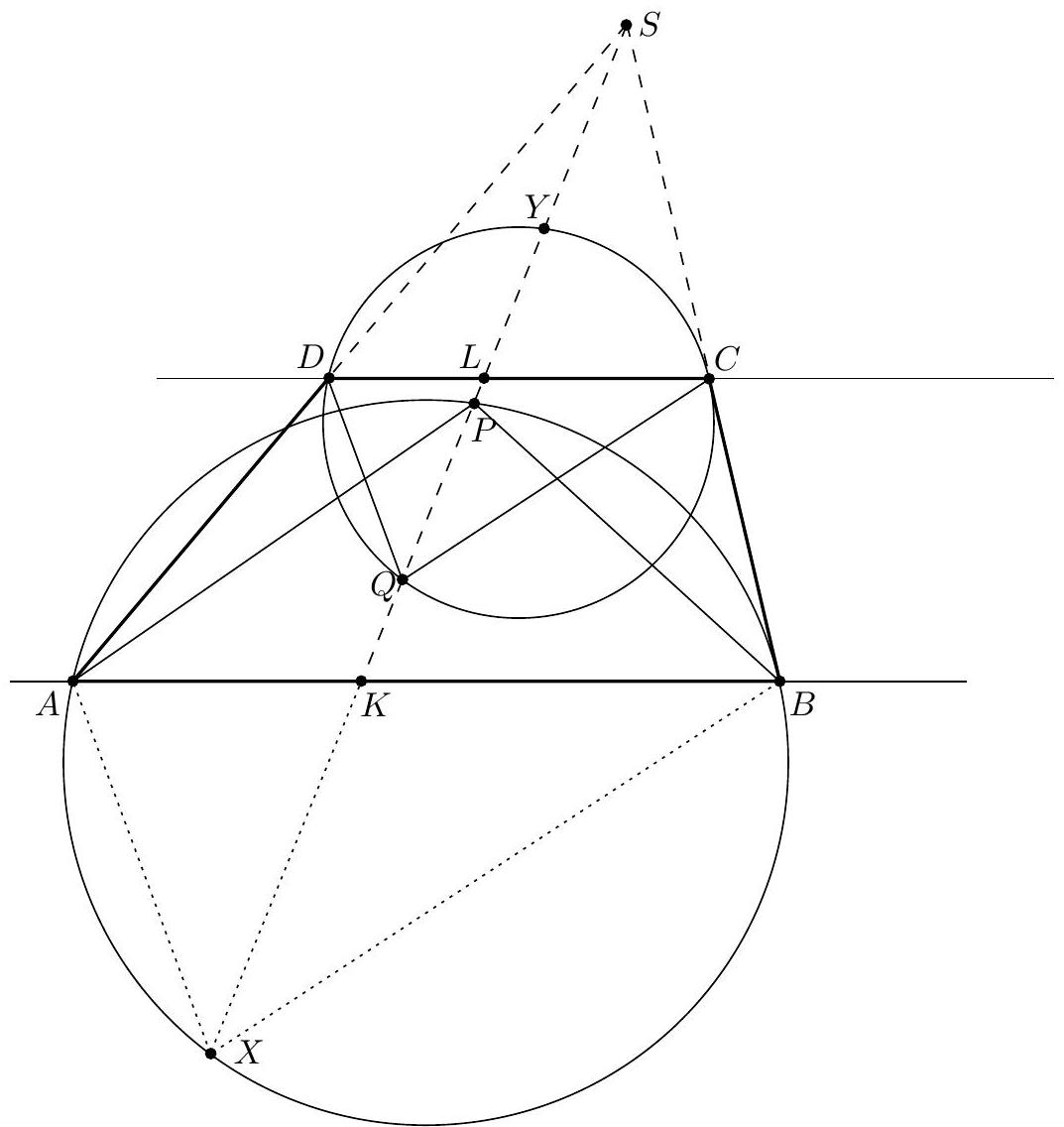 Consider the second intersection points $X$ and $Y$ of the line $S K$ with the circles $(A B P)$ and $(C D Q)$, respectively. Since $A P B X$ is a cyclic quadrilateral and $A B \\| C D$, one has $$ \\angle A X B=180^{\\circ}-\\angle A P B=180^{\\circ}-\\angle B C D=\\angle A B C . $$ This shows that $B C$ is tangent to the circle $(A B P)$ at $B$. Likewise, $B C$ is tangent to the circle $(C D Q)$ at $C$. Therefore $S P \\cdot S X=S B^{2}$ and $S Q \\cdot S Y=S C^{2}$. Let $h$ be the homothety with centre $S$ and ratio $S C / S B$. Since $h(B)=C$, the above conclusion about tangency implies that $h$ takes circle $(A B P)$ to circle $(C D Q)$. Also, $h$ takes $A B$ to $C D$, and it easily follows that $h(P)=Y, h(X)=Q$, yielding $S P / S Y=S B / S C=S X / S Q$. Equalities $S P \\cdot S X=S B^{2}$ and $S Q / S X=S C / S B$ imply $S P \\cdot S Q=S B \\cdot S C$, which is equivalent to $P, Q, B$ and $C$ being concyclic.", "metadata": {"resource_path": "IMO_SL/segmented/en-IMO2006SL.jsonl"}} |
| {"year": "2006", "tier": "T0", "problem_label": "G2", "problem_type": "Geometry", "exam": "IMO-SL", "problem": "Let $A B C D$ be a trapezoid with parallel sides $A B>C D$. Points $K$ and $L$ lie on the line segments $A B$ and $C D$, respectively, so that $A K / K B=D L / L C$. Suppose that there are points $P$ and $Q$ on the line segment $K L$ satisfying $$ \\angle A P B=\\angle B C D \\quad \\text { and } \\quad \\angle C Q D=\\angle A B C \\text {. } $$ Prove that the points $P, Q, B$ and $C$ are concyclic. (Ukraine)", "solution": "The case where $P=Q$ is trivial. Thus assume that $P$ and $Q$ are two distinct points. As in the first solution, notice that the lines $A D, B C$ and $K L$ concur at a point $S$. 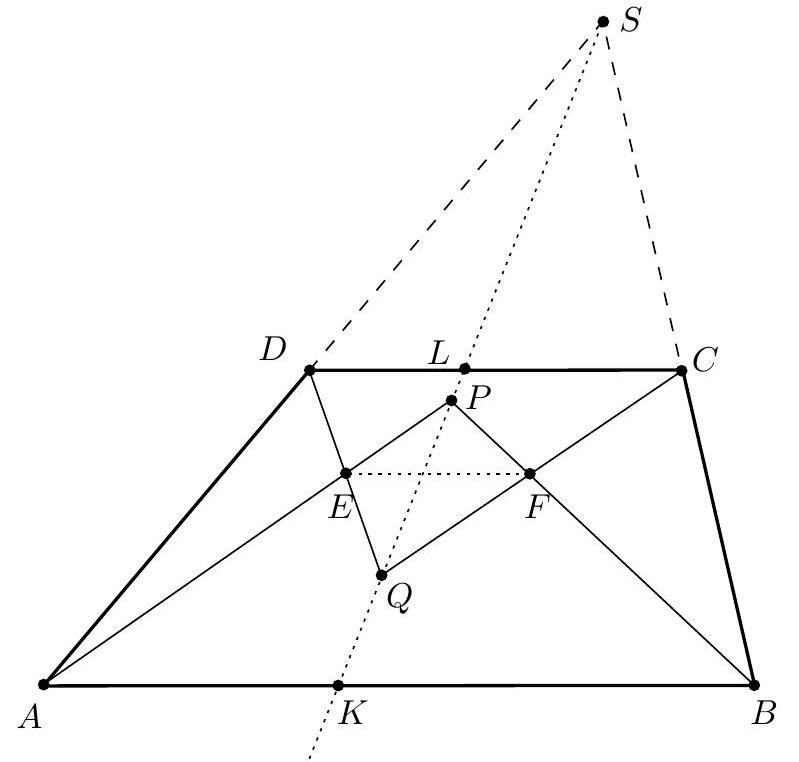 Let the lines $A P$ and $D Q$ meet at $E$, and let $B P$ and $C Q$ meet at $F$. Then $\\angle E P F=\\angle B C D$ and $\\angle F Q E=\\angle A B C$ by the condition of the problem. Since the angles $B C D$ and $A B C$ add up to $180^{\\circ}$, it follows that $P E Q F$ is a cyclic quadrilateral. Applying Menelaus' theorem, first to triangle $A S P$ and line $D Q$ and then to triangle $B S P$ and line $C Q$, we have $$ \\frac{A D}{D S} \\cdot \\frac{S Q}{Q P} \\cdot \\frac{P E}{E A}=1 \\text { and } \\frac{B C}{C S} \\cdot \\frac{S Q}{Q P} \\cdot \\frac{P F}{F B}=1 $$ The first factors in these equations are equal, as $A B \\| C D$. Thus the last factors are also equal, which implies that $E F$ is parallel to $A B$ and $C D$. Using this and the cyclicity of $P E Q F$, we obtain $$ \\angle B C D=\\angle B C F+\\angle F C D=\\angle B C Q+\\angle E F Q=\\angle B C Q+\\angle E P Q $$ On the other hand, $$ \\angle B C D=\\angle A P B=\\angle E P F=\\angle E P Q+\\angle Q P F, $$ and consequently $\\angle B C Q=\\angle Q P F$. The latter angle either coincides with $\\angle Q P B$ or is supplementary to $\\angle Q P B$, depending on whether $Q$ lies between $K$ and $P$ or not. In either case it follows that $P, Q, B$ and $C$ are concyclic.", "metadata": {"resource_path": "IMO_SL/segmented/en-IMO2006SL.jsonl"}} |
| {"year": "2006", "tier": "T0", "problem_label": "G3", "problem_type": "Geometry", "exam": "IMO-SL", "problem": "Let $A B C D E$ be a convex pentagon such that $$ \\angle B A C=\\angle C A D=\\angle D A E \\quad \\text { and } \\quad \\angle A B C=\\angle A C D=\\angle A D E \\text {. } $$ The diagonals $B D$ and $C E$ meet at $P$. Prove that the line $A P$ bisects the side $C D$.", "solution": "Let the diagonals $A C$ and $B D$ meet at $Q$, the diagonals $A D$ and $C E$ meet at $R$, and let the ray $A P$ meet the side $C D$ at $M$. We want to prove that $C M=M D$ holds. 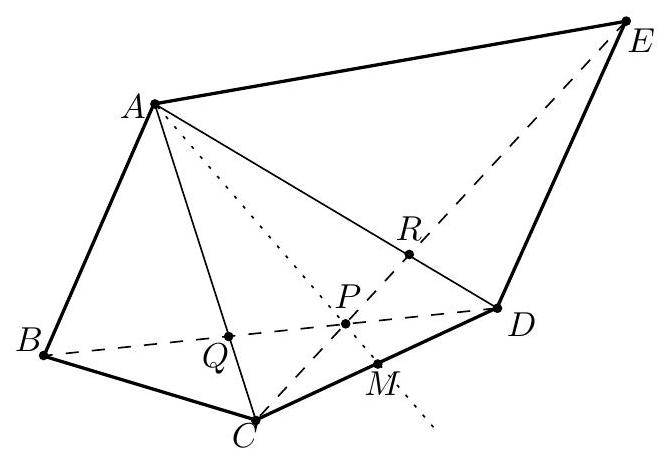 The idea is to show that $Q$ and $R$ divide $A C$ and $A D$ in the same ratio, or more precisely $$ \\frac{A Q}{Q C}=\\frac{A R}{R D} $$ (which is equivalent to $Q R \\| C D$ ). The given angle equalities imply that the triangles $A B C$, $A C D$ and $A D E$ are similar. We therefore have $$ \\frac{A B}{A C}=\\frac{A C}{A D}=\\frac{A D}{A E} $$ Since $\\angle B A D=\\angle B A C+\\angle C A D=\\angle C A D+\\angle D A E=\\angle C A E$, it follows from $A B / A C=$ $A D / A E$ that the triangles $A B D$ and $A C E$ are also similar. Their angle bisectors in $A$ are $A Q$ and $A R$, respectively, so that $$ \\frac{A B}{A C}=\\frac{A Q}{A R} $$ Because $A B / A C=A C / A D$, we obtain $A Q / A R=A C / A D$, which is equivalent to (1). Now Ceva's theorem for the triangle $A C D$ yields $$ \\frac{A Q}{Q C} \\cdot \\frac{C M}{M D} \\cdot \\frac{D R}{R A}=1 $$ In view of (1), this reduces to $C M=M D$, which completes the proof. Comment. Relation (1) immediately follows from the fact that quadrilaterals $A B C D$ and $A C D E$ are similar.", "metadata": {"resource_path": "IMO_SL/segmented/en-IMO2006SL.jsonl"}} |
| {"year": "2006", "tier": "T0", "problem_label": "G4", "problem_type": "Geometry", "exam": "IMO-SL", "problem": "A point $D$ is chosen on the side $A C$ of a triangle $A B C$ with $\\angle C<\\angle A<90^{\\circ}$ in such a way that $B D=B A$. The incircle of $A B C$ is tangent to $A B$ and $A C$ at points $K$ and $L$, respectively. Let $J$ be the incentre of triangle $B C D$. Prove that the line $K L$ intersects the line segment $A J$ at its midpoint. (Russia)", "solution": "Denote by $P$ be the common point of $A J$ and $K L$. Let the parallel to $K L$ through $J$ meet $A C$ at $M$. Then $P$ is the midpoint of $A J$ if and only if $A M=2 \\cdot A L$, which we are about to show.  Denoting $\\angle B A C=2 \\alpha$, the equalities $B A=B D$ and $A K=A L$ imply $\\angle A D B=2 \\alpha$ and $\\angle A L K=90^{\\circ}-\\alpha$. Since $D J$ bisects $\\angle B D C$, we obtain $\\angle C D J=\\frac{1}{2} \\cdot\\left(180^{\\circ}-\\angle A D B\\right)=90^{\\circ}-\\alpha$. Also $\\angle D M J=\\angle A L K=90^{\\circ}-\\alpha$ since $J M \\| K L$. It follows that $J D=J M$. Let the incircle of triangle $B C D$ touch its side $C D$ at $T$. Then $J T \\perp C D$, meaning that $J T$ is the altitude to the base $D M$ of the isosceles triangle $D M J$. It now follows that $D T=M T$, and we have $$ D M=2 \\cdot D T=B D+C D-B C \\text {. } $$ Therefore $$ \\begin{aligned} A M & =A D+(B D+C D-B C) \\\\ & =A D+A B+D C-B C \\\\ & =A C+A B-B C \\\\ & =2 \\cdot A L, \\end{aligned} $$ which completes the proof.", "metadata": {"resource_path": "IMO_SL/segmented/en-IMO2006SL.jsonl"}} |
| {"year": "2006", "tier": "T0", "problem_label": "G5", "problem_type": "Geometry", "exam": "IMO-SL", "problem": "In triangle $A B C$, let $J$ be the centre of the excircle tangent to side $B C$ at $A_{1}$ and to the extensions of sides $A C$ and $A B$ at $B_{1}$ and $C_{1}$, respectively. Suppose that the lines $A_{1} B_{1}$ and $A B$ are perpendicular and intersect at $D$. Let $E$ be the foot of the perpendicular from $C_{1}$ to line $D J$. Determine the angles $\\angle B E A_{1}$ and $\\angle A E B_{1}$. (Greece)", "solution": "Let $K$ be the intersection point of lines $J C$ and $A_{1} B_{1}$. Obviously $J C \\perp A_{1} B_{1}$ and since $A_{1} B_{1} \\perp A B$, the lines $J K$ and $C_{1} D$ are parallel and equal. From the right triangle $B_{1} C J$ we obtain $J C_{1}^{2}=J B_{1}^{2}=J C \\cdot J K=J C \\cdot C_{1} D$ from which we infer that $D C_{1} / C_{1} J=C_{1} J / J C$ and the right triangles $D C_{1} J$ and $C_{1} J C$ are similar. Hence $\\angle C_{1} D J=\\angle J C_{1} C$, which implies that the lines $D J$ and $C_{1} C$ are perpendicular, i.e. the points $C_{1}, E, C$ are collinear.  Since $\\angle C A_{1} J=\\angle C B_{1} J=\\angle C E J=90^{\\circ}$, points $A_{1}, B_{1}$ and $E$ lie on the circle of diameter $C J$. Then $\\angle D B A_{1}=\\angle A_{1} C J=\\angle D E A_{1}$, which implies that quadrilateral $B E A_{1} D$ is cyclic; therefore $\\angle A_{1} E B=90^{\\circ}$. Quadrilateral $A D E B_{1}$ is also cyclic because $\\angle E B_{1} A=\\angle E J C=\\angle E D C_{1}$, therefore we obtain $\\angle A E B_{1}=\\angle A D B=90^{\\circ}$. ", "metadata": {"resource_path": "IMO_SL/segmented/en-IMO2006SL.jsonl"}} |
| {"year": "2006", "tier": "T0", "problem_label": "G5", "problem_type": "Geometry", "exam": "IMO-SL", "problem": "In triangle $A B C$, let $J$ be the centre of the excircle tangent to side $B C$ at $A_{1}$ and to the extensions of sides $A C$ and $A B$ at $B_{1}$ and $C_{1}$, respectively. Suppose that the lines $A_{1} B_{1}$ and $A B$ are perpendicular and intersect at $D$. Let $E$ be the foot of the perpendicular from $C_{1}$ to line $D J$. Determine the angles $\\angle B E A_{1}$ and $\\angle A E B_{1}$. (Greece)", "solution": "Consider the circles $\\omega_{1}, \\omega_{2}$ and $\\omega_{3}$ of diameters $C_{1} D, A_{1} B$ and $A B_{1}$, respectively. Line segments $J C_{1}, J B_{1}$ and $J A_{1}$ are tangents to those circles and, due to the right angle at $D$, $\\omega_{2}$ and $\\omega_{3}$ pass through point $D$. Since $\\angle C_{1} E D$ is a right angle, point $E$ lies on circle $\\omega_{1}$, therefore $$ J C_{1}^{2}=J D \\cdot J E . $$ Since $J A_{1}=J B_{1}=J C_{1}$ are all radii of the excircle, we also have $$ J A_{1}^{2}=J D \\cdot J E \\quad \\text { and } \\quad J B_{1}^{2}=J D \\cdot J E \\text {. } $$ These equalities show that $E$ lies on circles $\\omega_{2}$ and $\\omega_{3}$ as well, so $\\angle B E A_{1}=\\angle A E B_{1}=90^{\\circ}$.", "metadata": {"resource_path": "IMO_SL/segmented/en-IMO2006SL.jsonl"}} |
| {"year": "2006", "tier": "T0", "problem_label": "G5", "problem_type": "Geometry", "exam": "IMO-SL", "problem": "In triangle $A B C$, let $J$ be the centre of the excircle tangent to side $B C$ at $A_{1}$ and to the extensions of sides $A C$ and $A B$ at $B_{1}$ and $C_{1}$, respectively. Suppose that the lines $A_{1} B_{1}$ and $A B$ are perpendicular and intersect at $D$. Let $E$ be the foot of the perpendicular from $C_{1}$ to line $D J$. Determine the angles $\\angle B E A_{1}$ and $\\angle A E B_{1}$. (Greece)", "solution": "First note that $A_{1} B_{1}$ is perpendicular to the external angle bisector $C J$ of $\\angle B C A$ and parallel to the internal angle bisector of that angle. Therefore, $A_{1} B_{1}$ is perpendicular to $A B$ if and only if triangle $A B C$ is isosceles, $A C=B C$. In that case the external bisector $C J$ is parallel to $A B$. Triangles $A B C$ and $B_{1} A_{1} J$ are similar, as their corresponding sides are perpendicular. In particular, we have $\\angle D A_{1} J=\\angle C_{1} B A_{1}$; moreover, from cyclic deltoid $J A_{1} B C_{1}$, $$ \\angle C_{1} A_{1} J=\\angle C_{1} B J=\\frac{1}{2} \\angle C_{1} B A_{1}=\\frac{1}{2} \\angle D A_{1} J $$ Therefore, $A_{1} C_{1}$ bisects angle $\\angle D A_{1} J$.  In triangle $B_{1} A_{1} J$, line $J C_{1}$ is the external bisector at vertex $J$. The point $C_{1}$ is the intersection of two external angle bisectors (at $A_{1}$ and $J$ ) so $C_{1}$ is the centre of the excircle $\\omega$, tangent to side $A_{1} J$, and to the extension of $B_{1} A_{1}$ at point $D$. Now consider the similarity transform $\\varphi$ which moves $B_{1}$ to $A, A_{1}$ to $B$ and $J$ to $C$. This similarity can be decomposed into a rotation by $90^{\\circ}$ around a certain point $O$ and a homothety from the same centre. This similarity moves point $C_{1}$ (the centre of excircle $\\omega$ ) to $J$ and moves $D$ (the point of tangency) to $C_{1}$. Since the rotation angle is $90^{\\circ}$, we have $\\angle X O \\varphi(X)=90^{\\circ}$ for an arbitrary point $X \\neq O$. For $X=D$ and $X=C_{1}$ we obtain $\\angle D O C_{1}=\\angle C_{1} O J=90^{\\circ}$. Therefore $O$ lies on line segment $D J$ and $C_{1} O$ is perpendicular to $D J$. This means that $O=E$. For $X=A_{1}$ and $X=B_{1}$ we obtain $\\angle A_{1} O B=\\angle B_{1} O A=90^{\\circ}$, i.e. $$ \\angle B E A_{1}=\\angle A E B_{1}=90^{\\circ} . $$ Comment. Choosing $X=J$, it also follows that $\\angle J E C=90^{\\circ}$ which proves that lines $D J$ and $C C_{1}$ intersect at point $E$. However, this is true more generally, without the assumption that $A_{1} B_{1}$ and $A B$ are perpendicular, because points $C$ and $D$ are conjugates with respect to the excircle. The last observation could replace the first paragraph of Solution 1.", "metadata": {"resource_path": "IMO_SL/segmented/en-IMO2006SL.jsonl"}} |
| {"year": "2006", "tier": "T0", "problem_label": "G6", "problem_type": "Geometry", "exam": "IMO-SL", "problem": "Circles $\\omega_{1}$ and $\\omega_{2}$ with centres $O_{1}$ and $O_{2}$ are externally tangent at point $D$ and internally tangent to a circle $\\omega$ at points $E$ and $F$, respectively. Line $t$ is the common tangent of $\\omega_{1}$ and $\\omega_{2}$ at $D$. Let $A B$ be the diameter of $\\omega$ perpendicular to $t$, so that $A, E$ and $O_{1}$ are on the same side of $t$. Prove that lines $A O_{1}, B O_{2}, E F$ and $t$ are concurrent. (Brasil)", "solution": "Point $E$ is the centre of a homothety $h$ which takes circle $\\omega_{1}$ to circle $\\omega$. The radii $O_{1} D$ and $O B$ of these circles are parallel as both are perpendicular to line t. Also, $O_{1} D$ and $O B$ are on the same side of line $E O$, hence $h$ takes $O_{1} D$ to $O B$. Consequently, points $E$, $D$ and $B$ are collinear. Likewise, points $F, D$ and $A$ are collinear as well. Let lines $A E$ and $B F$ intersect at $C$. Since $A F$ and $B E$ are altitudes in triangle $A B C$, their common point $D$ is the orthocentre of this triangle. So $C D$ is perpendicular to $A B$, implying that $C$ lies on line $t$. Note that triangle $A B C$ is acute-angled. We mention the well-known fact that triangles $F E C$ and $A B C$ are similar in ratio $\\cos \\gamma$, where $\\gamma=\\angle A C B$. In addition, points $C, E, D$ and $F$ lie on the circle with diameter $C D$.  Let $P$ be the common point of lines $E F$ and $t$. We are going to prove that $P$ lies on line $A O_{1}$. Denote by $N$ the second common point of circle $\\omega_{1}$ and $A C$; this is the point of $\\omega_{1}$ diametrically opposite to $D$. By Menelaus' theorem for triangle $D C N$, points $A, O_{1}$ and $P$ are collinear if and only if $$ \\frac{C A}{A N} \\cdot \\frac{N O_{1}}{O_{1} D} \\cdot \\frac{D P}{P C}=1 $$ Because $N O_{1}=O_{1} D$, this reduces to $C A / A N=C P / P D$. Let line $t$ meet $A B$ at $K$. Then $C A / A N=C K / K D$, so it suffices to show that $$ \\frac{C P}{P D}=\\frac{C K}{K D} $$ To verify (1), consider the circumcircle $\\Omega$ of triangle $A B C$. Draw its diameter $C U$ through $C$, and let $C U$ meet $A B$ at $V$. Extend $C K$ to meet $\\Omega$ at $L$. Since $A B$ is parallel to $U L$, we have $\\angle A C U=\\angle B C L$. On the other hand $\\angle E F C=\\angle B A C, \\angle F E C=\\angle A B C$ and $E F / A B=\\cos \\gamma$, as stated above. So reflection in the bisector of $\\angle A C B$ followed by a homothety with centre $C$ and ratio $1 / \\cos \\gamma$ takes triangle $F E C$ to triangle $A B C$. Consequently, this transformation takes $C D$ to $C U$, which implies $C P / P D=C V / V U$. Next, we have $K L=K D$, because $D$ is the orthocentre of triangle $A B C$. Hence $C K / K D=C K / K L$. Finally, $C V / V U=C K / K L$ because $A B$ is parallel to $U L$. Relation (1) follows, proving that $P$ lies on line $A O_{1}$. By symmetry, $P$ also lies on line $A O_{2}$ which completes the solution.", "metadata": {"resource_path": "IMO_SL/segmented/en-IMO2006SL.jsonl"}} |
| {"year": "2006", "tier": "T0", "problem_label": "G6", "problem_type": "Geometry", "exam": "IMO-SL", "problem": "Circles $\\omega_{1}$ and $\\omega_{2}$ with centres $O_{1}$ and $O_{2}$ are externally tangent at point $D$ and internally tangent to a circle $\\omega$ at points $E$ and $F$, respectively. Line $t$ is the common tangent of $\\omega_{1}$ and $\\omega_{2}$ at $D$. Let $A B$ be the diameter of $\\omega$ perpendicular to $t$, so that $A, E$ and $O_{1}$ are on the same side of $t$. Prove that lines $A O_{1}, B O_{2}, E F$ and $t$ are concurrent. (Brasil)", "solution": "We proceed as in the first solution to define a triangle $A B C$ with orthocentre $D$, in which $A F$ and $B E$ are altitudes. Denote by $M$ the midpoint of $C D$. The quadrilateral $C E D F$ is inscribed in a circle with centre $M$, hence $M C=M E=M D=M F$.  Consider triangles $A B C$ and $O_{1} O_{2} M$. Lines $O_{1} O_{2}$ and $A B$ are parallel, both of them being perpendicular to line $t$. Next, $M O_{1}$ is the line of centres of circles $(C E F)$ and $\\omega_{1}$ whose common chord is $D E$. Hence $M O_{1}$ bisects $\\angle D M E$ which is the external angle at $M$ in the isosceles triangle $C E M$. It follows that $\\angle D M O_{1}=\\angle D C A$, so that $M O_{1}$ is parallel to $A C$. Likewise, $M O_{2}$ is parallel to $B C$. Thus the respective sides of triangles $A B C$ and $O_{1} O_{2} M$ are parallel; in addition, these triangles are not congruent. Hence there is a homothety taking $A B C$ to $O_{1} O_{2} M$. The lines $A O_{1}$, $B O_{2}$ and $C M=t$ are concurrent at the centre $Q$ of this homothety. Finally, apply Pappus' theorem to the triples of collinear points $A, O, B$ and $O_{2}, D, O_{1}$. The theorem implies that the points $A D \\cap O O_{2}=F, A O_{1} \\cap B O_{2}=Q$ and $O O_{1} \\cap B D=E$ are collinear. In other words, line $E F$ passes through the common point $Q$ of $A O_{1}, B O_{2}$ and $t$. Comment. Relation (1) from Solution 1 expresses the well-known fact that points $P$ and $K$ are harmonic conjugates with respect to points $C$ and $D$. It is also easy to justify it by direct computation. Denoting $\\angle C A B=\\alpha, \\angle A B C=\\beta$, it is straightforward to obtain $C P / P D=C K / K D=\\tan \\alpha \\tan \\beta$.", "metadata": {"resource_path": "IMO_SL/segmented/en-IMO2006SL.jsonl"}} |
| {"year": "2006", "tier": "T0", "problem_label": "G7", "problem_type": "Geometry", "exam": "IMO-SL", "problem": "In a triangle $A B C$, let $M_{a}, M_{b}, M_{c}$ be respectively the midpoints of the sides $B C, C A$, $A B$ and $T_{a}, T_{b}, T_{c}$ be the midpoints of the $\\operatorname{arcs} B C, C A, A B$ of the circumcircle of $A B C$, not containing the opposite vertices. For $i \\in\\{a, b, c\\}$, let $\\omega_{i}$ be the circle with $M_{i} T_{i}$ as diameter. Let $p_{i}$ be the common external tangent to $\\omega_{j}, \\omega_{k}(\\{i, j, k\\}=\\{a, b, c\\})$ such that $\\omega_{i}$ lies on the opposite side of $p_{i}$ than $\\omega_{j}, \\omega_{k}$ do. Prove that the lines $p_{a}, p_{b}, p_{c}$ form a triangle similar to $A B C$ and find the ratio of similitude. (Slovakia)", "solution": "Let $T_{a} T_{b}$ intersect circle $\\omega_{b}$ at $T_{b}$ and $U$, and let $T_{a} T_{c}$ intersect circle $\\omega_{c}$ at $T_{c}$ and $V$. Further, let $U X$ be the tangent to $\\omega_{b}$ at $U$, with $X$ on $A C$, and let $V Y$ be the tangent to $\\omega_{c}$ at $V$, with $Y$ on $A B$. The homothety with centre $T_{b}$ and ratio $T_{b} T_{a} / T_{b} U$ maps the circle $\\omega_{b}$ onto the circumcircle of $A B C$ and the line $U X$ onto the line tangent to the circumcircle at $T_{a}$, which is parallel to $B C$; thus $U X \\| B C$. The same is true of $V Y$, so that $U X\\|B C\\| V Y$. Let $T_{a} T_{b}$ cut $A C$ at $P$ and let $T_{a} T_{c}$ cut $A B$ at $Q$. The point $X$ lies on the hypotenuse $P M_{b}$ of the right triangle $P U M_{b}$ and is equidistant from $U$ and $M_{b}$. So $X$ is the midpoint of $M_{b} P$. Similarly $Y$ is the midpoint of $M_{c} Q$. Denote the incentre of triangle $A B C$ as usual by $I$. It is a known fact that $T_{a} I=T_{a} B$ and $T_{c} I=T_{c} B$. Therefore the points $B$ and $I$ are symmetric across $T_{a} T_{c}$, and consequently $\\angle Q I B=\\angle Q B I=\\angle I B C$. This implies that $B C$ is parallel to the line $I Q$, and likewise, to $I P$. In other words, $P Q$ is the line parallel to $B C$ passing through $I$.  Clearly $M_{b} M_{c} \\| B C$. So $P M_{b} M_{c} Q$ is a trapezoid and the segment $X Y$ connects the midpoints of its nonparallel sides; hence $X Y \\| B C$. This combined with the previously established relations $U X\\|B C\\| V Y$ shows that all the four points $U, X, Y, V$ lie on a line which is the common tangent to circles $\\omega_{b}, \\omega_{c}$. Since it leaves these two circles on one side and the circle $\\omega_{a}$ on the other, this line is just the line $p_{a}$ from the problem statement. Line $p_{a}$ runs midway between $I$ and $M_{b} M_{c}$. Analogous conclusions hold for the lines $p_{b}$ and $p_{c}$. So these three lines form a triangle homothetic from centre $I$ to triangle $M_{a} M_{b} M_{c}$ in ratio $1 / 2$, hence similar to $A B C$ in ratio $1 / 4$.", "metadata": {"resource_path": "IMO_SL/segmented/en-IMO2006SL.jsonl"}} |
| {"year": "2006", "tier": "T0", "problem_label": "G8", "problem_type": "Geometry", "exam": "IMO-SL", "problem": "Let $A B C D$ be a convex quadrilateral. A circle passing through the points $A$ and $D$ and a circle passing through the points $B$ and $C$ are externally tangent at a point $P$ inside the quadrilateral. Suppose that $$ \\angle P A B+\\angle P D C \\leq 90^{\\circ} \\quad \\text { and } \\quad \\angle P B A+\\angle P C D \\leq 90^{\\circ} \\text {. } $$ Prove that $A B+C D \\geq B C+A D$. (Poland)", "solution": "We start with a preliminary observation. Let $T$ be a point inside the quadrilateral $A B C D$. Then: $$ \\begin{aligned} & \\text { Circles }(B C T) \\text { and }(D A T) \\text { are tangent at } T \\\\ & \\text { if and only if } \\quad \\angle A D T+\\angle B C T=\\angle A T B \\text {. } \\end{aligned} $$ Indeed, if the two circles touch each other then their common tangent at $T$ intersects the segment $A B$ at a point $Z$, and so $\\angle A D T=\\angle A T Z, \\angle B C T=\\angle B T Z$, by the tangent-chord theorem. Thus $\\angle A D T+\\angle B C T=\\angle A T Z+\\angle B T Z=\\angle A T B$. And conversely, if $\\angle A D T+\\angle B C T=\\angle A T B$ then one can draw from $T$ a ray $T Z$ with $Z$ on $A B$ so that $\\angle A D T=\\angle A T Z, \\angle B C T=\\angle B T Z$. The first of these equalities implies that $T Z$ is tangent to the circle $(D A T)$; by the second equality, $T Z$ is tangent to the circle $(B C T)$, so the two circles are tangent at $T$. 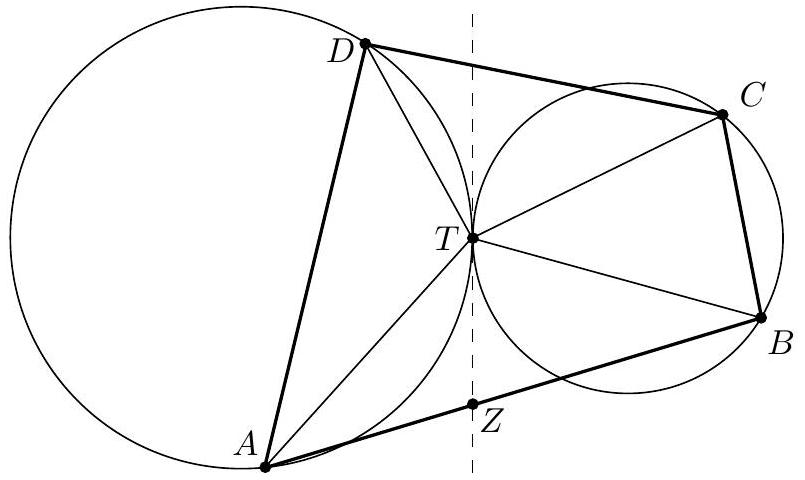 So the equivalence (1) is settled. It will be used later on. Now pass to the actual solution. Its key idea is to introduce the circumcircles of triangles $A B P$ and $C D P$ and to consider their second intersection $Q$ (assume for the moment that they indeed meet at two distinct points $P$ and $Q$ ). Since the point $A$ lies outside the circle $(B C P)$, we have $\\angle B C P+\\angle B A P<180^{\\circ}$. Therefore the point $C$ lies outside the circle $(A B P)$. Analogously, $D$ also lies outside that circle. It follows that $P$ and $Q$ lie on the same $\\operatorname{arc} C D$ of the circle $(B C P)$. 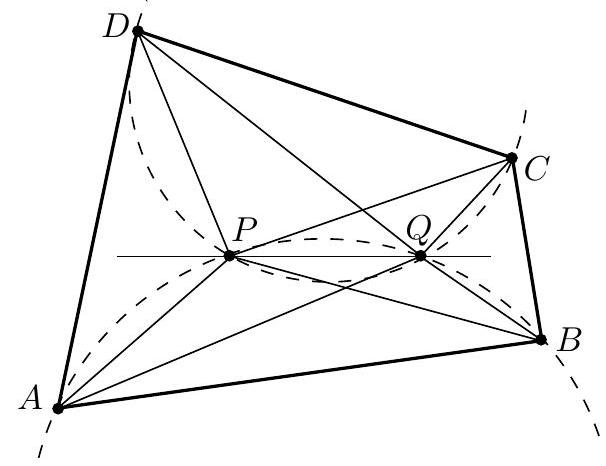 By symmetry, $P$ and $Q$ lie on the same arc $A B$ of the circle $(A B P)$. Thus the point $Q$ lies either inside the angle $B P C$ or inside the angle $A P D$. Without loss of generality assume that $Q$ lies inside the angle $B P C$. Then $$ \\angle A Q D=\\angle P Q A+\\angle P Q D=\\angle P B A+\\angle P C D \\leq 90^{\\circ} \\text {, } $$ by the condition of the problem. In the cyclic quadrilaterals $A P Q B$ and $D P Q C$, the angles at vertices $A$ and $D$ are acute. So their angles at $Q$ are obtuse. This implies that $Q$ lies not only inside the angle $B P C$ but in fact inside the triangle $B P C$, hence also inside the quadrilateral $A B C D$. Now an argument similar to that used in deriving (2) shows that $$ \\angle B Q C=\\angle P A B+\\angle P D C \\leq 90^{\\circ} . $$ Moreover, since $\\angle P C Q=\\angle P D Q$, we get $$ \\angle A D Q+\\angle B C Q=\\angle A D P+\\angle P D Q+\\angle B C P-\\angle P C Q=\\angle A D P+\\angle B C P . $$ The last sum is equal to $\\angle A P B$, according to the observation (1) applied to $T=P$. And because $\\angle A P B=\\angle A Q B$, we obtain $$ \\angle A D Q+\\angle B C Q=\\angle A Q B \\text {. } $$ Applying now (1) to $T=Q$ we conclude that the circles $(B C Q)$ and $(D A Q)$ are externally tangent at $Q$. (We have assumed $P \\neq Q$; but if $P=Q$ then the last conclusion holds trivially.) Finally consider the halfdiscs with diameters $B C$ and $D A$ constructed inwardly to the quadrilateral $A B C D$. They have centres at $M$ and $N$, the midpoints of $B C$ and $D A$ respectively. In view of (2) and (3), these two halfdiscs lie entirely inside the circles $(B Q C)$ and $(A Q D)$; and since these circles are tangent, the two halfdiscs cannot overlap. Hence $M N \\geq \\frac{1}{2} B C+\\frac{1}{2} D A$. On the other hand, since $\\overrightarrow{M N}=\\frac{1}{2}(\\overrightarrow{B A}+\\overrightarrow{C D})$, we have $M N \\leq \\frac{1}{2}(A B+C D)$. Thus indeed $A B+C D \\geq B C+D A$, as claimed.", "metadata": {"resource_path": "IMO_SL/segmented/en-IMO2006SL.jsonl"}} |
| {"year": "2006", "tier": "T0", "problem_label": "G9", "problem_type": "Geometry", "exam": "IMO-SL", "problem": "Points $A_{1}, B_{1}, C_{1}$ are chosen on the sides $B C, C A, A B$ of a triangle $A B C$, respectively. The circumcircles of triangles $A B_{1} C_{1}, B C_{1} A_{1}, C A_{1} B_{1}$ intersect the circumcircle of triangle $A B C$ again at points $A_{2}, B_{2}, C_{2}$, respectively $\\left(A_{2} \\neq A, B_{2} \\neq B, C_{2} \\neq C\\right)$. Points $A_{3}, B_{3}, C_{3}$ are symmetric to $A_{1}, B_{1}, C_{1}$ with respect to the midpoints of the sides $B C, C A, A B$ respectively. Prove that the triangles $A_{2} B_{2} C_{2}$ and $A_{3} B_{3} C_{3}$ are similar. (Russia)", "solution": "We will work with oriented angles between lines. For two straight lines $\\ell, m$ in the plane, $\\angle(\\ell, m)$ denotes the angle of counterclockwise rotation which transforms line $\\ell$ into a line parallel to $m$ (the choice of the rotation centre is irrelevant). This is a signed quantity; values differing by a multiple of $\\pi$ are identified, so that $$ \\angle(\\ell, m)=-\\angle(m, \\ell), \\quad \\angle(\\ell, m)+\\angle(m, n)=\\angle(\\ell, n) . $$ If $\\ell$ is the line through points $K, L$ and $m$ is the line through $M, N$, one writes $\\angle(K L, M N)$ for $\\angle(\\ell, m)$; the characters $K, L$ are freely interchangeable; and so are $M, N$. The counterpart of the classical theorem about cyclic quadrilaterals is the following: If $K, L, M, N$ are four noncollinear points in the plane then $$ K, L, M, N \\text { are concyclic if and only if } \\angle(K M, L M)=\\angle(K N, L N) \\text {. } $$ Passing to the solution proper, we first show that the three circles $\\left(A B_{1} C_{1}\\right),\\left(B C_{1} A_{1}\\right)$, $\\left(C A_{1} B_{1}\\right)$ have a common point. So, let $\\left(A B_{1} C_{1}\\right)$ and $\\left(B C_{1} A_{1}\\right)$ intersect at the points $C_{1}$ and $P$. Then by (1) $$ \\begin{gathered} \\angle\\left(P A_{1}, C A_{1}\\right)=\\angle\\left(P A_{1}, B A_{1}\\right)=\\angle\\left(P C_{1}, B C_{1}\\right) \\\\ =\\angle\\left(P C_{1}, A C_{1}\\right)=\\angle\\left(P B_{1}, A B_{1}\\right)=\\angle\\left(P B_{1}, C B_{1}\\right) \\end{gathered} $$ Denote this angle by $\\varphi$. The equality between the outer terms shows, again by (1), that the points $A_{1}, B_{1}, P, C$ are concyclic. Thus $P$ is the common point of the three mentioned circles. From now on the basic property (1) will be used without explicit reference. We have $$ \\varphi=\\angle\\left(P A_{1}, B C\\right)=\\angle\\left(P B_{1}, C A\\right)=\\angle\\left(P C_{1}, A B\\right) . $$ 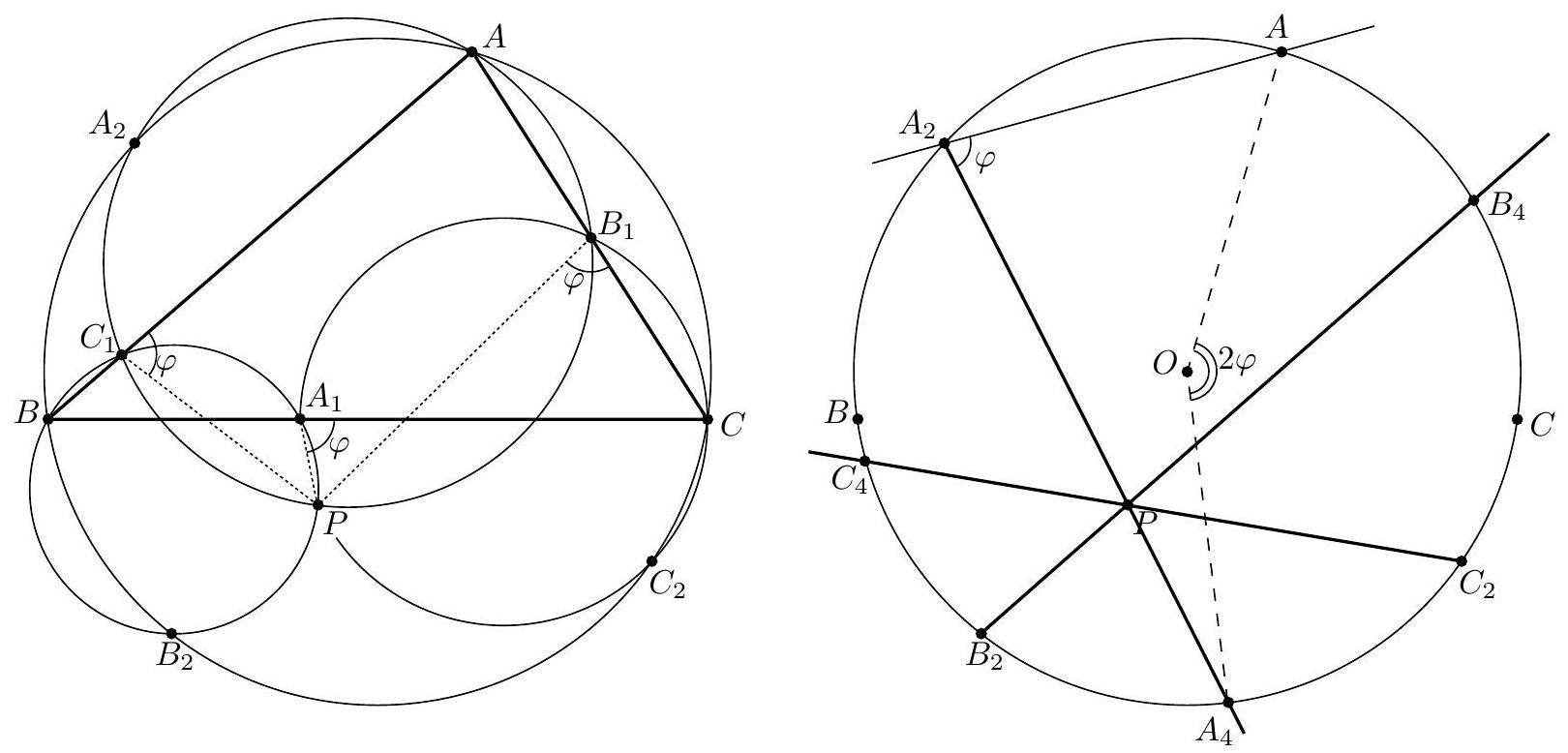 Let lines $A_{2} P, B_{2} P, C_{2} P$ meet the circle $(A B C)$ again at $A_{4}, B_{4}, C_{4}$, respectively. As $$ \\angle\\left(A_{4} A_{2}, A A_{2}\\right)=\\angle\\left(P A_{2}, A A_{2}\\right)=\\angle\\left(P C_{1}, A C_{1}\\right)=\\angle\\left(P C_{1}, A B\\right)=\\varphi \\text {, } $$ we see that line $A_{2} A$ is the image of line $A_{2} A_{4}$ under rotation about $A_{2}$ by the angle $\\varphi$. Hence the point $A$ is the image of $A_{4}$ under rotation by $2 \\varphi$ about $O$, the centre of $(A B C)$. The same rotation sends $B_{4}$ to $B$ and $C_{4}$ to $C$. Triangle $A B C$ is the image of $A_{4} B_{4} C_{4}$ in this map. Thus $$ \\angle\\left(A_{4} B_{4}, A B\\right)=\\angle\\left(B_{4} C_{4}, B C\\right)=\\angle\\left(C_{4} A_{4}, C A\\right)=2 \\varphi \\text {. } $$ Since the rotation by $2 \\varphi$ about $O$ takes $B_{4}$ to $B$, we have $\\angle\\left(A B_{4}, A B\\right)=\\varphi$. Hence by (2) $$ \\angle\\left(A B_{4}, P C_{1}\\right)=\\angle\\left(A B_{4}, A B\\right)+\\angle\\left(A B, P C_{1}\\right)=\\varphi+(-\\varphi)=0 $$ which means that $A B_{4} \\| P C_{1}$. 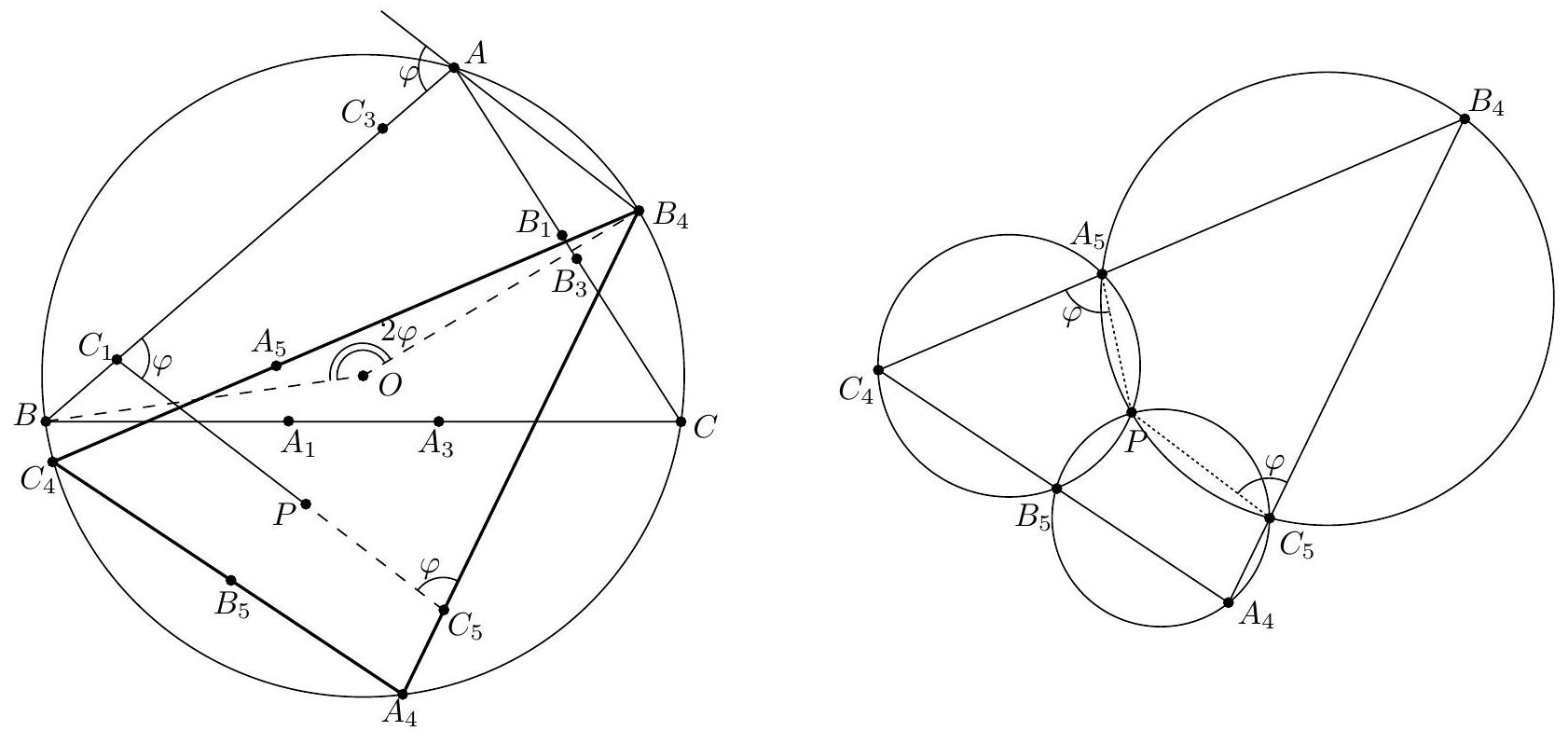 Let $C_{5}$ be the intersection of lines $P C_{1}$ and $A_{4} B_{4}$; define $A_{5}, B_{5}$ analogously. So $A B_{4} \\| C_{1} C_{5}$ and, by (3) and (2), $$ \\angle\\left(A_{4} B_{4}, P C_{1}\\right)=\\angle\\left(A_{4} B_{4}, A B\\right)+\\angle\\left(A B, P C_{1}\\right)=2 \\varphi+(-\\varphi)=\\varphi $$ i.e., $\\angle\\left(B_{4} C_{5}, C_{5} C_{1}\\right)=\\varphi$. This combined with $\\angle\\left(C_{5} C_{1}, C_{1} A\\right)=\\angle\\left(P C_{1}, A B\\right)=\\varphi$ (see (2)) proves that the quadrilateral $A B_{4} C_{5} C_{1}$ is an isosceles trapezoid with $A C_{1}=B_{4} C_{5}$. Interchanging the roles of $A$ and $B$ we infer that also $B C_{1}=A_{4} C_{5}$. And since $A C_{1}+B C_{1}=$ $A B=A_{4} B_{4}$, it follows that the point $C_{5}$ lies on the line segment $A_{4} B_{4}$ and partitions it into segments $A_{4} C_{5}, B_{4} C_{5}$ of lengths $B C_{1}\\left(=A C_{3}\\right)$ and $A C_{1}\\left(=B C_{3}\\right)$. In other words, the rotation which maps triangle $A_{4} B_{4} C_{4}$ onto $A B C$ carries $C_{5}$ onto $C_{3}$. Likewise, it sends $A_{5}$ to $A_{3}$ and $B_{5}$ to $B_{3}$. So the triangles $A_{3} B_{3} C_{3}$ and $A_{5} B_{5} C_{5}$ are congruent. It now suffices to show that the latter is similar to $A_{2} B_{2} C_{2}$. Lines $B_{4} C_{5}$ and $P C_{5}$ coincide respectively with $A_{4} B_{4}$ and $P C_{1}$. Thus by (4) $$ \\angle\\left(B_{4} C_{5}, P C_{5}\\right)=\\varphi $$ Analogously (by cyclic shift) $\\varphi=\\angle\\left(C_{4} A_{5}, P A_{5}\\right)$, which rewrites as $$ \\varphi=\\angle\\left(B_{4} A_{5}, P A_{5}\\right) $$ These relations imply that the points $P, B_{4}, C_{5}, A_{5}$ are concyclic. Analogously, $P, C_{4}, A_{5}, B_{5}$ and $P, A_{4}, B_{5}, C_{5}$ are concyclic quadruples. Therefore $$ \\angle\\left(A_{5} B_{5}, C_{5} B_{5}\\right)=\\angle\\left(A_{5} B_{5}, P B_{5}\\right)+\\angle\\left(P B_{5}, C_{5} B_{5}\\right)=\\angle\\left(A_{5} C_{4}, P C_{4}\\right)+\\angle\\left(P A_{4}, C_{5} A_{4}\\right) . $$ On the other hand, since the points $A_{2}, B_{2}, C_{2}, A_{4}, B_{4}, C_{4}$ all lie on the circle $(A B C)$, we have $$ \\angle\\left(A_{2} B_{2}, C_{2} B_{2}\\right)=\\angle\\left(A_{2} B_{2}, B_{4} B_{2}\\right)+\\angle\\left(B_{4} B_{2}, C_{2} B_{2}\\right)=\\angle\\left(A_{2} A_{4}, B_{4} A_{4}\\right)+\\angle\\left(B_{4} C_{4}, C_{2} C_{4}\\right) . $$ But the lines $A_{2} A_{4}, B_{4} A_{4}, B_{4} C_{4}, C_{2} C_{4}$ coincide respectively with $P A_{4}, C_{5} A_{4}, A_{5} C_{4}, P C_{4}$. So the sums on the right-hand sides of (5) and (6) are equal, leading to equality between their left-hand sides: $\\angle\\left(A_{5} B_{5}, C_{5} B_{5}\\right)=\\angle\\left(A_{2} B_{2}, C_{2} B_{2}\\right)$. Hence (by cyclic shift, once more) also $\\angle\\left(B_{5} C_{5}, A_{5} C_{5}\\right)=\\angle\\left(B_{2} C_{2}, A_{2} C_{2}\\right)$ and $\\angle\\left(C_{5} A_{5}, B_{5} A_{5}\\right)=\\angle\\left(C_{2} A_{2}, B_{2} A_{2}\\right)$. This means that the triangles $A_{5} B_{5} C_{5}$ and $A_{2} B_{2} C_{2}$ have their corresponding angles equal, and consequently they are similar. Comment 1. This is the way in which the proof has been presented by the proposer. Trying to work it out in the language of classical geometry, so as to avoid oriented angles, one is led to difficulties due to the fact that the reasoning becomes heavily case-dependent. Disposition of relevant points can vary in many respects. Angles which are equal in one case become supplementary in another. Although it seems not hard to translate all formulas from the shapes they have in one situation to the one they have in another, the real trouble is to identify all cases possible and rigorously verify that the key conclusions retain validity in each case. The use of oriented angles is a very efficient method to omit this trouble. It seems to be the most appropriate environment in which the solution can be elaborated. Comment 2. Actually, the fact that the circles $\\left(A B_{1} C_{1}\\right),\\left(B C_{1} A_{1}\\right)$ and $\\left(C A_{1} B_{1}\\right)$ have a common point does not require a proof; it is known as Miquel's theorem.", "metadata": {"resource_path": "IMO_SL/segmented/en-IMO2006SL.jsonl"}} |
| {"year": "2006", "tier": "T0", "problem_label": "G10", "problem_type": "Geometry", "exam": "IMO-SL", "problem": "To each side $a$ of a convex polygon we assign the maximum area of a triangle contained in the polygon and having $a$ as one of its sides. Show that the sum of the areas assigned to all sides of the polygon is not less than twice the area of the polygon. (Serbia)", "solution": "Lemma. Every convex $(2 n)$-gon, of area $S$, has a side and a vertex that jointly span a triangle of area not less than $S / n$. Proof. By main diagonals of the $(2 n)$-gon we shall mean those which partition the $(2 n)$-gon into two polygons with equally many sides. For any side $b$ of the $(2 n)$-gon denote by $\\Delta_{b}$ the triangle $A B P$ where $A, B$ are the endpoints of $b$ and $P$ is the intersection point of the main diagonals $A A^{\\prime}, B B^{\\prime}$. We claim that the union of triangles $\\Delta_{b}$, taken over all sides, covers the whole polygon. To show this, choose any side $A B$ and consider the main diagonal $A A^{\\prime}$ as a directed segment. Let $X$ be any point in the polygon, not on any main diagonal. For definiteness, let $X$ lie on the left side of the ray $A A^{\\prime}$. Consider the sequence of main diagonals $A A^{\\prime}, B B^{\\prime}, C C^{\\prime}, \\ldots$, where $A, B, C, \\ldots$ are consecutive vertices, situated right to $A A^{\\prime}$. The $n$-th item in this sequence is the diagonal $A^{\\prime} A$ (i.e. $A A^{\\prime}$ reversed), having $X$ on its right side. So there are two successive vertices $K, L$ in the sequence $A, B, C, \\ldots$ before $A^{\\prime}$ such that $X$ still lies to the left of $K K^{\\prime}$ but to the right of $L L^{\\prime}$. And this means that $X$ is in the triangle $\\Delta_{\\ell^{\\prime}}, \\ell^{\\prime}=K^{\\prime} L^{\\prime}$. Analogous reasoning applies to points $X$ on the right of $A A^{\\prime}$ (points lying on main diagonals can be safely ignored). Thus indeed the triangles $\\Delta_{b}$ jointly cover the whole polygon. The sum of their areas is no less than $S$. So we can find two opposite sides, say $b=A B$ and $b^{\\prime}=A^{\\prime} B^{\\prime}$ (with $A A^{\\prime}, B B^{\\prime}$ main diagonals) such that $\\left[\\Delta_{b}\\right]+\\left[\\Delta_{b^{\\prime}}\\right] \\geq S / n$, where $[\\cdots]$ stands for the area of a region. Let $A A^{\\prime}, B B^{\\prime}$ intersect at $P$; assume without loss of generality that $P B \\geq P B^{\\prime}$. Then $$ \\left[A B A^{\\prime}\\right]=[A B P]+\\left[P B A^{\\prime}\\right] \\geq[A B P]+\\left[P A^{\\prime} B^{\\prime}\\right]=\\left[\\Delta_{b}\\right]+\\left[\\Delta_{b^{\\prime}}\\right] \\geq S / n $$ proving the lemma. Now, let $\\mathcal{P}$ be any convex polygon, of area $S$, with $m$ sides $a_{1}, \\ldots, a_{m}$. Let $S_{i}$ be the area of the greatest triangle in $\\mathcal{P}$ with side $a_{i}$. Suppose, contrary to the assertion, that $$ \\sum_{i=1}^{m} \\frac{S_{i}}{S}<2 $$ Then there exist rational numbers $q_{1}, \\ldots, q_{m}$ such that $\\sum q_{i}=2$ and $q_{i}>S_{i} / S$ for each $i$. Let $n$ be a common denominator of the $m$ fractions $q_{1}, \\ldots, q_{m}$. Write $q_{i}=k_{i} / n$; so $\\sum k_{i}=2 n$. Partition each side $a_{i}$ of $\\mathcal{P}$ into $k_{i}$ equal segments, creating a convex $(2 n)$-gon of area $S$ (with some angles of size $180^{\\circ}$ ), to which we apply the lemma. Accordingly, this refined polygon has a side $b$ and a vertex $H$ spanning a triangle $T$ of area $[T] \\geq S / n$. If $b$ is a piece of a side $a_{i}$ of $\\mathcal{P}$, then the triangle $W$ with base $a_{i}$ and summit $H$ has area $$ [W]=k_{i} \\cdot[T] \\geq k_{i} \\cdot S / n=q_{i} \\cdot S>S_{i}, $$ in contradiction with the definition of $S_{i}$. This ends the proof.", "metadata": {"resource_path": "IMO_SL/segmented/en-IMO2006SL.jsonl"}} |
| {"year": "2006", "tier": "T0", "problem_label": "G10", "problem_type": "Geometry", "exam": "IMO-SL", "problem": "To each side $a$ of a convex polygon we assign the maximum area of a triangle contained in the polygon and having $a$ as one of its sides. Show that the sum of the areas assigned to all sides of the polygon is not less than twice the area of the polygon. (Serbia)", "solution": "As in the first solution, we allow again angles of size $180^{\\circ}$ at some vertices of the convex polygons considered. To each convex $n$-gon $\\mathcal{P}=A_{1} A_{2} \\ldots A_{n}$ we assign a centrally symmetric convex $(2 n)$-gon $\\mathcal{Q}$ with side vectors $\\pm \\overrightarrow{A_{i} A_{i+1}}, 1 \\leq i \\leq n$. The construction is as follows. Attach the $2 n$ vectors $\\pm \\overrightarrow{A_{i} A_{i+1}}$ at a common origin and label them $\\overrightarrow{\\mathbf{b}_{1}}, \\overrightarrow{\\mathbf{b}_{2}}, \\ldots, \\overrightarrow{\\mathbf{b}_{2 n}}$ in counterclockwise direction; the choice of the first vector $\\overrightarrow{\\mathbf{b}_{1}}$ is irrelevant. The order of labelling is well-defined if $\\mathcal{P}$ has neither parallel sides nor angles equal to $180^{\\circ}$. Otherwise several collinear vectors with the same direction are labelled consecutively $\\overrightarrow{\\mathbf{b}_{j}}, \\overrightarrow{\\mathbf{b}_{j+1}}, \\ldots, \\overrightarrow{\\mathbf{b}_{j+r}}$. One can assume that in such cases the respective opposite vectors occur in the order $-\\overrightarrow{\\mathbf{b}_{j}},-\\overrightarrow{\\mathbf{b}_{j+1}}, \\ldots,-\\overrightarrow{\\mathbf{b}_{j+r}}$, ensuring that $\\overrightarrow{\\mathbf{b}_{j+n}}=-\\overrightarrow{\\mathbf{b}_{j}}$ for $j=1, \\ldots, 2 n$. Indices are taken cyclically here and in similar situations below. Choose points $B_{1}, B_{2}, \\ldots, B_{2 n}$ satisfying $\\overrightarrow{B_{j} B_{j+1}}=\\overrightarrow{\\mathbf{b}_{j}}$ for $j=1, \\ldots, 2 n$. The polygonal line $\\mathcal{Q}=B_{1} B_{2} \\ldots B_{2 n}$ is closed, since $\\sum_{j=1}^{2 n} \\overrightarrow{\\mathbf{b}_{j}}=\\overrightarrow{0}$. Moreover, $\\mathcal{Q}$ is a convex $(2 n)$-gon due to the arrangement of the vectors $\\overrightarrow{\\mathbf{b}_{j}}$, possibly with $180^{\\circ}$-angles. The side vectors of $\\mathcal{Q}$ are $\\pm \\overrightarrow{A_{i} A_{i+1}}$, $1 \\leq i \\leq n$. So in particular $\\mathcal{Q}$ is centrally symmetric, because it contains as side vectors $\\overrightarrow{A_{i} A_{i+1}}$ and $-\\overrightarrow{A_{i} A_{i+1}}$ for each $i=1, \\ldots, n$. Note that $B_{j} B_{j+1}$ and $B_{j+n} B_{j+n+1}$ are opposite sides of $\\mathcal{Q}$, $1 \\leq j \\leq n$. We call $\\mathcal{Q}$ the associate of $\\mathcal{P}$. Let $S_{i}$ be the maximum area of a triangle with side $A_{i} A_{i+1}$ in $\\mathcal{P}, 1 \\leq i \\leq n$. We prove that $$ \\left[B_{1} B_{2} \\ldots B_{2 n}\\right]=2 \\sum_{i=1}^{n} S_{i} $$ and $$ \\left[B_{1} B_{2} \\ldots B_{2 n}\\right] \\geq 4\\left[A_{1} A_{2} \\ldots A_{n}\\right] $$ It is clear that (1) and (2) imply the conclusion of the original problem. Lemma. For a side $A_{i} A_{i+1}$ of $\\mathcal{P}$, let $h_{i}$ be the maximum distance from a point of $\\mathcal{P}$ to line $A_{i} A_{i+1}$, $i=1, \\ldots, n$. Denote by $B_{j} B_{j+1}$ the side of $\\mathcal{Q}$ such that $\\overrightarrow{A_{i} A_{i+1}}=\\overrightarrow{B_{j} B_{j+1}}$. Then the distance between $B_{j} B_{j+1}$ and its opposite side in $\\mathcal{Q}$ is equal to $2 h_{i}$. Proof. Choose a vertex $A_{k}$ of $\\mathcal{P}$ at distance $h_{i}$ from line $A_{i} A_{i+1}$. Let $\\mathbf{u}$ be the unit vector perpendicular to $A_{i} A_{i+1}$ and pointing inside $\\mathcal{P}$. Denoting by $\\mathbf{x} \\cdot \\mathbf{y}$ the dot product of vectors $\\mathbf{x}$ and $\\mathbf{y}$, we have $$ h=\\mathbf{u} \\cdot \\overrightarrow{A_{i} A_{k}}=\\mathbf{u} \\cdot\\left(\\overrightarrow{A_{i} A_{i+1}}+\\cdots+\\overrightarrow{A_{k-1} A_{k}}\\right)=\\mathbf{u} \\cdot\\left(\\overrightarrow{A_{i} A_{i-1}}+\\cdots+\\overrightarrow{A_{k+1} A_{k}}\\right) . $$ In $\\mathcal{Q}$, the distance $H_{i}$ between the opposite sides $B_{j} B_{j+1}$ and $B_{j+n} B_{j+n+1}$ is given by $$ H_{i}=\\mathbf{u} \\cdot\\left(\\overrightarrow{B_{j} B_{j+1}}+\\cdots+\\overrightarrow{B_{j+n-1} B_{j+n}}\\right)=\\mathbf{u} \\cdot\\left(\\overrightarrow{\\mathbf{b}_{j}}+\\overrightarrow{\\mathbf{b}_{j+1}}+\\cdots+\\overrightarrow{\\mathbf{b}_{j+n-1}}\\right) . $$ The choice of vertex $A_{k}$ implies that the $n$ consecutive vectors $\\overrightarrow{\\mathbf{b}_{j}}, \\overrightarrow{\\mathbf{b}_{j+1}}, \\ldots, \\overrightarrow{\\mathbf{b}_{j+n-1}}$ are precisely $\\overrightarrow{A_{i} A_{i+1}}, \\ldots, \\overrightarrow{A_{k-1} A_{k}}$ and $\\overrightarrow{A_{i} A_{i-1}}, \\ldots, \\overrightarrow{A_{k+1} A_{k}}$, taken in some order. This implies $H_{i}=2 h_{i}$. For a proof of (1), apply the lemma to each side of $\\mathcal{P}$. If $O$ the centre of $\\mathcal{Q}$ then, using the notation of the lemma, $$ \\left[B_{j} B_{j+1} O\\right]=\\left[B_{j+n} B_{j+n+1} O\\right]=\\left[A_{i} A_{i+1} A_{k}\\right]=S_{i} $$ Summation over all sides of $\\mathcal{P}$ yields (1). Set $d(\\mathcal{P})=[\\mathcal{Q}]-4[\\mathcal{P}]$ for a convex polygon $\\mathcal{P}$ with associate $\\mathcal{Q}$. Inequality $(2)$ means that $d(\\mathcal{P}) \\geq 0$ for each convex polygon $\\mathcal{P}$. The last inequality will be proved by induction on the number $\\ell$ of side directions of $\\mathcal{P}$, i. e. the number of pairwise nonparallel lines each containing a side of $\\mathcal{P}$. We choose to start the induction with $\\ell=1$ as a base case, meaning that certain degenerate polygons are allowed. More exactly, we regard as degenerate convex polygons all closed polygonal lines of the form $X_{1} X_{2} \\ldots X_{k} Y_{1} Y_{2} \\ldots Y_{m} X_{1}$, where $X_{1}, X_{2}, \\ldots, X_{k}$ are points in this order on a line segment $X_{1} Y_{1}$, and so are $Y_{m}, Y_{m-1}, \\ldots, Y_{1}$. The initial construction applies to degenerate polygons; their associates are also degenerate, and the value of $d$ is zero. For the inductive step, consider a convex polygon $\\mathcal{P}$ which determines $\\ell$ side directions, assuming that $d(\\mathcal{P}) \\geq 0$ for polygons with smaller values of $\\ell$. Suppose first that $\\mathcal{P}$ has a pair of parallel sides, i. e. sides on distinct parallel lines. Let $A_{i} A_{i+1}$ and $A_{j} A_{j+1}$ be such a pair, and let $A_{i} A_{i+1} \\leq A_{j} A_{j+1}$. Remove from $\\mathcal{P}$ the parallelogram $R$ determined by vectors $\\overrightarrow{A_{i} A_{i+1}}$ and $\\overrightarrow{A_{i} A_{j+1}}$. Two polygons are obtained in this way. Translating one of them by vector $\\overrightarrow{A_{i} A_{i+1}}$ yields a new convex polygon $\\mathcal{P}^{\\prime}$, of area $[\\mathcal{P}]-[R]$ and with value of $\\ell$ not exceeding the one of $\\mathcal{P}$. The construction just described will be called operation A.  The associate of $\\mathcal{P}^{\\prime}$ is obtained from $\\mathcal{Q}$ upon decreasing the lengths of two opposite sides by an amount of $2 A_{i} A_{i+1}$. By the lemma, the distance between these opposite sides is twice the distance between $A_{i} A_{i+1}$ and $A_{j} A_{j+1}$. Thus operation $\\mathbf{A}$ decreases $[\\mathcal{Q}]$ by the area of a parallelogram with base and respective altitude twice the ones of $R$, i. e. by $4[R]$. Hence $\\mathbf{A}$ leaves the difference $d(\\mathcal{P})=[\\mathcal{Q}]-4[\\mathcal{P}]$ unchanged. Now, if $\\mathcal{P}^{\\prime}$ also has a pair of parallel sides, apply operation $\\mathbf{A}$ to it. Keep doing so with the subsequent polygons obtained for as long as possible. Now, A decreases the number $p$ of pairs of parallel sides in $\\mathcal{P}$. Hence its repeated applications gradually reduce $p$ to 0 , and further applications of $\\mathbf{A}$ will be impossible after several steps. For clarity, let us denote by $\\mathcal{P}$ again the polygon obtained at that stage. The inductive step is complete if $\\mathcal{P}$ is degenerate. Otherwise $\\ell>1$ and $p=0$, i. e. there are no parallel sides in $\\mathcal{P}$. Observe that then $\\ell \\geq 3$. Indeed, $\\ell=2$ means that the vertices of $\\mathcal{P}$ all lie on the boundary of a parallelogram, implying $p>0$. Furthermore, since $\\mathcal{P}$ has no parallel sides, consecutive collinear vectors in the sequence $\\left(\\overrightarrow{\\mathbf{b}_{k}}\\right)$ (if any) correspond to consecutive $180^{\\circ}$-angles in $\\mathcal{P}$. Removing the vertices of such angles, we obtain a convex polygon with the same value of $d(\\mathcal{P})$. In summary, if operation $\\mathbf{A}$ is impossible for a nondegenerate polygon $\\mathcal{P}$, then $\\ell \\geq 3$. In addition, one may assume that $\\mathcal{P}$ has no angles of size $180^{\\circ}$. The last two conditions then also hold for the associate $\\mathcal{Q}$ of $\\mathcal{P}$, and we perform the following construction. Since $\\ell \\geq 3$, there is a side $B_{j} B_{j+1}$ of $\\mathcal{Q}$ such that the sum of the angles at $B_{j}$ and $B_{j+1}$ is greater than $180^{\\circ}$. (Such a side exists in each convex $k$-gon for $k>4$.) Naturally, $B_{j+n} B_{j+n+1}$ is a side with the same property. Extend the pairs of sides $B_{j-1} B_{j}, B_{j+1} B_{j+2}$ and $B_{j+n-1} B_{j+n}, B_{j+n+1} B_{j+n+2}$ to meet at $U$ and $V$, respectively. Let $\\mathcal{Q}^{\\prime}$ be the centrally symmetric convex $2(n+1)$-gon obtained from $\\mathcal{Q}$ by inserting $U$ and $V$ into the sequence $B_{1}, \\ldots, B_{2 n}$ as new vertices between $B_{j}, B_{j+1}$ and $B_{j+n}, B_{j+n+1}$, respectively. Informally, we adjoin to $\\mathcal{Q}$ the congruent triangles $B_{j} B_{j+1} U$ and $B_{j+n} B_{j+n+1} V$. Note that $B_{j}, B_{j+1}, B_{j+n}$ and $B_{j+n+1}$ are kept as vertices of $\\mathcal{Q}^{\\prime}$, although $B_{j} B_{j+1}$ and $B_{j+n} B_{j+n+1}$ are no longer its sides. Let $A_{i} A_{i+1}$ be the side of $\\mathcal{P}$ such that $\\overrightarrow{A_{i} A_{i+1}}=\\overrightarrow{B_{j} B_{j+1}}=\\overrightarrow{\\mathbf{b}_{j}}$. Consider the point $W$ such that triangle $A_{i} A_{i+1} W$ is congruent to triangle $B_{j} B_{j+1} U$ and exterior to $\\mathcal{P}$. Insert $W$ into the sequence $A_{1}, A_{2}, \\ldots, A_{n}$ as a new vertex between $A_{i}$ and $A_{i+1}$ to obtain an $(n+1)$-gon $\\mathcal{P}^{\\prime}$. We claim that $\\mathcal{P}^{\\prime}$ is convex and its associate is $\\mathcal{Q}^{\\prime}$.  Vectors $\\overrightarrow{A_{i} W}$ and $\\overrightarrow{\\mathbf{b}_{j-1}}$ are collinear and have the same direction, as well as vectors $\\overrightarrow{W A_{i+1}}$ and $\\overrightarrow{\\mathbf{b}_{j+1}}$. Since $\\overrightarrow{\\mathbf{b}_{j-1}}, \\overrightarrow{\\mathbf{b}_{j}}, \\overrightarrow{\\mathbf{b}_{j+1}}$ are consecutive terms in the sequence $\\left(\\overrightarrow{\\mathbf{b}_{k}}\\right)$, the angle inequalities $\\angle\\left(\\overrightarrow{\\mathbf{b}_{j-1}}, \\overrightarrow{\\mathbf{b}_{j}}\\right) \\leq \\angle\\left(\\overrightarrow{A_{i-1} A_{i}}, \\overrightarrow{\\mathbf{b}_{j}}\\right)$ and $\\angle\\left(\\overrightarrow{\\mathbf{b}_{j}}, \\overrightarrow{\\mathbf{b}_{j+1}}\\right) \\leq \\angle\\left(\\overrightarrow{\\mathbf{b}_{j}}, \\overrightarrow{A_{i+1} A_{i+2}}\\right)$ hold true. They show that $\\mathcal{P}^{\\prime}$ is a convex polygon. To construct its associate, vectors $\\pm \\overrightarrow{A_{i} A_{i+1}}= \\pm \\overrightarrow{\\mathbf{b}_{j}}$ must be deleted from the defining sequence $\\left(\\overrightarrow{\\mathbf{b}_{k}}\\right.$ ) of $\\mathcal{Q}$, and the vectors $\\pm \\overrightarrow{A_{i} W}, \\pm \\overrightarrow{W A_{i+1}}$ must be inserted appropriately into it. The latter can be done as follows: $$ \\ldots, \\overrightarrow{\\mathbf{b}_{j-1}}, \\overrightarrow{A_{i} W}, \\overrightarrow{W A_{i+1}}, \\overrightarrow{\\mathbf{b}_{j+1}}, \\ldots,-\\overrightarrow{\\mathbf{b}_{j-1}},-\\overrightarrow{A_{i} W},-\\overrightarrow{W A_{i+1}},-\\overrightarrow{\\mathbf{b}_{j+1}}, \\ldots $$ This updated sequence produces $\\mathcal{Q}^{\\prime}$ as the associate of $\\mathcal{P}^{\\prime}$. It follows from the construction that $\\left[\\mathcal{P}^{\\prime}\\right]=[\\mathcal{P}]+\\left[A_{i} A_{i+1} W\\right]$ and $\\left[\\mathcal{Q}^{\\prime}\\right]=[\\mathcal{Q}]+2\\left[A_{i} A_{i+1} W\\right]$. Therefore $d\\left(\\mathcal{P}^{\\prime}\\right)=d(\\mathcal{P})-2\\left[A_{i} A_{i+1} W\\right]<d(\\mathcal{P})$. To finish the induction, it remains to notice that the value of $\\ell$ for $\\mathcal{P}^{\\prime}$ is less than the one for $\\mathcal{P}$. This is because side $A_{i} A_{i+1}$ was removed. The newly added sides $A_{i} W$ and $W A_{i+1}$ do not introduce new side directions. Each one of them is either parallel to a side of $\\mathcal{P}$ or lies on the line determined by such a side. The proof is complete.", "metadata": {"resource_path": "IMO_SL/segmented/en-IMO2006SL.jsonl"}} |
| {"year": "2006", "tier": "T0", "problem_label": "N1", "problem_type": "Number Theory", "exam": "IMO-SL", "problem": "Determine all pairs $(x, y)$ of integers satisfying the equation $$ 1+2^{x}+2^{2 x+1}=y^{2} . $$", "solution": "If $(x, y)$ is a solution then obviously $x \\geq 0$ and $(x,-y)$ is a solution too. For $x=0$ we get the two solutions $(0,2)$ and $(0,-2)$. Now let $(x, y)$ be a solution with $x>0$; without loss of generality confine attention to $y>0$. The equation rewritten as $$ 2^{x}\\left(1+2^{x+1}\\right)=(y-1)(y+1) $$ shows that the factors $y-1$ and $y+1$ are even, exactly one of them divisible by 4 . Hence $x \\geq 3$ and one of these factors is divisible by $2^{x-1}$ but not by $2^{x}$. So $$ y=2^{x-1} m+\\epsilon, \\quad m \\text { odd }, \\quad \\epsilon= \\pm 1 $$ Plugging this into the original equation we obtain $$ 2^{x}\\left(1+2^{x+1}\\right)=\\left(2^{x-1} m+\\epsilon\\right)^{2}-1=2^{2 x-2} m^{2}+2^{x} m \\epsilon, $$ or, equivalently $$ 1+2^{x+1}=2^{x-2} m^{2}+m \\epsilon . $$ Therefore $$ 1-\\epsilon m=2^{x-2}\\left(m^{2}-8\\right) . $$ For $\\epsilon=1$ this yields $m^{2}-8 \\leq 0$, i.e., $m=1$, which fails to satisfy (2). For $\\epsilon=-1$ equation (2) gives us $$ 1+m=2^{x-2}\\left(m^{2}-8\\right) \\geq 2\\left(m^{2}-8\\right), $$ implying $2 m^{2}-m-17 \\leq 0$. Hence $m \\leq 3$; on the other hand $m$ cannot be 1 by (2). Because $m$ is odd, we obtain $m=3$, leading to $x=4$. From (1) we get $y=23$. These values indeed satisfy the given equation. Recall that then $y=-23$ is also good. Thus we have the complete list of solutions $(x, y):(0,2),(0,-2),(4,23),(4,-23)$.", "metadata": {"resource_path": "IMO_SL/segmented/en-IMO2006SL.jsonl"}} |
| {"year": "2006", "tier": "T0", "problem_label": "N2", "problem_type": "Number Theory", "exam": "IMO-SL", "problem": "For $x \\in(0,1)$ let $y \\in(0,1)$ be the number whose $n$th digit after the decimal point is the $\\left(2^{n}\\right)$ th digit after the decimal point of $x$. Show that if $x$ is rational then so is $y$. (Canada)", "solution": "Since $x$ is rational, its digits repeat periodically starting at some point. We wish to show that this is also true for the digits of $y$, implying that $y$ is rational. Let $d$ be the length of the period of $x$ and let $d=2^{u} \\cdot v$, where $v$ is odd. There is a positive integer $w$ such that $$ 2^{w} \\equiv 1 \\quad(\\bmod v) $$ (For instance, one can choose $w$ to be $\\varphi(v)$, the value of Euler's function at $v$.) Therefore $$ 2^{n+w}=2^{n} \\cdot 2^{w} \\equiv 2^{n} \\quad(\\bmod v) $$ for each $n$. Also, for $n \\geq u$ we have $$ 2^{n+w} \\equiv 2^{n} \\equiv 0 \\quad\\left(\\bmod 2^{u}\\right) $$ It follows that, for all $n \\geq u$, the relation $$ 2^{n+w} \\equiv 2^{n} \\quad(\\bmod d) $$ holds. Thus, for $n$ sufficiently large, the $2^{n+w}$ th digit of $x$ is in the same spot in the cycle of $x$ as its $2^{n}$ th digit, and so these digits are equal. Hence the $(n+w)$ th digit of $y$ is equal to its $n$th digit. This means that the digits of $y$ repeat periodically with period $w$ from some point on, as required.", "metadata": {"resource_path": "IMO_SL/segmented/en-IMO2006SL.jsonl"}} |
| {"year": "2006", "tier": "T0", "problem_label": "N3", "problem_type": "Number Theory", "exam": "IMO-SL", "problem": "The sequence $f(1), f(2), f(3), \\ldots$ is defined by $$ f(n)=\\frac{1}{n}\\left(\\left\\lfloor\\frac{n}{1}\\right\\rfloor+\\left\\lfloor\\frac{n}{2}\\right\\rfloor+\\cdots+\\left\\lfloor\\frac{n}{n}\\right\\rfloor\\right), $$ where $\\lfloor x\\rfloor$ denotes the integer part of $x$. (a) Prove that $f(n+1)>f(n)$ infinitely often. (b) Prove that $f(n+1)<f(n)$ infinitely often. (South Africa)", "solution": "Let $g(n)=n f(n)$ for $n \\geq 1$ and $g(0)=0$. We note that, for $k=1, \\ldots, n$, $$ \\left\\lfloor\\frac{n}{k}\\right\\rfloor-\\left\\lfloor\\frac{n-1}{k}\\right\\rfloor=0 $$ if $k$ is not a divisor of $n$ and $$ \\left\\lfloor\\frac{n}{k}\\right\\rfloor-\\left\\lfloor\\frac{n-1}{k}\\right\\rfloor=1 $$ if $k$ divides $n$. It therefore follows that if $d(n)$ is the number of positive divisors of $n \\geq 1$ then $$ \\begin{aligned} g(n) & =\\left\\lfloor\\frac{n}{1}\\right\\rfloor+\\left\\lfloor\\frac{n}{2}\\right\\rfloor+\\cdots+\\left\\lfloor\\frac{n}{n-1}\\right\\rfloor+\\left\\lfloor\\frac{n}{n}\\right\\rfloor \\\\ & =\\left\\lfloor\\frac{n-1}{1}\\right\\rfloor+\\left\\lfloor\\frac{n-1}{2}\\right\\rfloor+\\cdots+\\left\\lfloor\\frac{n-1}{n-1}\\right\\rfloor+\\left\\lfloor\\frac{n-1}{n}\\right\\rfloor+d(n) \\\\ & =g(n-1)+d(n) . \\end{aligned} $$ Hence $$ g(n)=g(n-1)+d(n)=g(n-2)+d(n-1)+d(n)=\\cdots=d(1)+d(2)+\\cdots+d(n), $$ meaning that $$ f(n)=\\frac{d(1)+d(2)+\\cdots+d(n)}{n} . $$ In other words, $f(n)$ is equal to the arithmetic mean of $d(1), d(2), \\ldots, d(n)$. In order to prove the claims, it is therefore sufficient to show that $d(n+1)>f(n)$ and $d(n+1)<f(n)$ both hold infinitely often. We note that $d(1)=1$. For $n>1, d(n) \\geq 2$ holds, with equality if and only if $n$ is prime. Since $f(6)=7 / 3>2$, it follows that $f(n)>2$ holds for all $n \\geq 6$. Since there are infinitely many primes, $d(n+1)=2$ holds for infinitely many values of $n$, and for each such $n \\geq 6$ we have $d(n+1)=2<f(n)$. This proves claim (b). To prove (a), notice that the sequence $d(1), d(2), d(3), \\ldots$ is unbounded (e. g. $d\\left(2^{k}\\right)=k+1$ for all $k$ ). Hence $d(n+1)>\\max \\{d(1), d(2), \\ldots, d(n)\\}$ for infinitely many $n$. For all such $n$, we have $d(n+1)>f(n)$. This completes the solution.", "metadata": {"resource_path": "IMO_SL/segmented/en-IMO2006SL.jsonl"}} |
| {"year": "2006", "tier": "T0", "problem_label": "N4", "problem_type": "Number Theory", "exam": "IMO-SL", "problem": "Let $P$ be a polynomial of degree $n>1$ with integer coefficients and let $k$ be any positive integer. Consider the polynomial $Q(x)=P(P(\\ldots P(P(x)) \\ldots))$, with $k$ pairs of parentheses. Prove that $Q$ has no more than $n$ integer fixed points, i.e. integers satisfying the equation $Q(x)=x$. (Romania)", "solution": "The claim is obvious if every integer fixed point of $Q$ is a fixed point of $P$ itself. For the sequel assume that this is not the case. Take any integer $x_{0}$ such that $Q\\left(x_{0}\\right)=x_{0}$, $P\\left(x_{0}\\right) \\neq x_{0}$ and define inductively $x_{i+1}=P\\left(x_{i}\\right)$ for $i=0,1,2, \\ldots$; then $x_{k}=x_{0}$. It is evident that $$ P(u)-P(v) \\text { is divisible by } u-v \\text { for distinct integers } u, v \\text {. } $$ (Indeed, if $P(x)=\\sum a_{i} x^{i}$ then each $a_{i}\\left(u^{i}-v^{i}\\right)$ is divisible by $u-v$.) Therefore each term in the chain of (nonzero) differences $$ x_{0}-x_{1}, \\quad x_{1}-x_{2}, \\quad \\ldots, \\quad x_{k-1}-x_{k}, \\quad x_{k}-x_{k+1} $$ is a divisor of the next one; and since $x_{k}-x_{k+1}=x_{0}-x_{1}$, all these differences have equal absolute values. For $x_{m}=\\min \\left(x_{1}, \\ldots, x_{k}\\right)$ this means that $x_{m-1}-x_{m}=-\\left(x_{m}-x_{m+1}\\right)$. Thus $x_{m-1}=x_{m+1}\\left(\\neq x_{m}\\right)$. It follows that consecutive differences in the sequence (2) have opposite signs. Consequently, $x_{0}, x_{1}, x_{2}, \\ldots$ is an alternating sequence of two distinct values. In other words, every integer fixed point of $Q$ is a fixed point of the polynomial $P(P(x))$. Our task is to prove that there are at most $n$ such points. Let $a$ be one of them so that $b=P(a) \\neq a$ (we have assumed that such an $a$ exists); then $a=P(b)$. Take any other integer fixed point $\\alpha$ of $P(P(x))$ and let $P(\\alpha)=\\beta$, so that $P(\\beta)=\\alpha$; the numbers $\\alpha$ and $\\beta$ need not be distinct ( $\\alpha$ can be a fixed point of $P$ ), but each of $\\alpha, \\beta$ is different from each of $a, b$. Applying property (1) to the four pairs of integers $(\\alpha, a),(\\beta, b)$, $(\\alpha, b),(\\beta, a)$ we get that the numbers $\\alpha-a$ and $\\beta-b$ divide each other, and also $\\alpha-b$ and $\\beta-a$ divide each other. Consequently $$ \\alpha-b= \\pm(\\beta-a), \\quad \\alpha-a= \\pm(\\beta-b) . $$ Suppose we have a plus in both instances: $\\alpha-b=\\beta-a$ and $\\alpha-a=\\beta-b$. Subtraction yields $a-b=b-a$, a contradiction, as $a \\neq b$. Therefore at least one equality in (3) holds with a minus sign. For each of them this means that $\\alpha+\\beta=a+b$; equivalently $a+b-\\alpha-P(\\alpha)=0$. Denote $a+b$ by $C$. We have shown that every integer fixed point of $Q$ other that $a$ and $b$ is a root of the polynomial $F(x)=C-x-P(x)$. This is of course true for $a$ and $b$ as well. And since $P$ has degree $n>1$, the polynomial $F$ has the same degree, so it cannot have more than $n$ roots. Hence the result. Comment. The first part of the solution, showing that integer fixed points of any iterate of $P$ are in fact fixed points of the second iterate $P \\circ P$ is standard; moreover, this fact has already appeared in contests. We however do not consider this as a major drawback to the problem because the only tricky moment comes up only at the next stage of the reasoning - to apply the divisibility property (1) to points from distinct 2-orbits of $P$. Yet maybe it would be more appropriate to state the problem in a version involving $k=2$ only.", "metadata": {"resource_path": "IMO_SL/segmented/en-IMO2006SL.jsonl"}} |
| {"year": "2006", "tier": "T0", "problem_label": "N5", "problem_type": "Number Theory", "exam": "IMO-SL", "problem": "Find all integer solutions of the equation $$ \\frac{x^{7}-1}{x-1}=y^{5}-1 $$ (Russia)", "solution": "The equation has no integer solutions. To show this, we first prove a lemma. Lemma. If $x$ is an integer and $p$ is a prime divisor of $\\frac{x^{7}-1}{x-1}$ then either $p \\equiv 1(\\bmod 7)$ or $p=7$. Proof. Both $x^{7}-1$ and $x^{p-1}-1$ are divisible by $p$, by hypothesis and by Fermat's little theorem, respectively. Suppose that 7 does not divide $p-1$. Then $\\operatorname{gcd}(p-1,7)=1$, so there exist integers $k$ and $m$ such that $7 k+(p-1) m=1$. We therefore have $$ x \\equiv x^{7 k+(p-1) m} \\equiv\\left(x^{7}\\right)^{k} \\cdot\\left(x^{p-1}\\right)^{m} \\equiv 1 \\quad(\\bmod p) $$ and so $$ \\frac{x^{7}-1}{x-1}=1+x+\\cdots+x^{6} \\equiv 7 \\quad(\\bmod p) $$ It follows that $p$ divides 7 , hence $p=7$ must hold if $p \\equiv 1(\\bmod 7)$ does not, as stated. The lemma shows that each positive divisor $d$ of $\\frac{x^{7}-1}{x-1}$ satisfies either $d \\equiv 0(\\bmod 7)$ or $d \\equiv 1(\\bmod 7)$. Now assume that $(x, y)$ is an integer solution of the original equation. Notice that $y-1>0$, because $\\frac{x^{7}-1}{x-1}>0$ for all $x \\neq 1$. Since $y-1$ divides $\\frac{x^{7}-1}{x-1}=y^{5}-1$, we have $y \\equiv 1(\\bmod 7)$ or $y \\equiv 2(\\bmod 7)$ by the previous paragraph. In the first case, $1+y+y^{2}+y^{3}+y^{4} \\equiv 5(\\bmod 7)$, and in the second $1+y+y^{2}+y^{3}+y^{4} \\equiv 3(\\bmod 7)$. Both possibilities contradict the fact that the positive divisor $1+y+y^{2}+y^{3}+y^{4}$ of $\\frac{x^{7}-1}{x-1}$ is congruent to 0 or 1 modulo 7 . So the given equation has no integer solutions.", "metadata": {"resource_path": "IMO_SL/segmented/en-IMO2006SL.jsonl"}} |
| {"year": "2006", "tier": "T0", "problem_label": "N6", "problem_type": "Number Theory", "exam": "IMO-SL", "problem": "Let $a>b>1$ be relatively prime positive integers. Define the weight of an integer $c$, denoted by $w(c)$, to be the minimal possible value of $|x|+|y|$ taken over all pairs of integers $x$ and $y$ such that $$ a x+b y=c . $$ An integer $c$ is called a local champion if $w(c) \\geq w(c \\pm a)$ and $w(c) \\geq w(c \\pm b)$. Find all local champions and determine their number.", "solution": "Call the pair of integers $(x, y)$ a representation of $c$ if $a x+b y=c$ and $|x|+|y|$ has the smallest possible value, i.e. $|x|+|y|=w(c)$. We characterise the local champions by the following three observations. Lemma 1. If $(x, y)$ a representation of a local champion $c$ then $x y<0$. Proof. Suppose indirectly that $x \\geq 0$ and $y \\geq 0$ and consider the values $w(c)$ and $w(c+a)$. All representations of the numbers $c$ and $c+a$ in the form $a u+b v$ can be written as $$ c=a(x-k b)+b(y+k a), \\quad c+a=a(x+1-k b)+b(y+k a) $$ where $k$ is an arbitrary integer. Since $|x|+|y|$ is minimal, we have $$ x+y=|x|+|y| \\leq|x-k b|+|y+k a| $$ for all $k$. On the other hand, $w(c+a) \\leq w(c)$, so there exists a $k$ for which $$ |x+1-k b|+|y+k a| \\leq|x|+|y|=x+y . $$ Then $$ (x+1-k b)+(y+k a) \\leq|x+1-k b|+|y+k a| \\leq x+y \\leq|x-k b|+|y+k a| . $$ Comparing the first and the third expressions, we find $k(a-b)+1 \\leq 0$ implying $k<0$. Comparing the second and fourth expressions, we get $|x+1-k b| \\leq|x-k b|$, therefore $k b>x$; this is a contradiction. If $x, y \\leq 0$ then we can switch to $-c,-x$ and $-y$. From this point, write $c=a x-b y$ instead of $c=a x+b y$ and consider only those cases where $x$ and $y$ are nonzero and have the same sign. By Lemma 1, there is no loss of generality in doing so. Lemma 2. Let $c=a x-b y$ where $|x|+|y|$ is minimal and $x, y$ have the same sign. The number $c$ is a local champion if and only if $|x|<b$ and $|x|+|y|=\\left\\lfloor\\frac{a+b}{2}\\right\\rfloor$. Proof. Without loss of generality we may assume $x, y>0$. The numbers $c-a$ and $c+b$ can be written as $$ c-a=a(x-1)-b y \\quad \\text { and } \\quad c+b=a x-b(y-1) $$ and trivially $w(c-a) \\leq(x-1)+y<w(c)$ and $w(c+b) \\leq x+(y-1)<w(c)$ in all cases. Now assume that $c$ is a local champion and consider $w(c+a)$. Since $w(c+a) \\leq w(c)$, there exists an integer $k$ such that $$ c+a=a(x+1-k b)-b(y-k a) \\text { and } \\quad|x+1-k b|+|y-k a| \\leq x+y \\text {. } $$ This inequality cannot hold if $k \\leq 0$, therefore $k>0$. We prove that we can choose $k=1$. Consider the function $f(t)=|x+1-b t|+|y-a t|-(x+y)$. This is a convex function and we have $f(0)=1$ and $f(k) \\leq 0$. By Jensen's inequality, $f(1) \\leq\\left(1-\\frac{1}{k}\\right) f(0)+\\frac{1}{k} f(k)<1$. But $f(1)$ is an integer. Therefore $f(1) \\leq 0$ and $$ |x+1-b|+|y-a| \\leq x+y . $$ Knowing $c=a(x-b)-b(y-a)$, we also have $$ x+y \\leq|x-b|+|y-a| . $$ Combining the two inequalities yields $|x+1-b| \\leq|x-b|$ which is equivalent to $x<b$. Considering $w(c-b)$, we obtain similarly that $y<a$. Now $|x-b|=b-x,|x+1-b|=b-x-1$ and $|y-a|=a-y$, therefore we have $$ \\begin{gathered} (b-x-1)+(a-y) \\leq x+y \\leq(b-x)+(a-y), \\\\ \\frac{a+b-1}{2} \\leq x+y \\leq \\frac{a+b}{2} . \\end{gathered} $$ Hence $x+y=\\left\\lfloor\\frac{a+b}{2}\\right\\rfloor$. To prove the opposite direction, assume $0<x<b$ and $x+y=\\left\\lfloor\\frac{a+b}{2}\\right\\rfloor$. Since $a>b$, we also have $0<y<a$. Then $$ w(c+a) \\leq|x+1-b|+|y-a|=a+b-1-(x+y) \\leq x+y=w(c) $$ and $$ w(c-b) \\leq|x-b|+|y+1-a|=a+b-1-(x+y) \\leq x+y=w(c) $$ therefore $c$ is a local champion indeed. Lemma 3. Let $c=a x-b y$ and assume that $x$ and $y$ have the same sign, $|x|<b,|y|<a$ and $|x|+|y|=\\left\\lfloor\\frac{a+b}{2}\\right\\rfloor$. Then $w(c)=x+y$. Proof. By definition $w(c)=\\min \\{|x-k b|+|y-k a|: k \\in \\mathbb{Z}\\}$. If $k \\leq 0$ then obviously $|x-k b|+|y-k a| \\geq x+y$. If $k \\geq 1$ then $$ |x-k b|+|y-k a|=(k b-x)+(k a-y)=k(a+b)-(x+y) \\geq(2 k-1)(x+y) \\geq x+y . $$ Therefore $w(c)=x+y$ indeed. Lemmas 1, 2 and 3 together yield that the set of local champions is $$ C=\\left\\{ \\pm(a x-b y): 0<x<b, x+y=\\left\\lfloor\\frac{a+b}{2}\\right\\rfloor\\right\\} \\text {. } $$ Denote by $C^{+}$and $C^{-}$the two sets generated by the expressions $+(a x-b y)$ and $-(a x-b y)$, respectively. It is easy to see that both sets are arithmetic progressions of length $b-1$, with difference $a+b$. If $a$ and $b$ are odd, then $C^{+}=C^{-}$, because $a(-x)-b(-y)=a(b-x)-b(a-y)$ and $x+y=\\frac{a+b}{2}$ is equivalent to $(b-x)+(a-y)=\\frac{a+b}{2}$. In this case there exist $b-1$ local champions. If $a$ and $b$ have opposite parities then the answer is different. For any $c_{1} \\in C^{+}$and $c_{2} \\in C^{-}$, $$ 2 c_{1} \\equiv-2 c_{2} \\equiv 2\\left(a \\frac{a+b-1}{2}-b \\cdot 0\\right) \\equiv-a \\quad(\\bmod a+b) $$ and $$ 2 c_{1}-2 c_{2} \\equiv-2 a \\quad(\\bmod a+b) $$ The number $a+b$ is odd and relatively prime to $a$, therefore the elements of $C^{+}$and $C^{-}$belong to two different residue classes modulo $a+b$. Hence, the set $C$ is the union of two disjoint arithmetic progressions and the number of all local champions is $2(b-1)$. So the number of local champions is $b-1$ if both $a$ and $b$ are odd and $2(b-1)$ otherwise. Comment. The original question, as stated by the proposer, was: (a) Show that there exists only finitely many local champions; (b) Show that there exists at least one local champion.", "metadata": {"resource_path": "IMO_SL/segmented/en-IMO2006SL.jsonl"}} |
| {"year": "2006", "tier": "T0", "problem_label": "N7", "problem_type": "Number Theory", "exam": "IMO-SL", "problem": "Prove that, for every positive integer $n$, there exists an integer $m$ such that $2^{m}+m$ is divisible by $n$. (Estonia)", "solution": "We will prove by induction on $d$ that, for every positive integer $N$, there exist positive integers $b_{0}, b_{1}, \\ldots, b_{d-1}$ such that, for each $i=0,1,2, \\ldots, d-1$, we have $b_{i}>N$ and $$ 2^{b_{i}}+b_{i} \\equiv i \\quad(\\bmod d) . $$ This yields the claim for $m=b_{0}$. The base case $d=1$ is trivial. Take an $a>1$ and assume that the statement holds for all $d<a$. Note that the remainders of $2^{i}$ modulo $a$ repeat periodically starting with some exponent $M$. Let $k$ be the length of the period; this means that $2^{M+k^{\\prime}} \\equiv 2^{M}(\\bmod a)$ holds only for those $k^{\\prime}$ which are multiples of $k$. Note further that the period cannot contain all the $a$ remainders, since 0 either is missing or is the only number in the period. Thus $k<a$. Let $d=\\operatorname{gcd}(a, k)$ and let $a^{\\prime}=a / d, k^{\\prime}=k / d$. Since $0<k<a$, we also have $0<d<a$. By the induction hypothesis, there exist positive integers $b_{0}, b_{1}, \\ldots, b_{d-1}$ such that $b_{i}>\\max \\left(2^{M}, N\\right)$ and $$ 2^{b_{i}}+b_{i} \\equiv i \\quad(\\bmod d) \\quad \\text { for } \\quad i=0,1,2, \\ldots, d-1 $$ For each $i=0,1, \\ldots, d-1$ consider the sequence $$ 2^{b_{i}}+b_{i}, \\quad 2^{b_{i}+k}+\\left(b_{i}+k\\right), \\ldots, \\quad 2^{b_{i}+\\left(a^{\\prime}-1\\right) k}+\\left(b_{i}+\\left(a^{\\prime}-1\\right) k\\right) . $$ Modulo $a$, these numbers are congruent to $$ 2^{b_{i}}+b_{i}, \\quad 2^{b_{i}}+\\left(b_{i}+k\\right), \\ldots, \\quad 2^{b_{i}}+\\left(b_{i}+\\left(a^{\\prime}-1\\right) k\\right), $$ respectively. The $d$ sequences contain $a^{\\prime} d=a$ numbers altogether. We shall now prove that no two of these numbers are congruent modulo $a$. Suppose that $$ 2^{b_{i}}+\\left(b_{i}+m k\\right) \\equiv 2^{b_{j}}+\\left(b_{j}+n k\\right) \\quad(\\bmod a) $$ for some values of $i, j \\in\\{0,1, \\ldots, d-1\\}$ and $m, n \\in\\left\\{0,1, \\ldots, a^{\\prime}-1\\right\\}$. Since $d$ is a divisor of $a$, we also have $$ 2^{b_{i}}+\\left(b_{i}+m k\\right) \\equiv 2^{b_{j}}+\\left(b_{j}+n k\\right) \\quad(\\bmod d) . $$ Because $d$ is a divisor of $k$ and in view of $(1)$, we obtain $i \\equiv j(\\bmod d)$. As $i, j \\in\\{0,1, \\ldots, d-1\\}$, this just means that $i=j$. Substituting this into (3) yields $m k \\equiv n k(\\bmod a)$. Therefore $m k^{\\prime} \\equiv n k^{\\prime}\\left(\\bmod a^{\\prime}\\right)$; and since $a^{\\prime}$ and $k^{\\prime}$ are coprime, we get $m \\equiv n\\left(\\bmod a^{\\prime}\\right)$. Hence also $m=n$. It follows that the $a$ numbers that make up the $d$ sequences (2) satisfy all the requirements; they are certainly all greater than $N$ because we chose each $b_{i}>\\max \\left(2^{M}, N\\right)$. So the statement holds for $a$, completing the induction.", "metadata": {"resource_path": "IMO_SL/segmented/en-IMO2006SL.jsonl"}} |
|
|