| {"year": "2008", "tier": "T0", "problem_label": "A1", "problem_type": "Algebra", "exam": "IMO-SL", "problem": "Find all functions $f:(0, \\infty) \\rightarrow(0, \\infty)$ such that $$ \\frac{f(p)^{2}+f(q)^{2}}{f\\left(r^{2}\\right)+f\\left(s^{2}\\right)}=\\frac{p^{2}+q^{2}}{r^{2}+s^{2}} $$ for all $p, q, r, s>0$ with $p q=r s$.", "solution": "Let $f$ satisfy the given condition. Setting $p=q=r=s=1$ yields $f(1)^{2}=f(1)$ and hence $f(1)=1$. Now take any $x>0$ and set $p=x, q=1, r=s=\\sqrt{x}$ to obtain $$ \\frac{f(x)^{2}+1}{2 f(x)}=\\frac{x^{2}+1}{2 x} . $$ This recasts into $$ \\begin{gathered} x f(x)^{2}+x=x^{2} f(x)+f(x), \\\\ (x f(x)-1)(f(x)-x)=0 . \\end{gathered} $$ And thus, $$ \\text { for every } x>0, \\text { either } f(x)=x \\text { or } f(x)=\\frac{1}{x} \\text {. } $$ Obviously, if $$ f(x)=x \\quad \\text { for all } x>0 \\quad \\text { or } \\quad f(x)=\\frac{1}{x} \\quad \\text { for all } x>0 $$ then the condition of the problem is satisfied. We show that actually these two functions are the only solutions. So let us assume that there exists a function $f$ satisfying the requirement, other than those in (2). Then $f(a) \\neq a$ and $f(b) \\neq 1 / b$ for some $a, b>0$. By (1), these values must be $f(a)=1 / a, f(b)=b$. Applying now the equation with $p=a, q=b, r=s=\\sqrt{a b}$ we obtain $\\left(a^{-2}+b^{2}\\right) / 2 f(a b)=\\left(a^{2}+b^{2}\\right) / 2 a b ;$ equivalently, $$ f(a b)=\\frac{a b\\left(a^{-2}+b^{2}\\right)}{a^{2}+b^{2}} . $$ We know however (see (1)) that $f(a b)$ must be either $a b$ or $1 / a b$. If $f(a b)=a b$ then by (3) $a^{-2}+b^{2}=a^{2}+b^{2}$, so that $a=1$. But, as $f(1)=1$, this contradicts the relation $f(a) \\neq a$. Likewise, if $f(a b)=1 / a b$ then (3) gives $a^{2} b^{2}\\left(a^{-2}+b^{2}\\right)=a^{2}+b^{2}$, whence $b=1$, in contradiction to $f(b) \\neq 1 / b$. Thus indeed the functions listed in (2) are the only two solutions. Comment. The equation has as many as four variables with only one constraint $p q=r s$, leaving three degrees of freedom and providing a lot of information. Various substitutions force various useful properties of the function searched. We sketch one more method to reach conclusion (1); certainly there are many others. Noticing that $f(1)=1$ and setting, first, $p=q=1, r=\\sqrt{x}, s=1 / \\sqrt{x}$, and then $p=x, q=1 / x$, $r=s=1$, we obtain two relations, holding for every $x>0$, $$ f(x)+f\\left(\\frac{1}{x}\\right)=x+\\frac{1}{x} \\quad \\text { and } \\quad f(x)^{2}+f\\left(\\frac{1}{x}\\right)^{2}=x^{2}+\\frac{1}{x^{2}} . $$ Squaring the first and subtracting the second gives $2 f(x) f(1 / x)=2$. Subtracting this from the second relation of (4) leads to $$ \\left(f(x)-f\\left(\\frac{1}{x}\\right)\\right)^{2}=\\left(x-\\frac{1}{x}\\right)^{2} \\quad \\text { or } \\quad f(x)-f\\left(\\frac{1}{x}\\right)= \\pm\\left(x-\\frac{1}{x}\\right) . $$ The last two alternatives combined with the first equation of (4) imply the two alternatives of (1).", "metadata": {"resource_path": "IMO_SL/segmented/en-IMO2008SL.jsonl"}} |
| {"year": "2008", "tier": "T0", "problem_label": "A2", "problem_type": "Algebra", "exam": "IMO-SL", "problem": "(a) Prove the inequality $$ \\frac{x^{2}}{(x-1)^{2}}+\\frac{y^{2}}{(y-1)^{2}}+\\frac{z^{2}}{(z-1)^{2}} \\geq 1 $$ for real numbers $x, y, z \\neq 1$ satisfying the condition $x y z=1$. (b) Show that there are infinitely many triples of rational numbers $x, y, z$ for which this inequality turns into equality.", "solution": "(a) We start with the substitution $$ \\frac{x}{x-1}=a, \\quad \\frac{y}{y-1}=b, \\quad \\frac{z}{z-1}=c, \\quad \\text { i.e., } \\quad x=\\frac{a}{a-1}, \\quad y=\\frac{b}{b-1}, \\quad z=\\frac{c}{c-1} \\text {. } $$ The inequality to be proved reads $a^{2}+b^{2}+c^{2} \\geq 1$. The new variables are subject to the constraints $a, b, c \\neq 1$ and the following one coming from the condition $x y z=1$, $$ (a-1)(b-1)(c-1)=a b c . $$ This is successively equivalent to $$ \\begin{aligned} a+b+c-1 & =a b+b c+c a, \\\\ 2(a+b+c-1) & =(a+b+c)^{2}-\\left(a^{2}+b^{2}+c^{2}\\right), \\\\ a^{2}+b^{2}+c^{2}-2 & =(a+b+c)^{2}-2(a+b+c), \\\\ a^{2}+b^{2}+c^{2}-1 & =(a+b+c-1)^{2} . \\end{aligned} $$ Thus indeed $a^{2}+b^{2}+c^{2} \\geq 1$, as desired. (b) From the equation $a^{2}+b^{2}+c^{2}-1=(a+b+c-1)^{2}$ we see that the proposed inequality becomes an equality if and only if both sums $a^{2}+b^{2}+c^{2}$ and $a+b+c$ have value 1 . The first of them is equal to $(a+b+c)^{2}-2(a b+b c+c a)$. So the instances of equality are described by the system of two equations $$ a+b+c=1, \\quad a b+b c+c a=0 $$ plus the constraint $a, b, c \\neq 1$. Elimination of $c$ leads to $a^{2}+a b+b^{2}=a+b$, which we regard as a quadratic equation in $b$, $$ b^{2}+(a-1) b+a(a-1)=0, $$ with discriminant $$ \\Delta=(a-1)^{2}-4 a(a-1)=(1-a)(1+3 a) . $$ We are looking for rational triples $(a, b, c)$; it will suffice to have $a$ rational such that $1-a$ and $1+3 a$ are both squares of rational numbers (then $\\Delta$ will be so too). Set $a=k / m$. We want $m-k$ and $m+3 k$ to be squares of integers. This is achieved for instance by taking $m=k^{2}-k+1$ (clearly nonzero); then $m-k=(k-1)^{2}, m+3 k=(k+1)^{2}$. Note that distinct integers $k$ yield distinct values of $a=k / m$. And thus, if $k$ is any integer and $m=k^{2}-k+1, a=k / m$ then $\\Delta=\\left(k^{2}-1\\right)^{2} / m^{2}$ and the quadratic equation has rational roots $b=\\left(m-k \\pm k^{2} \\mp 1\\right) /(2 m)$. Choose e.g. the larger root, $$ b=\\frac{m-k+k^{2}-1}{2 m}=\\frac{m+(m-2)}{2 m}=\\frac{m-1}{m} . $$ Computing $c$ from $a+b+c=1$ then gives $c=(1-k) / m$. The condition $a, b, c \\neq 1$ eliminates only $k=0$ and $k=1$. Thus, as $k$ varies over integers greater than 1 , we obtain an infinite family of rational triples $(a, b, c)$ - and coming back to the original variables $(x=a /(a-1)$ etc. $)$-an infinite family of rational triples $(x, y, z)$ with the needed property. (A short calculation shows that the resulting triples are $x=-k /(k-1)^{2}, y=k-k^{2}, z=(k-1) / k^{2}$; but the proof was complete without listing them.) Comment 1. There are many possible variations in handling the equation system $a^{2}+b^{2}+c^{2}=1$, $a+b+c=1(a, b, c \\neq 1)$ which of course describes a circle in the $(a, b, c)$-space (with three points excluded), and finding infinitely many rational points on it. Also the initial substitution $x=a /(a-1)$ (etc.) can be successfully replaced by other similar substitutions, e.g. $x=1-1 / \\alpha$ (etc.); or $x=x^{\\prime}-1$ (etc.); or $1-y z=u$ (etc.) - eventually reducing the inequality to $(\\cdots)^{2} \\geq 0$, the expression in the parentheses depending on the actual substitution. Depending on the method chosen, one arrives at various sequences of rational triples $(x, y, z)$ as needed; let us produce just one more such example: $x=(2 r-2) /(r+1)^{2}, y=(2 r+2) /(r-1)^{2}$, $z=\\left(r^{2}-1\\right) / 4$ where $r$ can be any rational number different from 1 or -1 . Solution 2 (an outline). (a) Without changing variables, just setting $z=1 / x y$ and clearing fractions, the proposed inequality takes the form $$ (x y-1)^{2}\\left(x^{2}(y-1)^{2}+y^{2}(x-1)^{2}\\right)+(x-1)^{2}(y-1)^{2} \\geq(x-1)^{2}(y-1)^{2}(x y-1)^{2} . $$ With the notation $p=x+y, q=x y$ this becomes, after lengthy routine manipulation and a lot of cancellation $$ q^{4}-6 q^{3}+2 p q^{2}+9 q^{2}-6 p q+p^{2} \\geq 0 \\text {. } $$ It is not hard to notice that the expression on the left is just $\\left(q^{2}-3 q+p\\right)^{2}$, hence nonnegative. (Without introducing $p$ and $q$, one is of course led with some more work to the same expression, just written in terms of $x$ and $y$; but then it is not that easy to see that it is a square.) (b) To have equality, one needs $q^{2}-3 q+p=0$. Note that $x$ and $y$ are the roots of the quadratic trinomial (in a formal variable $t$ ): $t^{2}-p t+q$. When $q^{2}-3 q+p=0$, the discriminant equals $$ \\delta=p^{2}-4 q=\\left(3 q-q^{2}\\right)^{2}-4 q=q(q-1)^{2}(q-4) . $$ Now it suffices to have both $q$ and $q-4$ squares of rational numbers (then $p=3 q-q^{2}$ and $\\sqrt{\\delta}$ are also rational, and so are the roots of the trinomial). On setting $q=(n / m)^{2}=4+(l / m)^{2}$ the requirement becomes $4 m^{2}+l^{2}=n^{2}$ (with $l, m, n$ being integers). This is just the Pythagorean equation, known to have infinitely many integer solutions. Comment 2. Part (a) alone might also be considered as a possible contest problem (in the category of easy problems).", "metadata": {"resource_path": "IMO_SL/segmented/en-IMO2008SL.jsonl"}} |
| {"year": "2008", "tier": "T0", "problem_label": "A3", "problem_type": "Algebra", "exam": "IMO-SL", "problem": "Let $S \\subseteq \\mathbb{R}$ be a set of real numbers. We say that a pair $(f, g)$ of functions from $S$ into $S$ is a Spanish Couple on $S$, if they satisfy the following conditions: (i) Both functions are strictly increasing, i.e. $f(x)<f(y)$ and $g(x)<g(y)$ for all $x, y \\in S$ with $x<y$; (ii) The inequality $f(g(g(x)))<g(f(x))$ holds for all $x \\in S$. Decide whether there exists a Spanish Couple (a) on the set $S=\\mathbb{N}$ of positive integers; (b) on the set $S=\\{a-1 / b: a, b \\in \\mathbb{N}\\}$.", "solution": "We show that the answer is NO for part (a), and YES for part (b). (a) Throughout the solution, we will use the notation $g_{k}(x)=\\overbrace{g(g(\\ldots g}^{k}(x) \\ldots))$, including $g_{0}(x)=x$ as well. Suppose that there exists a Spanish Couple $(f, g)$ on the set $\\mathbb{N}$. From property (i) we have $f(x) \\geq x$ and $g(x) \\geq x$ for all $x \\in \\mathbb{N}$. We claim that $g_{k}(x) \\leq f(x)$ for all $k \\geq 0$ and all positive integers $x$. The proof is done by induction on $k$. We already have the base case $k=0$ since $x \\leq f(x)$. For the induction step from $k$ to $k+1$, apply the induction hypothesis on $g_{2}(x)$ instead of $x$, then apply (ii): $$ g\\left(g_{k+1}(x)\\right)=g_{k}\\left(g_{2}(x)\\right) \\leq f\\left(g_{2}(x)\\right)<g(f(x)) $$ Since $g$ is increasing, it follows that $g_{k+1}(x)<f(x)$. The claim is proven. If $g(x)=x$ for all $x \\in \\mathbb{N}$ then $f(g(g(x)))=f(x)=g(f(x))$, and we have a contradiction with (ii). Therefore one can choose an $x_{0} \\in S$ for which $x_{0}<g\\left(x_{0}\\right)$. Now consider the sequence $x_{0}, x_{1}, \\ldots$ where $x_{k}=g_{k}\\left(x_{0}\\right)$. The sequence is increasing. Indeed, we have $x_{0}<g\\left(x_{0}\\right)=x_{1}$, and $x_{k}<x_{k+1}$ implies $x_{k+1}=g\\left(x_{k}\\right)<g\\left(x_{k+1}\\right)=x_{k+2}$. Hence, we obtain a strictly increasing sequence $x_{0}<x_{1}<\\ldots$ of positive integers which on the other hand has an upper bound, namely $f\\left(x_{0}\\right)$. This cannot happen in the set $\\mathbb{N}$ of positive integers, thus no Spanish Couple exists on $\\mathbb{N}$. (b) We present a Spanish Couple on the set $S=\\{a-1 / b: a, b \\in \\mathbb{N}\\}$. Let $$ \\begin{aligned} & f(a-1 / b)=a+1-1 / b, \\\\ & g(a-1 / b)=a-1 /\\left(b+3^{a}\\right) . \\end{aligned} $$ These functions are clearly increasing. Condition (ii) holds, since $$ f(g(g(a-1 / b)))=(a+1)-1 /\\left(b+2 \\cdot 3^{a}\\right)<(a+1)-1 /\\left(b+3^{a+1}\\right)=g(f(a-1 / b)) . $$ Comment. Another example of a Spanish couple is $f(a-1 / b)=3 a-1 / b, g(a-1 / b)=a-1 /(a+b)$. More generally, postulating $f(a-1 / b)=h(a)-1 / b, \\quad g(a-1 / b)=a-1 / G(a, b)$ with $h$ increasing and $G$ increasing in both variables, we get that $f \\circ g \\circ g<g \\circ f$ holds if $G(a, G(a, b))<G(h(a), b)$. A search just among linear functions $h(a)=C a, G(a, b)=A a+B b$ results in finding that any integers $A>0, C>2$ and $B=1$ produce a Spanish couple (in the example above, $A=1, C=3$ ). The proposer's example results from taking $h(a)=a+1, G(a, b)=3^{a}+b$.", "metadata": {"resource_path": "IMO_SL/segmented/en-IMO2008SL.jsonl"}} |
| {"year": "2008", "tier": "T0", "problem_label": "A4", "problem_type": "Algebra", "exam": "IMO-SL", "problem": "For an integer $m$, denote by $t(m)$ the unique number in $\\{1,2,3\\}$ such that $m+t(m)$ is a multiple of 3. A function $f: \\mathbb{Z} \\rightarrow \\mathbb{Z}$ satisfies $f(-1)=0, f(0)=1, f(1)=-1$ and $$ f\\left(2^{n}+m\\right)=f\\left(2^{n}-t(m)\\right)-f(m) \\quad \\text { for all integers } m, n \\geq 0 \\text { with } 2^{n}>m \\text {. } $$ Prove that $f(3 p) \\geq 0$ holds for all integers $p \\geq 0$.", "solution": "The given conditions determine $f$ uniquely on the positive integers. The signs of $f(1), f(2), \\ldots$ seem to change quite erratically. However values of the form $f\\left(2^{n}-t(m)\\right)$ are sufficient to compute directly any functional value. Indeed, let $n>0$ have base 2 representation $n=2^{a_{0}}+2^{a_{1}}+\\cdots+2^{a_{k}}, a_{0}>a_{1}>\\cdots>a_{k} \\geq 0$, and let $n_{j}=2^{a_{j}}+2^{a_{j-1}}+\\cdots+2^{a_{k}}, j=0, \\ldots, k$. Repeated applications of the recurrence show that $f(n)$ is an alternating sum of the quantities $f\\left(2^{a_{j}}-t\\left(n_{j+1}\\right)\\right)$ plus $(-1)^{k+1}$. (The exact formula is not needed for our proof.) So we focus attention on the values $f\\left(2^{n}-1\\right), f\\left(2^{n}-2\\right)$ and $f\\left(2^{n}-3\\right)$. Six cases arise; more specifically, $t\\left(2^{2 k}-3\\right)=2, t\\left(2^{2 k}-2\\right)=1, t\\left(2^{2 k}-1\\right)=3, t\\left(2^{2 k+1}-3\\right)=1, t\\left(2^{2 k+1}-2\\right)=3, t\\left(2^{2 k+1}-1\\right)=2$. Claim. For all integers $k \\geq 0$ the following equalities hold: $$ \\begin{array}{lll} f\\left(2^{2 k+1}-3\\right)=0, & f\\left(2^{2 k+1}-2\\right)=3^{k}, & f\\left(2^{2 k+1}-1\\right)=-3^{k}, \\\\ f\\left(2^{2 k+2}-3\\right)=-3^{k}, & f\\left(2^{2 k+2}-2\\right)=-3^{k}, & f\\left(2^{2 k+2}-1\\right)=2 \\cdot 3^{k} . \\end{array} $$ Proof. By induction on $k$. The base $k=0$ comes down to checking that $f(2)=-1$ and $f(3)=2$; the given values $f(-1)=0, f(0)=1, f(1)=-1$ are also needed. Suppose the claim holds for $k-1$. For $f\\left(2^{2 k+1}-t(m)\\right)$, the recurrence formula and the induction hypothesis yield $$ \\begin{aligned} & f\\left(2^{2 k+1}-3\\right)=f\\left(2^{2 k}+\\left(2^{2 k}-3\\right)\\right)=f\\left(2^{2 k}-2\\right)-f\\left(2^{2 k}-3\\right)=-3^{k-1}+3^{k-1}=0, \\\\ & f\\left(2^{2 k+1}-2\\right)=f\\left(2^{2 k}+\\left(2^{2 k}-2\\right)\\right)=f\\left(2^{2 k}-1\\right)-f\\left(2^{2 k}-2\\right)=2 \\cdot 3^{k-1}+3^{k-1}=3^{k}, \\\\ & f\\left(2^{2 k+1}-1\\right)=f\\left(2^{2 k}+\\left(2^{2 k}-1\\right)\\right)=f\\left(2^{2 k}-3\\right)-f\\left(2^{2 k}-1\\right)=-3^{k-1}-2 \\cdot 3^{k-1}=-3^{k} . \\end{aligned} $$ For $f\\left(2^{2 k+2}-t(m)\\right)$ we use the three equalities just established: $$ \\begin{aligned} & f\\left(2^{2 k+2}-3\\right)=f\\left(2^{2 k+1}+\\left(2^{2 k+1}-3\\right)\\right)=f\\left(2^{2 k+1}-1\\right)-f\\left(2^{2 k+1}-3\\right)=-3^{k}-0=-3^{k}, \\\\ & f\\left(2^{2 k+2}-2\\right)=f\\left(2^{2 k+1}+\\left(2^{2 k+1}-2\\right)\\right)=f\\left(2^{2 k+1}-3\\right)-f\\left(2^{2 k}-2\\right)=0-3^{k}=-3^{k}, \\\\ & f\\left(2^{2 k+2}-1\\right)=f\\left(2^{2 k+1}+\\left(2^{2 k+1}-1\\right)\\right)=f\\left(2^{2 k+1}-2\\right)-f\\left(2^{2 k+1}-1\\right)=3^{k}+3^{k}=2 \\cdot 3^{k} . \\end{aligned} $$ The claim follows. A closer look at the six cases shows that $f\\left(2^{n}-t(m)\\right) \\geq 3^{(n-1) / 2}$ if $2^{n}-t(m)$ is divisible by 3 , and $f\\left(2^{n}-t(m)\\right) \\leq 0$ otherwise. On the other hand, note that $2^{n}-t(m)$ is divisible by 3 if and only if $2^{n}+m$ is. Therefore, for all nonnegative integers $m$ and $n$, (i) $f\\left(2^{n}-t(m)\\right) \\geq 3^{(n-1) / 2}$ if $2^{n}+m$ is divisible by 3 ; (ii) $f\\left(2^{n}-t(m)\\right) \\leq 0$ if $2^{n}+m$ is not divisible by 3 . One more (direct) consequence of the claim is that $\\left|f\\left(2^{n}-t(m)\\right)\\right| \\leq \\frac{2}{3} \\cdot 3^{n / 2}$ for all $m, n \\geq 0$. The last inequality enables us to find an upper bound for $|f(m)|$ for $m$ less than a given power of 2 . We prove by induction on $n$ that $|f(m)| \\leq 3^{n / 2}$ holds true for all integers $m, n \\geq 0$ with $2^{n}>m$. The base $n=0$ is clear as $f(0)=1$. For the inductive step from $n$ to $n+1$, let $m$ and $n$ satisfy $2^{n+1}>m$. If $m<2^{n}$, we are done by the inductive hypothesis. If $m \\geq 2^{n}$ then $m=2^{n}+k$ where $2^{n}>k \\geq 0$. Now, by $\\left|f\\left(2^{n}-t(k)\\right)\\right| \\leq \\frac{2}{3} \\cdot 3^{n / 2}$ and the inductive assumption, $$ |f(m)|=\\left|f\\left(2^{n}-t(k)\\right)-f(k)\\right| \\leq\\left|f\\left(2^{n}-t(k)\\right)\\right|+|f(k)| \\leq \\frac{2}{3} \\cdot 3^{n / 2}+3^{n / 2}<3^{(n+1) / 2} . $$ The induction is complete. We proceed to prove that $f(3 p) \\geq 0$ for all integers $p \\geq 0$. Since $3 p$ is not a power of 2 , its binary expansion contains at least two summands. Hence one can write $3 p=2^{a}+2^{b}+c$ where $a>b$ and $2^{b}>c \\geq 0$. Applying the recurrence formula twice yields $$ f(3 p)=f\\left(2^{a}+2^{b}+c\\right)=f\\left(2^{a}-t\\left(2^{b}+c\\right)\\right)-f\\left(2^{b}-t(c)\\right)+f(c) . $$ Since $2^{a}+2^{b}+c$ is divisible by 3 , we have $f\\left(2^{a}-t\\left(2^{b}+c\\right)\\right) \\geq 3^{(a-1) / 2}$ by (i). Since $2^{b}+c$ is not divisible by 3 , we have $f\\left(2^{b}-t(c)\\right) \\leq 0$ by (ii). Finally $|f(c)| \\leq 3^{b / 2}$ as $2^{b}>c \\geq 0$, so that $f(c) \\geq-3^{b / 2}$. Therefore $f(3 p) \\geq 3^{(a-1) / 2}-3^{b / 2}$ which is nonnegative because $a>b$.", "metadata": {"resource_path": "IMO_SL/segmented/en-IMO2008SL.jsonl"}} |
| {"year": "2008", "tier": "T0", "problem_label": "A5", "problem_type": "Algebra", "exam": "IMO-SL", "problem": "Let $a, b, c, d$ be positive real numbers such that $$ a b c d=1 \\quad \\text { and } \\quad a+b+c+d>\\frac{a}{b}+\\frac{b}{c}+\\frac{c}{d}+\\frac{d}{a} $$ Prove that $$ a+b+c+d<\\frac{b}{a}+\\frac{c}{b}+\\frac{d}{c}+\\frac{a}{d} $$", "solution": "We show that if $a b c d=1$, the sum $a+b+c+d$ cannot exceed a certain weighted mean of the expressions $\\frac{a}{b}+\\frac{b}{c}+\\frac{c}{d}+\\frac{d}{a}$ and $\\frac{b}{a}+\\frac{c}{b}+\\frac{d}{c}+\\frac{a}{d}$. By applying the AM-GM inequality to the numbers $\\frac{a}{b}, \\frac{a}{b}, \\frac{b}{c}$ and $\\frac{a}{d}$, we obtain $$ a=\\sqrt[4]{\\frac{a^{4}}{a b c d}}=\\sqrt[4]{\\frac{a}{b} \\cdot \\frac{a}{b} \\cdot \\frac{b}{c} \\cdot \\frac{a}{d}} \\leq \\frac{1}{4}\\left(\\frac{a}{b}+\\frac{a}{b}+\\frac{b}{c}+\\frac{a}{d}\\right) $$ Analogously, $$ b \\leq \\frac{1}{4}\\left(\\frac{b}{c}+\\frac{b}{c}+\\frac{c}{d}+\\frac{b}{a}\\right), \\quad c \\leq \\frac{1}{4}\\left(\\frac{c}{d}+\\frac{c}{d}+\\frac{d}{a}+\\frac{c}{b}\\right) \\quad \\text { and } \\quad d \\leq \\frac{1}{4}\\left(\\frac{d}{a}+\\frac{d}{a}+\\frac{a}{b}+\\frac{d}{c}\\right) . $$ Summing up these estimates yields $$ a+b+c+d \\leq \\frac{3}{4}\\left(\\frac{a}{b}+\\frac{b}{c}+\\frac{c}{d}+\\frac{d}{a}\\right)+\\frac{1}{4}\\left(\\frac{b}{a}+\\frac{c}{b}+\\frac{d}{c}+\\frac{a}{d}\\right) . $$ In particular, if $a+b+c+d>\\frac{a}{b}+\\frac{b}{c}+\\frac{c}{d}+\\frac{d}{a}$ then $a+b+c+d<\\frac{b}{a}+\\frac{c}{b}+\\frac{d}{c}+\\frac{a}{d}$. Comment. The estimate in the above solution was obtained by applying the AM-GM inequality to each column of the $4 \\times 4$ array $$ \\begin{array}{llll} a / b & b / c & c / d & d / a \\\\ a / b & b / c & c / d & d / a \\\\ b / c & c / d & d / a & a / b \\\\ a / d & b / a & c / b & d / c \\end{array} $$ and adding up the resulting inequalities. The same table yields a stronger bound: If $a, b, c, d>0$ and $a b c d=1$ then $$ \\left(\\frac{a}{b}+\\frac{b}{c}+\\frac{c}{d}+\\frac{d}{a}\\right)^{3}\\left(\\frac{b}{a}+\\frac{c}{b}+\\frac{d}{c}+\\frac{a}{d}\\right) \\geq(a+b+c+d)^{4} $$ It suffices to apply Hölder's inequality to the sequences in the four rows, with weights $1 / 4$ : $$ \\begin{gathered} \\left(\\frac{a}{b}+\\frac{b}{c}+\\frac{c}{d}+\\frac{d}{a}\\right)^{1 / 4}\\left(\\frac{a}{b}+\\frac{b}{c}+\\frac{c}{d}+\\frac{d}{a}\\right)^{1 / 4}\\left(\\frac{b}{c}+\\frac{c}{d}+\\frac{d}{a}+\\frac{a}{b}\\right)^{1 / 4}\\left(\\frac{a}{d}+\\frac{b}{a}+\\frac{c}{b}+\\frac{d}{c}\\right)^{1 / 4} \\\\ \\geq\\left(\\frac{a a b a}{b b c d}\\right)^{1 / 4}+\\left(\\frac{b b c b}{c c d a}\\right)^{1 / 4}+\\left(\\frac{c c d c}{d d a b}\\right)^{1 / 4}+\\left(\\frac{d d a d}{a a b c}\\right)^{1 / 4}=a+b+c+d \\end{gathered} $$", "metadata": {"resource_path": "IMO_SL/segmented/en-IMO2008SL.jsonl"}} |
| {"year": "2008", "tier": "T0", "problem_label": "A6", "problem_type": "Algebra", "exam": "IMO-SL", "problem": "Let $f: \\mathbb{R} \\rightarrow \\mathbb{N}$ be a function which satisfies $$ f\\left(x+\\frac{1}{f(y)}\\right)=f\\left(y+\\frac{1}{f(x)}\\right) \\quad \\text { for all } x, y \\in \\mathbb{R} . $$ Prove that there is a positive integer which is not a value of $f$.", "solution": "Suppose that the statement is false and $f(\\mathbb{R})=\\mathbb{N}$. We prove several properties of the function $f$ in order to reach a contradiction. To start with, observe that one can assume $f(0)=1$. Indeed, let $a \\in \\mathbb{R}$ be such that $f(a)=1$, and consider the function $g(x)=f(x+a)$. By substituting $x+a$ and $y+a$ for $x$ and $y$ in (1), we have $$ g\\left(x+\\frac{1}{g(y)}\\right)=f\\left(x+a+\\frac{1}{f(y+a)}\\right)=f\\left(y+a+\\frac{1}{f(x+a)}\\right)=g\\left(y+\\frac{1}{g(x)}\\right) . $$ So $g$ satisfies the functional equation (1), with the additional property $g(0)=1$. Also, $g$ and $f$ have the same set of values: $g(\\mathbb{R})=f(\\mathbb{R})=\\mathbb{N}$. Henceforth we assume $f(0)=1$. Claim 1. For an arbitrary fixed $c \\in \\mathbb{R}$ we have $\\left\\{f\\left(c+\\frac{1}{n}\\right): n \\in \\mathbb{N}\\right\\}=\\mathbb{N}$. Proof. Equation (1) and $f(\\mathbb{R})=\\mathbb{N}$ imply $f(\\mathbb{R})=\\left\\{f\\left(x+\\frac{1}{f(c)}\\right): x \\in \\mathbb{R}\\right\\}=\\left\\{f\\left(c+\\frac{1}{f(x)}\\right): x \\in \\mathbb{R}\\right\\} \\subset\\left\\{f\\left(c+\\frac{1}{n}\\right): n \\in \\mathbb{N}\\right\\} \\subset f(\\mathbb{R})$. The claim follows. We will use Claim 1 in the special cases $c=0$ and $c=1 / 3$ : $$ \\left\\{f\\left(\\frac{1}{n}\\right): n \\in \\mathbb{N}\\right\\}=\\left\\{f\\left(\\frac{1}{3}+\\frac{1}{n}\\right): n \\in \\mathbb{N}\\right\\}=\\mathbb{N} $$ Claim 2. If $f(u)=f(v)$ for some $u, v \\in \\mathbb{R}$ then $f(u+q)=f(v+q)$ for all nonnegative rational $q$. Furthermore, if $f(q)=1$ for some nonnegative rational $q$ then $f(k q)=1$ for all $k \\in \\mathbb{N}$. Proof. For all $x \\in \\mathbb{R}$ we have by (1) $$ f\\left(u+\\frac{1}{f(x)}\\right)=f\\left(x+\\frac{1}{f(u)}\\right)=f\\left(x+\\frac{1}{f(v)}\\right)=f\\left(v+\\frac{1}{f(x)}\\right) $$ Since $f(x)$ attains all positive integer values, this yields $f(u+1 / n)=f(v+1 / n)$ for all $n \\in \\mathbb{N}$. Let $q=k / n$ be a positive rational number. Then $k$ repetitions of the last step yield $$ f(u+q)=f\\left(u+\\frac{k}{n}\\right)=f\\left(v+\\frac{k}{n}\\right)=f(v+q) $$ Now let $f(q)=1$ for some nonnegative rational $q$, and let $k \\in \\mathbb{N}$. As $f(0)=1$, the previous conclusion yields successively $f(q)=f(2 q), f(2 q)=f(3 q), \\ldots, f((k-1) q)=f(k q)$, as needed. Claim 3. The equality $f(q)=f(q+1)$ holds for all nonnegative rational $q$. Proof. Let $m$ be a positive integer such that $f(1 / m)=1$. Such an $m$ exists by (2). Applying the second statement of Claim 2 with $q=1 / m$ and $k=m$ yields $f(1)=1$. Given that $f(0)=f(1)=1$, the first statement of Claim 2 implies $f(q)=f(q+1)$ for all nonnegative rational $q$. Claim 4. The equality $f\\left(\\frac{1}{n}\\right)=n$ holds for every $n \\in \\mathbb{N}$. Proof. For a nonnegative rational $q$ we set $x=q, y=0$ in (1) and use Claim 3 to obtain $$ f\\left(\\frac{1}{f(q)}\\right)=f\\left(q+\\frac{1}{f(0)}\\right)=f(q+1)=f(q) . $$ By (2), for each $n \\in \\mathbb{N}$ there exists a $k \\in \\mathbb{N}$ such that $f(1 / k)=n$. Applying the last equation with $q=1 / k$, we have $$ n=f\\left(\\frac{1}{k}\\right)=f\\left(\\frac{1}{f(1 / k)}\\right)=f\\left(\\frac{1}{n}\\right) $$ Now we are ready to obtain a contradiction. Let $n \\in \\mathbb{N}$ be such that $f(1 / 3+1 / n)=1$. Such an $n$ exists by (2). Let $1 / 3+1 / n=s / t$, where $s, t \\in \\mathbb{N}$ are coprime. Observe that $t>1$ as $1 / 3+1 / n$ is not an integer. Choose $k, l \\in \\mathbb{N}$ so that that $k s-l t=1$. Because $f(0)=f(s / t)=1$, Claim 2 implies $f(k s / t)=1$. Now $f(k s / t)=f(1 / t+l)$; on the other hand $f(1 / t+l)=f(1 / t)$ by $l$ successive applications of Claim 3 . Finally, $f(1 / t)=t$ by Claim 4, leading to the impossible $t=1$. The solution is complete.", "metadata": {"resource_path": "IMO_SL/segmented/en-IMO2008SL.jsonl"}} |
| {"year": "2008", "tier": "T0", "problem_label": "A7", "problem_type": "Algebra", "exam": "IMO-SL", "problem": "Prove that for any four positive real numbers $a, b, c, d$ the inequality $$ \\frac{(a-b)(a-c)}{a+b+c}+\\frac{(b-c)(b-d)}{b+c+d}+\\frac{(c-d)(c-a)}{c+d+a}+\\frac{(d-a)(d-b)}{d+a+b} \\geq 0 $$ holds. Determine all cases of equality.", "solution": "Denote the four terms by $$ A=\\frac{(a-b)(a-c)}{a+b+c}, \\quad B=\\frac{(b-c)(b-d)}{b+c+d}, \\quad C=\\frac{(c-d)(c-a)}{c+d+a}, \\quad D=\\frac{(d-a)(d-b)}{d+a+b} . $$ The expression $2 A$ splits into two summands as follows, $$ 2 A=A^{\\prime}+A^{\\prime \\prime} \\quad \\text { where } \\quad A^{\\prime}=\\frac{(a-c)^{2}}{a+b+c}, \\quad A^{\\prime \\prime}=\\frac{(a-c)(a-2 b+c)}{a+b+c} ; $$ this is easily verified. We analogously represent $2 B=B^{\\prime}+B^{\\prime \\prime}, 2 C=C^{\\prime}+C^{\\prime \\prime}, 2 B=D^{\\prime}+D^{\\prime \\prime}$ and examine each of the sums $A^{\\prime}+B^{\\prime}+C^{\\prime}+D^{\\prime}$ and $A^{\\prime \\prime}+B^{\\prime \\prime}+C^{\\prime \\prime}+D^{\\prime \\prime}$ separately. Write $s=a+b+c+d$; the denominators become $s-d, s-a, s-b, s-c$. By the CauchySchwarz inequality, $$ \\begin{aligned} & \\left(\\frac{|a-c|}{\\sqrt{s-d}} \\cdot \\sqrt{s-d}+\\frac{|b-d|}{\\sqrt{s-a}} \\cdot \\sqrt{s-a}+\\frac{|c-a|}{\\sqrt{s-b}} \\cdot \\sqrt{s-b}+\\frac{|d-b|}{\\sqrt{s-c}} \\cdot \\sqrt{s-c}\\right)^{2} \\\\ & \\quad \\leq\\left(\\frac{(a-c)^{2}}{s-d}+\\frac{(b-d)^{2}}{s-a}+\\frac{(c-a)^{2}}{s-b}+\\frac{(d-b)^{2}}{s-c}\\right)(4 s-s)=3 s\\left(A^{\\prime}+B^{\\prime}+C^{\\prime}+D^{\\prime}\\right) . \\end{aligned} $$ Hence $$ A^{\\prime}+B^{\\prime}+C^{\\prime}+D^{\\prime} \\geq \\frac{(2|a-c|+2|b-d|)^{2}}{3 s} \\geq \\frac{16 \\cdot|a-c| \\cdot|b-d|}{3 s} . $$ Next we estimate the absolute value of the other sum. We couple $A^{\\prime \\prime}$ with $C^{\\prime \\prime}$ to obtain $$ \\begin{aligned} A^{\\prime \\prime}+C^{\\prime \\prime} & =\\frac{(a-c)(a+c-2 b)}{s-d}+\\frac{(c-a)(c+a-2 d)}{s-b} \\\\ & =\\frac{(a-c)(a+c-2 b)(s-b)+(c-a)(c+a-2 d)(s-d)}{(s-d)(s-b)} \\\\ & =\\frac{(a-c)(-2 b(s-b)-b(a+c)+2 d(s-d)+d(a+c))}{s(a+c)+b d} \\\\ & =\\frac{3(a-c)(d-b)(a+c)}{M}, \\quad \\text { with } \\quad M=s(a+c)+b d . \\end{aligned} $$ Hence by cyclic shift $$ B^{\\prime \\prime}+D^{\\prime \\prime}=\\frac{3(b-d)(a-c)(b+d)}{N}, \\quad \\text { with } \\quad N=s(b+d)+c a $$ Thus $$ A^{\\prime \\prime}+B^{\\prime \\prime}+C^{\\prime \\prime}+D^{\\prime \\prime}=3(a-c)(b-d)\\left(\\frac{b+d}{N}-\\frac{a+c}{M}\\right)=\\frac{3(a-c)(b-d) W}{M N} $$ where $$ W=(b+d) M-(a+c) N=b d(b+d)-a c(a+c) . $$ Note that $$ M N>(a c(a+c)+b d(b+d)) s \\geq|W| \\cdot s . $$ Now (2) and (4) yield $$ \\left|A^{\\prime \\prime}+B^{\\prime \\prime}+C^{\\prime \\prime}+D^{\\prime \\prime}\\right| \\leq \\frac{3 \\cdot|a-c| \\cdot|b-d|}{s} $$ Combined with (1) this results in $$ \\begin{aligned} 2(A+B & +C+D)=\\left(A^{\\prime}+B^{\\prime}+C^{\\prime}+D^{\\prime}\\right)+\\left(A^{\\prime \\prime}+B^{\\prime \\prime}+C^{\\prime \\prime}+D^{\\prime \\prime}\\right) \\\\ & \\geq \\frac{16 \\cdot|a-c| \\cdot|b-d|}{3 s}-\\frac{3 \\cdot|a-c| \\cdot|b-d|}{s}=\\frac{7 \\cdot|a-c| \\cdot|b-d|}{3(a+b+c+d)} \\geq 0 \\end{aligned} $$ This is the required inequality. From the last line we see that equality can be achieved only if either $a=c$ or $b=d$. Since we also need equality in (1), this implies that actually $a=c$ and $b=d$ must hold simultaneously, which is obviously also a sufficient condition.", "metadata": {"resource_path": "IMO_SL/segmented/en-IMO2008SL.jsonl"}} |
| {"year": "2008", "tier": "T0", "problem_label": "A7", "problem_type": "Algebra", "exam": "IMO-SL", "problem": "Prove that for any four positive real numbers $a, b, c, d$ the inequality $$ \\frac{(a-b)(a-c)}{a+b+c}+\\frac{(b-c)(b-d)}{b+c+d}+\\frac{(c-d)(c-a)}{c+d+a}+\\frac{(d-a)(d-b)}{d+a+b} \\geq 0 $$ holds. Determine all cases of equality.", "solution": "We keep the notations $A, B, C, D, s$, and also $M, N, W$ from the preceding solution; the definitions of $M, N, W$ and relations (3), (4) in that solution did not depend on the foregoing considerations. Starting from $$ 2 A=\\frac{(a-c)^{2}+3(a+c)(a-c)}{a+b+c}-2 a+2 c $$ we get $$ \\begin{aligned} 2(A & +C)=(a-c)^{2}\\left(\\frac{1}{s-d}+\\frac{1}{s-b}\\right)+3(a+c)(a-c)\\left(\\frac{1}{s-d}-\\frac{1}{s-b}\\right) \\\\ & =(a-c)^{2} \\frac{2 s-b-d}{M}+3(a+c)(a-c) \\cdot \\frac{d-b}{M}=\\frac{p(a-c)^{2}-3(a+c)(a-c)(b-d)}{M} \\end{aligned} $$ where $p=2 s-b-d=s+a+c$. Similarly, writing $q=s+b+d$ we have $$ 2(B+D)=\\frac{q(b-d)^{2}-3(b+d)(b-d)(c-a)}{N} ; $$ specific grouping of terms in the numerators has its aim. Note that $p q>2 s^{2}$. By adding the fractions expressing $2(A+C)$ and $2(B+D)$, $$ 2(A+B+C+D)=\\frac{p(a-c)^{2}}{M}+\\frac{3(a-c)(b-d) W}{M N}+\\frac{q(b-d)^{2}}{N} $$ with $W$ defined by (3). Substitution $x=(a-c) / M, y=(b-d) / N$ brings the required inequality to the form $$ 2(A+B+C+D)=M p x^{2}+3 W x y+N q y^{2} \\geq 0 . $$ It will be enough to verify that the discriminant $\\Delta=9 W^{2}-4 M N p q$ of the quadratic trinomial $M p t^{2}+3 W t+N q$ is negative; on setting $t=x / y$ one then gets (6). The first inequality in (4) together with $p q>2 s^{2}$ imply $4 M N p q>8 s^{3}(a c(a+c)+b d(b+d))$. Since $$ (a+c) s^{3}>(a+c)^{4} \\geq 4 a c(a+c)^{2} \\quad \\text { and likewise } \\quad(b+d) s^{3}>4 b d(b+d)^{2} $$ the estimate continues as follows, $$ 4 M N p q>8\\left(4(a c)^{2}(a+c)^{2}+4(b d)^{2}(b+d)^{2}\\right)>32(b d(b+d)-a c(a+c))^{2}=32 W^{2} \\geq 9 W^{2} $$ Thus indeed $\\Delta<0$. The desired inequality (6) hence results. It becomes an equality if and only if $x=y=0$; equivalently, if and only if $a=c$ and simultaneously $b=d$. Comment. The two solutions presented above do not differ significantly; large portions overlap. The properties of the number $W$ turn out to be crucial in both approaches. The Cauchy-Schwarz inequality, applied in the first solution, is avoided in the second, which requires no knowledge beyond quadratic trinomials. The estimates in the proof of $\\Delta<0$ in the second solution seem to be very wasteful. However, they come close to sharp when the terms in one of the pairs $(a, c),(b, d)$ are equal and much bigger than those in the other pair. In attempts to prove the inequality by just considering the six cases of arrangement of the numbers $a, b, c, d$ on the real line, one soon discovers that the cases which create real trouble are precisely those in which $a$ and $c$ are both greater or both smaller than $b$ and $d$.", "metadata": {"resource_path": "IMO_SL/segmented/en-IMO2008SL.jsonl"}} |
| {"year": "2008", "tier": "T0", "problem_label": "A7", "problem_type": "Algebra", "exam": "IMO-SL", "problem": "Prove that for any four positive real numbers $a, b, c, d$ the inequality $$ \\frac{(a-b)(a-c)}{a+b+c}+\\frac{(b-c)(b-d)}{b+c+d}+\\frac{(c-d)(c-a)}{c+d+a}+\\frac{(d-a)(d-b)}{d+a+b} \\geq 0 $$ holds. Determine all cases of equality.", "solution": "$$ \\begin{gathered} (a-b)(a-c)(a+b+d)(a+c+d)(b+c+d)= \\\\ =((a-b)(a+b+d))((a-c)(a+c+d))(b+c+d)= \\\\ =\\left(a^{2}+a d-b^{2}-b d\\right)\\left(a^{2}+a d-c^{2}-c d\\right)(b+c+d)= \\\\ =\\left(a^{4}+2 a^{3} d-a^{2} b^{2}-a^{2} b d-a^{2} c^{2}-a^{2} c d+a^{2} d^{2}-a b^{2} d-a b d^{2}-a c^{2} d-a c d^{2}+b^{2} c^{2}+b^{2} c d+b c^{2} d+b c d^{2}\\right)(b+c+d)= \\\\ =a^{4} b+a^{4} c+a^{4} d+\\left(b^{3} c^{2}+a^{2} d^{3}\\right)-a^{2} c^{3}+\\left(2 a^{3} d^{2}-b^{3} a^{2}+c^{3} b^{2}\\right)+ \\\\ +\\left(b^{3} c d-c^{3} d a-d^{3} a b\\right)+\\left(2 a^{3} b d+c^{3} d b-d^{3} a c\\right)+\\left(2 a^{3} c d-b^{3} d a+d^{3} b c\\right) \\\\ +\\left(-a^{2} b^{2} c+3 b^{2} c^{2} d-2 a c^{2} d^{2}\\right)+\\left(-2 a^{2} b^{2} d+2 b c^{2} d^{2}\\right)+\\left(-a^{2} b c^{2}-2 a^{2} c^{2} d-2 a b^{2} d^{2}+2 b^{2} c d^{2}\\right)+ \\\\ +\\left(-2 a^{2} b c d-a b^{2} c d-a b c^{2} d-2 a b c d^{2}\\right) \\\\ \\text { Introducing the notation } S_{x y z w}=\\sum_{c y c} a^{x} b^{y} c^{z} d^{w}, \\text { one can write } \\\\ \\sum_{c y c}(a-b)(a-c)(a+b+d)(a+c+d)(b+c+d)= \\\\ =S_{4100}+S_{4010}+S_{4001}+2 S_{3200}-S_{3020}+2 S_{3002}-S_{3110}+2 S_{3101}+2 S_{3011}-3 S_{2120}-6 S_{2111}= \\\\ +\\left(S_{4100}+S_{4001}+\\frac{1}{2} S_{3110}+\\frac{1}{2} S_{3011}-3 S_{2120}\\right)+ \\\\ +\\left(S_{4010}-S_{3020}-\\frac{3}{2} S_{3110}+\\frac{3}{2} S_{3011}+\\frac{9}{16} S_{2210}+\\frac{9}{16} S_{2201}-\\frac{9}{8} S_{2111}\\right)+ \\\\ +\\frac{9}{16}\\left(S_{3200}-S_{2210}-S_{2201}+S_{3002}\\right)+\\frac{23}{16}\\left(S_{3200}-2 S_{3101}+S_{3002}\\right)+\\frac{39}{8}\\left(S_{3101}-S_{2111}\\right), \\end{gathered} $$ where the expressions $$ \\begin{gathered} S_{4100}+S_{4001}+\\frac{1}{2} S_{3110}+\\frac{1}{2} S_{3011}-3 S_{2120}=\\sum_{c y c}\\left(a^{4} b+b c^{4}+\\frac{1}{2} a^{3} b c+\\frac{1}{2} a b c^{3}-3 a^{2} b c^{2}\\right), \\\\ S_{4010}-S_{3020}-\\frac{3}{2} S_{3110}+\\frac{3}{2} S_{3011}+\\frac{9}{16} S_{2210}+\\frac{9}{16} S_{2201}-\\frac{9}{8} S_{2111}=\\sum_{c y c} a^{2} c\\left(a-c-\\frac{3}{4} b+\\frac{3}{4} d\\right)^{2}, \\\\ S_{3200}-S_{2210}-S_{2201}+S_{3002}=\\sum_{c y c} b^{2}\\left(a^{3}-a^{2} c-a c^{2}+c^{3}\\right)=\\sum_{c y c} b^{2}(a+c)(a-c)^{2}, \\\\ S_{3200}-2 S_{3101}+S_{3002}=\\sum_{c y c} a^{3}(b-d)^{2} \\quad \\text { and } \\quad S_{3101}-S_{2111}=\\frac{1}{3} \\sum_{c y c} b d\\left(2 a^{3}+c^{3}-3 a^{2} c\\right) \\end{gathered} $$ are all nonnegative.", "metadata": {"resource_path": "IMO_SL/segmented/en-IMO2008SL.jsonl"}} |
| {"year": "2008", "tier": "T0", "problem_label": "C1", "problem_type": "Combinatorics", "exam": "IMO-SL", "problem": "In the plane we consider rectangles whose sides are parallel to the coordinate axes and have positive length. Such a rectangle will be called a box. Two boxes intersect if they have a common point in their interior or on their boundary. Find the largest $n$ for which there exist $n$ boxes $B_{1}, \\ldots, B_{n}$ such that $B_{i}$ and $B_{j}$ intersect if and only if $i \\not \\equiv j \\pm 1(\\bmod n)$.", "solution": "The maximum number of such boxes is 6 . One example is shown in the figure.  Now we show that 6 is the maximum. Suppose that boxes $B_{1}, \\ldots, B_{n}$ satisfy the condition. Let the closed intervals $I_{k}$ and $J_{k}$ be the projections of $B_{k}$ onto the $x$ - and $y$-axis, for $1 \\leq k \\leq n$. If $B_{i}$ and $B_{j}$ intersect, with a common point $(x, y)$, then $x \\in I_{i} \\cap I_{j}$ and $y \\in J_{i} \\cap J_{j}$. So the intersections $I_{i} \\cap I_{j}$ and $J_{i} \\cap J_{j}$ are nonempty. Conversely, if $x \\in I_{i} \\cap I_{j}$ and $y \\in J_{i} \\cap J_{j}$ for some real numbers $x, y$, then $(x, y)$ is a common point of $B_{i}$ and $B_{j}$. Putting it around, $B_{i}$ and $B_{j}$ are disjoint if and only if their projections on at least one coordinate axis are disjoint. For brevity we call two boxes or intervals adjacent if their indices differ by 1 modulo $n$, and nonadjacent otherwise. The adjacent boxes $B_{k}$ and $B_{k+1}$ do not intersect for each $k=1, \\ldots, n$. Hence $\\left(I_{k}, I_{k+1}\\right)$ or $\\left(J_{k}, J_{k+1}\\right)$ is a pair of disjoint intervals, $1 \\leq k \\leq n$. So there are at least $n$ pairs of disjoint intervals among $\\left(I_{1}, I_{2}\\right), \\ldots,\\left(I_{n-1}, I_{n}\\right),\\left(I_{n}, I_{1}\\right) ;\\left(J_{1}, J_{2}\\right), \\ldots,\\left(J_{n-1}, J_{n}\\right),\\left(J_{n}, J_{1}\\right)$. Next, every two nonadjacent boxes intersect, hence their projections on both axes intersect, too. Then the claim below shows that at most 3 pairs among $\\left(I_{1}, I_{2}\\right), \\ldots,\\left(I_{n-1}, I_{n}\\right),\\left(I_{n}, I_{1}\\right)$ are disjoint, and the same holds for $\\left(J_{1}, J_{2}\\right) \\ldots,\\left(J_{n-1}, J_{n}\\right),\\left(J_{n}, J_{1}\\right)$. Consequently $n \\leq 3+3=6$, as stated. Thus we are left with the claim and its justification. Claim. Let $\\Delta_{1}, \\Delta_{2}, \\ldots, \\Delta_{n}$ be intervals on a straight line such that every two nonadjacent intervals intersect. Then $\\Delta_{k}$ and $\\Delta_{k+1}$ are disjoint for at most three values of $k=1, \\ldots, n$. Proof. Denote $\\Delta_{k}=\\left[a_{k}, b_{k}\\right], 1 \\leq k \\leq n$. Let $\\alpha=\\max \\left(a_{1}, \\ldots, a_{n}\\right)$ be the rightmost among the left endpoints of $\\Delta_{1}, \\ldots, \\Delta_{n}$, and let $\\beta=\\min \\left(b_{1}, \\ldots, b_{n}\\right)$ be the leftmost among their right endpoints. Assume that $\\alpha=a_{2}$ without loss of generality. If $\\alpha \\leq \\beta$ then $a_{i} \\leq \\alpha \\leq \\beta \\leq b_{i}$ for all $i$. Every $\\Delta_{i}$ contains $\\alpha$, and thus no disjoint pair $\\left(\\Delta_{i}, \\Delta_{i+1}\\right)$ exists. If $\\beta<\\alpha$ then $\\beta=b_{i}$ for some $i$ such that $a_{i}<b_{i}=\\beta<\\alpha=a_{2}<b_{2}$, hence $\\Delta_{2}$ and $\\Delta_{i}$ are disjoint. Now $\\Delta_{2}$ intersects all remaining intervals except possibly $\\Delta_{1}$ and $\\Delta_{3}$, so $\\Delta_{2}$ and $\\Delta_{i}$ can be disjoint only if $i=1$ or $i=3$. Suppose by symmetry that $i=3$; then $\\beta=b_{3}$. Since each of the intervals $\\Delta_{4}, \\ldots, \\Delta_{n}$ intersects $\\Delta_{2}$, we have $a_{i} \\leq \\alpha \\leq b_{i}$ for $i=4, \\ldots, n$. Therefore $\\alpha \\in \\Delta_{4} \\cap \\ldots \\cap \\Delta_{n}$, in particular $\\Delta_{4} \\cap \\ldots \\cap \\Delta_{n} \\neq \\emptyset$. Similarly, $\\Delta_{5}, \\ldots, \\Delta_{n}, \\Delta_{1}$ all intersect $\\Delta_{3}$, so that $\\Delta_{5} \\cap \\ldots \\cap \\Delta_{n} \\cap \\Delta_{1} \\neq \\emptyset$ as $\\beta \\in \\Delta_{5} \\cap \\ldots \\cap \\Delta_{n} \\cap \\Delta_{1}$. This leaves $\\left(\\Delta_{1}, \\Delta_{2}\\right),\\left(\\Delta_{2}, \\Delta_{3}\\right)$ and $\\left(\\Delta_{3}, \\Delta_{4}\\right)$ as the only candidates for disjoint interval pairs, as desired. Comment. The problem is a two-dimensional version of the original proposal which is included below. The extreme shortage of easy and appropriate submissions forced the Problem Selection Committee to shortlist a simplified variant. The same one-dimensional Claim is used in both versions. Original proposal. We consider parallelepipeds in three-dimensional space, with edges parallel to the coordinate axes and of positive length. Such a parallelepiped will be called a box. Two boxes intersect if they have a common point in their interior or on their boundary. Find the largest $n$ for which there exist $n$ boxes $B_{1}, \\ldots, B_{n}$ such that $B_{i}$ and $B_{j}$ intersect if and only if $i \\not \\equiv j \\pm 1(\\bmod n)$. The maximum number of such boxes is 9 . Suppose that boxes $B_{1}, \\ldots, B_{n}$ satisfy the condition. Let the closed intervals $I_{k}, J_{k}$ and $K_{k}$ be the projections of box $B_{k}$ onto the $x-, y-$ and $z$-axis, respectively, for $1 \\leq k \\leq n$. As before, $B_{i}$ and $B_{j}$ are disjoint if and only if their projections on at least one coordinate axis are disjoint. We call again two boxes or intervals adjacent if their indices differ by 1 modulo $n$, and nonadjacent otherwise. The adjacent boxes $B_{i}$ and $B_{i+1}$ do not intersect for each $i=1, \\ldots, n$. Hence at least one of the pairs $\\left(I_{i}, I_{i+1}\\right),\\left(J_{i}, J_{i+1}\\right)$ and $\\left(K_{i}, K_{i+1}\\right)$ is a pair of disjoint intervals. So there are at least $n$ pairs of disjoint intervals among $\\left(I_{i}, I_{i+1}\\right),\\left(J_{i}, J_{i+1}\\right),\\left(K_{i}, K_{i+1}\\right), 1 \\leq i \\leq n$. Next, every two nonadjacent boxes intersect, hence their projections on the three axes intersect, too. Referring to the Claim in the solution of the two-dimensional version, we cocnclude that at most 3 pairs among $\\left(I_{1}, I_{2}\\right) \\ldots,\\left(I_{n-1}, I_{n}\\right),\\left(I_{n}, I_{1}\\right)$ are disjoint; the same holds for $\\left(J_{1}, J_{2}\\right), \\ldots,\\left(J_{n-1}, J_{n}\\right),\\left(J_{n}, J_{1}\\right)$ and $\\left(K_{1}, K_{2}\\right), \\ldots,\\left(K_{n-1}, K_{n}\\right),\\left(K_{n}, K_{1}\\right)$. Consequently $n \\leq 3+3+3=9$, as stated. For $n=9$, the desired system of boxes exists. Consider the intervals in the following table: | $i$ | $I_{i}$ | $J_{i}$ | $K_{i}$ | | :---: | :---: | :---: | :---: | | 1 | $[1,4]$ | $[1,6]$ | $[3,6]$ | | 2 | $[5,6]$ | $[1,6]$ | $[1,6]$ | | 3 | $[1,2]$ | $[1,6]$ | $[1,6]$ | | 4 | $[3,6]$ | $[1,4]$ | $[1,6]$ | | 5 | $[1,6]$ | $[5,6]$ | $[1,6]$ | | 6 | $[1,6]$ | $[1,2]$ | $[1,6]$ | | 7 | $[1,6]$ | $[3,6]$ | $[1,4]$ | | 8 | $[1,6]$ | $[1,6]$ | $[5,6]$ | | 9 | $[1,6]$ | $[1,6]$ | $[1,2]$ | We have $I_{1} \\cap I_{2}=I_{2} \\cap I_{3}=I_{3} \\cap I_{4}=\\emptyset, J_{4} \\cap J_{5}=J_{5} \\cap J_{6}=J_{6} \\cap J_{7}=\\emptyset$, and finally $K_{7} \\cap K_{8}=K_{8} \\cap K_{9}=K_{9} \\cap K_{1}=\\emptyset$. The intervals in each column intersect in all other cases. It follows that the boxes $B_{i}=I_{i} \\times J_{i} \\times K_{i}, i=1, \\ldots, 9$, have the stated property.", "metadata": {"resource_path": "IMO_SL/segmented/en-IMO2008SL.jsonl"}} |
| {"year": "2008", "tier": "T0", "problem_label": "C2", "problem_type": "Combinatorics", "exam": "IMO-SL", "problem": "For every positive integer $n$ determine the number of permutations $\\left(a_{1}, a_{2}, \\ldots, a_{n}\\right)$ of the set $\\{1,2, \\ldots, n\\}$ with the following property: $$ 2\\left(a_{1}+a_{2}+\\cdots+a_{k}\\right) \\quad \\text { is divisible by } k \\text { for } k=1,2, \\ldots, n \\text {. } $$", "solution": "For each $n$ let $F_{n}$ be the number of permutations of $\\{1,2, \\ldots, n\\}$ with the required property; call them nice. For $n=1,2,3$ every permutation is nice, so $F_{1}=1, F_{2}=2, F_{3}=6$. Take an $n>3$ and consider any nice permutation $\\left(a_{1}, a_{2}, \\ldots, a_{n}\\right)$ of $\\{1,2, \\ldots, n\\}$. Then $n-1$ must be a divisor of the number $$ \\begin{aligned} & 2\\left(a_{1}+a_{2}+\\cdots+a_{n-1}\\right)=2\\left((1+2+\\cdots+n)-a_{n}\\right) \\\\ & \\quad=n(n+1)-2 a_{n}=(n+2)(n-1)+\\left(2-2 a_{n}\\right) . \\end{aligned} $$ So $2 a_{n}-2$ must be divisible by $n-1$, hence equal to 0 or $n-1$ or $2 n-2$. This means that $$ a_{n}=1 \\quad \\text { or } \\quad a_{n}=\\frac{n+1}{2} \\quad \\text { or } \\quad a_{n}=n \\text {. } $$ Suppose that $a_{n}=(n+1) / 2$. Since the permutation is nice, taking $k=n-2$ we get that $n-2$ has to be a divisor of $$ \\begin{aligned} 2\\left(a_{1}+a_{2}+\\cdots+a_{n-2}\\right) & =2\\left((1+2+\\cdots+n)-a_{n}-a_{n-1}\\right) \\\\ & =n(n+1)-(n+1)-2 a_{n-1}=(n+2)(n-2)+\\left(3-2 a_{n-1}\\right) . \\end{aligned} $$ So $2 a_{n-1}-3$ should be divisible by $n-2$, hence equal to 0 or $n-2$ or $2 n-4$. Obviously 0 and $2 n-4$ are excluded because $2 a_{n-1}-3$ is odd. The remaining possibility $\\left(2 a_{n-1}-3=n-2\\right)$ leads to $a_{n-1}=(n+1) / 2=a_{n}$, which also cannot hold. This eliminates $(n+1) / 2$ as a possible value of $a_{n}$. Consequently $a_{n}=1$ or $a_{n}=n$. If $a_{n}=n$ then $\\left(a_{1}, a_{2}, \\ldots, a_{n-1}\\right)$ is a nice permutation of $\\{1,2, \\ldots, n-1\\}$. There are $F_{n-1}$ such permutations. Attaching $n$ to any one of them at the end creates a nice permutation of $\\{1,2, \\ldots, n\\}$. If $a_{n}=1$ then $\\left(a_{1}-1, a_{2}-1, \\ldots, a_{n-1}-1\\right)$ is a permutation of $\\{1,2, \\ldots, n-1\\}$. It is also nice because the number $$ 2\\left(\\left(a_{1}-1\\right)+\\cdots+\\left(a_{k}-1\\right)\\right)=2\\left(a_{1}+\\cdots+a_{k}\\right)-2 k $$ is divisible by $k$, for any $k \\leq n-1$. And again, any one of the $F_{n-1}$ nice permutations $\\left(b_{1}, b_{2}, \\ldots, b_{n-1}\\right)$ of $\\{1,2, \\ldots, n-1\\}$ gives rise to a nice permutation of $\\{1,2, \\ldots, n\\}$ whose last term is 1 , namely $\\left(b_{1}+1, b_{2}+1, \\ldots, b_{n-1}+1,1\\right)$. The bijective correspondences established in both cases show that there are $F_{n-1}$ nice permutations of $\\{1,2, \\ldots, n\\}$ with the last term 1 and also $F_{n-1}$ nice permutations of $\\{1,2, \\ldots, n\\}$ with the last term $n$. Hence follows the recurrence $F_{n}=2 F_{n-1}$. With the base value $F_{3}=6$ this gives the outcome formula $F_{n}=3 \\cdot 2^{n-2}$ for $n \\geq 3$.", "metadata": {"resource_path": "IMO_SL/segmented/en-IMO2008SL.jsonl"}} |
| {"year": "2008", "tier": "T0", "problem_label": "C3", "problem_type": "Combinatorics", "exam": "IMO-SL", "problem": "In the coordinate plane consider the set $S$ of all points with integer coordinates. For a positive integer $k$, two distinct points $A, B \\in S$ will be called $k$-friends if there is a point $C \\in S$ such that the area of the triangle $A B C$ is equal to $k$. A set $T \\subset S$ will be called a $k$-clique if every two points in $T$ are $k$-friends. Find the least positive integer $k$ for which there exists a $k$-clique with more than 200 elements.", "solution": "To begin, let us describe those points $B \\in S$ which are $k$-friends of the point $(0,0)$. By definition, $B=(u, v)$ satisfies this condition if and only if there is a point $C=(x, y) \\in S$ such that $\\frac{1}{2}|u y-v x|=k$. (This is a well-known formula expressing the area of triangle $A B C$ when $A$ is the origin.) To say that there exist integers $x, y$ for which $|u y-v x|=2 k$, is equivalent to saying that the greatest common divisor of $u$ and $v$ is also a divisor of $2 k$. Summing up, a point $B=(u, v) \\in S$ is a $k$-friend of $(0,0)$ if and only if $\\operatorname{gcd}(u, v)$ divides $2 k$. Translation by a vector with integer coordinates does not affect $k$-friendship; if two points are $k$-friends, so are their translates. It follows that two points $A, B \\in S, A=(s, t), B=(u, v)$, are $k$-friends if and only if the point $(u-s, v-t)$ is a $k$-friend of $(0,0)$; i.e., if $\\operatorname{gcd}(u-s, v-t) \\mid 2 k$. Let $n$ be a positive integer which does not divide $2 k$. We claim that a $k$-clique cannot have more than $n^{2}$ elements. Indeed, all points $(x, y) \\in S$ can be divided into $n^{2}$ classes determined by the remainders that $x$ and $y$ leave in division by $n$. If a set $T$ has more than $n^{2}$ elements, some two points $A, B \\in T, A=(s, t), B=(u, v)$, necessarily fall into the same class. This means that $n \\mid u-s$ and $n \\mid v-t$. Hence $n \\mid d$ where $d=\\operatorname{gcd}(u-s, v-t)$. And since $n$ does not divide $2 k$, also $d$ does not divide $2 k$. Thus $A$ and $B$ are not $k$-friends and the set $T$ is not a $k$-clique. Now let $M(k)$ be the least positive integer which does not divide $2 k$. Write $M(k)=m$ for the moment and consider the set $T$ of all points $(x, y)$ with $0 \\leq x, y<m$. There are $m^{2}$ of them. If $A=(s, t), B=(u, v)$ are two distinct points in $T$ then both differences $|u-s|,|v-t|$ are integers less than $m$ and at least one of them is positive. By the definition of $m$, every positive integer less than $m$ divides $2 k$. Therefore $u-s$ (if nonzero) divides $2 k$, and the same is true of $v-t$. So $2 k$ is divisible by $\\operatorname{gcd}(u-s, v-t)$, meaning that $A, B$ are $k$-friends. Thus $T$ is a $k$-clique. It follows that the maximum size of a $k$-clique is $M(k)^{2}$, with $M(k)$ defined as above. We are looking for the minimum $k$ such that $M(k)^{2}>200$. By the definition of $M(k), 2 k$ is divisible by the numbers $1,2, \\ldots, M(k)-1$, but not by $M(k)$ itself. If $M(k)^{2}>200$ then $M(k) \\geq 15$. Trying to hit $M(k)=15$ we get a contradiction immediately ( $2 k$ would have to be divisible by 3 and 5 , but not by 15 ). So let us try $M(k)=16$. Then $2 k$ is divisible by the numbers $1,2, \\ldots, 15$, hence also by their least common multiple $L$, but not by 16 . And since $L$ is not a multiple of 16 , we infer that $k=L / 2$ is the least $k$ with $M(k)=16$. Finally, observe that if $M(k) \\geq 17$ then $2 k$ must be divisible by the least common multiple of $1,2, \\ldots, 16$, which is equal to $2 L$. Then $2 k \\geq 2 L$, yielding $k>L / 2$. In conclusion, the least $k$ with the required property is equal to $L / 2=180180$.", "metadata": {"resource_path": "IMO_SL/segmented/en-IMO2008SL.jsonl"}} |
| {"year": "2008", "tier": "T0", "problem_label": "C4", "problem_type": "Combinatorics", "exam": "IMO-SL", "problem": "Let $n$ and $k$ be fixed positive integers of the same parity, $k \\geq n$. We are given $2 n$ lamps numbered 1 through $2 n$; each of them can be on or off. At the beginning all lamps are off. We consider sequences of $k$ steps. At each step one of the lamps is switched (from off to on or from on to off). Let $N$ be the number of $k$-step sequences ending in the state: lamps $1, \\ldots, n$ on, lamps $n+1, \\ldots, 2 n$ off. Let $M$ be the number of $k$-step sequences leading to the same state and not touching lamps $n+1, \\ldots, 2 n$ at all. Find the ratio $N / M$.", "solution": "A sequence of $k$ switches ending in the state as described in the problem statement (lamps $1, \\ldots, n$ on, lamps $n+1, \\ldots, 2 n$ off) will be called an admissible process. If, moreover, the process does not touch the lamps $n+1, \\ldots, 2 n$, it will be called restricted. So there are $N$ admissible processes, among which $M$ are restricted. In every admissible process, restricted or not, each one of the lamps $1, \\ldots, n$ goes from off to on, so it is switched an odd number of times; and each one of the lamps $n+1, \\ldots, 2 n$ goes from off to off, so it is switched an even number of times. Notice that $M>0$; i.e., restricted admissible processes do exist (it suffices to switch each one of the lamps $1, \\ldots, n$ just once and then choose one of them and switch it $k-n$ times, which by hypothesis is an even number). Consider any restricted admissible process $\\mathbf{p}$. Take any lamp $\\ell, 1 \\leq \\ell \\leq n$, and suppose that it was switched $k_{\\ell}$ times. As noticed, $k_{\\ell}$ must be odd. Select arbitrarily an even number of these $k_{\\ell}$ switches and replace each of them by the switch of lamp $n+\\ell$. This can be done in $2^{k_{\\ell}-1}$ ways (because a $k_{\\ell}$-element set has $2^{k_{\\ell}-1}$ subsets of even cardinality). Notice that $k_{1}+\\cdots+k_{n}=k$. These actions are independent, in the sense that the action involving lamp $\\ell$ does not affect the action involving any other lamp. So there are $2^{k_{1}-1} \\cdot 2^{k_{2}-1} \\cdots 2^{k_{n}-1}=2^{k-n}$ ways of combining these actions. In any of these combinations, each one of the lamps $n+1, \\ldots, 2 n$ gets switched an even number of times and each one of the lamps $1, \\ldots, n$ remains switched an odd number of times, so the final state is the same as that resulting from the original process $\\mathbf{p}$. This shows that every restricted admissible process $\\mathbf{p}$ can be modified in $2^{k-n}$ ways, giving rise to $2^{k-n}$ distinct admissible processes (with all lamps allowed). Now we show that every admissible process $\\mathbf{q}$ can be achieved in that way. Indeed, it is enough to replace every switch of a lamp with a label $\\ell>n$ that occurs in $\\mathbf{q}$ by the switch of the corresponding lamp $\\ell-n$; in the resulting process $\\mathbf{p}$ the lamps $n+1, \\ldots, 2 n$ are not involved. Switches of each lamp with a label $\\ell>n$ had occurred in $\\mathbf{q}$ an even number of times. So the performed replacements have affected each lamp with a label $\\ell \\leq n$ also an even number of times; hence in the overall effect the final state of each lamp has remained the same. This means that the resulting process $\\mathbf{p}$ is admissible - and clearly restricted, as the lamps $n+1, \\ldots, 2 n$ are not involved in it any more. If we now take process $\\mathbf{p}$ and reverse all these replacements, then we obtain process $\\mathbf{q}$. These reversed replacements are nothing else than the modifications described in the foregoing paragraphs. Thus there is a one-to $-\\left(2^{k-n}\\right)$ correspondence between the $M$ restricted admissible processes and the total of $N$ admissible processes. Therefore $N / M=2^{k-n}$.", "metadata": {"resource_path": "IMO_SL/segmented/en-IMO2008SL.jsonl"}} |
| {"year": "2008", "tier": "T0", "problem_label": "C5", "problem_type": "Combinatorics", "exam": "IMO-SL", "problem": "Let $S=\\left\\{x_{1}, x_{2}, \\ldots, x_{k+\\ell}\\right\\}$ be a $(k+\\ell)$-element set of real numbers contained in the interval $[0,1] ; k$ and $\\ell$ are positive integers. A $k$-element subset $A \\subset S$ is called nice if $$ \\left|\\frac{1}{k} \\sum_{x_{i} \\in A} x_{i}-\\frac{1}{\\ell} \\sum_{x_{j} \\in S \\backslash A} x_{j}\\right| \\leq \\frac{k+\\ell}{2 k \\ell} . $$ Prove that the number of nice subsets is at least $\\frac{2}{k+\\ell}\\left(\\begin{array}{c}k+\\ell \\\\ k\\end{array}\\right)$.", "solution": "For a $k$-element subset $A \\subset S$, let $f(A)=\\frac{1}{k} \\sum_{x_{i} \\in A} x_{i}-\\frac{1}{\\ell} \\sum_{x_{j} \\in S \\backslash A} x_{j}$. Denote $\\frac{k+\\ell}{2 k \\ell}=d$. By definition a subset $A$ is nice if $|f(A)| \\leq d$. To each permutation $\\left(y_{1}, y_{2}, \\ldots, y_{k+\\ell}\\right)$ of the set $S=\\left\\{x_{1}, x_{2}, \\ldots, x_{k+\\ell}\\right\\}$ we assign $k+\\ell$ subsets of $S$ with $k$ elements each, namely $A_{i}=\\left\\{y_{i}, y_{i+1}, \\ldots, y_{i+k-1}\\right\\}, i=1,2, \\ldots, k+\\ell$. Indices are taken modulo $k+\\ell$ here and henceforth. In other words, if $y_{1}, y_{2}, \\ldots, y_{k+\\ell}$ are arranged around a circle in this order, the sets in question are all possible blocks of $k$ consecutive elements. Claim. At least two nice sets are assigned to every permutation of $S$. Proof. Adjacent sets $A_{i}$ and $A_{i+1}$ differ only by the elements $y_{i}$ and $y_{i+k}, i=1, \\ldots, k+\\ell$. By the definition of $f$, and because $y_{i}, y_{i+k} \\in[0,1]$, $$ \\left|f\\left(A_{i+1}\\right)-f\\left(A_{i}\\right)\\right|=\\left|\\left(\\frac{1}{k}+\\frac{1}{\\ell}\\right)\\left(y_{i+k}-y_{i}\\right)\\right| \\leq \\frac{1}{k}+\\frac{1}{\\ell}=2 d \\text {. } $$ Each element $y_{i} \\in S$ belongs to exactly $k$ of the sets $A_{1}, \\ldots, A_{k+\\ell}$. Hence in $k$ of the expressions $f\\left(A_{1}\\right), \\ldots, f\\left(A_{k+\\ell}\\right)$ the coefficient of $y_{i}$ is $1 / k$; in the remaining $\\ell$ expressions, its coefficient is $-1 / \\ell$. So the contribution of $y_{i}$ to the sum of all $f\\left(A_{i}\\right)$ equals $k \\cdot 1 / k-\\ell \\cdot 1 / \\ell=0$. Since this holds for all $i$, it follows that $f\\left(A_{1}\\right)+\\cdots+f\\left(A_{k+\\ell}\\right)=0$. If $f\\left(A_{p}\\right)=\\min f\\left(A_{i}\\right), f\\left(A_{q}\\right)=\\max f\\left(A_{i}\\right)$, we obtain in particular $f\\left(A_{p}\\right) \\leq 0, f\\left(A_{q}\\right) \\geq 0$. Let $p<q$ (the case $p>q$ is analogous; and the claim is true for $p=q$ as $f\\left(A_{i}\\right)=0$ for all $i$ ). We are ready to prove that at least two of the sets $A_{1}, \\ldots, A_{k+\\ell}$ are nice. The interval $[-d, d]$ has length $2 d$, and we saw that adjacent numbers in the circular arrangement $f\\left(A_{1}\\right), \\ldots, f\\left(A_{k+\\ell}\\right)$ differ by at most $2 d$. Suppose that $f\\left(A_{p}\\right)<-d$ and $f\\left(A_{q}\\right)>d$. Then one of the numbers $f\\left(A_{p+1}\\right), \\ldots, f\\left(A_{q-1}\\right)$ lies in $[-d, d]$, and also one of the numbers $f\\left(A_{q+1}\\right), \\ldots, f\\left(A_{p-1}\\right)$ lies there. Consequently, one of the sets $A_{p+1}, \\ldots, A_{q-1}$ is nice, as well as one of the sets $A_{q+1}, \\ldots, A_{p-1}$. If $-d \\leq f\\left(A_{p}\\right)$ and $f\\left(A_{q}\\right) \\leq d$ then $A_{p}$ and $A_{q}$ are nice. Let now $f\\left(A_{p}\\right)<-d$ and $f\\left(A_{q}\\right) \\leq d$. Then $f\\left(A_{p}\\right)+f\\left(A_{q}\\right)<0$, and since $\\sum f\\left(A_{i}\\right)=0$, there is an $r \\neq q$ such that $f\\left(A_{r}\\right)>0$. We have $0<f\\left(A_{r}\\right) \\leq f\\left(A_{q}\\right) \\leq d$, so the sets $f\\left(A_{r}\\right)$ and $f\\left(A_{q}\\right)$ are nice. The only case remaining, $-d \\leq f\\left(A_{p}\\right)$ and $d<f\\left(A_{q}\\right)$, is analogous. Apply the claim to each of the $(k+\\ell)$ ! permutations of $S=\\left\\{x_{1}, x_{2}, \\ldots, x_{k+\\ell}\\right\\}$. This gives at least $2(k+\\ell)$ ! nice sets, counted with repetitions: each nice set is counted as many times as there are permutations to which it is assigned. On the other hand, each $k$-element set $A \\subset S$ is assigned to exactly $(k+\\ell) k ! \\ell$ ! permutations. Indeed, such a permutation $\\left(y_{1}, y_{2}, \\ldots, y_{k+\\ell}\\right)$ is determined by three independent choices: an in$\\operatorname{dex} i \\in\\{1,2, \\ldots, k+\\ell\\}$ such that $A=\\left\\{y_{i}, y_{i+1}, \\ldots, y_{i+k-1}\\right\\}$, a permutation $\\left(y_{i}, y_{i+1}, \\ldots, y_{i+k-1}\\right)$ of the set $A$, and a permutation $\\left(y_{i+k}, y_{i+k+1}, \\ldots, y_{i-1}\\right)$ of the set $S \\backslash A$. In summary, there are at least $\\frac{2(k+\\ell) !}{(k+\\ell) k ! \\ell !}=\\frac{2}{k+\\ell}\\left(\\begin{array}{c}k+\\ell \\\\ k\\end{array}\\right)$ nice sets.", "metadata": {"resource_path": "IMO_SL/segmented/en-IMO2008SL.jsonl"}} |
| {"year": "2008", "tier": "T0", "problem_label": "C6", "problem_type": "Combinatorics", "exam": "IMO-SL", "problem": "For $n \\geq 2$, let $S_{1}, S_{2}, \\ldots, S_{2^{n}}$ be $2^{n}$ subsets of $A=\\left\\{1,2,3, \\ldots, 2^{n+1}\\right\\}$ that satisfy the following property: There do not exist indices $a$ and $b$ with $a<b$ and elements $x, y, z \\in A$ with $x<y<z$ such that $y, z \\in S_{a}$ and $x, z \\in S_{b}$. Prove that at least one of the sets $S_{1}, S_{2}, \\ldots, S_{2^{n}}$ contains no more than $4 n$ elements.", "solution": "We prove that there exists a set $S_{a}$ with at most $3 n+1$ elements. Given a $k \\in\\{1, \\ldots, n\\}$, we say that an element $z \\in A$ is $k$-good to a set $S_{a}$ if $z \\in S_{a}$ and $S_{a}$ contains two other elements $x$ and $y$ with $x<y<z$ such that $z-y<2^{k}$ and $z-x \\geq 2^{k}$. Also, $z \\in A$ will be called $\\operatorname{good}$ to $S_{a}$ if $z$ is $k$-good to $S_{a}$ for some $k=1, \\ldots, n$. We claim that each $z \\in A$ can be $k$-good to at most one set $S_{a}$. Indeed, suppose on the contrary that $z$ is $k$-good simultaneously to $S_{a}$ and $S_{b}$, with $a<b$. Then there exist $y_{a} \\in S_{a}$, $y_{a}<z$, and $x_{b} \\in S_{b}, x_{b}<z$, such that $z-y_{a}<2^{k}$ and $z-x_{b} \\geq 2^{k}$. On the other hand, since $z \\in S_{a} \\cap S_{b}$, by the condition of the problem there is no element of $S_{a}$ strictly between $x_{b}$ and $z$. Hence $y_{a} \\leq x_{b}$, implying $z-y_{a} \\geq z-x_{b}$. However this contradicts $z-y_{a}<2^{k}$ and $z-x_{b} \\geq 2^{k}$. The claim follows. As a consequence, a fixed $z \\in A$ can be good to at most $n$ of the given sets (no more than one of them for each $k=1, \\ldots, n$ ). Furthermore, let $u_{1}<u_{2}<\\cdots<u_{m}<\\cdots<u_{p}$ be all elements of a fixed set $S_{a}$ that are not good to $S_{a}$. We prove that $u_{m}-u_{1}>2\\left(u_{m-1}-u_{1}\\right)$ for all $m \\geq 3$. Indeed, assume that $u_{m}-u_{1} \\leq 2\\left(u_{m-1}-u_{1}\\right)$ holds for some $m \\geq 3$. This inequality can be written as $2\\left(u_{m}-u_{m-1}\\right) \\leq u_{m}-u_{1}$. Take the unique $k$ such that $2^{k} \\leq u_{m}-u_{1}<2^{k+1}$. Then $2\\left(u_{m}-u_{m-1}\\right) \\leq u_{m}-u_{1}<2^{k+1}$ yields $u_{m}-u_{m-1}<2^{k}$. However the elements $z=u_{m}, x=u_{1}$, $y=u_{m-1}$ of $S_{a}$ then satisfy $z-y<2^{k}$ and $z-x \\geq 2^{k}$, so that $z=u_{m}$ is $k$-good to $S_{a}$. Thus each term of the sequence $u_{2}-u_{1}, u_{3}-u_{1}, \\ldots, u_{p}-u_{1}$ is more than twice the previous one. Hence $u_{p}-u_{1}>2^{p-1}\\left(u_{2}-u_{1}\\right) \\geq 2^{p-1}$. But $u_{p} \\in\\left\\{1,2,3, \\ldots, 2^{n+1}\\right\\}$, so that $u_{p} \\leq 2^{n+1}$. This yields $p-1 \\leq n$, i. e. $p \\leq n+1$. In other words, each set $S_{a}$ contains at most $n+1$ elements that are not good to it. To summarize the conclusions, mark with red all elements in the sets $S_{a}$ that are good to the respective set, and with blue the ones that are not good. Then the total number of red elements, counting multiplicities, is at most $n \\cdot 2^{n+1}$ (each $z \\in A$ can be marked red in at most $n$ sets). The total number of blue elements is at most $(n+1) 2^{n}$ (each set $S_{a}$ contains at most $n+1$ blue elements). Therefore the sum of cardinalities of $S_{1}, S_{2}, \\ldots, S_{2^{n}}$ does not exceed $(3 n+1) 2^{n}$. By averaging, the smallest set has at most $3 n+1$ elements.", "metadata": {"resource_path": "IMO_SL/segmented/en-IMO2008SL.jsonl"}} |
| {"year": "2008", "tier": "T0", "problem_label": "C6", "problem_type": "Combinatorics", "exam": "IMO-SL", "problem": "For $n \\geq 2$, let $S_{1}, S_{2}, \\ldots, S_{2^{n}}$ be $2^{n}$ subsets of $A=\\left\\{1,2,3, \\ldots, 2^{n+1}\\right\\}$ that satisfy the following property: There do not exist indices $a$ and $b$ with $a<b$ and elements $x, y, z \\in A$ with $x<y<z$ such that $y, z \\in S_{a}$ and $x, z \\in S_{b}$. Prove that at least one of the sets $S_{1}, S_{2}, \\ldots, S_{2^{n}}$ contains no more than $4 n$ elements.", "solution": "We show that one of the sets $S_{a}$ has at most $2 n+1$ elements. In the sequel $|\\cdot|$ denotes the cardinality of a (finite) set. Claim. For $n \\geq 2$, suppose that $k$ subsets $S_{1}, \\ldots, S_{k}$ of $\\left\\{1,2, \\ldots, 2^{n}\\right\\}$ (not necessarily different) satisfy the condition of the problem. Then $$ \\sum_{i=1}^{k}\\left(\\left|S_{i}\\right|-n\\right) \\leq(2 n-1) 2^{n-2} $$ Proof. Observe that if the sets $S_{i}(1 \\leq i \\leq k)$ satisfy the condition then so do their arbitrary subsets $T_{i}(1 \\leq i \\leq k)$. The condition also holds for the sets $t+S_{i}=\\left\\{t+x \\mid x \\in S_{i}\\right\\}$ where $t$ is arbitrary. Note also that a set may occur more than once among $S_{1}, \\ldots, S_{k}$ only if its cardinality is less than 3, in which case its contribution to the sum $\\sum_{i=1}^{k}\\left(\\left|S_{i}\\right|-n\\right)$ is nonpositive (as $n \\geq 2$ ). The proof is by induction on $n$. In the base case $n=2$ we have subsets $S_{i}$ of $\\{1,2,3,4\\}$. Only the ones of cardinality 3 and 4 need to be considered by the remark above; each one of them occurs at most once among $S_{1}, \\ldots, S_{k}$. If $S_{i}=\\{1,2,3,4\\}$ for some $i$ then no $S_{j}$ is a 3 -element subset in view of the condition, hence $\\sum_{i=1}^{k}\\left(\\left|S_{i}\\right|-2\\right) \\leq 2$. By the condition again, it is impossible that $S_{i}=\\{1,3,4\\}$ and $S_{j}=\\{2,3,4\\}$ for some $i, j$. So if $\\left|S_{i}\\right| \\leq 3$ for all $i$ then at most 3 summands $\\left|S_{i}\\right|-2$ are positive, corresponding to 3 -element subsets. This implies $\\sum_{i=1}^{k}\\left(\\left|S_{i}\\right|-2\\right) \\leq 3$, therefore the conclusion is true for $n=2$. Suppose that the claim holds for some $n \\geq 2$, and let the sets $S_{1}, \\ldots, S_{k} \\subseteq\\left\\{1,2, \\ldots, 2^{n+1}\\right\\}$ satisfy the given property. Denote $U_{i}=S_{i} \\cap\\left\\{1,2, \\ldots, 2^{n}\\right\\}, V_{i}=S_{i} \\cap\\left\\{2^{n}+1, \\ldots, 2^{n+1}\\right\\}$. Let $$ I=\\left\\{i|1 \\leq i \\leq k,| U_{i} \\mid \\neq 0\\right\\}, \\quad J=\\{1, \\ldots, k\\} \\backslash I $$ The sets $S_{j}$ with $j \\in J$ are all contained in $\\left\\{2^{n}+1, \\ldots, 2^{n+1}\\right\\}$, so the induction hypothesis applies to their translates $-2^{n}+S_{j}$ which have the same cardinalities. Consequently, this gives $\\sum_{j \\in J}\\left(\\left|S_{j}\\right|-n\\right) \\leq(2 n-1) 2^{n-2}$, so that $$ \\sum_{j \\in J}\\left(\\left|S_{j}\\right|-(n+1)\\right) \\leq \\sum_{j \\in J}\\left(\\left|S_{j}\\right|-n\\right) \\leq(2 n-1) 2^{n-2} $$ For $i \\in I$, denote by $v_{i}$ the least element of $V_{i}$. Observe that if $V_{a}$ and $V_{b}$ intersect, with $a<b$, $a, b \\in I$, then $v_{a}$ is their unique common element. Indeed, let $z \\in V_{a} \\cap V_{b} \\subseteq S_{a} \\cap S_{b}$ and let $m$ be the least element of $S_{b}$. Since $b \\in I$, we have $m \\leq 2^{n}$. By the condition, there is no element of $S_{a}$ strictly between $m \\leq 2^{n}$ and $z>2^{n}$, which implies $z=v_{a}$. It follows that if the element $v_{i}$ is removed from each $V_{i}$, a family of pairwise disjoint sets $W_{i}=V_{i} \\backslash\\left\\{v_{i}\\right\\}$ is obtained, $i \\in I$ (we assume $W_{i}=\\emptyset$ if $V_{i}=\\emptyset$ ). As $W_{i} \\subseteq\\left\\{2^{n}+1, \\ldots, 2^{n+1}\\right\\}$ for all $i$, we infer that $\\sum_{i \\in I}\\left|W_{i}\\right| \\leq 2^{n}$. Therefore $\\sum_{i \\in I}\\left(\\left|V_{i}\\right|-1\\right) \\leq \\sum_{i \\in I}\\left|W_{i}\\right| \\leq 2^{n}$. On the other hand, the induction hypothesis applies directly to the sets $U_{i}, i \\in I$, so that $\\sum_{i \\in \\mathcal{I}}\\left(\\left|U_{i}\\right|-n\\right) \\leq(2 n-1) 2^{n-2}$. In summary, $$ \\sum_{i \\in I}\\left(\\left|S_{i}\\right|-(n+1)\\right)=\\sum_{i \\in I}\\left(\\left|U_{i}\\right|-n\\right)+\\sum_{i \\in I}\\left(\\left|V_{i}\\right|-1\\right) \\leq(2 n-1) 2^{n-2}+2^{n} $$ The estimates (1) and (2) are sufficient to complete the inductive step: $$ \\begin{aligned} \\sum_{i=1}^{k}\\left(\\left|S_{i}\\right|-(n+1)\\right) & =\\sum_{i \\in I}\\left(\\left|S_{i}\\right|-(n+1)\\right)+\\sum_{j \\in J}\\left(\\left|S_{j}\\right|-(n+1)\\right) \\\\ & \\leq(2 n-1) 2^{n-2}+2^{n}+(2 n-1) 2^{n-2}=(2 n+1) 2^{n-1} \\end{aligned} $$ Returning to the problem, consider $k=2^{n}$ subsets $S_{1}, S_{2}, \\ldots, S_{2^{n}}$ of $\\left\\{1,2,3, \\ldots, 2^{n+1}\\right\\}$. If they satisfy the given condition, the claim implies $\\sum_{i=1}^{2^{n}}\\left(\\left|S_{i}\\right|-(n+1)\\right) \\leq(2 n+1) 2^{n-1}$. By averaging again, we see that the smallest set has at most $2 n+1$ elements. Comment. It can happen that each set $S_{i}$ has cardinality at least $n+1$. Here is an example by the proposer. For $i=1, \\ldots, 2^{n}$, let $S_{i}=\\left\\{i+2^{k} \\mid 0 \\leq k \\leq n\\right\\}$. Then $\\left|S_{i}\\right|=n+1$ for all $i$. Suppose that there exist $a<b$ and $x<y<z$ such that $y, z \\in S_{a}$ and $x, z \\in S_{b}$. Hence $z=a+2^{k}=b+2^{l}$ for some $k>l$. Since $y \\in S_{a}$ and $y<z$, we have $y \\leq a+2^{k-1}$. So the element $x \\in S_{b}$ satisfies $$ x<y \\leq a+2^{k-1}=z-2^{k-1} \\leq z-2^{l}=b . $$ However the least element of $S_{b}$ is $b+1$, a contradiction.", "metadata": {"resource_path": "IMO_SL/segmented/en-IMO2008SL.jsonl"}} |
| {"year": "2008", "tier": "T0", "problem_label": "G1", "problem_type": "Geometry", "exam": "IMO-SL", "problem": "In an acute-angled triangle $A B C$, point $H$ is the orthocentre and $A_{0}, B_{0}, C_{0}$ are the midpoints of the sides $B C, C A, A B$, respectively. Consider three circles passing through $H$ : $\\omega_{a}$ around $A_{0}, \\omega_{b}$ around $B_{0}$ and $\\omega_{c}$ around $C_{0}$. The circle $\\omega_{a}$ intersects the line $B C$ at $A_{1}$ and $A_{2} ; \\omega_{b}$ intersects $C A$ at $B_{1}$ and $B_{2} ; \\omega_{c}$ intersects $A B$ at $C_{1}$ and $C_{2}$. Show that the points $A_{1}, A_{2}, B_{1}, B_{2}, C_{1}, C_{2}$ lie on a circle.", "solution": "The perpendicular bisectors of the segments $A_{1} A_{2}, B_{1} B_{2}, C_{1} C_{2}$ are also the perpendicular bisectors of $B C, C A, A B$. So they meet at $O$, the circumcentre of $A B C$. Thus $O$ is the only point that can possibly be the centre of the desired circle. From the right triangle $O A_{0} A_{1}$ we get $$ O A_{1}^{2}=O A_{0}^{2}+A_{0} A_{1}^{2}=O A_{0}^{2}+A_{0} H^{2} $$ Let $K$ be the midpoint of $A H$ and let $L$ be the midpoint of $C H$. Since $A_{0}$ and $B_{0}$ are the midpoints of $B C$ and $C A$, we see that $A_{0} L \\| B H$ and $B_{0} L \\| A H$. Thus the segments $A_{0} L$ and $B_{0} L$ are perpendicular to $A C$ and $B C$, hence parallel to $O B_{0}$ and $O A_{0}$, respectively. Consequently $O A_{0} L B_{0}$ is a parallelogram, so that $O A_{0}$ and $B_{0} L$ are equal and parallel. Also, the midline $B_{0} L$ of triangle $A H C$ is equal and parallel to $A K$ and $K H$. It follows that $A K A_{0} O$ and $H A_{0} O K$ are parallelograms. The first one gives $A_{0} K=O A=R$, where $R$ is the circumradius of $A B C$. From the second one we obtain $$ 2\\left(O A_{0}^{2}+A_{0} H^{2}\\right)=O H^{2}+A_{0} K^{2}=O H^{2}+R^{2} . $$ (In a parallelogram, the sum of squares of the diagonals equals the sum of squares of the sides). From (1) and (2) we get $O A_{1}^{2}=\\left(O H^{2}+R^{2}\\right) / 2$. By symmetry, the same holds for the distances $O A_{2}, O B_{1}, O B_{2}, O C_{1}$ and $O C_{2}$. Thus $A_{1}, A_{2}, B_{1}, B_{2}, C_{1}, C_{2}$ all lie on a circle with centre at $O$ and radius $\\left(O H^{2}+R^{2}\\right) / 2$. 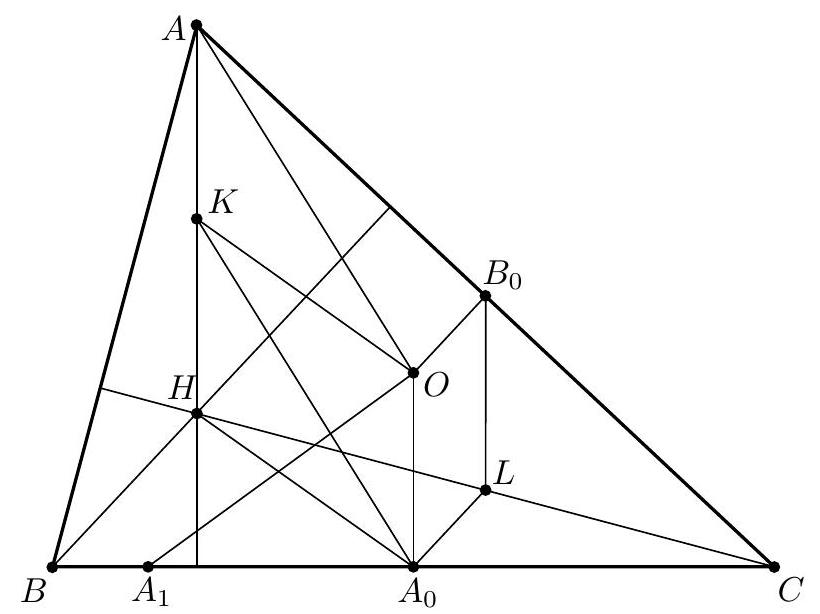", "metadata": {"resource_path": "IMO_SL/segmented/en-IMO2008SL.jsonl"}} |
| {"year": "2008", "tier": "T0", "problem_label": "G1", "problem_type": "Geometry", "exam": "IMO-SL", "problem": "In an acute-angled triangle $A B C$, point $H$ is the orthocentre and $A_{0}, B_{0}, C_{0}$ are the midpoints of the sides $B C, C A, A B$, respectively. Consider three circles passing through $H$ : $\\omega_{a}$ around $A_{0}, \\omega_{b}$ around $B_{0}$ and $\\omega_{c}$ around $C_{0}$. The circle $\\omega_{a}$ intersects the line $B C$ at $A_{1}$ and $A_{2} ; \\omega_{b}$ intersects $C A$ at $B_{1}$ and $B_{2} ; \\omega_{c}$ intersects $A B$ at $C_{1}$ and $C_{2}$. Show that the points $A_{1}, A_{2}, B_{1}, B_{2}, C_{1}, C_{2}$ lie on a circle.", "solution": "We are going to show again that the circumcentre $O$ is equidistant from the six points in question. Let $A^{\\prime}$ be the second intersection point of $\\omega_{b}$ and $\\omega_{c}$. The line $B_{0} C_{0}$, which is the line of centers of circles $\\omega_{b}$ and $\\omega_{c}$, is a midline in triangle $A B C$, parallel to $B C$ and perpendicular to the altitude $A H$. The points $A^{\\prime}$ and $H$ are symmetric with respect to the line of centers. Therefore $A^{\\prime}$ lies on the line $A H$. From the two circles $\\omega_{b}$ and $\\omega_{c}$ we obtain $A C_{1} \\cdot A C_{2}=A A^{\\prime} \\cdot A H=A B_{1} \\cdot A B_{2}$. So the quadrilateral $B_{1} B_{2} C_{1} C_{2}$ is cyclic. The perpendicular bisectors of the sides $B_{1} B_{2}$ and $C_{1} C_{2}$ meet at $O$. Hence $O$ is the circumcentre of $B_{1} B_{2} C_{1} C_{2}$ and so $O B_{1}=O B_{2}=O C_{1}=O C_{2}$. Analogous arguments yield $O A_{1}=O A_{2}=O B_{1}=O B_{2}$ and $O A_{1}=O A_{2}=O C_{1}=O C_{2}$. Thus $A_{1}, A_{2}, B_{1}, B_{2}, C_{1}, C_{2}$ lie on a circle centred at $O$.  Comment. The problem can be solved without much difficulty in many ways by calculation, using trigonometry, coordinate geometry or complex numbers. As an example we present a short proof using vectors.", "metadata": {"resource_path": "IMO_SL/segmented/en-IMO2008SL.jsonl"}} |
| {"year": "2008", "tier": "T0", "problem_label": "G1", "problem_type": "Geometry", "exam": "IMO-SL", "problem": "In an acute-angled triangle $A B C$, point $H$ is the orthocentre and $A_{0}, B_{0}, C_{0}$ are the midpoints of the sides $B C, C A, A B$, respectively. Consider three circles passing through $H$ : $\\omega_{a}$ around $A_{0}, \\omega_{b}$ around $B_{0}$ and $\\omega_{c}$ around $C_{0}$. The circle $\\omega_{a}$ intersects the line $B C$ at $A_{1}$ and $A_{2} ; \\omega_{b}$ intersects $C A$ at $B_{1}$ and $B_{2} ; \\omega_{c}$ intersects $A B$ at $C_{1}$ and $C_{2}$. Show that the points $A_{1}, A_{2}, B_{1}, B_{2}, C_{1}, C_{2}$ lie on a circle.", "solution": "Let again $O$ and $R$ be the circumcentre and circumradius. Consider the vectors $$ \\overrightarrow{O A}=\\mathbf{a}, \\quad \\overrightarrow{O B}=\\mathbf{b}, \\quad \\overrightarrow{O C}=\\mathbf{c}, \\quad \\text { where } \\quad \\mathbf{a}^{2}=\\mathbf{b}^{2}=\\mathbf{c}^{2}=R^{2} $$ It is well known that $\\overrightarrow{O H}=\\mathbf{a}+\\mathbf{b}+\\mathbf{c}$. Accordingly, $$ \\overrightarrow{A_{0} H}=\\overrightarrow{O H}-\\overrightarrow{O A_{0}}=(\\mathbf{a}+\\mathbf{b}+\\mathbf{c})-\\frac{\\mathbf{b}+\\mathbf{c}}{2}=\\frac{2 \\mathbf{a}+\\mathbf{b}+\\mathbf{c}}{2} $$ and $$ \\begin{gathered} O A_{1}^{2}=O A_{0}^{2}+A_{0} A_{1}^{2}=O A_{0}^{2}+A_{0} H^{2}=\\left(\\frac{\\mathbf{b}+\\mathbf{c}}{2}\\right)^{2}+\\left(\\frac{2 \\mathbf{a}+\\mathbf{b}+\\mathbf{c}}{2}\\right)^{2} \\\\ =\\frac{1}{4}\\left(\\mathbf{b}^{2}+2 \\mathbf{b} \\mathbf{c}+\\mathbf{c}^{2}\\right)+\\frac{1}{4}\\left(4 \\mathbf{a}^{2}+4 \\mathbf{a} \\mathbf{b}+4 \\mathbf{a} \\mathbf{c}+\\mathbf{b}^{2}+2 \\mathbf{b} \\mathbf{c}+\\mathbf{c}^{2}\\right)=2 R^{2}+(\\mathbf{a b}+\\mathbf{a c}+\\mathbf{b c}) \\end{gathered} $$ here $\\mathbf{a b}$, bc, etc. denote dot products of vectors. We get the same for the distances $O A_{2}, O B_{1}$, $O B_{2}, O C_{1}$ and $O C_{2}$.", "metadata": {"resource_path": "IMO_SL/segmented/en-IMO2008SL.jsonl"}} |
| {"year": "2008", "tier": "T0", "problem_label": "G2", "problem_type": "Geometry", "exam": "IMO-SL", "problem": "Given trapezoid $A B C D$ with parallel sides $A B$ and $C D$, assume that there exist points $E$ on line $B C$ outside segment $B C$, and $F$ inside segment $A D$, such that $\\angle D A E=\\angle C B F$. Denote by $I$ the point of intersection of $C D$ and $E F$, and by $J$ the point of intersection of $A B$ and $E F$. Let $K$ be the midpoint of segment $E F$; assume it does not lie on line $A B$. Prove that $I$ belongs to the circumcircle of $A B K$ if and only if $K$ belongs to the circumcircle of $C D J$.", "solution": "Assume that the disposition of points is as in the diagram. Since $\\angle E B F=180^{\\circ}-\\angle C B F=180^{\\circ}-\\angle E A F$ by hypothesis, the quadrilateral $A E B F$ is cyclic. Hence $A J \\cdot J B=F J \\cdot J E$. In view of this equality, $I$ belongs to the circumcircle of $A B K$ if and only if $I J \\cdot J K=F J \\cdot J E$. Expressing $I J=I F+F J, J E=F E-F J$, and $J K=\\frac{1}{2} F E-F J$, we find that $I$ belongs to the circumcircle of $A B K$ if and only if $$ F J=\\frac{I F \\cdot F E}{2 I F+F E} . $$ Since $A E B F$ is cyclic and $A B, C D$ are parallel, $\\angle F E C=\\angle F A B=180^{\\circ}-\\angle C D F$. Then $C D F E$ is also cyclic, yielding $I D \\cdot I C=I F \\cdot I E$. It follows that $K$ belongs to the circumcircle of $C D J$ if and only if $I J \\cdot I K=I F \\cdot I E$. Expressing $I J=I F+F J, I K=I F+\\frac{1}{2} F E$, and $I E=I F+F E$, we find that $K$ is on the circumcircle of $C D J$ if and only if $$ F J=\\frac{I F \\cdot F E}{2 I F+F E} $$ The conclusion follows. 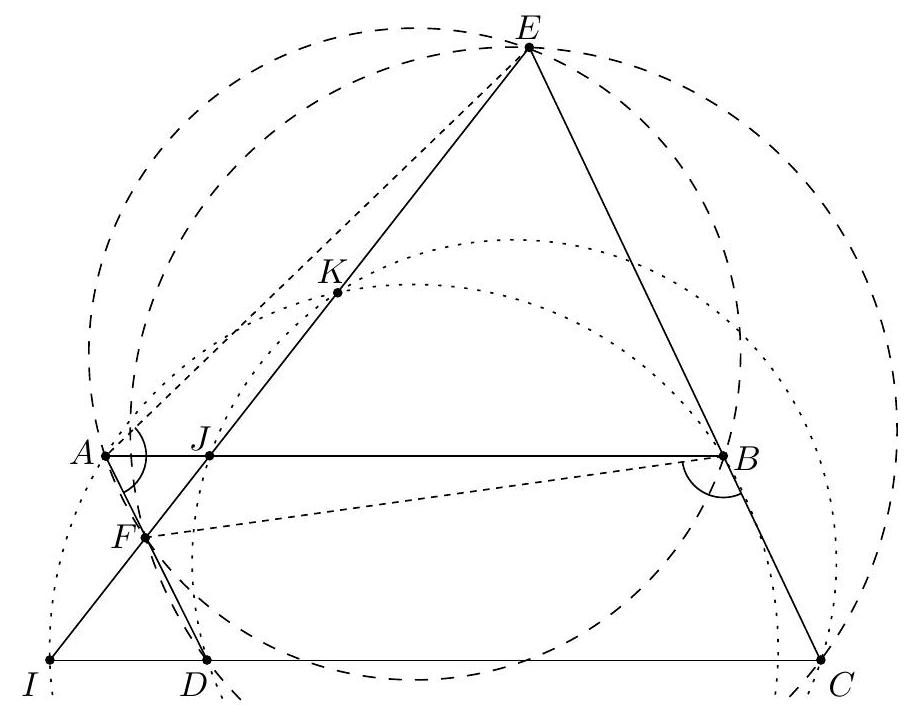 Comment. While the figure shows $B$ inside segment $C E$, it is possible that $C$ is inside segment $B E$. Consequently, $I$ would be inside segment $E F$ and $J$ outside segment $E F$. The position of point $K$ on line $E F$ with respect to points $I, J$ may also vary. Some case may require that an angle $\\varphi$ be replaced by $180^{\\circ}-\\varphi$, and in computing distances, a sum may need to become a difference. All these cases can be covered by the proposed solution if it is clearly stated that signed distances and angles are used.", "metadata": {"resource_path": "IMO_SL/segmented/en-IMO2008SL.jsonl"}} |
| {"year": "2008", "tier": "T0", "problem_label": "G3", "problem_type": "Geometry", "exam": "IMO-SL", "problem": "Let $A B C D$ be a convex quadrilateral and let $P$ and $Q$ be points in $A B C D$ such that $P Q D A$ and $Q P B C$ are cyclic quadrilaterals. Suppose that there exists a point $E$ on the line segment $P Q$ such that $\\angle P A E=\\angle Q D E$ and $\\angle P B E=\\angle Q C E$. Show that the quadrilateral $A B C D$ is cyclic.", "solution": "Let $F$ be the point on the line $A D$ such that $E F \\| P A$. By hypothesis, the quadrilateral $P Q D A$ is cyclic. So if $F$ lies between $A$ and $D$ then $\\angle E F D=\\angle P A D=180^{\\circ}-\\angle E Q D$; the points $F$ and $Q$ are on distinct sides of the line $D E$ and we infer that $E F D Q$ is a cyclic quadrilateral. And if $D$ lies between $A$ and $F$ then a similar argument shows that $\\angle E F D=\\angle E Q D$; but now the points $F$ and $Q$ lie on the same side of $D E$, so that $E D F Q$ is a cyclic quadrilateral. In either case we obtain the equality $\\angle E F Q=\\angle E D Q=\\angle P A E$ which implies that $F Q \\| A E$. So the triangles $E F Q$ and $P A E$ are either homothetic or parallel-congruent. More specifically, triangle $E F Q$ is the image of $P A E$ under the mapping $f$ which carries the points $P, E$ respectively to $E, Q$ and is either a homothety or translation by a vector. Note that $f$ is uniquely determined by these conditions and the position of the points $P, E, Q$ alone. Let now $G$ be the point on the line $B C$ such that $E G \\| P B$. The same reasoning as above applies to points $B, C$ in place of $A, D$, implying that the triangle $E G Q$ is the image of $P B E$ under the same mapping $f$. So $f$ sends the four points $A, P, B, E$ respectively to $F, E, G, Q$. If $P E \\neq Q E$, so that $f$ is a homothety with a centre $X$, then the lines $A F, P E, B G$-i.e. the lines $A D, P Q, B C$ - are concurrent at $X$. And since $P Q D A$ and $Q P B C$ are cyclic quadrilaterals, the equalities $X A \\cdot X D=X P \\cdot X Q=X B \\cdot X C$ hold, showing that the quadrilateral $A B C D$ is cyclic. Finally, if $P E=Q E$, so that $f$ is a translation, then $A D\\|P Q\\| B C$. Thus $P Q D A$ and $Q P B C$ are isosceles trapezoids. Then also $A B C D$ is an isosceles trapezoid, hence a cyclic quadrilateral. 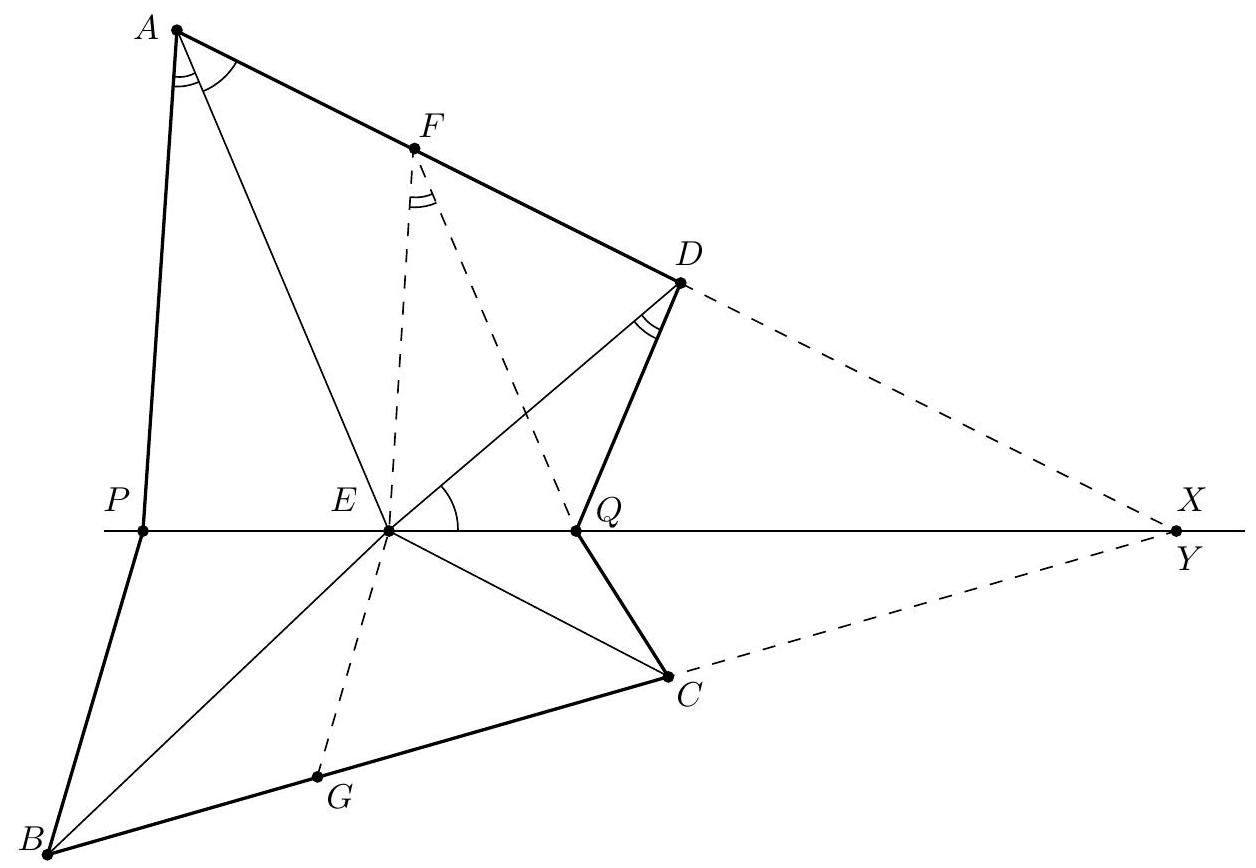", "metadata": {"resource_path": "IMO_SL/segmented/en-IMO2008SL.jsonl"}} |
| {"year": "2008", "tier": "T0", "problem_label": "G3", "problem_type": "Geometry", "exam": "IMO-SL", "problem": "Let $A B C D$ be a convex quadrilateral and let $P$ and $Q$ be points in $A B C D$ such that $P Q D A$ and $Q P B C$ are cyclic quadrilaterals. Suppose that there exists a point $E$ on the line segment $P Q$ such that $\\angle P A E=\\angle Q D E$ and $\\angle P B E=\\angle Q C E$. Show that the quadrilateral $A B C D$ is cyclic.", "solution": "Here is another way to reach the conclusion that the lines $A D, B C$ and $P Q$ are either concurrent or parallel. From the cyclic quadrilateral $P Q D A$ we get $$ \\angle P A D=180^{\\circ}-\\angle P Q D=\\angle Q D E+\\angle Q E D=\\angle P A E+\\angle Q E D . $$ Hence $\\angle Q E D=\\angle P A D-\\angle P A E=\\angle E A D$. This in view of the tangent-chord theorem means that the circumcircle of triangle $E A D$ is tangent to the line $P Q$ at $E$. Analogously, the circumcircle of triangle $E B C$ is tangent to $P Q$ at $E$. Suppose that the line $A D$ intersects $P Q$ at $X$. Since $X E$ is tangent to the circle $(E A D)$, $X E^{2}=X A \\cdot X D$. Also, $X A \\cdot X D=X P \\cdot X Q$ because $P, Q, D, A$ lie on a circle. Therefore $X E^{2}=X P \\cdot X Q$. It is not hard to see that this equation determines the position of the point $X$ on the line $P Q$ uniquely. Thus, if $B C$ also cuts $P Q$, say at $Y$, then the analogous equation for $Y$ yields $X=Y$, meaning that the three lines indeed concur. In this case, as well as in the case where $A D\\|P Q\\| B C$, the concluding argument is the same as in the first solution. It remains to eliminate the possibility that e.g. $A D$ meets $P Q$ at $X$ while $B C \\| P Q$. Indeed, $Q P B C$ would then be an isosceles trapezoid and the angle equality $\\angle P B E=\\angle Q C E$ would force that $E$ is the midpoint of $P Q$. So the length of $X E$, which is the geometric mean of the lengths of $X P$ and $X Q$, should also be their arithmetic mean-impossible, as $X P \\neq X Q$. The proof is now complete. Comment. After reaching the conclusion that the circles $(E D A)$ and $(E B C)$ are tangent to $P Q$ one may continue as follows. Denote the circles $(P Q D A),(E D A),(E B C),(Q P B C)$ by $\\omega_{1}, \\omega_{2}, \\omega_{3}, \\omega_{4}$ respectively. Let $\\ell_{i j}$ be the radical axis of the pair $\\left(\\omega_{i}, \\omega_{j}\\right)$ for $i<j$. As is well-known, the lines $\\ell_{12}, \\ell_{13}, \\ell_{23}$ concur, possibly at infinity (let this be the meaning of the word concur in this comment). So do the lines $\\ell_{12}, \\ell_{14}, \\ell_{24}$. Note however that $\\ell_{23}$ and $\\ell_{14}$ both coincide with the line $P Q$. Hence the pair $\\ell_{12}, P Q$ is in both triples; thus the four lines $\\ell_{12}, \\ell_{13}, \\ell_{24}$ and $P Q$ are concurrent. Similarly, $\\ell_{13}, \\ell_{14}, \\ell_{34}$ concur, $\\ell_{23}, \\ell_{24}, \\ell_{34}$ concur, and since $\\ell_{14}=\\ell_{23}=P Q$, the four lines $\\ell_{13}, \\ell_{24}, \\ell_{34}$ and $P Q$ are concurrent. The lines $\\ell_{13}$ and $\\ell_{24}$ are present in both quadruples, therefore all the lines $\\ell_{i j}$ are concurrent. Hence the result.", "metadata": {"resource_path": "IMO_SL/segmented/en-IMO2008SL.jsonl"}} |
| {"year": "2008", "tier": "T0", "problem_label": "G4", "problem_type": "Geometry", "exam": "IMO-SL", "problem": "In an acute triangle $A B C$ segments $B E$ and $C F$ are altitudes. Two circles passing through the points $A$ and $F$ are tangent to the line $B C$ at the points $P$ and $Q$ so that $B$ lies between $C$ and $Q$. Prove that the lines $P E$ and $Q F$ intersect on the circumcircle of triangle $A E F$.", "solution": "To approach the desired result we need some information about the slopes of the lines $P E$ and $Q F$; this information is provided by formulas (1) and (2) which we derive below. The tangents $B P$ and $B Q$ to the two circles passing through $A$ and $F$ are equal, as $B P^{2}=B A \\cdot B F=B Q^{2}$. Consider the altitude $A D$ of triangle $A B C$ and its orthocentre $H$. From the cyclic quadrilaterals $C D F A$ and $C D H E$ we get $B A \\cdot B F=B C \\cdot B D=B E \\cdot B H$. Thus $B P^{2}=B E \\cdot B H$, or $B P / B H=B E / B P$, implying that the triangles $B P H$ and $B E P$ are similar. Hence $$ \\angle B P E=\\angle B H P \\text {. } $$ The point $P$ lies between $D$ and $C$; this follows from the equality $B P^{2}=B C \\cdot B D$. In view of this equality, and because $B P=B Q$, $$ D P \\cdot D Q=(B P-B D) \\cdot(B P+B D)=B P^{2}-B D^{2}=B D \\cdot(B C-B D)=B D \\cdot D C . $$ Also $A D \\cdot D H=B D \\cdot D C$, as is seen from the similar triangles $B D H$ and $A D C$. Combining these equalities we obtain $A D \\cdot D H=D P \\cdot D Q$. Therefore $D H / D P=D Q / D A$, showing that the triangles $H D P$ and $Q D A$ are similar. Hence $\\angle H P D=\\angle Q A D$, which can be rewritten as $\\angle B P H=\\angle B A D+\\angle B A Q$. And since $B Q$ is tangent to the circumcircle of triangle $F A Q$, $$ \\angle B Q F=\\angle B A Q=\\angle B P H-\\angle B A D . $$ From (1) and (2) we deduce $$ \\begin{aligned} & \\angle B P E+\\angle B Q F=(\\angle B H P+\\angle B P H)-\\angle B A D=\\left(180^{\\circ}-\\angle P B H\\right)-\\angle B A D \\\\ & =\\left(90^{\\circ}+\\angle B C A\\right)-\\left(90^{\\circ}-\\angle A B C\\right)=\\angle B C A+\\angle A B C=180^{\\circ}-\\angle C A B . \\end{aligned} $$ Thus $\\angle B P E+\\angle B Q F<180^{\\circ}$, which means that the rays $P E$ and $Q F$ meet. Let $S$ be the point of intersection. Then $\\angle P S Q=180^{\\circ}-(\\angle B P E+\\angle B Q F)=\\angle C A B=\\angle E A F$. If $S$ lies between $P$ and $E$ then $\\angle P S Q=180^{\\circ}-\\angle E S F$; and if $E$ lies between $P$ and $S$ then $\\angle P S Q=\\angle E S F$. In either case the equality $\\angle P S Q=\\angle E A F$ which we have obtained means that $S$ lies on the circumcircle of triangle $A E F$. 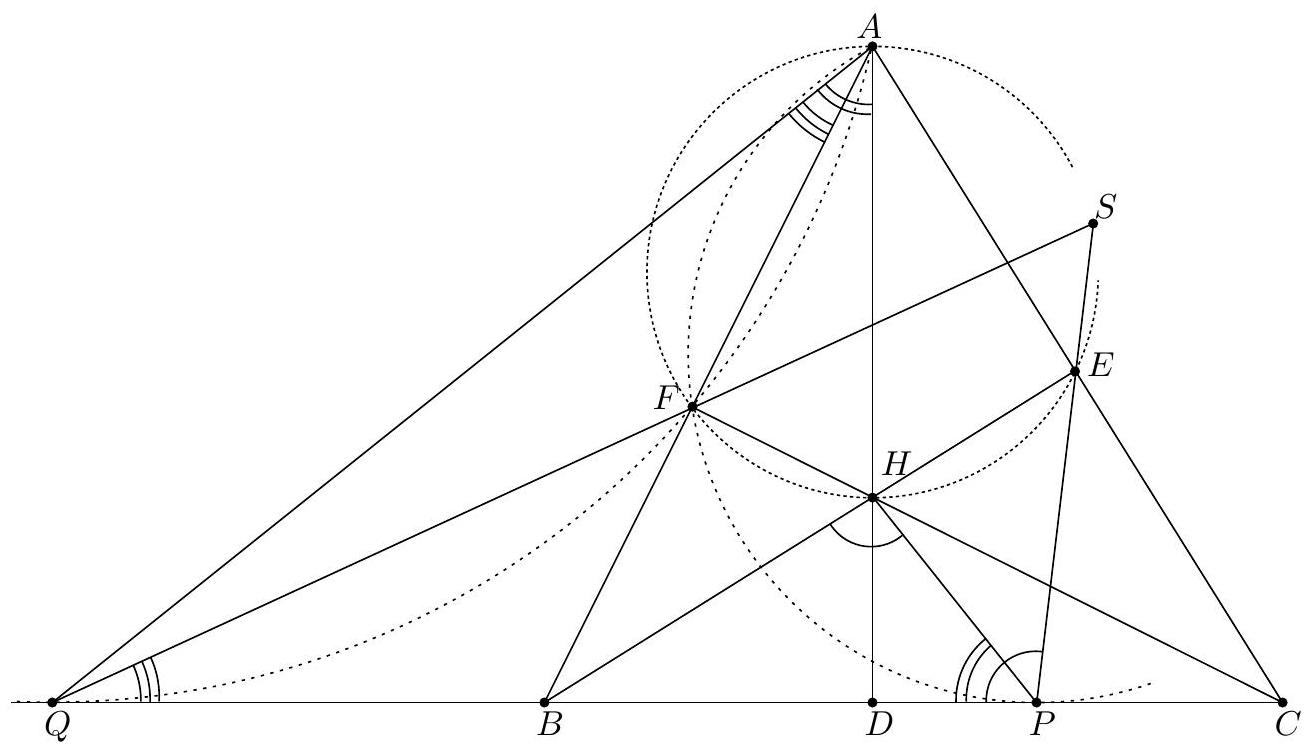", "metadata": {"resource_path": "IMO_SL/segmented/en-IMO2008SL.jsonl"}} |
| {"year": "2008", "tier": "T0", "problem_label": "G4", "problem_type": "Geometry", "exam": "IMO-SL", "problem": "In an acute triangle $A B C$ segments $B E$ and $C F$ are altitudes. Two circles passing through the points $A$ and $F$ are tangent to the line $B C$ at the points $P$ and $Q$ so that $B$ lies between $C$ and $Q$. Prove that the lines $P E$ and $Q F$ intersect on the circumcircle of triangle $A E F$.", "solution": "Let $H$ be the orthocentre of triangle $A B C$ and let $\\omega$ be the circle with diameter $A H$, passing through $E$ and $F$. Introduce the points of intersection of $\\omega$ with the following lines emanating from $P: P A \\cap \\omega=\\{A, U\\}, P H \\cap \\omega=\\{H, V\\}, P E \\cap \\omega=\\{E, S\\}$. The altitudes of triangle $A H P$ are contained in the lines $A V, H U, B C$, meeting at its orthocentre $Q^{\\prime}$. By Pascal's theorem applied to the (tied) hexagon $A E S F H V$, the points $A E \\cap F H=C$, $E S \\cap H V=P$ and $S F \\cap V A$ are collinear, so $F S$ passes through $Q^{\\prime}$. Denote by $\\omega_{1}$ and $\\omega_{2}$ the circles with diameters $B C$ and $P Q^{\\prime}$, respectively. Let $D$ be the foot of the altitude from $A$ in triangle $A B C$. Suppose that $A D$ meets the circles $\\omega_{1}$ and $\\omega_{2}$ at the respective points $K$ and $L$. Since $H$ is the orthocentre of $A B C$, the triangles $B D H$ and $A D C$ are similar, and so $D A \\cdot D H=D B \\cdot D C=D K^{2}$; the last equality holds because $B K C$ is a right triangle. Since $H$ is the orthocentre also in triangle $A Q^{\\prime} P$, we analogously have $D L^{2}=D A \\cdot D H$. Therefore $D K=D L$ and $K=L$. Also, $B D \\cdot B C=B A \\cdot B F$, from the similar triangles $A B D, C B F$. In the right triangle $B K C$ we have $B K^{2}=B D \\cdot B C$. Hence, and because $B A \\cdot B F=B P^{2}=B Q^{2}$ (by the definition of $P$ and $Q$ in the problem statement), we obtain $B K=B P=B Q$. It follows that $B$ is the centre of $\\omega_{2}$ and hence $Q^{\\prime}=Q$. So the lines $P E$ and $Q F$ meet at the point $S$ lying on the circumcircle of triangle $A E F$. 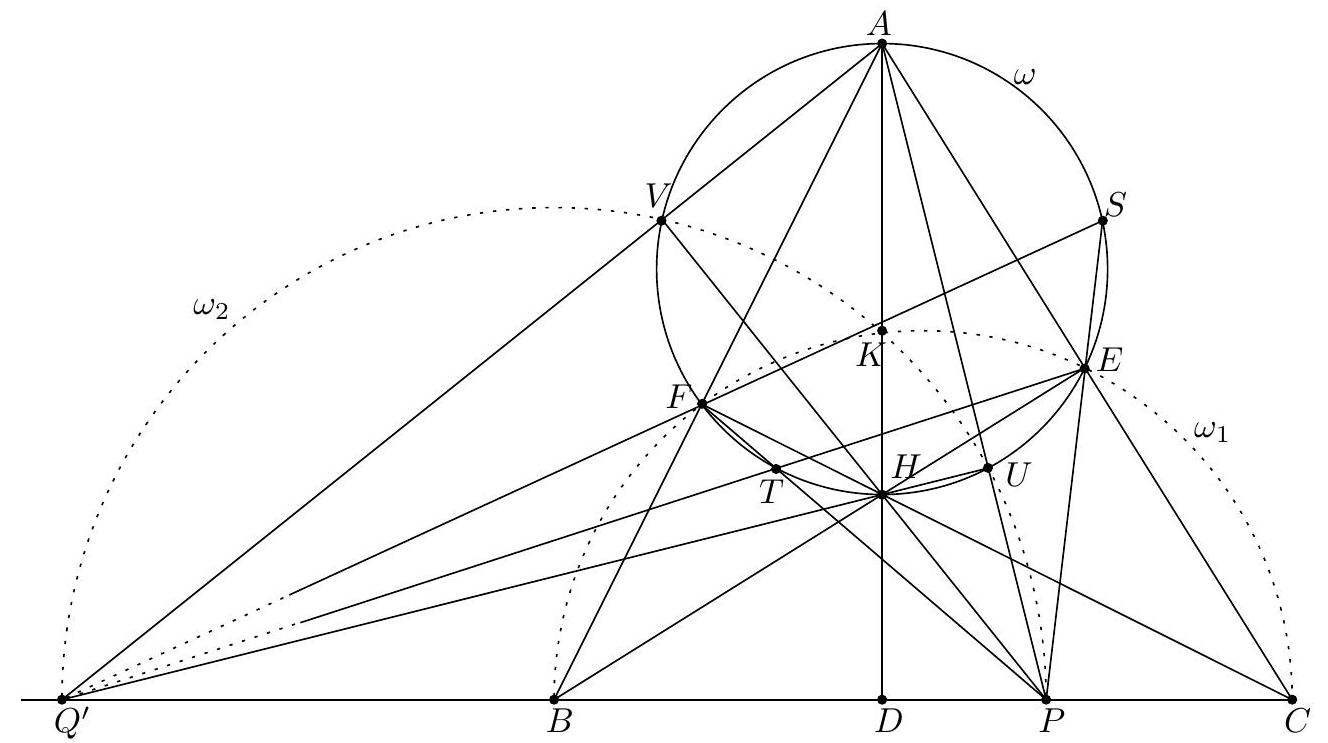 Comment 1. If $T$ is the point defined by $P F \\cap \\omega=\\{F, T\\}$, Pascal's theorem for the hexagon $A F T E H V$ will analogously lead to the conclusion that the line $E T$ goes through $Q^{\\prime}$. In other words, the lines $P F$ and $Q E$ also concur on $\\omega$. Comment 2. As is known from algebraic geometry, the points of the circle $\\omega$ form a commutative groups with the operation defined as follows. Choose any point $0 \\in \\omega$ (to be the neutral element of the group) and a line $\\ell$ exterior to the circle. For $X, Y \\in \\omega$, draw the line from the point $X Y \\cap \\ell$ through 0 to its second intersection with $\\omega$ and define this point to be $X+Y$. In our solution we have chosen $H$ to be the neutral element in this group and line $B C$ to be $\\ell$. The fact that the lines $A V, H U, E T, F S$ are concurrent can be deduced from the identities $A+A=0$, $F=E+A, V=U+A=S+E=T+F$. Comment 3. The problem was submitted in the following equivalent formulation: Let $B E$ and $C F$ be altitudes of an acute triangle $A B C$. We choose $P$ on the side $B C$ and $Q$ on the extension of $C B$ beyond $B$ such that $B Q^{2}=B P^{2}=B F \\cdot A B$. If $Q F$ and $P E$ intersect at $S$, prove that $E S A F$ is cyclic.", "metadata": {"resource_path": "IMO_SL/segmented/en-IMO2008SL.jsonl"}} |
| {"year": "2008", "tier": "T0", "problem_label": "G5", "problem_type": "Geometry", "exam": "IMO-SL", "problem": "Let $k$ and $n$ be integers with $0 \\leq k \\leq n-2$. Consider a set $L$ of $n$ lines in the plane such that no two of them are parallel and no three have a common point. Denote by $I$ the set of intersection points of lines in $L$. Let $O$ be a point in the plane not lying on any line of $L$. A point $X \\in I$ is colored red if the open line segment $O X$ intersects at most $k$ lines in $L$. Prove that $I$ contains at least $\\frac{1}{2}(k+1)(k+2)$ red points.", "solution": "There are at least $\\frac{1}{2}(k+1)(k+2)$ points in the intersection set $I$ in view of the condition $n \\geq k+2$. For each point $P \\in I$, define its order as the number of lines that intersect the open line segment $O P$. By definition, $P$ is red if its order is at most $k$. Note that there is always at least one point $X \\in I$ of order 0 . Indeed, the lines in $L$ divide the plane into regions, bounded or not, and $O$ belongs to one of them. Clearly any corner of this region is a point of $I$ with order 0 . Claim. Suppose that two points $P, Q \\in I$ lie on the same line of $L$, and no other line of $L$ intersects the open line segment $P Q$. Then the orders of $P$ and $Q$ differ by at most 1 . Proof. Let $P$ and $Q$ have orders $p$ and $q$, respectively, with $p \\geq q$. Consider triangle $O P Q$. Now $p$ equals the number of lines in $L$ that intersect the interior of side $O P$. None of these lines intersects the interior of side $P Q$, and at most one can pass through $Q$. All remaining lines must intersect the interior of side $O Q$, implying that $q \\geq p-1$. The conclusion follows. We prove the main result by induction on $k$. The base $k=0$ is clear since there is a point of order 0 which is red. Assuming the statement true for $k-1$, we pass on to the inductive step. Select a point $P \\in I$ of order 0 , and consider one of the lines $\\ell \\in L$ that pass through $P$. There are $n-1$ intersection points on $\\ell$, one of which is $P$. Out of the remaining $n-2$ points, the $k$ closest to $P$ have orders not exceeding $k$ by the Claim. It follows that there are at least $k+1$ red points on $\\ell$. Let us now consider the situation with $\\ell$ removed (together with all intersection points it contains). By hypothesis of induction, there are at least $\\frac{1}{2} k(k+1)$ points of order not exceeding $k-1$ in the resulting configuration. Restoring $\\ell$ back produces at most one new intersection point on each line segment joining any of these points to $O$, so their order is at most $k$ in the original configuration. The total number of points with order not exceeding $k$ is therefore at least $(k+1)+\\frac{1}{2} k(k+1)=\\frac{1}{2}(k+1)(k+2)$. This completes the proof. Comment. The steps of the proof can be performed in reverse order to obtain a configuration of $n$ lines such that equality holds simultaneously for all $0 \\leq k \\leq n-2$. Such a set of lines is illustrated in the Figure. ", "metadata": {"resource_path": "IMO_SL/segmented/en-IMO2008SL.jsonl"}} |
| {"year": "2008", "tier": "T0", "problem_label": "G6", "problem_type": "Geometry", "exam": "IMO-SL", "problem": "There is given a convex quadrilateral $A B C D$. Prove that there exists a point $P$ inside the quadrilateral such that $$ \\angle P A B+\\angle P D C=\\angle P B C+\\angle P A D=\\angle P C D+\\angle P B A=\\angle P D A+\\angle P C B=90^{\\circ} $$ if and only if the diagonals $A C$ and $B D$ are perpendicular.", "solution": "For a point $P$ in $A B C D$ which satisfies (1), let $K, L, M, N$ be the feet of perpendiculars from $P$ to lines $A B, B C, C D, D A$, respectively. Note that $K, L, M, N$ are interior to the sides as all angles in (1) are acute. The cyclic quadrilaterals $A K P N$ and $D N P M$ give $$ \\angle P A B+\\angle P D C=\\angle P N K+\\angle P N M=\\angle K N M . $$ Analogously, $\\angle P B C+\\angle P A D=\\angle L K N$ and $\\angle P C D+\\angle P B A=\\angle M L K$. Hence the equalities (1) imply $\\angle K N M=\\angle L K N=\\angle M L K=90^{\\circ}$, so that $K L M N$ is a rectangle. The converse also holds true, provided that $K, L, M, N$ are interior to sides $A B, B C, C D, D A$. (i) Suppose that there exists a point $P$ in $A B C D$ such that $K L M N$ is a rectangle. We show that $A C$ and $B D$ are parallel to the respective sides of $K L M N$. Let $O_{A}$ and $O_{C}$ be the circumcentres of the cyclic quadrilaterals $A K P N$ and $C M P L$. Line $O_{A} O_{C}$ is the common perpendicular bisector of $L M$ and $K N$, therefore $O_{A} O_{C}$ is parallel to $K L$ and $M N$. On the other hand, $O_{A} O_{C}$ is the midline in the triangle $A C P$ that is parallel to $A C$. Therefore the diagonal $A C$ is parallel to the sides $K L$ and $M N$ of the rectangle. Likewise, $B D$ is parallel to $K N$ and $L M$. Hence $A C$ and $B D$ are perpendicular.  (ii) Suppose that $A C$ and $B D$ are perpendicular and meet at $R$. If $A B C D$ is a rhombus, $P$ can be chosen to be its centre. So assume that $A B C D$ is not a rhombus, and let $B R<D R$ without loss of generality. Denote by $U_{A}$ and $U_{C}$ the circumcentres of the triangles $A B D$ and $C D B$, respectively. Let $A V_{A}$ and $C V_{C}$ be the diameters through $A$ and $C$ of the two circumcircles. Since $A R$ is an altitude in triangle $A D B$, lines $A C$ and $A V_{A}$ are isogonal conjugates, i. e. $\\angle D A V_{A}=\\angle B A C$. Now $B R<D R$ implies that ray $A U_{A}$ lies in $\\angle D A C$. Similarly, ray $C U_{C}$ lies in $\\angle D C A$. Both diameters $A V_{A}$ and $C V_{C}$ intersect $B D$ as the angles at $B$ and $D$ of both triangles are acute. Also $U_{A} U_{C}$ is parallel to $A C$ as it is the perpendicular bisector of $B D$. Hence $V_{A} V_{C}$ is parallel to $A C$, too. We infer that $A V_{A}$ and $C V_{C}$ intersect at a point $P$ inside triangle $A C D$, hence inside $A B C D$. Construct points $K, L, M, N, O_{A}$ and $O_{C}$ in the same way as in the introduction. It follows from the previous paragraph that $K, L, M, N$ are interior to the respective sides. Now $O_{A} O_{C}$ is a midline in triangle $A C P$ again. Therefore lines $A C, O_{A} O_{C}$ and $U_{A} U_{C}$ are parallel. The cyclic quadrilateral $A K P N$ yields $\\angle N K P=\\angle N A P$. Since $\\angle N A P=\\angle D A U_{A}=$ $\\angle B A C$, as specified above, we obtain $\\angle N K P=\\angle B A C$. Because $P K$ is perpendicular to $A B$, it follows that $N K$ is perpendicular to $A C$, hence parallel to $B D$. Likewise, $L M$ is parallel to $B D$. Consider the two homotheties with centres $A$ and $C$ which transform triangles $A B D$ and $C D B$ into triangles $A K N$ and $C M L$, respectively. The images of points $U_{A}$ and $U_{C}$ are $O_{A}$ and $O_{C}$, respectively. Since $U_{A} U_{C}$ and $O_{A} O_{C}$ are parallel to $A C$, the two ratios of homothety are the same, equal to $\\lambda=A N / A D=A K / A B=A O_{A} / A U_{A}=C O_{C} / C U_{C}=C M / C D=C L / C B$. It is now straightforward that $D N / D A=D M / D C=B K / B A=B L / B C=1-\\lambda$. Hence $K L$ and $M N$ are parallel to $A C$, implying that $K L M N$ is a rectangle and completing the proof. 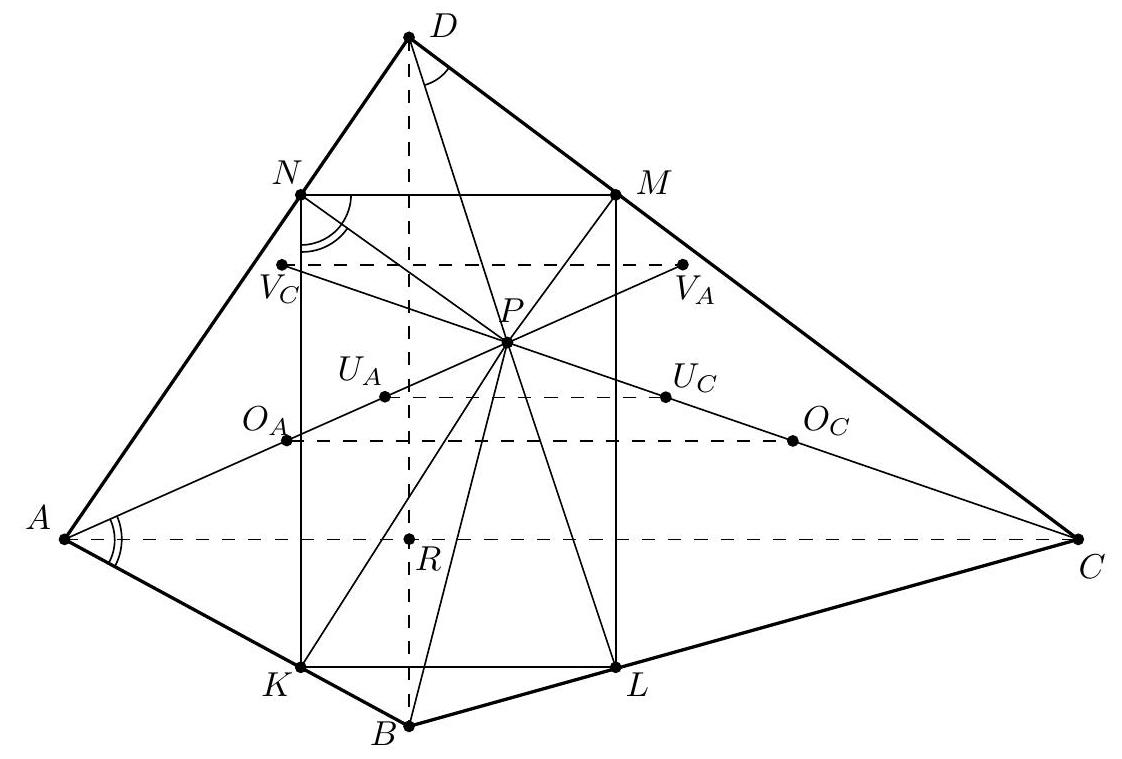", "metadata": {"resource_path": "IMO_SL/segmented/en-IMO2008SL.jsonl"}} |
| {"year": "2008", "tier": "T0", "problem_label": "G6", "problem_type": "Geometry", "exam": "IMO-SL", "problem": "There is given a convex quadrilateral $A B C D$. Prove that there exists a point $P$ inside the quadrilateral such that $$ \\angle P A B+\\angle P D C=\\angle P B C+\\angle P A D=\\angle P C D+\\angle P B A=\\angle P D A+\\angle P C B=90^{\\circ} $$ if and only if the diagonals $A C$ and $B D$ are perpendicular.", "solution": "For a point $P$ distinct from $A, B, C, D$, let circles $(A P D)$ and $(B P C)$ intersect again at $Q(Q=P$ if the circles are tangent). Next, let circles $(A Q B)$ and $(C Q D)$ intersect again at $R$. We show that if $P$ lies in $A B C D$ and satisfies (1) then $A C$ and $B D$ intersect at $R$ and are perpendicular; the converse is also true. It is convenient to use directed angles. Let $\\measuredangle(U V, X Y)$ denote the angle of counterclockwise rotation that makes line $U V$ parallel to line $X Y$. Recall that four noncollinear points $U, V, X, Y$ are concyclic if and only if $\\measuredangle(U X, V X)=\\measuredangle(U Y, V Y)$. The definitions of points $P, Q$ and $R$ imply $$ \\begin{aligned} \\measuredangle(A R, B R) & =\\measuredangle(A Q, B Q)=\\measuredangle(A Q, P Q)+\\measuredangle(P Q, B Q)=\\measuredangle(A D, P D)+\\measuredangle(P C, B C), \\\\ \\measuredangle(C R, D R) & =\\measuredangle(C Q, D Q)=\\measuredangle(C Q, P Q)+\\measuredangle(P Q, D Q)=\\measuredangle(C B, P B)+\\measuredangle(P A, D A), \\\\ \\measuredangle(B R, C R) & =\\measuredangle(B R, R Q)+\\measuredangle(R Q, C R)=\\measuredangle(B A, A Q)+\\measuredangle(D Q, C D) \\\\ & =\\measuredangle(B A, A P)+\\measuredangle(A P, A Q)+\\measuredangle(D Q, D P)+\\measuredangle(D P, C D) \\\\ & =\\measuredangle(B A, A P)+\\measuredangle(D P, C D) . \\end{aligned} $$ Observe that the whole construction is reversible. One may start with point $R$, define $Q$ as the second intersection of circles $(A R B)$ and $(C R D)$, and then define $P$ as the second intersection of circles $(A Q D)$ and $(B Q C)$. The equalities above will still hold true. Assume in addition that $P$ is interior to $A B C D$. Then $$ \\begin{gathered} \\measuredangle(A D, P D)=\\angle P D A, \\measuredangle(P C, B C)=\\angle P C B, \\measuredangle(C B, P B)=\\angle P B C, \\measuredangle(P A, D A)=\\angle P A D, \\\\ \\measuredangle(B A, A P)=\\angle P A B, \\measuredangle(D P, C D)=\\angle P D C . \\end{gathered} $$ (i) Suppose that $P$ lies in $A B C D$ and satisfies (1). Then $\\measuredangle(A R, B R)=\\angle P D A+\\angle P C B=90^{\\circ}$ and similarly $\\measuredangle(B R, C R)=\\measuredangle(C R, D R)=90^{\\circ}$. It follows that $R$ is the common point of lines $A C$ and $B D$, and that these lines are perpendicular. (ii) Suppose that $A C$ and $B D$ are perpendicular and intersect at $R$. We show that the point $P$ defined by the reverse construction (starting with $R$ and ending with $P$ ) lies in $A B C D$. This is enough to finish the solution, because then the angle equalities above will imply (1). One can assume that $Q$, the second common point of circles $(A B R)$ and $(C D R)$, lies in $\\angle A R D$. Then in fact $Q$ lies in triangle $A D R$ as angles $A Q R$ and $D Q R$ are obtuse. Hence $\\angle A Q D$ is obtuse, too, so that $B$ and $C$ are outside circle $(A D Q)(\\angle A B D$ and $\\angle A C D$ are acute). Now $\\angle C A B+\\angle C D B=\\angle B Q R+\\angle C Q R=\\angle C Q B$ implies $\\angle C A B<\\angle C Q B$ and $\\angle C D B<$ $\\angle C Q B$. Hence $A$ and $D$ are outside circle $(B C Q)$. In conclusion, the second common point $P$ of circles $(A D Q)$ and $(B C Q)$ lies on their arcs $A D Q$ and $B C Q$. We can assume that $P$ lies in $\\angle C Q D$. Since $$ \\begin{gathered} \\angle Q P C+\\angle Q P D=\\left(180^{\\circ}-\\angle Q B C\\right)+\\left(180^{\\circ}-\\angle Q A D\\right)= \\\\ =360^{\\circ}-(\\angle R B C+\\angle Q B R)-(\\angle R A D-\\angle Q A R)=360^{\\circ}-\\angle R B C-\\angle R A D>180^{\\circ}, \\end{gathered} $$ point $P$ lies in triangle $C D Q$, and hence in $A B C D$. The proof is complete. 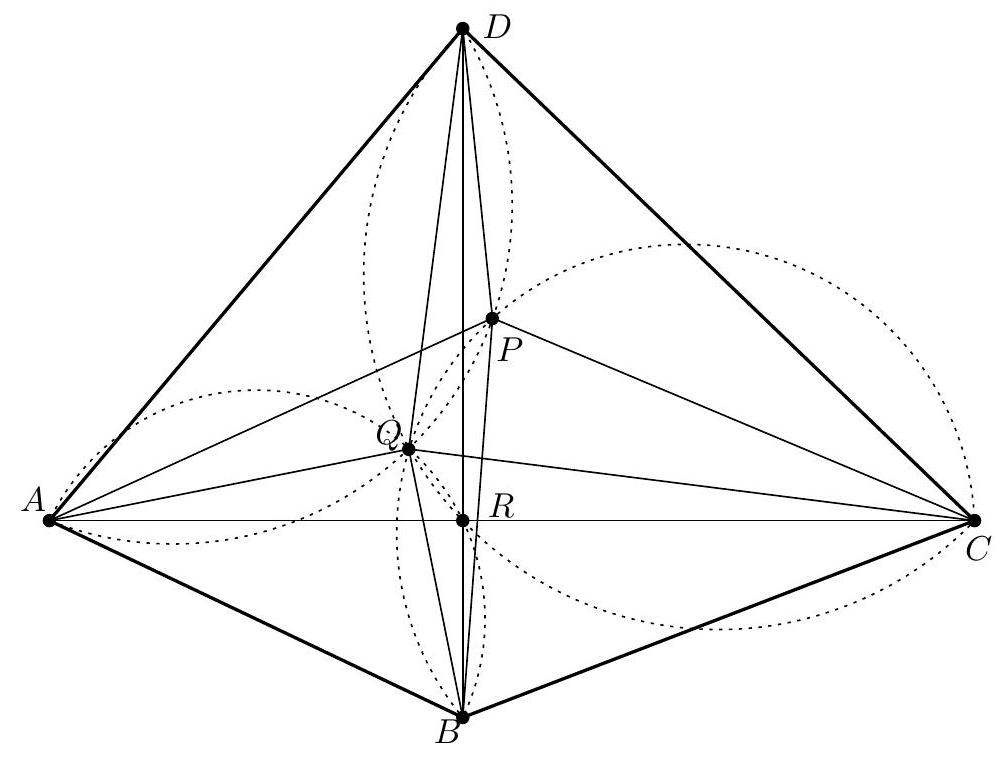", "metadata": {"resource_path": "IMO_SL/segmented/en-IMO2008SL.jsonl"}} |
| {"year": "2008", "tier": "T0", "problem_label": "G7", "problem_type": "Geometry", "exam": "IMO-SL", "problem": "Let $A B C D$ be a convex quadrilateral with $A B \\neq B C$. Denote by $\\omega_{1}$ and $\\omega_{2}$ the incircles of triangles $A B C$ and $A D C$. Suppose that there exists a circle $\\omega$ inscribed in angle $A B C$, tangent to the extensions of line segments $A D$ and $C D$. Prove that the common external tangents of $\\omega_{1}$ and $\\omega_{2}$ intersect on $\\omega$.", "solution": "The proof below is based on two known facts. Lemma 1. Given a convex quadrilateral $A B C D$, suppose that there exists a circle which is inscribed in angle $A B C$ and tangent to the extensions of line segments $A D$ and $C D$. Then $A B+A D=C B+C D$. Proof. The circle in question is tangent to each of the lines $A B, B C, C D, D A$, and the respective points of tangency $K, L, M, N$ are located as with circle $\\omega$ in the figure. Then $$ A B+A D=(B K-A K)+(A N-D N), \\quad C B+C D=(B L-C L)+(C M-D M) . $$ Also $B K=B L, D N=D M, A K=A N, C L=C M$ by equalities of tangents. It follows that $A B+A D=C B+C D$. 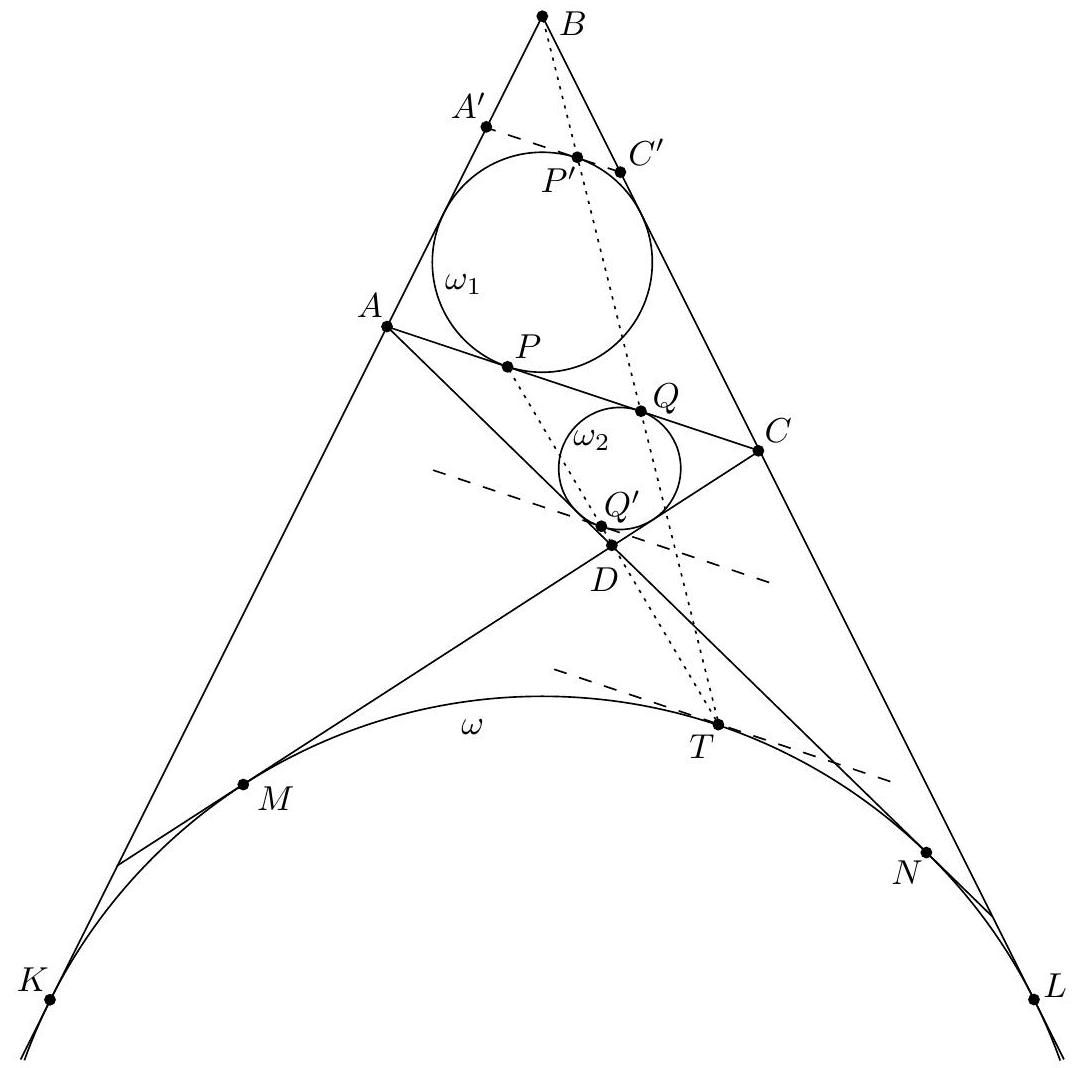 For brevity, in the sequel we write \"excircle $A C$ \" for the excircle of a triangle with side $A C$ which is tangent to line segment $A C$ and the extensions of the other two sides. Lemma 2. The incircle of triangle $A B C$ is tangent to its side $A C$ at $P$. Let $P P^{\\prime}$ be the diameter of the incircle through $P$, and let line $B P^{\\prime}$ intersect $A C$ at $Q$. Then $Q$ is the point of tangency of side $A C$ and excircle $A C$. Proof. Let the tangent at $P^{\\prime}$ to the incircle $\\omega_{1}$ meet $B A$ and $B C$ at $A^{\\prime}$ and $C^{\\prime}$. Now $\\omega_{1}$ is the excircle $A^{\\prime} C^{\\prime}$ of triangle $A^{\\prime} B C^{\\prime}$, and it touches side $A^{\\prime} C^{\\prime}$ at $P^{\\prime}$. Since $A^{\\prime} C^{\\prime} \\| A C$, the homothety with centre $B$ and ratio $B Q / B P^{\\prime}$ takes $\\omega_{1}$ to the excircle $A C$ of triangle $A B C$. Because this homothety takes $P^{\\prime}$ to $Q$, the lemma follows. Recall also that if the incircle of a triangle touches its side $A C$ at $P$, then the tangency point $Q$ of the same side and excircle $A C$ is the unique point on line segment $A C$ such that $A P=C Q$. We pass on to the main proof. Let $\\omega_{1}$ and $\\omega_{2}$ touch $A C$ at $P$ and $Q$, respectively; then $A P=(A C+A B-B C) / 2, C Q=(C A+C D-A D) / 2$. Since $A B-B C=C D-A D$ by Lemma 1, we obtain $A P=C Q$. It follows that in triangle $A B C$ side $A C$ and excircle $A C$ are tangent at $Q$. Likewise, in triangle $A D C$ side $A C$ and excircle $A C$ are tangent at $P$. Note that $P \\neq Q$ as $A B \\neq B C$. Let $P P^{\\prime}$ and $Q Q^{\\prime}$ be the diameters perpendicular to $A C$ of $\\omega_{1}$ and $\\omega_{2}$, respectively. Then Lemma 2 shows that points $B, P^{\\prime}$ and $Q$ are collinear, and so are points $D, Q^{\\prime}$ and $P$. Consider the diameter of $\\omega$ perpendicular to $A C$ and denote by $T$ its endpoint that is closer to $A C$. The homothety with centre $B$ and ratio $B T / B P^{\\prime}$ takes $\\omega_{1}$ to $\\omega$. Hence $B, P^{\\prime}$ and $T$ are collinear. Similarly, $D, Q^{\\prime}$ and $T$ are collinear since the homothety with centre $D$ and ratio $-D T / D Q^{\\prime}$ takes $\\omega_{2}$ to $\\omega$. We infer that points $T, P^{\\prime}$ and $Q$ are collinear, as well as $T, Q^{\\prime}$ and $P$. Since $P P^{\\prime} \\| Q Q^{\\prime}$, line segments $P P^{\\prime}$ and $Q Q^{\\prime}$ are then homothetic with centre $T$. The same holds true for circles $\\omega_{1}$ and $\\omega_{2}$ because they have $P P^{\\prime}$ and $Q Q^{\\prime}$ as diameters. Moreover, it is immediate that $T$ lies on the same side of line $P P^{\\prime}$ as $Q$ and $Q^{\\prime}$, hence the ratio of homothety is positive. In particular $\\omega_{1}$ and $\\omega_{2}$ are not congruent. In summary, $T$ is the centre of a homothety with positive ratio that takes circle $\\omega_{1}$ to circle $\\omega_{2}$. This completes the solution, since the only point with the mentioned property is the intersection of the the common external tangents of $\\omega_{1}$ and $\\omega_{2}$.", "metadata": {"resource_path": "IMO_SL/segmented/en-IMO2008SL.jsonl"}} |
| {"year": "2008", "tier": "T0", "problem_label": "N1", "problem_type": "Number Theory", "exam": "IMO-SL", "problem": "Let $n$ be a positive integer and let $p$ be a prime number. Prove that if $a, b, c$ are integers (not necessarily positive) satisfying the equations $$ a^{n}+p b=b^{n}+p c=c^{n}+p a, $$ then $a=b=c$.", "solution": "If two of $a, b, c$ are equal, it is immediate that all the three are equal. So we may assume that $a \\neq b \\neq c \\neq a$. Subtracting the equations we get $a^{n}-b^{n}=-p(b-c)$ and two cyclic copies of this equation, which upon multiplication yield $$ \\frac{a^{n}-b^{n}}{a-b} \\cdot \\frac{b^{n}-c^{n}}{b-c} \\cdot \\frac{c^{n}-a^{n}}{c-a}=-p^{3} . $$ If $n$ is odd then the differences $a^{n}-b^{n}$ and $a-b$ have the same sign and the product on the left is positive, while $-p^{3}$ is negative. So $n$ must be even. Let $d$ be the greatest common divisor of the three differences $a-b, b-c, c-a$, so that $a-b=d u, b-c=d v, \\quad c-a=d w ; \\operatorname{gcd}(u, v, w)=1, u+v+w=0$. From $a^{n}-b^{n}=-p(b-c)$ we see that $(a-b) \\mid p(b-c)$, i.e., $u \\mid p v$; and cyclically $v|p w, w| p u$. As $\\operatorname{gcd}(u, v, w)=1$ and $u+v+w=0$, at most one of $u, v, w$ can be divisible by $p$. Supposing that the prime $p$ does not divide any one of them, we get $u|v, v| w, w \\mid u$, whence $|u|=|v|=|w|=1$; but this quarrels with $u+v+w=0$. Thus $p$ must divide exactly one of these numbers. Let e.g. $p \\mid u$ and write $u=p u_{1}$. Now we obtain, similarly as before, $u_{1}|v, v| w, w \\mid u_{1}$ so that $\\left|u_{1}\\right|=|v|=|w|=1$. The equation $p u_{1}+v+w=0$ forces that the prime $p$ must be even; i.e. $p=2$. Hence $v+w=-2 u_{1}= \\pm 2$, implying $v=w(= \\pm 1)$ and $u=-2 v$. Consequently $a-b=-2(b-c)$. Knowing that $n$ is even, say $n=2 k$, we rewrite the equation $a^{n}-b^{n}=-p(b-c)$ with $p=2$ in the form $$ \\left(a^{k}+b^{k}\\right)\\left(a^{k}-b^{k}\\right)=-2(b-c)=a-b . $$ The second factor on the left is divisible by $a-b$, so the first factor $\\left(a^{k}+b^{k}\\right)$ must be $\\pm 1$. Then exactly one of $a$ and $b$ must be odd; yet $a-b=-2(b-c)$ is even. Contradiction ends the proof.", "metadata": {"resource_path": "IMO_SL/segmented/en-IMO2008SL.jsonl"}} |
| {"year": "2008", "tier": "T0", "problem_label": "N1", "problem_type": "Number Theory", "exam": "IMO-SL", "problem": "Let $n$ be a positive integer and let $p$ be a prime number. Prove that if $a, b, c$ are integers (not necessarily positive) satisfying the equations $$ a^{n}+p b=b^{n}+p c=c^{n}+p a, $$ then $a=b=c$.", "solution": "The beginning is as in the first solution. Assuming that $a, b, c$ are not all equal, hence are all distinct, we derive equation (1) with the conclusion that $n$ is even. Write $n=2 k$. Suppose that $p$ is odd. Then the integer $$ \\frac{a^{n}-b^{n}}{a-b}=a^{n-1}+a^{n-2} b+\\cdots+b^{n-1} $$ which is a factor in (1), must be odd as well. This sum of $n=2 k$ summands is odd only if $a$ and $b$ have different parities. The same conclusion holding for $b, c$ and for $c$, $a$, we get that $a, b, c, a$ alternate in their parities, which is clearly impossible. Thus $p=2$. The original system shows that $a, b, c$ must be of the same parity. So we may divide (1) by $p^{3}$, i.e. $2^{3}$, to obtain the following product of six integer factors: $$ \\frac{a^{k}+b^{k}}{2} \\cdot \\frac{a^{k}-b^{k}}{a-b} \\cdot \\frac{b^{k}+c^{k}}{2} \\cdot \\frac{b^{k}-c^{k}}{b-c} \\cdot \\frac{c^{k}+a^{k}}{2} \\cdot \\frac{c^{k}-a^{k}}{c-a}=-1 . $$ Each one of the factors must be equal to $\\pm 1$. In particular, $a^{k}+b^{k}= \\pm 2$. If $k$ is even, this becomes $a^{k}+b^{k}=2$ and yields $|a|=|b|=1$, whence $a^{k}-b^{k}=0$, contradicting (2). Let now $k$ be odd. Then the sum $a^{k}+b^{k}$, with value $\\pm 2$, has $a+b$ as a factor. Since $a$ and $b$ are of the same parity, this means that $a+b= \\pm 2$; and cyclically, $b+c= \\pm 2, c+a= \\pm 2$. In some two of these equations the signs must coincide, hence some two of $a, b, c$ are equal. This is the desired contradiction. Comment. Having arrived at the equation (1) one is tempted to write down all possible decompositions of $-p^{3}$ (cube of a prime) into a product of three integers. This leads to cumbersome examination of many cases, some of which are unpleasant to handle. One may do that just for $p=2$, having earlier in some way eliminated odd primes from consideration. However, the second solution shows that the condition of $p$ being a prime is far too strong. What is actually being used in that solution, is that $p$ is either a positive odd integer or $p=2$.", "metadata": {"resource_path": "IMO_SL/segmented/en-IMO2008SL.jsonl"}} |
| {"year": "2008", "tier": "T0", "problem_label": "N2", "problem_type": "Number Theory", "exam": "IMO-SL", "problem": "Let $a_{1}, a_{2}, \\ldots, a_{n}$ be distinct positive integers, $n \\geq 3$. Prove that there exist distinct indices $i$ and $j$ such that $a_{i}+a_{j}$ does not divide any of the numbers $3 a_{1}, 3 a_{2}, \\ldots, 3 a_{n}$.", "solution": "Without loss of generality, let $0<a_{1}<a_{2}<\\cdots<a_{n}$. One can also assume that $a_{1}, a_{2}, \\ldots, a_{n}$ are coprime. Otherwise division by their greatest common divisor reduces the question to the new sequence whose terms are coprime integers. Suppose that the claim is false. Then for each $i<n$ there exists a $j$ such that $a_{n}+a_{i}$ divides $3 a_{j}$. If $a_{n}+a_{i}$ is not divisible by 3 then $a_{n}+a_{i}$ divides $a_{j}$ which is impossible as $0<a_{j} \\leq a_{n}<a_{n}+a_{i}$. Thus $a_{n}+a_{i}$ is a multiple of 3 for $i=1, \\ldots, n-1$, so that $a_{1}, a_{2}, \\ldots, a_{n-1}$ are all congruent (to $-a_{n}$ ) modulo 3 . Now $a_{n}$ is not divisible by 3 or else so would be all remaining $a_{i}$ 's, meaning that $a_{1}, a_{2}, \\ldots, a_{n}$ are not coprime. Hence $a_{n} \\equiv r(\\bmod 3)$ where $r \\in\\{1,2\\}$, and $a_{i} \\equiv 3-r(\\bmod 3)$ for all $i=1, \\ldots, n-1$. Consider a sum $a_{n-1}+a_{i}$ where $1 \\leq i \\leq n-2$. There is at least one such sum as $n \\geq 3$. Let $j$ be an index such that $a_{n-1}+a_{i}$ divides $3 a_{j}$. Observe that $a_{n-1}+a_{i}$ is not divisible by 3 since $a_{n-1}+a_{i} \\equiv 2 a_{i} \\not \\equiv 0(\\bmod 3)$. It follows that $a_{n-1}+a_{i}$ divides $a_{j}$, in particular $a_{n-1}+a_{i} \\leq a_{j}$. Hence $a_{n-1}<a_{j} \\leq a_{n}$, implying $j=n$. So $a_{n}$ is divisible by all sums $a_{n-1}+a_{i}, 1 \\leq i \\leq n-2$. In particular $a_{n-1}+a_{i} \\leq a_{n}$ for $i=1, \\ldots, n-2$. Let $j$ be such that $a_{n}+a_{n-1}$ divides $3 a_{j}$. If $j \\leq n-2$ then $a_{n}+a_{n-1} \\leq 3 a_{j}<a_{j}+2 a_{n-1}$. This yields $a_{n}<a_{n-1}+a_{j}$; however $a_{n-1}+a_{j} \\leq a_{n}$ for $j \\leq n-2$. Therefore $j=n-1$ or $j=n$. For $j=n-1$ we obtain $3 a_{n-1}=k\\left(a_{n}+a_{n-1}\\right)$ with $k$ an integer, and it is straightforward that $k=1\\left(k \\leq 0\\right.$ and $k \\geq 3$ contradict $0<a_{n-1}<a_{n} ; k=2$ leads to $\\left.a_{n-1}=2 a_{n}>a_{n-1}\\right)$. Thus $3 a_{n-1}=a_{n}+a_{n-1}$, i. e. $a_{n}=2 a_{n-1}$. Similarly, if $j=n$ then $3 a_{n}=k\\left(a_{n}+a_{n-1}\\right)$ for some integer $k$, and only $k=2$ is possible. Hence $a_{n}=2 a_{n-1}$ holds true in both cases remaining, $j=n-1$ and $j=n$. Now $a_{n}=2 a_{n-1}$ implies that the sum $a_{n-1}+a_{1}$ is strictly between $a_{n} / 2$ and $a_{n}$. But $a_{n-1}$ and $a_{1}$ are distinct as $n \\geq 3$, so it follows from the above that $a_{n-1}+a_{1}$ divides $a_{n}$. This provides the desired contradiction.", "metadata": {"resource_path": "IMO_SL/segmented/en-IMO2008SL.jsonl"}} |
| {"year": "2008", "tier": "T0", "problem_label": "N3", "problem_type": "Number Theory", "exam": "IMO-SL", "problem": "Let $a_{0}, a_{1}, a_{2}, \\ldots$ be a sequence of positive integers such that the greatest common divisor of any two consecutive terms is greater than the preceding term; in symbols, $\\operatorname{gcd}\\left(a_{i}, a_{i+1}\\right)>a_{i-1}$. Prove that $a_{n} \\geq 2^{n}$ for all $n \\geq 0$.", "solution": "Since $a_{i} \\geq \\operatorname{gcd}\\left(a_{i}, a_{i+1}\\right)>a_{i-1}$, the sequence is strictly increasing. In particular $a_{0} \\geq 1, a_{1} \\geq 2$. For each $i \\geq 1$ we also have $a_{i+1}-a_{i} \\geq \\operatorname{gcd}\\left(a_{i}, a_{i+1}\\right)>a_{i-1}$, and consequently $a_{i+1} \\geq a_{i}+a_{i-1}+1$. Hence $a_{2} \\geq 4$ and $a_{3} \\geq 7$. The equality $a_{3}=7$ would force equalities in the previous estimates, leading to $\\operatorname{gcd}\\left(a_{2}, a_{3}\\right)=\\operatorname{gcd}(4,7)>a_{1}=2$, which is false. Thus $a_{3} \\geq 8$; the result is valid for $n=0,1,2,3$. These are the base cases for a proof by induction. Take an $n \\geq 3$ and assume that $a_{i} \\geq 2^{i}$ for $i=0,1, \\ldots, n$. We must show that $a_{n+1} \\geq 2^{n+1}$. Let $\\operatorname{gcd}\\left(a_{n}, a_{n+1}\\right)=d$. We know that $d>a_{n-1}$. The induction claim is reached immediately in the following cases: $$ \\begin{array}{ll} \\text { if } \\quad a_{n+1} \\geq 4 d & \\text { then } a_{n+1}>4 a_{n-1} \\geq 4 \\cdot 2^{n-1}=2^{n+1} \\\\ \\text { if } \\quad a_{n} \\geq 3 d & \\text { then } a_{n+1} \\geq a_{n}+d \\geq 4 d>4 a_{n-1} \\geq 4 \\cdot 2^{n-1}=2^{n+1} \\\\ \\text { if } \\quad a_{n}=d & \\text { then } a_{n+1} \\geq a_{n}+d=2 a_{n} \\geq 2 \\cdot 2^{n}=2^{n+1} \\end{array} $$ The only remaining possibility is that $a_{n}=2 d$ and $a_{n+1}=3 d$, which we assume for the sequel. So $a_{n+1}=\\frac{3}{2} a_{n}$. Let now $\\operatorname{gcd}\\left(a_{n-1}, a_{n}\\right)=d^{\\prime}$; then $d^{\\prime}>a_{n-2}$. Write $a_{n}=m d^{\\prime} \\quad(m$ an integer $)$. Keeping in mind that $d^{\\prime} \\leq a_{n-1}<d$ and $a_{n}=2 d$, we get that $m \\geq 3$. Also $a_{n-1}<d=\\frac{1}{2} m d^{\\prime}$, $a_{n+1}=\\frac{3}{2} m d^{\\prime}$. Again we single out the cases which imply the induction claim immediately: $$ \\begin{aligned} & \\text { if } m \\geq 6 \\quad \\text { then } a_{n+1}=\\frac{3}{2} m d^{\\prime} \\geq 9 d^{\\prime}>9 a_{n-2} \\geq 9 \\cdot 2^{n-2}>2^{n+1} \\\\ & \\text { if } 3 \\leq m \\leq 4 \\text { then } a_{n-1}<\\frac{1}{2} \\cdot 4 d^{\\prime} \\text {, and hence } a_{n-1}=d^{\\prime} \\\\ & \\qquad a_{n+1}=\\frac{3}{2} m a_{n-1} \\geq \\frac{3}{2} \\cdot 3 a_{n-1} \\geq \\frac{9}{2} \\cdot 2^{n-1}>2^{n+1} . \\end{aligned} $$ So we are left with the case $m=5$, which means that $a_{n}=5 d^{\\prime}, a_{n+1}=\\frac{15}{2} d^{\\prime}, a_{n-1}<d=\\frac{5}{2} d^{\\prime}$. The last relation implies that $a_{n-1}$ is either $d^{\\prime}$ or $2 d^{\\prime}$. Anyway, $a_{n-1} \\mid 2 d^{\\prime}$. The same pattern repeats once more. We denote $\\operatorname{gcd}\\left(a_{n-2}, a_{n-1}\\right)=d^{\\prime \\prime}$; then $d^{\\prime \\prime}>a_{n-3}$. Because $d^{\\prime \\prime}$ is a divisor of $a_{n-1}$, hence also of $2 d^{\\prime}$, we may write $2 d^{\\prime}=m^{\\prime} d^{\\prime \\prime}$ ( $m^{\\prime}$ an integer). Since $d^{\\prime \\prime} \\leq a_{n-2}<d^{\\prime}$, we get $m^{\\prime} \\geq 3$. Also, $a_{n-2}<d^{\\prime}=\\frac{1}{2} m^{\\prime} d^{\\prime \\prime}, a_{n+1}=\\frac{15}{2} d^{\\prime}=\\frac{15}{4} m^{\\prime} d^{\\prime \\prime}$. As before, we consider the cases: $$ \\begin{aligned} & \\text { if } m^{\\prime} \\geq 5 \\quad \\text { then } a_{n+1}=\\frac{15}{4} m^{\\prime} d^{\\prime \\prime} \\geq \\frac{75}{4} d^{\\prime \\prime}>\\frac{75}{4} a_{n-3} \\geq \\frac{75}{4} \\cdot 2^{n-3}>2^{n+1} \\\\ & \\text { if } 3 \\leq m^{\\prime} \\leq 4 \\text { then } a_{n-2}<\\frac{1}{2} \\cdot 4 d^{\\prime \\prime} \\text {, and hence } a_{n-2}=d^{\\prime \\prime} \\\\ & \\qquad a_{n+1}=\\frac{15}{4} m^{\\prime} a_{n-2} \\geq \\frac{15}{4} \\cdot 3 a_{n-2} \\geq \\frac{45}{4} \\cdot 2^{n-2}>2^{n+1} . \\end{aligned} $$ Both of them have produced the induction claim. But now there are no cases left. Induction is complete; the inequality $a_{n} \\geq 2^{n}$ holds for all $n$.", "metadata": {"resource_path": "IMO_SL/segmented/en-IMO2008SL.jsonl"}} |
| {"year": "2008", "tier": "T0", "problem_label": "N4", "problem_type": "Number Theory", "exam": "IMO-SL", "problem": "Let $n$ be a positive integer. Show that the numbers $$ \\left(\\begin{array}{c} 2^{n}-1 \\\\ 0 \\end{array}\\right), \\quad\\left(\\begin{array}{c} 2^{n}-1 \\\\ 1 \\end{array}\\right), \\quad\\left(\\begin{array}{c} 2^{n}-1 \\\\ 2 \\end{array}\\right), \\quad \\ldots, \\quad\\left(\\begin{array}{c} 2^{n}-1 \\\\ 2^{n-1}-1 \\end{array}\\right) $$ are congruent modulo $2^{n}$ to $1,3,5, \\ldots, 2^{n}-1$ in some order.", "solution": "It is well-known that all these numbers are odd. So the assertion that their remainders $\\left(\\bmod 2^{n}\\right)$ make up a permutation of $\\left\\{1,3, \\ldots, 2^{n}-1\\right\\}$ is equivalent just to saying that these remainders are all distinct. We begin by showing that $$ \\left(\\begin{array}{c} 2^{n}-1 \\\\ 2 k \\end{array}\\right)+\\left(\\begin{array}{c} 2^{n}-1 \\\\ 2 k+1 \\end{array}\\right) \\equiv 0 \\quad\\left(\\bmod 2^{n}\\right) \\quad \\text { and } \\quad\\left(\\begin{array}{c} 2^{n}-1 \\\\ 2 k \\end{array}\\right) \\equiv(-1)^{k}\\left(\\begin{array}{c} 2^{n-1}-1 \\\\ k \\end{array}\\right) \\quad\\left(\\bmod 2^{n}\\right) $$ The first relation is immediate, as the sum on the left is equal to $\\left(\\begin{array}{c}2^{n} \\\\ 2 k+1\\end{array}\\right)=\\frac{2^{n}}{2 k+1}\\left(\\begin{array}{c}2^{n}-1 \\\\ 2 k\\end{array}\\right)$, hence is divisible by $2^{n}$. The second relation: $$ \\left(\\begin{array}{c} 2^{n}-1 \\\\ 2 k \\end{array}\\right)=\\prod_{j=1}^{2 k} \\frac{2^{n}-j}{j}=\\prod_{i=1}^{k} \\frac{2^{n}-(2 i-1)}{2 i-1} \\cdot \\prod_{i=1}^{k} \\frac{2^{n-1}-i}{i} \\equiv(-1)^{k}\\left(\\begin{array}{c} 2^{n-1}-1 \\\\ k \\end{array}\\right) \\quad\\left(\\bmod 2^{n}\\right) . $$ This prepares ground for a proof of the required result by induction on $n$. The base case $n=1$ is obvious. Assume the assertion is true for $n-1$ and pass to $n$, denoting $a_{k}=\\left(\\begin{array}{c}2^{n-1}-1 \\\\ k\\end{array}\\right)$, $b_{m}=\\left(\\begin{array}{c}2^{n}-1 \\\\ m\\end{array}\\right)$. The induction hypothesis is that all the numbers $a_{k}\\left(0 \\leq k<2^{n-2}\\right)$ are distinct $\\left(\\bmod 2^{n-1}\\right)$; the claim is that all the numbers $b_{m}\\left(0 \\leq m<2^{n-1}\\right)$ are distinct $\\left(\\bmod 2^{n}\\right)$. The congruence relations (1) are restated as $$ b_{2 k} \\equiv(-1)^{k} a_{k} \\equiv-b_{2 k+1} \\quad\\left(\\bmod 2^{n}\\right) $$ Shifting the exponent in the first relation of (1) from $n$ to $n-1$ we also have the congruence $a_{2 i+1} \\equiv-a_{2 i}\\left(\\bmod 2^{n-1}\\right)$. We hence conclude: If, for some $j, k<2^{n-2}, a_{k} \\equiv-a_{j}\\left(\\bmod 2^{n-1}\\right)$, then $\\{j, k\\}=\\{2 i, 2 i+1\\}$ for some $i$. This is so because in the sequence $\\left(a_{k}: k<2^{n-2}\\right)$ each term $a_{j}$ is complemented to $0\\left(\\bmod 2^{n-1}\\right)$ by only one other term $a_{k}$, according to the induction hypothesis. From (2) we see that $b_{4 i} \\equiv a_{2 i}$ and $b_{4 i+3} \\equiv a_{2 i+1}\\left(\\bmod 2^{n}\\right)$. Let $$ M=\\left\\{m: 0 \\leq m<2^{n-1}, m \\equiv 0 \\text { or } 3(\\bmod 4)\\right\\}, \\quad L=\\left\\{l: 0 \\leq l<2^{n-1}, l \\equiv 1 \\text { or } 2(\\bmod 4)\\right\\} $$ The last two congruences take on the unified form $$ b_{m} \\equiv a_{\\lfloor m / 2\\rfloor} \\quad\\left(\\bmod 2^{n}\\right) \\quad \\text { for all } \\quad m \\in M $$ Thus all the numbers $b_{m}$ for $m \\in M$ are distinct $\\left(\\bmod 2^{n}\\right)$ because so are the numbers $a_{k}$ (they are distinct $\\left(\\bmod 2^{n-1}\\right)$, hence also $\\left(\\bmod 2^{n}\\right)$ ). Every $l \\in L$ is paired with a unique $m \\in M$ into a pair of the form $\\{2 k, 2 k+1\\}$. So (2) implies that also all the $b_{l}$ for $l \\in L$ are distinct $\\left(\\bmod 2^{n}\\right)$. It remains to eliminate the possibility that $b_{m} \\equiv b_{l}\\left(\\bmod 2^{n}\\right)$ for some $m \\in M, l \\in L$. Suppose that such a situation occurs. Let $m^{\\prime} \\in M$ be such that $\\left\\{m^{\\prime}, l\\right\\}$ is a pair of the form $\\{2 k, 2 k+1\\}$, so that $($ see $(2)) b_{m^{\\prime}} \\equiv-b_{l}\\left(\\bmod 2^{n}\\right)$. Hence $b_{m^{\\prime}} \\equiv-b_{m}\\left(\\bmod 2^{n}\\right)$. Since both $m^{\\prime}$ and $m$ are in $M$, we have by (4) $b_{m^{\\prime}} \\equiv a_{j}, b_{m} \\equiv a_{k}\\left(\\bmod 2^{n}\\right)$ for $j=\\left\\lfloor m^{\\prime} / 2\\right\\rfloor, k=\\lfloor m / 2\\rfloor$. Then $a_{j} \\equiv-a_{k}\\left(\\bmod 2^{n}\\right)$. Thus, according to $(3), j=2 i, k=2 i+1$ for some $i$ (or vice versa). The equality $a_{2 i+1} \\equiv-a_{2 i}\\left(\\bmod 2^{n}\\right)$ now means that $\\left(\\begin{array}{c}2^{n-1}-1 \\\\ 2 i\\end{array}\\right)+\\left(\\begin{array}{c}2^{n-1}-1 \\\\ 2 i+1\\end{array}\\right) \\equiv 0\\left(\\bmod 2^{n}\\right)$. However, the sum on the left is equal to $\\left(\\begin{array}{c}2^{n-1} \\\\ 2 i+1\\end{array}\\right)$. A number of this form cannot be divisible by $2^{n}$. This is a contradiction which concludes the induction step and proves the result.", "metadata": {"resource_path": "IMO_SL/segmented/en-IMO2008SL.jsonl"}} |
| {"year": "2008", "tier": "T0", "problem_label": "N4", "problem_type": "Number Theory", "exam": "IMO-SL", "problem": "Let $n$ be a positive integer. Show that the numbers $$ \\left(\\begin{array}{c} 2^{n}-1 \\\\ 0 \\end{array}\\right), \\quad\\left(\\begin{array}{c} 2^{n}-1 \\\\ 1 \\end{array}\\right), \\quad\\left(\\begin{array}{c} 2^{n}-1 \\\\ 2 \\end{array}\\right), \\quad \\ldots, \\quad\\left(\\begin{array}{c} 2^{n}-1 \\\\ 2^{n-1}-1 \\end{array}\\right) $$ are congruent modulo $2^{n}$ to $1,3,5, \\ldots, 2^{n}-1$ in some order.", "solution": "We again proceed by induction, writing for brevity $N=2^{n-1}$ and keeping notation $a_{k}=\\left(\\begin{array}{c}N-1 \\\\ k\\end{array}\\right), b_{m}=\\left(\\begin{array}{c}2 N-1 \\\\ m\\end{array}\\right)$. Assume that the result holds for the sequence $\\left(a_{0}, a_{1}, a_{2}, \\ldots, a_{N / 2-1}\\right)$. In view of the symmetry $a_{N-1-k}=a_{k}$ this sequence is a permutation of $\\left(a_{0}, a_{2}, a_{4}, \\ldots, a_{N-2}\\right)$. So the induction hypothesis says that this latter sequence, taken $(\\bmod N)$, is a permutation of $(1,3,5, \\ldots, N-1)$. Similarly, the induction claim is that $\\left(b_{0}, b_{2}, b_{4}, \\ldots, b_{2 N-2}\\right)$, taken $(\\bmod 2 N)$, is a permutation of $(1,3,5, \\ldots, 2 N-1)$. In place of the congruence relations (2) we now use the following ones, $$ b_{4 i} \\equiv a_{2 i} \\quad(\\bmod N) \\quad \\text { and } \\quad b_{4 i+2} \\equiv b_{4 i}+N \\quad(\\bmod 2 N) . $$ Given this, the conclusion is immediate: the first formula of (5) together with the induction hypothesis tells us that $\\left(b_{0}, b_{4}, b_{8}, \\ldots, b_{2 N-4}\\right)(\\bmod N)$ is a permutation of $(1,3,5, \\ldots, N-1)$. Then the second formula of $(5)$ shows that $\\left(b_{2}, b_{6}, b_{10}, \\ldots, b_{2 N-2}\\right)(\\bmod N)$ is exactly the same permutation; moreover, this formula distinguishes $(\\bmod 2 N)$ each $b_{4 i}$ from $b_{4 i+2}$. Consequently, these two sequences combined represent $(\\bmod 2 N)$ a permutation of the sequence $(1,3,5, \\ldots, N-1, N+1, N+3, N+5, \\ldots, N+N-1)$, and this is precisely the induction claim. Now we prove formulas (5); we begin with the second one. Since $b_{m+1}=b_{m} \\cdot \\frac{2 N-m-1}{m+1}$, $$ b_{4 i+2}=b_{4 i} \\cdot \\frac{2 N-4 i-1}{4 i+1} \\cdot \\frac{2 N-4 i-2}{4 i+2}=b_{4 i} \\cdot \\frac{2 N-4 i-1}{4 i+1} \\cdot \\frac{N-2 i-1}{2 i+1} . $$ The desired congruence $b_{4 i+2} \\equiv b_{4 i}+N$ may be multiplied by the odd number $(4 i+1)(2 i+1)$, giving rise to a chain of successively equivalent congruences: $$ \\begin{aligned} b_{4 i}(2 N-4 i-1)(N-2 i-1) & \\equiv\\left(b_{4 i}+N\\right)(4 i+1)(2 i+1) & & (\\bmod 2 N), \\\\ b_{4 i}(2 i+1-N) & \\equiv\\left(b_{4 i}+N\\right)(2 i+1) & & (\\bmod 2 N), \\\\ \\left(b_{4 i}+2 i+1\\right) N & \\equiv 0 & & (\\bmod 2 N) ; \\end{aligned} $$ and the last one is satisfied, as $b_{4 i}$ is odd. This settles the second relation in (5). The first one is proved by induction on $i$. It holds for $i=0$. Assume $b_{4 i} \\equiv a_{2 i}(\\bmod 2 N)$ and consider $i+1$ : $$ b_{4 i+4}=b_{4 i+2} \\cdot \\frac{2 N-4 i-3}{4 i+3} \\cdot \\frac{2 N-4 i-4}{4 i+4} ; \\quad a_{2 i+2}=a_{2 i} \\cdot \\frac{N-2 i-1}{2 i+1} \\cdot \\frac{N-2 i-2}{2 i+2} . $$ Both expressions have the fraction $\\frac{N-2 i-2}{2 i+2}$ as the last factor. Since $2 i+2<N=2^{n-1}$, this fraction reduces to $\\ell / m$ with $\\ell$ and $m$ odd. In showing that $b_{4 i+4} \\equiv a_{2 i+2}(\\bmod 2 N)$, we may ignore this common factor $\\ell / m$. Clearing other odd denominators reduces the claim to $$ b_{4 i+2}(2 N-4 i-3)(2 i+1) \\equiv a_{2 i}(N-2 i-1)(4 i+3) \\quad(\\bmod 2 N) $$ By the inductive assumption (saying that $b_{4 i} \\equiv a_{2 i}(\\bmod 2 N)$ ) and by the second relation of (5), this is equivalent to $$ \\left(b_{4 i}+N\\right)(2 i+1) \\equiv b_{4 i}(2 i+1-N) \\quad(\\bmod 2 N) $$ a congruence which we have already met in the preceding proof a few lines above. This completes induction (on $i$ ) and the proof of (5), hence also the whole solution. Comment. One can avoid the words congruent modulo in the problem statement by rephrasing the assertion into: Show that these numbers leave distinct remainders in division by $2^{n}$.", "metadata": {"resource_path": "IMO_SL/segmented/en-IMO2008SL.jsonl"}} |
| {"year": "2008", "tier": "T0", "problem_label": "N5", "problem_type": "Number Theory", "exam": "IMO-SL", "problem": "For every $n \\in \\mathbb{N}$ let $d(n)$ denote the number of (positive) divisors of $n$. Find all functions $f: \\mathbb{N} \\rightarrow \\mathbb{N}$ with the following properties: (i) $d(f(x))=x$ for all $x \\in \\mathbb{N}$; (ii) $f(x y)$ divides $(x-1) y^{x y-1} f(x)$ for all $x, y \\in \\mathbb{N}$.", "solution": "There is a unique solution: the function $f: \\mathbb{N} \\rightarrow \\mathbb{N}$ defined by $f(1)=1$ and $f(n)=p_{1}^{p_{1}^{a_{1}}-1} p_{2}^{p_{2}^{a_{2}}-1} \\cdots p_{k}^{p_{k}^{a_{k}}-1}$ where $n=p_{1}^{a_{1}} p_{2}^{a_{2}} \\cdots p_{k}^{a_{k}}$ is the prime factorization of $n>1$. Direct verification shows that this function meets the requirements. Conversely, let $f: \\mathbb{N} \\rightarrow \\mathbb{N}$ satisfy (i) and (ii). Applying (i) for $x=1$ gives $d(f(1))=1$, so $f(1)=1$. In the sequel we prove that (1) holds for all $n>1$. Notice that $f(m)=f(n)$ implies $m=n$ in view of (i). The formula $d\\left(p_{1}^{b_{1}} \\cdots p_{k}^{b_{k}}\\right)=\\left(b_{1}+1\\right) \\cdots\\left(b_{k}+1\\right)$ will be used throughout. Let $p$ be a prime. Since $d(f(p))=p$, the formula just mentioned yields $f(p)=q^{p-1}$ for some prime $q$; in particular $f(2)=q^{2-1}=q$ is a prime. We prove that $f(p)=p^{p-1}$ for all primes $p$. Suppose that $p$ is odd and $f(p)=q^{p-1}$ for a prime $q$. Applying (ii) first with $x=2$, $y=p$ and then with $x=p, y=2$ shows that $f(2 p)$ divides both $(2-1) p^{2 p-1} f(2)=p^{2 p-1} f(2)$ and $(p-1) 2^{2 p-1} f(p)=(p-1) 2^{2 p-1} q^{p-1}$. If $q \\neq p$ then the odd prime $p$ does not divide $(p-1) 2^{2 p-1} q^{p-1}$, hence the greatest common divisor of $p^{2 p-1} f(2)$ and $(p-1) 2^{2 p-1} q^{p-1}$ is a divisor of $f(2)$. Thus $f(2 p)$ divides $f(2)$ which is a prime. As $f(2 p)>1$, we obtain $f(2 p)=f(2)$ which is impossible. So $q=p$, i. e. $f(p)=p^{p-1}$. For $p=2$ the same argument with $x=2, y=3$ and $x=3, y=2$ shows that $f(6)$ divides both $3^{5} f(2)$ and $2^{6} f(3)=2^{6} 3^{2}$. If the prime $f(2)$ is odd then $f(6)$ divides $3^{2}=9$, so $f(6) \\in\\{1,3,9\\}$. However then $6=d(f(6)) \\in\\{d(1), d(3), d(9)\\}=\\{1,2,3\\}$ which is false. In conclusion $f(2)=2$. Next, for each $n>1$ the prime divisors of $f(n)$ are among the ones of $n$. Indeed, let $p$ be the least prime divisor of $n$. Apply (ii) with $x=p$ and $y=n / p$ to obtain that $f(n)$ divides $(p-1) y^{n-1} f(p)=(p-1) y^{n-1} p^{p-1}$. Write $f(n)=\\ell P$ where $\\ell$ is coprime to $n$ and $P$ is a product of primes dividing $n$. Since $\\ell$ divides $(p-1) y^{n-1} p^{p-1}$ and is coprime to $y^{n-1} p^{p-1}$, it divides $p-1$; hence $d(\\ell) \\leq \\ell<p$. But (i) gives $n=d(f(n))=d(\\ell P)$, and $d(\\ell P)=d(\\ell) d(P)$ as $\\ell$ and $P$ are coprime. Therefore $d(\\ell)$ is a divisor of $n$ less than $p$, meaning that $\\ell=1$ and proving the claim. Now (1) is immediate for prime powers. If $p$ is a prime and $a \\geq 1$, by the above the only prime factor of $f\\left(p^{a}\\right)$ is $p$ (a prime factor does exist as $f\\left(p^{a}\\right)>1$ ). So $f\\left(p^{a}\\right)=p^{b}$ for some $b \\geq 1$, and (i) yields $p^{a}=d\\left(f\\left(p^{a}\\right)\\right)=d\\left(p^{b}\\right)=b+1$. Hence $f\\left(p^{a}\\right)=p^{p^{a}-1}$, as needed. Let us finally show that (1) is true for a general $n>1$ with prime factorization $n=p_{1}^{a_{1}} \\cdots p_{k}^{a_{k}}$. We saw that the prime factorization of $f(n)$ has the form $f(n)=p_{1}^{b_{1}} \\cdots p_{k}^{b_{k}}$. For $i=1, \\ldots, k$, set $x=p_{i}^{a_{i}}$ and $y=n / x$ in (ii) to infer that $f(n)$ divides $\\left(p_{i}^{a_{i}}-1\\right) y^{n-1} f\\left(p_{i}^{a_{i}}\\right)$. Hence $p_{i}^{b_{i}}$ divides $\\left(p_{i}^{a_{i}}-1\\right) y^{n-1} f\\left(p_{i}^{a_{i}}\\right)$, and because $p_{i}^{b_{i}}$ is coprime to $\\left(p_{i}^{a_{i}}-1\\right) y^{n-1}$, it follows that $p_{i}^{b_{i}}$ divides $f\\left(p_{i}^{a_{i}}\\right)=p_{i}^{p_{i}^{a_{i}}-1}$. So $b_{i} \\leq p_{i}^{a_{i}}-1$ for all $i=1, \\ldots, k$. Combined with (i), these conclusions imply $$ p_{1}^{a_{1}} \\cdots p_{k}^{a_{k}}=n=d(f(n))=d\\left(p_{1}^{b_{1}} \\cdots p_{k}^{b_{k}}\\right)=\\left(b_{1}+1\\right) \\cdots\\left(b_{k}+1\\right) \\leq p_{1}^{a_{1}} \\cdots p_{k}^{a_{k}} . $$ Hence all inequalities $b_{i} \\leq p_{i}^{a_{i}}-1$ must be equalities, $i=1, \\ldots, k$, implying that (1) holds true. The proof is complete.", "metadata": {"resource_path": "IMO_SL/segmented/en-IMO2008SL.jsonl"}} |
| {"year": "2008", "tier": "T0", "problem_label": "N6", "problem_type": "Number Theory", "exam": "IMO-SL", "problem": "Prove that there exist infinitely many positive integers $n$ such that $n^{2}+1$ has a prime divisor greater than $2 n+\\sqrt{2 n}$.", "solution": "Let $p \\equiv 1(\\bmod 8)$ be a prime. The congruence $x^{2} \\equiv-1(\\bmod p)$ has two solutions in $[1, p-1]$ whose sum is $p$. If $n$ is the smaller one of them then $p$ divides $n^{2}+1$ and $n \\leq(p-1) / 2$. We show that $p>2 n+\\sqrt{10 n}$. Let $n=(p-1) / 2-\\ell$ where $\\ell \\geq 0$. Then $n^{2} \\equiv-1(\\bmod p)$ gives $$ \\left(\\frac{p-1}{2}-\\ell\\right)^{2} \\equiv-1 \\quad(\\bmod p) \\quad \\text { or } \\quad(2 \\ell+1)^{2}+4 \\equiv 0 \\quad(\\bmod p) $$ Thus $(2 \\ell+1)^{2}+4=r p$ for some $r \\geq 0$. As $(2 \\ell+1)^{2} \\equiv 1 \\equiv p(\\bmod 8)$, we have $r \\equiv 5(\\bmod 8)$, so that $r \\geq 5$. Hence $(2 \\ell+1)^{2}+4 \\geq 5 p$, implying $\\ell \\geq(\\sqrt{5 p-4}-1) / 2$. Set $\\sqrt{5 p-4}=u$ for clarity; then $\\ell \\geq(u-1) / 2$. Therefore $$ n=\\frac{p-1}{2}-\\ell \\leq \\frac{1}{2}(p-u) $$ Combined with $p=\\left(u^{2}+4\\right) / 5$, this leads to $u^{2}-5 u-10 n+4 \\geq 0$. Solving this quadratic inequality with respect to $u \\geq 0$ gives $u \\geq(5+\\sqrt{40 n+9}) / 2$. So the estimate $n \\leq(p-u) / 2$ leads to $$ p \\geq 2 n+u \\geq 2 n+\\frac{1}{2}(5+\\sqrt{40 n+9})>2 n+\\sqrt{10 n} $$ Since there are infinitely many primes of the form $8 k+1$, it follows easily that there are also infinitely many $n$ with the stated property. Comment. By considering the prime factorization of the product $\\prod_{n=1}^{N}\\left(n^{2}+1\\right)$, it can be obtained that its greatest prime divisor is at least $c N \\log N$. This could improve the statement as $p>n \\log n$. However, the proof applies some advanced information about the distribution of the primes of the form $4 k+1$, which is inappropriate for high schools contests.", "metadata": {"resource_path": "IMO_SL/segmented/en-IMO2008SL.jsonl"}} |
|
|