| {"year": "2002", "tier": "T3", "problem_label": "1", "problem_type": null, "exam": "INMO", "problem": "For a convex hexagon $A B C D E F$ in which each pair of opposite sides is unequal, consider the following six statements:\n\n$$\n\\begin{array}{ll}\n\\text { (a } \\left.\\mathrm{a}_{1}\\right) A B \\text { is parallel to } D E ; & \\left(\\mathrm{a}_{2}\\right) A E=B D \\\\\n\\left(\\mathrm{~b}_{1}\\right) B C \\text { is parallel to } E F ; & \\left(\\mathrm{b}_{2}\\right) B F=C E \\\\\n\\text { (c } \\left.\\mathrm{c}_{1}\\right) C D \\text { is parallel to } F A ; & \\left(\\mathrm{c}_{2}\\right) C A=D F\n\\end{array}\n$$\n\n(a) Show that if all the six statements are true, then the hexagon is cyclic(i.e., it can be inscribed in a circle).\n\n(b) Prove that, in fact, any five of these six statements also imply that the hexagon is cyclic.", "solution": "(a) Suppose all the six statements are true. Then $A B D E, B C E F, C D F A$ are isosceles trapeziums; if $K, L, M, P, Q, R$ are the mid-points of $A B, B C$, $C D, D E, E F, F A$ respectively, then we see that $K P \\perp A B, E D ; L Q \\perp$ $B C, E F$ and $M R \\perp C D, F A$.\n\n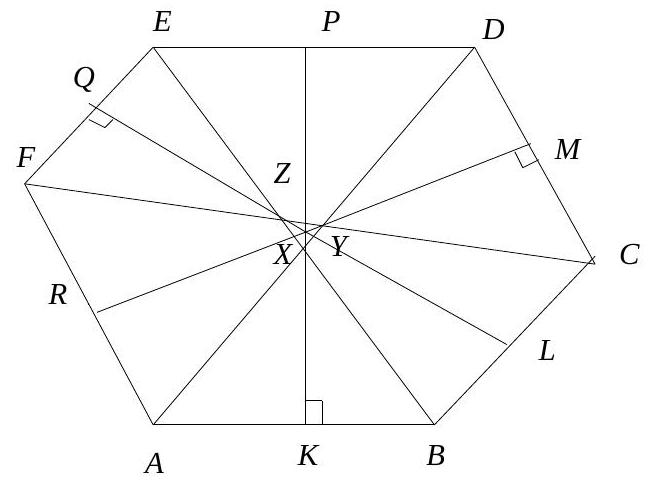\n\nIf $A D, B E, C F$ themselves concur at a point $O$, then $O A=O B=O C=$ $O D=O E=O F$. ( $O$ is on the perpendicular bisector of each of the sides.) Hence $A, B, C, D, E, F$ are concyclic and lie on a circle with centre $O$. Otherwise these lines $A D, B E, C F$ form a triangle, say $X Y Z$. (See Fig.) Then $K X, M Y, Q Z$, when extended, become the internal angle bisectors of the triangle $X Y Z$ and hence concur at the incentre $O^{\\prime}$ of $X Y Z$. As earlier $O^{\\prime}$ lies on the perpendicular bisector of each of the sides. Hence $O^{\\prime} A=O^{\\prime} B$ $=O^{\\prime} C=O^{\\prime} D=O^{\\prime} E=O^{\\prime} F$, giving the concyclicity of $A, B, C, D, E, F$.\n(b) Suppose $\\left(\\mathrm{a}_{1}\\right),\\left(\\mathrm{a}_{2}\\right),\\left(\\mathrm{b}_{1}\\right),\\left(\\mathrm{b}_{2}\\right)$ are true. Then we see that $A D=B E=$ $C F$. Assume that ( $\\mathrm{c}_{1}$ ) is true. Then $C D$ is parallel to $A F$. It follows that triangles $Y C D$ and $Y F A$ are similar. This gives\n\n$$\n\\frac{F Y}{A Y}=\\frac{Y C}{Y D}=\\frac{F Y+Y C}{A Y+Y D}=\\frac{F C}{A D}=1\n$$\n\nWe obtain $F Y=A Y$ and $Y C=Y D$. This forces that triangles $C Y A$ and $D Y F$ are congruent. In particular $A C=D F$ so that ( $\\mathrm{c}_{2}$ ) is true. The conclusion follows from (a). Now assume that ( $\\mathrm{c}_{2}$ ) is true; i.e., $A C=F D$. We have seen that $A D=B E=C F$. It follows that triangles $F D C$ and $A C D$ are congruent. In particular $\\angle A D C=\\angle F C D$. Similarly, we can show that $\\angle C F A=\\angle D A F$. We conclude that $C D$ is parallel to $A F$ giving $\\left(\\mathrm{c}_{1}\\right.$ ).", "metadata": {"resource_path": "INMO/segmented/en-2002.jsonl", "problem_match": "\n1.", "solution_match": "## Solution:"}} |
| {"year": "2002", "tier": "T3", "problem_label": "2", "problem_type": null, "exam": "INMO", "problem": "Determine the least positive value taken by the expression $a^{3}+b^{3}+c^{3}-3 a b c$ as $a, b, c$ vary over all positive integers. Find also all triples $(a, b, c)$ for which this least value is attained.", "solution": "We observe that\n\n$$\n\\left.Q=a^{3}+b^{3}+c^{3}-3 a b c=\\frac{1}{2}(a+b+c)\\right)\\left((a-b)^{2}+(b-c)^{2}+(c-a)^{2}\\right)\n$$\n\nSince we are looking for the least positive value taken by $Q$, it follows that $a, b, c$ are not all equal. Thus $a+b+c \\geq 1+1+2=4$ and $(a-b)^{2}+(b-$ $c)^{2}+(c-a)^{2} \\geq 1+1+0=2$. Thus we see that $Q \\geq 4$. Taking $a=1$, $b=1$ and $c=2$, we get $Q=4$. Therefore the least value of $Q$ is 4 and this is achieved only by $a+b+c=4$ and $(a-b)^{2}+(b-c)^{2}+(c-a)^{2}=2$. The triples for which $Q=4$ are therefore given by\n\n$$\n(a, b, c)=(1,1,2),(1,2,1),(2,1,1)\n$$", "metadata": {"resource_path": "INMO/segmented/en-2002.jsonl", "problem_match": "\n2.", "solution_match": "\nSolution:"}} |
| {"year": "2002", "tier": "T3", "problem_label": "3", "problem_type": null, "exam": "INMO", "problem": "Let $x, y$ be positive reals such that $x+y=2$. Prove that\n\n$$\nx^{3} y^{3}\\left(x^{3}+y^{3}\\right) \\leq 2\n$$", "solution": "We have from the AM-GM inequality, that\n\n$$\nx y \\leq\\left(\\frac{x+y}{2}\\right)^{2}=1\n$$\n\nThus we obtain $0<x y \\leq 1$. We write\n\n$$\n\\begin{aligned}\nx^{3} y^{3}\\left(x^{3}+y^{3}\\right) & =(x y)^{3}(x+y)\\left(x^{2}-x y+y^{2}\\right) \\\\\n& =2(x y)^{3}\\left((x+y)^{2}-3 x y\\right) \\\\\n& =2(x y)^{3}(4-3 x y)\n\\end{aligned}\n$$\n\nThus we need to prove that\n\n$$\n(x y)^{3}(4-3 x y) \\leq 1\n$$\n\nPutting $z=x y$, this inequality reduces to\n\n$$\nz^{3}(4-3 z) \\leq 1\n$$\n\nfor $0<z \\leq 1$. We can prove this in different ways. We can put the inequality in the form\n\n$$\n3 z^{4}-4 z^{3}+1 \\geq 0\n$$\n\nHere the expression in the LHS factors to $(z-1)^{2}\\left(3 z^{2}+2 z+1\\right)$ and $\\left(3 z^{2}+2 z+1\\right)$ is positive since its discriminant $D=-8<0$. Or applying the AM-GM inequality to the positive reals $4-3 z, z, z, z$, we obtain\n\n$$\nz^{3}(4-3 z) \\leq\\left(\\frac{4-3 z+3 z}{4}\\right)^{4} \\leq 1\n$$", "metadata": {"resource_path": "INMO/segmented/en-2002.jsonl", "problem_match": "\n3.", "solution_match": "\nSolution:"}} |
| {"year": "2002", "tier": "T3", "problem_label": "4", "problem_type": null, "exam": "INMO", "problem": "Do there exist 100 lines in the plane, no three of them concurrent, such that they intersect exactly in 2002 points?", "solution": "Any set of 100 lines in the plane can be partitioned into a finite number of disjoint sets, say $A_{1}, A_{2}, A_{3}, \\ldots, A_{k}$, such that\n\n(i) Any two lines in each $A_{j}$ are parallel to each other, for $1 \\leq j \\leq k$ (provided, of course, $\\left|A_{j}\\right| \\geq 2$ );\n\n(ii) for $j \\neq l$, the lines in $A_{j}$ and $A_{l}$ are not parallel.\n\nIf $\\left|A_{j}\\right|=m_{j}, 1 \\leq j \\leq k$, then the total number of points of intersection is given by $\\sum_{1 \\leq j \\leq l \\leq k} m_{j} m_{l}$, as no three lines are concurrent. Thus we have to find positive integers $m_{1}, m_{2}, \\ldots, m_{k}$ such that\n\n$$\n\\sum_{j=1}^{k} m_{j}=100, \\quad \\sum m_{j} m_{l}=2002\n$$\n\nfor an affirmative answer to the given question.\n\nWe observe that\n\n$$\n\\begin{aligned}\n\\sum_{j=1}^{k} m_{j}^{2} & =\\left(\\sum_{j=1}^{k} m_{j}\\right)^{2}-2\\left(\\sum m_{j} m_{l}\\right) \\\\\n& =100^{2}-2(2002)=5996\n\\end{aligned}\n$$\n\nThus we have to choose $m_{1}, m_{2}, \\ldots, m_{k}$ such that\n\n$$\n\\sum_{j=1}^{k} m_{j}=100, \\quad \\sum_{j=1}^{k} m_{j}^{2}=5996\n$$\n\nWe observe that $[\\sqrt{5996}]=77$. So we may take $m_{1}=77$, so that\n\n$$\n\\sum_{j=2}^{k} m_{j}=23, \\quad \\sum j=2^{k} m_{j}^{2}=67\n$$\n\nNow we may choose $m_{2}=5, m_{3}=m_{4}=4, m_{5}=m_{6}=\\cdots=m_{14}=1$. Finally, we can take\n\n$$\nk=14, \\quad\\left(m_{1}, m_{2}, \\ldots, m_{14}\\right)=(77,5,4,4,1,1,1,1,1,1,1,1,1,1)\n$$\n\nproving the existence of 100 lines with exactly 2002 points of intersection.", "metadata": {"resource_path": "INMO/segmented/en-2002.jsonl", "problem_match": "\n4.", "solution_match": "\nSolution:"}} |
| {"year": "2002", "tier": "T3", "problem_label": "5", "problem_type": null, "exam": "INMO", "problem": "Do there exist three distinct positive real numbers $a, b, c$ such that the numbers $a, b, c, b+c-a, c+a-b, a+b-c$ and $a+b+c$ form a 7-term arithmetic progression in some order?", "solution": "We show that the answer is NO. Suppose, if possible, let $a, b, c$ be three distinct positive real numbers such that $a, b, c, b+c-a, c+a-b$, $a+b-c$ and $a+b+c$ form a 7-term arithmetic progression in some order. We may assume that $a<b<c$. Then there are only two cases we need to check: (I) $a+b-c<a<c+a-b<b<c<b+c-a<a+b+c$ and (II) $a+b-c<a<b<c+a-b<c<b+c-a<a+b+c$.\n\nCase I. Suppose the chain of inequalities $a+b-c<a<c+a-b<b<$ $c<b+c-a<a+b+c$ holds good. let $d$ be the common difference. Thus we see that\n\n$$\nc=a+b+c-2 d, b=a+b+c-3 d, a=a+b+c-5 d\n$$\n\nAdding these, we see that $a+b+c=5 d$. But then $a=0$ contradicting the positivity of $a$.\n\nCase II. Suppose the inequalities $a+b-c<a<b<c+a-b<c<$ $b+c-a<a+b+c$ are true. Again we see that\n\n$$\nc=a+b+c-2 d, b=a+b+c-4 d, a=a+b+c-5 d\n$$\n\nWe thus obtain $a+b+c=(11 / 2) d$. This gives\n\n$$\na=\\frac{1}{2} d, b=\\frac{3}{2} d, c=\\frac{7}{2} d\n$$\n\nNote that $a+b-c=a+b+c-6 d=-(1 / 2) d$. However we also get $a+b-c=[(1 / 2)+(3 / 2)-(7 / 2)] d=-(3 / 2) d$. It follows that $3 e=e$ giving $d=0$. But this is impossible.\n\nThus there are no three distinct positive real numbers $a, b, c$ such that $a$, $b, c, b+c-a, c+a-b, a+b-c$ and $a+b+c$ form a 7-term arithmetic progression in some order.", "metadata": {"resource_path": "INMO/segmented/en-2002.jsonl", "problem_match": "\n5.", "solution_match": "\nSolution:"}} |
| {"year": "2002", "tier": "T3", "problem_label": "6", "problem_type": null, "exam": "INMO", "problem": "Suppose the $n^{2}$ numbers $1,2,3, \\ldots, n^{2}$ are arranged to form an $n$ by $n$ array consisting of $n$ rows and $n$ columns such that the numbers in each row(from left to right) and each column(from top to bottom) are in increasing order. Denote by $a_{j k}$ the number in $j$-th row and $k$-th column. Suppose $b_{j}$ is the maximum possible number of entries that can occur as $a_{j j}, 1 \\leq j \\leq n$. Prove that\n\n$$\nb_{1}+b_{2}+b_{3}+\\cdots b_{n} \\leq \\frac{n}{3}\\left(n^{2}-3 n+5\\right)\n$$\n\n(Example: In the case $n=3$, the only numbers which can occur as $a_{22}$ are 4,5 or 6 so that $b_{2}=3$.)", "solution": "Since $a_{j j}$ has to exceed all the numbers in the top left $j \\times j$ submatrix (excluding itself), and since there are $j^{2}-1$ entries, we must have $a_{j j} \\geq j^{2}$. Similarly, $a_{j j}$ must not exceed eac of the numbers in the bottom right $(n-j+1) \\times(n-j+1)$ submatrix (other than itself) and there are $(n-j+1)^{2}-1$ such entries giving $a_{j j} \\leq n^{2}-(n-j+1)^{2}+1$. Thus we see that\n\n$$\na_{j j} \\in\\left\\{j^{2}, j^{2}+1, j^{2}+2, \\ldots, n^{2}-(n-j+1)^{2}+1\\right\\}\n$$\n\nThe number of elements in this set is $n^{2}-(n-j+1)^{2}-j^{2}+2$. This implies that\n\n$$\nb_{j} \\leq n^{2}-(n-j+1)^{2}-j^{2}+2=(2 n+2) j-2 j^{2}-(2 n-1)\n$$\n\nIt follows that\n\n$$\n\\begin{aligned}\n\\sum_{j=1}^{n} b_{j} & \\leq(2 n+2) \\sum_{j=1}^{n} j-2 \\sum_{j=1}^{n} j^{2}-n(2 n-1) \\\\\n& =(2 n+2)\\left(\\frac{n(n+1)}{2}\\right)-2\\left(\\frac{n(n+1)(2 n+1)}{6}\\right)-n(2 n-1) \\\\\n& =\\frac{n}{3}\\left(n^{2}-3 n+5\\right)\n\\end{aligned}\n$$\n\nwhich is the required bound.", "metadata": {"resource_path": "INMO/segmented/en-2002.jsonl", "problem_match": "\n6.", "solution_match": "\nSolution:"}} |
|
|