| {"year": "2003", "tier": "T3", "problem_label": "1", "problem_type": null, "exam": "INMO", "problem": "Consider an acute triangle $A B C$ and let $P$ be an interior point of $A B C$. Suppose the lines $B P$ and $C P$, when produced, meet $A C$ and $A B$ in $E$ and $F$ respectively. Let $D$ be the point where $A P$ intersects the line segment $E F$ and $K$ be the foot of perpendicular from $D$ on to $B C$. Show that $D K$ bisects $\\angle E K F$.", "solution": "Produce $A P$ to meet $B C$ in $Q$. Join $K E$ and $K F$. Draw perpendiculars from $F$ and $E$ on to $B C$ to meet it in $M$ and $L$ respectively. Let us denote $\\angle B K F$ by $\\alpha$ and $\\angle C K E$ by $\\beta$. We show that $\\alpha=\\beta$ by proving $\\tan \\alpha=\\tan \\beta$. This implies that $\\angle D K F=\\angle D K E$.(See Figure below.)\n\n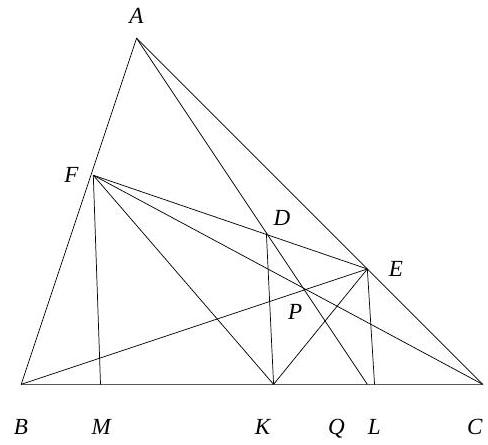\n\nSince the cevians $A Q, B E$ and $C F$ concur, we may write\n\n$$\n\\frac{B Q}{Q C}=\\frac{z}{y}, \\frac{C E}{E A}=\\frac{x}{z}, \\frac{A F}{F B}=\\frac{y}{x}\n$$\n\nWe observe that\n\n$$\n\\frac{F D}{D E}=\\frac{[A F D]}{[A E D]}=\\frac{[P F D]}{[P E D]}=\\frac{[A F P]}{[A E P]}\n$$\n\nHowever standard computations involving bases give\n\n$$\n[A F P]=\\frac{y}{y+x}[A B P], \\quad[A E P]=\\frac{z}{z+x}[A C P]\n$$\n\nand\n\n$$\n[A B P]=\\frac{z}{x+y+z}[A B C], \\quad[A C P]=\\frac{y}{x+y+z}[A B C]\n$$\n\nThus we obtain\n\n$$\n\\frac{F D}{D E}=\\frac{x+z}{x+y}\n$$\n\nOn the other hand\n\n$$\n\\tan \\alpha=\\frac{F M}{K M}=\\frac{F B \\sin B}{K M}, \\tan \\beta=\\frac{E L}{K L}=\\frac{E C \\sin C}{K L}\n$$\n\nUsing $F B=\\left(\\frac{x}{x+y}\\right) A B, E C=\\left(\\frac{x}{x+z}\\right) A C$ and $A B \\sin B=A C \\sin C$, we obtain\n\n$$\n\\begin{aligned}\n\\frac{\\tan \\alpha}{\\tan \\beta} & =\\left(\\frac{x+z}{x+y}\\right)\\left(\\frac{K L}{K M}\\right) \\\\\n& =\\left(\\frac{x+z}{x+y}\\right)\\left(\\frac{D E}{F D}\\right) \\\\\n& =\\left(\\frac{x+z}{x+y}\\right)\\left(\\frac{x+y}{x+z}\\right)=1\n\\end{aligned}\n$$\n\nWe conclude that $\\alpha=\\beta$.", "metadata": {"resource_path": "INMO/segmented/en-2003.jsonl", "problem_match": "\n1.", "solution_match": "\nSolution:"}} |
| {"year": "2003", "tier": "T3", "problem_label": "2", "problem_type": null, "exam": "INMO", "problem": "Find all primes $p$ and $q$, and even numbers $n>2$, satisfying the equation\n\n$$\np^{n}+p^{n-1}+\\cdots+p+1=q^{2}+q+1\n$$", "solution": "Obviously $p \\neq q$. We write this in the form\n\n$$\np\\left(p^{n-1}+p^{n-2}+\\cdots+1\\right)=q(q+1)\n$$\n\nIf $q \\leq p^{n / 2}-1$, then $q<p^{n / 2}$ and hence we see that $q^{2}<p^{n}$. Thus we obtain\n\n$$\nq^{2}+q<p^{n}+p^{n / 2}<p^{n}+p^{n-1}+\\cdots+p\n$$\n\nsince $n>2$. It follows that $q \\geq p^{n / 2}$. Since $n>2$ and is an even number, $n / 2$ is a natural number larger than 1 . This implies that $q \\neq p^{n / 2}$ by the given condition that $q$ is a prime. We conclude that $q \\geq p^{n / 2}+1$. We may also write the above relation in the form\n\n$$\np\\left(p^{n / 2}-1\\right)\\left(p^{n / 2}+1\\right)=(p-1) q(q+1)\n$$\n\nThis shows that $q$ divides $\\left(p^{n / 2}-1\\right)\\left(p^{n / 2}+1\\right)$. But $q \\geq p^{n / 2}+1$ and $q$ is a prime. Hence the only possibility is $q=p^{n / 2}+1$. This gives\n\n$$\np\\left(p^{n / 2}-1\\right)=(p-1)(q+1)=(p-1)\\left(p^{n / 2}+2\\right)\n$$\n\nSimplification leads to $3 p=p^{n / 2}+2$. This shows that $p$ divide 2. Thus $p=2$ and hence $q=5, n=4$. It is easy to verify that these indeed satisfy the given equation.", "metadata": {"resource_path": "INMO/segmented/en-2003.jsonl", "problem_match": "\n2.", "solution_match": "\nSolution:"}} |
| {"year": "2003", "tier": "T3", "problem_label": "3", "problem_type": null, "exam": "INMO", "problem": "Show that for every real number $a$ the equation\n\n$$\n8 x^{4}-16 x^{3}+16 x^{2}-8 x+a=0\n$$\n\nhas at least one non-real root and find the sum of all the non-real roots of the equation.", "solution": "Substituting $x=y+(1 / 2)$ in the equation, we obtain the equation in $y$ :\n\n$$\n8 y^{4}+4 y^{2}+a-\\frac{3}{2}=0\n$$\n\nUsing the transformation $z=y^{2}$, we get a quadratic equation in $z$ :\n\n$$\n8 z^{2}+4 z+a-\\frac{3}{2}=0\n$$\n\nThe discriminant of this equation is $32(2-a)$ which is nonnegative if and only if $a \\leq 2$. For $a \\leq 2$, we obtain the roots\n\n$$\nz_{1}=\\frac{-1+\\sqrt{2(2-a)}}{4}, \\quad z_{2}=\\frac{-1-\\sqrt{2(2-a)}}{4}\n$$\n\nFor getting real $y$ we need $z \\geq 0$. Obviously $z_{2}<0$ and hence it gives only non-real values of $y$. But $z_{1} \\geq 0$ if and only if $a \\leq \\frac{3}{2}$. In this case we obtain two real values for $y$ and hence two real roots for the original equation (1). Thus we conclude that there are two real roots and two non-real roots for $a \\leq \\frac{3}{2}$ and four non-real roots for $a>\\frac{3}{2}$. Obviously the sum of all the roots of the equation is 2 . For $a \\leq \\frac{3}{2}$, two real roots of (2) are given by $y_{1}=+\\sqrt{z_{1}}$ and $y_{2}=-\\sqrt{z_{1}}$. Hence the sum of real roots of (1) is given by $y_{1}+\\frac{1}{2}+y_{2}+\\frac{1}{2}$ which reduces to 1 . It follows the sum of the non-real roots of (1) for $a \\leq \\frac{3}{2}$ is also 1 . Thus\n\n$$\n\\text { The sum of nonreal roots }= \\begin{cases}1 & \\text { for } a \\leq \\frac{3}{2} \\\\ 2 & \\text { for } a>\\frac{3}{2}\\end{cases}\n$$", "metadata": {"resource_path": "INMO/segmented/en-2003.jsonl", "problem_match": "\n3.", "solution_match": "\nSolution:"}} |
| {"year": "2003", "tier": "T3", "problem_label": "4", "problem_type": null, "exam": "INMO", "problem": "Find all 7-digit numbers formed by using only the digits 5 and 7 , and divisible by both 5 and 7 .", "solution": "Clearly, the last digit must be 5 and we have to determine the remaining 6 digits. For divisibility by 7 , it is sufficient to consider the number obtained by replacing 7 by 0 ; for example 5775755 is divisible by 7 if and only 5005055 is divisible by 7 . Each such number is obtained by adding some of the numbers from the set $\\{50,500,5000,50000,500000,5000000\\}$ along with 5 . We look at the remainders of these when divided by 7 ; they are $\\{1,3,2,6,4,5\\}$. Thus it is sufficient to check for those combinations of\nremainders which add up to a number of the from $2+7 k$, since the last digit is already 5 . These are $\\{2\\},\\{3,6\\},\\{4,5\\},\\{2,3,4\\},\\{1,3,5\\},\\{1,2,6\\}$, $\\{2,3,5,6\\},\\{1,4,5,6\\}$ and $\\{1,2,3,4,6\\}$. These correspond to the numbers $7775775,7757575,5577775,7575575,5777555,7755755,5755575,5557755$, 755555 .", "metadata": {"resource_path": "INMO/segmented/en-2003.jsonl", "problem_match": "\n4.", "solution_match": "\nSolution:"}} |
| {"year": "2003", "tier": "T3", "problem_label": "5", "problem_type": null, "exam": "INMO", "problem": "Let $A B C$ be a triangle with sides $a, b, c$. Consider a triangle $A_{1} B_{1} C_{1}$ with sides equal to $a+\\frac{b}{2}, b+\\frac{c}{2}, c+\\frac{a}{2}$. Show that\n\n$$\n\\left[A_{1} B_{1} C_{1}\\right] \\geq \\frac{9}{4}[A B C]\n$$\n\nwhere $[X Y Z]$ denotes the area of the triangle $X Y Z$.", "solution": "It is easy to observe that there is a triangle with sides $a+\\frac{b}{2}$, $b+\\frac{c}{2}, c+\\frac{a}{2}$. Using Heron's formula, we get\n\n$$\n16[A B C]^{2}=(a+b+c)(a+b-c)(b+c-a)(c+a-b)\n$$\n\nand\n\n$$\n16\\left[A_{1} B_{1} C_{1}\\right]^{2}=\\frac{3}{16}(a+b+c)(-a+b+3 c)(-b+c+3 a)(-c+a+3 b)\n$$\n\nSince $a, b, c$ are the sides of a triangle, there are positive real numbers $p, q, r$ such that $a=q+r, b=r+p, c=p+q$. Using these relations we obtain\n\n$$\n\\frac{[A B C]^{2}}{\\left[A_{1} B_{1} C_{1}\\right]^{2}}=\\frac{16 p q r}{3(2 p+q)(2 q+r)(2 r+p)}\n$$\n\nThus it is sufficient to prove that\n\n$$\n(2 p+q)(2 q+r)(2 r+p) \\geq 27 p q r\n$$\n\nfor positive real numbers $p, q, r$. Using AM-GM inequality, we get\n\n$$\n2 p+q \\geq 3\\left(p^{2} q\\right)^{1 / 3}, 2 q+r \\geq 3\\left(q^{2} r\\right)^{1 / 3}, 2 r+p \\geq 3\\left(r^{2} p\\right)^{1 / 3}\n$$\n\nMultiplying these, we obtain the desired result. We also observe that equality holds if and only if $p=q=r$. This is equivalent to the statement that $A B C$ is equilateral.", "metadata": {"resource_path": "INMO/segmented/en-2003.jsonl", "problem_match": "\n5.", "solution_match": "\nSolution:"}} |
| {"year": "2003", "tier": "T3", "problem_label": "6", "problem_type": null, "exam": "INMO", "problem": "In a lottery, tickets are given nine-digit numbers using only the digits $1,2,3$. They are also coloured red, blue or green in such a way that two tickets whose numbers differ in all the nine places get different colours. Suppose\nthe ticket bearing the number 122222222 is red and that bearing the number 222222222 is green. Determine, with proof, the colour of the ticket bearing the number 123123123 .", "solution": "The following sequence of moves lead to the colour of the ticket bearing the number 123123123:\n\n| Line Number | Ticket Number | Colour | Reason |\n| :---: | :--- | :--- | :--- |\n| 1 | 122222222 | red | Given |\n| 2 | 222222222 | green | Given |\n| 3 | 313113113 | blue | Lines 1 \\& 2 |\n| 4 | 231331331 | green | Lines 1 \\& 3 |\n| 5 | 331331331 | blue | Lines 1 \\& 2 |\n| 6 | 123123123 | red | Lines 4 \\& 5 |\n\nIf 123123123 is reached by some other root, red colour must be obtained even along that root. For if for example 123123123 gets blue from some other root, then the following sequence leads to a contradiction:\n\n| Line Number | Ticket Number | Colour | Reason |\n| :---: | :--- | :--- | :--- |\n| 1 | 122222222 | red | Given |\n| 2 | 123123123 | blue | Given |\n| 3 | 231311311 | green | Lines 1 \\& 2 |\n| 4 | 211331311 | green | Lines 1 \\& 2 |\n| 5 | 332212212 | red | Lines 4 \\& 2 |\n| 6 | 113133133 | blue | Lines 3 \\& 5 |\n| 7 | 331331331 | green | Lines 1 \\& 2 |\n| 8 | 222222222 | red | Line 6 \\& 7 |\n\nThus the colour of 22222222 is red contradicting that it is grren.", "metadata": {"resource_path": "INMO/segmented/en-2003.jsonl", "problem_match": "\n6.", "solution_match": "\nSolution:"}} |
|
|


