| {"year": "2004", "tier": "T3", "problem_label": "1", "problem_type": null, "exam": "INMO", "problem": "Consider a convex quadrilateral $A B C D$, in which $K, L, M, N$ are the midpoints of the sides $A B$, $B C, C D, D A$ respectively. Suppose\n\n(a) $B D$ bisects $K M$ at $Q$;\n\n(b) $Q A=Q B=Q C=Q D$; and\n\n(c) $L K / L M=C D / C B$.\n\nProve that $A B C D$ is a square.", "solution": "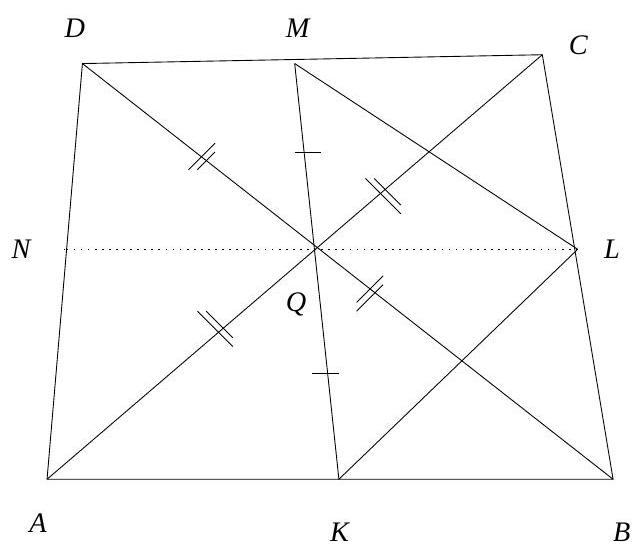\n\nFig. 1.\n\nObserve that $K L M N$ is a paralellogram, $Q$ is the midpoint of $M K$ and hence $N L$ also passes through $Q$. Let $T$ be the point of intersection of $A C$ and $B D$; and let $S$ be the point of intersection of $B D$ and $M N$.\n\nConsider the triangle $M N K$. Note that $S Q$ is parallel to $N K$ and $Q$ is the midpoint of $M K$. Hence $S$ is the mid-point of $M N$. Since $M N$ is parallel to $A C$, it follows that $T$ is the mid-point of $A C$. Now $Q$ is the circumcentre of $\\triangle A B C$ and the median $B T$ passes through $Q$. Here there are two possibilities:\n\n(i) $A B C$ is a right triangle with $\\angle A B C=90^{\\circ}$ and $T=Q$; and\n\n(ii) $T \\neq Q$ in which case $B T$ is perpendicular to $A C$.\n\nSuppose $\\angle A B C=90^{\\circ}$ and $T=Q$. Observe that $Q$ is the circumcentre of the triangle $D C B$ and hence $\\angle D C B=90^{\\circ}$. Similarly $\\angle D A B=90^{\\circ}$. It follows that $\\angle A D C=90^{\\circ}$. and $A B C D$ is a rectangle. This implies that $K L M N$ is a rhombus. Hence $L K / L M=1$ and this gives $C D=C B$. Thus $A B C D$ is a square.\n\nIn the second case, observe that $B D$ is perpendicular to $A C, K L$ is parallel to $A C$ and $L M$ is parallel to $B D$. Hence it follows that $M L$ is perpendicular to $L K$. Similar reasoning shows that $K L M N$ is a rectangle.\n\nUsing $L K / L M=C D / C B$, we get that $C B D$ is similar to $L M K$. In particular, $\\angle L M K=$ $\\angle C B D=\\alpha$ say. Since $L M$ is parallel to $D B$, we also get $\\angle B Q K=\\alpha$. Since $K L M N$ is a cyclic quadrilateral we also get $\\angle L N K=\\angle L M K=\\alpha$. Using the fact that $B D$ is parallel to $N K$, we get $\\angle L Q B=\\angle L N K=\\alpha$. Since $B D$ bisects $\\angle C B A$, we also have $\\angle K B Q=\\alpha$. Thus\n\n$$\nQ K=K B=B L=L Q\n$$\n\nand $B L$ is parallel to $Q K$. This gives $Q M$ is parallel to $L C$ and\n\n$$\nQ M=Q L=B L=L C\n$$\n\nIt follows that $Q L C M$ is a parallelogram. But $\\angle L C M=90^{\\circ}$. Hence $\\angle M Q L=90^{\\circ}$. This implies that $K L M N$ is a square. Also observe that $\\angle L Q K=90^{\\circ}$ and hence $\\angle C B A=\\angle L Q K=90^{\\circ}$. This gives $\\angle C D A=90^{\\circ}$ and hence $A B C D$ is a rectangle. Since $B A=B C$, it follows that $A B C D$ is a square.", "metadata": {"resource_path": "INMO/segmented/en-2004.jsonl", "problem_match": "\n1.", "solution_match": "## Solution:"}} |
| {"year": "2004", "tier": "T3", "problem_label": "2", "problem_type": null, "exam": "INMO", "problem": "Suppose $p$ is a prime greater than 3 . Find all pairs of integers $(a, b)$ satisfying the equation\n\n$$\na^{2}+3 a b+2 p(a+b)+p^{2}=0\n$$", "solution": "We write the equation in the form\n\n$$\na^{2}+2 a p+p^{2}+b(3 a+2 p)=0\n$$\n\nHence\n\n$$\nb=\\frac{-(a+p)^{2}}{3 a+2 p}\n$$\n\nis an integer. This shows that $3 a+2 p$ divides $(a+p)^{2}$ and hence also divides $(3 a+3 p)^{2}$. But, we have\n\n$$\n(3 a+3 p)^{2}=(3 a+2 p+p)^{2}=(3 a+2 p)^{2}+2 p(3 a+2 p)+p^{2}\n$$\n\nIt follows that $3 a+2 p$ divides $p^{2}$. Since $p$ is a prime, the only divisors of $p^{2}$ are $\\pm 1, \\pm p$ and $\\pm p^{2}$. Since $p>3$, we also have $p=3 k+1$ or $3 k+2$.\n\nCase 1: Suppose $p=3 k+1$. Obviously $3 a+2 p=1$ is not possible. Infact, we get $1=3 a+2 p=$ $3 a+2(3 k+1) \\Rightarrow 3 a+6 k=-1$ which is impossible. On the other hand $3 a+2 p=-1$ gives $3 a=-2 p-1=-6 k-3 \\Rightarrow a=-2 k-1$ and $a+p=-2 k-1+3 k+1=k$.\n\nThus $b=\\frac{-(a+p)^{2}}{(3 k+2 p)}=k^{2}$. Thus $(a, b)=\\left(-2 k-1, k^{2}\\right)$ when $p=3 k+1$. Similarly, $3 a+2 p=p \\Rightarrow$ $3 a=-p$ which is not possible. Considering $3 a+2 p=-p$, we get $3 a=-3 p$ or $a=-p \\Rightarrow b=0$. Hence $(a, b)=(-3 k-1,0)$ where $p=3 k+1$.\n\nLet us consider $3 a+2 p=p^{2}$. Hence $3 a=p^{2}-2 p=p(p-2)$ and neither $p$ nor $p-2$ is divisible by 3 . If $3 a+2 p=-p^{2}$, then $3 a=-p(p+2) \\Rightarrow a=-(3 k+1)(k+1)$.\n\nHence $a+p=(3 k+1)(-k-1+1)=-(3 k+1) k$. This gives $b=k^{2}$. Again $(a, b)=(-(k+$ 1) $\\left.(3 k+1), k^{2}\\right)$ when $p=3 k+1$.\n\nCase 2: Suppose $p=3 k-1$. If $3 a+2 p=1$, then $3 a=-6 k+3$ or $a=-2 k+1$. We also get\n\n$$\nb=\\frac{-(a+p)^{2}}{1}=\\frac{-(-2 k+1+3 k-1)^{2}}{1}=-k^{2}\n$$\n\nand we get the solution $(a, b)=\\left(-2 k+1, k^{2}\\right)$. On the other hand $3 a+2 p=-1$ does not have any solution integral solution for $a$. Similarly, there is no solution in the case $3 a+2 p=p$. Taking $3 a+2 p=-p$, we get $a=-p$ and hence $b=0$. We get the solution $(a, b)=(-3 k+1,0)$. If $3 a+2 p=p^{2}$, then $3 a=p(p-2)=(3 k-1)(3 k-3)$ giving $a=(3 k-1)(k-1)$ and hence $a+p=(3 k-1)(1+k-1)=k(3 k-1)$. This gives $b=-k^{2}$ and hence $(a, b)=\\left(3 k-1,-k^{2}\\right)$. Finally $3 a+2 p=-p^{2}$ does not have any solution.", "metadata": {"resource_path": "INMO/segmented/en-2004.jsonl", "problem_match": "\n2.", "solution_match": "\nSolution:"}} |
| {"year": "2004", "tier": "T3", "problem_label": "3", "problem_type": null, "exam": "INMO", "problem": "If $\\alpha$ is a real root of the equation $x^{5}-x^{3}+x-2=0$, prove that $\\left[\\alpha^{6}\\right]=3$. (For any real number $a$, we denote by $[a]$ the greatest integer not exceeding $a$.)", "solution": "Suppose $\\alpha$ is a real root of the given equation. Then\n\n$$\n\\alpha^{5}-\\alpha^{3}+\\alpha-2=0\n$$\n\nThis gives $\\alpha^{5}-\\alpha^{3}+\\alpha-1=1$ and hence $(\\alpha-1)\\left(\\alpha^{4}+\\alpha^{3}+1\\right)=1$. Observe that $\\alpha^{4}+\\alpha^{3}+1 \\geq$ $2 \\alpha^{2}+\\alpha^{3}=\\alpha^{2}(\\alpha+2)$. If $-1 \\leq \\alpha<0$, then $\\alpha+2>0$, giving $\\alpha^{2}(\\alpha+2)>0$ and hence $(\\alpha-1)\\left(\\alpha^{4}+\\alpha^{3}+1\\right)<0$. If $\\alpha<-1$, then $\\alpha^{4}+\\alpha^{3}=\\alpha^{3}(\\alpha+1)>0$ and hence $\\alpha^{4}+\\alpha^{3}+1>0$. This again gives $(\\alpha-1)\\left(\\alpha^{4}+\\alpha^{3}+1\\right)<0$.\n\nThe above resoning shows that for $\\alpha<0$, we have $\\alpha^{5}-\\alpha^{3}+\\alpha-1<0$ and hence cannot be equal to 1 . We conclude that a real root $\\alpha$ of $x^{5}-x^{3}+x-2=0$ is positive (obviously $\\alpha \\neq 0$ ).\n\nNow using $\\alpha^{5}-\\alpha^{3}+\\alpha-2=0$, we get\n\n$$\n\\alpha^{6}=\\alpha^{4}-\\alpha^{2}+2 \\alpha\n$$\n\nThe statement $\\left[\\alpha^{6}\\right]=3$ is equivalent to $3 \\leq \\alpha^{6}<4$.\n\nConsider $\\alpha^{4}-\\alpha^{2}+2 \\alpha<4$. Since $\\alpha>0$, this is equivalent to $\\alpha^{5}-\\alpha^{3}+2 \\alpha^{2}<4 \\alpha$. Using the relation (1), we can write $2 \\alpha^{2}-\\alpha+2<4 \\alpha$ or $2 \\alpha^{2}-5 \\alpha+2<0$. Treating this as a quadratic, we get this is equivalent to $\\frac{1}{2}<\\alpha<2$. Now observe that if $\\alpha \\geq 2$ then $1=(\\alpha-1)\\left(\\alpha^{4}+\\alpha^{3}+1\\right) \\geq 25$ which is impossible. If $0<\\alpha \\leq \\frac{1}{2}$, then $1=(\\alpha-1)\\left(\\alpha^{4}+\\alpha^{3}+1\\right)<0$ which again is impossible. We conlude that $\\frac{1}{2}<\\alpha<2$. Similarly $\\alpha^{4}-\\alpha^{2}+2 \\alpha \\geq 3$ is equivalent to $\\alpha^{5}-\\alpha^{3}+2 \\alpha^{2}-3 \\alpha \\geq 0$ which is equivalent to $2 \\alpha^{2}-4 \\alpha+2 \\geq 0$. But this is $2(\\alpha-1)^{2} \\geq 0$ which is valid. Hence $3 \\leq \\alpha^{6}<4$ and we get $\\left[\\alpha^{6}\\right]=3$.", "metadata": {"resource_path": "INMO/segmented/en-2004.jsonl", "problem_match": "\n3.", "solution_match": "\nSolution:"}} |
| {"year": "2004", "tier": "T3", "problem_label": "4", "problem_type": null, "exam": "INMO", "problem": "Let $R$ denote the circumradius of a triangle $A B C ; a, b, c$ its sides $B C, C A, A B$; and $r_{a}, r_{b}, r_{c}$ its exradii opposite $A, B, C$. If $2 R \\leq r_{a}$, prove that\n\n(i) $a>b$ and $a>c$;\n\n(ii) $2 R>r_{b}$ and $2 R>r_{c}$.", "solution": "We know that $2 R=\\frac{a b c}{2 \\triangle}$ and $r_{a}=\\frac{\\triangle}{s-a}$, where $a, b, c$ are the sides of the triangle $A B C$, $s=\\frac{a+b+c}{2}$ and $\\triangle$ is the area of $A B C$. Thus the given condition $2 R \\leq r_{a}$ translates to\n\n$$\na b c \\leq \\frac{2 \\triangle^{2}}{s-a}\n$$\n\nPutting $s-a=p, s-b=q, s-c=r$, we get $a=q+r, b=r+p, c=p+q$ and the condition now is\n\n$$\np(p+q)(q+r)(r+p) \\leq 2 \\triangle^{2}\n$$\n\nBut Heron's formula gives, $\\triangle^{2}=s(s-a)(s-b)(s-c)=p q r(p+q+r)$. We obtain $(p+q)(q+$ $r)(r+p) \\leq 2 q r(p+q+r)$. Expanding and effecting some cancellations, we get\n\n$$\np^{2}(q+r)+p\\left(q^{2}+r^{2}\\right) \\leq q r(q+r)\n$$\n\nSuppose $a \\leq b$. This implies that $q+r \\leq r+p$ and hence $q \\leq p$. This implies that $q^{2} r \\leq p^{2} r$ and $q r^{2} \\leq p r^{2}$ giving $q r(q+r) \\leq p^{2} r+p r^{2}<p^{2} r+p r^{2}+p^{2} q+p q^{2}=p^{2}(q+r)+p\\left(q^{2}+r^{2}\\right)$ which contradicts $(\\star)$. Similarly, $a \\leq c$ is also not possible. This proves (i).\n\nSuppose $2 R \\leq r_{b}$. As above this takes the form\n\n$$\nq^{2}(r+p)+q\\left(r^{2}+p^{2}\\right) \\leq p r(p+r)\n$$\n\nSince $a>b$ and $a>c$, we have $q>p, r>p$. Thus $q^{2} r>p^{2} r$ and $q r^{2}>p r^{2}$. Hence\n\n$$\nq^{2}(r+p)+q\\left(r^{2}+p^{2}\\right)>q^{2} r+q r^{2}>p^{2} r+p r^{2}=p r(p+r)\n$$\n\nwhich contradicts ( $\\star \\star$ ). Hence $2 R>r_{b}$. Similarly, we can prove that $2 R>r_{c}$. This proves (ii)", "metadata": {"resource_path": "INMO/segmented/en-2004.jsonl", "problem_match": "\n4.", "solution_match": "\nSolution:"}} |
| {"year": "2004", "tier": "T3", "problem_label": "5", "problem_type": null, "exam": "INMO", "problem": "Let $S$ denote the set of all 6-tuples $(a, b, c, d, e, f)$ of positive integers such that $a^{2}+b^{2}+c^{2}+d^{2}+e^{2}=$ $f^{2}$. Consider the set\n\n$$\nT=\\{a b c d e f:(a, b, c, d, e, f) \\in S\\}\n$$\n\nFind the greatest common divisor of all the members of $T$.", "solution": "We show that the required gcd is 24 . Consider an element $(a, d, c, d, e, f) \\in S$. We have\n\n$$\na^{2}+b^{2}+c^{2}+d^{2}+e^{2}=f^{2}\n$$\n\nWe first observe that not all $a, b, c, d, e$ can be odd. Otherwise, we have $a^{2} \\equiv b^{2} \\equiv c^{2} \\equiv d^{2} \\equiv e^{2} \\equiv 1$ $(\\bmod 8)$ and hence $f^{2} \\equiv 5(\\bmod 8)$, which is impossible because no square can be congruent to 5 modulo 8. Thus at least one of $a, b, c, d, e$ is even.\n\nSimilarly if none of $a, b, c, d, e$ is divisible by 3 , then $a^{2} \\equiv b^{2} \\equiv c^{2} \\equiv d^{2} \\equiv e^{2} \\equiv 1(\\bmod 3)$ and hence $f^{2} \\equiv 2(\\bmod 3)$ which again is impossible because no square is congruent to 2 modulo 3 . Thus 3 divides $a b c d e f$.\n\nThere are several possibilities for $a, b, c, d, e$.\n\nCase 1: Suppose one of them is even and the other four are odd; say $a$ is even, $b, c, d, e$ are odd. Then $b^{2}+c^{2}+d^{2}+e^{2} \\equiv 4(\\bmod 8)$. If $a^{2} \\equiv 4(\\bmod 8)$, then $f^{2} \\equiv 0(\\bmod 8)$ and hence $2|a, 4| f$ giving $8 \\mid a f$. If $a^{2} \\equiv 0(\\bmod 8)$, then $f^{2} \\equiv 4(\\bmod 8)$ which again gives that $4 \\mid a$ and $2 \\mid f$ so that $8 \\mid a f$. It follows that $8 \\mid a b c d e f$ and hence $24 \\mid a b c d e f$.\n\nCase 2: Suppose $a, b$ are even and $c, d, e$ are odd. Then $c^{2}+d^{2}+e^{2} \\equiv 3(\\bmod 8)$. Since $a^{2}+b^{2} \\equiv 0$ or 4 modulo 8 , it follows that $f^{2} \\equiv 3$ or $7(\\bmod 8)$ which is impossible. Hence this case does not arise.\n\nCase 3: If three of $a, b, c, d, e$ are even and two odd, then $8 \\mid a b c d e f$ and hence 24|abcdef.\n\nCase 4: If four of $a, b, c, d, e$ are even, then again $8 \\mid a b c d e f$ and 24|abcdef. Here again for any six tuple $(a, b, c, d, e, f)$ in $S$, we observe that $24 \\mid a b c d e f$. Since\n\n$$\n1^{2}+1^{2}+1^{2}+2^{2}+3^{2}=4^{2}\n$$\n\nWe see that $(1,1,1,2,3,4) \\in S$ and hence $24 \\in T$. Thus 24 is the gcd of $T$.", "metadata": {"resource_path": "INMO/segmented/en-2004.jsonl", "problem_match": "\n5.", "solution_match": "\nSolution:"}} |
| {"year": "2004", "tier": "T3", "problem_label": "6", "problem_type": null, "exam": "INMO", "problem": "Prove that the number of 5 -tuples of positive integers $(a, b, c, d, e)$ satisfying the equation\n\n$$\na b c d e=5(b c d e+a c d e+a b d e+a b c e+a b c d)\n$$\n\nis an odd integer.", "solution": "We write the equation in the form:\n\n$$\n\\frac{1}{a}+\\frac{1}{b}+\\frac{1}{c}+\\frac{1}{d}+\\frac{1}{e}=\\frac{1}{5}\n$$\n\nThe number of five tuple ( $a, b, c, d, e)$ which satisfy the given relation and for which $a \\neq b$ is even, because for if $(a, b, c, d, e)$ is a solution, then so is $(b, a, c, d, e)$ which is distinct from $(a, b, c, d, e)$. Similarly the number of five tuples which satisfy the equation and for which $c \\neq d$ is also even. Hence it suffices to count only those five tuples $(a, b, c, d, e)$ for which $a=b, c=d$. Thus the equation reduces to\n\n$$\n\\frac{2}{a}+\\frac{2}{c}+\\frac{1}{e}=\\frac{1}{5}\n$$\n\nHere again the tuple ( $a, a, c, c, e)$ for which $a \\neq c$ is even because we can associate different solution $(c, c, a, a, e)$ to this five tuple. Thus it suffices to consider the equation\n\n$$\n\\frac{4}{a}+\\frac{1}{e}=\\frac{1}{5}\n$$\n\nand show that the number of pairs $(a, e)$ satisfying this equation is odd.\n\nThis reduces to\n\n$$\na e=20 e+5 a\n$$\n\nor\n\n$$\n(a-20)(e-5)=100\n$$\n\nBut observe that\n\n$$\n\\begin{aligned}\n& 100=1 \\times 100=2 \\times 50=4 \\times 25=5 \\times 20 \\\\\n& \\quad=10 \\times 10=20 \\times 5=25 \\times 4=50 \\times 2=100 \\times 1\n\\end{aligned}\n$$\n\nNote that no factorisation of 100 as product of two negative numbers yield a positive tuple $(a, e)$. Hence we get these 9 solutions. This proves that the total number of five tuples $(a, b, c, d, e)$ satisfying the given equation is odd.", "metadata": {"resource_path": "INMO/segmented/en-2004.jsonl", "problem_match": "\n6.", "solution_match": "\nSolution:"}} |
|
|


