| {"year": "2006", "tier": "T3", "problem_label": "1", "problem_type": null, "exam": "INMO", "problem": "In a non-equilateral triangle $A B C$, the sides $a, b, c$ form an arithmetic progression. Let $I$ and $O$ denote the incentre and circumcentre of the triangle respectively.\n\n(i) Prove that $I O$ is perpendicular to $B I$.\n\n(ii) Suppose $B I$ extended meets $A C$ in $K$, and $D, E$ are the midpoints of $B C, B A$ respectively. Prove that $I$ is the circumcentre of triangle $D K E$.", "solution": "(i) Extend $B I$ to meet the circumcircle in $F$. Then we know that $F A=F I=F C$. (See Figure)\n\n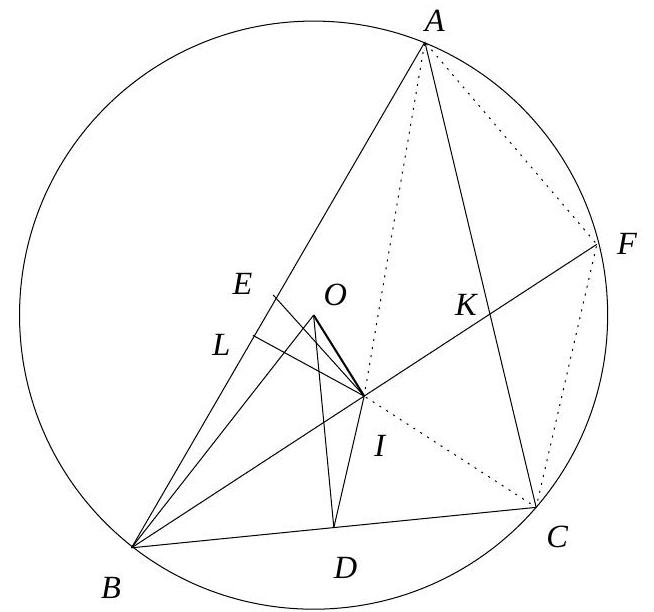\n\nLet $B I: I F=\\lambda: \\mu$. Applying Stewart's theorem to triangle $B A F$, we get\n\n$$\n\\lambda A F^{2}+\\mu A B^{2}=(\\lambda+\\mu)\\left(A I^{2}+B I \\cdot I F\\right)\n$$\n\nSimilarly, Stewart's theorem to triangle $B C F$ gives\n\n$$\n\\lambda C F^{2}+\\mu B C^{2}=(\\lambda+\\mu)\\left(C I^{2}+B I \\cdot I F\\right)\n$$\n\nSince $C F=A F$, subtraction gives\n\n$$\n\\mu\\left(A B^{2}-B C^{2}\\right)=(\\lambda+\\mu)\\left(A I^{2}-C I^{2}\\right)\n$$\n\nUsing the standard notations $A B=c, B C=a, C A=b$ and $s=(a+b+c) / 2$, we get $A I^{2}=r^{2}+(s-a)^{2}$ and $C I^{2}=r^{2}+(s-c)^{2}$ where $r$ is the in-radius of $A B C$. Thus\n\n$$\n\\mu\\left(c^{2}-a^{2}\\right)=(\\lambda+\\mu)\\left((s-a)^{2}-(s-c)^{2}\\right)=(\\lambda+\\mu)(c-a) b\n$$\n\nIt follows that either $c=a$ or $\\mu(c+a)=(\\lambda+\\mu) b$. But $c=a$ implies that $a=b=c$ since $a, b, c$ are in arithmetic progression. However, we have taken a non-equilateral triangle $A B C$. Thus $c \\neq a$ and we have $\\mu(c+a)=(\\lambda+\\mu) b$. But $c+a=2 b$ and we obtain\n$2 b \\mu=(\\lambda+\\mu) b$. We conclude that $\\lambda=\\mu$. This in turn tells that $I$ is the mid-point of $B F$. Since $O F=O B$, we conclude that $O I$ is perpendicular to $B F$.\n\n## Alternatively\n\nApplying Ptolemy's theorem to the cyclic quadrilateral $A B C F$, we get\n\n$$\nA B \\cdot C F+A F \\cdot B C=B F \\cdot C A\n$$\n\nSince $C F=A F$, we get $C F(c+a)=B F \\cdot b=B F(c+a) / 2$. This gives $B F=2 C F=2 I F$. Hence $I$ is the mid-point of $B F$ and as earlier we conclude that $O I$ is perpendicular to $B F$.\n\n## Alternatively\n\nJoin $B O$. We have to prove that $\\angle B I O=90^{\\circ}$, which is equivalent to $B I^{2}+I O^{2}=B O^{2}$. Draw $I L$ perpendicular to $A B$. Let $R$ denote the circumradius of $A B C$ and let $\\triangle$ denote its area. Observe that $B O=R, I O^{2}=R^{2}-2 R r$,\n\n$$\nB I=\\frac{B L}{\\cos (B / 2)}=(s-b) \\sqrt{\\frac{c a}{s(s-b)}}\n$$\n\nThus we obtain\n\n$$\nB I^{2}=a c(s-b) / s=\\frac{a c}{3}\n$$\n\nsince $a, b, c$ are in arithmetic progression. Thus we need to prove that\n\n$$\n\\frac{a c}{3}+R^{2}-2 R r=R^{2}\n$$\n\nThis reduces to proving $2 R r=a c / 3$. But\n\n$$\n2 R r=2 \\cdot \\frac{a b c}{4 \\Delta} \\cdot \\frac{\\Delta}{s}=\\frac{a b c}{2 s}=\\frac{a b c}{a+b+c}=\\frac{a c}{3}\n$$\n\nusing $a+c=2 b$. This proves the claim.\n\n(ii) Join $I D$. Note that $\\angle B I O=\\angle B D O=90^{\\circ}$. Hence $B, D, I, O$ are concyclic and hence $\\angle B I D=\\angle B O D=A$. Since $\\angle D B I=\\angle K B A=B / 2$, it follows that triangles $B A K$ and $B I D$ are similar. This gives\n\n$$\n\\frac{B A}{B I}=\\frac{B K}{B D}=\\frac{A K}{I D}\n$$\n\nHowever, we have seen earlier that $B I=a c / 3$. Moreover $A K=b c /(a+c)$. Thus we obtain\n\n$$\nB K=\\frac{B A \\cdot B D}{B I}=\\frac{1}{2} \\sqrt{3 a c}, \\quad I D=\\frac{A K \\cdot B I}{B A}=\\frac{1}{2} \\sqrt{\\frac{a c}{3}} .\n$$\n\nBy symmetry, we must have $I E=\\frac{1}{2} \\sqrt{\\frac{a c}{3}}$. Finally\n\n$$\nI K=\\frac{b}{a+b+c} \\cdot B K=\\frac{1}{3} B K=\\frac{1}{2} \\sqrt{\\frac{a c}{3}}\n$$\n\nThus $I D=I E=I K$ and $I$ is the circumcentre of $D K E$.\n\n## Alternatively\n\nObserve that $A K=b c /(a+c)=c / 2=A E$. Since $A I$ bisects angle $A$, we see that $A I E$ is congruent to $A I K$. This gives $I E=I K$. Similarly $C I D$ is congruent to $C I K$ giving $I D=I K$. We conclude that $I D=I K=I E$.", "metadata": {"resource_path": "INMO/segmented/en-2006.jsonl", "problem_match": "\n1.", "solution_match": "## Solution:"}} |
| {"year": "2006", "tier": "T3", "problem_label": "2", "problem_type": null, "exam": "INMO", "problem": "Prove that for every positive integer $n$ there exists a unique ordered pair $(a, b)$ of positive integers such that\n\n$$\nn=\\frac{1}{2}(a+b-1)(a+b-2)+a\n$$", "solution": "We have to prove that $f: \\mathbb{N} \\times \\mathbb{N} \\rightarrow \\mathbb{N}$ defined by\n\n$$\nf(a, b)=\\frac{1}{2}(a+b-1)(a+b-2)+a, \\quad \\forall a, b \\in \\mathbb{N}\n$$\n\nis a bijection. (Note that the right side is a natural number.) To this end define\n\n$$\nT(n)=\\frac{n(n+1)}{2}, \\quad n \\in \\mathbb{N} \\cup\\{0\\}\n$$\n\nAn idea of the proof can be obtained by looking at the following table of values of $f(a, b)$ for some small values of $a, b$.\n\n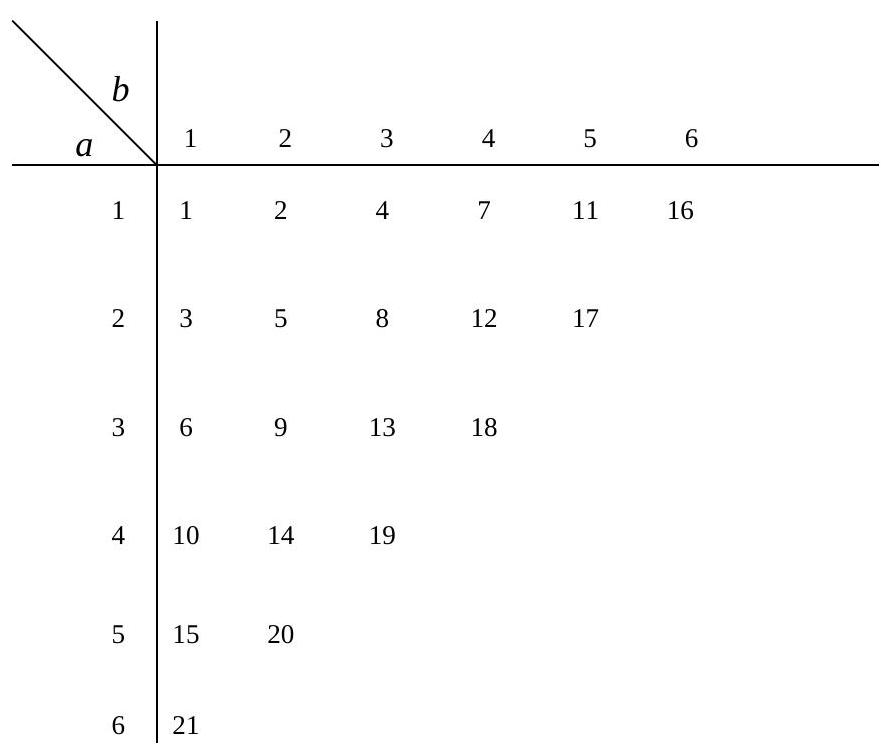\n\nWe observe that the $n$-th diagonal runs from $(1, n)$-th position to $(n, 1)$-th position and the entries are $n$ consecutive integers; the first entry in the $n$-th diagonal is one more than the last entry of the $(n-1)$-th diagonal. For example the first entry in 5 -th diagonal is 11 which is one more than the last entry of 4 -th diagonal which is 10 . Observe that 5 -th diagonal starts from 11 and ends with 15 which accounts for 5 consecutive natural numbers. Thus we see that $f(n-1,1)+1=f(1, n)$. We also observe that the first $n$ diagonals exhaust all the natural numbers from 1 to $T(n)$. (Thus a kind of visual bijection is already there. We formally prove the property.)\n\nWe first observe that\n\n$$\nf(a, b)-T(a+b-2)=a>0\n$$\n\nand\n\n$$\nT(a+b-1)-f(a, b)=\\frac{(a+b-1)(a+b)}{2}-\\frac{(a+b-1)(a+b-2)}{2}-a=b-1 \\geq 0\n$$\n\nThus we have\n\n$$\nT(a+b-2)<f(a, b)=\\frac{(a+b-1)(a+b-2)}{2}+a \\leq T(a+b-1)\n$$\n\nSuppose $f\\left(a_{1}, b_{1}\\right)=f\\left(a_{2}, b_{2}\\right)$. Then the previous observation shows that\n\n$$\n\\begin{aligned}\n& T\\left(a_{1}+b_{1}-2\\right)<f\\left(a_{1}, b_{1}\\right) \\leq T\\left(a_{1}+b_{1}-1\\right) \\\\\n& T\\left(a_{2}+b_{2}-2\\right)<f\\left(a_{2}, b_{2}\\right) \\leq T\\left(a_{2}+b_{2}-1\\right)\n\\end{aligned}\n$$\n\nSince the sequence $\\langle T(n)\\rangle_{n=0}^{\\infty}$ is strictly increasing, it follows that $a_{1}+b_{1}=a_{2}+b_{2}$. But then the relation $f\\left(a_{1}, b_{1}\\right)=f\\left(a_{2}, b_{2}\\right)$ implies that $a_{1}=a_{2}$ and $b_{1}=b_{2}$. Hence $f$ is one-one.\n\nLet $n$ be any natural number. Since the sequence $\\langle T(n)\\rangle_{n=0}^{\\infty}$ is strictly increasing, we can find a natural number $k$ such that\n\n$$\nT(k-1)<n \\leq T(k)\n$$\n\nEquivalently,\n\n$$\n\\frac{(k-1) k}{2}<n \\leq \\frac{k(k+1)}{2}\n$$\n\nNow set $a=n-\\frac{k(k-1)}{2}$ and $b=k-a+1$. Observe that $a>0$. Now (1) shows that\n\n$$\na=n-\\frac{k(k-1)}{2} \\leq \\frac{k(k+1)}{2}-\\frac{k(k-1)}{2}=k\n$$\n\nHence $b=k-a+1 \\geq 1$. Thus $a$ and $b$ are both positive integers and\n\n$$\nf(a, b)=\\frac{1}{2}(a+b-1)(a+b-2)+a=\\frac{k(k-1)}{2}+a=n\n$$\n\nThis shows that every natural number is in the range of $f$. Thus $f$ is also onto. We conclude that $f$ is a bijection.", "metadata": {"resource_path": "INMO/segmented/en-2006.jsonl", "problem_match": "\n2.", "solution_match": "\nSolution:"}} |
| {"year": "2006", "tier": "T3", "problem_label": "3", "problem_type": null, "exam": "INMO", "problem": "Let $X$ denote the set of all triples $(a, b, c)$ of integers. Define a function $f: X \\rightarrow X$ by\n\n$$\nf(a, b, c)=(a+b+c, a b+b c+c a, a b c)\n$$\n\nFind all triples $(a, b, c)$ in $X$ such that $f(f(a, b, c))=(a, b, c)$.", "solution": "We show that the solutionset consists of $\\{(t, 0,0) ; t \\in \\mathbb{Z}\\} \\cup\\{(-1,-1,1)\\}$. Let us put $a+b+c=d, a b+b c+c a=e$ and $a b c=f$. The given condition $f(f(a, b, c))=(a, b, c)$ implies that\n\n$$\nd+e+f=a, \\quad d e+e f+f d=b, d e f=c\n$$\n\nThus $a b c d e f=f c$ and hence either $c f=0$ or $a b d e=1$.\n\nCase I: Suppose $c f=0$. Then either $c=0$ or $f=0$. However $c=0$ implies $f=0$ and vice-versa. Thus we obtain $a+b=d, d+e=a, a b=e$ and $d e=b$. The first two relations give $b=-e$. Thus $e=a b=-a e$ and $d e=b=-e$. We get either $e=0$ or $a=d=-1$.\n\nIf $e=0$, then $b=0$ and $a=d=t$, say. We get the triple $(a, b, c)=(t, 0,0)$, where $t \\in \\mathbb{Z}$. If $e \\neq 0$, then $a=d=-1$. But then $d+e+f=a$ implies that $-1+e+0=-1$ forcing $e=0$. Thus we get the solution family $(a, b, c)=(t, 0,0)$, where $t \\in \\mathbb{Z}$.\n\nCase II: Suppose $c f \\neq 0$. In this case $a b d e=1$. Hence either all are equal to 1 ; or two equal to 1 and the other two equal to -1 ; or all equal to -1 .\n\nSuppose $a=b=d=e=1$. Then $a+b+c=d$ shows that $c=-1$. Similarly $f=-1$. Hence $e=a b+b c+c a=1-1-1=-1$ contradicting $e=1$.\n\nSuppose $a=b=1$ and $d=e=-1$. Then $a+b+c=d$ gives $c=-3$ and $d+e+f=a$ gives $f=3$. But then $f=a b c=1 \\cdot 1 \\cdot(-3)=-3$, a contradiction. Similarly $a=b=-1$ and $d=e=1$ is not possible.\n\nIf $a=1, b=-1, d=1$, $e=-1$, then $a+b+c=d$ gives $c=1$. Similarly $f=1$. But then $f=a b c=1 \\cdot 1 \\cdot(-1)=-1$ a contradiction. If $a=1, b=-1, d=-1, e=1$, then $c=-1$ and $e=a b+b c+c a=-1+1-1=-1$ and a contradiction to $e=1$. The symmetry between $(a, b, c)$ and $(d, e, f)$ shows that $a=-1, b=1, d=1, e=-1$ is not possible. Finally if $a=-1, b=1, d=-1$ and $e=1$, then $c=-1$ and $f=-1$. But then $f=a b c$ is not satisfied.\n\nThe only case left is that of $a, b, d, e$ being all equal to -1 . Then $c=1$ and $f=1$. It is easy to check that $(-1,-1,1)$ is indeed a solution.\n\n## Alternatively\n\n$c f \\neq 0$ implies that $|c| \\geq 1$ and $|f| \\geq 1$. Observe that\n\n$$\nd^{2}-2 e=a^{2}+b^{2}+c^{2}, \\quad a^{2}-2 b=d^{2}+e^{2}+f^{2}\n$$\n\nAdding these two, we get $-2(b+e)=b^{2}+c^{2}+e^{2}+f^{2}$. This may be written in the form\n\n$$\n(b+1)^{2}+(e+1)^{2}+c^{2}+f^{2}-2=0\n$$\n\nWe conclude that $c^{2}+f^{2} \\leq 2$. Using $|c| \\geq 1$ and $|f| \\geq 1$, we obtain $|c|=1$ and $|f|=1$, $b+1=0$ and $e+1=0$. Thus $b=e=-1$. Now $a+d=d+e+f+a+b+c$ and this gives $b+c+e+f=0$. It follows that $c=f=1$ and finally $a=d=-1$.", "metadata": {"resource_path": "INMO/segmented/en-2006.jsonl", "problem_match": "\n3.", "solution_match": "\nSolution:"}} |
| {"year": "2006", "tier": "T3", "problem_label": "4", "problem_type": null, "exam": "INMO", "problem": "Some 46 squares are randomly chosen from a $9 \\times 9$ chess board and are coloured red. Show that there exists a $2 \\times 2$ block of 4 squares of which at least three are coloured red.", "solution": "Consider a partition of $9 \\times 9$ chess board using sixteen $2 \\times 2$ block of 4 squares\n\n| 1 | 2 | | |\n| :---: | :---: | :---: | :---: |\n| 7 | 6 | 5 | |\n| 8 | 9 | | 10 |\n| | | | |\n| 10 | | | |\n| | 1 | 1 | 13 |\n\neach and remaining seventeen single squares as shown in the figure below.\n\nIf any one of these 16 big squares contain 3 red squares then we are done. On the contrary, each may contain at most 2 red squares and these account for at most $16 \\cdot 2=32$ red squares. Then there are 17 single squares connected in zig-zag fashion. It looks as follows:\n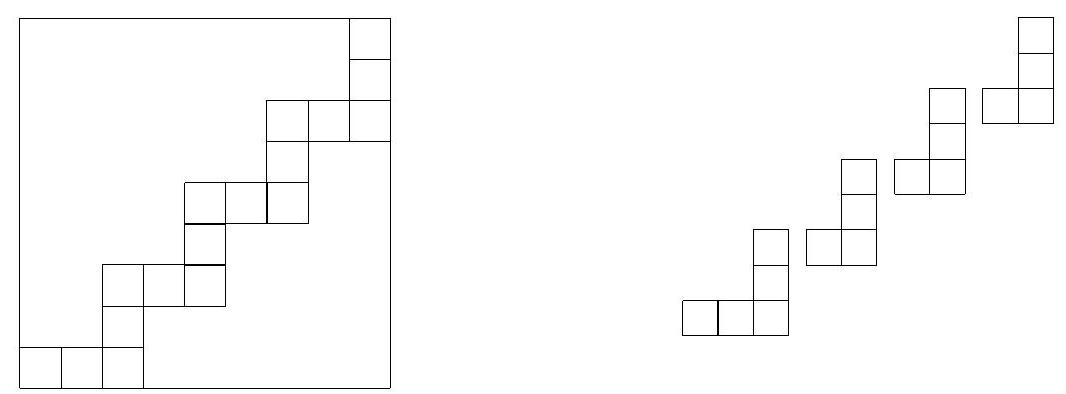\n\nWe split this again in to several mirror images of L-shaped figures as shown above. There are four such forks. If all the five unit squares of the first fork are red, then we can get a $2 \\times 2$ square having three red squares. Hence there can be at most four unit squares having red colour. Similarly, there can be at most three red squares from each of the remaining three forks. Together we get $4+3 \\cdot 3=13$ red squares. These together with 32 from the big squares account for only 45 red squares. But we know that 46 squares have red colour. The conclusion follows.", "metadata": {"resource_path": "INMO/segmented/en-2006.jsonl", "problem_match": "\n4.", "solution_match": "\nSolution:"}} |
| {"year": "2006", "tier": "T3", "problem_label": "5", "problem_type": null, "exam": "INMO", "problem": "In a cyclic quadrilateral $A B C D, A B=a, B C=b, C D=c, \\angle A B C=120^{\\circ}$, and $\\angle A B D=$ $30^{\\circ}$. Prove that\n\n(i) $c \\geq a+b$;\n\n(ii) $|\\sqrt{c+a}-\\sqrt{c+b}|=\\sqrt{c-a-b}$.", "solution": "Applying cosine rule to triangle $A B C$, we get\n\n$$\nA C^{2}=a^{2}+b^{2}-2 a b \\cos 120^{\\circ}=a^{2}+b^{2}+a b\n$$\n\nObserve that $\\angle D A C=\\angle D B C=120^{\\circ}-30^{\\circ}=90^{\\circ}$. Thus we get\n\n$$\nc^{2}=\\frac{A C^{2}}{\\cos ^{2} 30^{\\circ}}=\\frac{4}{3}\\left(a^{2}+b^{2}+a b\\right)\n$$\n\nSo\n\n$$\nc^{2}-(a+b)^{2}=\\frac{4}{3}\\left(a^{2}+b^{2}+a b\\right)-\\left(a^{2}+b^{2}+2 a b\\right)=\\frac{(a-b)^{2}}{3} \\geq 0\n$$\n\nThis proves $c \\geq a+b$ and thus (i) is true.\n\n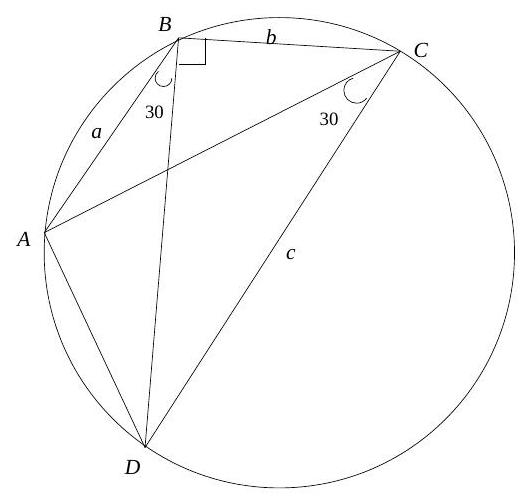\n\nFor proving (ii), consider the product\n\n$$\nQ=(\\alpha+\\beta+\\gamma)(\\alpha-\\beta-\\gamma)(\\alpha+\\beta-\\gamma)(\\alpha-\\beta+\\gamma)\n$$\n\nwhere $\\alpha=\\sqrt{c+a}, \\beta=\\sqrt{c+b}$ and $\\gamma=\\sqrt{c-a-b}$. Expanding the product, we get\n\n$$\n\\begin{aligned}\nQ & =(c+a)^{2}+(c+b)^{2}+(c-a-b)^{2}-2(c+a)(c+b)-2(c+a)(c-a-b)-2(c+b)(c-a-b) \\\\\n& =-3 c^{2}+4 a^{2}+4 b^{2}+4 a b \\\\\n& =0\n\\end{aligned}\n$$\n\nThus at least one of the factors must be equal to 0 . Since $\\alpha+\\beta+\\gamma>0$ and $\\alpha+\\beta-\\gamma>0$, it follows that the product of the remaining two factors is 0 . This gives\n\n$$\n\\sqrt{c+a}-\\sqrt{c+b}=\\sqrt{c-a-b} \\text { or } \\sqrt{c+a}-\\sqrt{c+b}=-\\sqrt{c-a-b}\n$$\n\nWe conclude that\n\n$$\n|\\sqrt{c+a}-\\sqrt{c+b}|=\\sqrt{c-a-b}\n$$", "metadata": {"resource_path": "INMO/segmented/en-2006.jsonl", "problem_match": "\n5.", "solution_match": "## Solution:"}} |
| {"year": "2006", "tier": "T3", "problem_label": "6", "problem_type": null, "exam": "INMO", "problem": "(a) Prove that if $n$ is a positive integer such that $n \\geq 4011^{2}$, then there exists an integer $l$ such that $n<l^{2}<\\left(1+\\frac{1}{2005}\\right) n$.\n\n(b) Find the smallest positive integer $M$ for which whenever an integer $n$ is such that $n \\geq M$, there exists an integer $l$, such that $n<l^{2}<\\left(1+\\frac{1}{2005}\\right) n$.", "solution": "(a) Let $n \\geq 4011^{2}$ and $m \\in \\mathbb{N}$ be such that $m^{2} \\leq n<(m+1)^{2}$. Then\n\n$$\n\\begin{aligned}\n\\left(1+\\frac{1}{2005}\\right) n-(m+1)^{2} & \\geq\\left(1+\\frac{1}{2005}\\right) m^{2}-(m+1)^{2} \\\\\n& =\\frac{m^{2}}{2005}-2 m-1 \\\\\n& =\\frac{1}{2005}\\left(m^{2}-4010 m-2005\\right) \\\\\n& =\\frac{1}{2005}\\left((m-2005)^{2}-2005^{2}-2005\\right) \\\\\n& \\geq \\frac{1}{2005}\\left((4011-2005)^{2}-2005^{2}-2005\\right) \\\\\n& =\\frac{1}{2005}\\left(2006^{2}-2005^{2}-2005\\right) \\\\\n& =\\frac{1}{2005}(4011-2005)=\\frac{2006}{2005}>0\n\\end{aligned}\n$$\n\nThus we get\n\n$$\nn<(m+1)^{2}<\\left(1+\\frac{1}{2005}\\right) n\n$$\n\nand $l^{2}=(m+1)^{2}$ is the desired square.\n(b) We show that $M=4010^{2}+1$ is the required least number. Suppose $n \\geq M$. Write $n=4010^{2}+k$, where $k$ is a positive integer. Note that we may assume $n<4011^{2}$ by part (a). Now\n\n$$\n\\begin{aligned}\n\\left(1+\\frac{1}{2005}\\right) n-4011^{2} & =\\left(1+\\frac{1}{2005}\\right)\\left(4010^{2}+k\\right)-4011^{2} \\\\\n& =4010^{2}+2 \\cdot 4010+k+\\frac{k}{2005}-4011^{2} \\\\\n& =(4010+1)^{2}+(k-1)+\\frac{k}{2005}-4011^{2} \\\\\n& =(k-1)+\\frac{k}{2005}>0\n\\end{aligned}\n$$\n\nThus we obtain\n\n$$\n4010^{2}<n<4011^{2}<\\left(1+\\frac{1}{2005}\\right) n\n$$\n\nWe check that $M=4010^{2}$ will not work. For suppose $n=4010^{2}$. Then\n\n$$\n\\left(1+\\frac{1}{2005}\\right) 4010^{2}=4010^{2}+2 \\cdot 4010=4011^{2}-1<4011^{2}\n$$\n\nThus there is no square integer between $n$ and $\\left(1+\\frac{1}{2005}\\right) n$.\n\nThis proves (b). $\\qquad$", "metadata": {"resource_path": "INMO/segmented/en-2006.jsonl", "problem_match": "\n6.", "solution_match": "## Solution:"}} |
|
|