| {"year": "2009", "tier": "T3", "problem_label": "1", "problem_type": null, "exam": "INMO", "problem": "Let $A B C$ be a triangle and let $P$ be an interior point such that $\\angle B P C=90^{\\circ}, \\angle B A P=$ $\\angle B C P$. Let $M, N$ be the mid-points of $A C, B C$ respectively. Suppose $B P=2 P M$. Prove that $A, P, N$ are collinear.", "solution": "Extend $C P$ to $D$ such that $C P=P D$. Let $\\angle B C P=\\alpha=\\angle B A P$. Observe that $B P$ is the perpendicular bisector of $C D$. Hence $B C=B D$ and $B C D$ is an isosceles triangle. Thus $\\angle B D P=\\alpha$. But then $\\angle B D P=$ $\\alpha=\\angle B A P$. This implies that $B, P, A, D$ all lie on a circle. In turn, we conclude that $\\angle D A B=\\angle D P B=90^{\\circ}$. Since $P$ is the midpoint of $C P$ (by construction) and $M$ is the mid-point of $C A$ (given), it follows that $P M$ is parallel to $D A$ and $D A=2 P M=B P$. Thus $D B P A$ is an isosceles trapezium and $D B$ is parallel to $P A$.\n\n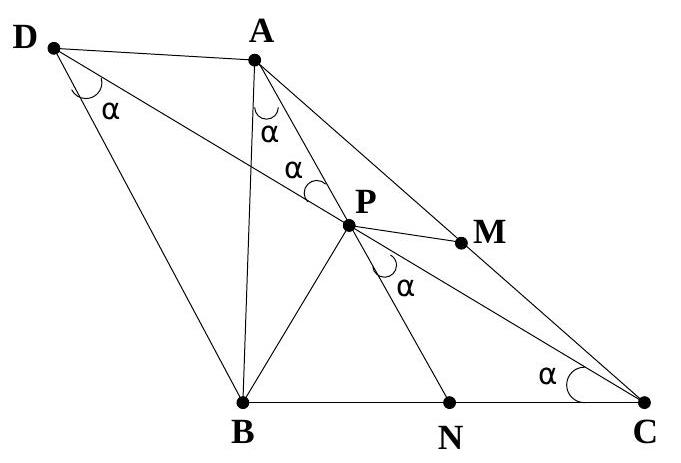\n\nWe hence get\n\n$$\n\\angle D P A=\\angle B A P=\\angle B C P=\\angle N P C\n$$\n\nthe last equality follows from the fact that $\\angle B P C=90^{\\circ}$, and $N$ is the mid-point of $C B$ so that $N P=N C=N B$ for the right-angled triangle $B P C$. It follows that $A, P, N$ are collinear.\n\n## Alternate Solution:\n\nWe use coordinate geometry. Let us take $P=(0,0)$, and the coordinate axes along $P C$ and $P B$; We take $C=(c, 0)$ and $B=(0, b)$. Let $A=(u, v)$. We see that $N=(c / 2, b / 2)$ and $M=((u+c) / 2, v / 2)$. The condition $P B=2 P M$ translates to\n\n$$\n(u+c)^{2}+v^{2}=b^{2}\n$$\n\nWe observe that the slope of $C P=0$; that of $C B$ is $-b / c$; that of $P A$ is $v / u$; and that of $B A$ is $(v-b) / u$. Taking proper signs, we can convert $\\angle P C B=\\angle P A B$, via tan function, to the following relation:\n\n$$\nu^{2}+v^{2}-v b=-c u\n$$\n\nThus we obtain\n\n$$\nu(u+c)=v(b-v), \\quad c(c+u)=b(b-v)\n$$\n\nIt follows that $v / u=b / c$. But then we get that the slope of $A P$ and $P N$ are the same. We conclude that $A, P, N$ are collinear.", "metadata": {"resource_path": "INMO/segmented/en-2009.jsonl", "problem_match": "\n1.", "solution_match": "## Solution:"}} |
| {"year": "2009", "tier": "T3", "problem_label": "2", "problem_type": null, "exam": "INMO", "problem": "Define a sequence $\\left\\langle a_{n}\\right\\rangle_{n=1}^{\\infty}$ as follows:\n\n$$\na_{n}= \\begin{cases}0, & \\text { if the number of positive divisors of } n \\text { is odd } \\\\ 1, & \\text { if the number of positive divisors of } n \\text { is even }\\end{cases}\n$$\n\n(The positive divisors of $n$ include 1 as well as $n$.) Let $x=0 . a_{1} a_{2} a_{3} \\ldots$ be the real number whose decimal expansion contains $a_{n}$ in the $n$-th place, $n \\geq 1$. Determine, with proof, whether $x$ is rational or irrational.", "solution": "We show that $x$ is irrational. Suppose that $x$ is rational. Then the sequence $\\left\\langle a_{n}\\right\\rangle_{n=1}^{\\infty}$ is periodic after some stage; there exist natural numbers $k, l$ such that $a_{n}=a_{n+l}$ for all $n \\geq k$. Choose $m$ such that $m l \\geq k$ and $m l$ is a perfect square. Let\n\n$$\nm=p_{1}^{\\alpha_{1}} p_{2}^{\\alpha_{2}} \\ldots p_{r}^{\\alpha_{r}}, \\quad l=p_{1}^{\\beta_{1}} p_{2}^{\\beta_{2}} \\ldots p_{r}^{\\beta_{r}}\n$$\n\nbe the prime decompositions of $m, l$ so that $\\alpha_{j}+\\beta_{j}$ is even for $1 \\leq j \\leq r$. Now take a prime $p$ different from $p_{1}, p_{2}, \\ldots, p_{r}$. Consider $m l$ and $p m l$. Since $p m l-m l$ is divisible by $l$, we have $a_{p m l}=a_{m l}$. Hence $d(p m l)$ and $d(m l)$ have same parity. But $d(p m l)=2 d(m l)$, since $\\operatorname{gcd}(p, m l)=1$ and $p$ is a prime. Since $m l$ is a square, $d(m l)$ is odd. It follows that $d(p m l)$ is even and hence $a_{p m l} \\neq a_{m l}$. This contradiction implies that $x$ is irrational.", "metadata": {"resource_path": "INMO/segmented/en-2009.jsonl", "problem_match": "\n2.", "solution_match": "## Solution:"}} |
| {"year": "2009", "tier": "T3", "problem_label": "2", "problem_type": null, "exam": "INMO", "problem": "Define a sequence $\\left\\langle a_{n}\\right\\rangle_{n=1}^{\\infty}$ as follows:\n\n$$\na_{n}= \\begin{cases}0, & \\text { if the number of positive divisors of } n \\text { is odd } \\\\ 1, & \\text { if the number of positive divisors of } n \\text { is even }\\end{cases}\n$$\n\n(The positive divisors of $n$ include 1 as well as $n$.) Let $x=0 . a_{1} a_{2} a_{3} \\ldots$ be the real number whose decimal expansion contains $a_{n}$ in the $n$-th place, $n \\geq 1$. Determine, with proof, whether $x$ is rational or irrational.", "solution": "As earlier, assume that $x$ is rational and choose natural numbers $k, l$ such that $a_{n}=a_{n+l}$ for all $n \\geq k$. Consider the numbers $a_{m+1}, a_{m+2}, \\ldots, a_{m+l}$, where $m \\geq k$ is any number. This must contain at least one 0 . Otherwise $a_{n}=1$ for all $n \\geq k$. But $a_{r}=0$ if and only if $r$ is a square. Hence it follows that there are no squares for $n>k$, which is absurd. Thus every $l$ consecutive terms of the sequence $\\left\\langle a_{n}\\right\\rangle$ must contain a 0 after certain stage. Let $t=\\max \\{k, l\\}$, and consider $t^{2}$ and $(t+1)^{2}$. Since there are no squares between $t^{2}$ and $(t+1)^{2}$, we conclude that $a_{t^{2}+j}=1$ for $1 \\leq j \\leq 2 t$. But then, we have $2 t(>l)$ consecutive terms of the sequence $\\left\\langle a_{n}\\right\\rangle$ which miss 0 , contradicting our earlier observation.", "metadata": {"resource_path": "INMO/segmented/en-2009.jsonl", "problem_match": "\n2.", "solution_match": "\nAlternative Solution:"}} |
| {"year": "2009", "tier": "T3", "problem_label": "3", "problem_type": null, "exam": "INMO", "problem": "Find all real numbers $x$ such that\n\n$$\n\\left[x^{2}+2 x\\right]=[x]^{2}+2[x]\n$$\n\n(Here $[x]$ denotes the largest integer not exceeding $x$.)", "solution": "Adding 1 both sides, the equation reduces to\n\n$$\n\\left[(x+1)^{2}\\right]=([x+1])^{2}\n$$\n\nwe have used $[x]+m=[x+m]$ for every integer $m$. Suppose $x+1 \\leq 0$. Then $[x+1] \\leq$ $x+1 \\leq 0$. Thus\n\n$$\n([x+1])^{2} \\geq(x+1)^{2} \\geq\\left[(x+1)^{2}\\right]=([x+1])^{2}\n$$\n\nThus equality holds everywhere. This gives $[x+1]=x+1$ and thus $x+1$ is an integer. Using $x+1 \\leq 0$, we conclude that\n\n$$\nx \\in\\{-1,-2,-3, \\ldots\\}\n$$\n\nSuppose $x+1>0$. We have\n\n$$\n(x+1)^{2} \\geq\\left[(x+1)^{2}\\right]=([x+1])^{2}\n$$\n\nMoreover, we also have\n\n$$\n(x+1)^{2} \\leq 1+\\left[(x+1)^{2}\\right]=1+([x+1])^{2}\n$$\n\nThus we obtain\n\n$$\n[x]+1=[x+1] \\leq(x+1)<\\sqrt{1+([x+1])^{2}}=\\sqrt{1+([x]+1)^{2}}\n$$\n\nThis shows that\n\n$$\nx \\in\\left[n, \\sqrt{1+(n+1)^{2}}-1\\right)\n$$\n\nwhere $n \\geq-1$ is an integer. Thus the solution set is\n\n$$\n\\{-1,-2,-3, \\ldots\\} \\cup\\left\\{\\cup_{n=-1}^{\\infty}\\left[n, \\sqrt{1+(n+1)^{2}}-1\\right)\\right\\}\n$$\n\nIt is easy verify that all the real numbers in this set indeed satisfy the given equation.", "metadata": {"resource_path": "INMO/segmented/en-2009.jsonl", "problem_match": "\n3.", "solution_match": "## Solution:"}} |
| {"year": "2009", "tier": "T3", "problem_label": "4", "problem_type": null, "exam": "INMO", "problem": "All the points in the plane are coloured using three colours. Prove that there exists a triangle with vertices having the same colour such that either it is isosceles or its angles are in geometric progression.", "solution": "Consider a circle of positive radius in the plane and inscribe a regular heptagon $A B C D E F G$ in it. Since the seven vertices of this heptagon are coloured by three colours, some three vertices have the same colour, by pigeon-hole principle. Consider the triangle formed by these three vertices. Let us call the part of the circumference separated by any two consecutive vertices of the heptagon an arc. The three vertices of the same colour are separated by arcs of length $l, m, n$ as we move, say counter-clockwise, along the circle, starting from a fixed vertex among these three, where $l+m+n=7$. Since, the order of $l, m, n$ does not matter for a triangle, there are four possibilities: $1+1+5=7 ; 1+2+4=7 ; 1+3+3=7 ; 2+2+3=7$. In the first, third and fourth cases, we have isosceles triangles. In the second case, we have a triangle whose angles are in geometric progression. The four corresponding figures are shown below.\n\n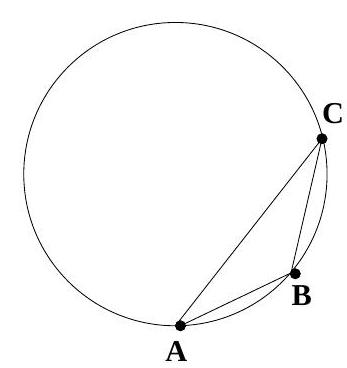\n\n(i)\n\n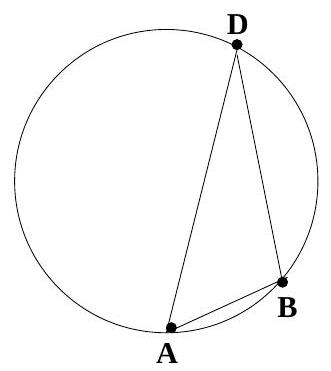\n\n(ii)\n\n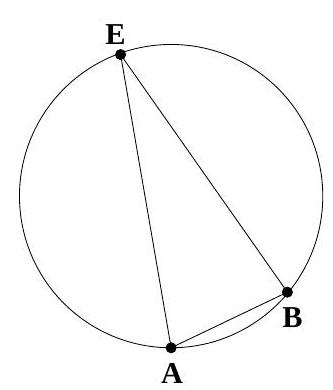\n\n(iii)\n\n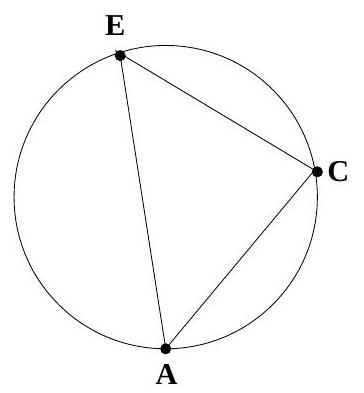\n\n(iv)\n\nIn (i), $A B=B C$; in (iii), $A E=B E$; in (iv), $A C=C E$; and in (ii) we see that $\\angle D=\\pi / 7$, $\\angle A=2 \\pi / 7$ and $\\angle B=4 \\pi / 7$ which are in geometric progression.", "metadata": {"resource_path": "INMO/segmented/en-2009.jsonl", "problem_match": "\n4.", "solution_match": "## Solution:"}} |
| {"year": "2009", "tier": "T3", "problem_label": "5", "problem_type": null, "exam": "INMO", "problem": "Let $A B C$ be an acute-angled triangle and let $H$ be its ortho-centre. Let $h_{\\text {max }}$ denote the largest altitude of the triangle $A B C$. Prove that\n\n$$\nA H+B H+C H \\leq 2 h_{\\max }\n$$", "solution": "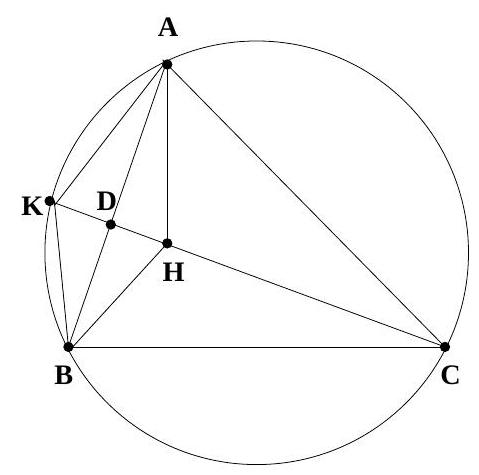\n\nLet $\\angle C$ be the smallest angle, so that $C A \\geq A B$ and $C B \\geq A B$. In this case the altitude through $C$ is the longest one. Let the altitude through $C$ meet $A B$ in $D$ and let $H$ be the ortho-centre of $A B C$. Let $C D$ extended meet the circum-circle of $A B C$ in $K$. We have $C D=h_{\\max }$ so that the inequality to be proved is\n\n$$\nA H+B H+C H \\leq 2 C D\n$$\n\nUsing $C D=C H+H D$, this reduces to $A H+B H \\leq C D+H D$. However, we observe that $A H=A K, B H=B K$ and $H D=D K$.(For example $B H=B K$ and $D H=D K$ follow from the congruency of the right-angled triangles $D B K$ and $D B H$.)\n\nThus we need to prove that $A K+B K \\leq C K$. Applying Ptolemy's theorem to the cyclic quadrilateral $B C A K$, we get\n\n$$\nA B \\cdot C K=A C \\cdot B K+B C \\cdot A K \\geq A B \\cdot B K+A B \\cdot A K\n$$\n\nThis implies that $C K \\geq A K+B K$, which is precisely what we are looking for.\n\nThere were other beautiful solutions given by students who participated in INMO-2009. We record them here.", "metadata": {"resource_path": "INMO/segmented/en-2009.jsonl", "problem_match": "\n5.", "solution_match": "## Solution:"}} |
| {"year": "2009", "tier": "T3", "problem_label": "6", "problem_type": null, "exam": "INMO", "problem": "Let $a, b, c$ be positive real numbers such that $a^{3}+b^{3}=c^{3}$. Prove that\n\n$$\na^{2}+b^{2}-c^{2}>6(c-a)(c-b)\n$$", "solution": "The given inequality may be written in the form\n\n$$\n7 c^{2}-6(a+b) c-\\left(a^{2}+b^{2}-6 a b\\right)<0\n$$\n\nPutting $x=7 c^{2}, y=-6(a+b) c, z=-\\left(a^{2}+b^{2}-6 a b\\right)$, we have to prove that $x+y+z<0$. Observe that $x, y, z$ are not all equal $(x>0, y<0)$. Using the identity\n\n$$\nx^{3}+y^{3}+z^{3}-3 x y z=\\frac{1}{2}(x+y+z)\\left[(x-y)^{2}+(y-z)^{2}+(z-x)^{2}\\right]\n$$\n\nwe infer that it is sufficient to prove $x^{3}+y^{3}+z^{3}-3 x y z<0$. Substituting the values of $x, y, z$, we see that this is equivalent to\n\n$$\n343 c^{6}-216(a+b)^{3} c^{3}-\\left(a^{2}+b^{2}-6 a b\\right)^{3}-126 c^{3}(a+b)\\left(a^{2}+b^{2}-6 a b\\right)<0\n$$\n\nUsing $c^{3}=a^{3}+b^{3}$, this reduces to\n\n$343\\left(a^{3}+b^{3}\\right)^{2}-216(a+b)^{3}\\left(a^{3}+b^{3}\\right)-\\left(a^{2}+b^{2}-6 a b\\right)^{3}-126\\left(\\left(a^{3}+b^{3}\\right)(a+b)\\left(a^{2}+b^{2}-6 a b\\right)<0\\right.$.\n\nThis may be simplified (after some tedious calculations) to,\n\n$$\n-a^{2} b^{2}\\left(129 a^{2}-254 a b+129 b^{2}\\right)<0\n$$\n\nBut $129 a^{2}-254 a b+129 b^{2}=129(a-b)^{2}+4 a b>0$. Hence the result follows.\n\nRemark: The best constant $\\theta$ in the inequality $a^{2}+b^{2}-c^{2} \\geq \\theta(c-a)(c-b)$, where $a, b, c$\nare positive reals such that $a^{3}+b^{3}=c^{3}$, is $\\theta=2\\left(1+2^{1 / 3}+2^{-1 / 3}\\right)$.\n\nHere again, there were some beautiful solutions given by students.", "metadata": {"resource_path": "INMO/segmented/en-2009.jsonl", "problem_match": "\n6.", "solution_match": "## Solution:"}} |
|
|


