| {"year": "2011", "tier": "T3", "problem_label": "1", "problem_type": null, "exam": "INMO", "problem": "Let $D, E, F$ be points on the sides $B C, C A, A B$ respectively of a triangle $A B C$ such that $B D=C E=A F$ and $\\angle B D F=\\angle C E D=\\angle A F E$. Prove that $A B C$ is equilateral.", "solution": "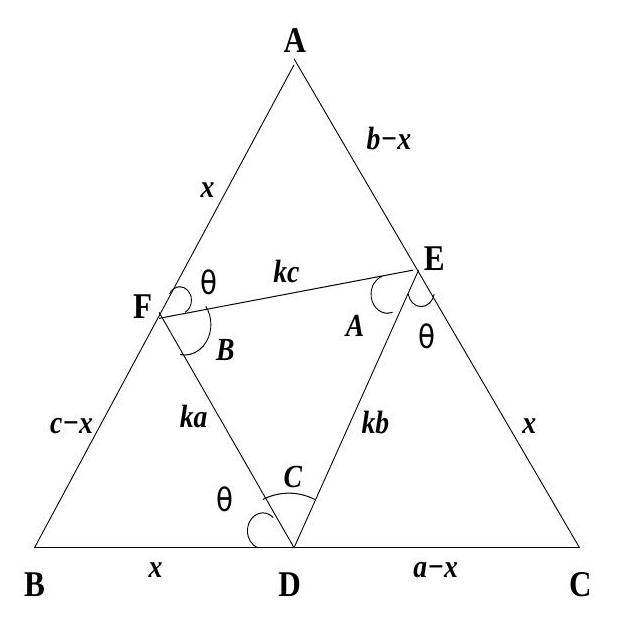\n\nLet $B D=C E=A F=x ; \\angle B D F=$ $\\angle C E D=\\angle A F E=\\theta$. Note that $\\angle A F D=$ $B+\\theta$, and hence $\\angle D F E=B$. Similarly, $\\angle E D F=C$ and $\\angle F E D=A$. Thus the triangle $E F D$ is similar to $A B C$. We may take $F D=k a, D E=k b$ and $E F=k c$, for some positive real constant $k$. Applying sine rule to triangle $B F D$, we obtain\n\n$$\n\\frac{c-x}{\\sin \\theta}=\\frac{k a}{\\sin B}=\\frac{2 R k a}{b}\n$$\n\nwhere $R$ is the circum-radius of $A B C$. Thus we get $2 R k \\sin \\theta=b(c-x) / a$. Similarly, we obtain $2 R k \\sin \\theta=c(a-x) / b$ and $2 R k \\sin \\theta=$ $a(b-x) / c$. We therefore get\n\n$$\n\\frac{b(c-x)}{a}=\\frac{c(a-x)}{b}=\\frac{a(b-x)}{c}\n$$\n\nIf some two sides are equal, say, $a=b$, then $a(c-x)=c(a-x)$ giving $a=c$; we get $a=b=c$ and $A B C$ is equilateral. Suppose no two sides of $A B C$ are equal. We may assume $a$ is the least. Since (1) is cyclic in $a, b, c$, we have to consider two cases: $a<b<c$ and $a<c<b$.\n\n\n\nIn this case $a<c$ and hence $b(c-x)<a(b-x)$, from (1). Since $b>a$ and $c-x>b-x$, we get $b(c-x)>a(b-x)$, which is a contradiction.\n\nCase 2. $\\underline{a<c<b}$.\n\nWe may write (1) in the form\n\n$$\n\\frac{(c-x)}{a / b}=\\frac{(a-x)}{b / c}=\\frac{(b-x)}{c / a}\n$$\n\nNow $a<c$ gives $a-x<c-x$ so that $\\frac{b}{c}<\\frac{a}{b}$. This gives $b^{2}<a c$. But $b>a$ and $b>c$, so that $b^{2}>a c$, which again leads to a contradiction\n\nThus Case 1 and Case 2 cannot occur. We conclude that $a=b=c$.", "metadata": {"resource_path": "INMO/segmented/en-2011.jsonl", "problem_match": "\n1.", "solution_match": "## Solution 1:"}} |
| {"year": "2011", "tier": "T3", "problem_label": "1", "problem_type": null, "exam": "INMO", "problem": "Let $D, E, F$ be points on the sides $B C, C A, A B$ respectively of a triangle $A B C$ such that $B D=C E=A F$ and $\\angle B D F=\\angle C E D=\\angle A F E$. Prove that $A B C$ is equilateral.", "solution": "We write (1) in the form (2), and start from there. The case of two equal sides is dealt as in Solution 1. We assume no two sides are equal. Using ratio properties in (2), we obtain\n\n$$\n\\frac{a-b}{\\left(a b-c^{2}\\right) / c a}=\\frac{b-c}{\\left(b c-a^{2}\\right) / a b}\n$$\n\nThis may be written as $c(a-b)\\left(b c-a^{2}\\right)=b(b-c)\\left(a b-c^{2}\\right)$. Further simplification gives $a b^{3}+b c^{3}+c a^{3}=a b c(a+b+c)$. This may be further written in the form\n\n$$\na b^{2}(b-c)+b c^{2}(c-a)+c a^{2}(a-b)=0\n$$\n\nIf $a<b<c$, we write (3) in the form\n\n$$\n0=a b^{2}(b-c)+b c^{2}(c-b+b-a)+c a^{2}(a-b)=b(c-b)\\left(c^{2}-a b\\right)+c(b-a)\\left(b c-a^{2}\\right)\n$$\n\nSince $c>b, c^{2}>a b, b>a$ and $b c>a^{2}$, this is impossible. If $a<c<b$, we write (3), as in previous case, in the form\n\n$$\n0=a(b-c)\\left(b^{2}-c a\\right)+c(c-a)\\left(b c-a^{2}\\right)\n$$\n\nwhich again is impossible.\n\nOne can also use inequalities: we can show that $a b^{3}+b c^{3}+c a^{3} \\geq a b c(a+b+c)$, and equality holds if and only if $a=b=c$. Here are some ways of deriving it:\n(i) We can write the inequality in the form\n\n$$\n\\frac{b^{2}}{c}+\\frac{c^{2}}{a}+\\frac{a^{2}}{b} \\geq a+b+c\n$$\n\nAdding $a+b+c$ both sides, this takes the form\n\n$$\n\\frac{b^{2}}{c}+c+\\frac{c^{2}}{a}+a+\\frac{a^{2}}{b}+b \\geq 2(a+b+c)\n$$\n\nBut AM-GM inequality gives\n\n$$\n\\frac{b^{2}}{c}+c \\geq 2 b, \\quad \\frac{c^{2}}{a}+a \\geq 2 a, \\quad \\frac{a^{2}}{b}+b \\geq 2 a\n$$\n\nHence the inequality follows and equality holds if and only if $a=b=c$.\n\n(ii) Again we write the inequality in the form\n\n$$\n\\frac{b^{2}}{c}+\\frac{c^{2}}{a}+\\frac{a^{2}}{b} \\geq a+b+c\n$$\n\nWe use $b / c$ with weight $b, c / a$ with weight $c$ and $a / b$ with weight $a$, and apply weighted AM-HM inequality:\n\n$$\nb \\cdot \\frac{b}{c}+c \\cdot \\frac{c}{a}+a \\cdot \\frac{a}{b} \\geq \\frac{(a+b+c)^{2}}{b \\cdot \\frac{c}{b}+c \\cdot \\frac{a}{c}+a \\cdot \\frac{b}{a}}\n$$\n\nwhich reduces to $a+b+c$. Again equality holds if and only if $a=b=c$.", "metadata": {"resource_path": "INMO/segmented/en-2011.jsonl", "problem_match": "\n1.", "solution_match": "\nSolution 2."}} |
| {"year": "2011", "tier": "T3", "problem_label": "1", "problem_type": null, "exam": "INMO", "problem": "Let $D, E, F$ be points on the sides $B C, C A, A B$ respectively of a triangle $A B C$ such that $B D=C E=A F$ and $\\angle B D F=\\angle C E D=\\angle A F E$. Prove that $A B C$ is equilateral.", "solution": "Here is a pure geometric solution given by a student. Consider the triangle $B D F, C E D$ and $A F E$ with $B D, C E$ and $A F$ as bases. The sides $D F, E D$ and $F E$ make equal angles $\\theta$ with the bases of respective triangles. If $B \\geq C \\geq A$, then it is easy to see that $F D \\geq D E \\geq E F$. Now using the triangle $F D E$, we see that $B \\geq C \\geq A$ gives $D E \\geq E F \\geq F D$. Combining, you get $F D=D E=E F$ and hence $A=B=\\bar{C}=60^{\\circ}$.", "metadata": {"resource_path": "INMO/segmented/en-2011.jsonl", "problem_match": "\n1.", "solution_match": "\nSolution 3."}} |
| {"year": "2011", "tier": "T3", "problem_label": "2", "problem_type": null, "exam": "INMO", "problem": "Call a natural number $n$ faithful, if there exist natural numbers $a<b<c$ such that $a$ divides $b, b$ divides $c$ and $n=a+b+c$.\n\n(i) Show that all but a finite number of natural numbers are faithful.\n\n(ii) Find the sum of all natural numbers which are not faithful.", "solution": "Suppose $n \\in \\mathbb{N}$ is faithful. Let $k \\in \\mathbb{N}$ and consider $k n$. Since $n=a+b+c$, with $a>b>c, c \\mid b$ and $b \\mid a$, we see that $k n=k a+k b+k c$ which shows that $k n$ is faithful.\n\nLet $p>5$ be a prime. Then $p$ is odd and $p=(p-3)+2+1$ shows that $p$ is faithful. If $n \\in \\mathbb{N}$ contains a prime factor $p>5$, then the above observation shows that $n$ is faithful. This shows that a number which is not faithful must be of the form $2^{\\alpha} 3^{\\beta} 5^{\\gamma}$. We also observe that $2^{4}=16=12+3+1,3^{2}=9=6+2+1$ and $5^{2}=25=22+2+1$, so that $2^{4}, 3^{2}$ and $5^{2}$ are faithful. Hence $n \\in \\mathbb{N}$ is also faithful if it contains a factor of the form $2^{\\alpha}$ where $\\alpha \\geq 4$; a factor of the form $3^{\\beta}$ where $\\beta \\geq 2$; or a factor of the form $5^{\\gamma}$ where $\\gamma \\geq 2$. Thus the numbers which are not faithful are of the form $2^{\\alpha} 3^{\\beta} 5^{\\gamma}$, where $\\alpha \\leq 3, \\beta \\leq 1$ and $\\gamma \\leq 1$. We may enumerate all such numbers:\n\n$$\n1,2,3,4,5,6,8,10,12,15,20,24,30,40,60,120\n$$\n\nAmong these $120=112+7+1,60=48+8+4,40=36+3+1,30=18+9+3,20=12+6+2$, $15=12+2+1$, and $10=6+3+1$. It is easy to check that the other numbers cannot be written in the required form. Hence the only numbers which are not faithful are\n\n$$\n1,2,3,4,5,6,8,12,24\n$$\n\nTheir sum is 65 .", "metadata": {"resource_path": "INMO/segmented/en-2011.jsonl", "problem_match": "\n2.", "solution_match": "\nSolution 1:"}} |
| {"year": "2011", "tier": "T3", "problem_label": "2", "problem_type": null, "exam": "INMO", "problem": "Call a natural number $n$ faithful, if there exist natural numbers $a<b<c$ such that $a$ divides $b, b$ divides $c$ and $n=a+b+c$.\n\n(i) Show that all but a finite number of natural numbers are faithful.\n\n(ii) Find the sum of all natural numbers which are not faithful.", "solution": "If $n=a+b+c$ with $a<b<c$ is faithful, we see that $a \\geq 1, b \\geq 2$ and $c \\geq 4$. Hence $n \\geq 7$. Thus $1,2,3,4,5,6$ are not faithful. As observed earlier, $k n$ is faithful whenever\n$n$ is. We also notice that for odd $n \\geq 7$, we can write $n=1+2+(n-3)$ so that all odd $n \\geq 7$ are faithful. Consider $2 n, 4 n, 8 n$, where $n \\geq 7$ is odd. By observation, they are all faithful. Let us list a few of them:\n\n$$\n\\begin{aligned}\n2 n & : \\quad 14,18,22,26,30,34,38,42,46,50,54,58,62, \\ldots \\\\\n4 n & : \\quad 28,36,44,52,60,68, \\ldots \\\\\n8 n & : \\quad 56,72, \\ldots\n\\end{aligned}\n$$\n\nWe observe that $16=12+3+1$ and hence it is faithful. Thus all multiples of 16 are also faithful. Thus we see that $16,32,48,64, \\ldots$ are faithful. Any even number which is not a multiple of 16 must be either an odd multiple of 2 , or that of 4 , or that of 8 . Hence, the only numbers not covered by this process are $8,10,12,20,24,40$. Of these, we see that\n\n$$\n10=1+3+6, \\quad 20=2 \\times 10, \\quad 40=4 \\times 10\n$$\n\nso that $10,20,40$ are faithful. Thus the only numbers which are not faithful are\n\n$$\n1,2,3,4,5,6,8,12,24\n$$\n\nTheir sum is 65 .", "metadata": {"resource_path": "INMO/segmented/en-2011.jsonl", "problem_match": "\n2.", "solution_match": "\nSolution 2:"}} |
| {"year": "2011", "tier": "T3", "problem_label": "3", "problem_type": null, "exam": "INMO", "problem": "Consider two polynomials $P(x)=a_{n} x^{n}+a_{n-1} x^{n-1}+\\cdots+a_{1} x+a_{0}$ and $Q(x)=b_{n} x^{n}+$ $b_{n-1} x^{n-1}+\\cdots+b_{1} x+b_{0}$ with integer coefficients such that $a_{n}-b_{n}$ is a prime, $a_{n-1}=b_{n-1}$ and $a_{n} b_{0}-a_{0} b_{n} \\neq 0$. Suppose there exists a rational number $r$ such that $P(r)=Q(r)=0$. Prove that $r$ is an integer.", "solution": "Let $r=u / v$ where $\\operatorname{gcd}(u, v)=1$. Then we get\n\n$$\n\\begin{array}{r}\na_{n} u^{n}+a_{n-1} u^{n-1} v+\\cdots+a_{1} u v^{n-1}+a_{0} v^{n}=0 \\\\\nb_{n} u^{n}+b_{n-1} u^{n-1} v+\\cdots+b_{1} u v^{n-1}+b_{0} v^{n}=0\n\\end{array}\n$$\n\nSubtraction gives\n\n$$\n\\left(a_{n}-b_{n}\\right) u^{n}+\\left(a_{n-2}-b_{n-2}\\right) u^{n-2} v^{2}+\\cdots+\\left(a_{1}-b_{1}\\right) u v^{n-1}+\\left(a_{0}-b_{0}\\right) v^{n}=0\n$$\n\nsince $a_{n-1}=b_{n-1}$. This shows that $v$ divides $\\left(a_{n}-b_{n}\\right) u^{n}$ and hence it divides $a_{n}-b_{n}$. Since $a_{n}-b_{n}$ is a prime, either $v=1$ or $v=a_{n}-b_{n}$. Suppose the latter holds. The relation takes the form\n\n$$\nu^{n}+\\left(a_{n-2}-b_{n-2}\\right) u^{n-2} v+\\cdots+\\left(a_{1}-b_{1}\\right) u v^{n-2}+\\left(a_{0}-b_{0}\\right) v^{n-1}=0\n$$\n\n(Here we have divided through-out by $v$.) If $n>1$, this forces $v \\mid u$, which is impossible since $\\operatorname{gcd}(v, u)=1\\left(v>1\\right.$ since it is equal to the prime $\\left.a_{n}-b_{n}\\right)$. If $n=1$, then we get two equations:\n\n$$\n\\begin{aligned}\na_{1} u+a_{0} v & =0 \\\\\nb_{1} u+b_{0} v & =0\n\\end{aligned}\n$$\n\nThis forces $a_{1} b_{0}-a_{0} b_{1}=0$ contradicting $a_{n} b_{0}-a_{0} b_{n} \\neq 0$. (Note: The condition $a_{n} b_{0}-a_{0} b_{n} \\neq 0$ is extraneous. The condition $a_{n-1}=b_{n-1}$ forces that for $n=1$, we have $a_{0}=b_{0}$. Thus we obtain, after subtraction\n\n$$\n\\left(a_{1}-b_{1}\\right) u=0\n$$\n\nThis implies that $u=0$ and hence $r=0$ is an integer.)", "metadata": {"resource_path": "INMO/segmented/en-2011.jsonl", "problem_match": "\n3.", "solution_match": "\nSolution:"}} |
| {"year": "2011", "tier": "T3", "problem_label": "4", "problem_type": null, "exam": "INMO", "problem": "Suppose five of the nine vertices of a regular nine-sided polygon are arbitrarily chosen. Show that one can select four among these five such that they are the vertices of a trapezium.", "solution": "Suppose four distinct points $P, Q, R, S$ (in that order on the circle) among these five are such that $\\widehat{P Q}=\\widehat{R S}$. Then $P Q R S$ is an isosceles trapezium, with $P S \\| Q R$. We use this in our argument.\n\n- If four of the five points chosen are adjacent, then we are through as observed earlier. (In this case four points $A, B, C, D$ are such that $\\widehat{A B}=\\widehat{B C}=\\widehat{C D}$.) See Fig 1 .\n\n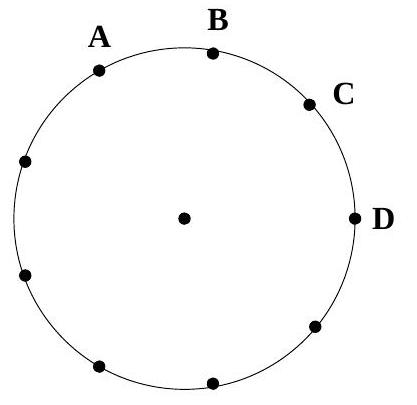\n\nFig 1.\n\n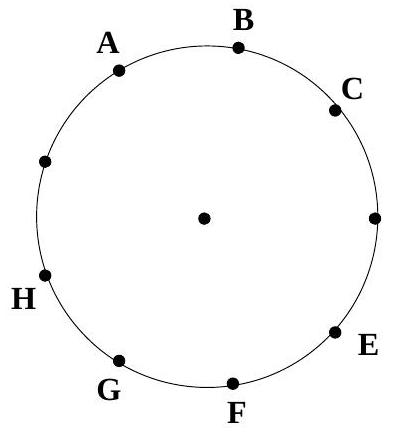\n\nFig 2.\n\n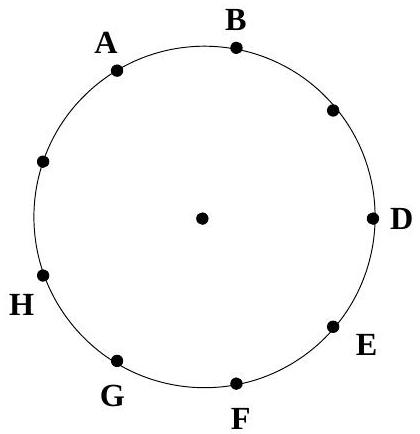\n\nFig 3.\n\n- Suppose only three of the vertices are adjacent, say $A, B, C$ (see Fig 2.) Then the remaining two must be among $E, F, G, H$. If these two are adjacent vertices, we can pair them with $A, B$ or $B, C$ to get equal arcs. If they are not adjacent, then they must be either $E, G$ or $F, H$ or $E, H$. In the first two cases, we can pair them with $A, C$ to get equal arcs. In the last case, we observe that $\\widehat{H A}=\\widehat{C E}$ and $A H E C$ is an isosceles trapezium.\n- Suppose only two among the five are adjacent, say $A, B$. Then the remaining three are among $D, E, F, G, H$. (See Fig 3.) If any two of these are adjacent, we can combine them with $A, B$ to get equal arcs. If no two among these three vertices are adjacent, then they must be $D, F, H$. In this case $\\widehat{H A}=\\widehat{B D}$ and $A H D B$ is an isosceles trapezium.\n\nFinally, if we choose 5 among the 9 vertices of a regular nine-sided polygon, then some two must be adjacent. Thus any choice of 5 among 9 must fall in to one of the above three possibilities.", "metadata": {"resource_path": "INMO/segmented/en-2011.jsonl", "problem_match": "\n4.", "solution_match": "\nSolution 1:"}} |
| {"year": "2011", "tier": "T3", "problem_label": "4", "problem_type": null, "exam": "INMO", "problem": "Suppose five of the nine vertices of a regular nine-sided polygon are arbitrarily chosen. Show that one can select four among these five such that they are the vertices of a trapezium.", "solution": "Here is another solution used by many students. Suppose you join the vertices of the nine-sided regular polygon. You get $\\binom{9}{2}=36$ line segments. All these fall in to 9 sets of parallel lines. Now using any 5 points, you get $\\binom{5}{2}=10$ line segments. By pigeon-hole principle, two of these must be parallel. But, these parallel lines determine a trapezium.", "metadata": {"resource_path": "INMO/segmented/en-2011.jsonl", "problem_match": "\n4.", "solution_match": "\nSolution 2:"}} |
| {"year": "2011", "tier": "T3", "problem_label": "5", "problem_type": null, "exam": "INMO", "problem": "Let $A B C D$ be a quadrilateral inscribed in a circle $\\Gamma$. Let $E, F, G, H$ be the midpoints of the arcs $A B, B C, C D, D A$ of the circle $\\Gamma$. Suppose $A C \\cdot B D=E G \\cdot F H$. Prove that $A C, B D$, $E G, F H$ are concurrent.", "solution": "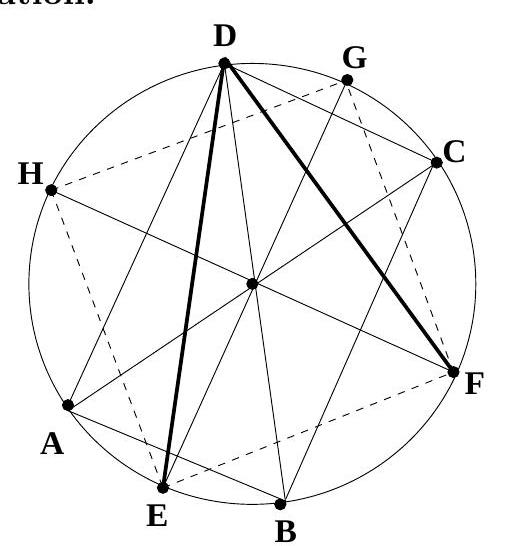\n\nLet $R$ be the radius of the circle $\\Gamma$. Observe that $\\angle E D F=\\frac{1}{2} \\angle D$. Hence $E F=2 R \\sin \\frac{D}{2}$. Similarly, $H G=2 R \\sin \\frac{B}{2}$. But $\\angle B=180^{\\circ}-\\angle D$. Thus $H G=2 R \\cos \\frac{D}{2}$. We hence get\n\n$E F \\cdot G H=4 R^{2} \\sin \\frac{D}{2} \\cos \\frac{D}{2}=2 R^{2} \\sin D=R \\cdot A C$.\n\nSimilarly, we obtain $E H \\cdot F G=R \\cdot B D$.\n\nTherefore\n\n$$\nR(A C+B D)=E F \\cdot G H+E H \\cdot F G=E G \\cdot F H\n$$\n\nby Ptolemy's theorem. By the given hypothesis, this gives $R(A C+B D)=A C \\cdot B D$. Thus\n\n$$\nA C \\cdot B D=R(A C+B D) \\geq 2 R \\sqrt{A C \\cdot B D}\n$$\n\nusing AM-GM inequality. This implies that $A C \\cdot B D \\geq 4 R^{2}$. But $A C$ and $B D$ are the chords of $\\Gamma$, so that $A C \\leq 2 R$ and $B D \\leq 2 R$. We obtain $A C \\cdot B D \\leq 4 R^{2}$. It follows that $A C \\cdot B D=4 R^{2}$, implying that $A C=B D=2 R$. Thus $A C$ and $B D$ are two diameters of $\\Gamma$. Using $E G \\cdot F H=A C \\cdot B D$, we conclude that $E G$ and $F H$ are also two diameters of $\\Gamma$. Hence $A C, B D, E G$ and $F H$ all pass through the centre of $\\Gamma$.", "metadata": {"resource_path": "INMO/segmented/en-2011.jsonl", "problem_match": "\n5.", "solution_match": "## Solution:"}} |
| {"year": "2011", "tier": "T3", "problem_label": "6", "problem_type": null, "exam": "INMO", "problem": "Find all functions $f: \\mathbf{R} \\rightarrow \\mathbf{R}$ such that\n\n$$\nf(x+y) f(x-y)=(f(x)+f(y))^{2}-4 x^{2} f(y)\n$$\n\nfor all $x, y \\in \\mathbf{R}$, where $\\mathbf{R}$ denotes the set of all real numbers.", "solution": "Put $x=y=0$; we get $f(0)^{2}=4 f(0)^{2}$ and hence $f(0)=0$.\n\nPut $x=y$ : we get $4 f(x)^{2}-4 x^{2} f(x)=0$ for all $x$. Hence for each $x$, either $f(x)=0$ or $f(x)=x^{2}$.\n\nSuppose $f(x) \\not \\equiv 0$. Then we can find $x_{0} \\neq 0$ such that $f\\left(x_{0}\\right) \\neq 0$. Then $f\\left(x_{0}\\right)=x_{0}^{2} \\neq 0$. Assume that there exists some $y_{0} \\neq 0$ such that $f\\left(y_{0}\\right)=0$. Then\n\n$$\nf\\left(x_{0}+y_{0}\\right) f\\left(x_{0}-y_{0}\\right)=f\\left(x_{0}\\right)^{2}\n$$\n\nNow $f\\left(x_{0}+y_{0}\\right) f\\left(x_{0}-y_{0}\\right)=0$ or $f\\left(x_{0}+y_{0}\\right) f\\left(x_{0}-y_{0}\\right)=\\left(x_{0}+y_{0}\\right)^{2}\\left(x_{0}-y_{0}\\right)^{2}$. If $f\\left(x_{0}+\\right.$ $\\left.y_{0}\\right) f\\left(x_{0}-y_{0}\\right)=0$, then $f\\left(x_{0}\\right)=0$, a contradiction. Hence it must be the latter so that\n\n$$\n\\left(x_{0}^{2}-y_{0}^{2}\\right)^{2}=x_{0}^{4}\n$$\n\nThis reduces to $y_{0}^{2}\\left(y_{0}^{2}-2 x_{0}^{2}\\right)=0$. Since $y_{0} \\neq 0$, we get $y_{0}= \\pm \\sqrt{2} x_{0}$.\n\nSuppose $y_{0}=\\sqrt{2} x_{0}$. Put $x=\\sqrt{2} x_{0}$ and $y=x_{0}$ in (1); we get\n\n$$\nf\\left((\\sqrt{2}+1) x_{0}\\right) f\\left((\\sqrt{2}-1) x_{0}\\right)=\\left(f\\left(\\sqrt{2} x_{0}\\right)+f\\left(x_{0}\\right)\\right)^{2}-4\\left(2 x_{0}^{2}\\right) f\\left(x_{0}\\right)\n$$\n\nBut $f\\left(\\sqrt{2} x_{0}\\right)=f\\left(y_{0}\\right)=0$. Thus we get\n\n$$\n\\begin{aligned}\nf\\left((\\sqrt{2}+1) x_{0}\\right) f\\left((\\sqrt{2}-1) x_{0}\\right) & =f\\left(x_{0}\\right)^{2}-8 x_{0}^{2} f\\left(x_{0}\\right) \\\\\n& =x_{0}^{4}-8 x_{0}^{4}=-7 x_{0}^{4}\n\\end{aligned}\n$$\n\nNow if LHS is equal to 0 , we get $x_{0}=0$, a contradiction. Otherwise LHS is equal to $(\\sqrt{2}+$ $1)^{2}(\\sqrt{2}-1)^{2} x_{0}^{4}$ which reduces to $x_{0}^{4}$. We obtain $x_{0}^{4}=-7 x_{0}^{4}$ and this forces again $x_{0}=0$. Hence there is no $y \\neq 0$ such that $f(y)=0$. We conclude that $f(x)=x^{2}$ for all $x$.\n\nThus there are two solutions: $f(x)=0$ for all $x$ or $f(x)=x^{2}$, for all $x$. It is easy to verify that both these satisfy the functional equation.", "metadata": {"resource_path": "INMO/segmented/en-2011.jsonl", "problem_match": "\n6.", "solution_match": "\nSolution 1.:"}} |
| {"year": "2011", "tier": "T3", "problem_label": "6", "problem_type": null, "exam": "INMO", "problem": "Find all functions $f: \\mathbf{R} \\rightarrow \\mathbf{R}$ such that\n\n$$\nf(x+y) f(x-y)=(f(x)+f(y))^{2}-4 x^{2} f(y)\n$$\n\nfor all $x, y \\in \\mathbf{R}$, where $\\mathbf{R}$ denotes the set of all real numbers.", "solution": "As earlier, we get $f(0)=0$. Putting $x=0$, we will also get\n\n$$\nf(y)(f(y)-f(-y))=0\n$$\n\nAs earlier, we may conclude that either $f(y)=0$ or $f(y)=f(-y)$ for each $y \\in \\mathbb{R}$. Replacing $y$ by $-y$, we may also conclude that $f(-y)(f(-y)-f(y))=0$. If $f(y)=0$ and $f(-y) \\neq 0$ for some $y$, then we must have $f(-y)=f(y)=0$, a contradiction. Hence either $f(y)=f(-y)=0$ or $f(y)=f(-y)$ for each $y$. This forces $f$ is an even function.\n\nTaking $y=1$ in (1), we get\n\n$$\nf(x+1) f(x-1)=(f(x)+f(1))^{2}-4 x^{2} f(1)\n$$\n\nReplacing $y$ by $x$ and $x$ by 1 , you also get\n\n$$\nf(1+x) f(1-x)=(f(1)+f(x))^{2}-4 f(x)\n$$\n\nComparing these two using the even nature of $f$, we get $f(x)=c x^{2}$, where $c=f(1)$. Putting $x=y=1$ in (1), you get $4 c^{2}-4 c=0$. Hence $c=0$ or 1 . We get $f(x)=0$ for all $x$ or $f(x)=x^{2}$ for all $x$.", "metadata": {"resource_path": "INMO/segmented/en-2011.jsonl", "problem_match": "\n6.", "solution_match": "\nSolution 2:"}} |
|
|


